Dynamical evolution and dissolution timescale of young stellar clusters in the Orion star-forming complex
Pith reviewed 2026-06-28 00:27 UTC · model grok-4.3
The pith
Simulations of Orion clusters show a split into long-lived open clusters and rapidly dissolving groups based on their virial parameter.
A machine-rendered reading of the paper's core claim, the machinery that carries it, and where it could break.
Core claim
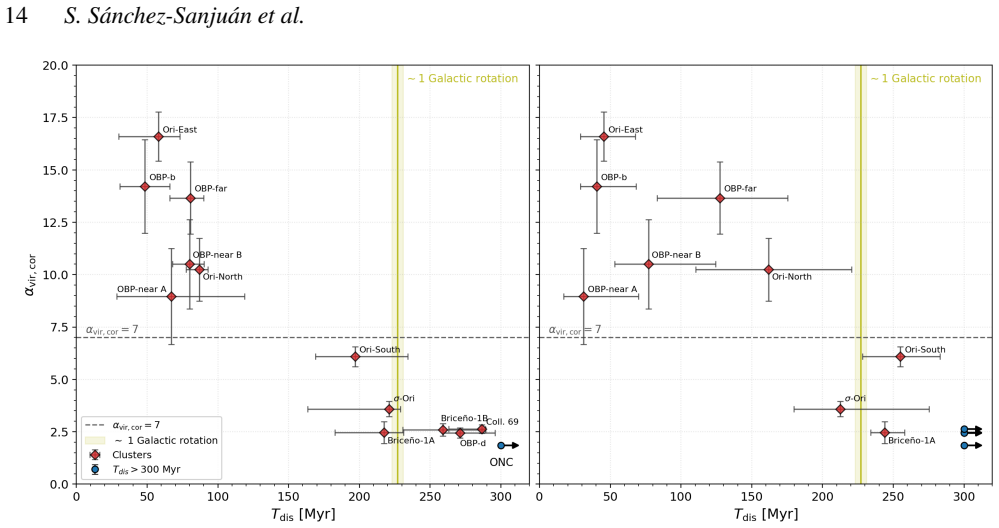
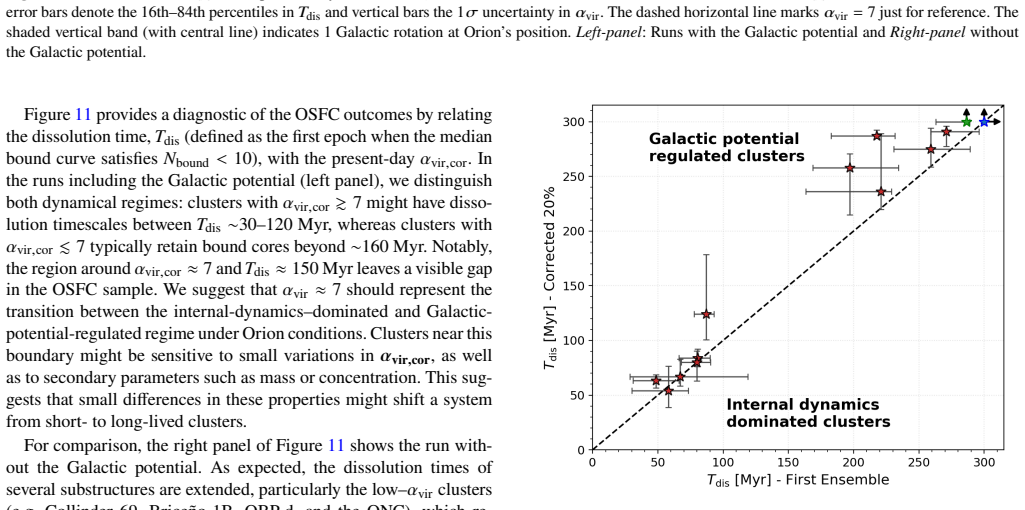
Direct N-body simulations initialized from the present-day global parameters and evolved for 300 Myr in a Galactic potential suggest a separation of the OSFC clusters into two regimes: seven clusters with α_vir ≲7 evolve in a Galactic-potential-regulated regime that retains a bound core for ≳170 Myr as long-lived open clusters, whereas six clusters with α_vir ≳7 enter an internal-dynamics-dominated regime, dissolving before 120 Myr and rapidly populating the Galactic stellar field. For both regimes, a control test indicates negligible cluster-cluster interactions under current OSFC conditions. Finally, long-lived clusters show low-amplitude modulations in the bound fraction correlated with t
What carries the argument
The virial parameter α_vir, which compares the kinetic and gravitational potential energies of each cluster, used to separate the clusters into long-lived and dissolving regimes in the N-body simulations.
If this is right
- Seven clusters with α_vir below about 7 retain bound cores for at least 170 million years as open clusters.
- Six clusters with higher α_vir dissolve completely before 120 million years and add their stars to the Galactic field.
- Cluster interactions within the complex have little effect on their evolution.
- Bound fractions in long-lived clusters vary slightly with the clusters' motion perpendicular to the Galactic disk.
Where Pith is reading between the lines
- Clusters in other star-forming regions may follow the same division if their virial parameters are measured similarly.
- The contribution of dissolving clusters to the thin disk population can be estimated from such simulations.
- The modulation effect suggests that disk passages can temporarily bind some stars even in marginally unbound systems.
Load-bearing premise
The present-day structural parameters, mass-function corrections, and three-dimensional velocity distributions can be used directly as initial conditions without substantial bias from unresolved binaries, mass segregation, or selection effects.
What would settle it
Future measurements of the number of stars still bound to each cluster after 100 million years of evolution, or the detection of periodic changes in bound fraction matching the vertical oscillation period through the Galactic disk.
Figures



read the original abstract
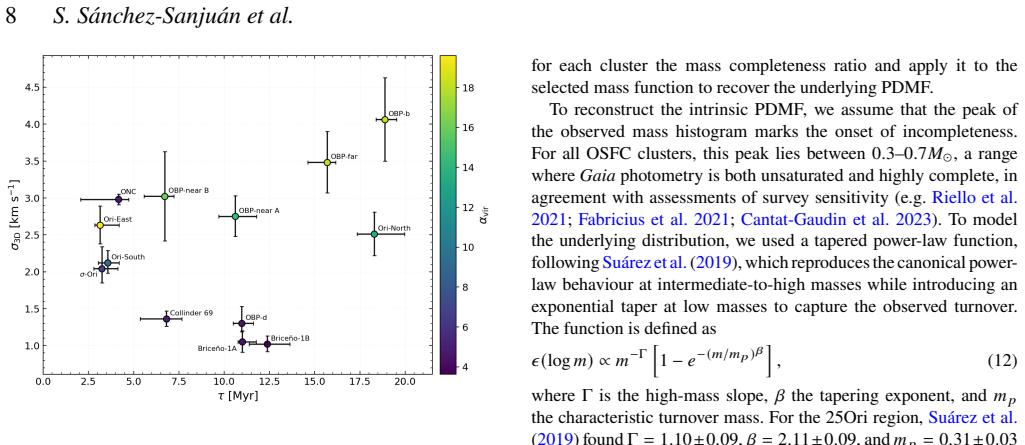
We present a comprehensive analysis of the Orion star-forming complex (OSFC), combining structural, kinematic, and dynamical information to constrain the present-day state and future evolution of its stellar substructures. Using \textit{Gaia} DR3 astrometry and complementary radial velocities from high-resolution spectroscopic surveys, we derived three-dimensional velocity distributions and structural parameters for 13 young clusters. For the stellar component, we estimated a correction of the present-day mass function for observational incompleteness and calculated the virial state, $\alpha_{\rm vir}$, finding that all clusters are supervirial. Direct $N$-body simulations initialized from the present-day global parameters and evolved for 300~Myr in a Galactic potential suggest a separation of the OSFC clusters into two regimes: seven clusters with $\alpha_{\rm vir}\lesssim 7$ evolve in a Galactic-potential-regulated regime that retains a bound core for $\gtrsim 170$ Myr as long-lived open clusters, whereas six clusters with $\alpha_{\rm vir}\gtrsim 7$ enter an internal-dynamics--dominated regime, dissolving before 120 Myr and rapidly populating the Galactic stellar field. For both regimes, a control test indicates negligible cluster--cluster interactions under current OSFC conditions. Finally, long-lived clusters show low-amplitude modulations in the bound fraction correlated with the Galactic vertical motion, consistent with disk-crossing tidal heating and the temporary recapture of marginal members. These results highlight the OSFC as a natural laboratory where heterogeneous initial conditions give rise to persistent open clusters and dispersing groups.
Editorial analysis
A structured set of objections, weighed in public.
Referee Report
Summary. The paper derives 3D velocities, structural parameters, and virial ratios α_vir for 13 clusters in the Orion star-forming complex from Gaia DR3 and spectroscopic data. It initializes direct N-body simulations from these present-day global parameters (including incompleteness-corrected masses) and evolves them for 300 Myr in a Galactic potential, reporting a bifurcation: seven clusters with α_vir ≲ 7 retain bound cores for ≳170 Myr in a Galactic-potential-regulated regime, while six with α_vir ≳ 7 dissolve before 120 Myr in an internal-dynamics-dominated regime. Control tests indicate negligible cluster-cluster interactions, and long-lived clusters show modulations in bound fraction tied to Galactic vertical motion.
Significance. If the α_vir-based classification and dissolution timescales prove robust, the work supplies a concrete dynamical mechanism linking present-day supervirial states to the future persistence or dispersal of OSFC substructures, with direct implications for the formation of long-lived open clusters versus the Galactic field population. The use of direct N-body integration with a Galactic potential and the control test for interactions are strengths that allow falsifiable predictions about bound fractions over 300 Myr.
major comments (4)
- [Abstract] Abstract: the separation threshold α_vir = 7 is presented without a priori justification or independent prediction; it is applied after the simulations to partition the 13 clusters into the two regimes, raising the possibility that the value was chosen to match the outcomes rather than tested as a fixed criterion.
- [Abstract] Abstract: α_vir = 5σ²R/GM is computed directly from the Gaia-derived velocity dispersions and used both to initialize the N-body runs and to label their long-term outcomes, creating a circularity that is not mitigated by any reported sensitivity analysis or independent validation of the bound-core definition.
- [Abstract] Abstract: no error bars, uncertainties, or Monte-Carlo realizations are supplied for the α_vir values, so it is impossible to assess whether clusters lying near the α_vir = 7 boundary could migrate between regimes under plausible measurement errors.
- [Abstract] Abstract: the manuscript mentions only a mass-function incompleteness correction and does not address the contribution of unresolved binaries (typical fraction 0.3–0.5) to the observed velocity dispersion σ; even a 1–2 km s⁻¹ binary-induced component could shift multiple clusters across the α_vir = 7 boundary and collapse the reported 170 Myr vs. <120 Myr separation.
minor comments (1)
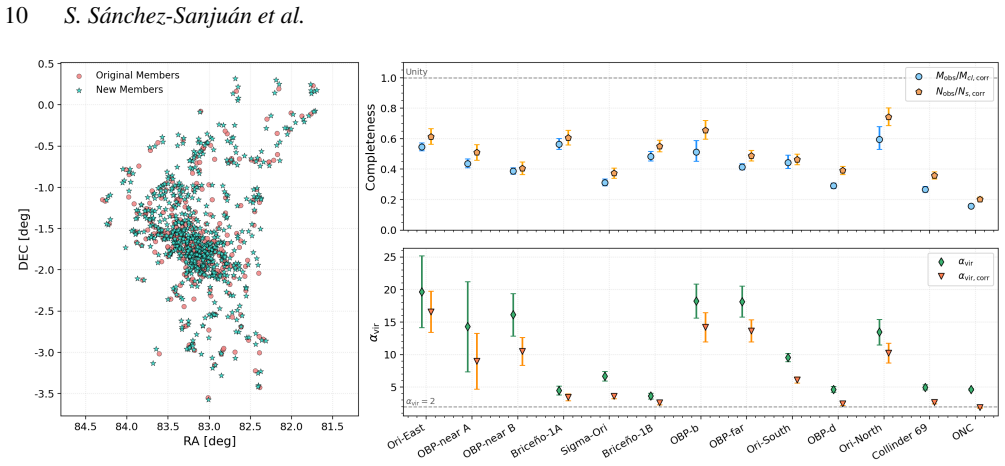
- [Abstract] The abstract states that all clusters are supervirial but supplies no numerical range or table of the derived α_vir values, hindering immediate assessment of how close any cluster lies to the reported threshold.
Simulated Author's Rebuttal
We thank the referee for their constructive comments. We address each major comment below.
read point-by-point responses
-
Referee: [Abstract] Abstract: the separation threshold α_vir = 7 is presented without a priori justification or independent prediction; it is applied after the simulations to partition the 13 clusters into the two regimes, raising the possibility that the value was chosen to match the outcomes rather than tested as a fixed criterion.
Authors: We agree that the threshold of 7 was identified empirically from the clear bifurcation in dissolution timescales seen in the simulations. In the revised manuscript we will state explicitly that this is an empirical division based on the results rather than an a priori criterion, and we will add discussion of its physical motivation in the context of the Galactic potential. revision: yes
-
Referee: [Abstract] Abstract: α_vir = 5σ²R/GM is computed directly from the Gaia-derived velocity dispersions and used both to initialize the N-body runs and to label their long-term outcomes, creating a circularity that is not mitigated by any reported sensitivity analysis or independent validation of the bound-core definition.
Authors: We disagree that a circularity exists. α_vir is measured independently from the Gaia data and used only to set initial conditions; the dissolution timescales are measured separately from the N-body integrations. The reported separation is therefore a correlation between initial state and outcome. We will add a sensitivity analysis to further test the classification. revision: no
-
Referee: [Abstract] Abstract: no error bars, uncertainties, or Monte-Carlo realizations are supplied for the α_vir values, so it is impossible to assess whether clusters lying near the α_vir = 7 boundary could migrate between regimes under plausible measurement errors.
Authors: We accept this criticism. The revised manuscript will report uncertainties on each α_vir value (propagated from velocity dispersion and radius errors) and include Monte-Carlo realizations to check the stability of the regime assignments near the boundary. revision: yes
-
Referee: [Abstract] Abstract: the manuscript mentions only a mass-function incompleteness correction and does not address the contribution of unresolved binaries (typical fraction 0.3–0.5) to the observed velocity dispersion σ; even a 1–2 km s⁻¹ binary-induced component could shift multiple clusters across the α_vir = 7 boundary and collapse the reported 170 Myr vs. <120 Myr separation.
Authors: This is a valid concern. We will add a quantitative estimate of the binary contribution to σ for the young Orion clusters and demonstrate that the reported bifurcation in dissolution timescales remains robust for plausible binary fractions. revision: yes
Circularity Check
No significant circularity detected
full rationale
The paper computes α_vir from Gaia-derived velocities, radii, and masses as part of the present-day characterization, adopts those same global parameters as N-body initial conditions, and reports that the resulting dissolution times fall into two groups separated at α_vir ≈ 7. This is a direct reporting of simulation outcomes binned by an input parameter; the evolved bound fractions and dissolution times are generated by independent dynamical integration and are not algebraically or statistically equivalent to the input α_vir values by construction. No self-citations, uniqueness theorems, fitted parameters renamed as predictions, or ansatzes appear in the load-bearing steps. The derivation chain from initial conditions through 300 Myr integration is therefore self-contained.
Axiom & Free-Parameter Ledger
free parameters (1)
- α_vir regime threshold =
7
axioms (2)
- domain assumption The Galactic potential model used in the N-body integrations accurately represents the Milky Way's gravitational field over 300 Myr.
- domain assumption Cluster-cluster interactions can be neglected under present-day OSFC conditions.
Reference graph
Works this paper leans on
-
[1]
, year = 1976, month = dec, volume =
Error propagation by the Monte Carlo method in geochemical calculations. , year = 1976, month = dec, volume =. doi:10.1016/0016-7037(76)90092-2 , adsurl =
-
[2]
Disentangling the independently controllable factors of variation by interacting with the world
Embedded Clusters in Molecular Clouds. , keywords =. doi:10.1146/annurev.astro.41.011802.094844 , archivePrefix =. astro-ph/0301540 , primaryClass =
work page internal anchor Pith review Pith/arXiv arXiv doi:10.1146/annurev.astro.41.011802.094844
-
[3]
A Fractal Origin for the Mass Spectrum of Interstellar Clouds. II. Cloud Models and Power-Law Slopes. , keywords =. doi:10.1086/324384 , archivePrefix =. astro-ph/0112528 , primaryClass =
work page internal anchor Pith review Pith/arXiv arXiv doi:10.1086/324384
-
[4]
ARA&A , year = 1964, volume = 2, pages =
The O Associations in the Solar Neighborhood. , year = 1964, month = jan, volume =. doi:10.1146/annurev.aa.02.090164.001241 , adsurl =
-
[5]
OB Associations and their origins. , keywords =. doi:10.1016/j.newar.2020.101549 , archivePrefix =. 2011.09483 , primaryClass =
-
[6]
Untangling the Galaxy. I. Local Structure and Star Formation History of the Milky Way. , keywords =. doi:10.3847/1538-3881/ab339a , archivePrefix =. 1907.07709 , primaryClass =
-
[7]
Expanding associations in the Vela-Puppis region. 3D structure and kinematics of the young population. , keywords =. doi:10.1051/0004-6361/201834957 , archivePrefix =. 1812.08114 , primaryClass =
work page internal anchor Pith review Pith/arXiv arXiv doi:10.1051/0004-6361/201834957
-
[8]
Kinematics in Young Star Clusters and Associations with Gaia DR2
Kinematics in Young Star Clusters and Associations with Gaia DR2. , keywords =. doi:10.3847/1538-4357/aaef8c , archivePrefix =. 1807.02115 , primaryClass =
work page internal anchor Pith review Pith/arXiv arXiv doi:10.3847/1538-4357/aaef8c
-
[9]
3D Morphology of Open Clusters in the Solar Neighborhood with Gaia EDR 3: Its Relation to Cluster Dynamics. , keywords =. doi:10.3847/1538-4357/abeaac , archivePrefix =. 2102.10508 , primaryClass =
-
[10]
The Gaia mission. , keywords =. doi:10.1051/0004-6361/201629272 , archivePrefix =. 1609.04153 , primaryClass =
work page internal anchor Pith review Pith/arXiv arXiv doi:10.1051/0004-6361/201629272
-
[11]
Gaia Data Release 2. Summary of the contents and survey properties
Gaia Data Release 2. Summary of the contents and survey properties. , keywords =. doi:10.1051/0004-6361/201833051 , archivePrefix =. 1804.09365 , primaryClass =
work page internal anchor Pith review Pith/arXiv arXiv doi:10.1051/0004-6361/201833051
-
[12]
Summary of the contents and survey properties
Gaia Early Data Release 3. Summary of the contents and survey properties. , keywords =. doi:10.1051/0004-6361/202039657 , archivePrefix =. 2012.01533 , primaryClass =
-
[13]
Hierarchical Cluster Assembly in Globally Collapsing Clouds
Hierarchical star cluster assembly in globally collapsing molecular clouds. , keywords =. doi:10.1093/mnras/stw3229 , archivePrefix =. 1611.00088 , primaryClass =
work page internal anchor Pith review Pith/arXiv arXiv doi:10.1093/mnras/stw3229
-
[14]
The Kinematics of the Scorpius-Centaurus OB Association from Gaia DR1
The kinematics of the Scorpius-Centaurus OB association from Gaia DR1. , keywords =. doi:10.1093/mnras/sty207 , archivePrefix =. 1801.08540 , primaryClass =
work page internal anchor Pith review Pith/arXiv arXiv doi:10.1093/mnras/sty207
-
[15]
The Physics of Star Cluster Formation and Evolution. , keywords =. doi:10.1007/s11214-020-00689-4 , archivePrefix =. 2005.00801 , primaryClass =
-
[16]
Clusters in the solar neighbourhood: how are they destroyed?
Clusters in the solar neighbourhood: how are they destroyed?. , keywords =. doi:10.1051/0004-6361:20065567 , archivePrefix =. astro-ph/0606749 , primaryClass =
work page internal anchor Pith review Pith/arXiv arXiv doi:10.1051/0004-6361:20065567
-
[17]
Star Clusters Across Cosmic Time. , keywords =. doi:10.1146/annurev-astro-091918-104430 , archivePrefix =. 1812.01615 , primaryClass =
-
[18]
and Aarseth, S
Kroupa, P. and Aarseth, S. and Hurley, J. , year =. The formation of a bound star cluster: from the Orion nebula cluster to the Pleiades , journal =
-
[19]
and Kroupa, P
Baumgardt, H. and Kroupa, P. , year =. A comprehensive set of simulations studying the influence of residual gas expulsion on star cluster evolution , journal =
-
[20]
Goodwin, S. P. and Bastian, N. , year =. Gas expulsion and the destruction of massive young clusters , journal =
-
[21]
Kruijssen, J. M. D. , year =. On the fraction of star formation occurring in bound stellar clusters , journal =
-
[22]
, year =
Spitzer, L. , year =. Dynamical Evolution of Globular Clusters , publisher =
-
[23]
and Portegies Zwart, S
Gieles, M. and Portegies Zwart, S. F. and Baumgardt, H. and Athanassoula, E. and Lamers, H. J. G. L. M. and Sipior, M. and Leenaarts, J. , year =. Star cluster disruption by giant molecular clouds , journal =
-
[24]
Lamers, H. J. G. L. M. and Gieles, M. and Portegies Zwart, S. F. , year =. An analytical description of the disruption of star clusters in tidal fields , journal =
-
[25]
and Makino, J
Baumgardt, H. and Makino, J. , year =. Dynamical evolution of star clusters in tidal fields , journal =
-
[26]
and Just, A
Ernst, A. and Just, A. and Berczik, P. , year =. Tidal tail structures and mass loss of open star clusters , journal =
-
[27]
and Spurzem, R
Wang, L. and Spurzem, R. and Aarseth, S. and Giersz, M. and Askar, A. and Berczik, P. and Naab, T. and Schadow, R. and Kouwenhoven, M. B. N. , year =. NBODY6++GPU: ready for the gravitational million-body problem , journal =
-
[28]
Menten, K. M. and Reid, M. J. and Forbrich, J. and Brunthaler, A. , year =. The distance to the Orion Nebula , journal =
-
[29]
Astronomy & Astrophysics , volume =
Gro. Astronomy & Astrophysics , volume =. 2018 , title =
2018
-
[30]
A Systematic Analysis of Star Cluster Disruption by Tidal Shocks. II. Predicting Star Cluster Dissolution Rates from a Time-series Analysis of Their Tidal Histories. , keywords =. doi:10.3847/1538-4357/ad7a7b , archivePrefix =. 2410.16389 , primaryClass =
-
[31]
How can young massive clusters reach their present-day sizes?
How can young massive clusters reach their present-day sizes?. , keywords =. doi:10.1051/0004-6361/201526928 , archivePrefix =. 1510.04293 , primaryClass =
work page internal anchor Pith review Pith/arXiv arXiv doi:10.1051/0004-6361/201526928
-
[32]
Dynamical evolution of star forming regions - II. Basic kinematics
Dynamical evolution of star-forming regions - II. Basic kinematics. , keywords =. doi:10.1093/mnras/stw087 , archivePrefix =. 1601.02606 , primaryClass =
work page internal anchor Pith review Pith/arXiv arXiv doi:10.1093/mnras/stw087
-
[33]
The effect of mass loss on the dynamical evolution of a stellar system - Analytic approximations. , keywords =. doi:10.1086/157703 , adsurl =
-
[34]
Flipping-up the field: gravitational feedback as a mechanism for young clusters dispersal. , keywords =. doi:10.1093/mnras/stz1897 , archivePrefix =. 1907.04316 , primaryClass =
-
[35]
A compendium of distances to molecular clouds in the Star Formation Handbook. , keywords =. doi:10.1051/0004-6361/201936145 , archivePrefix =. 2001.00591 , primaryClass =
-
[36]
3D mapping of young stars in the solar neighbourhood with Gaia DR2
3D mapping of young stars in the solar neighbourhood with Gaia DR2. , keywords =. doi:10.1051/0004-6361/201834150 , archivePrefix =. 1810.09819 , primaryClass =
work page internal anchor Pith review Pith/arXiv arXiv doi:10.1051/0004-6361/201834150
-
[37]
A sextet of clusters in the Vela OB2 region revealed by Gaia
A sextet of clusters in the Vela OB2 region revealed by Gaia. , keywords =. doi:10.1093/mnrasl/sly144 , archivePrefix =. 1807.07073 , primaryClass =
work page internal anchor Pith review Pith/arXiv arXiv doi:10.1093/mnrasl/sly144
-
[38]
SPYGLASS. IV. New Stellar Survey of Recent Star Formation within 1 kpc. , keywords =. doi:10.3847/1538-4357/ace5b3 , archivePrefix =. 2306.08150 , primaryClass =
-
[39]
First Phase Space Portrait of a Hierarchical Stellar Structure in the Milky Way. , keywords =. doi:10.3847/1538-4357/abda43 , archivePrefix =. 2101.04133 , primaryClass =
-
[40]
Young, wild, and free: The early expansion of star clusters. , keywords =. doi:10.1051/0004-6361/202347420 , archivePrefix =. 2312.02263 , primaryClass =
-
[41]
Dynamical evolution of stars and gas of young embedded stellar sub-clusters
Dynamical evolution of stars and gas of young embedded stellar sub-clusters. , keywords =. doi:10.1093/mnras/sty681 , archivePrefix =. 1803.04301 , primaryClass =
work page internal anchor Pith review Pith/arXiv arXiv doi:10.1093/mnras/sty681
-
[42]
Star cluster formation from turbulent clumps - III. Across the mass spectrum. , keywords =. doi:10.1093/mnras/stad1532 , archivePrefix =. 2301.08997 , primaryClass =
-
[43]
Tidal tails of open star clusters as probes of early gas expulsion. I. A semi-analytic model. , keywords =. doi:10.1051/0004-6361/201936570 , archivePrefix =. 2006.14087 , primaryClass =
-
[44]
Monthly Notices of the Royal Astronomical Society , author =
A complete N-body model of the old open cluster M67. , keywords =. doi:10.1111/j.1365-2966.2005.09448.x , archivePrefix =. astro-ph/0507239 , primaryClass =
-
[45]
Overview of the Orion Complex. Handbook of Star Forming Regions, Volume I , year = 2008, editor =. doi:10.48550/arXiv.0812.0046 , publisher =
work page internal anchor Pith review Pith/arXiv arXiv doi:10.48550/arxiv.0812.0046 2008
-
[46]
The APOGEE-2 Survey of the Orion Star-forming Complex. II. Six-dimensional Structure. , keywords =. doi:10.3847/1538-3881/aad1f1 , archivePrefix =. 1805.04649 , primaryClass =
work page internal anchor Pith review Pith/arXiv arXiv doi:10.3847/1538-3881/aad1f1
-
[47]
Mapping the distribution of OB stars and associations in Auriga. , keywords =. doi:10.1093/mnras/stad1160 , archivePrefix =. 2304.08370 , primaryClass =
-
[48]
The dynamics of the Vel cluster and nearby Vela OB2 association. , keywords =. doi:10.1093/mnras/staa939 , archivePrefix =. 2003.14209 , primaryClass =
-
[49]
Are hierarchically formed embedded star clusters surviving gas expulsion depending on their initial conditions?. , keywords =. doi:10.1093/mnras/stab2644 , archivePrefix =. 2109.05944 , primaryClass =
-
[50]
Discovery of a 21 Myr old stellar population in the Orion complex. , keywords =. doi:10.1051/0004-6361/201834710 , archivePrefix =. 1811.11762 , primaryClass =
-
[51]
Stellar evolution and Astrophysics , author=. Acad. Sci. Armenian SSR, Yerevan , year=
-
[52]
Radiation-hydrodynamic Simulations of the Formation of Orion-like Star Clusters. I. Implications for the Origin of the Initial Mass Function. , keywords =. doi:10.1088/0004-637X/740/2/74 , archivePrefix =. 1104.2038 , primaryClass =
work page internal anchor Pith review Pith/arXiv arXiv doi:10.1088/0004-637x/740/2/74 2038
-
[53]
Radiation-hydrodynamic Simulations of the Formation of Orion-like Star Clusters. II. The Initial Mass Function from Winds, Turbulence, and Radiation. , keywords =. doi:10.1088/0004-637X/754/1/71 , archivePrefix =. 1203.2620 , primaryClass =
work page internal anchor Pith review Pith/arXiv arXiv doi:10.1088/0004-637x/754/1/71
-
[54]
SIRIUS project. III. Star-by-star simulations of star cluster formation using a direct N-body integrator with stellar feedback. , keywords =. doi:10.1093/pasj/psab061 , archivePrefix =. 2103.02829 , primaryClass =
-
[55]
Disruption of Hierarchical Clustering in the Vela OB2 Complex and the Cluster Pair Collinder 135 and UBC 7 with Gaia EDR3: Evidence of Supernova Quenching. , keywords =. doi:10.3847/1538-4357/ac2838 , archivePrefix =. 2106.07658 , primaryClass =
-
[56]
The Gaia-ESO Survey: N-body modelling of the Gamma Velorum cluster
The Gaia-ESO Survey: N-body modelling of the Gamma Velorum cluster. , keywords =. doi:10.1051/0004-6361/201425514 , archivePrefix =. 1504.02484 , primaryClass =
work page internal anchor Pith review Pith/arXiv arXiv doi:10.1051/0004-6361/201425514
-
[57]
Thirty systems with space-based light curves
On the formation of trapezium-like systems. , keywords =. doi:10.1111/j.1365-2966.2011.18849.x , archivePrefix =. 1104.1933 , primaryClass =
-
[58]
The evolution of velocity dispersion in the Sco-Cen OB association
The evolution of velocity dispersion in the Sco-Cen OB association. arXiv e-prints , keywords =. doi:10.48550/arXiv.2509.19487 , archivePrefix =. 2509.19487 , primaryClass =
work page internal anchor Pith review Pith/arXiv arXiv doi:10.48550/arxiv.2509.19487
-
[59]
Using molecular gas observations to guide initial conditions for star cluster simulations. , keywords =. doi:10.1093/mnras/stac3745 , archivePrefix =. 2212.08440 , primaryClass =
-
[60]
Kinematic study of the Orion Complex: analysing the young stellar clusters from big and small structures. , keywords =. doi:10.1093/mnras/stae2157 , archivePrefix =. 2409.09206 , primaryClass =
-
[61]
ACM Transactions on Knowledge Discovery from Data (TKDD) , year=
Hierarchical Density Estimates for Data Clustering, Visualization, and Outlier Detection , author=. ACM Transactions on Knowledge Discovery from Data (TKDD) , year=
-
[62]
Parallax bias versus magnitude, colour, and position
Gaia Early Data Release 3. Parallax bias versus magnitude, colour, and position. , keywords =. doi:10.1051/0004-6361/202039653 , archivePrefix =. 2012.01742 , primaryClass =
-
[63]
A classifier for spurious astrometric solutions in Gaia eDR3. , keywords =. doi:10.1093/mnras/stab3588 , archivePrefix =. 2101.11641 , primaryClass =
-
[64]
Sloan Digital Sky Survey IV: Mapping the Milky Way, Nearby Galaxies, and the Distant Universe
Sloan Digital Sky Survey IV: Mapping the Milky Way, Nearby Galaxies, and the Distant Universe. , keywords =. doi:10.3847/1538-3881/aa7567 , archivePrefix =. 1703.00052 , primaryClass =
work page internal anchor Pith review Pith/arXiv arXiv doi:10.3847/1538-3881/aa7567
-
[65]
The GALAH+ survey: Third data release. , keywords =. doi:10.1093/mnras/stab1242 , archivePrefix =. 2011.02505 , primaryClass =
-
[66]
The Astropy Project: Sustaining and Growing a Community-oriented Open-source Project and the Latest Major Release (v5.0) of the Core Package. , keywords =. doi:10.3847/1538-4357/ac7c74 , archivePrefix =. 2206.14220 , primaryClass =
work page internal anchor Pith review Pith/arXiv arXiv doi:10.3847/1538-4357/ac7c74
-
[67]
Probability Theory and Related Fields , year =
Freedman, David and Diaconis, Persi , title =. Probability Theory and Related Fields , year =
-
[68]
The Gaia-ESO Survey: 3D dynamics of young groups and clusters from GES and Gaia EDR3. , keywords =. doi:10.1093/mnras/stae1806 , archivePrefix =. 2311.08358 , primaryClass =
-
[69]
The structure of star clusters. I. an empirical density law. , year = 1962, month = oct, volume =. doi:10.1086/108756 , adsurl =
-
[70]
The Structure of Young Star Clusters in the Large Magellanic Cloud. , keywords =. doi:10.1086/165807 , adsurl =
-
[71]
Young Massive Star Clusters. , keywords =. doi:10.1146/annurev-astro-081309-130834 , archivePrefix =. 1002.1961 , primaryClass =
work page internal anchor Pith review Pith/arXiv arXiv doi:10.1146/annurev-astro-081309-130834 1961
-
[72]
A new generation of PARSEC-COLIBRI stellar isochrones including the TP-AGB phase
A New Generation of PARSEC-COLIBRI Stellar Isochrones Including the TP-AGB Phase. , keywords =. doi:10.3847/1538-4357/835/1/77 , archivePrefix =. 1701.08510 , primaryClass =
work page internal anchor Pith review Pith/arXiv arXiv doi:10.3847/1538-4357/835/1/77
-
[73]
Evidence for Radial Expansion at the Core of the Orion Complex with Gaia EDR3. , keywords =. doi:10.3847/1538-4357/ac0633 , archivePrefix =. 2101.10380 , primaryClass =
-
[74]
Structure, kinematics, and ages of the young stellar populations in the Orion region. , keywords =. doi:10.1051/0004-6361/201935781 , archivePrefix =. 1906.07002 , primaryClass =
-
[75]
and Haberland, Matt and Reddy, Tyler and Cournapeau, David and Burovski, Evgeni and Peterson, Pearu and Weckesser, Warren and Bright, Jonathan and
Virtanen, Pauli and Gommers, Ralf and Oliphant, Travis E. and Haberland, Matt and Reddy, Tyler and Cournapeau, David and Burovski, Evgeni and Peterson, Pearu and Weckesser, Warren and Bright, Jonathan and. Nature Methods , year =
-
[76]
System IMF of the 25 Ori Group from Planetary-Mass Objects to Intermediate/High-Mass Stars
System initial mass function of the 25 Ori group from planetary-mass objects to intermediate/high-mass stars. , keywords =. doi:10.1093/mnras/stz756 , archivePrefix =. 1903.05739 , primaryClass =
work page internal anchor Pith review Pith/arXiv arXiv doi:10.1093/mnras/stz756 1903
-
[77]
Revista Mexicana de Astronomia y Astrofisica Conference Series , year = 2007, editor =
The lambda Orionis Star Forming Region: the Spitzer perspective. Revista Mexicana de Astronomia y Astrofisica Conference Series , year = 2007, editor =
2007
-
[78]
Handbook of Star Forming Regions, Volume I , year = 2008, editor =
The Orionis Star Forming Region. Handbook of Star Forming Regions, Volume I , year = 2008, editor =
2008
-
[79]
The impact of mass loss on star cluster formation - II. Numerical N-body integration and further applications. , keywords =. doi:10.1046/j.1365-8711.2003.06101.x , archivePrefix =. astro-ph/0211026 , primaryClass =
-
[80]
The Astrophysical Multipurpose Software Environment
The Astrophysical Multipurpose Software Environment. , keywords =. doi:10.1051/0004-6361/201321252 , archivePrefix =. 1307.3016 , primaryClass =
work page internal anchor Pith review Pith/arXiv arXiv doi:10.1051/0004-6361/201321252
discussion (0)
Sign in with ORCID, Apple, or X to comment. Anyone can read and Pith papers without signing in.