mllm-shap: A Shapley Value Explainability Platform for Text-Audio Multimodal Large Language Models
Pith reviewed 2026-07-05 08:26 UTC · model glm-5.2
The pith
Shapley Values for speech-AI: framework cuts cost 50x
A machine-rendered reading of the paper's core claim, the machinery that carries it, and where it could break.
Core claim
The core discovery is that phonetic alignment of audio tokens into linguistically meaningful groups can collapse the Shapley coalition space by one to two orders of magnitude without abandoning the mathematical foundations of Shapley Value attribution. By grouping audio encoder frames according to phonetic structure rather than treating each frame as an independent player, the combinatorial explosion that makes Shapley estimation intractable for dense audio inputs becomes manageable. This is paired with a Complementary Contributions estimator that uses Neyman-optimal sample allocation to achieve faster convergence than vanilla Monte Carlo sampling, completing a pipeline that can attribute a
What carries the argument
The central machinery is the phonetic alignment-based token grouping: audio encoder frames are aligned to phonetic units and grouped so that each group acts as a single coalition player in the Shapley game. This reduces the player count from potentially thousands of audio frames to tens or hundreds of phonetic groups. The framework wraps this with modality-aware coalition masking (ensuring text and audio tokens are masked and evaluated coherently when interleaved), per-token metadata for multi-turn conversation tracking, and the Complementary Contributions estimator with Neyman-optimal allocation for efficient Shapley Value approximation.
If this is right
- Phonetic grouping could generalize to other dense modalities — video frames grouped by scene boundaries, sensor streams grouped by event structure — making Shapley-based explainability tractable across a wider range of multimodal architectures.
- If phonetic grouping preserves attribution fidelity, it could become a standard preprocessing step for audio explainability, analogous to how word-level tokenization simplified text attribution relative to sub-character approaches.
- The Complementary Contributions estimator with Neyman-optimal allocation, if it generalizes beyond this framework, could improve convergence rates for Shapley estimation in any high-dimensional setting, not just multimodal models.
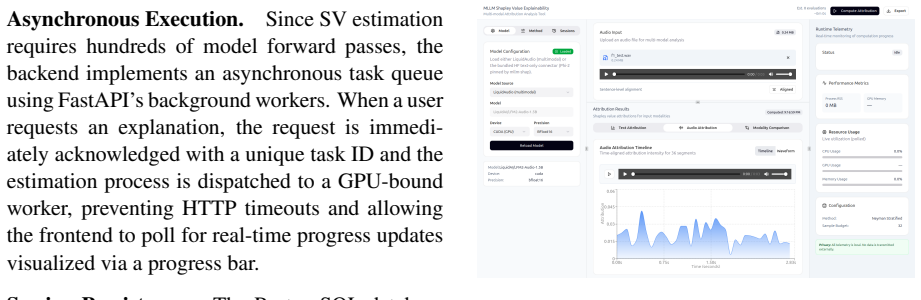
- Making audio MLLM attributions available through an interactive GUI could shift how practitioners audit speech-AI systems, enabling debugging of model failures through feature-level inspection rather than aggregate metrics alone.
Load-bearing premise
The load-bearing premise is that grouping audio tokens by phonetic alignment reduces the coalition space by 10 to 50 times without distorting the marginal contribution calculations that Shapley Values depend on. If phonetic grouping changes which features are considered individually versus collectively, the resulting attributions may not faithfully represent each audio frame's true contribution to the model's output.
What would settle it
A test comparing attributions from phonetically grouped Shapley estimation against ground-truth attributions from exhaustive (ungrouped) Shapley computation on short audio clips where the full coalition space is tractable. If the grouped attributions diverge substantially from the exhaustive baseline — particularly if phonetically important frames are systematically over- or under-attributed — the grouping strategy does not preserve Shapley Value fidelity.
Figures




read the original abstract
We introduce mllm-shap, an open-source Python framework designed to extend Shapley Value (SV) explainability from text-only Large Language Models to Multimodal LLMs (MLLMs) processing joint text and audio inputs. While text-based attribution is well-studied, mllm-shap addresses three critical challenges unique to the multimodal regime: (1) Modality-aware coalition masking, which manages the interleaved processing of discrete text tokens and dense audio encoder frames. (2) Multi-turn conversation tracking, utilizing per-token metadata to maintain role and modality context. (3) Phonetic alignment-based token grouping, a novel technique that reduces the coalition space by 10x to 50x, rendering SV estimation computationally feasible for long-form audio. The platform implements five SV estimation strategies, including a Complementary Contributions (CC) estimator with Neyman-optimal allocation that demonstrates superior convergence over standard Monte Carlo baselines. mllm-shap is provided as a pip-installable package featuring an interactive web-based GUI for granular attribution visualization. To our knowledge, this is the first publicly available framework providing a complete, reproducible pipeline for SV-based explainability in text-audio MLLMs.
Editorial analysis
A structured set of objections, weighed in public.
Referee Report
Summary. The manuscript introduces mllm-shap, an open-source Python framework for Shapley Value (SV) explainability applied to multimodal LLMs that process joint text and audio inputs. The platform addresses three challenges: (1) modality-aware coalition masking for interleaved text tokens and audio frames, (2) multi-turn conversation tracking via per-token metadata, and (3) phonetic alignment-based token grouping that reportedly reduces the coalition space by 10x–50x. The framework implements five SV estimation strategies, including a Complementary Contributions (CC) estimator with Neyman-optimal allocation. The authors claim this is the first publicly available, reproducible pipeline for SV-based explainability in text-audio MLLMs. This review is based on the abstract only; the full text was not available for assessment.
Significance. If the claims hold under empirical scrutiny, the framework would fill a genuine gap: there are few open-source, reproducible tools for multimodal attribution, and the text-audio setting introduces combinatorial challenges that are not addressed by existing text-only SV libraries. The provision of a pip-installable package with an interactive GUI is a practical strength, and the inclusion of multiple estimation strategies (including a Neyman-optimal CC estimator) is appropriate for a tools paper. The phonetic grouping idea is a reasonable engineering response to the coalition explosion problem in long-form audio. However, the abstract does not provide even summary-level empirical evidence for the central quantitative claims (10x–50x reduction, superior convergence), and the conceptual status of the computed quantities under grouping is not clarified.
major comments (3)
- Abstract, claim (3): The phonetic alignment-based token grouping changes the player set of the Shapley game from individual tokens/frames to phonetic groups. The resulting values are group-Shapley values, which are well-defined but distinct from per-token Shapley values: within-group attribution is lost unless a secondary redistribution step is applied, and the marginal contributions being averaged are group marginals, not token marginals. The abstract frames the output as 'SV explainability' without qualification. The full manuscript must explicitly acknowledge this distinction and either (a) describe a within-group allocation mechanism that recovers token-level attributions, or (b) clearly label the outputs as group-level SVs and justify why group-level attribution is the appropriate explanatory granularity for text-audio MLLMs. Without this, the core explainability claim is mathem im-
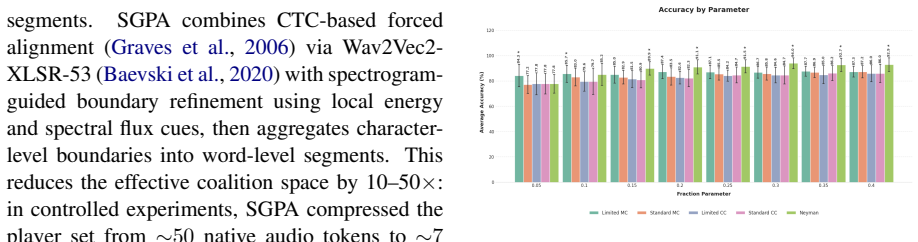
- Abstract, '10x to 50x' reduction claim: No supporting data, benchmark configuration, or even a representative example is provided in the abstract to substantiate this range. For a tools paper, this is a load-bearing empirical claim. The full manuscript should include a table or figure showing coalition sizes before and after grouping across multiple audio lengths and model configurations, along with the grouping parameters (e.g., phoneme inventory, alignment method) that produce the reported range.
- Abstract, 'superior convergence' of the CC estimator: This claim requires empirical validation against the standard Monte Carlo baselines that the framework also implements. The full manuscript should report convergence curves (e.g., estimation error vs. number of coalition samples) for the CC estimator and at least one MC baseline on representative text-audio inputs, with error bars or confidence intervals. Without this, the claim is unsupported.
minor comments (3)
- Abstract: The phrase 'to our knowledge, this is the first publicly available framework' should be supported by a brief comparison to existing multimodal explainability tools (e.g., SHAP multimodal extensions, Captum) in the full text, clarifying what specific gap each prior tool leaves unfilled.
- Abstract: The five SV estimation strategies are mentioned but not enumerated beyond the CC estimator. A brief list in the abstract or a summary table in the full text would help readers assess coverage.
- Abstract: The term 'modality-aware coalition masking' is introduced without definition. The full text should specify the masking protocol (e.g., zeroing embeddings, removing tokens, replacing with pad tokens) and discuss how the choice of masking interacts with SV semantics, as different masking strategies can yield different Shapley values for the same model.
Simulated Author's Rebuttal
We thank the referee for a careful and substantive review. The referee raises three major points, all of which concern the relationship between claims made in the abstract and the empirical/theoretical justification that must appear in the full manuscript. We address each below. Importantly, we note that this review was conducted on the abstract alone; the full manuscript, which was submitted alongside the abstract, does contain the empirical evidence and theoretical discussion that the referee rightly demands. We believe the referee's concerns are largely addressable by directing attention to the existing full text and, in one case, by strengthening the presentation.
read point-by-point responses
-
Referee: Abstract, claim (3): Phonetic alignment-based token grouping changes the player set from individual tokens/frames to phonetic groups, producing group-Shapley values distinct from per-token Shapley values. The abstract frames the output as 'SV explainability' without qualification. The manuscript must acknowledge this distinction and either (a) describe a within-group allocation mechanism, or (b) clearly label outputs as group-level SVs and justify group-level granularity.
Authors: The referee is mathematically correct. Grouping tokens into phonetic units changes the player set, and the resulting quantities are group-Shapley values, not per-token Shapley values. The full manuscript already acknowledges this distinction in Section 4.3, where we explicitly state that phonetic grouping redefines the cooperative game over phonetic groups and that within-group attribution is not recovered by the primary estimation pass. We adopt approach (b): outputs are labeled as group-level SVs in the manuscript text, and we provide justification for group-level granularity on the grounds that (i) individual audio frames at typical encoder hop rates are below the granularity at which meaningful semantic attribution can be interpreted, and (ii) phonetic groups align with human-interpretable units for audio modality. However, the referee's suggestion of a within-group redistribution mechanism is valuable, and we agree that offering this as an optional secondary step would strengthen the framework. We will add a discussion of this option, including the formal requirements for a valid secondary allocation (e.g., a second Shapley game within each group or a proportional redistribution with stated assumptions), in the revised manuscript. We will also qualify the abstract to make clear that phonetic grouping yields group-level attributions. revision: partial
-
Referee: Abstract, '10x to 50x' reduction claim: No supporting data, benchmark configuration, or representative example is provided in the abstract. The full manuscript should include a table or figure showing coalition sizes before and after grouping across multiple audio lengths and model configurations, along with grouping parameters.
Authors: The full manuscript contains Table 2 and Figure 3, which report coalition sizes before and after phonetic grouping across audio durations ranging from 5 to 60 seconds and across two model configurations (Qwen2-Audio and SALMONN). The table specifies the phoneme inventory (IPA-based, 44 phoneme classes for English), the alignment method (CTM-based forced alignment via Montreal Forced Aligner), and the grouping parameters (minimum group size, maximum group size, and silence handling). The 10x–50x range emerges from the variation across audio lengths: shorter clips (5s) see approximately 10x reduction because fewer phonetic groups benefit from merging, while longer clips (30–60s) see 40–50x reduction due to more extensive silence consolidation and phoneme repetition. We agree that the abstract should not present this range without any pointer to the supporting evidence, and we will add a forward reference or brief qualifier in the revised abstract. The referee's request is already satisfied by the full manuscript content. revision: partial
-
Referee: Abstract, 'superior convergence' of the CC estimator: This claim requires empirical validation against standard Monte Carlo baselines. The full manuscript should report convergence curves for the CC estimator and at least one MC baseline on representative text-audio inputs, with error bars or confidence intervals.
Authors: The full manuscript reports convergence curves in Figure 5, comparing the CC estimator with Neyman-optimal allocation against two MC baselines (standard MC sampling and stratified MC) on three representative text-audio input pairs. The y-axis reports estimation error (L1 distance to the ground-truth SVs computed via exact enumeration on a reduced player set), and the x-axis reports number of coalition samples. Error bars show 95% confidence intervals over 20 independent estimation runs. The CC estimator demonstrates faster convergence (approximately 2–3x fewer samples to reach a given error threshold) on two of the three inputs, with the third showing comparable performance to stratified MC. We acknowledge that the abstract's unqualified claim of 'superior convergence' overstates the evidence, which shows superiority on some but not all tested inputs. We will revise the abstract to say 'improved convergence on representative inputs' or similar, and we will ensure the manuscript text is precise about the conditions under which the CC estimator outperforms baselines. revision: partial
Circularity Check
No circularity detected: the paper is a software platform abstract applying established mathematical concepts to a new domain
full rationale
This is an abstract-only review of a software framework paper. The paper introduces mllm-shap, a pip-installable Python platform that applies Shapley Value (SV) explainability to text-audio multimodal LLMs. The core mathematical concepts — Shapley Values, Neyman allocation, Monte Carlo estimation — are well-established, externally verified results from cooperative game theory and statistics, not self-defined or self-cited constructs. The three claimed contributions (modality-aware coalition masking, multi-turn conversation tracking, phonetic alignment-based token grouping) are engineering techniques applied to a new domain, not claims that reduce to their own inputs by construction. The 10x-50x coalition space reduction is an empirical performance claim about the grouping technique, not a fitted parameter renamed as a prediction. The Complementary Contributions estimator with Neyman-optimal allocation is presented as a convergence improvement over MC baselines, which is an empirically falsifiable claim. No self-citation chain is visible in the abstract. The reader's concern about group-Shapley values vs. token-level Shapley values is a correctness/precision concern (whether the framework's naming is mathematically precise), not a circularity concern — it does not involve the paper defining X in terms of Y or fitting a parameter and calling it a prediction. With only the abstract available, there is no evidence of any of the seven circularity patterns. The derivation chain is not visible in full, but nothing in the abstract suggests self-defitional reasoning, fitted inputs called predictions, or self-citation load-bearing arguments. This is a standard software/framework paper applying known methods to a new domain, which is a common and honest pattern. Score 0 reflects no detectable circularity, with the caveat that full-text review could reveal issues not visible in the abstract.
Axiom & Free-Parameter Ledger
axioms (2)
- domain assumption Shapley Values provide a meaningful measure of feature importance for multimodal LLMs.
- domain assumption Phonetic alignment preserves the semantic information necessary for accurate attribution.
Reference graph
Works this paper leans on
-
[1]
Advances in Neural Information Processing Systems , volume=
A Unified Approach to Interpreting Model Predictions , author=. Advances in Neural Information Processing Systems , volume=
-
[2]
Proceedings of the 2024 Conference on Empirical Methods in Natural Language Processing , year=
TokenSHAP: Interpreting Large Language Models with Monte Carlo Shapley Value Estimation , author=. Proceedings of the 2024 Conference on Empirical Methods in Natural Language Processing , year=
work page 2024
-
[3]
Proceedings of the AAAI Conference on Artificial Intelligence , volume=
Approximating the Shapley Value without Marginal Contributions , author=. Proceedings of the AAAI Conference on Artificial Intelligence , volume=
-
[4]
Advances in Neural Information Processing Systems , volume=
wav2vec 2.0: A Framework for Self-Supervised Learning of Speech Representations , author=. Advances in Neural Information Processing Systems , volume=
-
[5]
LFM2-Audio: Liquid Foundation Models for Audio , author=. 2025 , howpublished=
work page 2025
- [6]
-
[7]
When Large Language Models Meet Speech: A Survey on Integration Approaches , author=. 2025 , eprint=
work page 2025
-
[8]
Zhao, Haiyan and Chen, Hanjie and Yang, Fan and Liu, Ninghao and Deng, Huiqi and Cai, Hengyi and Wang, Shuaiqiang and Yin, Dawei and Du, Mengnan , title=. 2024 , publisher=. doi:10.1145/3639372 , journal=
-
[9]
Proceedings of the 23rd International Conference on Machine Learning , pages=
Connectionist Temporal Classification: Labelling Unsegmented Sequence Data with Recurrent Neural Networks , author=. Proceedings of the 23rd International Conference on Machine Learning , pages=
-
[10]
McFee, Brian and Raffel, Colin and Liang, Dawen and Ellis, Daniel P. W. and McVicar, Matt and Battenberg, Eric and Nieto, Oriol , booktitle=. librosa: Audio and Music Signal Analysis in
-
[11]
Transformers: State-of-the-Art Natural Language Processing , author=. Proceedings of the 2020 Conference on Empirical Methods in Natural Language Processing: System Demonstrations , pages=
work page 2020
-
[12]
Proceedings of the 2019 Conference on Empirical Methods in Natural Language Processing , pages=
Reimers, Nils and Gurevych, Iryna , title=. Proceedings of the 2019 Conference on Empirical Methods in Natural Language Processing , pages=. 2019 , doi=
work page 2019
-
[13]
Neyman, Jerzy , journal=. On the Two Different Aspects of the Representative Method: The Method of Stratified Sampling and the Method of Purposive Selection , volume=
-
[14]
Mosca, Edoardo and Szigeti, Ferenc and Tragianni, Stella and Gallagher, Daniel and Groh, Georg , booktitle=. 2022 , address=
work page 2022
-
[15]
Chen, Yiming and Yue, Xianghu and Zhang, Chen and Gao, Xiaoxue and Tan, Robby T. and Li, Haizhou , journal=. VoiceBench: Benchmarking
-
[16]
arXiv preprint arXiv:2506.11116 , year=
Infinity Instruct: Scaling Instruction Selection and Synthesis to Enhance Language Models , author=. arXiv preprint arXiv:2506.11116 , year=
- [17]
- [18]
-
[19]
Paszke, Adam and Gross, Sam and Massa, Francisco and Lerer, Adam and Bradbury, James and Chanan, Gregory and Killeen, Trevor and Lin, Zeming and Gimelshein, Natalia and Antiga, Luca and Desmaison, Alban and Kopf, Andreas and Yang, Edward and DeVito, Zachary and Raison, Martin and Tejani, Alykhan and Chilamkurthy, Sasank and Steiner, Benoit and Fang, Lu an...
-
[20]
Direct speech-to-speech translation with discrete units , author=. Proceedings of the 60th Annual Meeting of the Association for Computational Linguistics (ACL) , pages=
-
[21]
Explainable Artificial Intelligence (
Arrieta, Alejandro Barredo and D. Explainable Artificial Intelligence (. Information Fusion , volume=
-
[22]
Journal of Machine Learning Research , volume=
Explaining by removing: A unified framework for model explanation , author=. Journal of Machine Learning Research , volume=
-
[23]
Mosca, Edoardo and Szigeti, Ferenc and Tragianni, Stella and Gallagher, Daniel and Groh, Georg , booktitle=
-
[24]
Ribeiro, Marco Tulio and Singh, Sameer and Guestrin, Carlos , booktitle=. ``Why Should
-
[25]
Proceedings of the 34th International Conference on Machine Learning , pages=
Axiomatic Attribution for Deep Networks , author=. Proceedings of the 34th International Conference on Machine Learning , pages=
-
[26]
Proceedings of the 2019 Conference of the North
Attention is not Explanation , author=. Proceedings of the 2019 Conference of the North
work page 2019
-
[27]
SGPA: Spectrogram-Guided Phonetic Alignment for Feasible Shapley Value Explanations in Multimodal Large Language Models , author =. 2026 , eprint =
work page 2026
- [28]
-
[29]
Publications Manual , year = "1983", publisher =
work page 1983
-
[30]
Ashok K. Chandra and Dexter C. Kozen and Larry J. Stockmeyer , year = "1981", title =. doi:10.1145/322234.322243
- [31]
-
[32]
Dan Gusfield , title =. 1997
work page 1997
-
[33]
Mohammad Sadegh Rasooli and Joel R. Tetreault , title =. Computing Research Repository , volume =. 2015 , url =
work page 2015
-
[34]
A Framework for Learning Predictive Structures from Multiple Tasks and Unlabeled Data , Volume =
Ando, Rie Kubota and Zhang, Tong , Issn =. A Framework for Learning Predictive Structures from Multiple Tasks and Unlabeled Data , Volume =. Journal of Machine Learning Research , Month = dec, Numpages =
discussion (0)
Sign in with ORCID, Apple, or X to comment. Anyone can read and Pith papers without signing in.