Detecting Aimbot Cheaters in MOGs
Pith reviewed 2026-06-28 09:17 UTC · model grok-4.3
The pith
Adversarial patches in games can detect or disable visual aimbot cheaters by triggering their computer vision models.
A machine-rendered reading of the paper's core claim, the machinery that carries it, and where it could break.
Core claim
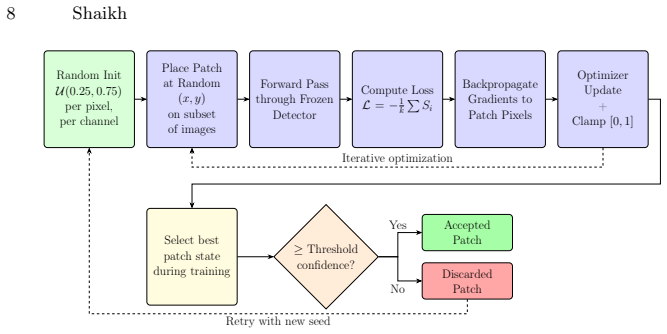
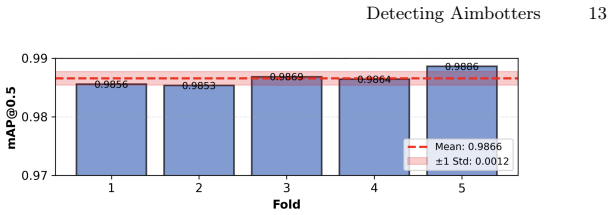
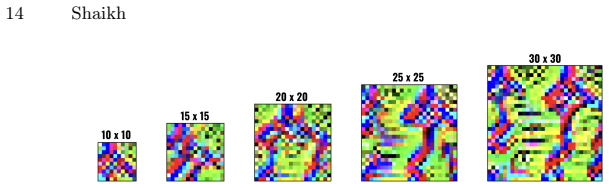
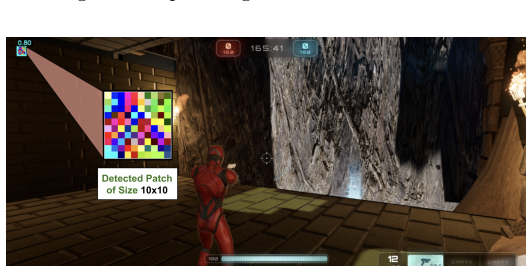
PATCH deploys adversarial patches as in-game honeytokens that deliberately activate the object-detection models used by visual aimbots; this either directly identifies the cheater or renders the game unplayable through patch flooding, achieving over 90 percent detection in white-box scenarios across patch sizes and 60-90 percent cross-model transferability with larger patches, with validation on Fortnite confirming real-world applicability.
What carries the argument
Adversarial patches used as honeytokens that trigger cheaters' YOLO-style object detectors, either for detection or viewport flooding.
If this is right
- Detection works across multiple patch sizes and screen resolutions in the tested engine.
- Larger patches achieve usable transfer rates between different YOLO variants.
- The method applies directly to a commercial title like Fortnite without game-specific retraining.
- The defense operates entirely on the client screen feed, bypassing kernel-level anti-cheat tools.
Where Pith is reading between the lines
- Game designers could embed these patches at fixed map locations so they appear only to cheaters.
- If cheaters start retraining on patches, future work would need patches that remain effective against fine-tuned models.
- The same honeytoken idea might extend to other visual cheats that rely on screen-based detection rather than memory reads.
Load-bearing premise
Cheaters will keep using the same off-the-shelf or similar object-detection models that the patches are designed to fool, instead of retraining or switching to new architectures.
What would settle it
A controlled test in which aimbot users retrain their detectors on images containing the patches and the resulting detection rate falls below 50 percent.
Figures





read the original abstract
Multiplayer Online Games have become a multibillion dollar industry in the entertainment sector. However, the presence of cheaters undermines the experience of honest players and devalues the effort of game developers, as it directly affects player retention, competitive integrity, the legitimacy and trustworthiness of a game, and most importantly the overall revenue streams. Among various cheating techniques, visual aimbots represent an emerging threat. They use computer vision models to detect opponents from client screen captures rather than accessing game memory, making them completely undetectable by commercial kernel level anti cheat solutions. In this paper, we introduce PATCH, a novel proactive defense strategy that deploys adversarial patches as in game honeytokens to mitigate the presence of visual aimbot cheaters. Our approach centers on deliberately triggering the cheaters' object detection model, enabling either direct detection, or rendering the game unplayable for the cheater via patch flooding on their viewport. We evaluate our approach on various criteria; analyzing the effectiveness of different patch sizes, scalability of patches to different screen resolutions, efficacy against diverse visual aimbot cheat configurations and also explore various YOLO models to assess patch transferability. Evaluation on a custom Unreal Engine game demonstrates over 90 percent detection rate in white box scenarios for almost all patch sizes, and reaches 60 to 90 percent cross model transferability with larger patches. We further validate our approach on Fortnite, a commercial MOG, demonstrating real world applicability.
Editorial analysis
A structured set of objections, weighed in public.
Referee Report
Summary. The paper introduces PATCH, a proactive defense deploying adversarial patches as in-game honeytokens to detect or disrupt visual aimbot cheaters in multiplayer online games. These cheaters rely on computer vision models (e.g., YOLO variants) applied to client screen captures rather than memory access. The method triggers the cheater's detector for direct detection or uses patch flooding to render the game unplayable. Evaluation on a custom Unreal Engine game reports over 90% detection in white-box scenarios across most patch sizes, 60-90% cross-model transferability with larger patches, plus validation on the commercial game Fortnite.
Significance. If the results hold, the work addresses an emerging class of memoryless aimbots that evade kernel-level anti-cheats, offering a deployable countermeasure in a multibillion-dollar industry. The commercial Fortnite validation and analysis across patch sizes, resolutions, and YOLO models provide concrete evidence of applicability, though significance hinges on robustness beyond static models.
major comments (2)
- [Evaluation] Evaluation section (white-box and transferability experiments): the >90% detection and 60-90% transferability rates are measured exclusively against static YOLO variants; no experiments test adaptive adversaries that retrain on the generated patches or switch architectures, which directly undermines the central claim of practical detection and disruption.
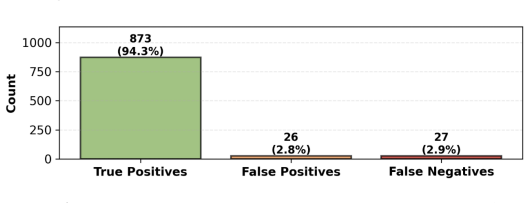
- [Evaluation] Experimental setup and results: false-positive rates on legitimate (non-cheating) players are not reported, leaving the reliability of the direct-detection mechanism unverified despite its role in the core contribution.
minor comments (2)
- [Abstract] Abstract: the phrase 'patch flooding on their viewport' is introduced without a brief mechanism sketch, reducing clarity for readers unfamiliar with the flooding approach.
- [Evaluation] The paper mentions scalability across screen resolutions and diverse cheat configurations but provides no quantitative breakdown or table reference in the abstract-level description.
Simulated Author's Rebuttal
We thank the referee for the constructive feedback. Below we respond point-by-point to the major comments, indicating where revisions will be made.
read point-by-point responses
-
Referee: [Evaluation] Evaluation section (white-box and transferability experiments): the >90% detection and 60-90% transferability rates are measured exclusively against static YOLO variants; no experiments test adaptive adversaries that retrain on the generated patches or switch architectures, which directly undermines the central claim of practical detection and disruption.
Authors: We agree that the reported results are obtained only against static YOLO models and that no experiments evaluate adaptive adversaries capable of retraining on the patches. This is a substantive limitation for claims of practical, long-term detection. The cross-model transferability results provide limited evidence of generalization across architectures, but they do not address retraining attacks. In the revised manuscript we will add an explicit limitations subsection acknowledging this gap and will clarify that the current evaluation targets known static detectors rather than claiming robustness against adaptive ones. revision: partial
-
Referee: [Evaluation] Experimental setup and results: false-positive rates on legitimate (non-cheating) players are not reported, leaving the reliability of the direct-detection mechanism unverified despite its role in the core contribution.
Authors: We acknowledge that false-positive rates on legitimate players are not reported. This information is necessary to assess the practicality of the direct-detection mechanism. In the revised version we will add an analysis of false positives using recorded legitimate gameplay sessions from both the custom Unreal Engine environment and Fortnite, reporting the resulting rates and any associated trade-offs with detection performance. revision: yes
Circularity Check
No circularity: empirical evaluation on independent test configurations
full rationale
The paper proposes the PATCH defense and reports measured detection rates (>90% white-box, 60-90% transfer) from explicit evaluations on a custom Unreal Engine game and Fortnite. No equations, fitted parameters, predictions derived from inputs, or self-citation chains are present in the provided text or abstract. Results are obtained from separate test setups rather than reducing to the method definition by construction. The central claim rests on external experimental outcomes, not self-referential definitions or renamings.
Axiom & Free-Parameter Ledger
free parameters (1)
- patch size
Reference graph
Works this paper leans on
-
[1]
In: IEEE conference on computational inteligence in games (CIG)
Alayed, H., Frangoudes, F., Neuman, C.: Behavioral-based cheating detection in online first person shooters using machine learning techniques. In: IEEE conference on computational inteligence in games (CIG). IEEE (2013) Detecting Aimbotters 21
2013
-
[2]
In: 26th International Sympo- sium on Research in Attacks, Intrusions and Defenses
Anwar, M.S., Zuo, C., Yagemann, C., Lin, Z.: Extracting Threat Intelli- gence From Cheat Binaries For Anti-Cheating. In: 26th International Sympo- sium on Research in Attacks, Intrusions and Defenses. p. 17–31. ACM (2023). https://doi.org/10.1145/3607199.3607211
-
[3]
Bulletin of Elec- trical Engineering and Informatics13(4), 2456–2470 (2024)
Asmara, R.A., Anugrah, M.R.S., Wibowo, D.W., Arai, K., Burhanuddin, M.A., Handayani, A.N., Damayanti, F.A.: Yolo-based object detection performance eval- uation for automatic target aimbot in first-person shooter games. Bulletin of Elec- trical Engineering and Informatics13(4), 2456–2470 (2024)
2024
-
[4]
Official website
BattlEye Innovations: BattlEye. Official website. URLhttps://www.battleye. com/about/, [Accessed 2026-03-18]
2026
-
[5]
Official website
Epic Games: Easy Anti-Cheat. Official website. URLhttps://www.easy.ac/, [Ac- cessed 2026-03-18]
2026
-
[6]
Fortune Business Insights: Online gaming market size, share & industry anal- ysis, by gaming type, platform, gamer type, demographic, and regional fore- cast, 2026–2034.https://www.fortunebusinessinsights.com/online-gaming- market-112179(2026), last updated: February 23, 2026; Accessed: 2026-03-26
2026
-
[7]
In: 18th Asia Pacific Symposium on Intelligent and Evolutionary Systems - Volume 2
Han, M.L., Park, J.K., Kim, H.K.: Online Game Bot Detection in FPS Game. In: 18th Asia Pacific Symposium on Intelligent and Evolutionary Systems - Volume 2. pp. 479–491. Springer International Publishing (2015)
2015
-
[8]
Jocher, G., Qiu, J., Chaurasia, A.: Ultralytics YOLO.https://github.com/ ultralytics/ultralytics(Jan 2023)
2023
-
[9]
IEEE Transactions on Games 15(4), 566–579 (2023)
Kanervisto, A., Kinnunen, T., Hautamäki, V.: GAN-Aimbots: Using Machine Learning for Cheating in First Person Shooters. IEEE Transactions on Games 15(4), 566–579 (2023). https://doi.org/10.1109/TG.2022.3173450
-
[10]
Karkallis, P., Blasco, J.: Vic: Evasive video game cheating via virtual machine introspection.https://arxiv.org/abs/2502.12322(2025)
arXiv 2025
-
[11]
Jurnal Teknik Informatika (Jutif)4(1), 109–115 (Feb 2023)
Kelik Nugroho, A., Permadi, I., Habiballah, A.: Image detection in the aimbot program using yolov4-tiny. Jurnal Teknik Informatika (Jutif)4(1), 109–115 (Feb 2023). https://doi.org/10.52436/1.jutif.2023.4.1.821
-
[12]
Maberry, K., Paustian, S., Bakir, S.: Using an Artificial Neural Network to de- tect aim assistance in Counter-Strike: Global Offensive.https://www.cs.nmt.edu/ ~kmaberry/ann_fps_cheater.pdf(2016)
2016
-
[13]
2024 Joint 13th International Conference on Soft Computing and Intelligent Systems and 25th International Symposium on Advanced Intelligent Systems (SCIS&ISIS) pp
Matsuhira, K., Hattori, S., Sunayama, W.: Effects of adversarial patches against object detection on combating cheats in online first person shooter games. 2024 Joint 13th International Conference on Soft Computing and Intelligent Systems and 25th International Symposium on Advanced Intelligent Systems (SCIS&ISIS) pp. 1–6 (2024),https://api.semanticschola...
2024
-
[14]
Riot Games: Riot Vanguard. Support article. URLhttps://support-valorant. riotgames.com/hc/en-us/articles/360046160933-What-is-Vanguard, [Ac- cessed 2026-03-18]
arXiv 2026
-
[15]
In: 2nd International Conference on Future Genera- tion Communication and Networking
Robles, R.J., Yeo, S.S., Moon, Y.D., Park, G., Kim, S.: Online games and security issues. In: 2nd International Conference on Future Genera- tion Communication and Networking. vol. 2, pp. 145–148. IEEE (2008). https://doi.org/10.1109/FGCN.2008.199
-
[16]
RootKit-Org: Ai-aimbot: Real-time object detection-based aimbot.https:// github.com/RootKit-Org/AI-Aimbot(2023), accessed: 2026-03-25
2023
-
[17]
In: Cybersecurity
Shaikh,S.,Bertin,H.,Dacier,M.,Bromberg,Y.D.:Aframeworktoenablecheating detection in multiplayer online games. In: Cybersecurity. pp. 166–181. Springer Nature Switzerland (2025) 22 Shaikh
2025
-
[18]
StatCounter Global Stats: Desktop screen resolution stats worldwide.https:// gs.statcounter.com/screen-resolution-stats/desktop/worldwide(2026), ac- cessed: 2026-03-26
2026
-
[19]
Statista: Games - worldwide: Revenue.https://www.statista.com/outlook/amo/ media/games/worldwide#revenue(2025), accessed: 2026-03-31
2025
-
[20]
In: 33rd USENIX Security Symposium
Sun, C., Ye, K., Su, L., Zhang, J., Qian, C.: Invisibility Cloak: Proactive Defense Against Visual Game Cheating. In: 33rd USENIX Security Symposium. pp. 3045–
-
[21]
USENIX Association (Aug 2024)
2024
-
[22]
Sunone: Sunone boosty page.https://boosty.to/sunone(2026), accessed: 2026- 04-03
2026
-
[23]
SunOner: Sunone aimbot: Real-time object detection-based aimbot utiliz- ing yolov8, yolov10, and yolov11.https://github.com/SunOner/sunone_aimbot (2024), accessed: 2026-03-25
2024
-
[24]
Turner, J.: What is an aimbot? gaming cheat definition & examples.https: //aibudwp.com/what-is-an-aimbot-gaming-cheat-definition-examples/ (December 2025), accessed: 2026-04-06
2025
-
[25]
News article
Weatherbed, J.: Apex Legends devs confirm esports hacking incident, respond with ‘layered’ updates. News article. URLhttps://www.theverge.com/2024/ 3/18/24104666/apex-legends-postpones-algs-competition-hack-concerns (Mar 2024), [Accessed 2026-03-18]
2024
-
[26]
In: 13th European Workshop on Systems Security (EuroSec)
Witschel, T., Wressnegger, C.: Aim low, shoot high: evading aimbot detectors by mimicking user behavior. In: 13th European Workshop on Systems Security (EuroSec). p. 19–24. ACM (2020). https://doi.org/10.1145/3380786.3391397
-
[27]
Xiao, Z., Goto, T., Ghosh, P., Kirishima, T., Tsuchida, K.: Detection of a novel object-detection-based cheat tool for first-person shooter games using ma- chine learning. In: IEEE/ACIS 21st International Conference on Software Engi- neering Research, Management and Applications (SERA). pp. 389–394 (2023). https://doi.org/10.1109/SERA57763.2023.10197816
-
[28]
In: The International Joint Conference on Neural Networks (IJCNN) (2012)
Yu, S.Y., Hammerla, N., Yan, J., Andras, P.: A statistical aimbot detection method for online FPS games. In: The International Joint Conference on Neural Networks (IJCNN) (2012). https://doi.org/10.1109/IJCNN.2012.6252489
discussion (0)
Sign in with ORCID, Apple, or X to comment. Anyone can read and Pith papers without signing in.