Hacking Generative Perplexity: Why Unconditional Text Evaluation Needs Distributional Metrics
Pith reviewed 2026-06-27 18:51 UTC · model grok-4.3
The pith
Generative perplexity can be gamed by incoherent text generators, showing it fails to measure text quality.
A machine-rendered reading of the paper's core claim, the machinery that carries it, and where it could break.
Core claim
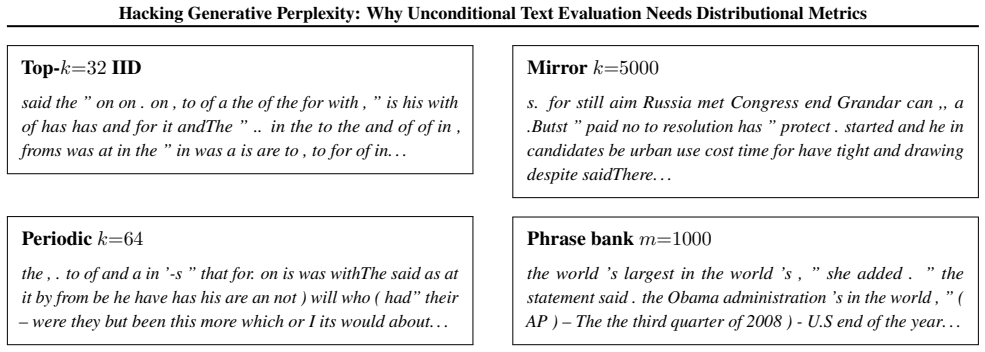
By constructing a suite of zero-parameter, deliberately naive samplers, the paper shows that these achieve state-of-the-art gen-PPL on LM1B and OpenWebText at non-degenerate entropy, surpassing diffusion and continuous-flow models, yet the text is incoherent by construction. This establishes that gen-PPL measures only predictability under the AR scorer, not grammaticality or semantic coherence.
What carries the argument
The suite of zero-parameter naive samplers that hack gen-PPL while ensuring incoherence by design, used to expose the metric's flaws.
If this is right
- Current leaderboards based on gen-PPL for non-autoregressive LMs are unreliable.
- Evaluation should use distributional divergence metrics instead of gen-PPL.
- Recent diffusion and continuous-flow models may not be as advanced as gen-PPL suggests.
- Text quality assessment needs direct comparison to reference distributions.
Where Pith is reading between the lines
- Similar hacking could affect other proxy metrics that rely on external scorers.
- Autoregressive models themselves might benefit from distributional evaluation for generation tasks.
- Developing parameter-free distributional metrics could standardize unconditional text evaluation.
- Future work should test if these naive samplers also fool other proposed metrics.
Load-bearing premise
That the empirical-entropy guardrail combined with gen-PPL is sufficient to ensure the metric reflects grammaticality or semantic coherence rather than mere predictability under the frozen AR scorer.
What would settle it
Finding that the constructed naive samplers do not actually achieve lower gen-PPL than published diffusion models on LM1B and OpenWebText, or that the distributional metrics do not change model rankings.
Figures
read the original abstract
Diffusion and continuous flow-based language models have emerged as the leading non-autoregressive alternatives to language modeling. Progress in both paradigms is overwhelmingly tracked by generative perplexity (gen-PPL): the per-token negative log-likelihood of samples under a frozen autoregressive (AR) scorer such as gpt2-large, typically paired with an empirical-entropy guardrail to rule out low-entropy collapse. We argue that this metric is unsound. By construction, gen-PPL measures only predictability under the scoring AR, not grammaticality or semantic coherence -- and the set of predictable but still low-quality sequences is combinatorially large. To make this concrete, we construct a suite of zero-parameter, deliberately naive samplers that achieve state-of-the-art gen-PPL on LM1B and OpenWebText at non-degenerate entropy, surpassing recently published diffusion and continuous-flow models while producing text that is incoherent by construction. We recommend evaluation suites that directly quantify the distributional divergence between generated and reference text, and use such a suite to re-benchmark recent non-autoregressive models, recovering a more faithful picture of the current state of the art.
Editorial analysis
A structured set of objections, weighed in public.
Referee Report
Summary. The paper claims that generative perplexity (gen-PPL) is an unsound evaluation metric for non-autoregressive language models (diffusion and continuous-flow) because it only captures predictability under a frozen autoregressive scorer such as gpt2-large, not grammaticality or semantic coherence. The authors demonstrate this via an explicit construction of zero-parameter, deliberately naive samplers that achieve state-of-the-art gen-PPL on LM1B and OpenWebText while satisfying an empirical-entropy guardrail and producing text that is incoherent by design; they surpass recently published models and recommend replacing gen-PPL with suites that directly quantify distributional divergence between generated and reference text, which they apply to re-benchmark recent non-AR models.
Significance. If the counterexample construction holds, the result is significant for non-autoregressive language modeling research: it supplies a parameter-free, falsifiable demonstration that gen-PPL can be gamed without improving text quality, which may explain apparent progress in diffusion and flow-based models. The explicit zero-parameter samplers and the re-benchmarking with distributional metrics constitute a concrete, reproducible contribution that could shift evaluation practices toward more faithful metrics.
minor comments (2)
- [Abstract] Abstract, paragraph on metric construction: the term 'non-degenerate entropy' is used without a numerical threshold or range; adding the precise entropy guardrail values employed would improve reproducibility of the counterexamples.
- [Evaluation suite] The re-benchmarking section would benefit from a brief table listing the distributional metrics employed and the exact scores recovered for the diffusion/continuous-flow models.
Simulated Author's Rebuttal
We thank the referee for their positive assessment, accurate summary of our contributions, and recommendation to accept. No major comments require point-by-point response.
Circularity Check
No significant circularity
full rationale
The paper's core argument rests on explicit construction of zero-parameter naive samplers that satisfy the entropy guardrail yet produce incoherent text while achieving low gen-PPL. This is a direct counterexample to the metric's validity and does not reduce to any fitted parameter, self-definition, or self-citation chain. No load-bearing step equates a prediction to its input by construction; the derivation is self-contained against the external benchmark of the constructed samplers.
Axiom & Free-Parameter Ledger
axioms (2)
- domain assumption Gen-PPL is defined as the per-token negative log-likelihood under a frozen AR model
- domain assumption An empirical-entropy guardrail suffices to exclude degenerate low-entropy outputs
Reference graph
Works this paper leans on
-
[1]
Albergo, M. S., Boffi, N. M., and Vanden-Eijnden, E. Stochastic interpolants: A unifying framework for flows and diffusions.arXiv preprint arXiv:2303.08797,
-
[2]
T., Yang, Z., Qi, Z., Han, J., Sahoo, S
Arriola, M., Gokaslan, A., Chiu, J. T., Yang, Z., Qi, Z., Han, J., Sahoo, S. S., and Kuleshov, V . Block diffusion: Inter- polating between autoregressive and diffusion language models.arXiv preprint arXiv:2503.09573,
-
[3]
Boffi, N. M., Albergo, M. S., and Vanden-Eijnden, E. Flow map matching with stochastic interpolants: A mathemat- ical framework for consistency models.arXiv preprint arXiv:2406.07507,
-
[4]
Boffi, N. M., Albergo, M. S., and Vanden-Eijnden, E. How to build a consistency model: Learning flow maps via self-distillation.arXiv preprint arXiv:2505.18825,
-
[5]
Brown, T. B., Mann, B., Ryder, N., Subbiah, M., Kaplan, J., Dhariwal, P., Neelakantan, A., Shyam, P., Sastry, G., Askell, A., Agarwal, S., Herbert-V oss, A., Krueger, G., Henighan, T., Child, R., Ramesh, A., Ziegler, D. M., Wu, J., Winter, C., Hesse, C., Chen, M., Sigler, E., Litwin, M., Gray, S., Chess, B., Clark, J., Berner, C., McCandlish, S., Radford,...
1901
-
[6]
Campbell, A., Yim, J., Barzilay, R., and Jaakkola, T. Gener- ative flows on discrete state-spaces: Enabling continuous- time models for graph and text generation.arXiv preprint arXiv:2402.04997,
-
[7]
Chen, C., Borgeaud, S., Irving, G., Lespiau, J.-B., Sifre, L., and Jumper, J. Accelerating large language model decoding with speculative sampling.arXiv preprint arXiv:2302.01318,
-
[8]
Dieleman, S., Sartran, L., Roshannai, A., Savinov, N., Ganin, Y ., Richemond, P. H., Doucet, A., Strudel, R., Dyer, C., Durkan, C., Hawthorne, C., Leblond, R., Grath- wohl, W., and Adler, J. Continuous diffusion for categori- cal data.arXiv preprint arXiv:2211.15089,
-
[9]
One step diffusion via shortcut models.arXiv preprint arXiv:2410.12557,
Frans, K., Hafner, D., Levine, S., and Abbeel, P. One step diffusion via shortcut models.arXiv preprint arXiv:2410.12557,
-
[10]
Gat, I., Remez, T., Shaul, N., Kreuk, F., Chen, R. T. Q., Synnaeve, G., Adi, Y ., and Lipman, Y . Discrete flow matching.arXiv preprint arXiv:2407.15595,
-
[11]
Geng, Z., Deng, M., Bai, X., Kolter, J. Z., and He, K. Mean flows for one-step generative modeling.arXiv preprint arXiv:2505.13447,
-
[12]
Mask-predict: Parallel decoding of conditional masked language models
Ghazvininejad, M., Levy, O., Liu, Y ., and Zettlemoyer, L. Mask-predict: Parallel decoding of conditional masked language models. InProceedings of the 2019 Conference on Empirical Methods in Natural Language Processing,
2019
-
[13]
8 Hacking Generative Perplexity: Why Unconditional Text Evaluation Needs Distributional Metrics Han, X., Kumar, S., and Tsvetkov, Y . SSD-LM: Semi- autoregressive simplex-based diffusion language model for text generation and modular control.arXiv preprint arXiv:2210.17432,
-
[14]
B., Zhang, H., and Liang, P
Hashimoto, T. B., Zhang, H., and Liang, P. Unifying human and statistical evaluation for natural language genera- tion. InProceedings of the 2019 Conference of the North American Chapter of the Association for Computational Linguistics, pp. 1689–1701,
2019
-
[15]
Hoogeboom, E., Ruhe, D., Heek, J., Mensink, T., and Sal- imans, T. Beyond single tokens: Distilling discrete diffusion models via discrete MMD.arXiv preprint arXiv:2603.20155,
-
[16]
B., Chess, B., Child, R., Gray, S., Radford, A., Wu, J., and Amodei, D
Kaplan, J., McCandlish, S., Henighan, T., Brown, T. B., Chess, B., Child, R., Gray, S., Radford, A., Wu, J., and Amodei, D. Scaling laws for neural language models. In arXiv preprint arXiv:2001.08361,
Pith/arXiv arXiv 2001
-
[17]
Lee, C., Yoo, J., Agarwal, M., Shah, S., Huang, J., Raghu- nathan, A., Hong, S., Boffi, N. M., and Kim, J. Flow map language models: One-step language modeling via continuous denoising.arXiv preprint arXiv:2602.16813,
-
[18]
Deterministic non- autoregressive neural sequence modeling by iterative re- finement
Lee, J., Mansimov, E., and Cho, K. Deterministic non- autoregressive neural sequence modeling by iterative re- finement. InProceedings of the 2018 Conference on Em- pirical Methods in Natural Language Processing, 2018a. Lee, K., Lee, K., Lee, H., and Shin, J. A simple unified framework for detecting out-of-distribution samples and adversarial attacks. InA...
2018
-
[19]
A diversity-promoting objective function for neural conver- sation models
Li, J., Galley, M., Brockett, C., Gao, J., and Dolan, B. A diversity-promoting objective function for neural conver- sation models. InProceedings of the 2016 Conference of the North American Chapter of the Association for Com- putational Linguistics: Human Language Technologies, pp. 110–119,
2016
-
[20]
Nalisnick, E., Matsukawa, A., Teh, Y . W., and Lakshmi- narayanan, B. Detecting out-of-distribution inputs to deep generative models using typicality.arXiv preprint arXiv:1906.02994,
arXiv 1906
-
[21]
Large language diffusion models.arXiv preprint arXiv:2502.09992,
Nie, S., Zhu, F., You, Z., Zhang, X., Ou, J., Hu, J., Zhou, J., Lin, Y ., Wen, J.-R., and Li, C. Large language diffusion models.arXiv preprint arXiv:2502.09992,
-
[22]
Pillutla, K., Swayamdipta, S., Zellers, R., Thickstun, J., Welleck, S., Choi, Y ., and Harchaoui, Z
URL https://arxiv.org/abs/2502.03540. Pillutla, K., Swayamdipta, S., Zellers, R., Thickstun, J., Welleck, S., Choi, Y ., and Harchaoui, Z. MAUVE: Mea- suring the gap between neural text and human text using divergence frontiers. InAdvances in Neural Information Processing Systems, pp. 4816–4828,
-
[23]
Potaptchik, P., Yim, J., Saravanan, A., Holderrieth, P., Vanden-Eijnden, E., and Albergo, M. S. Discrete flow maps.arXiv preprint arXiv:2604.09784,
-
[24]
CANDI: Hybrid discrete-continuous diffusion models.arXiv preprint arXiv:2510.22510,
Pynadath, P., Shi, J., and Zhang, R. CANDI: Hybrid discrete-continuous diffusion models.arXiv preprint arXiv:2510.22510,
-
[25]
Generative frontiers: Why evaluation matters for diffusion language models
9 Hacking Generative Perplexity: Why Unconditional Text Evaluation Needs Distributional Metrics Pynadath, P., Shi, J., and Zhang, R. Generative frontiers: Why evaluation matters for diffusion language models. arXiv preprint arXiv:2604.02718,
-
[26]
˙I., Ambrogioni, L., and van de Meent, J.-W
Roos, D., Davis, O., Eijkelboom, F., Bronstein, M., Welling, M., Ceylan, ˙I. ˙I., Ambrogioni, L., and van de Meent, J.-W. Categorical flow maps.arXiv preprint arXiv:2602.12233,
-
[27]
S., Deschenaux, J., Gokaslan, A., Wang, G., Chiu, J
Sahoo, S. S., Deschenaux, J., Gokaslan, A., Wang, G., Chiu, J. T., and Kuleshov, V . The diffusion duality.arXiv preprint arXiv:2506.10892,
-
[28]
Shi, J., Han, K., Wang, Z., Doucet, A., and Titsias, M. K. Simplified and generalized masked diffusion for discrete data.arXiv preprint arXiv:2406.04329,
-
[29]
Self-conditioned embedding diffusion for text generation.arXiv preprint arXiv:2211.04236,
Strudel, R., Tallec, C., Altch´e, F., Du, Y ., Ganin, Y ., Mensch, A., Grathwohl, W., Savinov, N., Dieleman, S., Sifre, L., and Leblond, R. Self-conditioned embedding diffusion for text generation.arXiv preprint arXiv:2211.04236,
-
[30]
Wang, G., Schiff, Y ., Sahoo, S. S., and Kuleshov, V . ReMDM: Remasking discrete diffusion models with inference-time scaling.arXiv preprint arXiv:2503.00307,
-
[31]
[in the first time] realized that she could be more than quiet since she was such older
10 Hacking Generative Perplexity: Why Unconditional Text Evaluation Needs Distributional Metrics A. Full Parameter Sweeps Tables 3–6 show gen-PPL andHacross the full parameter range for each sampler family. Table 3.Top-kfull sweep. LM1B (L=128) OWT (L=1024) k Hgen-PPLHgen-PPL 16 2.54 39.79 — — 32 2.99 75.00 3.33 59.46 64 3.33 117.37 3.78 99.88 128 3.59 18...
2000
discussion (0)
Sign in with ORCID, Apple, or X to comment. Anyone can read and Pith papers without signing in.