RAILS: Verification-Native Clearing For Agentic Commerce
Pith reviewed 2026-06-27 18:33 UTC · model grok-4.3
The pith
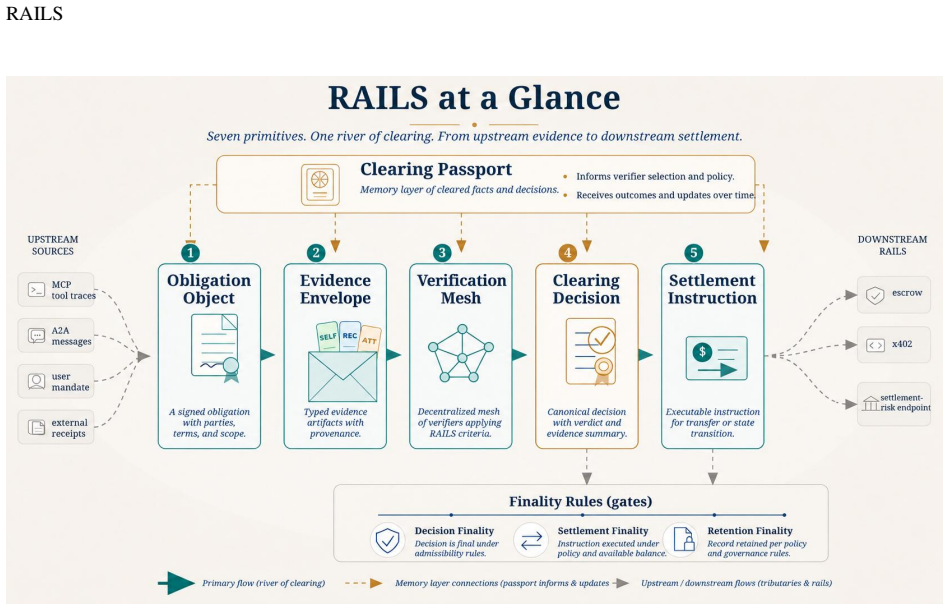
Seven primitives linked by admissibility-graded verification guarantee that agent settlements rest only on evidence meeting each obligation's floor.
A machine-rendered reading of the paper's core claim, the machinery that carries it, and where it could break.
Core claim
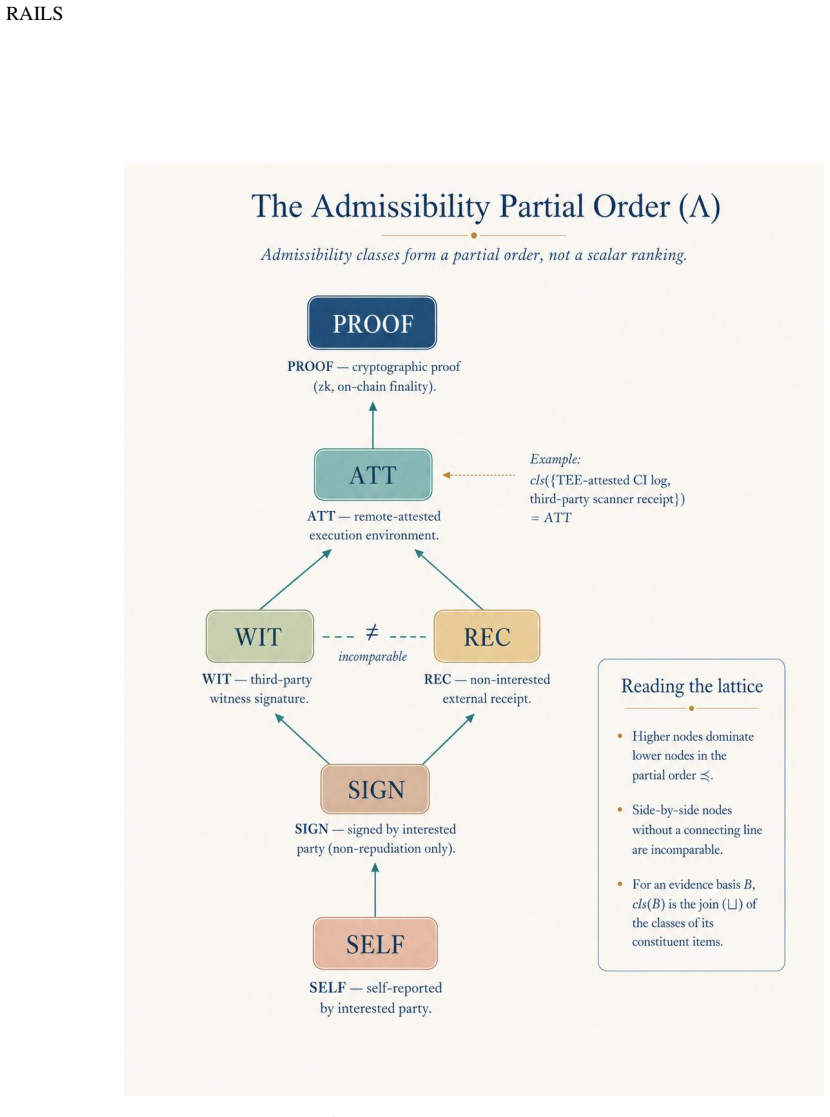
RAILS defines a clearing protocol whose seven primitives, bound by a formal model of admissibility-graded verification, together yield the soundness property that no financially material settlement is supported by evidence below the obligation's admissibility floor. The property is stated to be falsifiable against the spec, and the paper notes no prior agent-commerce verification mechanism states a comparable guarantee.
What carries the argument
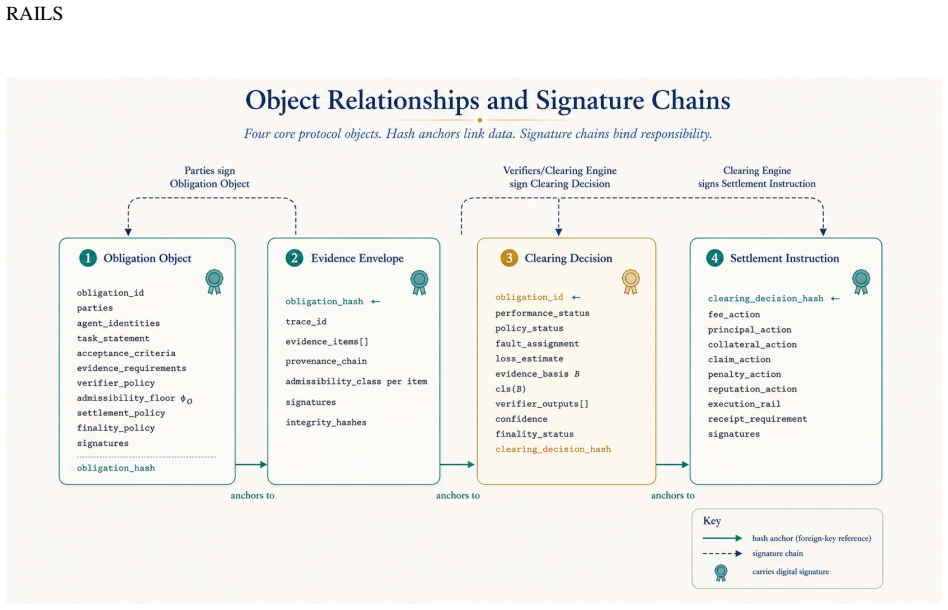
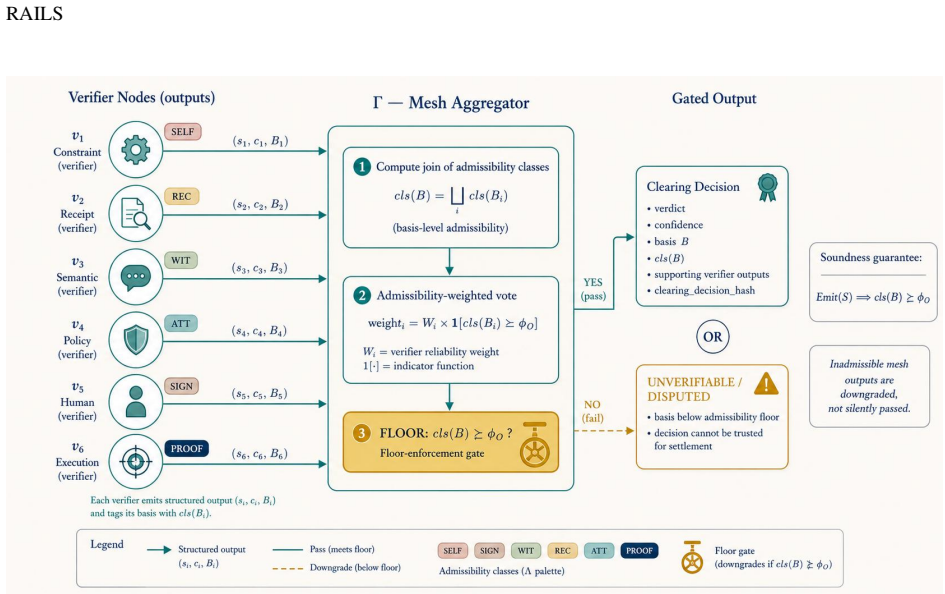
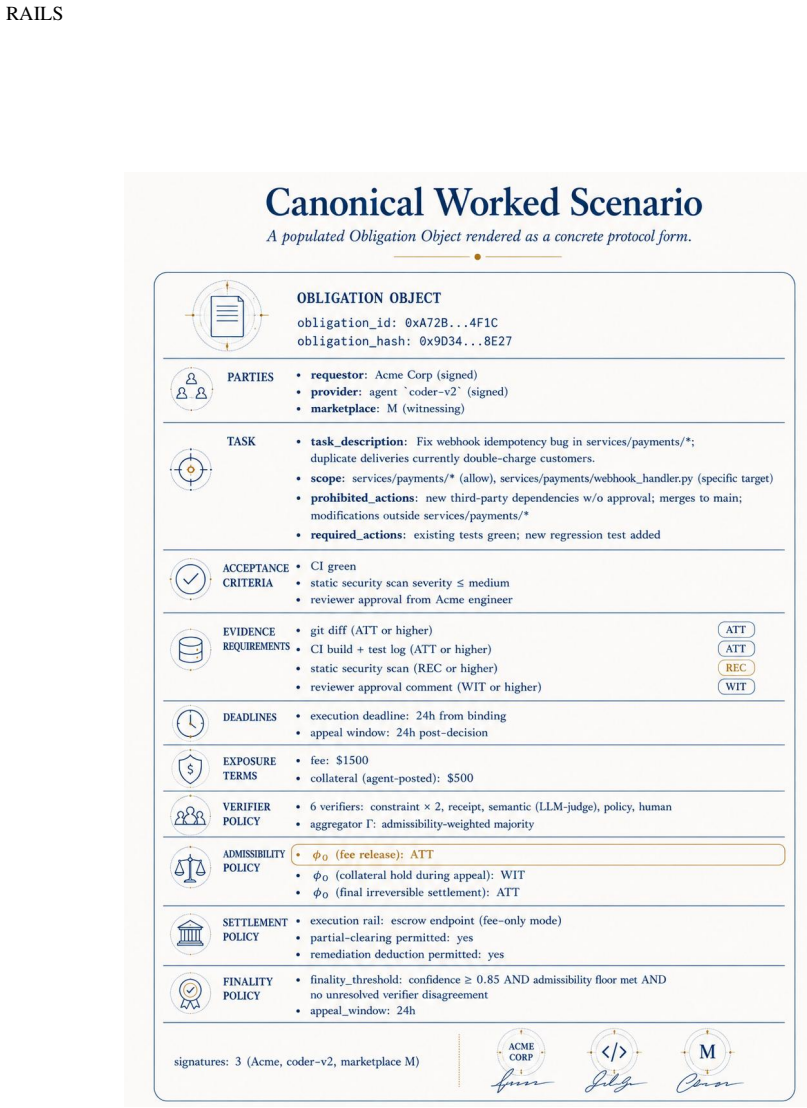
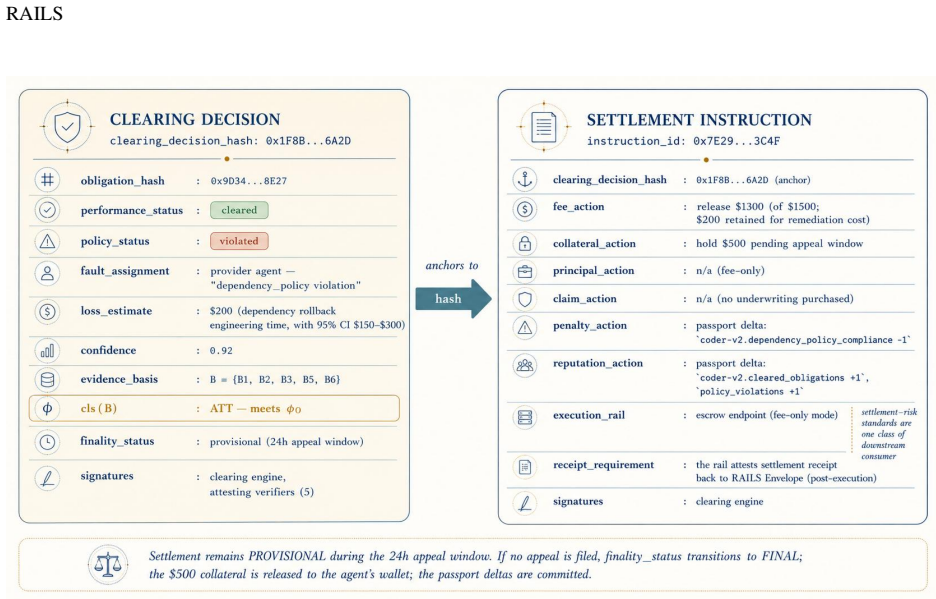
The seven primitives (Obligation Object, Evidence Envelope, Verification Mesh, Clearing Decision, Settlement Instruction, Clearing Passport, Finality Rules) bound by the formal model of admissibility-graded verification, which enforces the soundness property on clearing decisions.
If this is right
- Clearing decisions can be produced only when evidence meets the obligation's admissibility floor.
- Settlement instructions follow directly from verified clearing decisions rather than from authorization or payment alone.
- Finality rules apply after a clearing passport has been issued.
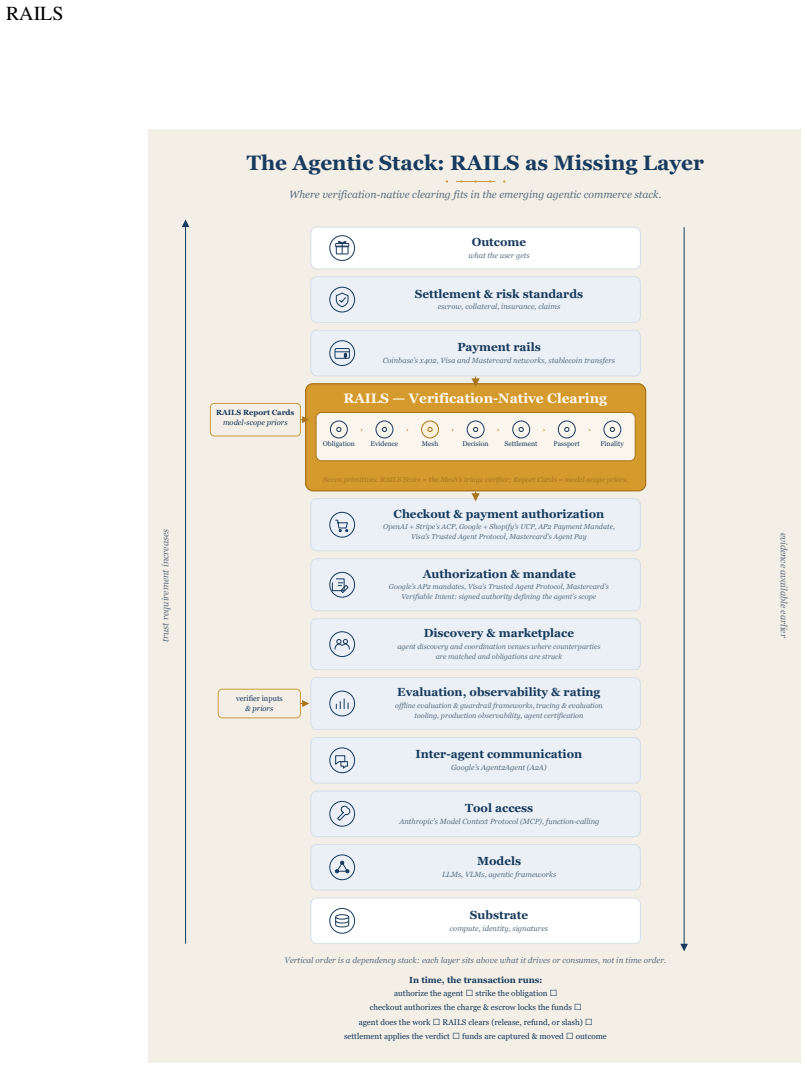
- The protocol operates independently of specific payment rails or inter-agent communication formats.
Where Pith is reading between the lines
- The soundness property could allow downstream systems to treat cleared obligations as having explicit, auditable responsibility assignments.
- Integration with existing mandate or network protocols would require mapping their outputs into the Evidence Envelope and Verification Mesh structures.
- The approach separates the determination of fulfillment from the execution of funds movement, which may reduce reliance on escrow-style risk buffers.
- Testable extensions include encoding specific obligation types such as code deployment or service delivery into Obligation Objects and checking whether the model still preserves the floor property.
Load-bearing premise
The formal model of admissibility-graded verification is correctly specified and sufficient to guarantee the soundness property holds for all relevant agent obligations and evidence types.
What would settle it
A concrete counterexample in which a financially material settlement is executed despite its supporting evidence falling below the obligation's stated admissibility floor, or a demonstration that the model fails to enforce the property across the full range of obligation and evidence types.
Figures





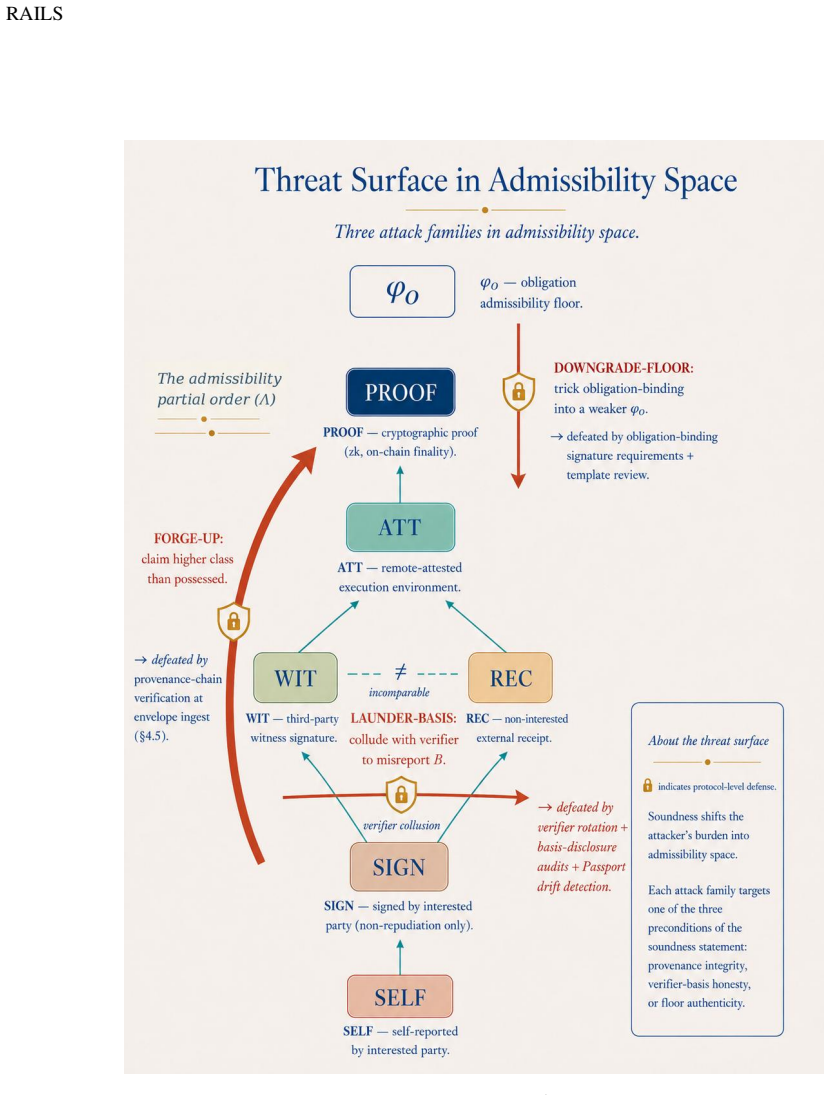


read the original abstract
Autonomous agents negotiate, purchase, deploy code, and move funds, but no neutral mechanism determines whether they met their delegated obligation, who is responsible when they did not, or which settlement action follows. This is the agentic clearing problem. Tool protocols (MCP), inter-agent communication (A2A), payment rails (x402), mandate and network agent protocols (AP2, Visa, Mastercard), and settlement-risk standards each assume that determination and none produce it. Clearing is the missing primitive. Payment is not clearing. Authorization is not clearing. LLM-as-judge evaluation is not clearing. Settlement-risk escrow is not clearing: it consumes clearing decisions. RAILS (Real-Time Agent Integrity & Ledger Settlement) is the integrity and clearing layer for agentic commerce, spanning a per-output reliability score, a published reliability record, and a clearing function that consumes them. The clearing protocol at its core closes that gap. Seven primitives (Obligation Object, Evidence Envelope, Verification Mesh, Clearing Decision, Settlement Instruction, Clearing Passport, Finality Rules), bound by a formal model of admissibility-graded verification, together yield a soundness property: no financially material settlement is supported by evidence below the obligation's admissibility floor. The property is falsifiable against the spec. We are not aware of a prior agent-commerce verification mechanism that states a property of this kind. The approaches nearest to it emit a pass, a delivery guarantee, a bare score, or an equilibrium. This paper specifies that clearing protocol.
Editorial analysis
A structured set of objections, weighed in public.
Referee Report
Summary. The paper proposes RAILS as the missing clearing primitive for agentic commerce. It defines seven primitives (Obligation Object, Evidence Envelope, Verification Mesh, Clearing Decision, Settlement Instruction, Clearing Passport, Finality Rules) that are bound together by a formal model of admissibility-graded verification; this combination is asserted to deliver a soundness property under which no financially material settlement can be supported by evidence falling below the obligation's admissibility floor. The property is stated to be falsifiable against the specification, and the paper claims to be the first mechanism to articulate an equivalent guarantee.
Significance. If the formal model and its derivation were supplied and verified, the work would address a genuine gap between existing payment rails, agent protocols, and settlement-risk mechanisms by supplying an explicit, falsifiable integrity guarantee for delegated obligations. The emphasis on a soundness property rather than a pass/fail score or equilibrium is a potentially useful framing, but its value cannot be assessed without the model itself.
major comments (1)
- [Abstract] Abstract (paragraph beginning 'RAILS (Real-Time Agent Integrity & Ledger Settlement)'): The central claim that the seven primitives 'bound by a formal model of admissibility-graded verification' yield the stated soundness property is load-bearing, yet the manuscript supplies neither the model's axioms, the admissibility grading function, the binding rules among primitives, nor any derivation or proof sketch showing how the property follows. Without these elements it is impossible to determine whether the soundness guarantee is correctly obtained or holds for the relevant obligation and evidence types.
Simulated Author's Rebuttal
We thank the referee for identifying the critical gap in the presentation of the formal model. We agree that the soundness claim is load-bearing and that the manuscript as submitted does not supply the required axioms, grading function, binding rules, or derivation. We will revise accordingly.
read point-by-point responses
-
Referee: [Abstract] Abstract (paragraph beginning 'RAILS (Real-Time Agent Integrity & Ledger Settlement)'): The central claim that the seven primitives 'bound by a formal model of admissibility-graded verification' yield the stated soundness property is load-bearing, yet the manuscript supplies neither the model's axioms, the admissibility grading function, the binding rules among primitives, nor any derivation or proof sketch showing how the property follows. Without these elements it is impossible to determine whether the soundness guarantee is correctly obtained or holds for the relevant obligation and evidence types.
Authors: We accept the criticism. The submitted manuscript states the existence of a formal model and the resulting soundness property but does not include its axioms, the admissibility grading function, the explicit binding rules among the seven primitives, or a derivation. In the revised version we will add a new section (provisionally Section 3) that supplies: (1) the formal signature and axioms of admissibility-graded verification, (2) the definition of the admissibility grading function, (3) the inductive binding rules that connect Obligation Object, Evidence Envelope, Verification Mesh, Clearing Decision, Settlement Instruction, Clearing Passport, and Finality Rules, and (4) a proof sketch establishing that no financially material settlement can be supported by evidence below the obligation's admissibility floor. The property will be stated in a falsifiable form against the specification. These additions will make the central claim verifiable. revision: yes
Circularity Check
No circularity detected; derivation chain not specified
full rationale
The provided text (abstract and description) asserts that seven primitives bound by a formal model of admissibility-graded verification yield a soundness property, but supplies no equations, axioms, grading functions, binding rules, derivation steps, or self-citations. Without any mathematical content or cited prior results that could be inspected for reduction to inputs by construction, no load-bearing circular steps exist to quote or exhibit. The claim is presented at a level too high to evaluate for self-definitional, fitted-prediction, or self-citation patterns.
Axiom & Free-Parameter Ledger
Reference graph
Works this paper leans on
-
[1]
Zheng, L., Chiang, W.-L., Sheng, Y ., Zhuang, S., Wu, Z., Zhuang, Y ., Lin, Z., Li, Z., Li, D., Xing, E. P., Zhang, H., Gonzalez, J. E., & Stoica, I. (2023).Judging LLM-as-a-Judge with MT-Bench and Chatbot Arena. NeurIPS 2023 Datasets and Benchmarks Track. arXiv:2306.05685.https://arxiv.org/abs/2306.05685
Pith/arXiv arXiv 2023
-
[2]
E., Yang, J., Wettig, A., Yao, S., Pei, K., Press, O., & Narasimhan, K
Jiménez, C. E., Yang, J., Wettig, A., Yao, S., Pei, K., Press, O., & Narasimhan, K. (2024).SWE-bench: Can Language Models Resolve Real-World GitHub Issues?International Conference on Learning Representations (ICLR). arXiv:2310.06770.https://arxiv.org/abs/2310.06770
Pith/arXiv arXiv 2024
-
[3]
Liu, X., Yu, H., Zhang, H., Xu, Y ., Lei, X., Lai, H., Gu, Y ., Ding, H., Men, K., Yang, K., Zhang, S., Deng, X., Zeng, A., Du, Z., Zhang, C., Shen, S., Zhang, T., Su, Y ., Sun, H., Huang, M., Dong, Y ., & Tang, J. (2024). AgentBench: Evaluating LLMs as Agents. International Conference on Learning Representations (ICLR). arXiv:2308.03688.https://arxiv.org...
Pith/arXiv arXiv 2024
-
[4]
Wang, W., Zhang, D., Feng, T., Wang, B., & Tang, J. (2024).BattleAgentBench: A Benchmark for Evaluating Cooperation and Competition Capabilities of Language Models in Multi-Agent Systems. arXiv:2408.15971. https://arxiv.org/abs/2408.15971
arXiv 2024
-
[5]
Duffie, D., & Zhu, H. (2011). Does a Central Clearing Counterparty Reduce Counterparty Risk?The Review of Asset Pricing Studies, 1(1), 74–95
2011
-
[6]
(2011).The Economics of Central Clearing: Theory and Practice
Pirrong, C. (2011).The Economics of Central Clearing: Theory and Practice. ISDA Discussion Papers Series. International Swaps and Derivatives Association. https://www.isda.org/a/THiDE/isdadiscussion-ccp-pirrong.pdf
2011
-
[7]
(2016).Intel SGX Explained
Costan, V ., & Devadas, S. (2016).Intel SGX Explained. Cryptology ePrint Archive, Paper 2016/086. https://eprint.iacr.org/2016/086.pdf. 40 RAILS
2016
-
[8]
(2026).The Surprising Universality of LLM Outputs: A Real-Time Verification Primitive
Bogdan, A., & de Valois-Franklin, A. (2026).The Surprising Universality of LLM Outputs: A Real-Time Verification Primitive. arXiv:2604.25634.https://arxiv.org/abs/2604.25634
Pith/arXiv arXiv 2026
-
[9]
(2026).Machine Psychometrics: A Mathematical Psychology of Artificial Intelligence
Bogdan, A., & de Valois-Franklin, A. (2026).Machine Psychometrics: A Mathematical Psychology of Artificial Intelligence. arXiv:2605.23952.https://arxiv.org/abs/2605.23952
Pith/arXiv arXiv 2026
-
[10]
(2026).Quantifying Trust: Financial Risk Management for Trustworthy AI Agents
Hua, W., Peng, T., Wang, C., Pei, J., Kaufman, J., Lim, B., & Fang, C. (2026).Quantifying Trust: Financial Risk Management for Trustworthy AI Agents. arXiv:2604.03976.https://arxiv.org/abs/2604.03976
Pith/arXiv arXiv 2026
-
[11]
(2026).TessPay: Verify-then-Pay Infrastructure for Trusted Agentic Commerce
Goenka, M., Pathak, T., & Asthana, S. (2026).TessPay: Verify-then-Pay Infrastructure for Trusted Agentic Commerce. arXiv:2602.00213.https://arxiv.org/abs/2602.00213
arXiv 2026
-
[12]
(2026).A402: Binding Cryptocurrency Payments to Service Execution for Agentic Commerce
Li, Y ., Wang, L., Wang, K., Yang, Z., Wang, K., Guan, Z., & Gao, J. (2026).A402: Binding Cryptocurrency Payments to Service Execution for Agentic Commerce. arXiv:2603.01179. https://arxiv.org/abs/2603.01179
arXiv 2026
-
[13]
(2025).Operator: A Protocol for Trustless Verification Under Uncertainty
Shi, D., & Joo, K. (2025).Operator: A Protocol for Trustless Verification Under Uncertainty. arXiv:2507.00631. https://arxiv.org/abs/2507.00631
arXiv 2025
-
[14]
H., Deppeler, A., Yu, J., & Lam, K.-Y
Zhang, Y ., Xiang, Y ., Lei, Y ., Wang, Q., Qiu, T., Sun, Y ., Zarkov, S., Yuen, T. H., Deppeler, A., Yu, J., & Lam, K.-Y . (2026).SoK: Blockchain Agent-to-Agent Payments. arXiv:2604.03733. https://arxiv.org/abs/2604.03733
Pith/arXiv arXiv 2026
-
[15]
Hu, B., & Rong, H. (2025).Inter-Agent Trust Models: A Comparative Study of Brief, Claim, Proof, Stake, Reputation and Constraint in Agentic Web Protocol Design. arXiv:2511.03434. https://arxiv.org/abs/2511.03434
arXiv 2025
-
[16]
(2025).ERC-8004: Trustless Agents
De Rossi, M., Crapis, D., Ellis, J., & Reppel, E. (2025).ERC-8004: Trustless Agents. Ethereum Improvement Proposal.https://eips.ethereum.org/EIPS/eip-8004
2025
-
[17]
https://www.anthropic.com/news/model-context-protocol
Anthropic (2024).Introducing the Model Context Protocol. https://www.anthropic.com/news/model-context-protocol. Specification: https://modelcontextprotocol.io
2024
-
[18]
Google Developers Blog
Google (2025).Announcing the Agent2Agent Protocol (A2A). Google Developers Blog. https://developers.googleblog.com/en/a2a-a-new-era-of-agent-interoperability/. Specification (Linux Foundation):https://a2a-protocol.org
2025
-
[19]
Specification: https://ap2-protocol.org
Google Cloud (2025).Announcing the Agent Payments Protocol (AP2).https://cloud.google.com/blog/ products/ai-machine-learning/announcing-agents-to-payments-ap2-protocol. Specification: https://ap2-protocol.org
2025
-
[20]
Whitepaper
Coinbase (2025).x402: An Open Standard for Internet-Native Payments. Whitepaper. https://www.x402.org/x402-whitepaper.pdf
2025
-
[21]
Google Developers Blog (developed with Shopify)
Google (2026).Under the Hood: Universal Commerce Protocol (UCP). Google Developers Blog (developed with Shopify). https://developers.googleblog.com/under-the-hood-universal-commerce-protocol-ucp/
2026
-
[22]
Specification: https://www.agenticcommerce.dev
Stripe & OpenAI (2025).Agentic Commerce Protocol (ACP). Specification: https://www.agenticcommerce.dev. Announcement: https://stripe.com/blog/developing-an-open-standard-for-agentic-commerce
2025
-
[23]
Visa Developer
Visa (2025).Trusted Agent Protocol. Visa Developer. https://developer.visa.com/capabilities/trusted-agent-protocol/overview. Companion program: Visa Intelligent Commerce
2025
-
[24]
https://www.mastercard.com/us/en/news-and-trends/stories/2026/verifiable-intent.html
Mastercard (2026).How Verifiable Intent Builds Trust in Agentic AI Commerce. https://www.mastercard.com/us/en/news-and-trends/stories/2026/verifiable-intent.html. Specification:https://verifiableintent.dev. Companion program: Mastercard Agent Pay
2026
-
[25]
Virtuals Protocol Whitepaper
Virtuals Protocol (2025).Agent Commerce Protocol (ACP). Virtuals Protocol Whitepaper. https://whitepaper.virtuals.io/about-virtuals/agent-commerce-protocol-acp
2025
-
[26]
Issue resolved, no breaking changes
Kvist, R., Dattani, R., et al. (2025).Underwriting Superintelligence. https://underwriting-superintelligence.com/. 41 RAILS Appendix Two kinds of material belong here. The first is a notation reference that collects in one place every symbol, function, and named constant introduced across the body. The second is a fully instantiated set of worked-scenario...
2025
discussion (0)
Sign in with ORCID, Apple, or X to comment. Anyone can read and Pith papers without signing in.