State-Feedback Control of Logistic-Based Gene Regulatory Networks: Closed-Form Lyapunov Certificates, Monostabilization, and Delay-Uniform Stability
Pith reviewed 2026-06-27 17:36 UTC · model grok-4.3
The pith
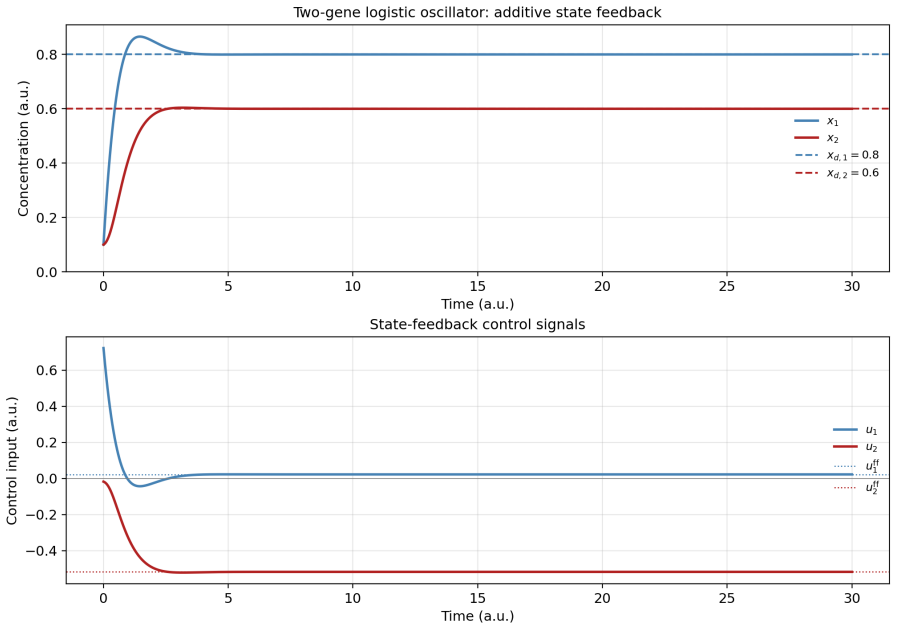
A feedforward-plus-proportional law turns any positive setpoint into a globally exponentially stable equilibrium of a logistic gene network under an explicit gain condition.
A machine-rendered reading of the paper's core claim, the machinery that carries it, and where it could break.
Core claim
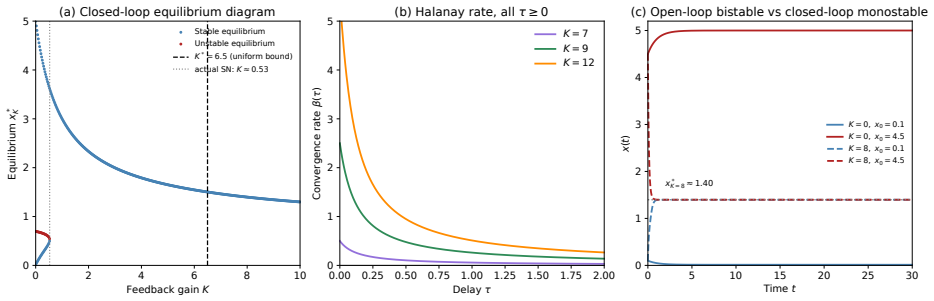
A feedforward-plus-proportional control law renders any positive setpoint a closed-loop equilibrium of a logistic-based GRN and guarantees global exponential stability when (γ1+K1)(γ2+K2) > κ1 κ2 λ²/64, with the proof relying on a common quadratic Lyapunov function constructed from the logistic sector bound; additionally, a parameter-uniform monostabilization budget K* = κλ/4 - γ is established for bistable switches, and Halanay-type delay-uniform GES holds under γ + K > κλ/4.
What carries the argument
The common quadratic Lyapunov function built from the logistic sector bound, whose derivative supplies the explicit global exponential stability inequality for the closed-loop error system.
If this is right
- Any positive concentration vector can be made an equilibrium by choice of the feedforward term alone.
- Global exponential stability with an explicit rate holds once the proportional gains satisfy the quadratic inequality.
- Bistable self-activation switches are monostabilized by any gain exceeding the uniform budget K* = κλ/4 - γ.
- Global exponential stability remains uniform in delay size whenever γ + K > κλ/4, with two-sided rate bounds.
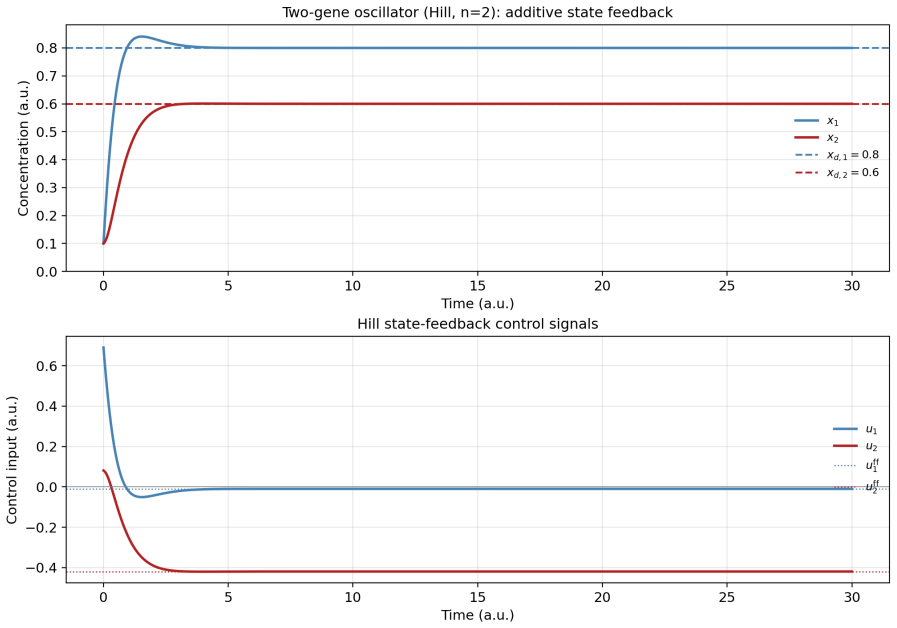
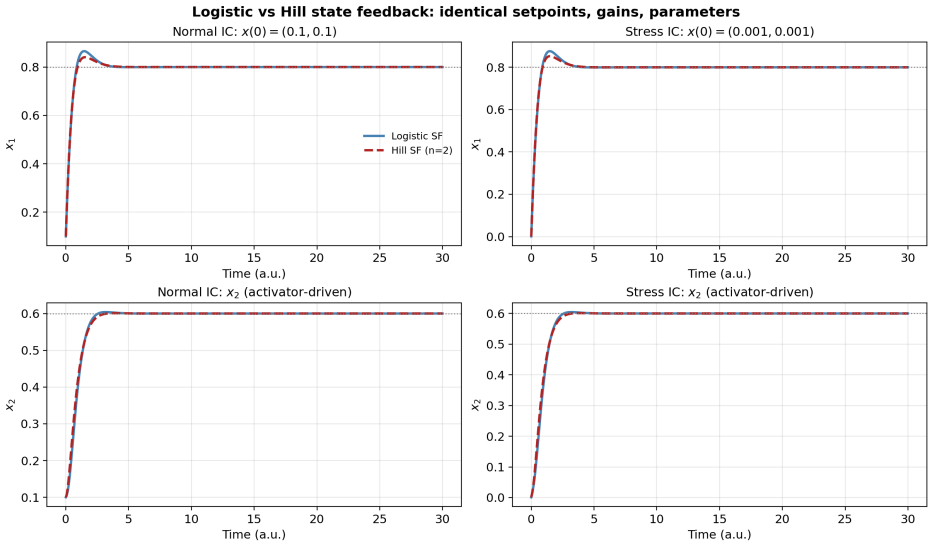
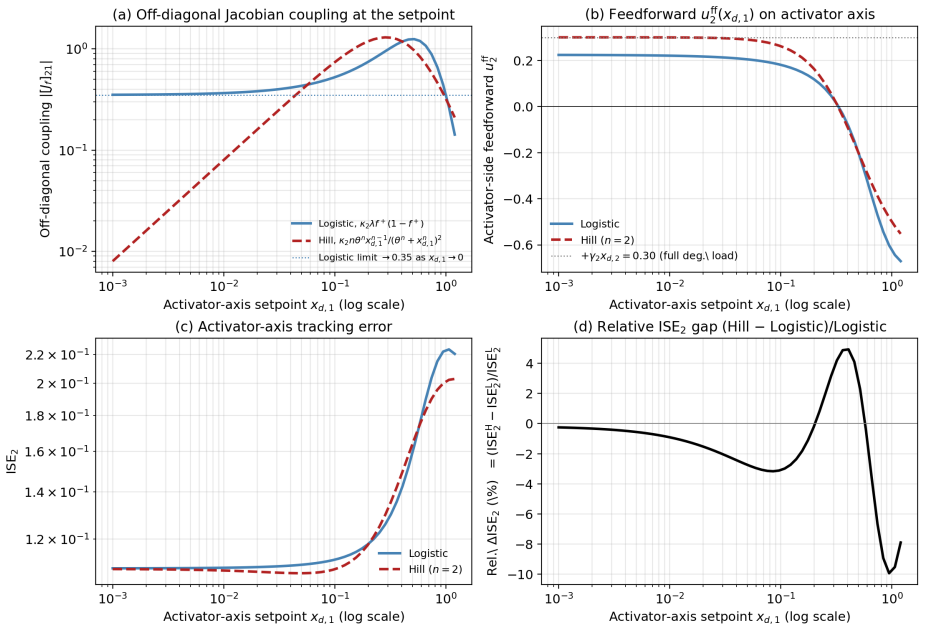
- The logistic coupling term remains strictly positive near the origin, unlike the vanishing Hill coupling.
Where Pith is reading between the lines
- The same Lyapunov construction may extend directly to networks with more than two nodes if a suitable diagonal or block-diagonal P matrix can be found.
- The explicit settling-time bound within 1 percent of simulation suggests the certificates are tight enough for quantitative synthetic-biology design.
- Because the logistic model preserves network coupling at low concentrations, the controller may remain effective in regimes where Hill-based designs lose controllability.
Load-bearing premise
The logistic production function admits a sector bound that permits a quadratic Lyapunov function whose time derivative is negative definite under the stated gain condition.
What would settle it
A simulation or experiment on a two-node logistic GRN in which the product (γ1+K1)(γ2+K2) is set below κ1 κ2 λ²/64 and the closed-loop trajectories are observed to diverge from the setpoint or converge only locally.
Figures
read the original abstract
Gene regulatory networks (GRNs) are high-value targets for therapeutic and synthetic-biology control. Classical Hill models carry a structural defect: the production term vanishes when the activator is absent, causing loss of controllability under multiplicative actuation and a collapse of network coupling under additive actuation -- precisely where biological operation is most common. Building on logistic functions as robust Hill alternatives, we develop an additive state-feedback framework for logistic-based GRNs, with two companion scalar results. A feedforward-plus-proportional law turns any positive setpoint into a closed-loop equilibrium, regardless of the uncontrolled dynamics. We prove local exponential stability under a Gershgorin gain bound and, via a common quadratic Lyapunov function built on the logistic sector bound, global exponential stability under the explicit condition $(\gamma_1+K_1)(\gamma_2+K_2)>\kappa_1\kappa_2\lambda^2/64$, with a closed-form rate. A diagonal Lyapunov certificate $P=\mathrm{diag}(B,A)$ yields an explicit settling-time bound (within $1\%$ of simulation) and an ISS ultimate-bound estimate. We further establish a parameter-uniform monostabilization budget $K^{*}=\kappa\lambda/4-\gamma$ for bistable self-activation switches, and a Halanay-type delay-uniform global exponential stability theorem under $\gamma+K>\kappa\lambda/4$, with two-sided closed-form rate bounds. Numerical comparison with the Hill counterpart confirms robust tracking in the nominal range while exposing the structural divergence near the boundary of the positive orthant: the Hill coupling $|[J_f]_{21}|=\Theta(x_{d,1}^{n-1})\to0$ as $x_{d,1}\to0$, whereas the logistic coupling stays strictly positive.
Editorial analysis
A structured set of objections, weighed in public.
Referee Report
Summary. The paper develops an additive state-feedback control framework for logistic-based gene regulatory networks as an alternative to Hill models. It shows that a feedforward-plus-proportional law renders any positive setpoint a closed-loop equilibrium, proves local exponential stability via Gershgorin and global exponential stability via a common quadratic Lyapunov function on the logistic sector bound under the explicit gain condition (γ1+K1)(γ2+K2) > κ1 κ2 λ^{2}/64 with closed-form rate, provides a parameter-uniform monostabilization budget K* = κλ/4 - γ for bistable switches, and establishes Halanay-type delay-uniform global exponential stability under γ+K > κλ/4, with numerical comparisons highlighting structural advantages over Hill models near the positive orthant boundary.
Significance. If the derivations hold, the explicit closed-form Lyapunov certificates, parameter-uniform monostabilization budget, and delay-uniform stability bounds constitute a practical contribution to control of GRNs, directly addressing controllability loss in Hill models under additive actuation. The reproducible numerical comparisons and use of standard tools (Gershgorin, sector-bound quadratic Lyapunov, Halanay) add value for synthetic-biology applications.
minor comments (2)
- [Abstract] Abstract: the claim of an 'explicit settling-time bound (within 1% of simulation)' should be tied to a specific theorem or corollary number and the corresponding simulation figure or table in the main text for reproducibility.
- [Global stability paragraph] The logistic sector bound |σ(λe) - σ(0)| ≤ (λ/4)|e| is invoked for the common quadratic Lyapunov function; the main text should explicitly state the logistic function definition and confirm the bound holds with equality only at the origin for the chosen scaling.
Simulated Author's Rebuttal
We thank the referee for the thorough and positive assessment of our manuscript on additive state-feedback control for logistic-based GRNs. The recommendation for minor revision is noted. No specific major comments or points requiring clarification were raised in the report.
Circularity Check
No significant circularity; derivations follow from standard Lyapunov analysis
full rationale
The central results (global exponential stability under the gain condition, monostabilization budget K*=κλ/4−γ, Halanay delay theorem) are obtained by substituting the logistic sector bound |σ(λe)−σ(0)|≤(λ/4)|e| into the derivative of the diagonal quadratic Lyapunov function V=(1/2)B e1²+(1/2)A e2², then applying the elementary estimate |e1 e2|≤(e1²+e2²)/2 to obtain the explicit threshold (γ1+K1)(γ2+K2)>κ1κ2λ²/64. All steps are direct algebraic consequences of the closed-loop vector field and standard comparison lemmas; no parameter is fitted to data and then re-labeled as a prediction, no self-citation supplies a uniqueness theorem, and no ansatz is smuggled in. The feedforward-plus-proportional law is constructed explicitly to enforce the setpoint equilibrium and does not presuppose the stability result. The derivation is therefore self-contained against external benchmarks.
Axiom & Free-Parameter Ledger
axioms (2)
- standard math Lyapunov stability theorems and comparison lemmas apply to the closed-loop system
- domain assumption Logistic functions satisfy a sector bound permitting a common quadratic Lyapunov function
Reference graph
Works this paper leans on
-
[1]
M. Acar, A. Becskei, and A. van Oudenaarden, Enhancement of cellular memory by reduc- ing stochastic transitions,Nature435(7039) (2005) 228–232. doi:10.1038/nature03524
-
[2]
G. K. Ackers, A. D. Johnson, and M. A. Shea, Quantitative model for gene regulation by λ phage repressor,Proceedings of the National Academy of Sciences USA79(4) (1982) 1129–1133.doi:10.1073/pnas.79.4.1129
-
[3]
Alon,An Introduction to Systems Biology: Design Principles of Biological Circuits, Chapman & Hall/CRC, Boca Raton, 2006
U. Alon,An Introduction to Systems Biology: Design Principles of Biological Circuits, Chapman & Hall/CRC, Boca Raton, 2006. ISBN 978-1-58488-642-6
2006
-
[4]
I. Belgacem and J.-L. Gouz´ e, Global stability of full open reversible Michaelis–Menten reactions, in:8th IFAC Symposium on Advanced Control of Chemical Processes (ADCHEM), Singapore, 10–13 Jul. 2012, pp. 591–596. doi:10.3182/20120710-4-SG-2026.00039
-
[5]
I. Belgacem and J.-L. Gouz´ e, Global stability of enzymatic chain of full re- versible Michaelis–Menten reactions,Acta Biotheoretica61(3) (2013) 425–436. doi:10.1007/s10441-013-9195-3
-
[6]
I. Belgacem and J.-L. Gouz´ e, Analysis and reduction of transcription-translation coupled models for gene expression, in:12th IFAC Symposium on Com- puter Applications in Biotechnology (CAB), Mumbai, India, 2013, pp. 42–47. doi:10.3182/20131216-3-IN-2044.00012
-
[7]
I. Belgacem and J.-L. Gouz´ e, Stability analysis and reduction of gene transcription models, in:52nd IEEE Annual Conference on Decision and Control (CDC), Florence, Italy, 2013, pp. 2691–2696.doi:10.1109/CDC.2013.6760289
-
[8]
I. Belgacem, E. Grac, D. Ropers, and J.-L. Gouz´ e, Stability analysis of a reduced transcription-translation model of RNA polymerase, in:53rd IEEE Conference on Decision and Control (CDC), Los Angeles, CA, USA, Dec. 2014, pp. 3924–3929. doi:10.1109/CDC.2014.7039999. 29
-
[9]
I. Belgacem and J.-L. Gouz´ e, Mathematical study of the global dynamics of a concave gene expression model, in:22nd Mediterranean Conference on Control and Automation (MED), Palermo, Italy, 2014, pp. 1341–1346.doi:10.1109/MED.2014.6961562
-
[10]
Belgacem, E
I. Belgacem, E. Grac, D. Ropers, and J.-L. Gouz´ e, A coupled transcription-translation mathematical model of RNA polymerase, in:21st International Symposium on Mathe- matical Theory of Networks and Systems (MTNS), Groningen, The Netherlands, Jul. 2014, pp. 1383–1386. ISBN 978-90-367-6321-9. http://congres.cran.univ-lorraine. fr/2014/MTNS14/media/files/0201.pdf
2014
-
[11]
I. Belgacem, S. Casagranda, E. Grac, D. Ropers, and J.-L. Gouz´ e, Reduction and stability analysis of a transcription-translation model of RNA polymerase,Bulletin of Mathematical Biology80 (2018) 294–318.doi:10.1007/s11538-017-0372-4
-
[12]
I. Belgacem, J.-L. Gouz´ e, and R. Edwards, Control of negative feedback loops in genetic networks, in:Proceedings of the 59th IEEE Conference on Decision and Control (CDC), Jeju Island, Republic of Korea (virtual), IEEE, Dec. 2020, pp. 5098–5105. doi:10.1109/CDC42340.2020.9304088. HAL preprint hal-03144847
-
[13]
I. Belgacem, Exploring logistic functions as robust alternatives to Hill functions in genetic network modeling,arXiv preprintarXiv:2512.14325, 2025
Pith/arXiv arXiv 2025
-
[14]
I. Belgacem, R. Edwards, and ´E. Farcot, Computer-aided analysis of high-dimensional Glass networks: periodicity, chaos, and bifurcations in a ring circuit,Chaos: An Interdisciplinary Journal of Nonlinear Science(2025).doi:10.1063/5.0243955
-
[15]
I. Belgacem, Logistic gene regulatory networks: prevention of expression shutdown, and numerical stability beyond Hill functions,arXiv preprintarXiv:2605.01056, 2026
Pith/arXiv arXiv 2026
-
[16]
I. Belgacem, Beyond linear additive and Hill functions: a general logistic reformulation of delay-coupled gene regulatory networks with equilibrium analysis, Hopf bifurcation, and Lipschitz stability,arXiv preprintarXiv:2604.26810, 2026
Pith/arXiv arXiv 2026
-
[17]
I. Belgacem, Sustained limit cycles in the logistic two-gene genetic oscillator: a delay- driven Hopf bifurcation,arXiv preprintarXiv:2605.23722, 2026
Pith/arXiv arXiv 2026
-
[18]
Belgacem, Extending the logistic framework beyond gene regulation: tractable analysis of delayed and stochastic biological systems, companion manuscript, 2026
I. Belgacem, Extending the logistic framework beyond gene regulation: tractable analysis of delayed and stochastic biological systems, companion manuscript, 2026
2026
-
[19]
L. Chambon, I. Belgacem, and J.-L. Gouz´ e, Qualitative control of undesired oscillations in a genetic negative feedback loop with uncertain measurements,Automatica112 (2020) 108642.doi:10.1016/j.automatica.2019.108642
-
[20]
H. de Jong, Modeling and simulation of genetic regulatory systems: a literature review,Journal of Computational Biology9(1) (2002) 67–103. doi:10.1089/10665270252833208. 30
-
[21]
´E. Farcot, S. Best, R. Edwards, I. Belgacem, X. Xu, and P. Gill, Chaos in a ring circuit,Chaos: An Interdisciplinary Journal of Nonlinear Science29 (2019) 043103. doi:10.1063/1.5079941
-
[22]
Halanay,Differential Equations: Stability, Oscillations, Time Lags, Academic Press, New York, 1966
A. Halanay,Differential Equations: Stability, Oscillations, Time Lags, Academic Press, New York, 1966
1966
-
[23]
A. V. Hill, The possible effects of the aggregation of the molecules of haemoglobin on its dissociation curves,Journal of Physiology40 (1910) iv–vii
1910
-
[24]
L. Huang, Z. Yuan, P. Liu, and T. Zhou, Effects of promoter leakage on dynamics of gene expression,BMC Systems Biology9(1) (2015) 16.doi:10.1186/s12918-015-0157-z
-
[25]
F. Jacob and J. Monod, Genetic regulatory mechanisms in the synthesis of proteins,Jour- nal of Molecular Biology3(3) (1961) 318–356.doi:10.1016/S0022-2836(61)80072-7
-
[26]
S. Kumar, S. Anastassov, S. K. Aoki, J. Falkenstein, C.-H. Chang, T. Frei, P. Buchmann, P. Argast, and M. Khammash, Diya – A universal light illumination platform for multiwell plate cultures,iScience26(10) (2023) 107862.doi:10.1016/j.isci.2023.107862
-
[27]
A. M. Walczak, J. N. Onuchic, and P. G. Wolynes, Absolute rate theories of epigenetic stability,Proceedings of the National Academy of Sciences USA102(52) (2005) 18926– 18931.doi:10.1073/pnas.0509547102
-
[28]
J. N. Weiss, The Hill equation revisited: uses and misuses,FASEB Journal11(11) (1997) 835–841.doi:10.1096/fasebj.11.11.9285481. 31
discussion (0)
Sign in with ORCID, Apple, or X to comment. Anyone can read and Pith papers without signing in.