Characterizing Stellar Streams with Error-Aware Machine Learning
Pith reviewed 2026-06-27 16:02 UTC · model grok-4.3
The pith
Incorporating observational uncertainties into neural network training lets SCREAM identify more stellar stream members than prior ML methods.
A machine-rendered reading of the paper's core claim, the machinery that carries it, and where it could break.
Core claim
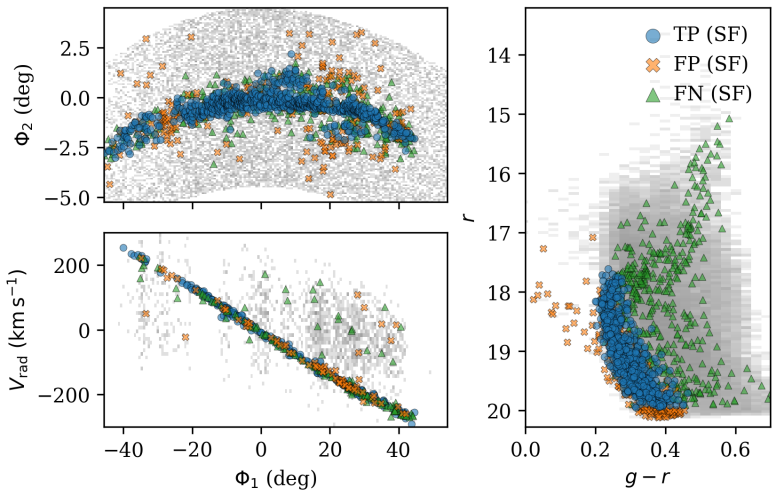
SCREAM identifies stream members as localized feature-space over-densities while directly incorporating observational uncertainties into the neural network training objective. Validated against independent labels on the GD-1 stream, the method achieves an F1 score of 0.745, substantially outperforming existing ML methods in precision and recall, and recovers the physically expected diffuse cocoon plus faint main-sequence members that classical physics-based algorithms miss.
What carries the argument
SCREAM, the weakly-supervised neural network framework that builds on CATHODE to locate over-densities while adding observational uncertainties to the training loss.
If this is right
- Uncertainty-aware training improves both precision and recall compared with standard ML methods for stream selection.
- The approach recovers diffuse structures and faint members without relying on rigid gravitational potentials or strict isochrone filters.
- Weakly-supervised over-density detection can be applied to other streams using Gaia and DESI-like catalogs.
- Direct inclusion of measurement errors in the objective reduces the impact of noisy data on membership classification.
Where Pith is reading between the lines
- If the uncertainty term drives the gains, the same loss modification could improve other astronomical tasks that classify objects from catalogs with varying error bars.
- The framework might extend to identifying other low-surface-brightness galactic substructures where classical methods struggle with selection biases.
- Larger future surveys with higher typical uncertainties could see even larger relative gains from this style of training.
Load-bearing premise
That the reported performance gain and recovery of additional members are driven by the explicit inclusion of observational uncertainties rather than by other modeling choices or by biases in the independent validation labels.
What would settle it
Retraining the identical network architecture on the same GD-1 data but with the uncertainty term removed from the objective, then checking whether the F1 score against the independent labels drops substantially.
Figures

read the original abstract
Stellar streams are thin, elongated collections of stars formed by gravitational disruption of orbiting star clusters or dwarf galaxies and are highly sensitive probes of the Milky Way's dark matter distribution and formation history. We present $\texttt{SCREAM}$ ($\textbf{S}$tream $\textbf{C}$ha$\textbf{R}$acterization with $\textbf{E}$rror $\textbf{A}$ware $\textbf{M}$achine Learning), a weakly-supervised framework to identify member stars of stellar streams. Building on the $\texttt{CATHODE}$ method originally developed for particle physics, $\texttt{SCREAM}$ identifies streams as localized feature-space over-densities, avoiding rigid physical priors like assumed gravitational potentials or strict isochrone filtering. Crucially, $\texttt{SCREAM}$ is the first machine learning (ML) framework in this domain to directly incorporate observational uncertainties into the neural network training objective. Using astrometric and photometric data from Gaia Data Release 3 and the Dark Energy Spectroscopic Instrument (DESI) Legacy imaging survey, we demonstrate our algorithm's performance on the prominent GD-1 stream. Validated against independent labels, $\texttt{SCREAM}$ achieves an F1 score of 0.745, substantially outperforming existing ML methods in both precision and recall. Furthermore, $\texttt{SCREAM}$ recovers the physically expected diffuse "cocoon" of GD-1 and faint main-sequence members that classical physics-based algorithms (e.g., $\texttt{STREAMFINDER}$) miss. Our results highlight the transformative potential of uncertainty-aware, weakly-supervised ML to uncover complex galactic structures.
Editorial analysis
A structured set of objections, weighed in public.
Referee Report
Summary. The manuscript introduces SCREAM, a weakly-supervised machine learning framework building on CATHODE for identifying stellar stream members as localized over-densities in feature space without rigid physical priors. It claims to be the first such method to directly incorporate observational uncertainties into the neural network training objective, reports an F1 score of 0.745 on GD-1 validated against independent labels, substantially outperforms existing ML methods, and recovers the expected diffuse cocoon plus faint main-sequence members missed by classical algorithms such as STREAMFINDER.
Significance. If the performance gains and additional member recovery are demonstrably attributable to the explicit uncertainty term rather than other modeling choices, the work would represent a useful advance in applying uncertainty-aware ML to galactic archaeology, enabling more robust identification of stream structures as probes of dark matter and Milky Way history. The emphasis on validation against independent labels is a positive element.
major comments (3)
- [Abstract] Abstract: the central claim that SCREAM is the first framework to directly incorporate observational uncertainties into the NN training objective, and that this drives the reported F1=0.745 and recovery of cocoon/faint members, cannot be evaluated because the abstract supplies no equation, loss-function definition, or description of how uncertainties enter the objective (e.g., as an additional term, modified likelihood, or input feature).
- [Abstract] Abstract: no ablation or controlled comparison is described that removes or replaces the uncertainty component while holding other elements (architecture, features, weak-supervision details) fixed; without this, the attribution of performance gains specifically to uncertainty incorporation remains untested and is load-bearing for the novelty claim.
- [Abstract] Abstract: the validation protocol against independent labels is not specified (how labels were constructed, selection criteria, potential biases, or cross-validation scheme), preventing assessment of whether the F1 score and member-recovery results are robust or could arise from label artifacts.
minor comments (1)
- The expansion of the SCREAM acronym uses non-standard bolding; consider conventional formatting for readability.
Simulated Author's Rebuttal
We thank the referee for their careful review and constructive feedback on the abstract. We address each major comment point-by-point below. We agree that additional detail in the abstract would improve clarity and will revise the manuscript accordingly.
read point-by-point responses
-
Referee: [Abstract] Abstract: the central claim that SCREAM is the first framework to directly incorporate observational uncertainties into the NN training objective, and that this drives the reported F1=0.745 and recovery of cocoon/faint members, cannot be evaluated because the abstract supplies no equation, loss-function definition, or description of how uncertainties enter the objective (e.g., as an additional term, modified likelihood, or input feature).
Authors: We agree that the abstract is too concise to convey the precise mechanism. Section 3.2 of the manuscript defines the modified training objective, in which observational uncertainties enter as an explicit additive term in the loss that penalizes predictions inconsistent with error bars. We will revise the abstract to include a one-sentence description of this term so that the novelty claim can be evaluated from the abstract alone. revision: yes
-
Referee: [Abstract] Abstract: no ablation or controlled comparison is described that removes or replaces the uncertainty component while holding other elements (architecture, features, weak-supervision details) fixed; without this, the attribution of performance gains specifically to uncertainty incorporation remains untested and is load-bearing for the novelty claim.
Authors: The referee is correct that no such controlled ablation is described. While the manuscript reports overall gains relative to prior ML methods, it does not isolate the uncertainty term by retraining with the same architecture and supervision but without the uncertainty component. We will add this ablation study to the revised manuscript to strengthen the attribution. revision: yes
-
Referee: [Abstract] Abstract: the validation protocol against independent labels is not specified (how labels were constructed, selection criteria, potential biases, or cross-validation scheme), preventing assessment of whether the F1 score and member-recovery results are robust or could arise from label artifacts.
Authors: The validation details (construction of independent spectroscopic labels, selection cuts, and cross-validation scheme) appear in Section 4.3. We acknowledge that the abstract does not summarize these steps. We will add a brief clause to the abstract describing the independent-label validation protocol. revision: yes
Circularity Check
No significant circularity in derivation or validation chain
full rationale
The paper introduces SCREAM as an extension of the external CATHODE method, with performance (F1=0.745 on GD-1) reported against independent validation labels rather than any self-fitted quantity. No equations, procedures, or self-citations are described that reduce the claimed gains or recovered members to quantities defined by the model's own parameters or prior author work. The central result is therefore benchmarked externally and does not reduce to its inputs by construction.
Axiom & Free-Parameter Ledger
axioms (1)
- domain assumption Stellar streams appear as localized over-densities in feature space without requiring assumed gravitational potentials or strict isochrone cuts
Reference graph
Works this paper leans on
-
[1]
doi: 10.1016/j.newar.2024.101713. John Franklin Crenshaw, J. Bryce Kalmbach, Alexander Gagliano, Ziang Yan, Andrew J. Connolly, Alex I. Malz, Samuel J. Schmidt, and The LSST Dark Energy Science Collaboration. Probabilistic Forward Modeling of Galaxy Catalogs with Normalizing Flows. AJ, 168(2):80, August
-
[2]
doi: 10.3847/1538-3881/ad54bf. Arjun Dey, David J. Schlegel, Dustin Lang, Robert Blum, Kaylan Burleigh, Xiaohui Fan, Joseph R. Findlay, Doug Finkbeiner, David Herrera, Stéphanie Juneau, Martin Landriau, Michael Levi, Ian McGreer, Aaron Meisner, Adam D. Myers, John Moustakas, Peter Nugent, Anna Patej, Edward F. Schlafly, Alistair R. Walker, Francisco Valde...
-
[3]
NICE: Non-linear Independent Components Estimation
doi: 10.3847/1538-3881/ab089d. Laurent Dinh, David Krueger, and Yoshua Bengio. NICE: Non-linear Independent Components Estimation.arXiv e-prints, art. arXiv:1410.8516, October
work page internal anchor Pith review Pith/arXiv arXiv doi:10.3847/1538-3881/ab089d
-
[4]
NICE: Non-linear Independent Components Estimation
doi: 10.48550/arXiv.1410.8516. Conor Durkan, Artur Bekasov, Iain Murray, and George Papamakarios. Neural Spline Flows.arXiv e-prints, art. arXiv:1906.04032, June
work page internal anchor Pith review Pith/arXiv arXiv doi:10.48550/arxiv.1410.8516 1906
-
[5]
doi: 10.48550/arXiv.1906.04032. Gaia Collaboration, A. Vallenari, A. G. A. Brown, T. Prusti, J. H. J. de Bruijne, F. Arenou, C. Babu- siaux, M. Biermann, O. L. Creevey, C. Ducourant, D. W. Evans, L. Eyer, R. Guerra, A. Hutton, C. Jordi, S. A. Klioner, U. L. Lammers, L. Lindegren, X. Luri, F. Mignard, C. Panem, D. Pourbaix, S. Randich, P. Sartoretti, C. So...
-
[6]
doi: 10.1051/0004-6361/202243940. C. J. Grillmair and O. Dionatos. Detection of a 63° Cold Stellar Stream in the Sloan Digital Sky Survey. ApJ, 643(1):L17–L20, May
-
[7]
doi: 10.1086/505111. Anna Hallin, Joshua Isaacson, Gregor Kasieczka, Claudius Krause, Benjamin Nachman, Tobias Quadfasel, Matthias Schlaffer, David Shih, and Manuel Sommerhalder. Classifying anomalies through outer density estimation. Phys. Rev. D, 106(5):055006, September
-
[8]
Anna Hallin, David Shih, Claudius Krause, and Matthew R
doi: 10.1103/ PhysRevD.106.055006. Anna Hallin, David Shih, Claudius Krause, and Matthew R. Buckley. Via Machinae 3.0: A search for stellar streams in Gaia with the CATHODE algorithm.arXiv e-prints, art. arXiv:2509.08064, September
-
[9]
Dan Hendrycks and Kevin Gimpel
doi: 10.48550/arXiv.2509.08064. Dan Hendrycks and Kevin Gimpel. Gaussian error linear units (gelus).arXiv preprint arXiv:1606.08415,
-
[10]
7 Emma Jarvis, Ting S. Li, Sergey E. Koposov, Raymond G. Carlberg, Monica Valluri, Nasser Mohammed, J. Aguilar, S. Ahlen, Carlos Allende Prieto, Leandro Beraldo e Silva, D. Bianchi, D. Brooks, Amanda Byström, T. Claybaugh, A. P. Cooper, A. Cuceu, A. de la Macorra, Arjun Dey, Biprateep Dey, P. Doel, J. E. Forero-Romero, E. Gaztañaga, Oleg Y . Gnedin, Satya...
-
[11]
Characterizing the GD-1 Stream with DESI DR2 Data: Thin Stream and Hot Cocoon
doi: 10.48550/arXiv.2604.20958. Kathryn V . Johnston. A Prescription for Building the Milky Way’s Halo from Disrupted Satellites. ApJ, 495(1):297–308, March
work page internal anchor Pith review Pith/arXiv arXiv doi:10.48550/arxiv.2604.20958
-
[12]
doi: 10.1086/305273. Diederik P. Kingma and Jimmy Ba. Adam: A method for stochastic optimization. InInternational Conference on Learning Representations (ICLR),
-
[13]
doi: 10.1093/mnras/275.2.429. Khyati Malhan and Rodrigo A. Ibata. STREAMFINDER - I. A new algorithm for detecting stellar streams. MNRAS, 477(3):4063–4076, July
-
[14]
doi: 10.1093/mnras/sty912. Cecilia Mateu. galstreams: A library of Milky Way stellar stream footprints and tracks. MNRAS, 520(4):5225–5258, April
-
[15]
doi: 10.1093/mnras/stad321. Eric M. Metodiev, Benjamin Nachman, and Jesse Thaler. Classification without labels: learning from mixed samples in high energy physics.Journal of High Energy Physics, 2017(10):174, October
-
[16]
Benjamin Nachman and David Shih
doi: 10.1007/JHEP10(2017)174. Benjamin Nachman and David Shih. Anomaly detection with density estimation. Phys. Rev. D, 101 (7):075042, April
-
[17]
Anomaly detection with density estimation , volume=
doi: 10.1103/PhysRevD.101.075042. Mariel Pettee, Sowmya Thanvantri, Benjamin Nachman, David Shih, Matthew R. Buckley, and Jack H. Collins. Weakly supervised anomaly detection in the Milky Way. MNRAS, 527(3): 8459–8474, January
-
[18]
doi: 10.1093/mnras/stad3663. Frank Rosenblatt. The perceptron: a probabilistic model for information storage and organization in the brain.Psychological review, 65(6):386,
-
[19]
Maps of Dust IR Emission for Use in Estimation of Reddening and CMBR Foregrounds
doi: 10.1086/305772. Debajyoti Sengupta, Stephen Mulligan, David Shih, John Andrew Raine, and Tobias Golling. SKY- CURTAINS: model-agnostic search for stellar streams with Gaia data. MNRAS, 536(2):1104–1114, January
work page internal anchor Pith review doi:10.1086/305772
-
[20]
doi: 10.1093/mnras/stae2570. David Shih, Matthew R. Buckley, Lina Necib, and John Tamanas. VIA MACHINAE: Searching for stellar streams using unsupervised machine learning. MNRAS, 509(4):5992–6007, February
-
[21]
doi: 10.1093/mnras/stab3372. David Shih, Matthew R. Buckley, and Lina Necib. VIA MACHINAE 2.0: Full-sky, model-agnostic search for stellar streams in Gaia DR2. MNRAS, 529(4):4745–4767, April
-
[22]
doi: 10.1093/ mnras/stae446. Zechang Sun, Joshua S. Speagle, Song Huang, Yuan-Sen Ting, and Zheng Cai. Zephyr : Stitching Heterogeneous Training Data with Normalizing Flows for Photometric Redshift Inference.arXiv e-prints, art. arXiv:2310.20125, October
-
[23]
doi: 10.48550/arXiv.2310.20125. Bingjie Wang, Joel Leja, V . Ashley Villar, and Joshua S. Speagle. SBI ++: Flexible, Ultra-fast Likelihood-free Inference Customized for Astronomical Applications. ApJ, 952(1):L10, July
-
[24]
doi: 10.3847/2041-8213/ace361. 8
discussion (0)
Sign in with ORCID, Apple, or X to comment. Anyone can read and Pith papers without signing in.