Path-Traced Inverse Rendering with Global Illumination in 3D Gaussian Fields
Pith reviewed 2026-06-27 14:18 UTC · model grok-4.3
The pith
3D Gaussian fields support unbiased path-traced inverse rendering by defining a path-space interaction model for overlapping primitives.
A machine-rendered reading of the paper's core claim, the machinery that carries it, and where it could break.
Core claim
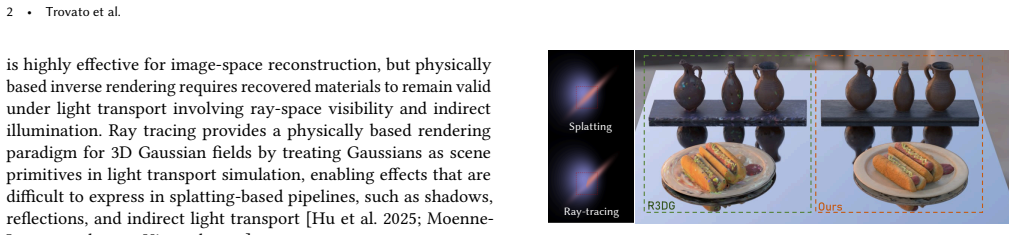
We propose a splatting-free path-traced inverse rendering framework for 3D Gaussian fields, where forward light transport and backward gradient propagation are defined within a unified ray-tracing pipeline. The framework optimizes materials and a compact Spherical-Gaussian environment under the full rendering equation with ray-traced visibility and multi-bounce light transport.
What carries the argument
Path-space equivalent interaction model for overlapping Gaussian primitives, which supports unbiased Monte-Carlo path tracing and replay of pathwise gradients over ray-traced interactions.
If this is right
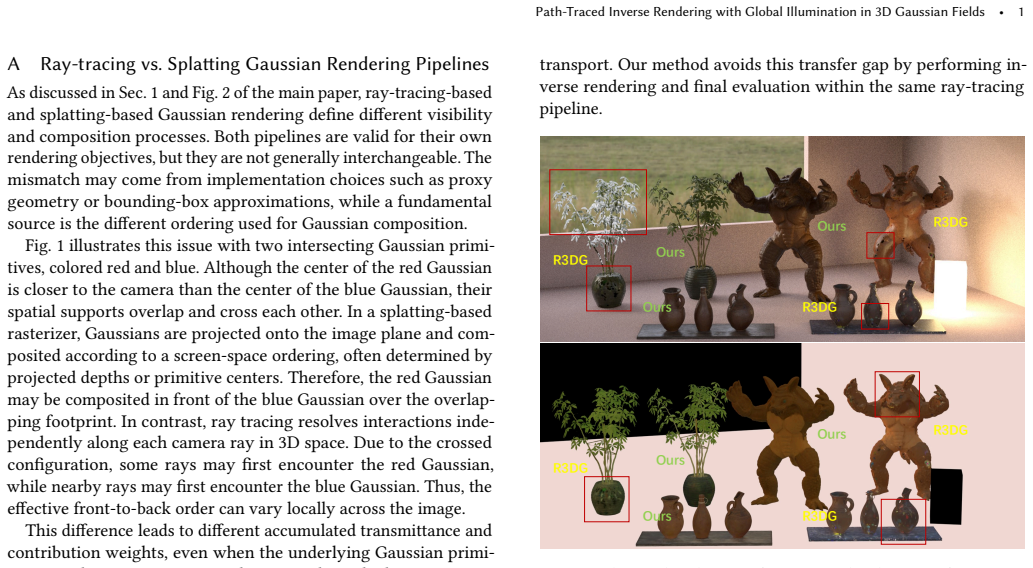
- Forward and backward passes remain consistent within ray tracing, eliminating artifacts from pipeline mismatch.
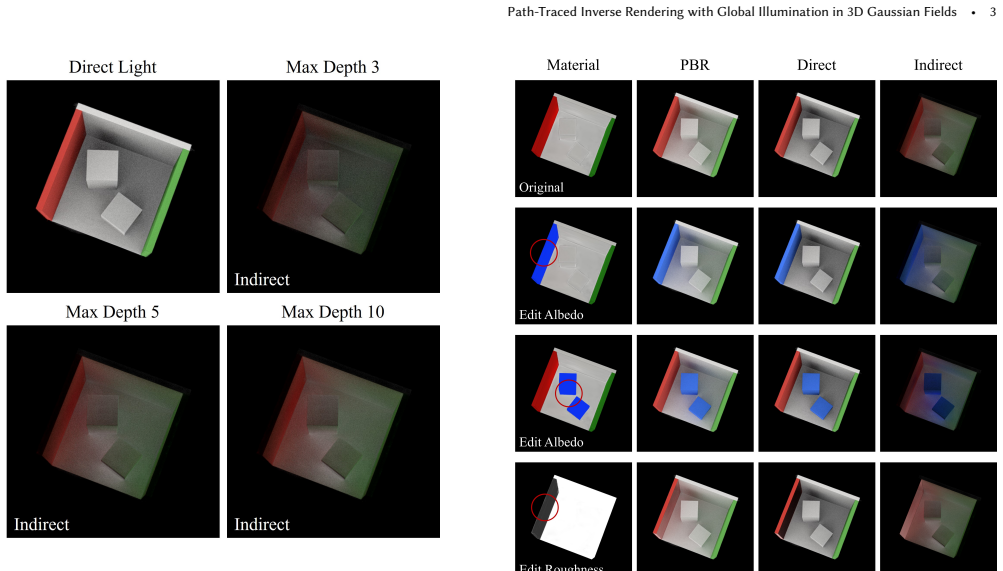
- Material and lighting estimates improve because optimization accounts for multi-bounce global illumination.
- Path-traced rendering quality increases with more plausible shadows, reflections, and relighting.
- Environment is represented compactly as Spherical-Gaussian maps optimized jointly with materials.
Where Pith is reading between the lines
- This approach could integrate 3D Gaussian scenes into existing path-tracing based production pipelines without conversion.
- Extensions might include handling of participating media if the interaction model generalizes to volume effects.
- Similar interaction models could apply to other point-based or primitive-based representations in inverse rendering.
Load-bearing premise
An equivalent interaction model exists for overlapping Gaussians that keeps Monte-Carlo path tracing unbiased and allows gradient replay.
What would settle it
Demonstrating a scene where the rendered images or gradients from this model differ systematically from a reference path tracer on the same geometry would falsify the claim.
Figures








read the original abstract
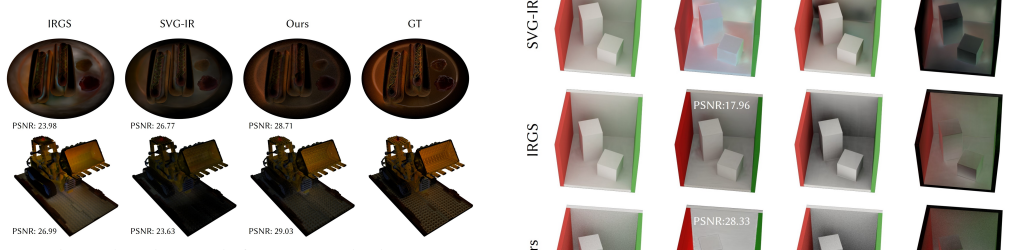
Ray tracing enables 3D Gaussian fields to serve as a representation for physically based light transport. Faithful inverse rendering requires forward rendering and backward optimization to be defined within a consistent light-transport pipeline. Existing inverse rendering methods estimate G-buffers via splatting and optimize materials in screen space, tying the recovered properties to a rasterization-based pipeline. This pipeline mismatch, together with simplified rendering equations that neglect indirect illumination, often leads to inconsistent shading, visible artifacts, and inaccurate material-lighting estimation under path-traced rendering. Therefore, we propose a splatting-free path-traced inverse rendering framework for 3D Gaussian fields, where forward light transport and backward gradient propagation are defined within a unified ray-tracing pipeline. Our key idea is to define a path-space equivalent interaction model for overlapping Gaussian primitives, under which Monte-Carlo-based path tracing is unbiased for the induced light-transport integral, while pathwise gradients are replayed over the same ray-traced interactions rather than splatting-derived screen-space buffers. The framework optimizes materials and a compact Spherical-Gaussian environment under the full rendering equation with ray-traced visibility and multi-bounce light transport. Extensive experiments demonstrate competitive material inversion and improved path-traced rendering quality, producing more plausible shadows, reflections, and relighting results under global illumination.
Editorial analysis
A structured set of objections, weighed in public.
Referee Report
Summary. The manuscript proposes a splatting-free path-traced inverse rendering framework for 3D Gaussian fields. Forward light transport and backward gradient propagation are defined within a unified ray-tracing pipeline via a path-space equivalent interaction model for overlapping Gaussian primitives. This enables unbiased Monte-Carlo path tracing under the full rendering equation (with ray-traced visibility and multi-bounce transport), while pathwise gradients are replayed over the same interactions. Materials and a compact Spherical-Gaussian environment are optimized; experiments claim competitive material inversion and improved path-traced quality with plausible shadows, reflections, and relighting.
Significance. If the interaction model is shown to preserve unbiasedness, the work would advance inverse rendering by allowing 3D Gaussian representations to be optimized directly under physically-based global illumination without rasterization mismatches or simplified equations. The unified pipeline could yield more consistent material and lighting recovery.
major comments (2)
- [Abstract and §3] Abstract and §3 (method): The claim that the path-space equivalent interaction model for overlapping Gaussian primitives renders Monte-Carlo path tracing unbiased lacks any derivation, explicit definition of intersection probabilities/transmittance/scattering, or proof that the estimator expectation equals the induced light-transport integral. This is load-bearing for the unbiasedness and gradient-replay claims.
- [§4] §4 (experiments): No bias analysis, variance measurements, or comparison against a ground-truth path-traced integral is reported to validate that the interaction model introduces no bias; without this, the reported improvements in relighting cannot be attributed to the central technical contribution.
minor comments (2)
- [§3] Notation for the interaction model (e.g., how overlaps are aggregated along a ray) should be introduced with a clear equation early in §3 to aid readability.
- [Abstract] The abstract states 'extensive experiments' but does not name the datasets, metrics, or number of scenes; adding these would strengthen the summary.
Simulated Author's Rebuttal
We thank the referee for the constructive feedback highlighting the need for rigorous justification of the unbiasedness claim and additional experimental validation. We address each major comment below and will revise the manuscript accordingly to strengthen these aspects.
read point-by-point responses
-
Referee: [Abstract and §3] Abstract and §3 (method): The claim that the path-space equivalent interaction model for overlapping Gaussian primitives renders Monte-Carlo path tracing unbiased lacks any derivation, explicit definition of intersection probabilities/transmittance/scattering, or proof that the estimator expectation equals the induced light-transport integral. This is load-bearing for the unbiasedness and gradient-replay claims.
Authors: We agree that the current manuscript does not contain a complete derivation or proof of unbiasedness. While the abstract and §3 introduce the path-space equivalent interaction model and state that Monte-Carlo path tracing is unbiased under it, they stop short of defining the intersection probabilities, transmittance, and scattering terms or proving that the estimator expectation matches the induced integral. In the revised version we will expand §3 with these explicit definitions and the required proof, which will also clarify the consistency of pathwise gradient replay. revision: yes
-
Referee: [§4] §4 (experiments): No bias analysis, variance measurements, or comparison against a ground-truth path-traced integral is reported to validate that the interaction model introduces no bias; without this, the reported improvements in relighting cannot be attributed to the central technical contribution.
Authors: We concur that the existing experiments lack the quantitative checks needed to confirm absence of bias. The current §4 reports competitive material inversion and qualitative improvements in shadows, reflections, and relighting but does not include bias analysis, variance statistics, or direct comparison to a reference ground-truth path-traced integral. In the revision we will add these measurements and comparisons in §4 to substantiate that the interaction model preserves unbiasedness and that the observed gains stem from the proposed contribution. revision: yes
Circularity Check
No circularity: new interaction model defined independently
full rationale
The paper's central contribution is the definition of a path-space equivalent interaction model for overlapping 3D Gaussian primitives that makes Monte-Carlo path tracing unbiased under the full rendering equation. The abstract presents this as a novel construction enabling consistent forward and backward passes, without any reduction to prior fitted parameters, self-citations that bear the load of the unbiasedness claim, or renaming of known results. No equations or steps in the provided text exhibit self-definitional equivalence or fitted-input-as-prediction patterns. The derivation is therefore self-contained against external benchmarks for the purpose of this analysis.
Axiom & Free-Parameter Ledger
axioms (1)
- domain assumption Monte-Carlo path tracing is unbiased for the light-transport integral induced by the path-space equivalent interaction model
invented entities (1)
-
path-space equivalent interaction model for overlapping Gaussian primitives
no independent evidence
Reference graph
Works this paper leans on
-
[1]
1997 , url=
Robust Monte Carlo methods for light transport simulation , author=. 1997 , url=
1997
-
[2]
CVPR , year=
Mip-NeRF 360: Unbounded Anti-Aliased Neural Radiance Fields , author=. CVPR , year=
-
[3]
arXiv preprint arXiv:2603.01491 , year=
Radiometrically Consistent Gaussian Surfels for Inverse Rendering , author=. arXiv preprint arXiv:2603.01491 , year=
-
[4]
International Journal of Computer Vision , pages=
Large-Scale Data for Multiple-View Stereopsis , author=. International Journal of Computer Vision , pages=. 2016 , publisher=
2016
-
[5]
and Deng, Boyang and Debevec, Paul and Freeman, William T
Zhang, Xiuming and Srinivasan, Pratul P. and Deng, Boyang and Debevec, Paul and Freeman, William T. and Barron, Jonathan T. , year=. NeRFactor: neural factorization of shape and reflectance under an unknown illumination , volume=. ACM Transactions on Graphics , publisher=. doi:10.1145/3478513.3480496 , number=
-
[6]
Advances in Neural Information Processing Systems Datasets and Benchmarks Track , year=
Stanford-ORB: a real-world 3D object inverse rendering benchmark , author=. Advances in Neural Information Processing Systems Datasets and Benchmarks Track , year=
-
[7]
ICLR , year=
GI-GS: Global Illumination Decomposition on Gaussian Splatting for Inverse Rendering , author=. ICLR , year=
-
[8]
2025 , MONTH = Dec, DOI =
Poirier-Ginter, Yohan and Hu, Jeffrey and Lalonde, Jean-Fran. 2025 , MONTH = Dec, DOI =
2025
-
[9]
Mitsuba 3 renderer , author =
-
[10]
Dr.Jit: A Just-In-Time Compiler for Differentiable Rendering , journal =
Wenzel Jakob and S. Dr.Jit: A Just-In-Time Compiler for Differentiable Rendering , journal =. 2022 , month = jul, doi =
2022
-
[11]
Zeng, Zheng and Deschaintre, Valentin and Georgiev, Iliyan and Hold-Geoffroy, Yannick and Hu, Yiwei and Luan, Fujun and Yan, Ling-Qi and Ha. RGB X: Image decomposition and synthesis using material- and lighting-aware diffusion models , year =. doi:10.1145/3641519.3657445 , booktitle =
-
[12]
3D Gaussian Splatting for Real-Time Radiance Field Rendering , journal =
Kerbl, Bernhard and Kopanas, Georgios and Leimk. 3D Gaussian Splatting for Real-Time Radiance Field Rendering , journal =. 2023 , month =
2023
-
[13]
ACM Transactions on Graphics and SIGGRAPH Asia , year =
Nicolas Moenne-Loccoz and Ashkan Mirzaei and Or Perel and Riccardo de Lutio and Janick Martinez Esturo and Gavriel State and Sanja Fidler and Nicholas Sharp and Zan Gojcic , title =. ACM Transactions on Graphics and SIGGRAPH Asia , year =
-
[14]
EGSR conference proceedings , year =
Stochastic Ray Tracing of 3D Transparent Gaussians , author =. EGSR conference proceedings , year =
-
[15]
CVPR , year=
IRGS: Inter-Reflective Gaussian Splatting with 2D Gaussian Ray Tracing , author=. CVPR , year=
-
[16]
Condor, Jorge and Speierer, Sebastien and Bode, Lukas and Bozic, Aljaz and Green, Simon and Didyk, Piotr and Jarabo, Adrian , title =. 2025 , publisher =. doi:10.1145/3711853 , journal=
-
[17]
2024 , eprint=
GS-ID: Illumination Decomposition on Gaussian Splatting via Diffusion Prior and Parametric Light Source Optimization , author=. 2024 , eprint=
2024
-
[18]
arXiv preprint arXiv:2311.16473 , year=
Gs-ir: 3d gaussian splatting for inverse rendering , author=. arXiv preprint arXiv:2311.16473 , year=
-
[19]
Gao, Jian and Gu, Chun and Lin, Youtian and Zhu, Hao and Cao, Xun and Zhang, Li and Yao, Yao , title =. arXiv:2311.16043 , year =
-
[20]
Transactions on Graphics (Proceedings of SIGGRAPH) , volume =
Delio Vicini and Sébastien Speierer and Wenzel Jakob , title =. Transactions on Graphics (Proceedings of SIGGRAPH) , volume =. 2021 , month = aug, doi =
2021
-
[21]
Parker, Steven G. and Bigler, James and Dietrich, Andreas and Friedrich, Heiko and Hoberock, Jared and Luebke, David and McAllister, David and McGuire, Morgan and Morley, Keith and Robison, Austin and Stich, Martin , title =. ACM Trans. Graph. , month = jul, articleno =. 2010 , issue_date =. doi:10.1145/1778765.1778803 , abstract =
-
[22]
Sun, Hanxiao and Gao, Yupeng and Xie, Jin and Yang, Jian and Wang, Beibei , title =. arXiv:2504.06815 , year =
-
[23]
2025 , eprint=
Real-time Global Illumination for Dynamic 3D Gaussian Scenes , author=. 2025 , eprint=
2025
-
[24]
arXiv preprint arXiv:2408.08524 , year=
GS-ID: Illumination Decomposition on Gaussian Splatting via Adaptive Light Aggregation and Diffusion-Guided Material Priors , author=. arXiv preprint arXiv:2408.08524 , year=
-
[25]
Wang, Jiaping and Ren, Peiran and Gong, Minmin and Snyder, John and Guo, Baining , title =. 2009 , issue_date =. doi:10.1145/1618452.1618479 , journal =
-
[26]
Debevec, Paul , title =. 1998 , isbn =. doi:10.1145/280814.280864 , booktitle =
-
[27]
Ramamoorthi, Ravi and Hanrahan, Pat , title =. 2001 , isbn =. doi:10.1145/383259.383317 , booktitle =
-
[28]
Deep graph learning for spatially-varying indoor lighting prediction , volume=
Bai, Jiayang and Guo, Jie and Wang, Chenchen and Chen, Zhenyu and He, Zhen and Yang, Shan and Yu, Piaopiao and Zhang, Yan and Guo, Yanwen , year=. Deep graph learning for spatially-varying indoor lighting prediction , volume=. Science China Information Sciences , publisher=. doi:10.1007/s11432-022-3576-9 , number=
-
[29]
2025 , eprint=
RaySplats: Ray Tracing based Gaussian Splatting , author=. 2025 , eprint=
2025
-
[30]
2024 , eprint=
Unified Gaussian Primitives for Scene Representation and Rendering , author=. 2024 , eprint=
2024
-
[31]
arXiv preprint arXiv:2412.15215 , year=
EnvGS: Modeling View-Dependent Appearance with Environment Gaussian , author=. arXiv preprint arXiv:2412.15215 , year=
-
[32]
SIGGRAPH 2024 Conference Papers , year =
2D Gaussian Splatting for Geometrically Accurate Radiance Fields , author=. SIGGRAPH 2024 Conference Papers , year =
2024
-
[33]
ACM Transactions on Graphics (Proceedings of SIGGRAPH Asia) , volume =
Baptiste Nicolet and Alec Jacobson and Wenzel Jakob , title =. ACM Transactions on Graphics (Proceedings of SIGGRAPH Asia) , volume =. 2021 , month = dec, doi =
2021
-
[34]
Learning to predict indoor illumination from a single image , year =
Gardner, Marc-Andr\'. Learning to predict indoor illumination from a single image , year =. doi:10.1145/3130800.3130891 , journal =
-
[35]
All-frequency shadows using non-linear wavelet lighting approximation , year =
Ng, Ren and Ramamoorthi, Ravi and Hanrahan, Pat , title =. 2003 , issue_date =. doi:10.1145/882262.882280 , month = jul, pages =
-
[36]
Ling, Jingwang and Yu, Ruihan and Xu, Feng and Du, Chun and Zhao, Shuang , title =. 2024 , isbn =. doi:10.1145/3641519.3657404 , booktitle =
-
[37]
NeILF: Neural Incident Light Field for Material and Lighting Estimation , booktitle =
Yao Yao and Jingyang Zhang and Jingbo Liu and Yihang Qu and Tian Fang and David McKinnon and Yanghai Tsin and Long Quan , year =. NeILF: Neural Incident Light Field for Material and Lighting Estimation , booktitle =
-
[38]
International Conference on Computer Vision (ICCV) , year=
NeILF++: Inter-reflectable Light Fields for Geometry and Material Estimation , author=. International Conference on Computer Vision (ICCV) , year=
-
[39]
Proceedings of the IEEE/CVF Conference on Computer Vision and Pattern Recognition (CVPR) , year=
TensoIR: Tensorial Inverse Rendering , author=. Proceedings of the IEEE/CVF Conference on Computer Vision and Pattern Recognition (CVPR) , year=
-
[40]
Kai Zhang and Fujun Luan and Qianqian Wang and Kavita Bala and Noah Snavely , booktitle=
-
[41]
CVPR , year=
Modeling Indirect Illumination for Inverse Rendering , author=. CVPR , year=
-
[42]
Measurement of Areas on a Sphere Using Fibonacci and Latitude–Longitude Lattices , volume=
González, Álvaro , year=. Measurement of Areas on a Sphere Using Fibonacci and Latitude–Longitude Lattices , volume=. Mathematical Geosciences , publisher=. doi:10.1007/s11004-009-9257-x , number=
-
[43]
2025 , journal=
Jiahui Fan and Fujun Luan and Jian Yang and Milos Hasan and Beibei Wang , title=. 2025 , journal=
2025
-
[44]
Proceedings of the IEEE/CVF Conference on Computer Vision and Pattern Recognition , pages=
Gaussianshader: 3d gaussian splatting with shading functions for reflective surfaces , author=. Proceedings of the IEEE/CVF Conference on Computer Vision and Pattern Recognition , pages=
-
[45]
arXiv preprint arXiv:2404.09412 , year=
DeferredGS: Decoupled and Editable Gaussian Splatting with Deferred Shading , author=. arXiv preprint arXiv:2404.09412 , year=
-
[46]
Guo, Yijia and Bai, Yuanxi and Hu, Liwen and Guo, Ziyi and Liu, Mianzhi and Cai, Yu and Huang, Tiejun and Ma, Lei , title =. 2024 , isbn =. doi:10.1145/3664647.3680893 , pages =
-
[47]
2025 , journal =
Jiang, Kaiwen and Sun, Jia-Mu and Li, Zilu and Wang, Dan and Li, Tzu-Mao and Ramamoorthi, Ravi , title =. 2025 , journal =
2025
-
[48]
Zoubin Bi and Yixin Zeng and Chong Zeng and Fan Pei and Xiang Feng and Kun Zhou and Hongzhi Wu , booktitle =. GS
-
[49]
Proceedings of the Computer Vision and Pattern Recognition Conference , pages=
DashGaussian: Optimizing 3D Gaussian Splatting in 200 Seconds , author=. Proceedings of the Computer Vision and Pattern Recognition Conference , pages=
-
[50]
Acm siggraph , volume=
Physically-based shading at disney , author=. Acm siggraph , volume=. 2012 , organization=
2012
-
[51]
Kajiya, James T. , title =. SIGGRAPH Comput. Graph. , month = aug, pages =. 1986 , issue_date =. doi:10.1145/15886.15902 , abstract =
discussion (0)
Sign in with ORCID, Apple, or X to comment. Anyone can read and Pith papers without signing in.