Learning the Universe with PRFM-vol: Introducing a new subgrid model for star formation in cosmological simulations
Pith reviewed 2026-06-27 15:51 UTC · model grok-4.3
The pith
PRFM-vol introduces a subgrid star formation model for cosmological simulations that uses pressure-regulated feedback-modulated relations.
A machine-rendered reading of the paper's core claim, the machinery that carries it, and where it could break.
Core claim
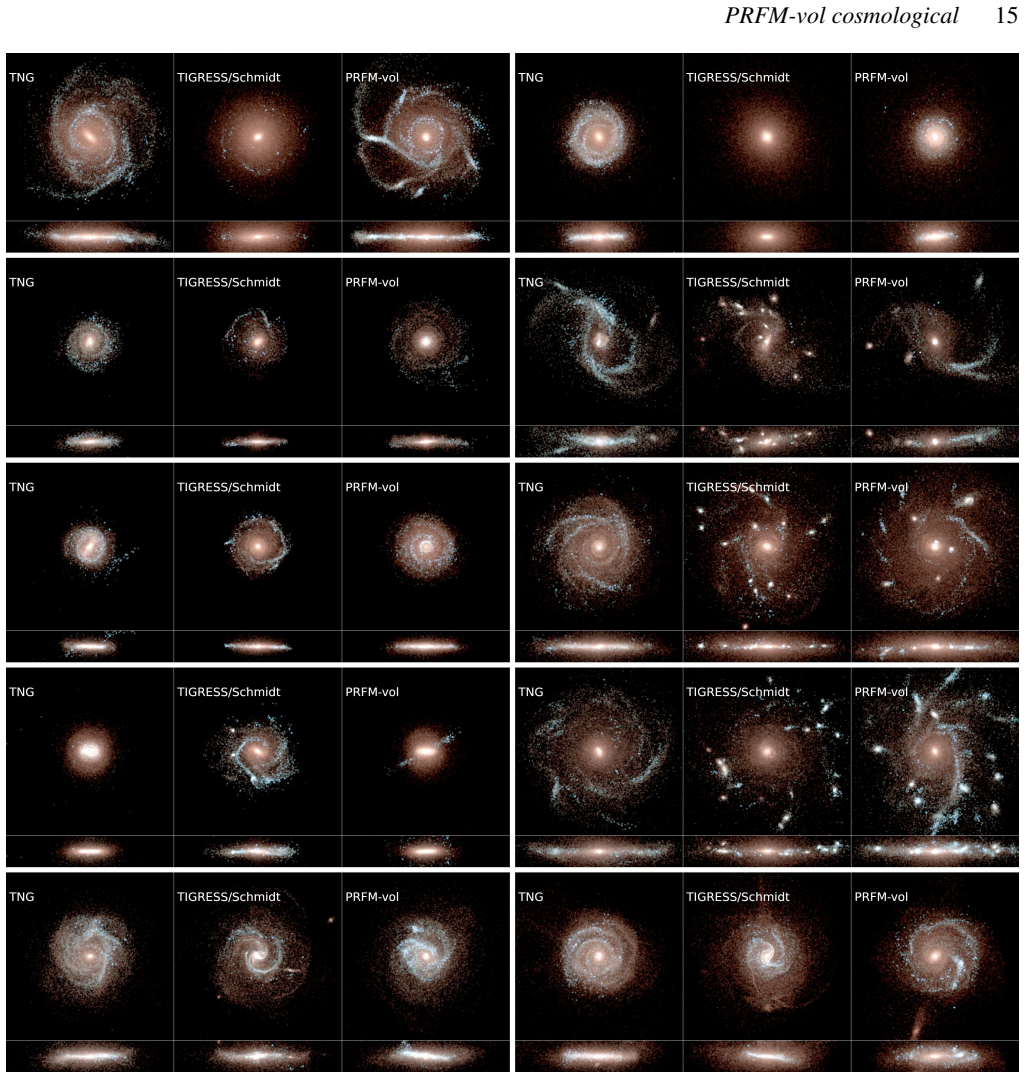
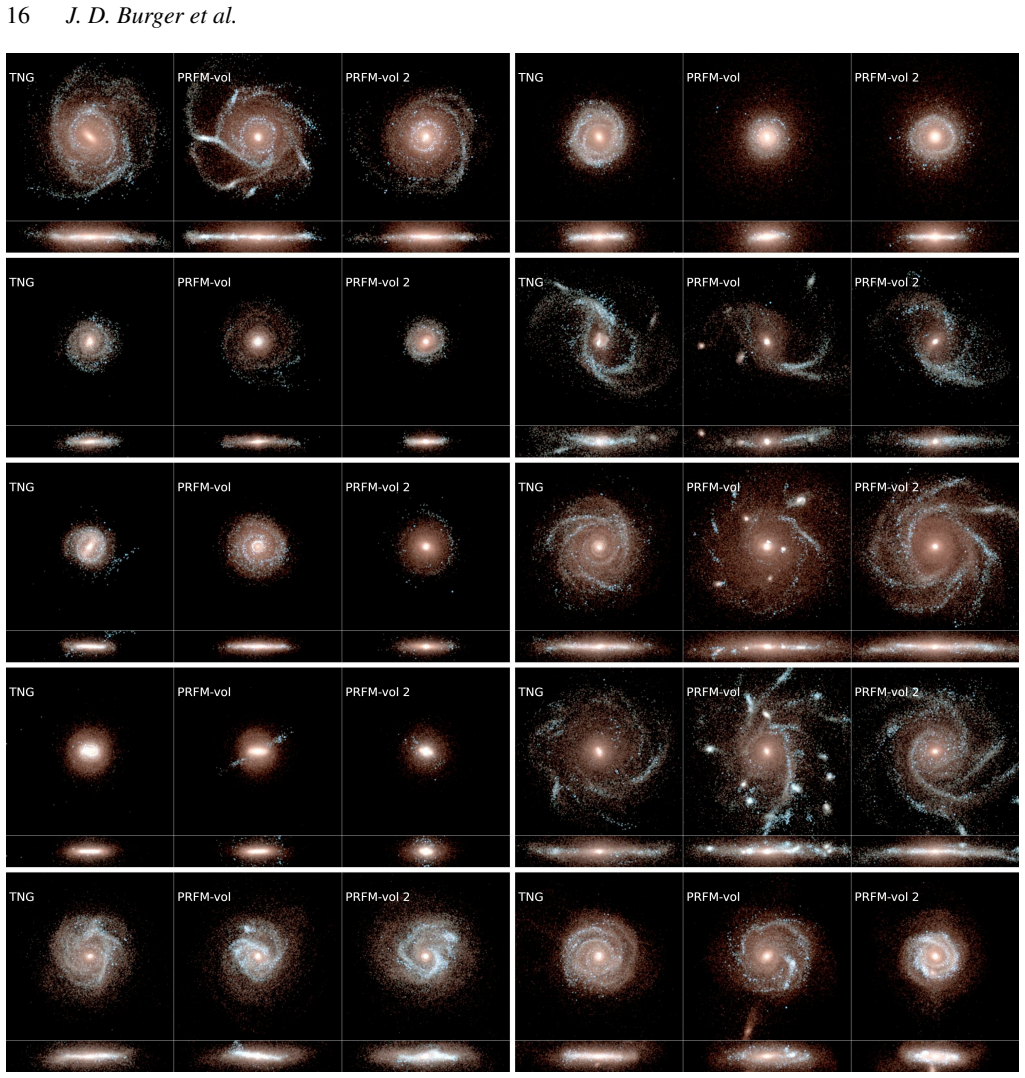
PRFM-vol deploys a modified effective equation of state and a density-dependent star formation rate prescription based on PRFM theory. This allows the model to match the scaling relations from TIGRESS in isolated galaxy tests, including the effect of the stellar potential on the star formation rate. In cosmological multizoom simulations, PRFM-vol results in increased stellar scale heights and slight stellar mass increase, and shows that the effective equation of state controls whether Toomre instabilities produce stellar clumps in galaxy morphologies.
What carries the argument
The PRFM-vol model that uses a modified effective equation of state and a density-dependent star formation rate based on PRFM theory.
Load-bearing premise
The PRFM scaling relations and TIGRESS results obtained in focused ISM simulations can be directly transplanted into cosmological volumes through a single modified effective equation of state and a density-dependent SFR prescription without additional resolution-dependent corrections.
What would settle it
If PRFM-vol simulations do not produce the expected increase in stellar scale heights or the morphology variations with effective pressure, the direct transplantation of the model would be called into question.
Figures





read the original abstract
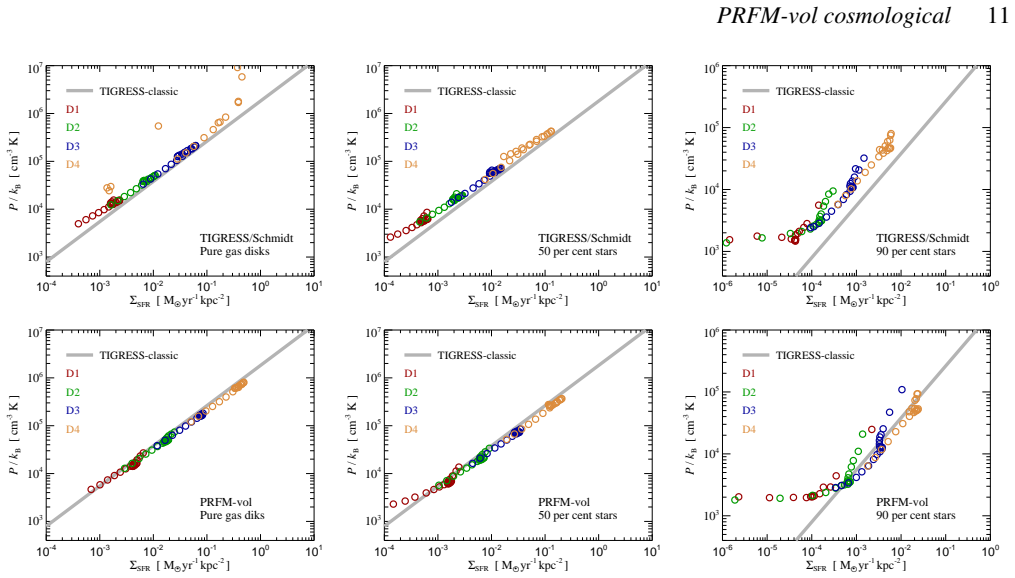
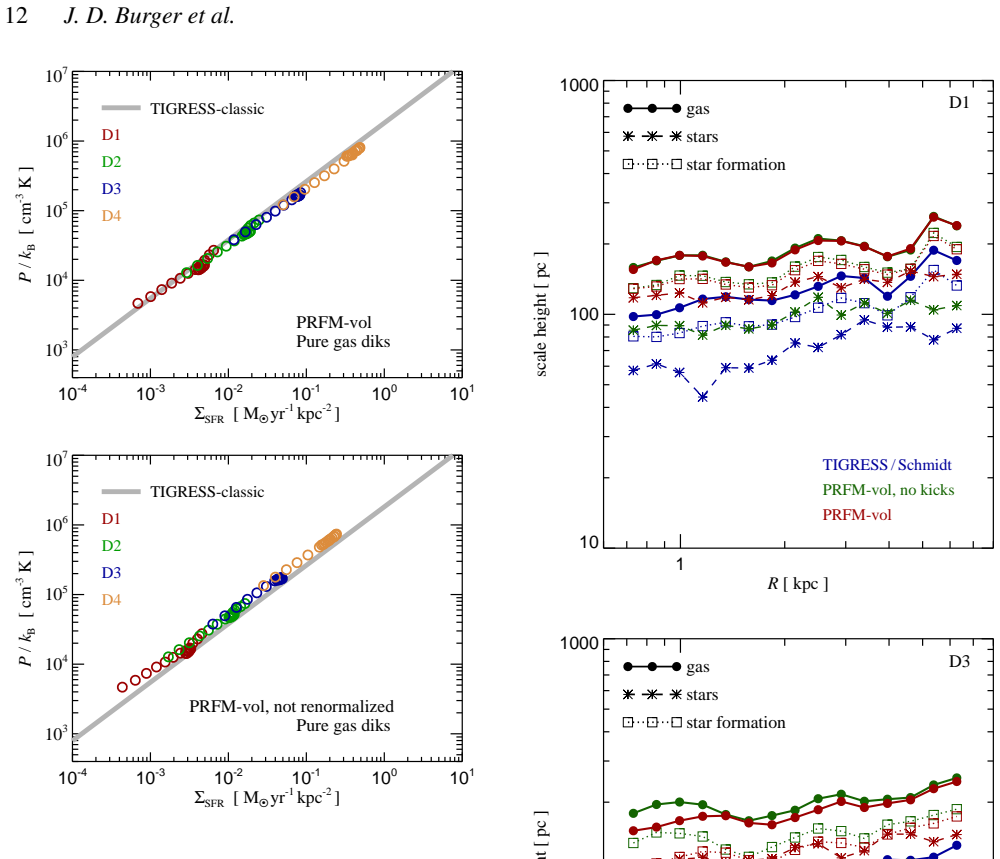
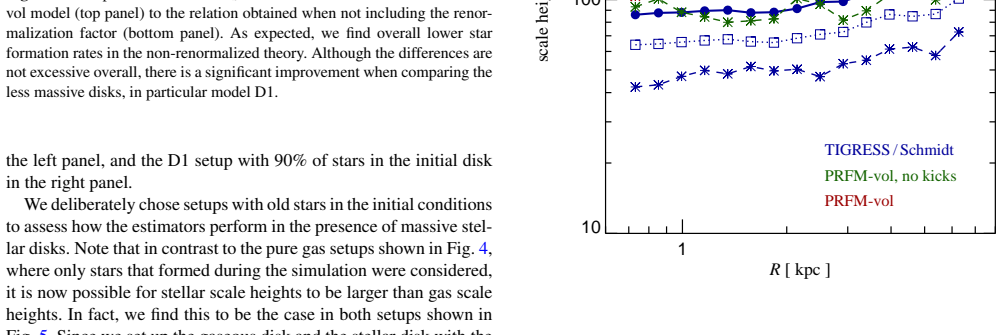
We introduce PRFM-vol, a new subgrid model for star formation in cosmological simulations that aims to increase the physical realism of cosmological simulations by leveraging results obtained with focused ISM simulations. We deploy a modified effective equation of state and calculate the star formation rate for each gas cell as a function of the ambient densities of gas, dark matter, and stars, based on the pressure-regulated feedback-modulated (PRFM) theory of star formation. Test simulations of our model in isolated galaxies show that we match PRFM predictions and TIGRESS scaling relations remarkably well, provided sufficiently high resolution is available. In particular, we are able to clearly demonstrate the impact of the stellar potential on the star formation rate, thereby retaining an important prediction of PRFM. We then apply our new model to cosmological multizoom simulations and find, compared to our previous TIGRESS/Schmidt model, a significant increase in the stellar scale heights and a slight increase in stellar mass. We demonstrate that modifying the effective equation of state significantly affects the morphology of simulated galaxies. Pronounced stellar clumps appear if the effective pressure at low hydrogen number densities is low, and disappear for higher pressure. We show that the formation of clumps is a result of Toomre instabilities, and conclude that simulated galaxy morphologies can be used to constrain effective equation of state models. Overall, our results establish PRFM-vol as a new self-consistent, physics-motivated subgrid model for star formation in high-resolution cosmological simulations.
Editorial analysis
A structured set of objections, weighed in public.
Referee Report
Summary. The paper introduces PRFM-vol, a subgrid star formation model for cosmological simulations that combines a modified effective equation of state with a density-dependent SFR prescription derived from PRFM theory (using gas, dark matter, and stellar densities). Isolated galaxy tests are reported to match PRFM predictions and TIGRESS scaling relations at sufficiently high resolution, including the effect of stellar potential; cosmological multizoom runs then show increased stellar scale heights, slightly higher stellar mass, and morphology changes (clump formation via Toomre instabilities) that depend on the low-density EOS pressure. The authors conclude that PRFM-vol is a self-consistent, physics-motivated model and that galaxy morphologies can constrain effective EOS choices.
Significance. If the transplantation of PRFM/TIGRESS relations to cosmological volumes holds without additional resolution-dependent corrections, the model would offer a more physically grounded alternative to standard subgrid prescriptions, with the potential to link ISM-scale theory directly to galaxy-scale outcomes and use morphology as an EOS diagnostic. The use of independent TIGRESS results and absence of new free parameters are strengths. However, the current lack of quantitative validation in the cosmological regime limits the immediate impact.
major comments (3)
- [Abstract] Abstract (final paragraph) and § on cosmological runs: The central claim that PRFM-vol is self-consistent in cosmological multizoom simulations rests on the unverified assumption that the isolated-galaxy 'sufficiently high resolution' threshold is met and that PRFM scaling relations hold without further corrections; no resolution values, convergence tests, or direct SFR-density comparisons are reported for the cosmological runs, so the reported scale-height and morphology changes may not reflect the intended PRFM physics.
- [Abstract] Abstract: The reported 'significant increase in the stellar scale heights and a slight increase in stellar mass' relative to the TIGRESS/Schmidt model are presented without error bars, sample statistics, or quantitative measures of difference, weakening the ability to judge whether these outcomes are robust or resolution-dependent.
- [Abstract] Abstract (morphology discussion): The demonstration that clump formation is controlled by the low-density effective pressure and arises from Toomre instabilities is interesting, but the EOS modification itself is described as an exploratory choice rather than derived from PRFM; this makes it unclear whether the morphology-EOS link is a genuine prediction or a consequence of the ad-hoc adjustment.
minor comments (1)
- [Abstract] The abstract states that the model 'retain[s] an important prediction of PRFM' regarding stellar potential, but no explicit comparison metric or figure reference is given to quantify how well this is recovered.
Simulated Author's Rebuttal
We thank the referee for their careful reading and constructive comments, which help clarify the presentation of our results. We respond to each major comment below and indicate where revisions will be made to the manuscript.
read point-by-point responses
-
Referee: [Abstract] Abstract (final paragraph) and § on cosmological runs: The central claim that PRFM-vol is self-consistent in cosmological multizoom simulations rests on the unverified assumption that the isolated-galaxy 'sufficiently high resolution' threshold is met and that PRFM scaling relations hold without further corrections; no resolution values, convergence tests, or direct SFR-density comparisons are reported for the cosmological runs, so the reported scale-height and morphology changes may not reflect the intended PRFM physics.
Authors: We agree that the cosmological multizoom section would benefit from explicit resolution information. In the revised manuscript we will report the spatial resolution achieved in the cosmological runs, confirm that it meets or exceeds the threshold validated in the isolated-galaxy tests, and add a brief discussion of why direct cell-by-cell SFR-density comparisons are not straightforward in the full cosmological volume. We will also note any available convergence information from the simulation suite. These additions will make the self-consistency argument more transparent without altering the underlying results. revision: yes
-
Referee: [Abstract] Abstract: The reported 'significant increase in the stellar scale heights and a slight increase in stellar mass' relative to the TIGRESS/Schmidt model are presented without error bars, sample statistics, or quantitative measures of difference, weakening the ability to judge whether these outcomes are robust or resolution-dependent.
Authors: We acknowledge that the abstract would be strengthened by quantitative context. In revision we will replace the qualitative descriptors with approximate numerical differences (e.g., fractional change in scale height and stellar mass) drawn from the simulation outputs and will clarify the number of galaxies and resolution regime involved. Because the runs are single realizations, formal error bars are not available, but we will add a short statement on robustness based on the controlled comparison between the two models. revision: yes
-
Referee: [Abstract] Abstract (morphology discussion): The demonstration that clump formation is controlled by the low-density effective pressure and arises from Toomre instabilities is interesting, but the EOS modification itself is described as an exploratory choice rather than derived from PRFM; this makes it unclear whether the morphology-EOS link is a genuine prediction or a consequence of the ad-hoc adjustment.
Authors: We agree that the distinction should be stated more clearly. The PRFM-vol model derives the SFR from PRFM theory; the low-density EOS is varied in an exploratory manner precisely to test its influence on morphology. In the revised abstract and discussion we will explicitly separate the PRFM-based SFR prescription from the exploratory EOS choice, while retaining the demonstration that Toomre instabilities drive the clumps when the low-density pressure is reduced. This framing presents the morphology-EOS sensitivity as a model outcome rather than a direct PRFM prediction, consistent with the manuscript's intent to show that galaxy morphologies can constrain effective EOS prescriptions. revision: partial
Circularity Check
No significant circularity; model implements independent prior theory
full rationale
The derivation adopts PRFM theory and TIGRESS scaling relations from prior focused ISM simulations as the foundation for the subgrid prescription (modified EOS plus density-dependent SFR). Isolated-galaxy tests verify faithful reproduction of those relations at high resolution, which constitutes an implementation check rather than a prediction that reduces to the input by construction. Cosmological multizoom applications then explore morphological consequences of the chosen EOS, without any load-bearing step that equates the central claim to a self-citation chain, fitted parameter renamed as prediction, or self-definitional loop. The paper remains self-contained against external benchmarks from the cited prior work.
Axiom & Free-Parameter Ledger
Reference graph
Works this paper leans on
-
[1]
The Milky Way Tomography with SDSS. I. Stellar Number Density Distribution. , keywords =. doi:10.1086/523619 , archivePrefix =. astro-ph/0510520 , primaryClass =
work page internal anchor Pith review Pith/arXiv arXiv doi:10.1086/523619
-
[2]
The photo-astrometric vertical tracer density of the Milky Way - II. Results from Gaia. , keywords =. doi:10.1093/mnras/stac305 , archivePrefix =. 2111.08043 , primaryClass =
-
[3]
The emergence of galactic thin and thick discs across cosmic history. , keywords =. doi:10.1093/mnras/staf604 , archivePrefix =. 2409.15909 , primaryClass =
-
[4]
2002, title The epoch of helium reionization , , 332, 601, 10.1046/j.1365-8711.2002.05291.x
Flattening and truncation of stellar discs in edge-on spiral galaxies. , keywords =. doi:10.1046/j.1365-8711.2002.05556.x , archivePrefix =. astro-ph/0204154 , primaryClass =
-
[5]
The Gravitational Potential Near the Sun From SEGUE K-dwarf Kinematics
The Gravitational Potential near the Sun from SEGUE K-dwarf Kinematics. , keywords =. doi:10.1088/0004-637X/772/2/108 , archivePrefix =. 1209.0256 , primaryClass =
work page internal anchor Pith review Pith/arXiv arXiv doi:10.1088/0004-637x/772/2/108
-
[6]
Pressure balance in the multiphase ISM of cosmologically simulated disc galaxies. , keywords =. doi:10.1093/mnras/staa2578 , archivePrefix =. 2005.12916 , primaryClass =
-
[7]
The anatomy of a star-forming galaxy: pressure-driven regulation of star formation in simulated galaxies. , keywords =. doi:10.1093/mnras/stw1741 , archivePrefix =. 1607.05795 , primaryClass =
work page internal anchor Pith review Pith/arXiv arXiv doi:10.1093/mnras/stw1741
-
[8]
Self-Interacting Dark Matter Subhalos in the Milky Way's Tides. , keywords =. doi:10.1103/PhysRevLett.124.141102 , archivePrefix =. 1904.07872 , primaryClass =
-
[9]
Three-phase Interstellar Medium in Galaxies Resolving Evolution with Star Formation and Supernova Feedback (TIGRESS): Algorithms, Fiducial Model, and Convergence. , keywords =. doi:10.3847/1538-4357/aa8599 , archivePrefix =. 1612.03918 , primaryClass =
work page internal anchor Pith review Pith/arXiv arXiv doi:10.3847/1538-4357/aa8599
-
[10]
Three-dimensional Hydrodynamic Simulations of Multiphase Galactic Disks with Star Formation Feedback. I. Regulation of Star Formation Rates. , keywords =. doi:10.1088/0004-637X/776/1/1 , archivePrefix =. 1308.3231 , primaryClass =
work page internal anchor Pith review Pith/arXiv arXiv doi:10.1088/0004-637x/776/1/1
-
[11]
Vertical Equilibrium, Energetics, and Star Formation Rates in Magnetized Galactic Disks Regulated by Momentum Feedback from Supernovae. , keywords =. doi:10.1088/0004-637X/815/1/67 , archivePrefix =. 1511.00010 , primaryClass =
work page internal anchor Pith review Pith/arXiv arXiv doi:10.1088/0004-637x/815/1/67
-
[12]
First results from the IllustrisTNG simulations: the galaxy colour bimodality. , keywords =. doi:10.1093/mnras/stx3040 , archivePrefix =. 1707.03395 , primaryClass =
work page internal anchor Pith review Pith/arXiv arXiv doi:10.1093/mnras/stx3040
-
[13]
P., Pillepich , A., Springel , V., et al
First results from the IllustrisTNG simulations: a tale of two elements - chemical evolution of magnesium and europium. , keywords =. doi:10.1093/mnras/sty618 , archivePrefix =. 1707.03401 , primaryClass =
work page internal anchor Pith review Pith/arXiv arXiv doi:10.1093/mnras/sty618
-
[14]
First results from the IllustrisTNG simulations: radio haloes and magnetic fields. , keywords =. doi:10.1093/mnras/sty2206 , archivePrefix =. 1707.03396 , primaryClass =
work page internal anchor Pith review Pith/arXiv arXiv doi:10.1093/mnras/sty2206
-
[15]
First results from the IllustrisTNG simulations: the stellar mass content of groups and clusters of galaxies. , keywords =. doi:10.1093/mnras/stx3112 , archivePrefix =. 1707.03406 , primaryClass =
work page internal anchor Pith review Pith/arXiv arXiv doi:10.1093/mnras/stx3112
-
[16]
Simulating galaxy formation with the IllustrisTNG model. , keywords =. doi:10.1093/mnras/stx2656 , archivePrefix =. 1703.02970 , primaryClass =
work page internal anchor Pith review Pith/arXiv arXiv doi:10.1093/mnras/stx2656
-
[17]
The MillenniumTNG Project: high-precision predictions for matter clustering and halo statistics. , keywords =. doi:10.1093/mnras/stad1657 , archivePrefix =. 2210.10059 , primaryClass =
-
[18]
, title =
Krumholz, Mark R. , title =. Physics Reports , volume =. 2014 , doi =
2014
-
[19]
Imladris: a detailed and flexible model for galaxy simulations with individual stars
Imladris: a detailed and flexible model for galaxy simulations with individual stars. arXiv e-prints , keywords =. doi:10.48550/arXiv.2604.00100 , archivePrefix =. 2604.00100 , primaryClass =
work page internal anchor Pith review Pith/arXiv arXiv doi:10.48550/arxiv.2604.00100
-
[20]
Kinematic Signatures of Impulsive Supernova Feedback in Dwarf Galaxies. , keywords =. doi:10.1103/PhysRevLett.129.191103 , archivePrefix =. 2211.03795 , primaryClass =
-
[21]
The Open Journal of Astrophysics , keywords =
Introducing the THESAN-ZOOM project: radiation-hydrodynamic simulations of high-redshift galaxies with a multi-phase interstellar medium. The Open Journal of Astrophysics , keywords =. doi:10.33232/001c.145804 , archivePrefix =. 2502.20437 , primaryClass =
-
[22]
F., Wetzel, A., Kereˇs, D., et al
FIRE-2 simulations: physics versus numerics in galaxy formation. , keywords =. doi:10.1093/mnras/sty1690 , archivePrefix =. 1702.06148 , primaryClass =
work page internal anchor Pith review Pith/arXiv arXiv doi:10.1093/mnras/sty1690
-
[23]
VINTERGATAN - I. The origins of chemically, kinematically, and structurally distinct discs in a simulated Milky Way-mass galaxy. , keywords =. doi:10.1093/mnras/stab322 , archivePrefix =. 2006.06008 , primaryClass =
-
[24]
The Auriga Project: the properties and formation mechanisms of disc galaxies across cosmic time
The Auriga Project: the properties and formation mechanisms of disc galaxies across cosmic time. , keywords =. doi:10.1093/mnras/stx071 , archivePrefix =. 1610.01159 , primaryClass =
work page internal anchor Pith review Pith/arXiv arXiv doi:10.1093/mnras/stx071
-
[25]
SIMBA: Cosmological simulations with black hole growth and feedback. , keywords =. doi:10.1093/mnras/stz937 , archivePrefix =. 1901.10203 , primaryClass =
work page internal anchor Pith review Pith/arXiv arXiv doi:10.1093/mnras/stz937 1901
-
[26]
The ASTRID simulation: the evolution of supermassive black holes. , keywords =. doi:10.1093/mnras/stac351 , archivePrefix =. 2110.14154 , primaryClass =
-
[27]
The COLIBRE project: cosmological hydrodynamical simulations of galaxy formation and evolution , journal =
Schaye, Joop and Chaikin, Evgenii and Schaller, Matthieu and Ploeckinger, Sylvia and Hu. The COLIBRE project: cosmological hydrodynamical simulations of galaxy formation and evolution , journal =. 2026 , doi =
2026
-
[28]
Galaxy formation in the Planck cosmology - I. Matching the observed evolution of star formation rates, colours and stellar masses. , keywords =. doi:10.1093/mnras/stv705 , archivePrefix =. 1410.0365 , primaryClass =
work page internal anchor Pith review Pith/arXiv arXiv doi:10.1093/mnras/stv705
-
[29]
The MillenniumTNG Project: the large-scale clustering of galaxies. , keywords =. doi:10.1093/mnras/stad1097 , archivePrefix =. 2210.10065 , primaryClass =
-
[30]
The MillenniumTNG Project: semi-analytic galaxy formation models on the past lightcone. , keywords =. doi:10.1093/mnras/stad2688 , archivePrefix =. 2210.10419 , primaryClass =
-
[31]
The MillenniumTNG Project: the hydrodynamical full physics simulation and a first look at its galaxy clusters. , keywords =. doi:10.1093/mnras/stac3620 , archivePrefix =. 2210.10060 , primaryClass =
-
[32]
UniverseMachine: The Correlation between Galaxy Growth and Dark Matter Halo Assembly from z=0-10
UNIVERSEMACHINE: The correlation between galaxy growth and dark matter halo assembly from z = 0-10. , keywords =. doi:10.1093/mnras/stz1182 , archivePrefix =. 1806.07893 , primaryClass =
work page internal anchor Pith review Pith/arXiv arXiv doi:10.1093/mnras/stz1182
-
[33]
Galaxy Formation through Hierarchical Clustering. , keywords =. doi:10.1086/170483 , adsurl =
-
[34]
The EAGLE project: Simulating the evolution and assembly of galaxies and their environments
The EAGLE project: simulating the evolution and assembly of galaxies and their environments. , keywords =. doi:10.1093/mnras/stu2058 , archivePrefix =. 1407.7040 , primaryClass =
work page internal anchor Pith review Pith/arXiv arXiv doi:10.1093/mnras/stu2058
-
[35]
Protostellar discs in their natural habitat ─ the formation of protostars and their accretion discs in the turbulent and magnetized interstellar medium. , keywords =. doi:10.1093/mnras/staf1404 , archivePrefix =. 2506.14394 , primaryClass =
-
[36]
The Horizon-AGN simulation: morphological diversity of galaxies promoted by AGN feedback
The HORIZON-AGN simulation: morphological diversity of galaxies promoted by AGN feedback. , keywords =. doi:10.1093/mnras/stw2265 , archivePrefix =. 1606.03086 , primaryClass =
work page internal anchor Pith review Pith/arXiv arXiv doi:10.1093/mnras/stw2265
-
[37]
SZ effects in the Magneticum Pathfinder Simulation: Comparison with the Planck, SPT, and ACT results
SZ effects in the Magneticum Pathfinder simulation: comparison with the Planck, SPT, and ACT results. , keywords =. doi:10.1093/mnras/stw2035 , archivePrefix =. 1509.05134 , primaryClass =
work page internal anchor Pith review Pith/arXiv arXiv doi:10.1093/mnras/stw2035
-
[38]
Degeneracies between self-interacting dark matter and supernova feedback as cusp-core transformation mechanisms. , keywords =. doi:10.1093/mnras/stac994 , archivePrefix =. 2108.07358 , primaryClass =
-
[39]
A., Pakmor, R., Naab, T., & Springel, V
LYRA - I. Simulating the multiphase ISM of a dwarf galaxy with variable energy supernovae from individual stars. , keywords =. doi:10.1093/mnras/staa3875 , archivePrefix =. 2010.07311 , primaryClass =
-
[40]
Post-Newtonian dynamical modeling of supermassive black holes in galactic-scale simulations
Post-Newtonian Dynamical Modeling of Supermassive Black Holes in Galactic-scale Simulations. , keywords =. doi:10.3847/1538-4357/aa6d65 , archivePrefix =. 1611.07028 , primaryClass =
work page internal anchor Pith review Pith/arXiv arXiv doi:10.3847/1538-4357/aa6d65
-
[41]
A calibrated model for N-body dynamical friction acting on supermassive black holes. , keywords =. doi:10.1093/mnras/stae2144 , archivePrefix =. 2405.08870 , primaryClass =
-
[42]
, title =
Kley, Wilhelm and Nelson, Richard P. , title =. Annual Review of Astronomy and Astrophysics , volume =. 2012 , doi =
2012
-
[43]
Nature Reviews Physics , keywords =
Cosmological simulations of galaxy formation. Nature Reviews Physics , keywords =. doi:10.1038/s42254-019-0127-2 , archivePrefix =. 1909.07976 , primaryClass =
-
[44]
, year = 1964, month = may, volume =
On the gravitational stability of a disk of stars. , year = 1964, month = may, volume =. doi:10.1086/147861 , adsurl =
-
[45]
Cosmological smoothed particle hydrodynamics simulations: a hybrid multiphase model for star formation. , keywords =. doi:10.1046/j.1365-8711.2003.06206.x , archivePrefix =. astro-ph/0206393 , primaryClass =
-
[46]
Monthly Notices of the Royal Astronomical Society , author =
Galaxies on FIRE (Feedback In Realistic Environments): stellar feedback explains cosmologically inefficient star formation. , keywords =. doi:10.1093/mnras/stu1738 , archivePrefix =. 1311.2073 , primaryClass =
work page internal anchor Pith review Pith/arXiv arXiv doi:10.1093/mnras/stu1738 2073
-
[47]
2019, MNRAS, 489, 4233, doi: 10.1093/mnras/stz2391
Simulating the interstellar medium and stellar feedback on a moving mesh: implementation and isolated galaxies. , keywords =. doi:10.1093/mnras/stz2391 , archivePrefix =. 1905.08806 , primaryClass =
-
[48]
K., Blecha, L., Torrey, P., et al
Introducing the BRAHMA simulation suite: signatures of low-mass black hole seeding models in cosmological simulations. , keywords =. doi:10.1093/mnras/stae1386 , archivePrefix =. 2402.03626 , primaryClass =
-
[49]
Correction to: Prevention is better than cure? Feedback from high specific energy winds in cosmological simulations with ARKENSTONE. , keywords =. doi:10.1093/mnras/stag374 , adsurl =
-
[50]
A model for unresolved cool clouds entrained in galactic winds in cosmological simulations
ARKENSTONE - II. A model for unresolved cool clouds entrained in galactic winds in cosmological simulations. , keywords =. doi:10.1093/mnras/stae2589 , archivePrefix =. 2408.15321 , primaryClass =
-
[51]
A novel method for robustly capturing high specific energy outflows in cosmological simulations
ARKENSTONE - I. A novel method for robustly capturing high specific energy outflows in cosmological simulations. , keywords =. doi:10.1093/mnras/stad3168 , archivePrefix =. 2301.07116 , primaryClass =
-
[52]
Simulating galaxy formation with black hole driven thermal and kinetic feedback. , keywords =. doi:10.1093/mnras/stw2944 , archivePrefix =. 1607.03486 , primaryClass =
work page internal anchor Pith review Pith/arXiv arXiv doi:10.1093/mnras/stw2944
-
[53]
Through Thick and Thin: The Cosmic Evolution of Disk Scale Height
Through Thick and Thin: The Cosmic Evolution of Disk Scale Height. , keywords =. doi:10.3847/1538-4365/ae3f24 , archivePrefix =. 2601.04988 , primaryClass =
work page internal anchor Pith review Pith/arXiv arXiv doi:10.3847/1538-4365/ae3f24
-
[54]
Physical Models of Galaxy Formation in a Cosmological Framework. , keywords =. doi:10.1146/annurev-astro-082812-140951 , archivePrefix =. 1412.2712 , primaryClass =
work page internal anchor Pith review Pith/arXiv arXiv doi:10.1146/annurev-astro-082812-140951
-
[55]
Theoretical Challenges in Galaxy Formation
Theoretical Challenges in Galaxy Formation. , keywords =. doi:10.1146/annurev-astro-081913-040019 , archivePrefix =. 1612.06891 , primaryClass =
work page internal anchor Pith review Pith/arXiv arXiv doi:10.1146/annurev-astro-081913-040019
-
[56]
First results from the IllustrisTNG simulations: matter and galaxy clustering
First results from the IllustrisTNG simulations: matter and galaxy clustering. , keywords =. doi:10.1093/mnras/stx3304 , archivePrefix =. 1707.03397 , primaryClass =
work page internal anchor Pith review Pith/arXiv arXiv doi:10.1093/mnras/stx3304
-
[57]
First Results from SMAUG: Characterization of Multiphase Galactic Outflows from a Suite of Local Star-forming Galactic Disk Simulations. , keywords =. doi:10.3847/1538-4357/aba962 , archivePrefix =. 2006.16315 , primaryClass =
-
[58]
Introducing TIGRESS-NCR. I. Coregulation of the Multiphase Interstellar Medium and Star Formation Rates. , keywords =. doi:10.3847/1538-4357/acbd3a , archivePrefix =. 2211.13293 , primaryClass =
-
[59]
Metallicity Dependence of Pressure-regulated Feedback-modulated Star Formation in the TIGRESS-NCR Simulation Suite. , keywords =. doi:10.3847/1538-4357/ad59ab , archivePrefix =. 2405.19227 , primaryClass =
-
[60]
A Framework for Multiphase Galactic Wind Launching Using TIGRESS. , keywords =. doi:10.3847/2041-8213/abc252 , archivePrefix =. 2010.09090 , primaryClass =
-
[61]
and Shetty, Rahul , title =
Ostriker, Eve C. and Shetty, Rahul , title =. The Astrophysical Journal , volume =. 2011 , doi =
2011
-
[62]
and McKee, Christopher F
Ostriker, Eve C. and McKee, Christopher F. and Leroy, Adam K. , title =. The Astrophysical Journal , volume =. 2010 , doi =
2010
-
[63]
Pressure-regulated, Feedback-modulated Star Formation in Disk Galaxies. , keywords =. doi:10.3847/1538-4357/ac7de2 , archivePrefix =. 2206.00681 , primaryClass =
-
[64]
Applying a star formation model calibrated on high-resolution interstellar medium simulations to cosmological simulations of galaxy formation. , keywords =. doi:10.1093/mnras/staf1720 , archivePrefix =. 2502.13244 , primaryClass =
-
[65]
Modelling feedback from stars and black holes in galaxy mergers. , keywords =. doi:10.1111/j.1365-2966.2005.09238.x , archivePrefix =. astro-ph/0411108 , primaryClass =
-
[66]
P., Hu, C.-Y ., & Sternberg, A
The GHOSDT Simulations: I. Magnetic Support in Gas-rich Disks. , keywords =. doi:10.3847/1538-4357/adc814 , archivePrefix =. 2411.10514 , primaryClass =
-
[67]
Diversity in density profiles of self-interacting dark matter satellite halos. , keywords =. doi:10.1088/1475-7516/2019/12/010 , archivePrefix =. 1904.10539 , primaryClass =
-
[68]
Constraining velocity-dependent self-interacting dark matter with the Milky Way's dwarf spheroidal galaxies. , keywords =. doi:10.1093/mnras/stab506 , archivePrefix =. 2007.02958 , primaryClass =
-
[69]
Toward Implementation of the Pressure-regulated, Feedback-modulated Model of Star Formation in Cosmological Simulations: Methods and Application to TNG. , keywords =. doi:10.3847/1538-4357/ad73a4 , archivePrefix =. 2409.09121 , primaryClass =
-
[70]
Astropy: A Community Python Package for Astronomy
Astropy: A community Python package for astronomy. , keywords =. 2013. doi:10.1051/0004-6361/201322068 , archivePrefix =. 1307.6212 , primaryClass =
work page internal anchor Pith review Pith/arXiv arXiv doi:10.1051/0004-6361/201322068 2013
-
[71]
1996, A&AS, 117, 393, doi: 10.1051/aas:1996164
SExtractor: Software for source extraction. , keywords =. 1996. doi:10.1051/aas:1996164 , adsurl =
-
[72]
Quantifying the Observational Effort Required for the Radial Velocity Characterization of TESS Planets. , keywords =. 2018. doi:10.3847/1538-3881/aacea9 , archivePrefix =. 1807.01263 , primaryClass =
work page internal anchor Pith review Pith/arXiv arXiv doi:10.3847/1538-3881/aacea9 2018
-
[73]
X-Ray Scattering Echoes and Ghost Halos from the Intergalactic Medium: Relation to the Nature of AGN Variability. , keywords =. 2015. doi:10.1088/0004-637X/805/1/23 , archivePrefix =. 1503.01475 , primaryClass =
work page internal anchor Pith review Pith/arXiv arXiv doi:10.1088/0004-637x/805/1/23 2015
-
[74]
, keywords =
The 2013 Release of Cloudy. , keywords =. 2013
2013
-
[75]
1989", month =
T _ E X and LAT _ E X Macro Definition Files for Astronomical Publications. , year = "1989", month = "Mar", pages =
1989
-
[76]
Dark Matter Properties and Halo Central Densities. , keywords =. doi:10.1086/340190 , adsurl =
-
[77]
The large-scale structure of the Universe
The large-scale structure of the Universe. , keywords =. doi:10.1038/nature04805 , archivePrefix =. astro-ph/0604561 , primaryClass =
work page internal anchor Pith review Pith/arXiv arXiv doi:10.1038/nature04805
-
[78]
Planck 2018 results. VI. Cosmological parameters. , keywords =. doi:10.1051/0004-6361/201833910 , archivePrefix =. 1807.06209 , primaryClass =
work page internal anchor Pith review Pith/arXiv arXiv doi:10.1051/0004-6361/201833910 2018
-
[79]
arXiv e-prints , keywords =
SN-driven mechanism of cusp-core transformation: an appraisal. arXiv e-prints , keywords =
-
[80]
The unexpected diversity of dwarf galaxy rotation curves
The unexpected diversity of dwarf galaxy rotation curves. , keywords =. doi:10.1093/mnras/stv1504 , archivePrefix =. 1504.01437 , primaryClass =
work page internal anchor Pith review Pith/arXiv arXiv doi:10.1093/mnras/stv1504
discussion (0)
Sign in with ORCID, Apple, or X to comment. Anyone can read and Pith papers without signing in.