Integral Field Unit Spectroscopy with One Fiber
Pith reviewed 2026-06-27 15:31 UTC · model grok-4.3
The pith
A foundation model predicts full spatially resolved galaxy spectra from single-fiber data and images alone.
A machine-rendered reading of the paper's core claim, the machinery that carries it, and where it could break.
Core claim
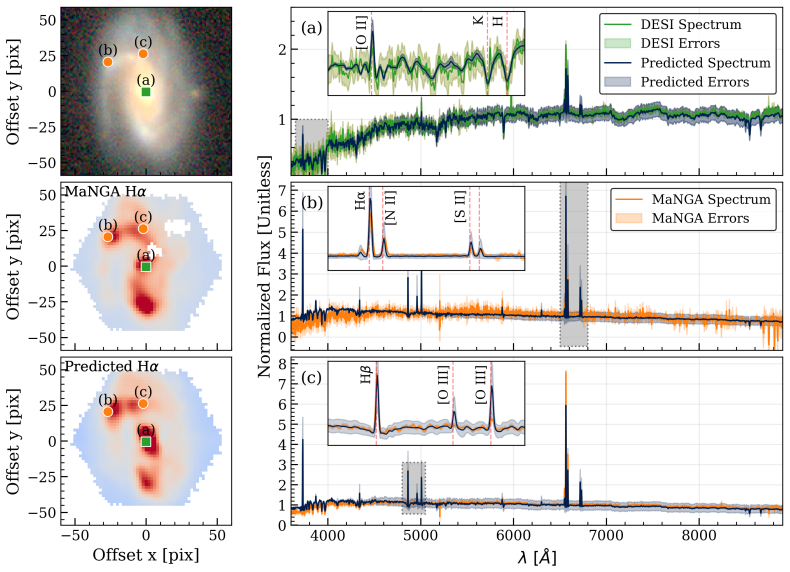
The central discovery is that emission line flux maps predicted by the model for galaxies observed by MaNGA agree with the actual IFU measurements at a level comparable to that achieved by a model trained directly on MaNGA data.
What carries the argument
Multi-modal masked autoencoder that injects fiber positional encodings and redshift-aware wavelength encodings into image-based predictions of spectra.
If this is right
- Predicted emission line maps match independent MaNGA observations.
- Performance reaches levels comparable to a supervised baseline trained on IFU data.
- Calibrated uncertainties are provided for each spectral prediction.
- The method works without any IFU training data by exploiting fiber placement variance and galaxy self-similarity.
Where Pith is reading between the lines
- This approach could extend spatially resolved spectroscopy to samples orders of magnitude larger than current IFU catalogs.
- Similar techniques might reconstruct other spatially resolved properties from sparse sampling in different scientific domains.
- Models like this could help prioritize which galaxies merit expensive full IFU follow-up observations.
- Testing on galaxies with unusual morphologies would reveal the limits of the self-similarity assumption.
Load-bearing premise
The random placements of fibers in the DESI survey plus the morphological self-similarity within galaxies supply enough training signal to learn accurate spectra everywhere without IFU examples.
What would settle it
Finding a large set of galaxies where the model's predicted emission line maps deviate significantly from MaNGA observations in spatial patterns not sampled by single fibers.
Figures

read the original abstract
Integral field unit (IFU) spectroscopy provides spatially resolved spectra across galaxies, offering crucial insights into their evolution. However, its high observational cost limits current IFU datasets to $\sim 10^4$ objects. We present a multi-modal, probabilistic foundation model that predicts high-resolution spectra with calibrated uncertainties at arbitrary spatial locations within a galaxy directly from broadband images. Built on a masked autoencoder framework, our architecture injects fiber positional encodings and redshift aware wavelength encodings, enabling spatially conditioned predictions. Trained on 4.7 million images and single fiber spectroscopic observations from the Dark Energy Spectroscopic Instrument (DESI) survey, our model exploits the natural variance of fiber placements and the morphological self-similarity of galaxies to achieve IFU-like capabilities without any IFU training data. Predicted emission line flux maps match independent IFU observations from the Mapping Nearby Galaxies at APO (MaNGA) survey, with performance comparable to a supervised baseline trained directly on IFU data.
Editorial analysis
A structured set of objections, weighed in public.
Referee Report
Summary. The manuscript presents a masked autoencoder foundation model trained exclusively on 4.7 million DESI single-fiber spectra plus broadband images. Fiber positional encodings and redshift-aware wavelength encodings allow the model to predict high-resolution spectra (including emission-line fluxes) at arbitrary spatial locations. The central claim is that the resulting emission-line flux maps match independent MaNGA IFU observations at a level comparable to a supervised baseline trained directly on IFU data, thereby achieving IFU-like capabilities without any IFU training data.
Significance. If the quantitative claims hold, the work would demonstrate that the natural variance in single-fiber placements combined with morphological self-similarity can substitute for dedicated IFU training data, offering a scalable route to spatially resolved spectroscopy for large galaxy samples.
major comments (2)
- [Abstract] Abstract: the statement that 'predicted emission line flux maps match independent IFU observations from the MaNGA survey, with performance comparable to a supervised baseline' is presented without any numerical metrics (e.g., mean absolute error, R², or spatial correlation coefficients), error bars, sample selection criteria, or description of the comparison procedure. This absence prevents assessment of whether the headline result is load-bearing or merely qualitative.
- The generalization argument (natural variance of DESI fiber placements plus morphological self-similarity) is load-bearing for the zero-shot claim. No control experiment or stratified analysis is described that tests whether broadband morphology remains a faithful proxy for emission-line spatial distributions in galaxies where ionized gas deviates from the stellar continuum (off-center H II regions, outflows, or AGN cones). Without such a test the central claim rests on an unverified assumption.
Simulated Author's Rebuttal
We thank the referee for their thoughtful and constructive review. We address each major comment below and will revise the manuscript accordingly to improve clarity and strengthen the presentation of our results.
read point-by-point responses
-
Referee: [Abstract] Abstract: the statement that 'predicted emission line flux maps match independent IFU observations from the MaNGA survey, with performance comparable to a supervised baseline' is presented without any numerical metrics (e.g., mean absolute error, R², or spatial correlation coefficients), error bars, sample selection criteria, or description of the comparison procedure. This absence prevents assessment of whether the headline result is load-bearing or merely qualitative.
Authors: We agree that the abstract would benefit from greater specificity to allow readers to immediately assess the strength of the central claim. The detailed quantitative comparisons, including MAE, R² values, spatial correlation coefficients, error bars, sample selection, and comparison procedure, are provided in Sections 4 and 5 of the manuscript. In the revised version we will update the abstract to incorporate the key numerical metrics and a concise description of the MaNGA comparison while preserving brevity. revision: yes
-
Referee: [—] The generalization argument (natural variance of DESI fiber placements plus morphological self-similarity) is load-bearing for the zero-shot claim. No control experiment or stratified analysis is described that tests whether broadband morphology remains a faithful proxy for emission-line spatial distributions in galaxies where ionized gas deviates from the stellar continuum (off-center H II regions, outflows, or AGN cones). Without such a test the central claim rests on an unverified assumption.
Authors: This is a fair and important point. While the MaNGA validation sample contains galaxies spanning a range of activity types (including AGN hosts and starbursts where gas-stellar decoupling occurs), we did not perform an explicit stratified analysis by these categories. We will add such a stratified breakdown in the revised manuscript, reporting performance separately for subsamples with AGN, outflows, and off-center H II regions to directly test robustness under morphological mismatch. revision: yes
Circularity Check
No significant circularity; independent external training and test sets
full rationale
The paper trains exclusively on 4.7M DESI single-fiber spectra plus images and evaluates predicted emission-line flux maps against independent MaNGA IFU observations. The abstract and description contain no self-definitional equations, no fitted parameters renamed as predictions, and no load-bearing self-citations. The central claim is an empirical generalization test against held-out external data rather than a reduction to the training inputs by construction.
Axiom & Free-Parameter Ledger
axioms (1)
- domain assumption Morphological self-similarity of galaxies plus natural variance in fiber placements allows learning of spatially resolved spectra without IFU training data
Reference graph
Works this paper leans on
-
[1]
and Ba, Jimmy , title =
Kingma, Diederik P. and Ba, Jimmy , title =. International Conference on Learning Representations (ICLR) , year =
-
[2]
Closing the stellar labels gap: An unsupervised, generative model for Gaia BP/RP spectra. arXiv e-prints , keywords =. doi:10.48550/arXiv.2307.06378 , archivePrefix =. 2307.06378 , primaryClass =
-
[3]
Advances in neural information processing systems , volume=
Attention is all you need , author=. Advances in neural information processing systems , volume=
-
[4]
International conference on machine learning , pages=
Convolutional sequence to sequence learning , author=. International conference on machine learning , pages=. 2017 , organization=
2017
-
[5]
Data Release 1 of the Dark Energy Spectroscopic Instrument
Data Release 1 of the Dark Energy Spectroscopic Instrument. arXiv e-prints , keywords =. doi:10.48550/arXiv.2503.14745 , archivePrefix =. 2503.14745 , primaryClass =
work page internal anchor Pith review Pith/arXiv arXiv doi:10.48550/arxiv.2503.14745
-
[6]
Masked Autoencoders Are Scalable Vision Learners
Masked Autoencoders Are Scalable Vision Learners. arXiv e-prints , keywords =. doi:10.48550/arXiv.2111.06377 , archivePrefix =. 2111.06377 , primaryClass =
work page internal anchor Pith review Pith/arXiv arXiv doi:10.48550/arxiv.2111.06377
-
[7]
AION-1: Omnimodal Foundation Model for Astronomical Sciences. arXiv e-prints , keywords =. doi:10.48550/arXiv.2510.17960 , archivePrefix =. 2510.17960 , primaryClass =
-
[8]
Predicting galaxy spectra from images with hybrid convolutional neural networks. arXiv e-prints , keywords =. doi:10.48550/arXiv.2009.12318 , archivePrefix =. 2009.12318 , primaryClass =
-
[9]
Overview of the SDSS-IV MaNGA Survey: Mapping Nearby Galaxies at Apache Point Observatory
Overview of the SDSS-IV MaNGA Survey: Mapping nearby Galaxies at Apache Point Observatory. , keywords =. doi:10.1088/0004-637X/798/1/7 , archivePrefix =. 1412.1482 , primaryClass =
work page internal anchor Pith review Pith/arXiv arXiv doi:10.1088/0004-637x/798/1/7
-
[10]
The Sloan Digital Sky Survey: Technical Summary
The Sloan Digital Sky Survey: Technical Summary. , keywords =. doi:10.1086/301513 , archivePrefix =. astro-ph/0006396 , primaryClass =
work page internal anchor Pith review Pith/arXiv arXiv doi:10.1086/301513
-
[11]
Overview of the DESI Legacy Imaging Surveys
Overview of the DESI Legacy Imaging Surveys. , keywords =. doi:10.3847/1538-3881/ab089d , archivePrefix =. 1804.08657 , primaryClass =
work page internal anchor Pith review Pith/arXiv arXiv doi:10.3847/1538-3881/ab089d
-
[12]
Overview of the Instrumentation for the Dark Energy Spectroscopic Instrument
Overview of the Instrumentation for the Dark Energy Spectroscopic Instrument. , keywords =. doi:10.3847/1538-3881/ac882b , archivePrefix =. 2205.10939 , primaryClass =
work page internal anchor Pith review Pith/arXiv arXiv doi:10.3847/1538-3881/ac882b
-
[13]
, title =
Newman, Jeffrey A. , title =. Astroparticle Physics , year =
-
[14]
MNRAS531(4), 4990–5011 (2024) arXiv:2310.03024 [astro-ph.IM]
Parker, Liam and Lanusse, Francois and Golkar, Siavash and Sarra, Leopoldo and Cranmer, Miles and Bietti, Alberto and Eickenberg, Michael and Krawezik, Geraud and McCabe, Michael and Morel, Rudy and Ohana, Ruben and Pettee, Mariel and Régaldo-Saint Blancard, Bruno and Cho, Kyunghyun and Ho, Shirley , year=. AstroCLIP: a cross-modal foundation model for ga...
-
[15]
4M: Massively Multimodal Masked Modeling , booktitle =
David Mizrahi* and Roman Bachmann* and Oguzhan Fatih Kar and Teresa Yeo and Mingfei Gao and Afshin Dehghan and Amir Zamir , year =. 4M: Massively Multimodal Masked Modeling , booktitle =
-
[16]
2021 , eprint=
Masked Autoencoders Are Scalable Vision Learners , author=. 2021 , eprint=
2021
-
[17]
2022 , eprint=
MultiMAE: Multi-modal Multi-task Masked Autoencoders , author=. 2022 , eprint=
2022
-
[18]
2021 , eprint=
An Image is Worth 16x16 Words: Transformers for Image Recognition at Scale , author=. 2021 , eprint=
2021
-
[19]
2025 , eprint=
Re-envisioning Euclid Galaxy Morphology: Identifying and Interpreting Features with Sparse Autoencoders , author=. 2025 , eprint=
2025
-
[20]
Said, Khaled and Howlett, Cullan and Davis, Tamara and Lucey, John and Saulder, Christoph and Douglass, Kelly and Kim, Alex G and Kremin, Anthony and Ross, Caitlin and Aldering, Greg and Aguilar, Jessica Nicole and Ahlen, Steven and BenZvi, Segev and Bianchi, Davide and Brooks, David and Claybaugh, Todd and Dawson, Kyle and de la Macorra, Axel and Dey, Bi...
-
[21]
American Astronomical Society Meeting Abstracts \#243 , year = 2024, series =
Photometric Redshifts for Next Generation of Sky Surveys. American Astronomical Society Meeting Abstracts \#243 , year = 2024, series =
2024
discussion (0)
Sign in with ORCID, Apple, or X to comment. Anyone can read and Pith papers without signing in.