Hector Galaxy Survey: Linking the low- and high-mass ends of the initial mass function in star-forming galaxies
Pith reviewed 2026-06-27 12:38 UTC · model grok-4.3
The pith
The IMF in star-forming galaxies is not universal, with low- and high-mass slopes showing weak correlation and ties to galaxy properties.
A machine-rendered reading of the paper's core claim, the machinery that carries it, and where it could break.
Core claim
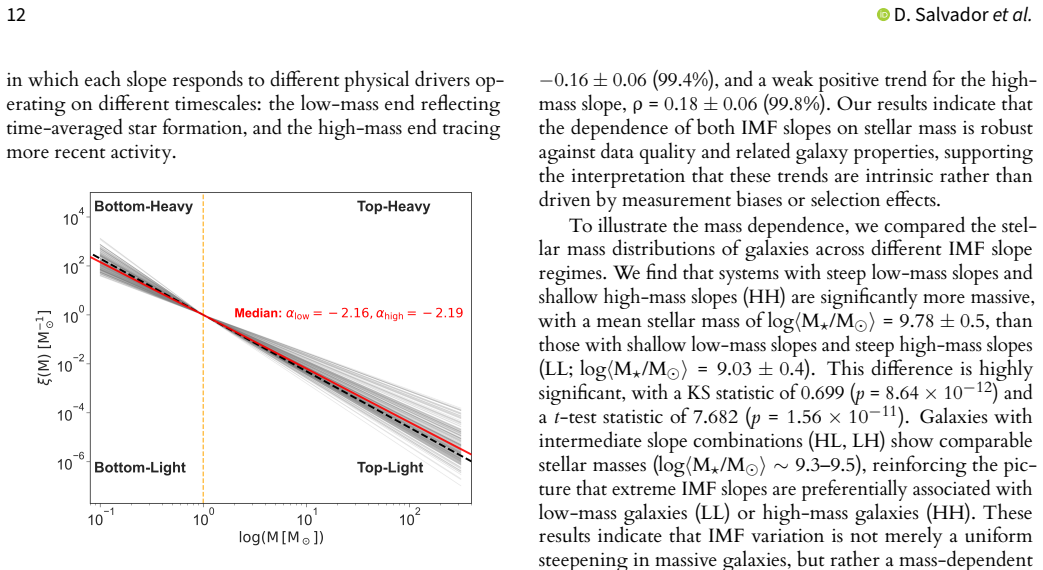
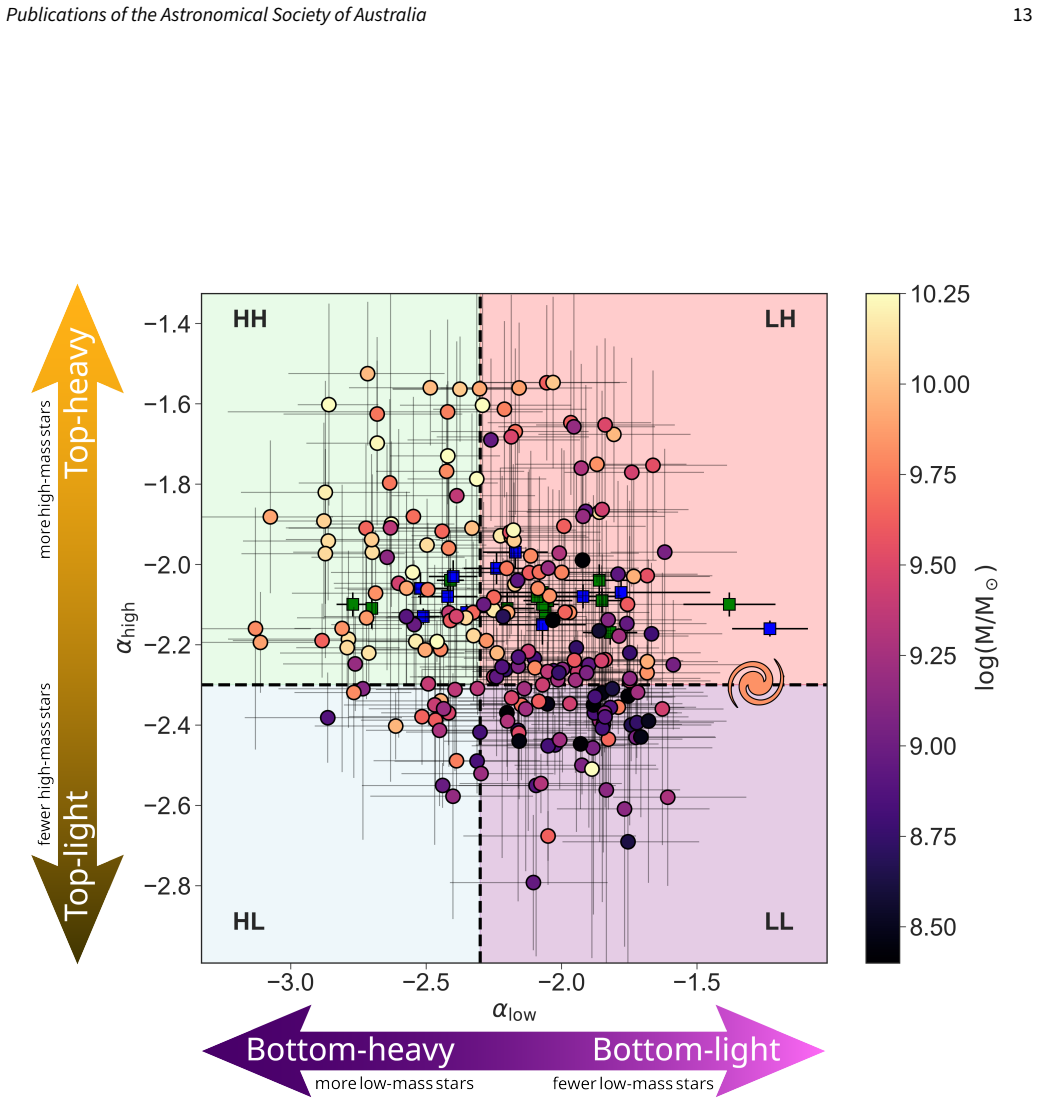
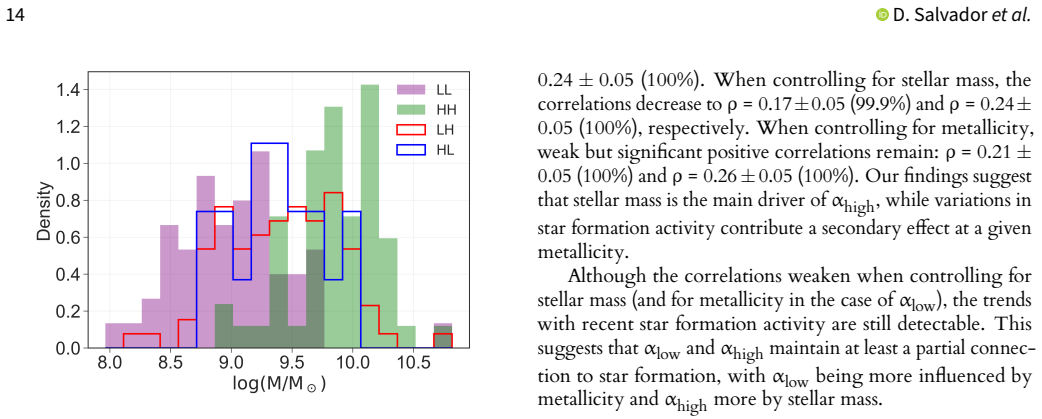
The first simultaneous analysis of both IMF ends in star-forming galaxies reveals substantial diversity in shapes and a weak but robust correlation between low- and high-mass slopes. Both slopes correlate with stellar mass, star formation activity, and [M/H], with higher values linked to bottom-heavy and top-heavy IMFs. Partial correlations show the low-mass slope driven primarily by metallicity and the high-mass slope by stellar mass and recent star formation. Since the low-mass slope averages over long timescales and the high-mass over recent ones, the processes likely occur on decoupled timescales. This challenges IMF universality and requires flexible prescriptions in galaxy evolution mo
What carries the argument
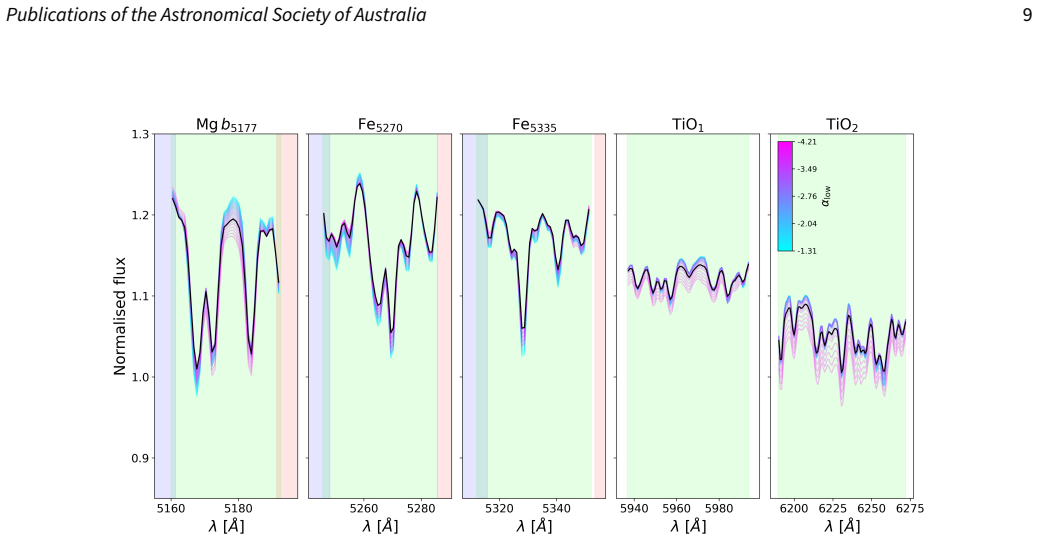
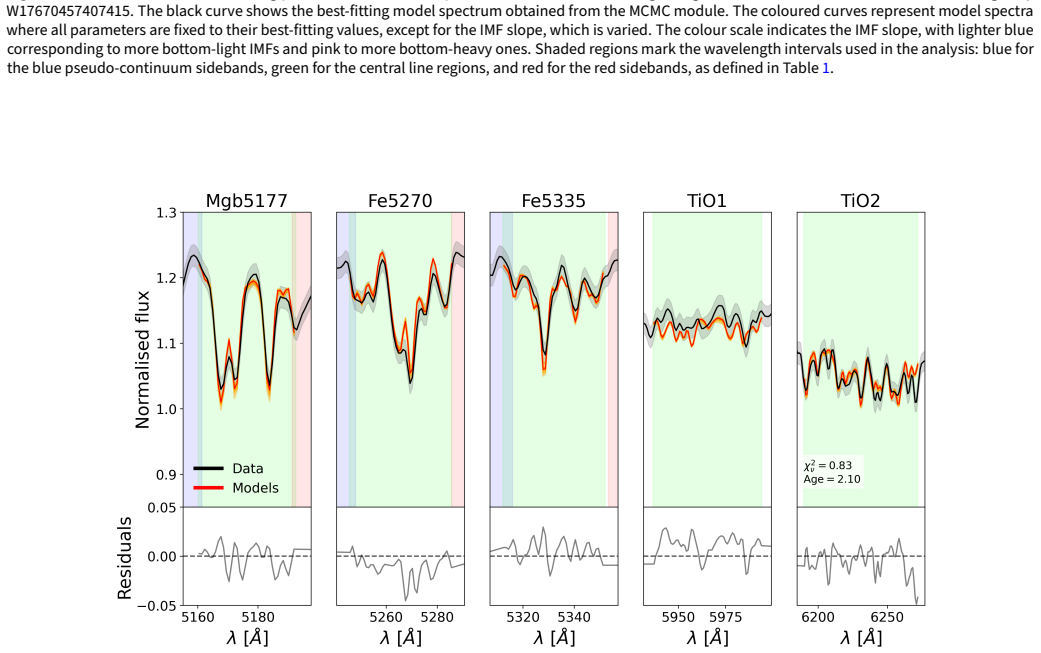
Simultaneous IMF slope estimation via stellar population synthesis fitting of absorption features for the low-mass end and the Kennicutt diagnostic using H-alpha and color for the high-mass end.
Load-bearing premise
The models used to fit the spectral features and the Kennicutt diagnostic recover the true IMF slopes accurately, without large biases from dust, complex star formation histories, or other unaccounted galaxy properties.
What would settle it
Independent measurements of the IMF slopes in the same galaxies using methods such as gravitational lensing or stellar dynamics that show either no correlation between the ends or no dependence on mass and metallicity would falsify the central findings.
Figures





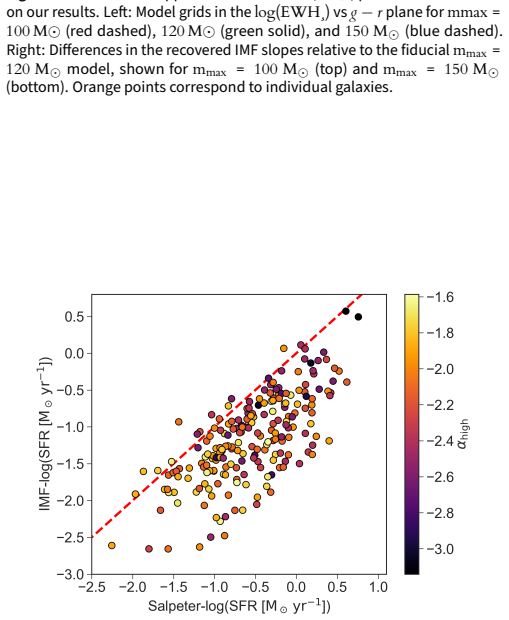
read the original abstract
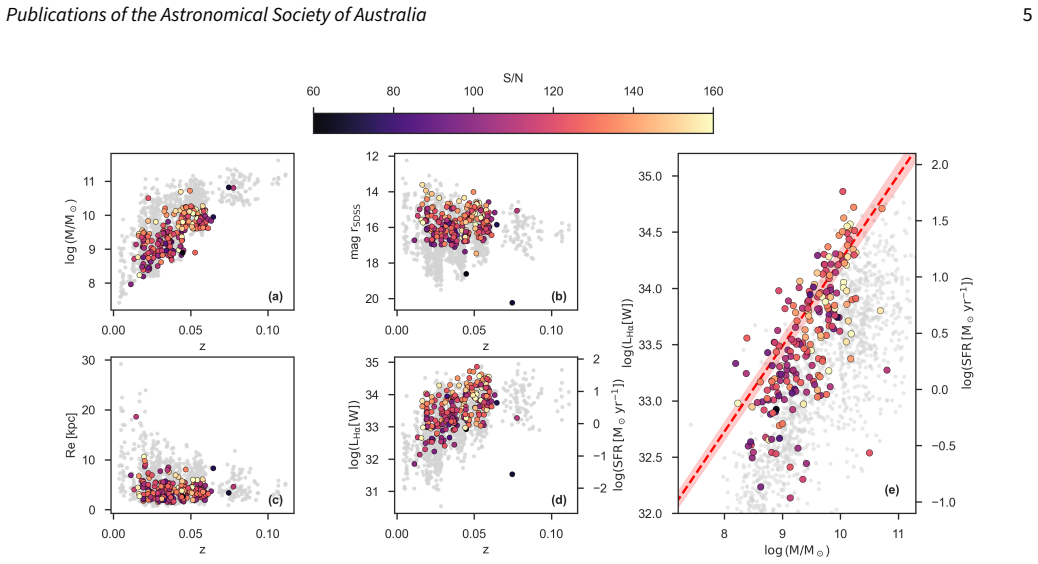
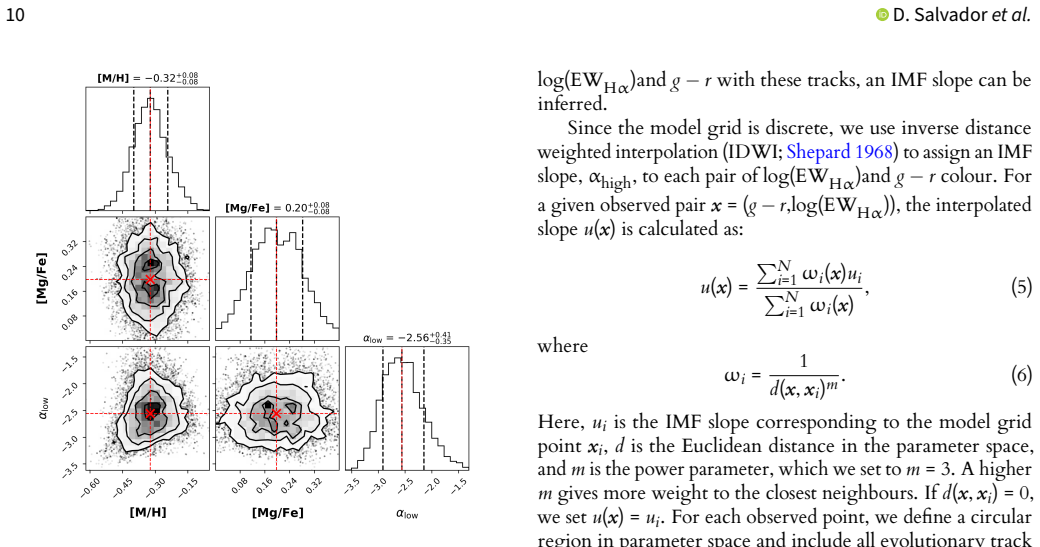
The stellar initial mass function (IMF) is a fundamental ingredient in galaxy evolution, linking observed integrated light to galaxy properties. Constraining the full IMF shape beyond the Milky Way remains challenging, as most studies focus either on the low-mass end of quiescent galaxies or the high-mass end of star-forming galaxies. Here we present the first simultaneous analysis of both ends of the IMF in 214 star-forming galaxies from the Hector survey. We estimate the low-mass end slope using a stellar population approach that fits IMF-sensitive absorption features with extended star formation histories, while the high-mass end slope is derived via the Kennicutt diagnostic, which compares the observed H-alpha equivalent width and g-r colour with stellar population synthesis model predictions. We find substantial diversity in IMF shapes and a weak but statistically robust correlation between the low- and high-mass IMF slopes. Both IMF slopes show significant correlations with stellar mass, star formation activity, and stellar metallicity ([M/H]). In general, higher stellar mass, stronger star formation activity, and higher metallicity are associated with both bottom-heavy and top-heavy IMFs. Partial correlation analysis reveals that the low-mass end slope is primarily driven by [M/H], whereas the high-mass end is mainly linked to stellar mass and recent star formation. Because the low-mass end slope traces the IMF over long-term averages and the high-mass end slope captures only recent star formation, the processes shaping each end likely occur over different and possibly decoupled timescales. Our findings challenge the universality of the IMF and emphasise the need for galaxy evolution and stellar population models to incorporate a flexible IMF prescription. Accounting for these variations is essential to build an IMF-consistent picture of galaxy evolution across cosmic time.
Editorial analysis
A structured set of objections, weighed in public.
Referee Report
Summary. The manuscript analyzes the initial mass function (IMF) in 214 star-forming galaxies from the Hector Galaxy Survey. It employs stellar population synthesis (SPS) modeling to constrain the low-mass IMF slope from absorption features with extended star-formation histories, and the Kennicutt diagnostic (Hα equivalent width vs. g-r color) for the high-mass slope. The authors report substantial diversity in IMF shapes, a weak but robust correlation between low- and high-mass slopes, and correlations of both slopes with stellar mass, star formation activity, and metallicity. Partial correlation analysis suggests different drivers for each end, implying decoupled timescales.
Significance. If the IMF slope measurements are free from significant systematic biases, the results would be significant for challenging the assumption of a universal IMF and for requiring flexible IMF prescriptions in galaxy evolution models. The simultaneous constraint on both ends of the IMF in a large sample of star-forming galaxies is novel, though the correlations are described as weak.
major comments (3)
- [Abstract] Abstract: The central claims of diversity, low-high slope correlation, and trends with mass/SF/metallicity rest on accurate recovery of true IMF slopes, but the abstract (and presumably the methods) provides no quantitative validation such as mock recovery fractions, bias maps, or tests for residual degeneracies with dust attenuation curves and non-parametric SFH components.
- [Methods] Methods (SPS and Kennicutt sections): It is unclear whether the SPS fits fully marginalize over flexible recent bursts on top of extended SFH or varied dust laws; without this, the recovered slopes may covary with the same observables (mass, [M/H], SFR) used in the partial correlation analysis, undermining the reported drivers.
- [Results] Results (partial correlation analysis): The claim that low-mass slope is primarily driven by [M/H] while high-mass is linked to mass and recent SF requires demonstration that the two IMF estimators are not sharing systematic errors from unmodeled galaxy properties; no such cross-check is described.
minor comments (2)
- [Abstract] The abstract would be strengthened by reporting the actual correlation coefficients, p-values, and sample selection criteria rather than qualitative descriptors.
- Notation for the low-mass and high-mass slopes should be defined consistently and early (e.g., Γ_low and Γ_high) to aid readability.
Simulated Author's Rebuttal
We thank the referee for their careful reading and constructive feedback on our manuscript. We address each major comment below. Where the concerns identify gaps in validation or clarification, we have revised the manuscript accordingly to strengthen the presentation of our results on IMF diversity and correlations.
read point-by-point responses
-
Referee: [Abstract] Abstract: The central claims of diversity, low-high slope correlation, and trends with mass/SF/metallicity rest on accurate recovery of true IMF slopes, but the abstract (and presumably the methods) provides no quantitative validation such as mock recovery fractions, bias maps, or tests for residual degeneracies with dust attenuation curves and non-parametric SFH components.
Authors: We agree that explicit quantitative validation strengthens the central claims. While the methods section outlines the SPS and Kennicutt approaches and notes internal consistency checks, we did not include detailed mock recovery statistics or bias maps in the submitted version. We have added a new appendix with mock tests showing recovery fractions and bias assessments for both IMF estimators, including tests varying dust laws and SFH parametrizations. The abstract has been updated to reference these validations. revision: yes
-
Referee: [Methods] Methods (SPS and Kennicutt sections): It is unclear whether the SPS fits fully marginalize over flexible recent bursts on top of extended SFH or varied dust laws; without this, the recovered slopes may covary with the same observables (mass, [M/H], SFR) used in the partial correlation analysis, undermining the reported drivers.
Authors: The SPS modeling uses extended SFHs with multiple age bins to capture variations, but does not fully marginalize over arbitrary recent bursts or all alternative dust attenuation curves. This is a valid concern for potential covariances. We have revised the methods section to explicitly state the SFH and dust assumptions, added sensitivity tests marginalizing over additional burst parameters and dust laws, and included a discussion of how these affect the partial correlations. The Kennicutt diagnostic section was clarified similarly. revision: partial
-
Referee: [Results] Results (partial correlation analysis): The claim that low-mass slope is primarily driven by [M/H] while high-mass is linked to mass and recent SF requires demonstration that the two IMF estimators are not sharing systematic errors from unmodeled galaxy properties; no such cross-check is described.
Authors: The partial correlation analysis controls for inter-variable dependencies to identify primary drivers. To directly address potential shared systematics between the two independent IMF estimators, we have added cross-checks in the results section, including sample splits by metallicity and SFR, residual analysis, and comparison of IMF slopes against unmodeled properties. These confirm that the reported drivers are not dominated by shared errors from the estimators. revision: yes
Circularity Check
No significant circularity; derivation is data-driven from observations
full rationale
The paper estimates low-mass IMF slope by fitting observed absorption features to SPS models with extended SFHs, and high-mass slope via Kennicutt diagnostic on Hα EW and g-r colour. Reported correlations with mass, SFR, and metallicity are statistical outputs from these fits to independent data. No equations reduce the slopes or correlations to quantities defined by the fit itself, and no self-citation chains or ansatzes are invoked as load-bearing for the central claims. This matches the expected non-finding for a purely empirical analysis against external SPS models.
Axiom & Free-Parameter Ledger
axioms (2)
- domain assumption Stellar population synthesis models correctly map IMF-sensitive absorption features to low-mass slope when star-formation history is extended.
- domain assumption The Kennicutt diagnostic isolates the high-mass IMF slope from H-alpha equivalent width and g-r colour without significant contamination.
Reference graph
Works this paper leans on
-
[1]
The Stability of a Spherical Nebula. Philosophical Transactions of the Royal Society of London Series A , year = 1902, month = jan, volume =. doi:10.1098/rsta.1902.0012 , adsurl =
-
[2]
An Analysis of the Shapes of Interstellar Extinction Curves. V. The IR-through-UV Curve Morphology. , keywords =. doi:10.1086/518158 , archivePrefix =. 0705.0154 , primaryClass =
work page internal anchor Pith review Pith/arXiv arXiv doi:10.1086/518158
-
[3]
Metal-rich, Metal-poor: Updated Stellar Population Models for Old Stellar Systems
Metal-rich, Metal-poor: Updated Stellar Population Models for Old Stellar Systems. , keywords =. doi:10.3847/1538-4357/aaab49 , archivePrefix =. 1801.10185 , primaryClass =
work page internal anchor Pith review Pith/arXiv arXiv doi:10.3847/1538-4357/aaab49
-
[4]
sMILES: a library of semi-empirical MILES stellar spectra with variable [ /Fe] abundances. , keywords =. doi:10.1093/mnras/stab1001 , archivePrefix =. 2104.04822 , primaryClass =
-
[5]
The Character of M Dwarfs. , keywords =. doi:10.1146/annurev-astro-052722-102740 , adsurl =
-
[6]
, year = 1997, month = jan, volume =
Model Atmospheres of Very Low Mass Stars and Brown Dwarfs. , year = 1997, month = jan, volume =. doi:10.1146/annurev.astro.35.1.137 , adsurl =
-
[7]
The Distribution of Low-Mass Stars in the Galactic Disc. , keywords =. doi:10.1093/mnras/262.3.545 , adsurl =
-
[8]
The Initial Mass Function and Stellar Birthrate in the Solar Neighborhood. , keywords =. doi:10.1086/190629 , adsurl =
-
[9]
The Physical Origin of the Stellar Initial Mass Function. , keywords =. doi:10.1146/annurev-astro-052622-031748 , archivePrefix =. 2404.07301 , primaryClass =
-
[10]
Massive Star Formation at Supersolar Metallicities: Constraints on the Initial Mass Function. arXiv e-prints , keywords =. doi:10.48550/arXiv.2509.20440 , archivePrefix =. 2509.20440 , primaryClass =
-
[11]
The statistical properties of stars and their dependence on metallicity: the effects of opacity
The statistical properties of stars and their dependence on metallicity: the effects of opacity. , keywords =. doi:10.1093/mnras/stu795 , archivePrefix =. 1405.5583 , primaryClass =
work page internal anchor Pith review Pith/arXiv arXiv doi:10.1093/mnras/stu795
-
[12]
Multimass modelling of Milky Way globular clusters – I
Dickson, N and Hénault-Brunet, V and Baumgardt, H and Gieles, M and Smith, P J , year=. Multimass modelling of Milky Way globular clusters – I. Implications on their stellar initial mass function above 1 M⊙ , volume=. Monthly Notices of the Royal Astronomical Society , publisher=. doi:10.1093/mnras/stad1254 , number=
-
[13]
Evidence for a bottom-light initial mass function in massive star clusters. , keywords =. doi:10.1093/mnras/stad631 , archivePrefix =. 2303.01636 , primaryClass =
-
[14]
Quantifying the Effects of Known Unknowns on Inferred High-redshift Galaxy Properties: Burstiness, IMF, and Nebular Physics. , keywords =. doi:10.3847/1538-4357/ad187c , archivePrefix =. 2310.06781 , primaryClass =
-
[15]
Publications of the Astronomical Society of Australia , author=
Hector Galaxy Survey: Data Processing, Quality Control and Early Science , DOI=. Publications of the Astronomical Society of Australia , author=. 2025 , pages=
2025
-
[16]
The cosmic evolution of metallicity from the SDSS fossil record. , keywords =. doi:10.1111/j.1365-2966.2008.13981.x , archivePrefix =. 0804.3091 , primaryClass =
-
[17]
Stellar populations and physical properties of starbursts in the antennae galaxy from self-consistent modelling of MUSE spectra. , keywords =. doi:10.1093/mnras/staa2158 , archivePrefix =. 1912.08151 , primaryClass =
-
[18]
CALIFA, the Calar Alto Legacy Integral Field Area survey. III. Second public data release. , keywords =. doi:10.1051/0004-6361/201425080 , archivePrefix =. 1409.8302 , primaryClass =
work page internal anchor Pith review Pith/arXiv arXiv doi:10.1051/0004-6361/201425080
-
[19]
CALIFA, the Calar Alto Legacy Integral Field Area survey - II. First public data release⋆ , DOI= "10.1051/0004-6361/201220582", url= "https://doi.org/10.1051/0004-6361/201220582", journal =
-
[20]
The Effects of Stellar Rotation. II. A Comprehensive Set of Starburst99 Models. , keywords =. doi:10.1088/0067-0049/212/1/14 , archivePrefix =. 1403.5444 , primaryClass =
work page internal anchor Pith review Pith/arXiv arXiv doi:10.1088/0067-0049/212/1/14
-
[21]
and Meynet, Georges and Morisset, Christophe and Sander, Andreas A
Hawcroft, Calum and Leitherer, Claus and Aranguré, Oskar and Chisholm, John and Ekström, Sylvia and Martinet, Sébastien and Martins, Lucimara P. and Meynet, Georges and Morisset, Christophe and Sander, Andreas A. C. and Wofford, Aida , year=. pySTARBURST99: The Next Generation of S<scp>TARBURST</scp>99 , volume=. The Astrophysical Journal Supplement Serie...
-
[22]
Dust attenuation in z $\sim$ 1 galaxies from Herschel and 3D-HST H$\alpha$ measurements
Dust attenuation in z -0.5ex 1 galaxies from Herschel and 3D-HST H measurements. , keywords =. doi:10.1051/0004-6361/201526782 , archivePrefix =. 1507.00005 , primaryClass =
work page internal anchor Pith review Pith/arXiv arXiv doi:10.1051/0004-6361/201526782
-
[23]
Dependence of the IRX- Dust Attenuation Relation on Metallicity and Environment. , keywords =. doi:10.3847/2041-8213/abc1ef , archivePrefix =. 2010.10538 , primaryClass =
-
[24]
A UBVR CCD Survey of the Magellanic Clouds
A UBVR CCD Survey of the Magellanic Clouds. , keywords =. doi:10.1086/338286 , archivePrefix =. astro-ph/0110531 , primaryClass =
work page internal anchor Pith review Pith/arXiv arXiv doi:10.1086/338286
-
[25]
Galaxy And Mass Assembly (GAMA): Linking Star Formation Histories and Stellar Mass Growth
Galaxy And Mass Assembly (GAMA): linking star formation histories and stellar mass growth. , keywords =. doi:10.1093/mnras/stt1011 , archivePrefix =. 1306.2424 , primaryClass =
work page internal anchor Pith review Pith/arXiv arXiv doi:10.1093/mnras/stt1011
-
[26]
Ground-based and Airborne Instrumentation for Astronomy VII , editor =
Robert Content and Will Saunders and Jon Lawrence and Julia Bryant and Ross Zhelem , title =. Ground-based and Airborne Instrumentation for Astronomy VII , editor =. 2018 , doi =
2018
-
[27]
Ground-based and Airborne Instrumentation for Astronomy IX , editor =
Ross Zhelem and Julia Bryant and Joss Bland-Hawthorn and Rebecca Brown and Robert Content and Scott Croom and Tony Farrell and Michael Goodwin and Ellen Houston and Urs Klauser and Jon Lawrence and Slavko Mali and Rolf Muller and Richard Mcdermid and Helen McGregor and Mahesh Mohanan and Barnaby Norris and Naveen Pai and David Robertson and Will Saunders ...
2022
-
[28]
Dark Matter Contraction and the Stellar Content of Massive Early-type Galaxies: Disfavoring ``Light'' Initial Mass Functions. , keywords =. doi:10.1088/2041-8205/721/2/L163 , archivePrefix =. 1007.2409 , primaryClass =
work page internal anchor Pith review Pith/arXiv arXiv doi:10.1088/2041-8205/721/2/l163 2041
-
[29]
AN OBJECTIVE DEFINITION FOR THE MAIN SEQUENCE OF STAR-FORMING GALAXIES , volume=
Renzini, Alvio and Peng, Ying-jie , year=. AN OBJECTIVE DEFINITION FOR THE MAIN SEQUENCE OF STAR-FORMING GALAXIES , volume=. The Astrophysical Journal , publisher=. doi:10.1088/2041-8205/801/2/l29 , number=
-
[30]
On the Nature of Sodium Excess Objects. I. Data and Observed Trends. , keywords =. doi:10.1088/0067-0049/208/1/7 , archivePrefix =. 1307.1472 , primaryClass =
work page internal anchor Pith review Pith/arXiv arXiv doi:10.1088/0067-0049/208/1/7
-
[31]
Stellar population models of Lick indices with variable element abundance ratios. , keywords =. doi:10.1046/j.1365-8711.2003.06248.x , archivePrefix =. astro-ph/0209250 , primaryClass =
-
[32]
Old Stellar Populations. V. Absorption Feature Indices for the Complete Lick/IDS Sample of Stars. , keywords =. doi:10.1086/192087 , adsurl =
-
[33]
Evidence for a Mild Steepening and Bottom-heavy Initial Mass Function in Massive Galaxies from Sodium and Titanium-oxide Indicators. , keywords =. doi:10.1088/2041-8205/753/2/L32 , archivePrefix =. 1204.3823 , primaryClass =
work page internal anchor Pith review Pith/arXiv arXiv doi:10.1088/2041-8205/753/2/l32 2041
-
[34]
The Initial Mass Function of Stars: Evidence for Uniformity in Variable Systems
The Initial Mass Function of Stars: Evidence for Uniformity in Variable Systems. Science , keywords =. doi:10.1126/science.1067524 , archivePrefix =. astro-ph/0201098 , primaryClass =
work page internal anchor Pith review Pith/arXiv arXiv doi:10.1126/science.1067524
-
[35]
The SAMI Galaxy Survey: Data Release Two with absorption-line physics value-added products
The SAMI Galaxy Survey: Data Release Two with absorption-line physics value-added products. , keywords =. doi:10.1093/mnras/sty2355 , archivePrefix =. 1808.03365 , primaryClass =
work page internal anchor Pith review Pith/arXiv arXiv doi:10.1093/mnras/sty2355
-
[36]
Performance of AAOmega: the AAT multi-purpose fiber-fed spectrograph , volume=
Sharp, Robert and Saunders, Will and Smith, Greg and Churilov, Vladimir and Correll, David and Dawson, John and Farrel, Tony and Frost, Gabriella and Haynes, Roger and Heald, Ron and Lankshear, Allan and Mayfield, Don and Waller, Lew and Whittard, Dennis , editor=. Performance of AAOmega: the AAT multi-purpose fiber-fed spectrograph , volume=. 2006 , mont...
-
[37]
Focal ratio degradation in optical fibres for the Hector integral field units. , keywords =. doi:10.1093/mnras/stad1273 , adsurl =
-
[38]
Ground-based and Airborne Instrumentation for Astronomy VIII , year = 2020, editor =
The Hector Instrument: performance of the Hector fibre integral field units. Ground-based and Airborne Instrumentation for Astronomy VIII , year = 2020, editor =. doi:10.1117/12.2561514 , adsurl =
-
[39]
Development and focal ratio degradation optimisation of integral field units on Hector. UV/Optical/IR Space Telescopes and Instruments: Innovative Technologies and Concepts IX , year = 2019, editor =. doi:10.1117/12.2529212 , adsurl =
-
[40]
New-generation hexabundles: development and initial results. Advances in Optical and Mechanical Technologies for Telescopes and Instrumentation III , year = 2018, editor =. doi:10.1117/12.2313033 , adsurl =
-
[41]
Focal ratio degradation in lightly-fused hexabundles
Focal ratio degradation in lightly fused hexabundles. , keywords =. doi:10.1093/mnras/stt2254 , archivePrefix =. 1311.6865 , primaryClass =
work page internal anchor Pith review Pith/arXiv arXiv doi:10.1093/mnras/stt2254
-
[43]
Ground-based and Airborne Instrumentation for Astronomy X , year = 2024, editor =
Hector: performance of the new integral field spectrograph instrument for the Anglo-Australian Telescope. Ground-based and Airborne Instrumentation for Astronomy X , year = 2024, editor =. doi:10.1117/12.3016340 , adsurl =
-
[44]
The galaxy-wide IMF of dwarf late-type to massive early-type galaxies
The galaxy-wide initial mass function of dwarf late-type to massive early-type galaxies. , keywords =. doi:10.1093/mnras/stt1806 , archivePrefix =. 1309.6634 , primaryClass =
work page internal anchor Pith review Pith/arXiv arXiv doi:10.1093/mnras/stt1806
-
[45]
Counting Low-Mass Stars in Integrated Light
Counting Low-mass Stars in Integrated Light. , keywords =. doi:10.1088/0004-637X/747/1/69 , archivePrefix =. 1109.0007 , primaryClass =
work page internal anchor Pith review Pith/arXiv arXiv doi:10.1088/0004-637x/747/1/69
-
[46]
The SAMI Galaxy Survey: Revisiting Galaxy Classification Through High-Order Stellar Kinematics
The SAMI Galaxy Survey: Revisiting Galaxy Classification through High-order Stellar Kinematics. , keywords =. doi:10.3847/1538-4357/835/1/104 , archivePrefix =. 1611.07039 , primaryClass =
work page internal anchor Pith review Pith/arXiv arXiv doi:10.3847/1538-4357/835/1/104
-
[47]
Chen, Yan-Ping and Trager, S. C. and Peletier, R. F. and Lançon, A. and Vazdekis, A. and Prugniel, Ph. and Silva, D. R. and Gonneau, A. , year=. The X-shooter Spectral Library (XSL): I. DR1: Near-ultraviolet through optical spectra from the first year of the survey⋆ , volume=. doi:10.1051/0004-6361/201322505 , journal=
-
[48]
Classification parameters for the emission-line spectra of extragalactic objects. , keywords =. doi:10.1086/130766 , adsurl =
-
[49]
Variation of the High-mass Slope of the Stellar Initial Mass Function: Theory Meets Observations. , keywords =. doi:10.3847/1538-4357/ad09bc , archivePrefix =. 2309.10842 , primaryClass =
-
[50]
emcee: The MCMC Hammer. , keywords =. doi:10.1086/670067 , archivePrefix =. 1202.3665 , primaryClass =
work page internal anchor Pith review Pith/arXiv arXiv doi:10.1086/670067
-
[51]
The ages and metallicities of galaxies in the local universe. , keywords =. doi:10.1111/j.1365-2966.2005.09321.x , archivePrefix =. astro-ph/0506539 , primaryClass =
-
[52]
Semi-empirical analysis of Sloan Digital Sky Survey galaxies - I. Spectral synthesis method. , keywords =. doi:10.1111/j.1365-2966.2005.08752.x , archivePrefix =. astro-ph/0412481 , primaryClass =
-
[53]
Improving the full spectrum fitting method: accurate convolution with Gauss-Hermite functions
Improving the full spectrum fitting method: accurate convolution with Gauss-Hermite functions. , keywords =. doi:10.1093/mnras/stw3020 , archivePrefix =. 1607.08538 , primaryClass =
work page internal anchor Pith review Pith/arXiv arXiv doi:10.1093/mnras/stw3020
-
[54]
Full spectrum fitting with photometry in PPXF: stellar population versus dynamical masses, non-parametric star formation history and metallicity for 3200 LEGA-C galaxies at redshift z 0.8. , keywords =. doi:10.1093/mnras/stad2597 , archivePrefix =. 2208.14974 , primaryClass =
-
[55]
Parametric Recovery of Line-of-Sight Velocity Distributions from Absorption-Line Spectra of Galaxies via Penalized Likelihood. , keywords =. doi:10.1086/381875 , archivePrefix =. astro-ph/0312201 , primaryClass =
work page internal anchor Pith review Pith/arXiv arXiv doi:10.1086/381875
-
[56]
, keywords =
Theoretical isochrones from models with new radiative opacities. , keywords =
-
[57]
A library of high resolution synthetic stellar spectra from 300 nm to 1.8 m with solar and -enhanced composition. , keywords =. doi:10.1051/0004-6361:20053511 , archivePrefix =. astro-ph/0505511 , primaryClass =
work page internal anchor Pith review Pith/arXiv arXiv doi:10.1051/0004-6361:20053511
-
[58]
VizieR Online Data Catalog: MILES library of empirical spectra (Sanchez-blazquez+, 2006)
2006
-
[59]
A Large Stellar Evolution Database for Population Synthesis Studies. II. Stellar Models and Isochrones for an -enhanced Metal Distribution. , keywords =. doi:10.1086/501344 , archivePrefix =. astro-ph/0603721 , primaryClass =
work page internal anchor Pith review Pith/arXiv arXiv doi:10.1086/501344
-
[60]
A Large Stellar Evolution Database for Population Synthesis Studies. I. Scaled Solar Models and Isochrones. , keywords =. doi:10.1086/422498 , archivePrefix =. astro-ph/0405193 , primaryClass =
work page internal anchor Pith review Pith/arXiv arXiv doi:10.1086/422498
-
[61]
Young LMC clusters: the role of red supergiants and multiple stellar populations in their integrated light and CMDs. , keywords =. doi:10.1093/mnras/stx1824 , archivePrefix =. 1708.00369 , primaryClass =
work page internal anchor Pith review Pith/arXiv arXiv doi:10.1093/mnras/stx1824
-
[62]
Evolutionary stellar population synthesis with MILES - II. Scaled-solar and \alpha-enhanced models
Evolutionary stellar population synthesis with MILES - II. Scaled-solar and -enhanced models. , keywords =. doi:10.1093/mnras/stv151 , archivePrefix =. 1504.08032 , primaryClass =
work page internal anchor Pith review Pith/arXiv arXiv doi:10.1093/mnras/stv151
-
[63]
Evolutionary stellar population synthesis with MILES - I. The base models and a new line index system. , keywords =. doi:10.1111/j.1365-2966.2010.16407.x , archivePrefix =. 1004.4439 , primaryClass =
-
[65]
, archivePrefix = "arXiv", eprint =
Galaxy And Mass Assembly (GAMA): stellar mass estimates. , keywords =. doi:10.1111/j.1365-2966.2011.19536.x , archivePrefix =. 1108.0635 , primaryClass =
-
[66]
The effect of the environment-dependent stellar initial mass function on the photometric properties of star-forming galaxies. , keywords =. doi:10.1051/0004-6361/202347928 , archivePrefix =. 2405.05313 , primaryClass =
-
[67]
The SAMI Galaxy Survey: _ SFR drives the presence of complex emission-line profiles in star-forming galaxies. , keywords =. doi:10.1093/mnras/stad3747 , archivePrefix =. 2312.03659 , primaryClass =
-
[68]
Dahlgren, Björn , title =. 2018 , publisher =. doi:10.21105/joss.00565 , url =
-
[69]
Stellar population synthesis at the resolution of 2003. , keywords =. doi:10.1046/j.1365-8711.2003.06897.x , archivePrefix =. astro-ph/0309134 , primaryClass =
-
[70]
SPIDER VIII - constraints on the stellar initial mass function of early-type galaxies from a variety of spectral features. , keywords =. doi:10.1093/mnras/stt943 , archivePrefix =. 1305.2273 , primaryClass =
work page internal anchor Pith review Pith/arXiv arXiv doi:10.1093/mnras/stt943
-
[71]
van Dokkum, Pieter G. and Conroy, Charlie , year=. THE STELLAR INITIAL MASS FUNCTION IN EARLY-TYPE GALAXIES FROM ABSORPTION LINE SPECTROSCOPY. I. DATA AND EMPIRICAL TRENDS , volume=. The Astrophysical Journal , publisher=. doi:10.1088/0004-637x/760/1/70 , number=
-
[72]
2024 , eprint=
First detection of CO isotopologues in a high-redshift main-sequence galaxy: evidence of a top-heavy stellar initial mass function , author=. 2024 , eprint=
2024
-
[73]
Extreme CO Isotopic Abundances in the ULIRG IRAS 13120-5453: An Extremely Young Starburst or Top-heavy Initial Mass Function. , keywords =. doi:10.3847/2041-8213/aa6ea4 , archivePrefix =. 1704.06671 , primaryClass =
work page internal anchor Pith review Pith/arXiv arXiv doi:10.3847/2041-8213/aa6ea4 2041
-
[74]
The evolution of CNO isotopes: the impact of massive stellar rotators. , keywords =. doi:10.1093/mnras/stz2741 , archivePrefix =. 1907.09476 , primaryClass =
-
[75]
Star Formation in R136: A Cluster of O3 Stars Revealed by Hubble Space Telescope Spectroscopy. , keywords =. doi:10.1086/305126 , adsurl =
-
[76]
The Stellar Initial Mass Function (38th Herstmonceux Conference) , year = 1998, editor =
The Initial Mass Function of Massive Stars in the Local Group. The Stellar Initial Mass Function (38th Herstmonceux Conference) , year = 1998, editor =
1998
-
[77]
The Origin and Universality of the Stellar Initial Mass Function
The Origin and Universality of the Stellar Initial Mass Function. Protostars and Planets VI , year = 2014, editor =. doi:10.2458/azu_uapress_9780816531240-ch003 , archivePrefix =. 1312.5326 , primaryClass =
work page internal anchor Pith review Pith/arXiv arXiv doi:10.2458/azu_uapress_9780816531240-ch003 2014
-
[78]
Galactic Stellar and Substellar Initial Mass Function
Galactic Stellar and Substellar Initial Mass Function. , keywords =. doi:10.1086/376392 , archivePrefix =. astro-ph/0304382 , primaryClass =
work page internal anchor Pith review Pith/arXiv arXiv doi:10.1086/376392
-
[79]
Modeling the Panchromatic Spectral Energy Distributions of Galaxies
Conroy, Charlie , year=. Modeling the Panchromatic Spectral Energy Distributions of Galaxies , volume=. Annual Review of Astronomy and Astrophysics , publisher=. doi:10.1146/annurev-astro-082812-141017 , number=
work page internal anchor Pith review doi:10.1146/annurev-astro-082812-141017
-
[80]
Fitting the integrated spectral energy distributions of galaxies , volume=
Walcher, Jakob and Groves, Brent and Budavári, Tamás and Dale, Daniel , year=. Fitting the integrated spectral energy distributions of galaxies , volume=. Astrophysics and Space Science , publisher=. doi:10.1007/s10509-010-0458-z , number=
-
[81]
Multi-Epoch High-Spectral-Resolution Observations of Neutral Sodium in 14 Type Ia Supernovae
Multi-epoch high-spectral-resolution observations of neutral sodium in 14 Type Ia supernovae. , keywords =. doi:10.1093/mnras/stu1202 , archivePrefix =. 1311.3645 , primaryClass =
work page internal anchor Pith review Pith/arXiv arXiv doi:10.1093/mnras/stu1202
-
[82]
Poznanski, Dovi and Prochaska, J. Xavier and Bloom, Joshua S. , year=. An empirical relation between sodium absorption and dust extinction: Sodium and dust , volume=. Monthly Notices of the Royal Astronomical Society , publisher=. doi:10.1111/j.1365-2966.2012.21796.x , number=
discussion (0)
Sign in with ORCID, Apple, or X to comment. Anyone can read and Pith papers without signing in.