DIffuse X-ray Explorer (DIXE): Sky Survey Strategy and Collimator Response Demodulation
Pith reviewed 2026-06-27 11:53 UTC · model grok-4.3
The pith
A Markov Chain Monte Carlo demodulation technique lets the DIXE X-ray instrument localize point sources to 1° and resolve extended sources to 3° within its 10° field of view.
A machine-rendered reading of the paper's core claim, the machinery that carries it, and where it could break.
Core claim
Through simulation, the MCMC-based demodulation method applied to the collimator response achieves a localization accuracy of 1° for point-like sources and a spatial resolution of 3° for the extended sources of complex surface brightness distribution, both of which are significantly smaller than the 10° field of view.
What carries the argument
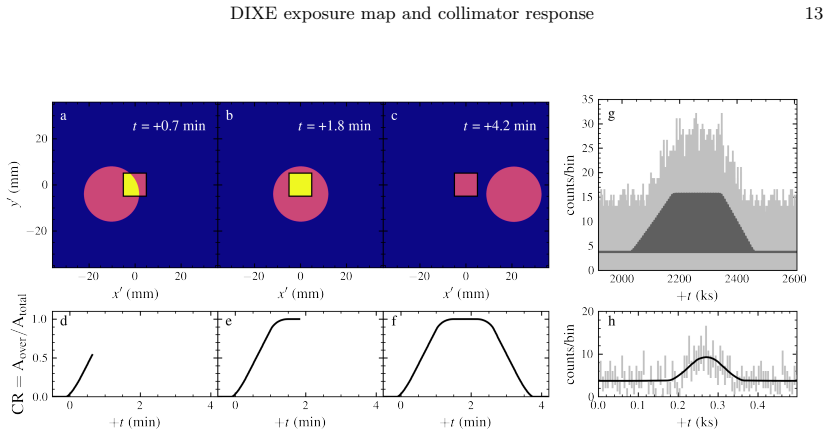
Markov Chain Monte Carlo sampling that demodulates the collimator response to enhance imaging beyond the mechanical field of view.
If this is right
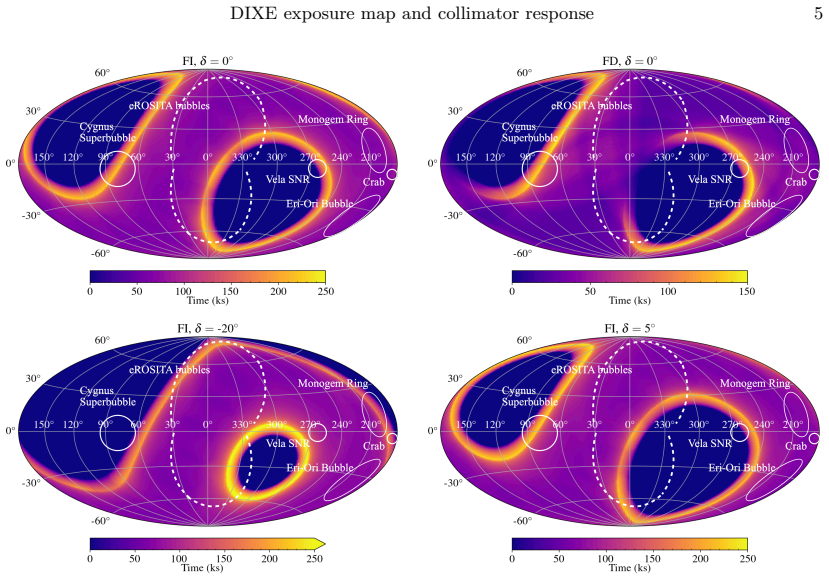
- DIXE achieves approximately 72.5% sky coverage in one year of operation.
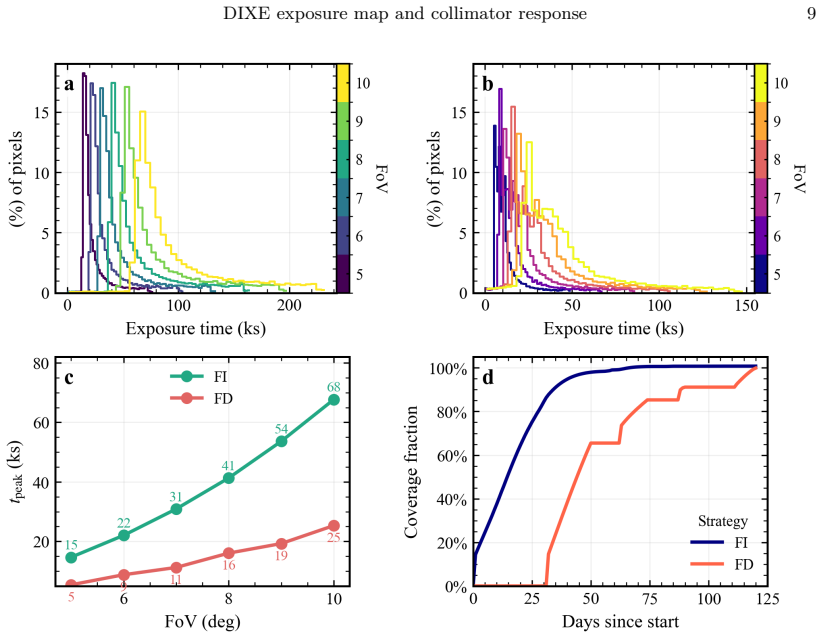
- Two sun-avoidance strategies yield typical exposures of 26 ks and 68 ks respectively.
- The demodulation method applies to the mechanically collimated payload to improve its imaging performance.
- The instrument operates with fixed zenith pointing on the China Space Station while avoiding the Sun by at least 25°.
Where Pith is reading between the lines
- This approach may allow similar collimated X-ray instruments to achieve sub-field-of-view resolution without hardware changes.
- Improved localization could help separate point sources from diffuse emission in Milky Way surveys.
- Applying the method to real data would require validating the collimator response model against on-orbit measurements.
Load-bearing premise
The simulations accurately capture real collimator response, background, and noise without unmodeled systematics that would prevent the MCMC method from reaching the stated 1° and 3° performance on actual data.
What would settle it
Comparison of the method's output positions and maps against known catalog sources or independent high-resolution observations on actual flight data from DIXE or a similar instrument.
Figures






read the original abstract
DIffuse X-ray Explorer (DIXE) is a proposed high-resolution X-ray spectroscopic surveyor aimed at studying large structures of hot gas in the Milky Way. Its payload is designed to have a field of view (FoV) of $10^\circ$ (half-power diameter) and an energy resolution of better than 6 eV, covering an energy range of 0.1-10 keV. It will be mounted on the China Space Station (CSS) and follow the CSS orbit to conduct the survey with fixed zenith pointing in order to optimize the coverage of key science targets. The payload will avoid the Sun passively via an operable sunshade, where a minimum $25^\circ$ angular separation between the pointing axis and the direction of the Sun is required. Two Sun-avoidance strategies are considered: one focusing on minimizing mechanical risk and the other on maximizing exposure time. The one-year exposure maps indicate that DIXE will cover approximately $72.5\%$ of the sky, with typical exposure times of 26 ks and 68 ks for the two strategies, respectively. Although mechanically collimated, the imaging performance of the payload can be enhanced with a demodulation method based on Markov Chain Monte Carlo sampling using the collimator response. Through simulation, we found that the method could achieve a localization accuracy of $1^\circ$ for point-like sources and a spatial resolution of $3^\circ$ for the extended sources of complex surface brightness distribution, both of which are significantly smaller than the FoV.
Editorial analysis
A structured set of objections, weighed in public.
Referee Report
Summary. The manuscript proposes the DIffuse X-ray Explorer (DIXE) payload for high-resolution X-ray spectroscopy (0.1-10 keV, <6 eV resolution) on the China Space Station with a 10° FoV collimated instrument. It compares two sun-avoidance strategies (minimum 25° separation) that yield 72.5% sky coverage and one-year exposures of 26 ks or 68 ks. It further presents an MCMC demodulation approach that, according to simulations, recovers 1° localization for point sources and 3° resolution for complex extended sources.
Significance. If the simulation results hold under realistic conditions, the MCMC demodulation technique would provide a practical route to sub-FoV imaging performance with mechanically collimated detectors, directly benefiting studies of extended hot-gas structures. The exposure-map calculations and explicit comparison of the two sun-avoidance strategies supply concrete, mission-planning data. The work is strengthened by its emphasis on simulation-derived performance metrics.
major comments (2)
- [Abstract] Abstract (simulation paragraph): the reported 1° point-source localization and 3° extended-source resolution rest entirely on simulations whose forward model (collimator transmission function, background spectrum and variability, detector noise) is described only at the abstract level; without explicit parameterization or validation against possible on-orbit mismatches, the central performance claims cannot be assessed for robustness.
- [Simulation section] Simulation description: no recovery tests, analytic validation, or sensitivity analysis (e.g., degradation under thermal distortion of the collimator or orbit-dependent particle background) are presented to bound the risk that unmodeled systematics would broaden the MCMC posteriors beyond the quoted 1°/3° values.
Simulated Author's Rebuttal
We thank the referee for the constructive feedback on our manuscript. The comments highlight important areas where the simulation methodology requires greater transparency and validation to support the performance claims. We agree with the assessment and will revise the manuscript accordingly by expanding the relevant sections.
read point-by-point responses
-
Referee: [Abstract] Abstract (simulation paragraph): the reported 1° point-source localization and 3° extended-source resolution rest entirely on simulations whose forward model (collimator transmission function, background spectrum and variability, detector noise) is described only at the abstract level; without explicit parameterization or validation against possible on-orbit mismatches, the central performance claims cannot be assessed for robustness.
Authors: We agree that the abstract provides only a summary-level description. The full manuscript contains a simulation section describing the MCMC approach and collimator response, but we acknowledge that explicit parameterization of the forward model (transmission function, background spectrum and variability, detector noise) and discussion of on-orbit mismatches are not sufficiently detailed. In the revised version we will add these explicit parameters and a brief assessment of mismatch effects. revision: yes
-
Referee: [Simulation section] Simulation description: no recovery tests, analytic validation, or sensitivity analysis (e.g., degradation under thermal distortion of the collimator or orbit-dependent particle background) are presented to bound the risk that unmodeled systematics would broaden the MCMC posteriors beyond the quoted 1°/3° values.
Authors: The current manuscript reports the simulation outcomes but does not present recovery tests, analytic validation, or sensitivity analyses for systematics such as thermal distortion or orbit-dependent background. We accept this as a valid criticism. The revised manuscript will incorporate recovery tests on simulated data with known inputs and a sensitivity analysis quantifying the impact of the listed systematics on the reported 1° localization and 3° resolution. revision: yes
Circularity Check
No circularity; performance figures are simulation outputs, not tautological restatements
full rationale
The paper's key claims (1° point-source localization and 3° extended-source resolution) are explicitly stated as results obtained through simulation of the MCMC demodulation method applied to the collimator response. These are independent forward-model outputs rather than quantities defined in terms of themselves or recovered by construction from fitted parameters. No self-citation chains, uniqueness theorems, ansatzes smuggled via prior work, or renaming of known results appear in the provided text. The derivation chain consists of survey strategy calculations and simulation validation, both of which remain self-contained against external benchmarks.
Axiom & Free-Parameter Ledger
free parameters (2)
- 25° sun angular separation
- one-year exposure times (26 ks, 68 ks)
axioms (1)
- domain assumption Collimator response function is known exactly and can be used as input to MCMC sampling for source reconstruction.
Reference graph
Works this paper leans on
-
[1]
Detection of large-scale X-ray bubbles in the Milky Way halo. Nature , keywords =. doi:10.1038/s41586-020-2979-0 , archivePrefix =. 2012.05840 , primaryClass =
-
[2]
NGC 3079: X-ray emission from the nuclear super-bubble and halo
NGC 3079: X-ray emission from the nuclear super-bubble and halo. , keywords =. doi:10.48550/arXiv.astro-ph/9810099 , archivePrefix =. astro-ph/9810099 , primaryClass =
work page internal anchor Pith review Pith/arXiv arXiv doi:10.48550/arxiv.astro-ph/9810099
-
[3]
Chandra Observations of NGC 253. II. On the Origin of Diffuse X-Ray Emission in the Halos of Starburst Galaxies. , keywords =. doi:10.1086/338889 , archivePrefix =. astro-ph/0111511 , primaryClass =
work page internal anchor Pith review Pith/arXiv arXiv doi:10.1086/338889
-
[4]
2001, MNRAS, 322, 231, doi: 10.1046/j.1365-8711.2001.04022.x
The energetics and mass loss of the dwarf starburst Markarian 33. , keywords =. doi:10.1046/j.1365-8711.2001.04722.x , archivePrefix =. astro-ph/0106475 , primaryClass =
-
[5]
Kinematic Evidence for Superbubbles in I ZW 18: Constraints on the Star Formation History and Chemical Evolution. , keywords =. doi:10.1086/177453 , archivePrefix =. astro-ph/9601107 , primaryClass =
work page internal anchor Pith review Pith/arXiv arXiv doi:10.1086/177453
-
[6]
An X-Ray and Optical Study of the Dwarf Galaxy NGC 1569: Evidence for a Starburst-driven Outflow. , keywords =. doi:10.1086/175944 , adsurl =
-
[7]
Chandra observation of NGC 4449: analysis of the X-ray emission from a dwarf starburst galaxy. , keywords =. doi:10.1046/j.1365-8711.2003.06590.x , archivePrefix =. astro-ph/0303251 , primaryClass =
-
[8]
R-matrix Electron-impact Excitation Data for the H- and He-like Ions with Z = 6-30. , keywords =. doi:10.3847/1538-4365/ac9c57 , archivePrefix =. 2210.13427 , primaryClass =
-
[9]
Thermal Radiation Processes. , keywords =. doi:10.1007/s11214-008-9310-y , archivePrefix =. 0801.1011 , primaryClass =
work page internal anchor Pith review Pith/arXiv arXiv doi:10.1007/s11214-008-9310-y
-
[10]
AAS/High Energy Astrophysics Division \#12 , year = 2011, series =
Handbook Of X-ray Astronomy. AAS/High Energy Astrophysics Division \#12 , year = 2011, series =
2011
-
[11]
The eROSITA X-ray telescope on SRG. , keywords =. doi:10.1051/0004-6361/202039313 , archivePrefix =. 2010.03477 , primaryClass =
-
[12]
Journal of Low Temperature Physics , keywords =
DIffuse X-ray Explorer: A High-Resolution X-ray Spectroscopic Sky Surveyor on the China Space Station. Journal of Low Temperature Physics , keywords =. doi:10.1007/s10909-024-03095-0 , archivePrefix =. 2406.09813 , primaryClass =
-
[13]
Journal of Low Temperature Physics , keywords =
HUBS: Hot Universe Baryon Surveyor. Journal of Low Temperature Physics , keywords =. doi:10.1007/s10909-019-02279-3 , adsurl =
-
[14]
Temporal variations of geocoronal and heliospheric X-ray emission associated with the solar wind interaction with neutrals. , keywords =. doi:10.1029/2000JA000461 , adsurl =
-
[15]
Solar Wind Charge Exchange: An Astrophysical Nuisance
Solar wind charge exchange: an astrophysical nuisance. , keywords =. doi:10.1007/s00159-018-0114-0 , archivePrefix =. 1811.06454 , primaryClass =
work page internal anchor Pith review Pith/arXiv arXiv doi:10.1007/s00159-018-0114-0
-
[16]
Evidence for Solar-Wind Charge-Exchange X-Ray Emission from the Earth's Magnetosheath. , keywords =. doi:10.1093/pasj/59.sp1.S133 , adsurl =
-
[17]
First Maps of the Soft X-Ray Diffuse Background from the ROSAT XRT/PSPC All-Sky Survey. , keywords =. doi:10.1086/176517 , adsurl =
-
[18]
Spectra of the 1/4 keV X-Ray Diffuse Background from the Diffuse X-Ray Spectrometer Experiment. , keywords =. doi:10.1086/321424 , adsurl =
-
[19]
Star formation near the Sun is driven by expansion of the Local Bubble. , keywords =. doi:10.1038/s41586-021-04286-5 , archivePrefix =. 2201.05124 , primaryClass =
-
[22]
The SRG/eROSITA view of the soft X-ray background in the eFEDS field
Abundance and temperature of the outer hot circumgalactic medium. The SRG/eROSITA view of the soft X-ray background in the eFEDS field. , keywords =. doi:10.1051/0004-6361/202243992 , archivePrefix =. 2210.03133 , primaryClass =
-
[23]
Analysis Procedures for ROSAT XRT/PSPC Observations of Extended Objects and the Diffuse Background. , keywords =. doi:10.1086/173925 , adsurl =
-
[24]
The Fermi/eROSITA bubbles: a look into the nuclear outflow from the Milky Way. , keywords =. doi:10.1007/s00159-024-00152-1 , archivePrefix =. 2403.09824 , primaryClass =
-
[25]
Misaligned Jets from Sgr A* and the Origin of Fermi/eROSITA Bubbles. , keywords =. doi:10.3847/1538-4357/acd75d , archivePrefix =. 2211.12967 , primaryClass =
-
[26]
Fermi and eROSITA bubbles as relics of the past activity of the Galaxy's central black hole. Nature Astronomy , keywords =. doi:10.1038/s41550-022-01618-x , archivePrefix =. 2203.02526 , primaryClass =
-
[27]
Multi-wavelength features of Fermi Bubbles as signatures of a Galactic wind
Multiwavelength features of Fermi bubbles as signatures of a Galactic wind. , keywords =. doi:10.1093/mnras/stv1806 , archivePrefix =. 1505.03634 , primaryClass =
work page internal anchor Pith review Pith/arXiv arXiv doi:10.1093/mnras/stv1806
-
[28]
Thermal and chemical properties of the eROSITA bubbles from Suzaku observations. Nature Astronomy , keywords =. doi:10.1038/s41550-023-01963-5 , archivePrefix =. 2201.09915 , primaryClass =
-
[29]
Astropy: A Community Python Package for Astronomy
Astropy: A community Python package for astronomy. , keywords =. doi:10.1051/0004-6361/201322068 , archivePrefix =. 1307.6212 , primaryClass =
work page internal anchor Pith review Pith/arXiv arXiv doi:10.1051/0004-6361/201322068
-
[30]
HEALPix: A Framework for High-Resolution Discretization and Fast Analysis of Data Distributed on the Sphere. , eprint =. doi:10.1086/427976 , adsurl =
work page internal anchor Pith review doi:10.1086/427976
-
[31]
In-flight calibration of Hitomi Soft X-ray Spectrometer. (1) Background. PASJ , keywords =. doi:10.1093/pasj/psx139 , adsurl =
-
[33]
HI4PI: A full-sky HI survey based on EBHIS and GASS
HI4PI: A full-sky H I survey based on EBHIS and GASS. A&A , keywords =. doi:10.1051/0004-6361/201629178 , archivePrefix =. 1610.06175 , primaryClass =
work page internal anchor Pith review Pith/arXiv arXiv doi:10.1051/0004-6361/201629178
-
[34]
The 2-8 keV cosmic X-ray background spectrum as observed with XMM-Newton
The 2-8 keV cosmic X-ray background spectrum as observed with XMM-Newton. A&A , keywords =. doi:10.1051/0004-6361:20034421 , archivePrefix =. astro-ph/0311538 , primaryClass =
work page internal anchor Pith review Pith/arXiv arXiv doi:10.1051/0004-6361:20034421
-
[35]
The AGN catalog and its X-ray spectral properties
The eROSITA Final Equatorial-Depth Survey (eFEDS). The AGN catalog and its X-ray spectral properties. A&A , keywords =. doi:10.1051/0004-6361/202141643 , archivePrefix =. 2106.14522 , primaryClass =
-
[36]
Constraining the Milky Way's Hot Gas Halo with OVII and OVII Emission Lines
Constraining the Milky Way's Hot Gas Halo with O VII and O VIII Emission Lines. ApJ , keywords =. doi:10.1088/0004-637X/800/1/14 , archivePrefix =. 1412.3116 , primaryClass =
work page internal anchor Pith review Pith/arXiv arXiv doi:10.1088/0004-637x/800/1/14
-
[37]
The Milky Way's Hot Gas Kinematics: Signatures in Current and Future OVII Absorption Line Observations. ApJ , keywords =. doi:10.3847/0004-637X/818/2/112 , archivePrefix =. 1601.06797 , primaryClass =
work page internal anchor Pith review Pith/arXiv arXiv doi:10.3847/0004-637x/818/2/112
-
[38]
An XMM-Newton Survey of the Soft X-Ray Background. III. The Galactic Halo X-Ray Emission. ApJ , keywords =. doi:10.1088/0004-637X/773/2/92 , archivePrefix =. 1306.2312 , primaryClass =
work page internal anchor Pith review Pith/arXiv arXiv doi:10.1088/0004-637x/773/2/92
-
[39]
Energy Spectra of the Soft X-ray Diffuse Emission in Fourteen Fields Observed with Suzaku
Energy Spectra of the Soft X-Ray Diffuse Emission in Fourteen Fields Observed with Suzaku. PASJ , keywords =. doi:10.1093/pasj/61.4.805 , archivePrefix =. 0903.2981 , primaryClass =
work page internal anchor Pith review Pith/arXiv arXiv doi:10.1093/pasj/61.4.805
-
[40]
Spatial distribution of the Milky Way hot gaseous halo constrained by Suzaku X-ray observations
Spatial Distribution of the Milky Way Hot Gaseous Halo Constrained by Suzaku X-Ray Observations. ApJ , keywords =. doi:10.3847/1538-4357/aacceb , archivePrefix =. 1806.04832 , primaryClass =
work page internal anchor Pith review Pith/arXiv arXiv doi:10.3847/1538-4357/aacceb
-
[41]
The Extended Distribution of Baryons Around Galaxies
The Extended Distribution of Baryons around Galaxies. ApJ , keywords =. doi:10.3847/1538-4357/aacafe , archivePrefix =. 1803.08963 , primaryClass =
work page internal anchor Pith review Pith/arXiv arXiv doi:10.3847/1538-4357/aacafe
-
[42]
The Mass and Absorption Columns of Galactic Gaseous Halos
The Mass and Absorption Columns of Galactic Gaseous Halos. ApJ , keywords =. doi:10.3847/1538-4357/aaafd4 , archivePrefix =. 1801.05833 , primaryClass =
work page internal anchor Pith review Pith/arXiv arXiv doi:10.3847/1538-4357/aaafd4
-
[43]
eROSITA narrowband maps at the energies of soft X-ray emission lines. A&A , keywords =. doi:10.1051/0004-6361/202449398 , archivePrefix =. 2401.17310 , primaryClass =
-
[44]
Progress on Establishing the Spatial Distribution of Material Responsible for the 1 4 keV Soft X-Ray Diffuse Background Local and Halo Components. ApJ , keywords =. doi:10.1086/305135 , adsurl =
-
[45]
The Structure of the Local Hot Bubble
The Structure of the Local Hot Bubble. ApJ , keywords =. doi:10.3847/1538-4357/834/1/33 , archivePrefix =. 1611.05133 , primaryClass =
work page internal anchor Pith review Pith/arXiv arXiv doi:10.3847/1538-4357/834/1/33
-
[46]
The local hot bubble in the western Galactic hemisphere
The SRG/eROSITA diffuse soft X-ray background: I. The local hot bubble in the western Galactic hemisphere. A&A , keywords =. doi:10.1051/0004-6361/202451045 , archivePrefix =. 2410.23345 , primaryClass =
-
[47]
International Journal of Modern Physics D , keywords =
XRISM: X-ray imaging and spectroscopy mission. International Journal of Modern Physics D , keywords =. doi:10.1142/S0218271822300014 , adsurl =
-
[48]
The XRISM first-light observation: Velocity structure and thermal properties of the supernova remnant N 132D. , keywords =. doi:10.1093/pasj/psae080 , archivePrefix =. 2408.14301 , primaryClass =
-
[49]
AIAA/AAS astrodynamics specialist conference and exhibit , keywords =
Revisiting Spacetrack Report #3. AIAA/AAS astrodynamics specialist conference and exhibit , keywords =
-
[50]
The European Photon Imaging Camera on XMM-Newton: The MOS Cameras
The European Photon Imaging Camera on XMM-Newton: The MOS cameras. , keywords =. doi:10.1051/0004-6361:20000087 , archivePrefix =. astro-ph/0011498 , primaryClass =
work page internal anchor Pith review Pith/arXiv arXiv doi:10.1051/0004-6361:20000087
-
[51]
An Overview of the Performance and Scientific Results from the Chandra X-Ray Observatory (CXO)
An Overview of the Performance and Scientific Results from the Chandra X-Ray Observatory. , keywords =. doi:10.1086/338108 , archivePrefix =. astro-ph/0110308 , primaryClass =
work page internal anchor Pith review Pith/arXiv arXiv doi:10.1086/338108
-
[52]
Irwin, K.D. and Hilton, G.C. Transition-Edge Sensors. Cryogenic Particle Detection. 2005. doi:10.1007/10933596_3
-
[53]
The Athena X-ray Integral Field Unit (X-IFU)
The Athena X-ray Integral Field Unit (X-IFU). Space Telescopes and Instrumentation 2016: Ultraviolet to Gamma Ray , year = 2016, editor =. doi:10.1117/12.2232432 , archivePrefix =. 1608.08105 , primaryClass =
work page internal anchor Pith review Pith/arXiv arXiv doi:10.1117/12.2232432 2016
-
[54]
Journal of Astronomical Telescopes, Instruments, and Systems , year = 2018, month = apr, volume =
Hitomi (ASTRO-H) X-ray Astronomy Satellite. Journal of Astronomical Telescopes, Instruments, and Systems , year = 2018, month = apr, volume =. doi:10.1117/1.JATIS.4.2.021402 , adsurl =
-
[55]
ROSAT Survey Diffuse X-Ray Background Maps. II. , keywords =. doi:10.1086/304399 , adsurl =
-
[56]
The Large-scale Bipolar Wind in the Galactic Center
The Large-Scale Bipolar Wind in the Galactic Center. , keywords =. doi:10.1086/344573 , archivePrefix =. astro-ph/0208553 , primaryClass =
work page internal anchor Pith review Pith/arXiv arXiv doi:10.1086/344573
-
[57]
Structure and Origin of the Cygnus Superbubble. , keywords =. doi:10.1007/BF01068256 , adsurl =
-
[58]
, year = 2001, month = may, volume =
The Cygnus superbubble revisited. , year = 2001, month = may, volume =. doi:10.1051/0004-6361:20010387 , adsurl =
-
[59]
The ROSAT-HRI X-Ray Survey of the Cygnus Loop
The ROSAT HRI X-Ray Survey of the Cygnus Loop. , keywords =. doi:10.1086/304334 , archivePrefix =. astro-ph/9703092 , primaryClass =
work page internal anchor Pith review Pith/arXiv arXiv doi:10.1086/304334
-
[60]
Einstein observations of VELA X and the VELA pulsar. , keywords =. doi:10.1086/163749 , adsurl =
-
[61]
, year = 1998, month = nov, volume =
Discovery of a young nearby supernova remnant. , year = 1998, month = nov, volume =. doi:10.1038/24103 , adsurl =
-
[62]
, keywords =
Spatially resolved X-ray spectroscopy of the Vela supernova remnant. , keywords =
-
[63]
The NewAthena mission concept in the context of the next decade of X-ray astronomy. Nature Astronomy , keywords =. doi:10.1038/s41550-024-02416-3 , archivePrefix =. 2501.03100 , primaryClass =
-
[64]
The XMM-Newton Line Emission Analysis Program (X-LEAP). II. The Multiscale Temperature Structures in the Milky Way Hot Gas. , keywords =. doi:10.3847/1538-4357/ad31a0 , archivePrefix =. 2403.05664 , primaryClass =
-
[65]
A Practical Python Guide for the Analysis of Survey Data, Updated Edition
Statistics, Data Mining, and Machine Learning in Astronomy. A Practical Python Guide for the Analysis of Survey Data, Updated Edition. doi:10.1515/9780691197050 , adsurl =
-
[66]
UV and X-ray Spectroscopy of Astrophysical and Laboratory Plasmas , year = 1996, editor =
SPEX: a new code for spectral analysis of X & UV spectra. UV and X-ray Spectroscopy of Astrophysical and Laboratory Plasmas , year = 1996, editor =
1996
-
[67]
doi:10.5281/zenodo.12771915 , version =
SPEX X-ray spectral fitting package. doi:10.5281/zenodo.12771915 , version =
-
[68]
Suzaku observations of the Monogem Ring and the origin of the Gemini H ring. , keywords =. doi:10.1093/mnras/sty915 , adsurl =
-
[69]
A new understanding of the Gemini-Monoceros X-ray enhancement from discoveries with eROSITA. , keywords =. doi:10.1051/0004-6361/202348834 , archivePrefix =. 2401.17289 , primaryClass =
-
[70]
Gas shells and magnetic fields in the Orion-Eridanus superbubble. , keywords =. doi:10.1051/0004-6361/201936239 , archivePrefix =. 1909.10083 , primaryClass =
-
[71]
A Multiwavelength Study of the Eridanus Soft X-Ray Enhancement. , keywords =. doi:10.1086/172423 , adsurl =
-
[72]
Journal of Low Temperature Physics , keywords =
Preliminary Design of Detector Assembly for DIXE. Journal of Low Temperature Physics , keywords =. doi:10.1007/s10909-024-03131-z , archivePrefix =. 2405.07559 , primaryClass =
-
[73]
X-ray synchrotron emission from supernova remnants
X-ray synchrotron emission from supernova remnants. Advances in Space Research , keywords =. doi:10.1016/j.asr.2005.03.047 , archivePrefix =. astro-ph/0503309 , primaryClass =
work page internal anchor Pith review Pith/arXiv arXiv doi:10.1016/j.asr.2005.03.047 2005
-
[74]
A detailed look at the thermal and nonthermal X-ray emission from the Vela supernova remnant with SRG/eROSITA. , keywords =. doi:10.1051/0004-6361/202346691 , archivePrefix =. 2306.10975 , primaryClass =
-
[75]
, year = 2024, month = sep, volume =
X-rays from a newly discovered superbubble in M31. , year = 2024, month = sep, volume =. doi:10.1093/mnras/stae2024 , adsurl =
-
[76]
emcee: The MCMC Hammer. , keywords =. doi:10.1086/670067 , archivePrefix =. 1202.3665 , primaryClass =
work page internal anchor Pith review Pith/arXiv arXiv doi:10.1086/670067
-
[77]
Experimental Astronomy , year = 1995, month = dec, volume =
Direct demodulation method and its application to hard X-ray imaging. Experimental Astronomy , year = 1995, month = dec, volume =. doi:10.1007/BF00419259 , adsurl =
-
[78]
Reconstruction of Objects by Direct Demodulation
Reconstruction of Objects by Direct Demodulation. , keywords =. doi:10.1007/BF00660079 , archivePrefix =. astro-ph/0503126 , primaryClass =
work page internal anchor Pith review Pith/arXiv arXiv doi:10.1007/bf00660079
-
[79]
Simulation of non X-ray background for the DIffuse X-ray Explorer (DIXE) mission
Simulation of non X-ray background for the DIffuse X-ray Explorer (DIXE) mission. Experimental Astronomy , keywords =. doi:10.1007/s10686-026-10053-z , archivePrefix =. 2604.13569 , primaryClass =
work page internal anchor Pith review Pith/arXiv arXiv doi:10.1007/s10686-026-10053-z
-
[80]
HaloSat: A CubeSat to Study the Hot Galactic Halo. , keywords =. doi:10.3847/1538-4357/ab4193 , archivePrefix =. 1909.13822 , primaryClass =
-
[81]
Journal of High Energy Astrophysics , keywords =
In-orbit calibration to the point-spread function of Insight-HXMT. Journal of High Energy Astrophysics , keywords =. doi:10.1016/j.jheap.2020.01.002 , archivePrefix =. 2002.01097 , primaryClass =
discussion (0)
Sign in with ORCID, Apple, or X to comment. Anyone can read and Pith papers without signing in.