A Companion App for an Autonomous Family Vehicle: Identification of Values for an Autonomous Mobility System
Pith reviewed 2026-06-27 12:09 UTC · model grok-4.3
The pith
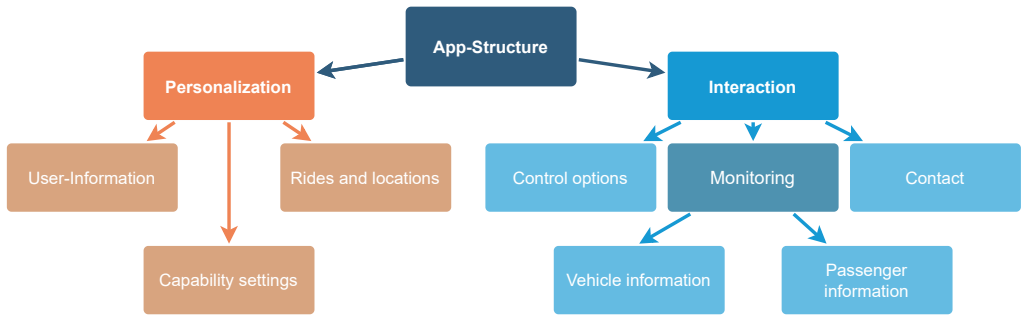
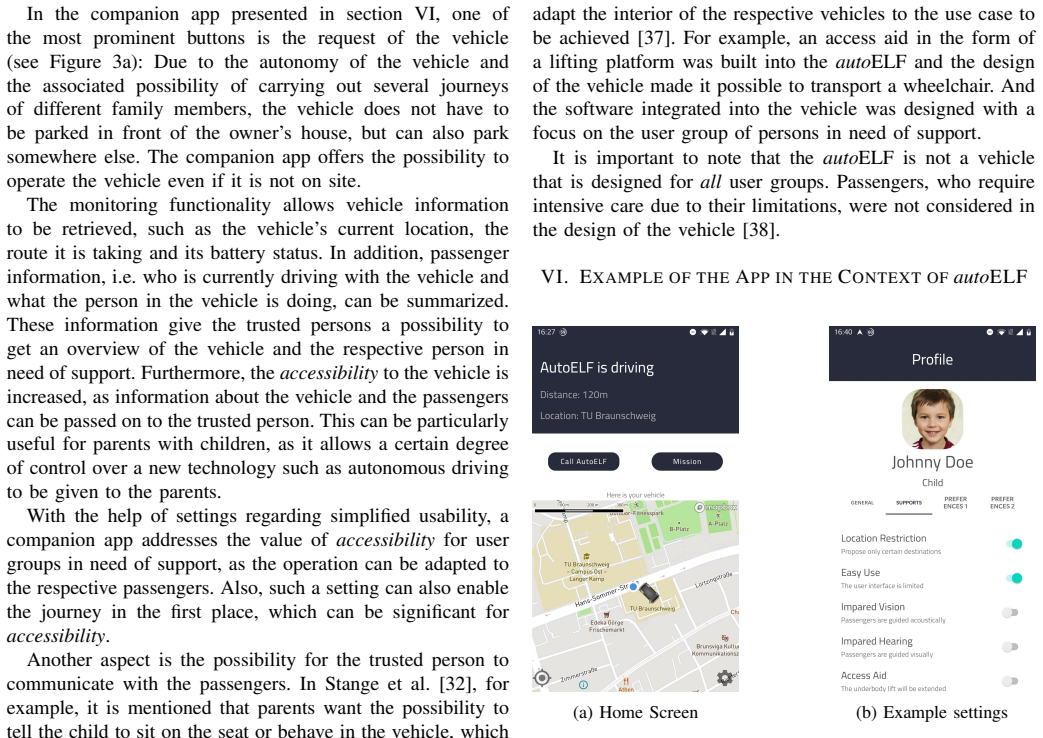
A companion app lets trusted persons track rides and configure autonomous vehicle settings for passengers needing support.
A machine-rendered reading of the paper's core claim, the machinery that carries it, and where it could break.
Core claim
The paper claims that a companion app can provide new perspectives and opportunities for people in need of support by allowing trusted individuals to track the ride and place vehicle settings in their hands, thereby enabling the trusted person to configure the vehicle according to the passenger's needs while involving those trusted persons in the options offered by the vehicle.
What carries the argument
The companion app's two core functions of real-time ride tracking by a trusted person and delegated configuration of vehicle settings.
If this is right
- Trusted individuals can adapt the vehicle settings to match the specific needs of the passenger.
- People needing support gain access to autonomous vehicle features without requiring a physical accompanying person.
- The design incorporates values that matter to both passengers and trusted persons.
- Safety-relevant aspects of the companion app are addressed as part of the overall system.
Where Pith is reading between the lines
- The same app structure could apply to non-family autonomous mobility services such as public shuttles.
- Designers would still need to decide how much final authority remains with the passenger versus the trusted person.
- Real deployment would require explicit rules for data access and deletion to limit privacy exposure.
Load-bearing premise
Delegating tracking and configuration control to a trusted person will meet safety and support needs without creating new risks such as privacy breaches or over-reliance.
What would settle it
A field test in which passengers or trusted persons report increased privacy concerns, anxiety, or reduced independence after using the app would show the approach does not deliver the claimed benefits.
Figures

read the original abstract
In this paper, we present a companion app for an autonomous vehicle aimed at user groups who would normally require an accompanying person to drive them. Two aspects of a companion app are presented in this paper: First, the possibility for a trusted person to track the ride of the person in need of support and second, to put the settings of the vehicle for persons in need of support in the hands of a trusted person. In addition, this article describes the requirements and addressed values and discusses the safety-relevant aspects of such a companion app. We also discuss and identify the values that influence passengers and trusted persons using the companion app. Overall, a companion app can provide new perspectives and opportunities for people in need of support, allowing them to take advantage of the features offered by autonomous vehicles. It enables trusted individuals to configure the vehicle according to the passengers needs. Also such an app can be a mechanism to involve trusted persons in the options given by the vehicle and give them the possibility to adapt the vehicle to the needs of the person in need of support.
Editorial analysis
A structured set of objections, weighed in public.
Referee Report
Summary. The manuscript proposes a companion app for autonomous family vehicles to assist users who typically require an accompanying driver. Key features include allowing trusted persons to track rides and configure vehicle settings. The paper identifies values relevant to passengers and trusted persons, outlines requirements, discusses safety aspects at a conceptual level, and concludes that the app can provide new opportunities and enable needs-based configuration.
Significance. If the conceptual design is developed further, the work could contribute to discussions on inclusive autonomous mobility systems by emphasizing the role of trusted individuals in monitoring and customization. The explicit focus on values identification is a positive step toward human-centered considerations. However, the absence of any empirical validation, methodological detail, or quantitative assessment limits the result to a high-level proposal rather than a substantiated contribution.
major comments (2)
- [Value Identification (title and abstract)] The title and abstract claim to 'identify the values' influencing passengers and trusted persons, yet no section describes the identification process, data sources, stakeholder input method, or analysis technique used to derive these values.
- [Safety Aspects (abstract)] The abstract states that the paper 'discusses the safety-relevant aspects' of the companion app, but the provided description offers only a high-level possibility statement without examining risks introduced by the design itself, such as privacy implications of tracking or over-reliance on remote configuration.
minor comments (1)
- [Abstract] The final sentences of the abstract repeat the same benefit statement three times with minor wording variations; consolidation would improve readability.
Simulated Author's Rebuttal
We thank the referee for the constructive comments on our conceptual proposal for a companion app in autonomous family vehicles. We address each major comment below and outline planned revisions to strengthen the manuscript.
read point-by-point responses
-
Referee: [Value Identification (title and abstract)] The title and abstract claim to 'identify the values' influencing passengers and trusted persons, yet no section describes the identification process, data sources, stakeholder input method, or analysis technique used to derive these values.
Authors: The values were derived via conceptual analysis from existing literature on user needs in autonomous mobility, trust factors, and ethical considerations in AV design, combined with deduction from the proposed app functionalities. We agree the manuscript lacks an explicit description of this process. We will add a dedicated subsection detailing the literature sources consulted and the reasoning steps, clarifying the conceptual (non-empirical) nature of the identification. revision: yes
-
Referee: [Safety Aspects (abstract)] The abstract states that the paper 'discusses the safety-relevant aspects' of the companion app, but the provided description offers only a high-level possibility statement without examining risks introduced by the design itself, such as privacy implications of tracking or over-reliance on remote configuration.
Authors: The safety discussion is currently at a high-level conceptual stage focused on benefits. We acknowledge the need to address introduced risks such as privacy from tracking and over-reliance on remote settings. We will expand this section with an explicit analysis of these risks and outline mitigation approaches including consent mechanisms and data protection measures. revision: yes
Circularity Check
No significant circularity; purely descriptive conceptual proposal
full rationale
The paper presents a high-level systems-design concept for a companion app, identifying values, requirements, and safety aspects without any equations, derivations, fitted parameters, predictions, or self-citation chains. Its central claim is a possibility statement ('a companion app can provide new perspectives') rather than a technical assertion that could reduce to its inputs. No load-bearing steps exist that match the enumerated circularity patterns.
Axiom & Free-Parameter Ledger
Reference graph
Works this paper leans on
-
[1]
Usability and User Experience of Older Adults in an Autonomous Vehicle: Insights from the autoELF High-fidelity Prototype Study,
K. Kuhlmann, T. Schräder, L. Johann Brettin, M. Maurer, and V . Schmidt, “Usability and User Experience of Older Adults in an Autonomous Vehicle: Insights from the autoELF High-fidelity Prototype Study,” to be published, 2025
2025
-
[2]
An Approach for a Requirement Analysis for an Autonomous Family Vehicle,
T. Schräder, T. Stolte, I. Jatzkowski, R. Graubohm, and M. Maurer, “An Approach for a Requirement Analysis for an Autonomous Family Vehicle,” in2019 IEEE Intelligent Vehicles Symposium (IV), Paris, France: IEEE, 2019, pp. 1597–1603.DOI: 10.1109/IVS.2019.8813882
-
[3]
Value Sensitive Design and Information Systems,
B. Friedman, P. H. Kahn, A. Borning, and A. Huldtgren, “Value Sensitive Design and Information Systems,” inEarly engagement and new technologies: Opening up the laboratory, N. Doorn, D. Schuurbiers, I. Van De Poel, and M. E. Gorman, Eds., vol. 16, Series Title: Philosophy of Engineering and Technology, Dordrecht: Springer Netherlands, 2013, pp. 55–95.DOI:...
-
[4]
Simpson and E
J.A. Simpson and E. S. C. Weiner, Eds.,Value, n, Oxford, 1983
1983
-
[5]
R. Graubohm, T. Schräder, and M. Maurer, “Value Sensitive Design in the development of driverless vehicles: A case study on an autonomous family vehicle,”Proceedings of the Design Society: DESIGN Conference, vol. 1, pp. 907–916, 2020.DOI: 10.1017/dsd. 2020.140
work page doi:10.1017/dsd 2020
-
[6]
M. Nolte, “Werte- und fähigkeitsbasierte Bewegungsplanung für autonome Straßenfahrzeuge – Ein systemischer Ansatz,” https://doi.org/10.24355/dbbs.084-202501271119-0, Ph.D. dissertation, Technische Universität Braunschweig, Braunschweig, 2025
-
[7]
Design Principles to Accommodate Older Adults,
M. A. Farage, K. W. Miller, F. Ajayi, and D. Hutchins, “Design Principles to Accommodate Older Adults,”Global Journal of Health Science, vol. 4, no. 2, 2012.DOI: 10.5539/gjhs.v4n2p2
-
[8]
Eatock et al.,Demographic outlook for the European Union: in depth analysis.LU: Publications Office, 2017
D. Eatock et al.,Demographic outlook for the European Union: in depth analysis.LU: Publications Office, 2017
2017
-
[9]
Demographic Turning Points for the United States: Population Projections for 2020 to 2060,
J. Vespa, L. Medina, and D. M. Armstrong, “Demographic Turning Points for the United States: Population Projections for 2020 to 2060,” US Census Bureau, US Department of Commerce, Economics and Statistics Administration, Washington, DC, Tech. Rep., 2018
2020
-
[10]
Ausblick auf die Bevölkerungsentwicklung in Deutschland und den Bundesländern nach dem Corona-Jahr 2020,
“Ausblick auf die Bevölkerungsentwicklung in Deutschland und den Bundesländern nach dem Corona-Jahr 2020,” Statistisches Bunde- samt, Ed., 2021
2020
-
[11]
The Diabetes Assistant: A Smartphone-Based System for Real-Time Control of Blood Glucose,
P. Keith-Hynes, B. Mize, A. Robert, and J. Place, “The Diabetes Assistant: A Smartphone-Based System for Real-Time Control of Blood Glucose,”Electronics, vol. 3, no. 4, pp. 609–623, 2014.DOI: 10.3390/electronics3040609
-
[12]
D. Ahmetovic, C. Gleason, K. M. Kitani, H. Takagi, and C. Asakawa, “NavCog: Turn-by-turn smartphone navigation assistant for people with visual impairments or blindness,” inProceedings of the 13th International Web for All Conference, Montreal Canada: ACM, 2016. DOI: 10.1145/2899475.2899509
-
[13]
A. Gabel, M. Pleger, and I. Schiering, “RehaGoal App – Eine mHealth Anwendung zur Unterstützung bei Beeinträchtigungen in der Handlungsplanung,” inAssistive Technologien im Sozial- und Gesundheitssektor, E.-W. Luthe, S. V . Müller, and I. Schiering, Eds., Wiesbaden: Springer Fachmedien Wiesbaden, 2022, pp. 779–793. DOI: 10.1007/978-3-658-34027-8_31
-
[14]
H. Isyanto, A. S. Arifin, and M. Suryanegara, “Design and Imple- mentation of IoT-Based Smart Home V oice Commands for disabled people using Google Assistant,” in2020 International Conference on Smart Technology and Applications (ICoSTA), Surabaya, Indonesia: IEEE, 2020.DOI: 10.1109/ICoSTA48221.2020.1570613925
-
[15]
Daily life activity tracking application for smart homes using android smartphone,
M. Fahim, I. Fatima, S. Lee, and Y .-K. Lee, “Daily life activity tracking application for smart homes using android smartphone,” 2012
2012
-
[16]
Otto: An Autonomous School Bus System for Parents and Children,
J. Ayoub, B. Mason, K. Morse, A. Kirchner, N. Tumanyan, and F. Zhou, “Otto: An Autonomous School Bus System for Parents and Children,” inExtended Abstracts of the 2020 CHI Conference on Human Factors in Computing Systems, Honolulu HI USA: ACM, 2020.DOI: 10.1145/3334480.3382926
-
[17]
J. Tulusan, T. Staake, and E. Fleisch, “Providing eco-driving feedback to corporate car drivers: What impact does a smartphone application have on their fuel efficiency?” InProceedings of the 2012 ACM Conference on Ubiquitous Computing - UbiComp ’12, Pittsburgh, Pennsylvania: ACM Press, 2012.DOI: 10.1145/2370216.2370250
-
[18]
Smart keys for cyber-cars: Secure smartphone- based NFC-enabled car immobilizer,
C. Busold et al., “Smart keys for cyber-cars: Secure smartphone- based NFC-enabled car immobilizer,” inProceedings of the third ACM conference on Data and application security and privacy - CODASPY ’13, San Antonio, Texas, USA: ACM Press, 2013.DOI: 10.1145/2435349.2435382
-
[19]
iBump: Smartphone application to detect car accidents,
F. Aloul, I. Zualkernan, R. Abu-Salma, H. Al-Ali, and M. Al-Merri, “iBump: Smartphone application to detect car accidents,”Computers & Electrical Engineering, vol. 43, pp. 66–75, 2015.DOI: https://doi. org/10.1016/j.compeleceng.2015.03.003
-
[20]
Personalized user profiles for autonomous vehicles,
A. Trende, D. Gräfing, and L. Weber, “Personalized user profiles for autonomous vehicles,” inProceedings of the 11th International Conference on Automotive User Interfaces and Interactive Vehicular Applications: Adjunct Proceedings, Utrecht Netherlands: ACM, 2019, pp. 287–291.DOI: 10.1145/3349263.3351315
-
[21]
Learning driving styles for autonomous vehicles from demonstration,
M. Kuderer, S. Gulati, and W. Burgard, “Learning driving styles for autonomous vehicles from demonstration,” in2015 IEEE Interna- tional Conference on Robotics and Automation (ICRA), Seattle, W A, USA: IEEE, 2015, pp. 2641–2646.DOI: 10.1109/ICRA.2015.7139555
-
[22]
Self- Adapting Comfort Models for Comfort-Based HV AC Control,
S. Möller, A. Rauch, A. Kospach, and M. Waltenberger, “Self- Adapting Comfort Models for Comfort-Based HV AC Control,” Aachen, 2021, pp. 437–452
2021
-
[23]
Designing a virtual assistant for in-car child entertainment,
M. Gordon and C. Breazeal, “Designing a virtual assistant for in-car child entertainment,” inProceedings of the 14th International Con- ference on Interaction Design and Children, Boston Massachusetts: ACM, 2015, pp. 359–362.DOI: 10.1145/2771839.2771916
-
[24]
Towards leveraging the driver’s mobile device for an intelligent, sociable in-car robotic assistant,
K. J. Williams, J. C. Peters, and C. L. Breazeal, “Towards leveraging the driver’s mobile device for an intelligent, sociable in-car robotic assistant,” in2013 IEEE Intelligent Vehicles Symposium (IV), Gold Coast City, Australia: IEEE, 2013, pp. 369–376.DOI: 10.1109/IVS. 2013.6629497
work page doi:10.1109/ivs 2013
-
[25]
Benutzerprofile,
V olvo Car Corporation. “Benutzerprofile,” Accessed: Apr. 12, 2024. [Online]. Available: https://www.volvocars.com/de/support/car/v90/ 21w22/article/50a89cf5a9a85a58c0a8015141823beb [26]Safety Guidelines for Autonomous Mobility and Delivery Providers on the Uber Platform, 2022
2024
-
[26]
MOIA für Menschen mit eingeschränkter Mobilität,
“MOIA für Menschen mit eingeschränkter Mobilität,” Accessed: Aug. 20, 2024. [Online]. Available: https://help.moia.io/hc/de/articles/ 360001025217-MOIA-f%C3%BCr-Menschen-mit-eingeschr%C3% A4nkter-Mobilit%C3%A4t
2024
-
[27]
MOIA für Menschen mit Sehbehinderung,
“MOIA für Menschen mit Sehbehinderung,” Accessed: Aug. 20,
-
[28]
Available: https : / / help
[Online]. Available: https : / / help . moia . io / hc / de / articles / 360011372178-MOIA-f%C3%BCr-Menschen-mit-Sehbehinderung
-
[29]
Waymo safety Impact,
“Waymo safety Impact,” Accessed: Jun. 4, 2025. [Online]. Available: https://waymo.com/safety/impact/
2025
-
[30]
Accessibility features - Waymo One Help,
Waymo. “Accessibility features - Waymo One Help,” Accessed: Aug. 20, 2024. [Online]. Available: https : / / support . google . com / waymo/answer/9566824?hl=en
arXiv 2024
-
[31]
M. Dorynek, A. Aumüller, J. Ma, B. Rathsack, J. Weidmann, and K. Bengler, “Mobility on Demand for Everybody—Investigation of the Current Challenges in Establishing Ride-Pooling Services for Persons with Mobility Impairments in Germany,”Disabilities, vol. 2, no. 2, pp. 247–263, 2022.DOI: 10.3390/disabilities2020018
-
[32]
V . Stange, L. Behrens, K. Kuhlmann, T. Schräder, L. Johann Brettin, and M. Maurer, “Parents’ perspectives on transporting their children in autonomous vehicles – A contextual interview study with parents in Germany,”Transportation Research Part F: Traffic Psychology and Behaviour, vol. 107, pp. 436–463, 2024.DOI: 10.1016/j.trf.2024.08. 030
-
[33]
Transporting Children in Autonomous Vehicles: An Exploratory Study,
P. D. Tremoulet, T. Seacrist, C. W. McIntosh, H. Loeb, A. DiPietro, and S. Tushak, “Transporting Children in Autonomous Vehicles: An Exploratory Study,”Human Factors, 2020
2020
-
[34]
Nielsen,Usability engineering
J. Nielsen,Usability engineering. Academic Press, 1993. [35]ISO 21448 - Road Vehicles - Safety of the Intended Functionality, Geneva, Switzerland, 2022
1993
-
[35]
How safe is safe enough? A psychometric study of attitudes towards technological risks and benefits,
B. Fischhoff, P. Slovic, and S. Lichtenstein, “How safe is safe enough? A psychometric study of attitudes towards technological risks and benefits,”Policy Science, vol. 9, pp. 127–152, 1978.DOI: https://doi. org/10.1007/BF00143739
-
[36]
UNICARagil – Disruptive Modular Architectures for Agile Automated Vehicle Concepts,
T. Woopen et al., “UNICARagil – Disruptive Modular Architectures for Agile Automated Vehicle Concepts,” Aachen, 2018.DOI: 10 . 51202/9783181023945-75
2018
-
[37]
Konzept eines fahrerlosen Familienfahrzeugs,
T. Schräder, “Konzept eines fahrerlosen Familienfahrzeugs,” Ph.D. dissertation, Technische Universität Braunschweig, Braunschweig, 2025.DOI: https://doi.org/10.24355/dbbs.084-202503301200-0
-
[38]
T. Schräder, T. Stolte, I. Jatzkowski, R. Graubohm, M. Nolte, and M. Maurer, “Compensating for the Absence of a Required Accom- panying Person: A Draft of a Functional System Architecture for an Automated Vehicle,” Indianapolis, USA, 2021.DOI: DOI:10.1109/ ITSC48978.2021.9564762
arXiv 2021
-
[39]
Entwicklung eines Nutzerprofils für die Adaption eines autonomen Familienfahrzeugs,
H. Lampe, “Entwicklung eines Nutzerprofils für die Adaption eines autonomen Familienfahrzeugs,” Bachelor Thesis, Technische Univer- sität Braunschweig, Braunschweig, 2022
2022
discussion (0)
Sign in with ORCID, Apple, or X to comment. Anyone can read and Pith papers without signing in.