CRIRES+ reveals the chemistry of the stellar sub-populations in the bulge fossil fragment Liller 1
Pith reviewed 2026-06-27 12:18 UTC · model grok-4.3
The pith
Liller 1 formed in place inside the Galactic bulge, shown by its stars lacking globular-cluster chemical signatures.
A machine-rendered reading of the paper's core claim, the machinery that carries it, and where it could break.
Core claim
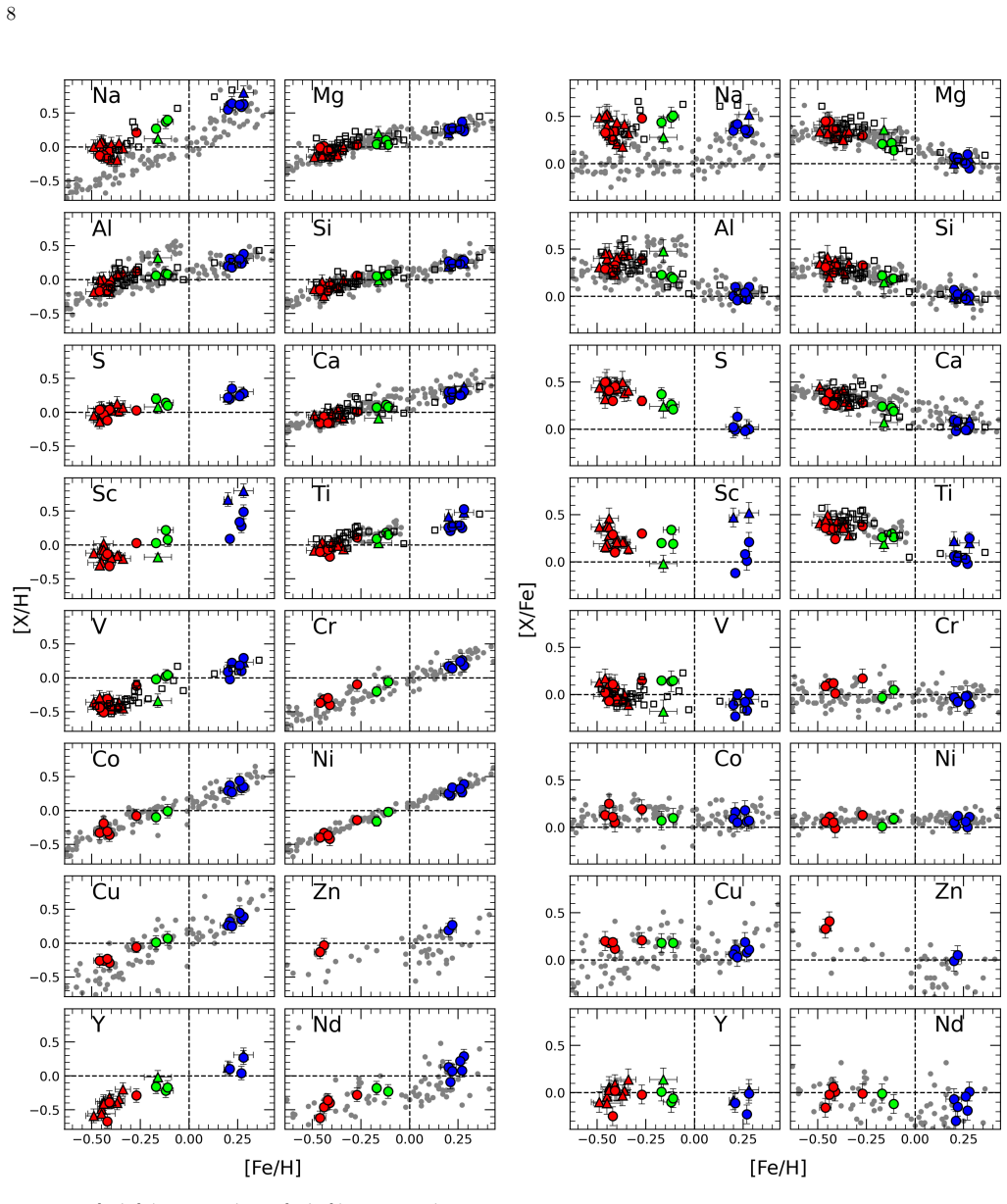
High-resolution CRIRES+ spectra of 30 kinematically selected red giant branch stars reveal a multi-metallicity population of different ages whose overall abundance trends fit a self-enrichment scenario. The absence of the Na-O anticorrelation that marks genuine globular clusters, together with patterns matching the bulge field and Terzan 5, supplies spectroscopic evidence that Liller 1 formed in situ within the Galactic bulge.
What carries the argument
Chemical abundance patterns from CRIRES+ spectra, especially the lack of Na-O anticorrelation and the match to bulge-field trends, used to distinguish in-situ formation from accreted globular-cluster origin.
If this is right
- Liller 1 belongs to the class of bulge fossil fragments rather than the class of accreted globular clusters.
- Self-enrichment operated inside the bulge environment to produce the observed metallicity spread.
- Chemical screening of this kind can classify other dense systems orbiting the bulge.
- The lack of globular-cluster pollution signatures removes Liller 1 from the set of objects that experienced that process.
Where Pith is reading between the lines
- Similar chemical tagging could identify additional in-situ fragments still hidden in the bulge.
- The result tightens constraints on how much of the bulge stellar mass formed locally versus through mergers.
- Extending the same abundance analysis to the other 16 systems in the survey would test whether the pattern is common.
Load-bearing premise
The 30 kinematically selected red giant branch stars represent the full population of Liller 1 and the measured abundances can be compared directly to field and Terzan 5 stars without large systematic offsets.
What would settle it
Discovery of a clear Na-O anticorrelation or abundance trends that diverge from the bulge field in a larger sample of Liller 1 stars.
Figures


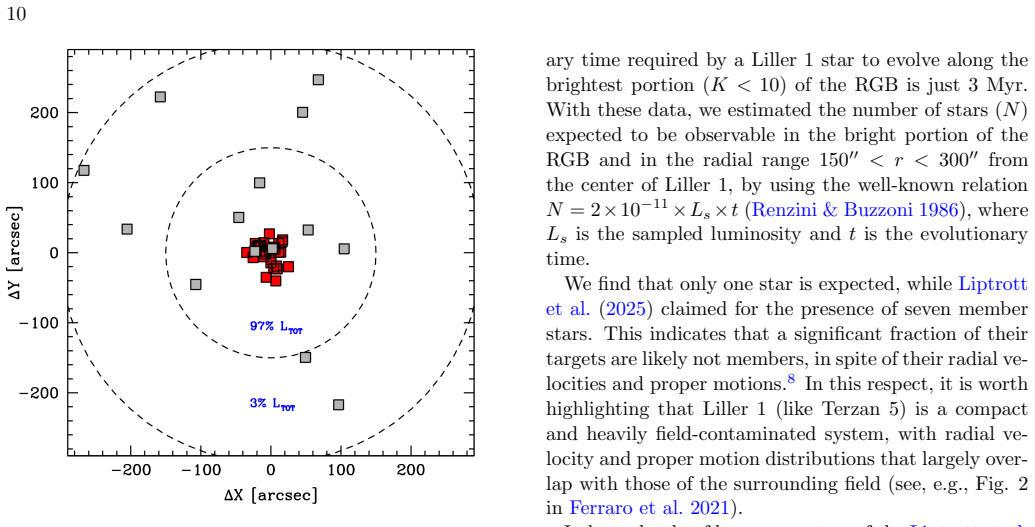


read the original abstract
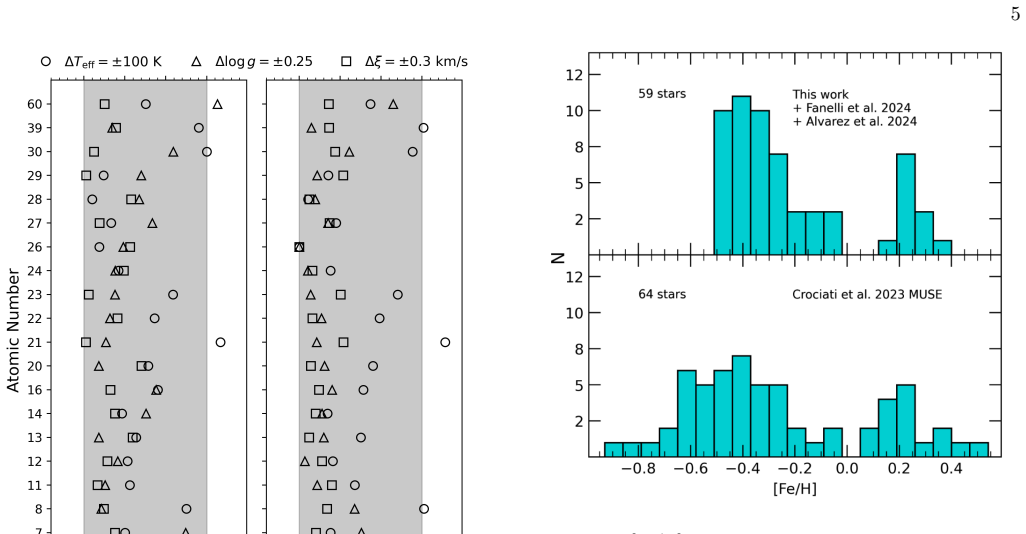
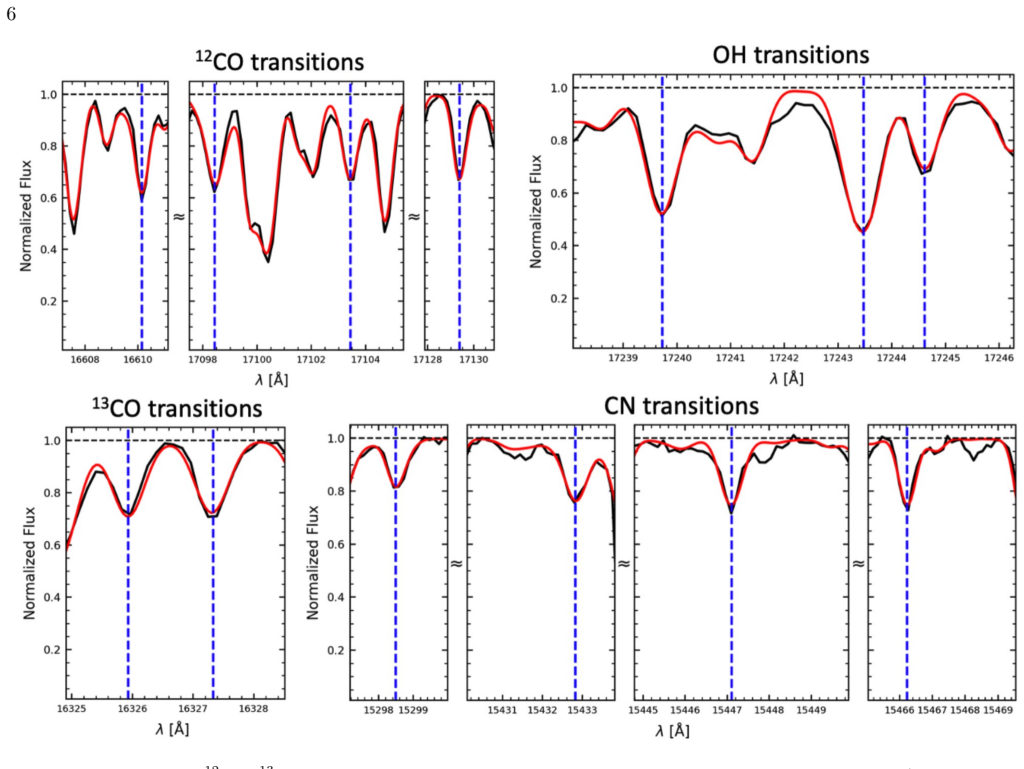
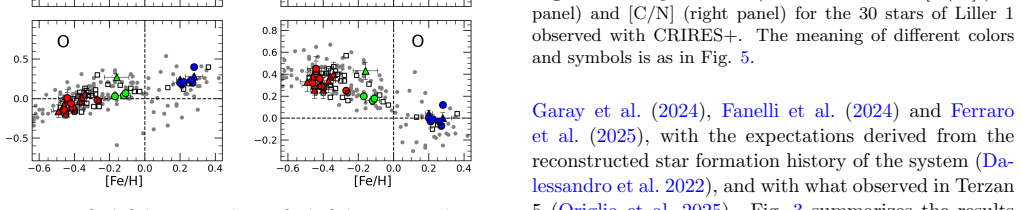
In this paper we present the chemical screening of the complex stellar population discovered in the Bulge Fossil Fragment Liller 1. This study is part of the Bulge Cluster Origin (BulCO) survey based on a Large Program at the ESO-VLT with the high resolution spectrograph CRIRES+. The survey is aimed at performing an unprecedented chemical screening of 17 stellar systems orbiting the Milky Way bulge, with the ultimate goal of unveiling their origin and true nature. We measured precise chemical abundances of iron, CNO, iron-peak, $\alpha$- other light-elements, and neutron-capture elements for a sample of 30 red giant branch stars, kinematic members of Liller 1. The presented analysis provides the high-resolution spectroscopic proof of the complex chemistry of this massive stellar system, with multi-metallicity sub-populations of different ages that nicely fits into a self-enrichment scenario. We find no evidence for the Na-O anticorrelation associated with genuine globular clusters; rather the overall abundance trends are similar to those seen in the bulge field and in Terzan 5, providing definitive evidence of an in-situ formation of Liller 1 within the Galactic bulge.
Editorial analysis
A structured set of objections, weighed in public.
Referee Report
Summary. The paper reports CRIRES+ high-resolution spectroscopy of 30 kinematically selected red giant branch stars in Liller 1. It measures abundances for Fe, CNO, iron-peak, alpha, light, and neutron-capture elements, identifies multiple metallicity subpopulations of different ages consistent with self-enrichment, finds no Na-O anticorrelation, and reports abundance trends matching the Galactic bulge field and Terzan 5, concluding that this constitutes definitive evidence for in-situ formation of Liller 1 within the bulge.
Significance. If the abundance measurements and sample selection hold after detailed scrutiny, the work supplies direct chemical evidence distinguishing Liller 1 from classical globular clusters and supporting its classification as a bulge fossil fragment formed in situ, thereby strengthening the case for complex in-situ stellar systems in the inner Galaxy.
major comments (3)
- [Sample selection and abundance analysis sections] The central claim of 'definitive evidence' for in-situ formation rests on the 30-star kinematic sample being representative of all subpopulations and on the abundance scale being free of systematic offsets relative to comparison samples. The manuscript must provide explicit validation of kinematic membership (e.g., radial-velocity and proper-motion cuts, contamination estimates) and quantitative cross-checks against field and Terzan 5 analyses (model atmospheres, line lists, NLTE corrections).
- [Results on light-element abundances] Absence of the Na-O anticorrelation is load-bearing for ruling out a genuine globular-cluster origin. The paper must present the full Na and O measurements (with uncertainties) for the 30 stars, including any post-hoc cuts or sensitivity tests to model assumptions, so that the claimed lack of anticorrelation can be verified against the reported precision.
- [Metallicity and age subpopulations] The multi-metallicity subpopulations and age differences are used to support a self-enrichment scenario. The manuscript should quantify how the derived [Fe/H] distribution and age estimates were obtained and whether they remain robust when alternative isochrone sets or distance assumptions are adopted.
minor comments (2)
- Figure captions and axis labels for abundance plots should explicitly state the number of stars plotted and the source of comparison data points.
- The abstract states 'precise chemical abundances' without quoting typical uncertainties; these should be summarized in the text or a table.
Simulated Author's Rebuttal
We thank the referee for the constructive and detailed report. We address each major comment below with point-by-point responses and have revised the manuscript to incorporate additional details, tables, and robustness tests where appropriate.
read point-by-point responses
-
Referee: [Sample selection and abundance analysis sections] The central claim of 'definitive evidence' for in-situ formation rests on the 30-star kinematic sample being representative of all subpopulations and on the abundance scale being free of systematic offsets relative to comparison samples. The manuscript must provide explicit validation of kinematic membership (e.g., radial-velocity and proper-motion cuts, contamination estimates) and quantitative cross-checks against field and Terzan 5 analyses (model atmospheres, line lists, NLTE corrections).
Authors: We agree that explicit documentation strengthens the central claim. The revised manuscript expands Section 2 with a new subsection 2.2 detailing the kinematic criteria: radial velocities within ±20 km/s of the systemic velocity (measured from the 30 stars themselves), Gaia EDR3 proper-motion membership probability >70% using the method of Vasiliev & Baumgardt (2021), and a field contamination estimate of ~8% derived from a control field at similar Galactic latitude. For the abundance scale, we added Appendix A containing a side-by-side comparison of our ATLAS9 models, line lists, and NLTE corrections (for Na, O, and Mg) against those employed in the Terzan 5 (Origlia et al. 2019) and bulge-field studies. Differential tests on 5 common stars yield mean offsets <0.04 dex for [Fe/H] and [α/Fe], confirming the trends are directly comparable. revision: yes
-
Referee: [Results on light-element abundances] Absence of the Na-O anticorrelation is load-bearing for ruling out a genuine globular-cluster origin. The paper must present the full Na and O measurements (with uncertainties) for the 30 stars, including any post-hoc cuts or sensitivity tests to model assumptions, so that the claimed lack of anticorrelation can be verified against the reported precision.
Authors: We have added Table 3 listing [Na/Fe] and [O/Fe] (with 1σ uncertainties) for every star. A new paragraph in Section 4.2 describes the sensitivity analysis: we re-derived abundances after perturbing T_eff by ±150 K and log g by ±0.3 dex, and after swapping the Na and O line lists. In all realizations the Spearman rank correlation coefficient between [Na/Fe] and [O/Fe] remains statistically consistent with zero (p > 0.4). No post-hoc cuts were applied beyond the initial kinematic membership; the absence of an anticorrelation is therefore robust within the stated precision (~0.15 dex). revision: yes
-
Referee: [Metallicity and age subpopulations] The multi-metallicity subpopulations and age differences are used to support a self-enrichment scenario. The manuscript should quantify how the derived [Fe/H] distribution and age estimates were obtained and whether they remain robust when alternative isochrone sets or distance assumptions are adopted.
Authors: Section 3 now quantifies the [Fe/H] derivation: equivalent widths of 18–25 Fe I lines per star analyzed with MOOG and ATLAS9 models, with the distribution fitted by a three-component Gaussian mixture model yielding peaks at [Fe/H] ≈ −0.75, −0.35, and +0.05. Ages were obtained by χ^{2} minimization of PARSEC isochrones to the Gaia CMD at the adopted distance 8.1 kpc. The revised text and new Appendix B report tests with BaSTI isochrones and distance shifts of ±0.4 kpc; the three subpopulations and their ~2–5 Gyr age spread remain statistically significant in every case, supporting the self-enrichment interpretation. revision: yes
Circularity Check
No circularity: empirical abundance measurements and direct comparisons
full rationale
The paper reports spectroscopic abundance measurements for 30 kinematically selected RGB stars and compares the resulting trends (no Na-O anticorrelation, similarity to bulge field and Terzan 5) to external populations. No equations, fitted parameters renamed as predictions, or self-citation chains are present that would reduce the central claim to its own inputs by construction. The derivation chain is observational and self-contained.
Axiom & Free-Parameter Ledger
Reference graph
Works this paper leans on
-
[1]
nonparametric.smootherslowess.lowess.html 13 T able 3.Chemical abundances and corresponding errors of the observed metal-poor stars in Liller 1
9 https://www.statsmodels.org/devel/generated/statsmodels. nonparametric.smootherslowess.lowess.html 13 T able 3.Chemical abundances and corresponding errors of the observed metal-poor stars in Liller 1. ID [Fe/H] [C/H] [N/H] [O/H] [Na/H] [Mg/H] [Al/H] [Si/H] [S/H] [Ca/H] [Sc/H] [Ti/H] [V/H] [Cr/H] [Co/H] [Ni/H] [Cu/H] [Zn/H] [Y/H] [Nd/H] 12C/13C 100157 -...
2022
-
[2]
Near-infrared narrow-band photometry of M-giant and Mira stars: models meet observations
Alvarez, R., & Plez, B. 1998, A&A, 330, 1109, doi: 10.48550/arXiv.astro-ph/9710157 Alvarez Garay, D. A., Fanelli, C., Origlia, L., et al. 2024, A&A, 686, A198, doi: 10.1051/0004-6361/202449595
work page internal anchor Pith review Pith/arXiv arXiv doi:10.48550/arxiv.astro-ph/9710157 1998
-
[3]
Barbuy, B., Fria¸ ca, A. C. S., da Silveira, C. R., et al. 2015, A&A, 580, A40, doi: 10.1051/0004-6361/201525694
-
[4]
2022, MNRAS, 509, 614, doi: 10.1093/mnras/stab3081
Bastian, N., & Pfeffer, J. 2022, MNRAS, 509, 614, doi: 10.1093/mnras/stab3081
-
[5]
2016, ApJL, 819, L2, doi: 10.3847/2041-8205/819/1/L2
Behrendt, M., Burkert, A., & Schartmann, M. 2016, ApJL, 819, L2, doi: 10.3847/2041-8205/819/1/L2
-
[6]
2014, ApJ, 787, 10, doi: 10.1088/0004-637X/787/1/10
Bisterzo, S., Travaglio, C., Gallino, R., Wiescher, M., & K¨ appeler, F. 2014, ApJ, 787, 10, doi: 10.1088/0004-637X/787/1/10
-
[7]
Boothroyd, A. I., & Sackmann, I.-J. 1999, ApJ, 510, 232, doi: 10.1086/306546
-
[8]
2016, in Astrophysics and Space Science
Bournaud, F. 2016, in Astrophysics and Space Science
2016
-
[9]
Library, Vol. 418, Galactic Bulges, ed. E. Laurikainen, R. Peletier, & D. Gadotti, 355, doi: 10.1007/978-3-319-19378-6 13
-
[10]
Bournaud, F., & Elmegreen, B. G. 2009, ApJL, 694, L158, doi: 10.1088/0004-637X/694/2/L158
-
[11]
Bressan, A., Marigo, P., Girardi, L., et al. 2012, MNRAS, 427, 127, doi: 10.1111/j.1365-2966.2012.21948.x
-
[12]
2023, A&A, 677, A73, doi: 10.1051/0004-6361/202346174
Carretta, E., & Bragaglia, A. 2023, A&A, 677, A73, doi: 10.1051/0004-6361/202346174
-
[13]
Carretta, E., Bragaglia, A., Gratton, R. G., et al. 2009, A&A, 505, 117, doi: 10.1051/0004-6361/200912096
-
[14]
Cavallo, R. M., Sweigart, A. V., & Bell, R. A. 1998, ApJ, 492, 575, doi: 10.1086/305053
-
[15]
1995, ApJL, 453, L41, doi: 10.1086/309744
Charbonnel, C. 1995, ApJL, 453, L41, doi: 10.1086/309744
-
[16]
Crociati, C., Valenti, E., Ferraro, F. R., et al. 2023, ApJ, 951, 17, doi: 10.3847/1538-4357/acd382
-
[17]
2024, A&A, 691, A311, doi: 10.1051/0004-6361/202451174
Crociati, C., Cignoni, M., Dalessandro, E., et al. 2024, A&A, 691, A311, doi: 10.1051/0004-6361/202451174
-
[18]
2022, ApJ, 940, 170, doi: 10.3847/1538-4357/ac9907
Dalessandro, E., Crociati, C., Cignoni, M., et al. 2022, ApJ, 940, 170, doi: 10.3847/1538-4357/ac9907
-
[19]
2009a, ApJ, 703, 785, doi: 10.1088/0004-637X/703/1/785
Dekel, A., Sari, R., & Ceverino, D. 2009, ApJ, 703, 785, doi: 10.1088/0004-637X/703/1/785
-
[20]
A., & Weiss, A
Denissenkov, P. A., & Weiss, A. 1996, A&A, 308, 773
1996
-
[21]
J., Anglada-Escude, G., Baade, D., et al
Dorn, R. J., Anglada-Escude, G., Baade, D., et al. 2014, The Messenger, 156, 7
2014
-
[22]
Observing the Universe at infrared wavelengths and high spectral resolution
Dorn, R. J., Bristow, P., Smoker, J. V., et al. 2023, A&A, 671, A24, doi: 10.1051/0004-6361/202245217
-
[23]
G., Bournaud, F., & Elmegreen, D
Elmegreen, B. G., Bournaud, F., & Elmegreen, D. M. 2008, ApJ, 688, 67, doi: 10.1086/592190
-
[24]
Lemonias, J. J. 2009, ApJ, 692, 12, doi: 10.1088/0004-637X/692/1/12
-
[25]
2021, A&A, 645, A19, doi: 10.1051/0004-6361/202039397
Fanelli, C., Origlia, L., Oliva, E., et al. 2021, A&A, 645, A19, doi: 10.1051/0004-6361/202039397
-
[26]
Fanelli, C., Origlia, L., Rich, R. M., et al. 2024, A&A, 690, A139, doi: 10.1051/0004-6361/202451030
-
[27]
R., Massari, D., Dalessandro, E., et al
Ferraro, F. R., Massari, D., Dalessandro, E., et al. 2016, ApJ, 828, 75, doi: 10.3847/0004-637X/828/2/75
-
[28]
R., Dalessandro, E., Mucciarelli, A., et al
Ferraro, F. R., Dalessandro, E., Mucciarelli, A., et al. 2009, Nature, 462, 483, doi: 10.1038/nature08581
-
[29]
R., Pallanca, C., Lanzoni, B., et al
Ferraro, F. R., Pallanca, C., Lanzoni, B., et al. 2021, Nature Astronomy, 5, 311, doi: 10.1038/s41550-020-01267-y
-
[30]
R., Chiappino, L., Bartolomei, A., et al
Ferraro, F. R., Chiappino, L., Bartolomei, A., et al. 2025, A&A, 696, A179, doi: 10.1051/0004-6361/202554092
-
[31]
R., Vesperini, E., Lanzoni, B., et al
Ferraro, F. R., Vesperini, E., Lanzoni, B., et al. 2026, A&A, 709, A163, doi: 10.1051/0004-6361/202556993
-
[32]
2011, ApJ, 733, 101, doi: 10.1088/0004-637X/733/2/101
Genzel, R., Newman, S., Jones, T., et al. 2011, ApJ, 733, 101, doi: 10.1088/0004-637X/733/2/101
-
[33]
2012, ApJL, 744, L8, doi: 10.1088/2041-8205/744/1/L8
Gerhard, O., & Martinez-Valpuesta, I. 2012, ApJL, 744, L8, doi: 10.1088/2041-8205/744/1/L8
-
[34]
G., Lucatello, S., Bragaglia, A., et al
Gratton, R. G., Lucatello, S., Bragaglia, A., et al. 2007, A&A, 464, 953, doi: 10.1051/0004-6361:20066061
-
[35]
2008, A&A, 486, 951, doi: 10.1051/0004-6361:200809724
Gustafsson, B., Edvardsson, B., Eriksson, K., et al. 2008, A&A, 486, 951, doi: 10.1051/0004-6361:200809724
-
[36]
2004, A&A, 413, 547, doi: 10.1051/0004-6361:20034282
Immeli, A., Samland, M., Gerhard, O., & Westera, P. 2004, A&A, 413, 547, doi: 10.1051/0004-6361:20034282
-
[37]
Johnson, C. I., Rich, R. M., Kobayashi, C., & Fulbright, J. P. 2012, ApJ, 749, 175, doi: 10.1088/0004-637X/749/2/175
-
[38]
2014, AJ, 148, 67, doi: 10.1088/0004-6256/148/4/67
Koch, A. 2014, AJ, 148, 67, doi: 10.1088/0004-6256/148/4/67
-
[39]
Society of Photo-Optical Instrumentation Engineers (SPIE) Conference Series , year = 2004, series =
Kaeufl, H.-U., Ballester, P., Biereichel, P., et al. 2004, in Society of Photo-Optical Instrumentation Engineers (SPIE) Conference Series, Vol. 5492, Ground-based Instrumentation for Astronomy, ed. A. F. M. Moorwood & M. Iye, 1218–1227, doi: 10.1117/12.551480
-
[40]
S., Daddi, E., Bournaud, F., et al
Kalita, B. S., Daddi, E., Bournaud, F., et al. 2022, A&A, 666, A44, doi: 10.1051/0004-6361/202243100
-
[41]
Liptrott, A., Schiavon, R. P., Mason, A. C., et al. 2025, arXiv e-prints, arXiv:2510.07411, doi: 10.48550/arXiv.2510.07411
-
[42]
2022, A&A, 661, A140, doi: 10.1051/0004-6361/202142971
Magg, E., Bergemann, M., Serenelli, A., et al. 2022, A&A, 661, A140, doi: 10.1051/0004-6361/202142971
-
[43]
2017, ApJ, 835, 77, doi: 10.3847/1538-4357/835/1/77
Marigo, P., Girardi, L., Bressan, A., et al. 2017, ApJ, 835, 77, doi: 10.3847/1538-4357/835/1/77
-
[44]
Massari, D., Mucciarelli, A., Ferraro, F. R., et al. 2014, ApJ, 795, 22, doi: 10.1088/0004-637X/795/1/22
-
[45]
2018, MNRAS, 479, 3126, doi: 10.1093/mnras/sty1557
McKenzie, M., & Bekki, K. 2018, MNRAS, 479, 3126, doi: 10.1093/mnras/sty1557
-
[46]
Origlia, L., Ferraro, F. R., Fanelli, C., et al. 2025, A&A, 697, A19, doi: 10.1051/0004-6361/202452110 16
-
[47]
Origlia, L., Massari, D., Rich, R. M., et al. 2013, ApJL, 779, L5, doi: 10.1088/2041-8205/779/1/L5
-
[48]
Origlia, L., Rich, R. M., Ferraro, F. R., et al. 2011, ApJL, 726, L20, doi: 10.1088/2041-8205/726/2/L20
-
[49]
2019, ApJ, 871, 114, doi: 10.3847/1538-4357/aaf730
Origlia, L., Mucciarelli, A., Fiorentino, G., et al. 2019, ApJ, 871, 114, doi: 10.3847/1538-4357/aaf730
-
[50]
Pallanca, C., Ferraro, F. R., Lanzoni, B., et al. 2021, ApJ, 917, 92, doi: 10.3847/1538-4357/ac0889
-
[51]
2021, MNRAS, 500, 2514, doi: 10.1093/mnras/staa3407
Pfeffer, J., Lardo, C., Bastian, N., Saracino, S., & Kamann, S. 2021, MNRAS, 500, 2514, doi: 10.1093/mnras/staa3407
-
[52]
2013, A&A, 558, A46, doi: 10.1051/0004-6361/201321950
Pietrinferni, A., Cassisi, S., Salaris, M., & Hidalgo, S. 2013, A&A, 558, A46, doi: 10.1051/0004-6361/201321950
-
[53]
2012, Turbospectrum: Code for spectral synthesis, Astrophysics Source Code Library, record ascl:1205.004
Plez, B. 2012, Turbospectrum: Code for spectral synthesis, Astrophysics Source Code Library, record ascl:1205.004. http://ascl.net/1205.004
2012
-
[54]
2020, MNRAS, 491, 1832, doi: 10.1093/mnras/stz3154
Prantzos, N., Abia, C., Cristallo, S., Limongi, M., & Chieffi, A. 2020, MNRAS, 491, 1832, doi: 10.1093/mnras/stz3154
-
[55]
1986, in Astrophysics and Space Science Library, Vol
Renzini, A., & Buzzoni, A. 1986, in Astrophysics and Space Science Library, Vol. 122, Spectral Evolution of Galaxies, ed. C. Chiosi & A. Renzini, 195–231, doi: 10.1007/978-94-009-4598-2 19
-
[56]
Rich, R. M., Origlia, L., & Valenti, E. 2012, ApJ, 746, 59, doi: 10.1088/0004-637X/746/1/59
-
[57]
Romano, D., Ferraro, F. R., Origlia, L., et al. 2023, ApJ, 951, 85, doi: 10.3847/1538-4357/acd8ba
-
[58]
2015, Baltic Astronomy, 24, 453, doi: 10.1515/astro-2017-0249
Ryabchikova, T., & Pakhomov, Y. 2015, Baltic Astronomy, 24, 453, doi: 10.1515/astro-2017-0249
-
[59]
2013, MNRAS, 430, 2039, doi: 10.1093/mnras/stt029
Saha, K., & Gerhard, O. 2013, MNRAS, 430, 2039, doi: 10.1093/mnras/stt029
-
[60]
Sales-Silva, J. V., Cunha, K., Smith, V. V., et al. 2024, ApJ, 965, 119, doi: 10.3847/1538-4357/ad28c2
-
[61]
Saracino, S., Dalessandro, E., Ferraro, F. R., et al. 2015, ApJ, 806, 152, doi: 10.1088/0004-637X/806/2/152
-
[62]
Tacchella, S., Lang, P., Carollo, C. M., et al. 2015, ApJ, 802, 101, doi: 10.1088/0004-637X/802/2/101
-
[63]
2024, Nature, 636, 69, doi: 10.1038/s41586-024-08201-6
Tan, Q.-H., Daddi, E., Magnelli, B., et al. 2024, Nature, 636, 69, doi: 10.1038/s41586-024-08201-6
-
[64]
2020, Atoms, 8, 4, doi: 10.3390/atoms8010004
Thorsbro, B. 2020, Atoms, 8, 4, doi: 10.3390/atoms8010004
-
[65]
2018, ApJ, 866, 52, doi: 10.3847/1538-4357/aadb97
Thorsbro, B., Ryde, N., Schultheis, M., et al. 2018, ApJ, 866, 52, doi: 10.3847/1538-4357/aadb97
-
[66]
Thorsbro, B., Ryde, N., Rich, R. M., et al. 2020, ApJ, 894, 26, doi: 10.3847/1538-4357/ab8226
-
[67]
Valenti, E., Ferraro, F. R., & Origlia, L. 2010, MNRAS, 402, 1729, doi: 10.1111/j.1365-2966.2009.15991.x Van der Swaelmen, M., Barbuy, B., Hill, V., et al. 2016, A&A, 586, A1, doi: 10.1051/0004-6361/201525709
-
[68]
Zullo, G., Pallanca, C., Ferraro, F. R., et al. 2026, A&A, 709, A212, doi: 10.1051/0004-6361/202659349
discussion (0)
Sign in with ORCID, Apple, or X to comment. Anyone can read and Pith papers without signing in.