Spatially Masked Regression Reveals Local and Distributed Predictability in Electrophysiological Recordings
Pith reviewed 2026-06-27 10:24 UTC · model grok-4.3
The pith
Spatially masked regression shows each electrode signal carries both local redundancy and broader distributed structure.
A machine-rendered reading of the paper's core claim, the machinery that carries it, and where it could break.
Core claim
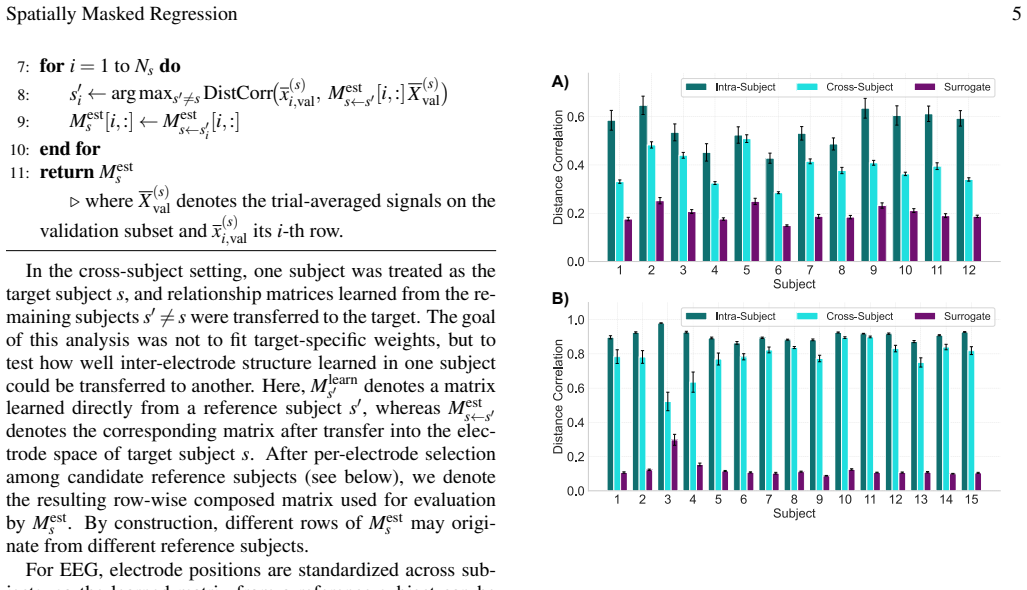
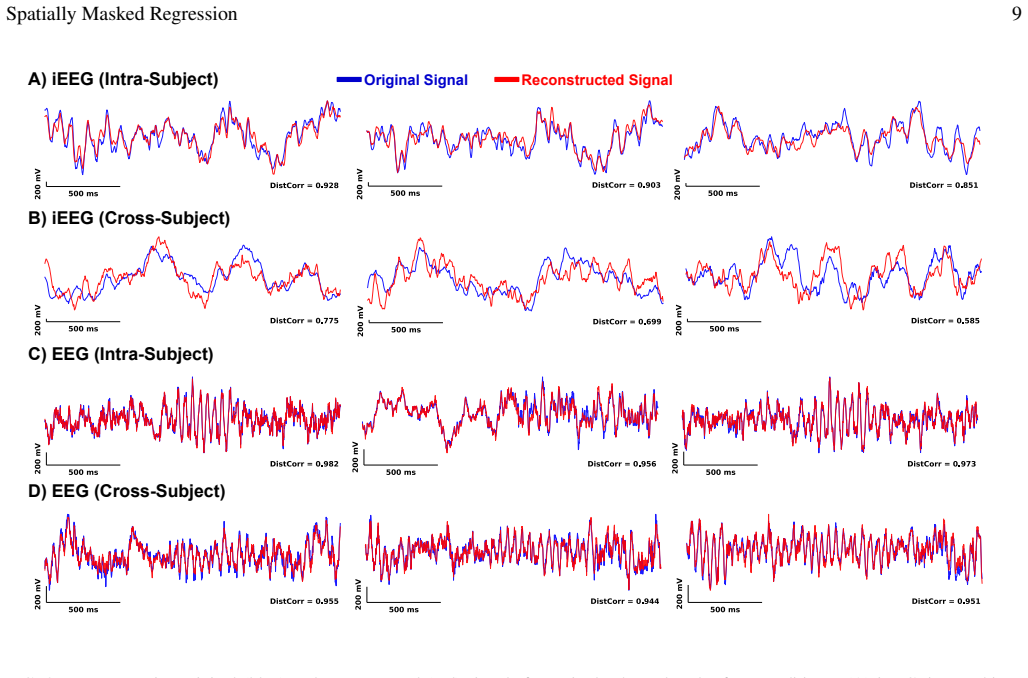
Using Spatially Masked Regression, each electrode's timeseries is reconstructed from the remaining electrodes while a configurable neighborhood around the target is excluded. Progressive increase of the mask reveals substantial residual predictability after local neighbors are withheld, with nearby electrodes contributing strongly yet not accounting for all information. Distance correlation between original and reconstructed signals is high within subjects in both iEEG and scalp EEG modalities, markedly higher cross-subject transfer occurs in scalp EEG, and surrogates that preserve marginal or spectral properties but disrupt phase or temporal structure substantially reduce performance, indic
What carries the argument
Spatially Masked Regression (SMR), a reconstruction framework that withholds a configurable spatial neighborhood around each target electrode to quantify how much predictive information survives local exclusion.
If this is right
- Nearby electrodes contribute strongly to reconstruction but leave substantial residual predictability from more distant channels.
- Individual channels reflect both local redundancy and broader distributed structure.
- Cross-subject transfer is markedly stronger in standardized scalp EEG than in heterogeneous iEEG coverage.
- SMR performance depends on structured temporal and cross-channel organization rather than marginal statistics alone.
Where Pith is reading between the lines
- The same masking logic could be used to test whether local field potentials in other modalities embed comparable distributed components.
- Task or state dependence of the local-to-distributed balance could be measured by applying SMR within different experimental conditions.
- The framework supplies a concrete spatial control that connectivity models could be required to match.
Load-bearing premise
Progressively increasing the spatial mask cleanly isolates local contributions without removing or biasing the distributed signals the method aims to measure.
What would settle it
If reconstruction accuracy remained unchanged as the mask radius increased, or if phase-disrupted surrogates performed equivalently to real data.
Figures



read the original abstract
Neural recordings are often interpreted as local measurements, yet the signal at any one sensor can also reflect structured activity distributed across the broader network. This raises a basic question: to what extent does an electrode's signal reflect local versus distributed information in the underlying system? More specifically, how much of an electrode's activity is carried by its immediate neighborhood, and how much is embedded more broadly across the array? We address this with a Spatially Masked Regression (SMR) framework that reconstructs each electrode's timeseries from the remaining electrodes while excluding a configurable neighborhood around the target. By progressively increasing this mask, spatial locality becomes an experimental control for quantifying how much predictive information survives after nearby channels are withheld. We apply SMR to intracranial EEG with heterogeneous electrode coverage and to scalp EEG with standardized montages over sensorimotor cortex. Using distance correlation between original and reconstructed signals, we find strong within-subject reconstruction in both modalities, substantial residual predictability even when local neighbors are excluded, and markedly stronger cross-subject transfer in EEG than in iEEG. Masking shows that nearby electrodes contribute strongly to reconstruction but do not account for all of it, indicating that individual channels reflect both local redundancy and broader distributed structure. Surrogates that preserve selected marginal or spectral properties while disrupting phase structure or temporal ordering substantially reduce performance, supporting the conclusion that SMR depends on structured temporal and cross-channel organization rather than on marginal statistics alone. These results position SMR as an interpretable framework for quantifying the balance between local and distributed information in recordings.
Editorial analysis
A structured set of objections, weighed in public.
Referee Report
Summary. The paper introduces Spatially Masked Regression (SMR), which reconstructs each electrode's time series from the remaining electrodes while excluding a configurable spatial neighborhood around the target. Using distance correlation, it reports strong reconstruction in both iEEG and scalp EEG, with substantial residuals persisting after local masking, stronger cross-subject transfer in EEG, and surrogate controls showing dependence on structured temporal and cross-channel organization rather than marginal statistics. The central claim is that individual channels reflect both local redundancy and broader distributed structure.
Significance. If the attribution of residuals to distributed structure holds after addressing input-dimensionality confounds, SMR offers a controlled, interpretable approach for separating local from network-scale contributions in electrophysiological data, with potential utility for interpreting sensor signals in both invasive and noninvasive recordings.
major comments (2)
- [Results (iEEG masking experiments)] iEEG analysis (Results section on progressive masking): heterogeneous electrode coverage means larger masks exclude varying numbers of channels, so the regression operates on fewer predictors; without explicit controls (fixed-predictor subsampling, per-mask regularization, or normalization by input count), the drop in reconstruction performance and residual distance correlation cannot be unambiguously attributed to spatial scale rather than reduced feature dimensionality. This directly affects the claim that residuals indicate distributed structure.
- [Results (cross-modality comparison)] Comparison between iEEG and scalp EEG: the same masking procedure is applied to datasets with fundamentally different coverage statistics (heterogeneous vs. standardized montages), yet no analysis quantifies or corrects for the resulting difference in effective predictor count across mask sizes; this weakens the cross-modality interpretation of residual predictability.
minor comments (2)
- [Methods] Methods: the precise regression model (linear, ridge, etc.), regularization parameters, and cross-validation scheme are not fully specified, making it difficult to assess whether performance differences arise from the masking itself.
- [Figures and Methods] Figure legends and text: distance correlation values are reported without accompanying effect-size benchmarks or confidence intervals, and the exact surrogate generation procedures (phase randomization, temporal shuffling) could be described with more quantitative detail.
Simulated Author's Rebuttal
We thank the referee for these constructive comments on potential dimensionality confounds. We agree that varying predictor counts across mask sizes and modalities require explicit controls to strengthen attribution of residuals to distributed structure, and we will incorporate the requested analyses in revision.
read point-by-point responses
-
Referee: [Results (iEEG masking experiments)] iEEG analysis (Results section on progressive masking): heterogeneous electrode coverage means larger masks exclude varying numbers of channels, so the regression operates on fewer predictors; without explicit controls (fixed-predictor subsampling, per-mask regularization, or normalization by input count), the drop in reconstruction performance and residual distance correlation cannot be unambiguously attributed to spatial scale rather than reduced feature dimensionality. This directly affects the claim that residuals indicate distributed structure.
Authors: We agree this is a valid concern: heterogeneous iEEG coverage means mask size directly modulates input dimensionality, which could contribute to observed performance drops. Our existing surrogate controls rule out marginal statistics but do not isolate dimensionality. In revision we will add fixed-predictor subsampling (randomly selecting the minimum number of channels available at the largest mask for all smaller masks) and report distance correlation normalized by input count. These controls will allow unambiguous attribution of residuals to distributed structure beyond local neighbors. revision: yes
-
Referee: [Results (cross-modality comparison)] Comparison between iEEG and scalp EEG: the same masking procedure is applied to datasets with fundamentally different coverage statistics (heterogeneous vs. standardized montages), yet no analysis quantifies or corrects for the resulting difference in effective predictor count across mask sizes; this weakens the cross-modality interpretation of residual predictability.
Authors: We concur that differing coverage statistics between modalities create unequal effective predictor counts, complicating direct comparison of residual predictability. In the revised manuscript we will (i) tabulate the number of available predictors at each mask radius for both datasets and (ii) repeat the cross-modality comparison after subsampling to matched predictor counts. This will clarify whether the stronger cross-subject transfer observed in EEG reflects genuine differences in distributed structure or simply differences in input dimensionality. revision: yes
Circularity Check
No significant circularity; derivation is self-contained
full rationale
The SMR procedure is introduced as an explicit regression-with-masking construction whose inputs (electrode timeseries, configurable spatial mask) and outputs (reconstructed signal, distance correlation) are defined independently of the target claim about local vs. distributed structure. Distance correlation and surrogate tests are external, non-fitted measures. No equation reduces the reported residual predictability to a fitted parameter by construction, no uniqueness theorem is imported from self-citation, and no ansatz is smuggled via prior work. The central result therefore does not collapse to its own inputs.
Axiom & Free-Parameter Ledger
axioms (2)
- domain assumption Regression can be applied to electrophysiological time series to reconstruct one channel from others.
- domain assumption Distance correlation validly quantifies shared predictive information between original and reconstructed signals.
Reference graph
Works this paper leans on
-
[1]
Neuronal Oscillations in Cortical Networks , journal =
Buzs. Neuronal Oscillations in Cortical Networks , journal =. 2004 , volume =. doi:10.1126/science.1099745 , url =
-
[2]
Roy, Yannick and Banville, Hubert and Albuquerque, Isabela and Gramfort, Alexandre and Falk, Tiago H and Faubert, Jocelyn , title =. 2019 , month =. doi:10.1088/1741-2552/ab260c , url =
-
[3]
Nature Reviews Neuroscience , year =
Bullmore, Ed and Sporns, Olaf , title =. Nature Reviews Neuroscience , year =. doi:10.1038/nrn2575 , url =
-
[4]
Friston, Karl J. , title =. Brain Connectivity , year =. doi:10.1089/brain.2011.0008 , url =
-
[5]
Lang, Edward W. and Tom. Brain Connectivity Analysis: A Short Survey , journal =. 2012 , volume =. doi:10.1155/2012/412512 , url =
-
[6]
and Ding, Jun and Nunez, Paul L
Srinivasan, Ramesh and Winter, William R. and Ding, Jun and Nunez, Paul L. , title =. Journal of Neuroscience Methods , year =. doi:10.1016/j.jneumeth.2007.06.026 , url =
-
[7]
Clinical Neurophysiology , year =
Nolte, Guido and Bai, Ou and Wheaton, Lewis and Mari, Zoltan and Vorbach, Sherry and Hallett, Mark , title =. Clinical Neurophysiology , year =. doi:10.1016/j.clinph.2004.04.029 , url =
-
[8]
Schoffelen, Jan-Mathijs and Gross, Joachim , title =. Human Brain Mapping , year =. doi:10.1002/hbm.20745 , url =
-
[9]
Hallquist, Michael N. and Hillary, Frank G. , title =. Network Neuroscience , year =. doi:10.1162/netn_a_00054 , url =
-
[10]
Lachaux, Jean-Philippe and Rodriguez, Eugenio and Martinerie, Jacques and Varela, Francisco J. , title =. Human Brain Mapping , year =. doi:10.1002/(SICI)1097-0193(1999)8:4<194::AID-HBM4>3.0.CO;2-C , url =
-
[11]
Ince, Robin A.A. and Giordano, Bruno L. and Kayser, Christoph and Rousselet, Guillaume A. and Gross, Joachim and Schyns, Philippe G. , title =. Human Brain Mapping , volume =. doi:https://doi.org/10.1002/hbm.23471 , url =
-
[12]
Journal of Computational Neuroscience , year =
Vicente, Raul and Wibral, Michael and Lindner, Michael and Pipa, Gordon , title =. Journal of Computational Neuroscience , year =. doi:10.1007/s10827-010-0262-3 , url =
-
[13]
Owen, Lucas L. W. and Muntianu, Tiberiu A. and Heusser, Andrew C. and Daly, Peter M. and Scangos, Katherine W. and Manning, Jeremy R. , title =. Cerebral Cortex , year =. doi:10.1093/cercor/bhaa115 , url =
-
[14]
and Collins, Jasmine and Jozefowicz, Rafal and Stavisky, Sergey D
Pandarinath, Chethan and O'Shea, Daniel J. and Collins, Jasmine and Jozefowicz, Rafal and Stavisky, Sergey D. and Kao, Jonathan C. and Ryu, Sung-Phil and Hochberg, Leigh R. and Henderson, James M. and Shenoy, Krishna V. and Abbott, L. F. and Sussillo, David , title =. Nature Methods , year =. doi:10.1038/s41592-018-0109-9 , url =
-
[15]
Estimating Brain Functional Connectivity with Sparse Multivariate Autoregression , journal =
Vald. Estimating Brain Functional Connectivity with Sparse Multivariate Autoregression , journal =. 2005 , volume =. doi:10.1098/rstb.2005.1654 , url =
-
[16]
Peterson, Steven M. and Singh, Satpreet H. and Dichter, Benjamin and Scheid, Michael and Rao, Rajesh P. N. and Brunton, Bingni W. , title =. Scientific Data , year =. doi:10.1038/s41597-022-01280-y , url =
-
[17]
Jurcak, Valer and Tsuzuki, Daisuke and Dan, Ippeita , title =. NeuroImage , year =. doi:10.1016/j.neuroimage.2006.09.024 , url =
-
[18]
Measuring and Testing Dependence by Correlation of Distances , journal =
Sz. Measuring and Testing Dependence by Correlation of Distances , journal =. 2007 , volume =. doi:10.1214/009053607000000505 , url =
-
[19]
B. Modeling Extracellular Field Potentials and the Frequency-Filtering Properties of Extracellular Space , journal =. 2004 , volume =. doi:10.1016/S0006-3495(04)74250-2 , url =
-
[20]
B. Macroscopic Models of Local Field Potentials and the Apparent 1/<em>f</em> Noise in Brain Activity , journal=. 2009 , month=. doi:10.1016/j.bpj.2008.12.3951 , url=
-
[21]
Comparative Power Spectral Analysis of Simultaneous
Dehghani, Nima and B. Comparative Power Spectral Analysis of Simultaneous. Journal of Computational Neuroscience , year =. doi:10.1007/s10827-010-0263-2 , url =
-
[22]
Peyrache, Adrien and Dehghani, Nima and Eskandar, Emad N. and Madsen, Joseph R. and Anderson, William S. and Donoghue, John A. and Hochberg, Leigh R. and Halgren, Eric and Cash, Sydney S. and Destexhe, Alain , title =. Proceedings of the National Academy of Sciences of the United States of America , year =. doi:10.1073/pnas.1109895109 , url =
-
[23]
Dehghani, Nima and Peyrache, Adrien and Telenczuk, Bartosz and Le Van Quyen, Michel and Halgren, Eric and Cash, Sydney S and Hatsopoulos, Nicholas G and Destexhe, Alain , title =. Scientific Reports , year =. doi:10.1038/srep23176 , url =
-
[24]
Nature Neuroscience , volume =
Human intracranial EEG: promises and limitations , author =. Nature Neuroscience , volume =. 2018 , doi =
2018
-
[25]
Mercier and Anne-Sophie Dubarry and Fran
Manuel R. Mercier and Anne-Sophie Dubarry and Fran. Advances in human intracranial electroencephalography research, guidelines and good practices , journal =. 2022 , issn =. doi:10.1016/j.neuroimage.2022.119438 , url =
-
[26]
Military Medical Research , year =
Zhang, Hao and Zhou, Qing-Qi and Chen, He and Hu, Xiao-Qing and Li, Wei-Guang and Bai, Yang and Han, Jun-Xia and Wang, Yao and Liang, Zhen-Hu and Chen, Dan and Cong, Feng-Yu and Yan, Jia-Qing and Li, Xiao-Li , title =. Military Medical Research , year =. doi:10.1186/s40779-023-00502-7 , url =
-
[27]
PLoS ONE , volume =
Upper limb movements can be decoded from the time-domain of low-frequency EEG , author =. PLoS ONE , volume =. 2017 , doi =
2017
-
[28]
Journal of the Royal Statistical Society Series B: Statistical Methodology , volume =
Regularization and variable selection via the elastic net , author =. Journal of the Royal Statistical Society Series B: Statistical Methodology , volume =. 2005 , doi =
2005
-
[29]
Adam: A Method for Stochastic Optimization
Kingma, Diederik P. and Ba, Jimmy , title =. International Conference on Learning Representations (ICLR) , year =. doi:10.48550/arXiv.1412.6980 , url =
work page internal anchor Pith review Pith/arXiv arXiv doi:10.48550/arxiv.1412.6980
-
[30]
Journal of the Society for Industrial and Applied Mathematics , volume =
Algorithms for the assignment and transportation problems , author =. Journal of the Society for Industrial and Applied Mathematics , volume =. 1957 , doi =
1957
-
[31]
Physica D: Nonlinear Phenomena , volume =
Testing for nonlinearity in time series: the method of surrogate data , author =. Physica D: Nonlinear Phenomena , volume =. 1992 , doi =
1992
-
[32]
Physical Review Letters , volume =
Improved surrogate data for nonlinearity tests , author =. Physical Review Letters , volume =. 1996 , doi =
1996
-
[33]
The Annals of Statistics , volume =
The jackknife and the bootstrap for general stationary observations , author =. The Annals of Statistics , volume =. 1989 , doi =
1989
-
[34]
Physical Review E , volume =
Testing for nonlinearity in irregular fluctuations with long-term trends , author =. Physical Review E , volume =. 2006 , doi =
2006
-
[35]
Frontiers in Physiology , volume =
Surrogate data method requires end-matched segmentation of electroencephalographic signals to estimate non-linearity , author =. Frontiers in Physiology , volume =. 2018 , doi =
2018
-
[36]
Physical Review E , volume =
Constrained surrogate time series with preservation of the mean and variance structure , author =. Physical Review E , volume =. 2006 , doi =
2006
-
[37]
Physical Review Letters , volume =
Surrogate test for pseudoperiodic time series data , author =. Physical Review Letters , volume =. 2001 , doi =
2001
-
[38]
NeuroImage: Clinical , volume =
Motor-related oscillatory activity in schizophrenia according to phase of illness and clinical symptom severity , author =. NeuroImage: Clinical , volume =. 2021 , doi =
2021
-
[39]
Progress in Neurobiology , volume =
When do bursts matter in the primary motor cortex Investigating changes in the intermittencies of beta rhythms associated with movement states , author =. Progress in Neurobiology , volume =. 2023 , doi =
2023
-
[40]
Clinical Neurophysiology , volume =
Alpha, beta and gamma electrocorticographic rhythms in somatosensory, motor, premotor and prefrontal cortical areas differ in movement execution and observation in humans , author =. Clinical Neurophysiology , volume =. 2016 , doi =
2016
-
[41]
doi:10.1017/CBO9780511979958 , url =
Handbook of Neural Activity Measurement , year =. doi:10.1017/CBO9780511979958 , url =
-
[42]
The origin of extracellular fields and currents---EEG, ECoG, LFP and spikes , journal =
Buzs. The origin of extracellular fields and currents---EEG, ECoG, LFP and spikes , journal =. 2012 , volume =. doi:10.1038/nrn3241 , pmid =
-
[43]
Literature survey , author =
The dielectric properties of biological tissues: I. Literature survey , author =. Physics in Medicine and Biology , year =
-
[44]
and Gabriel, Camelia , journal =
Gabriel, Stanley and Lau, Ronald W. and Gabriel, Camelia , journal =. The dielectric properties of biological tissues: II. Measurements in the frequency range 10 Hz--20. 1996 , volume =
1996
-
[45]
Parametric models for the dielectric spectrum of tissues , author =
The dielectric properties of biological tissues: III. Parametric models for the dielectric spectrum of tissues , author =. Physics in Medicine and Biology , year =
-
[46]
Journal of Neurophysiology , year =
Magnetoencephalography demonstrates multiple asynchronous generators during human sleep spindles , author =. Journal of Neurophysiology , year =
-
[47]
and Chen, Chih C
Dehghani, Nima and Cash, Sydney S. and Chen, Chih C. and Hagler, Donald J. and Huang, Mingxiong and Dale, Anders M. and Halgren, Eric , journal =. Divergent cortical generators of. 2010 , volume =
2010
-
[48]
Dehghani, Nima and Cash, Sydney S. and Halgren, Eric , journal =. Emergence of synchronous. 2011 , volume =. doi:10.1002/hbm.21183 , pmid =
-
[49]
Frontiers in Systems Neuroscience , year =
Understanding the role of sensorimotor beta oscillations , author =. Frontiers in Systems Neuroscience , year =
-
[50]
, title =
Muthukumaraswamy, Suresh D. , title =. Journal of Neurophysiology , volume =. 2010 , doi =
2010
-
[51]
and Telenczuk, Bartosz and Halgren, Eric and Cash, Sydney and Hatsopoulos, Nicholas G
Le Van Quyen, Michel and Muller, Lyle E. and Telenczuk, Bartosz and Halgren, Eric and Cash, Sydney and Hatsopoulos, Nicholas G. and Dehghani, Nima and Destexhe, Alain , title =. Proceedings of the National Academy of Sciences , volume =. 2016 , doi =
2016
-
[52]
2024 , doi =
Electric Brain Signals: Foundations and Applications of Biophysical Modeling , author =. 2024 , doi =
2024
-
[53]
Nature Reviews Neuroscience , year =
Varela, Francisco and Lachaux, Jean-Philippe and Rodriguez, Eugenio and Martinerie, Jacques , title =. Nature Reviews Neuroscience , year =. doi:10.1038/35067550 , url =
-
[54]
PLoS Computational Biology , year =
Human motor cortical activity is selectively phase-entrained on underlying rhythms , author =. PLoS Computational Biology , year =
-
[55]
NeuroImage , volume =
Automated anatomical labeling of activations in SPM using a macroscopic anatomical parcellation of the MNI MRI single-subject brain , author =. NeuroImage , volume =. 2002 , doi =
2002
-
[56]
Independent Component Analysis: Algorithms and Applications , journal =
Hyv. Independent Component Analysis: Algorithms and Applications , journal =. 2000 , volume =. doi:10.1016/S0893-6080(00)00026-5 , url =
-
[57]
Bastos, Andr. A Tutorial Review of Functional Connectivity Analysis Methods and Their Interpretational Pitfalls , journal =. 2016 , volume =. doi:10.3389/fnsys.2015.00175 , url =
discussion (0)
Sign in with ORCID, Apple, or X to comment. Anyone can read and Pith papers without signing in.