Investigating the role of turbulence in the interstellar medium in zsim3 dusty star-forming galaxies using kpc-resolution ALMA dust and gas maps
Pith reviewed 2026-06-27 12:07 UTC · model grok-4.3
The pith
High-resolution ALMA maps of z~3 galaxies show their star formation matches models that include turbulence but not those that omit it.
A machine-rendered reading of the paper's core claim, the machinery that carries it, and where it could break.
Core claim
Utilizing the high-resolution 870 micron dust continuum and CO data, the galaxies' kpc-scale star-formation scaling relations are found to be offset from theoretical predictions that do not take turbulence into account, but consistent with gravo-turbulent models, suggesting turbulence plays a central role in regulating star formation at high redshift.
What carries the argument
Comparison of observed kpc-scale star-formation scaling relations against theoretical predictions that either include or exclude turbulence.
If this is right
- The molecular gas distribution is significantly more extended than the dust emission and comparable in size to the stellar emission.
- The two galaxies at the same redshift are consistent with interacting systems.
- Kinematic fits indicate rotating discs with ordered-to-random motion ratios of 5 to 6.
- Theoretical star-formation models must incorporate turbulence to reproduce the observed relations at these redshifts.
Where Pith is reading between the lines
- Similar maps at lower redshifts could test whether turbulence's role weakens as galaxies settle into more stable configurations.
- Cosmological simulations that currently under-predict turbulent support might need revised sub-grid prescriptions to match high-redshift observations.
- If the turbulence interpretation holds, the efficiency of star formation on kiloparsec scales would depend on local velocity dispersion rather than gas density alone.
Load-bearing premise
The analysis assumes a constant CO-to-H2 conversion factor and excitation ratio across the observed regions.
What would settle it
A measurement showing that the CO-to-H2 conversion factor varies by more than a factor of two between different regions within the same galaxy would remove the reported offset from non-turbulent models.
Figures



read the original abstract
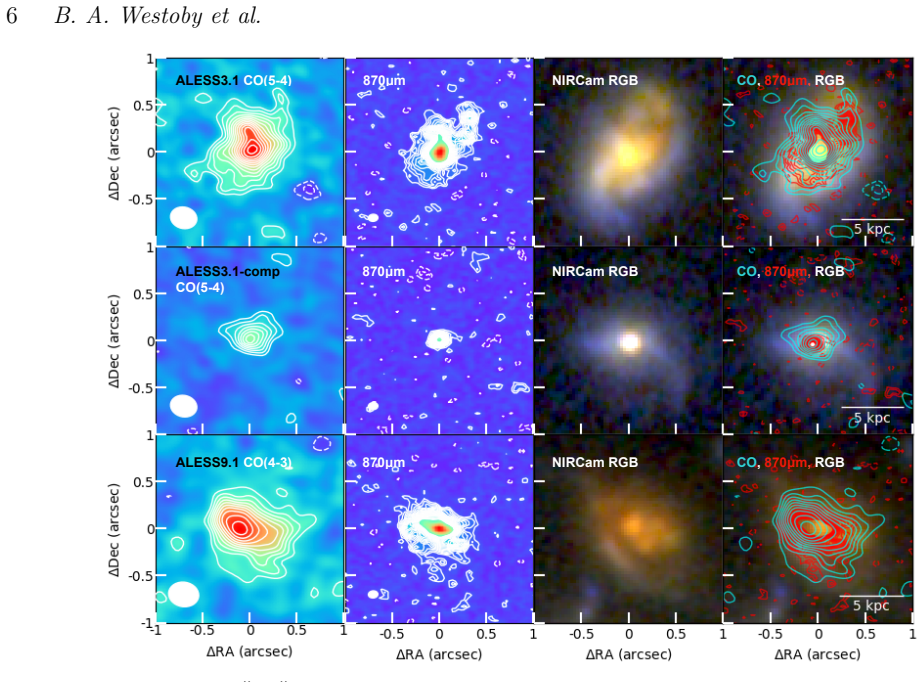
We present ALMA high-resolution ($\sim$0.25$^{\prime\prime}$/2 kpc) CO(5-4) and CO(4-3) observations of three $z\sim 3$ submillimetre-selected dusty galaxies from the ALESS survey. These data complement existing [sub]-kpc scale ALMA 870$\mu$m continuum imaging and JWST NIRCam and MIRI imaging from the ALESS-JWST program, allowing us to trace the molecular gas, dust-obscured star formation, and stellar populations on similar spatial scales. We spectroscopically confirm that two of the sources lie at the same redshift and are likely interacting. We find that the molecular-gas distribution broadly follows the dusty star-forming structures seen in the 870$\mu$m dust continuum imaging, but that the gas reservoirs are significantly more extended than the dust emission with a spatial extent comparable to the rest-frame near-infrared stellar emission. By modeling the kinematics for the two highest signal-to-noise sources, we find that the galaxies are well-fit by rotating disc models with high ratios of ordered to random motion ($V_{\rm{max}}/\overline{\sigma}=5\pm1$ and $6\pm1$), although smaller-scale kinematic deviations cannot be ruled out at the current sensitivity and spatial resolution. Finally, utilizing the high-resolution 870$\mu$m dust continuum and CO data, we investigate star-formation scaling relations on kpc-scales in these high-redshift galaxies. Assuming a constant CO-to-H$_{2}$ conversion factor and excitation ratio, we find that the data are offset from theoretical star-formation relation predictions that do not take turbulence into account, but consistent with gravo-turbulent models, thereby suggesting that turbulence plays a central role in regulating star formation at high redshift.
Editorial analysis
A structured set of objections, weighed in public.
Referee Report
Summary. The manuscript presents ALMA high-resolution (~0.25 arcsec / 2 kpc) CO(5-4) and CO(4-3) observations of three z~3 submillimetre-selected dusty galaxies from the ALESS survey, combined with existing 870 μm continuum and JWST NIRCam/MIRI imaging. It maps the molecular gas distribution (more extended than dust but comparable to stellar emission), spectroscopically confirms an interacting pair, models the kinematics of the two highest-S/N sources as rotating disks with V_max/σ ≈ 5–6, and examines kpc-scale star-formation scaling relations. Under the assumption of constant CO-to-H2 conversion factor and excitation ratio, the data points are reported as offset from non-turbulent theoretical predictions but consistent with gravo-turbulent models, implying turbulence regulates star formation at high redshift.
Significance. If the constant-conversion-factor assumption holds and the model comparison is robust, the resolved multi-tracer maps and kinematic results would provide valuable constraints on the physical conditions in high-z DSFGs and observational support for turbulence-regulated star formation on kpc scales, complementing lower-resolution studies.
major comments (1)
- [Abstract and star-formation scaling relations section] Abstract and star-formation scaling relations section: the central claim that the kpc-scale points support gravo-turbulent regulation (offset from non-turbulent predictions) rests entirely on the assumption of spatially and source-invariant α_CO and r_54. No quantitative offsets, error bars on the model comparison, or tests of alternative conversion-factor values (e.g., varying with density or turbulence) are provided; if these parameters shift systematically, the data could move onto the non-turbulent locus, undermining the turbulence conclusion.
Simulated Author's Rebuttal
We thank the referee for their constructive comments on our manuscript. We address the single major comment below and indicate the revisions we will incorporate.
read point-by-point responses
-
Referee: [Abstract and star-formation scaling relations section] Abstract and star-formation scaling relations section: the central claim that the kpc-scale points support gravo-turbulent regulation (offset from non-turbulent predictions) rests entirely on the assumption of spatially and source-invariant α_CO and r_54. No quantitative offsets, error bars on the model comparison, or tests of alternative conversion-factor values (e.g., varying with density or turbulence) are provided; if these parameters shift systematically, the data could move onto the non-turbulent locus, undermining the turbulence conclusion.
Authors: We agree that the interpretation depends on the stated assumption of constant α_CO and r_54, which is explicitly noted in the abstract and scaling-relations section. In the revised manuscript we will add quantitative offsets between the observed kpc-scale points and the non-turbulent model locus, together with error bars that incorporate the reported uncertainties on the data. We will also expand the discussion to examine how plausible systematic variations in α_CO (e.g., with density or turbulence) could shift the points, while noting that the present data remain consistent with gravo-turbulent predictions under the standard conversion factors adopted in the high-redshift DSFG literature. Comprehensive spatially resolved tests of variable conversion factors lie beyond the sensitivity and tracer coverage of the current observations. revision: partial
Circularity Check
No significant circularity; comparison to external models is independent
full rationale
The paper's central claim rests on placing observed kpc-scale gas and SFR surface densities (derived from CO luminosities under a stated constant α_CO and excitation ratio) onto star-formation relation diagrams and noting their offset from non-turbulent theoretical tracks while matching gravo-turbulent ones. This comparison uses external models as benchmarks rather than deriving the models or the offset from the paper's own fitted quantities or self-citations. No self-definitional equations, fitted-input-as-prediction reductions, or load-bearing self-citation chains appear in the provided derivation chain; the result remains falsifiable against independent theory and is therefore self-contained.
Axiom & Free-Parameter Ledger
free parameters (2)
- CO-to-H2 conversion factor
- excitation ratio
axioms (2)
- domain assumption Rotating disc models adequately describe the gas kinematics
- standard math The ~0.25 arcsec resolution corresponds to ~2 kpc physical scales at z~3
Reference graph
Works this paper leans on
-
[1]
, author =. 2025 , pages =. doi:10.1051/0004-6361/202452948 , abstract =
-
[2]
The dawn of discs: unveiling the turbulent ionized gas kinematics of the galaxy population at. , author =. 2025 , pages =. doi:10.1093/mnras/staf1540 , abstract =
-
[3]
Kinematic scaling relations of disc galaxies from ionised gas at. , author =. 2026 , pages =. doi:10.1051/0004-6361/202557349 , abstract =
-
[4]
Reconciling extragalactic star formation efficiencies with theory:. , author =. 2025 , pages =. doi:10.1051/0004-6361/202453564 , abstract =
-
[5]
V. , author =. 2026 , pages =. doi:10.3847/1538-4365/ae27d4 , abstract =
-
[6]
, author =. 2024 , pages =. doi:10.1093/mnras/stae2217 , abstract =
-
[7]
, author =. 2025 , pages =. doi:10.3847/1538-4357/ad9f3b , abstract =
-
[8]
Sharda, Piyush and Menon, Shyam H and Federrath, Christoph and Krumholz, Mark R and Beattie, James R and Jameson, Katherine E and Tokuda, Kazuki and Burkhart, Blakesley and Crocker, Roland M and Law, Charles J and Seta, Amit and Gaetz, Terrance J and Pingel, Nickolas M and Seitenzahl, Ivo R and Sano, Hidetoshi and Fukui, Yasuo , title =. , volume =. 2022 ...
-
[9]
, author =. 2016 , pages =. doi:10.3847/0004-637X/832/2/143 , abstract =
-
[10]
Resolving the. , author =. 2026 , pages =. doi:10.3847/1538-4357/ae14eb , abstract =
-
[11]
, author =. 2011 , pages =. doi:10.1088/0004-637X/740/2/96 , abstract =
-
[12]
McKay, S. J. and Barger, A. J. and Cowie, L. L. and Bauer, F. E. , year =. doi:10.48550/ARXIV.2604.11879 , abstract =
work page internal anchor Pith review Pith/arXiv arXiv doi:10.48550/arxiv.2604.11879
-
[13]
ALESS--JWST: Dust-driven Morphologies and Hidden Stellar Mass in $z\sim3$ Sub-millimeter Galaxies
Li, J. and da Cunha, E. and Hodge, J. A. and Smail, I. and Kendrew, S. and battisti, A. and Cracraft, M. and Boogaard, L. A. and Brandt, W. N. and Chen, C. -C. and Cox, P. and Knudsen, K. K. and Liao, C. -L. and Rivera, G. Calistro and Rybak, M. and Swinbank, A. M. and van der Werf, P. and Walter, F. and Weiss, A. and Westoby, B. A. , year =. doi:10.48550...
work page internal anchor Pith review Pith/arXiv arXiv doi:10.48550/arxiv.2604.13408
-
[14]
How well does. , author =. doi:10.1093/mnras/stag576 , abstract =
-
[15]
A. , author =. 2020 , pages =. doi:10.3847/1538-4357/ab64f4 , abstract =
-
[16]
Spatially resolved dust properties and quasar-galaxy decomposition of a hyper-luminous infrared galaxy at. , author =. 2023 , pages =. doi:10.1093/mnras/stad1464 , abstract =
-
[17]
Detecting a disc bending wave in a barred-spiral galaxy at redshift 4.4 , volume =. , author =. 2023 , pages =. doi:10.1093/mnras/stad3588 , abstract =
-
[18]
2021, Science, 372, 1201, doi: 10.1126/science.abe9680
Spiral morphology in an intensely star-forming disk galaxy more than 12 billion years ago , volume =. , author =. 2021 , pages =. doi:10.1126/science.abe9680 , abstract =
-
[19]
, author =. 2013 , pages =. doi:10.1088/0004-637X/779/1/67 , abstract =
-
[20]
, author =. 2015 , pages =. doi:10.1088/2041-8205/798/1/L18 , abstract =
-
[21]
High-redshift star formation in the. , author =. 1998 , keywords =. doi:10.1038/28328 , number =
-
[22]
The. , author =. 1998 , keywords =. doi:10.1086/305588 , number =
work page internal anchor Pith review doi:10.1086/305588 1998
-
[23]
, author =. 2011 , pages =. doi:10.1088/0004-637X/730/1/40 , abstract =
-
[24]
Statistical. , author =. 2022 , pages =. doi:10.3847/1538-4365/ac626b , abstract =
-
[25]
An. , author =. 2024 , pages =. doi:10.3847/1538-4357/ad148c , abstract =
-
[26]
A. , author =. 2017 , pages =. doi:10.3847/1538-4357/aa863a , abstract =
-
[27]
, author =. 2022 , pages =. doi:10.3847/2041-8213/ac98c6 , abstract =
-
[28]
The. , author =. 2023 , pages =. doi:10.3847/1538-4357/accb86 , abstract =
-
[29]
, author =. 2013 , pages =. doi:10.1088/0004-637X/777/1/5 , abstract =
-
[30]
A., Schnurr O., Hirschi R., Yusof N., Parker R
Tracing the molecular gas in distant submillimetre galaxies via. , author =. 2011 , pages =. doi:10.1111/j.1365-2966.2010.18028.x , language =
-
[31]
Full of. , author =. 2020 , pages =. doi:10.1093/mnras/staa879 , abstract =
-
[32]
, author =. 2025 , pages =. doi:10.1093/pasj/psaf010 , abstract =
-
[33]
, author =. 2014 , pages =. doi:10.1088/0004-637X/788/2/125 , abstract =
-
[34]
An. , author =. 2017 , pages =. doi:10.3847/1538-4357/aa6caf , abstract =
-
[35]
Mancera Piña, Pavel E. and Teodoro, Enrico M. Di and Fall, S. Michael and Marasco, Antonino and Kriek, Mariska and Martorano, Marco , month = dec, year =. Kinematic scaling relations of disc galaxies from ionised gas at \ z. doi:10.48550/arXiv.2511.08685 , abstract =
work page internal anchor Pith review Pith/arXiv arXiv doi:10.48550/arxiv.2511.08685
-
[36]
Dynamical properties of. , author =. 2021 , pages =. doi:10.1093/mnras/stab2295 , abstract =
-
[37]
A massive stellar bulge in a regularly rotating galaxy 1.2 billion years after the. , author =. 2021 , pages =. doi:10.1126/science.abc1893 , abstract =
-
[38]
The. , author =. 2024 , keywords =. doi:10.1051/0004-6361/202450455 , abstract =
-
[39]
A simple model to interpret the ultraviolet, optical and infrared emission from galaxies , volume =. , author =. 2008 , pages =. doi:10.1111/j.1365-2966.2008.13535.x , abstract =
-
[40]
, author =. 2015 , pages =. doi:10.1088/0004-637X/806/1/110 , language =
-
[41]
Measurements of the. , author =. 2021 , pages =. doi:10.3847/1538-4357/ac0ae0 , abstract =
-
[42]
Resolving the. , author =. 2018 , keywords =. doi:10.3847/1538-4357/aacffa , abstract =
-
[43]
and Van der Werk, Paul and Smail, Ian and Butterworth, Joshua and Jansen, Jasper and Topkaras, Theodoros and Chen, Chian-Chou and Chapman, Scott C
Frias Castillo, Marta and Rybak, Matus and Hodge, Jacqueline A. and Van der Werk, Paul and Smail, Ian and Butterworth, Joshua and Jansen, Jasper and Topkaras, Theodoros and Chen, Chian-Chou and Chapman, Scott C. and Weiss, Axel and Algera, Hiddo and Birkin, Jack E. and da Cunha, Elisabete and Chen, Jianhang and Dannerbauer, Helmut and Jiménez-Andrade, E. ...
-
[44]
, author =. 2023 , pages =. doi:10.3847/1538-4357/acb931 , abstract =
-
[45]
Prajapati, Prachi and Riechers, Dominik and Cox, Pierre and Weiss, Axel and Saintonge, Amelie and Jones, Bethany and Bakx, Tom J. L. C. and Berta, Stefano and van der Werf, Paul and Neri, Roberto and Butler, Kirsty M. and Cooray, Asantha and Ismail, Diana and Baker, Andrew J. and Borsato, Edoardo and Harris, Andrew and Ivison, Rob and Lehnert, Matthew and...
-
[46]
The. , author =. 1999 , pages =. doi:10.1086/307069 , abstract =
-
[47]
Submillimetre-wavelength detection of dusty star-forming galaxies at high redshift , volume =. , author =. 1998 , pages =. doi:10.1038/28338 , language =
-
[48]
A. , author =. 1997 , pages =. doi:10.1086/311017 , language =
-
[49]
The. , author =. 2023 , pages =. doi:10.1088/1538-3873/ace216 , abstract =
-
[50]
Integral field spectroscopy of. , author =. 2012 , pages =. doi:10.1111/j.1365-2966.2012.21386.x , abstract =
-
[51]
An analytic model of angular momentum transport by gravitational torques: from galaxies to massive black holes:. , author =. 2011 , pages =. doi:10.1111/j.1365-2966.2011.18542.x , abstract =
-
[52]
The. , author =. 2020 , pages =. doi:10.3847/1538-4357/ab5fdd , abstract =
-
[53]
Ikeda, Ryota and Iono, Daisuke and Tadaki, Ken-ichi and Franco, Maximilien and Yun, Min S. and Zavala, Jorge A. and Tamura, Yoichi and Tsukui, Takafumi and Williams, Christina C. and Hatsukade, Bunyo and Lee, Minju M. and Michiyama, Tomonari and Mitsuhashi, Ikki and Nakanishi, Kouichiro and Casey, Caitlin M. and Ikarashi, Soh and Lee, Kianhong and Matsuda...
-
[54]
A. , author =. 2024 , pages =. doi:10.1051/0004-6361/202449925 , abstract =
-
[55]
Iorio, Giuliano , month = apr, year =. "
-
[56]
, author =. 2024 , pages =. doi:10.1093/mnras/stae1089 , abstract =
-
[57]
, author =. 2015 , pages =. doi:10.1051/0004-6361/201425043 , abstract =
-
[58]
, author =. 2011 , pages =. doi:10.1088/0004-637X/737/2/67 , abstract =
-
[59]
A unified model for galactic discs: star formation, turbulence driving, and mass transport , volume =. , author =. 2018 , pages =. doi:10.1093/mnras/sty852 , abstract =
-
[60]
The evolution of turbulent galactic discs: gravitational instability, feedback, and accretion , volume =. , author =. 2022 , pages =. doi:10.1093/mnras/stac1324 , abstract =
-
[61]
Comparing the statistics of interstellar turbulence in simulations and observations:. , author =. 2010 , pages =. doi:10.1051/0004-6361/200912437 , abstract =
-
[62]
Feedback-regulated star formation in molecular clouds and galactic discs , volume =. , author =. 2013 , pages =. doi:10.1093/mnras/stt866 , language =
-
[63]
Pressure-regulated,. , author =. 2022 , pages =. doi:10.3847/1538-4357/ac7de2 , abstract =
-
[64]
, author =. 2012 , pages =. doi:10.1088/0004-637X/761/2/156 , language =
-
[65]
A. , author =. 2019 , pages =. doi:10.3847/2041-8213/ab48f6 , abstract =
-
[66]
A. , author =. 2025 , pages =. doi:10.3847/1538-4357/adc4e0 , abstract =
-
[67]
doi:10.1093/mnras/stw3285 , abstract =
, author =. doi:10.1093/mnras/stw3285 , abstract =
-
[68]
A survey of molecular gas in luminous sub-millimetre galaxies , volume =. , author =. 2013 , pages =. doi:10.1093/mnras/sts562 , abstract =
-
[69]
, author =. 2010 , pages =. doi:10.1088/0004-637X/724/1/687 , abstract =
-
[70]
A. , author =. 2011 , pages =. doi:10.1088/0004-637X/739/2/84 , abstract =
-
[71]
, author =. 2016 , pages =. doi:10.3847/0004-637X/825/1/12 , abstract =
-
[72]
, author =. 2013 , pages =. doi:10.1088/0004-637X/779/1/89 , language =
-
[73]
Volumetric star formation laws of disc galaxies , volume =. , author =. 2019 , pages =. doi:10.1051/0004-6361/201834382 , abstract =
-
[74]
The impact of gas disc flaring on rotation curve decomposition and revisiting baryonic and dark matter relations for nearby galaxies , volume =. , author =. 2022 , pages =. doi:10.1093/mnras/stac1508 , abstract =
-
[75]
Global. , author =. 2020 , pages =. doi:10.1093/mnras/staa3200 , abstract =
-
[76]
Robust. , author =. 2020 , pages =. doi:10.1093/mnras/staa1256 , abstract =
-
[77]
The galaxy-halo connection of disc galaxies over six orders of magnitude in stellar mass , volume =. , author =. 2025 , pages =. doi:10.1051/0004-6361/202554381 , abstract =
-
[78]
To. , author =. 2024 , pages =. doi:10.3847/1538-4357/ad66cc , abstract =
-
[79]
A., Schnurr O., Hirschi R., Yusof N., Parker R
The properties of the interstellar medium within a star-forming galaxy at z= 2.3:. , author =. doi:10.1111/j.1365-2966.2010.17549.x , abstract =
-
[80]
, author =. 2012 , pages =. doi:10.1088/0004-637X/760/1/11 , abstract =
discussion (0)
Sign in with ORCID, Apple, or X to comment. Anyone can read and Pith papers without signing in.