The Hubble Missing Globular Clusters Survey IV. Ultra-faint compact satellites of the Milky Way. The case of Koposov 2
Pith reviewed 2026-06-27 09:06 UTC · model grok-4.3
The pith
Koposov 2 is an ancient star cluster that has lost a large fraction of its original mass.
A machine-rendered reading of the paper's core claim, the machinery that carries it, and where it could break.
Core claim
Performing a spectroscopically-informed Bayesian isochrone fit on the MGCS data yields a distance modulus of 16.85, an age of 13.7 Gyr, a half-light radius of 2.7 pc, M_V of -0.95, and stellar mass of 372 solar masses. The luminosity function is reproduced by a model with mass-function slope x = -0.35, indicating loss of low-mass stars. Most ultra-faint compact satellites occupy the same M_V-R_h locus as open clusters.
What carries the argument
Spectroscopically-informed Bayesian isochrone fitting on deep HST photometry, combined with incompleteness-corrected luminosity-function and surface stellar density modeling.
Load-bearing premise
The spectroscopic metallicity is accurate and the corrections for photometric incompleteness and field contamination are reliable.
What would settle it
An independent spectroscopic metallicity or age measurement that differs substantially from 13.7 Gyr and the adopted value would falsify the old, mass-depleted cluster interpretation.
Figures


read the original abstract
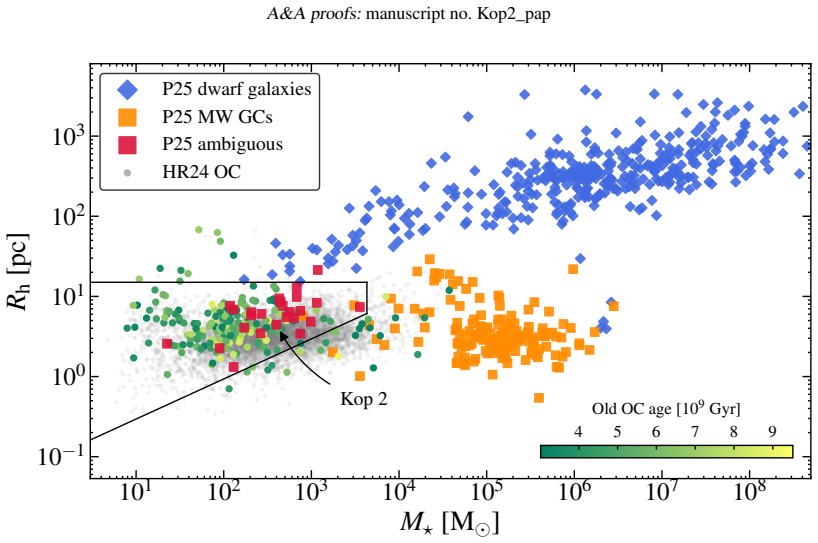
In the last decades a number of extremely faint and compact Galactic satellites (Ultra Faint Compact Satellites; UFCS) have been discovered by large panoramic surveys. Their nature is uncertain due to their location in the overlapping dwarf galaxy-star cluster region of the $M_V-R_h$ plane and their faintness and distance. Here we show how the deep HST photometry from the Missing Globular Clusters Survey (MGCS), combined with spectroscopic metallicities, provides new insight into the nature of these satellites through accurate distance and age estimates. We consider the case of Koposov 2, currently the most metal-poor bound star cluster known in the entire Milky Way or an extreme case of Ultra Faint Dwarf galaxy. By performing a spectroscopically-informed bayesian isochrone fit on the MGCS data we find $(m-M)_0=16.85\pm 0.06$ ($D=23.4\pm 0.6$ kpc) and age=$13.7^{+0.9}_{-1.3}$ Gyr, showing that, contrary to previous age estimates, Koposov 2 is as old as the oldest Galactic globular clusters. The luminosity function, corrected for incompleteness, is well reproduced by a model with the same age and metallicity and a slope of the mass function $x=-0.35$, suggesting a significant depletion of faint stars. We model the surface stellar density field, deriving new robust estimates of the half-light radius ($R_h=0.39^{+0.06}_{-0.04}$ arcsec, corresponding to $R_h=2.7^{+0.4}_{-0.3}$ pc), of the absolute integrated magnitude ($M_V=-0.95\pm0.22$) and of the stellar mass ($M_{\star}=371.8\pm41.6M_{\odot}$), showing that Koposov 2 is much more compact than dwarf galaxies of similar stellar mass. The new evidence significantly support the hypothesis that Koposov 2 is a star cluster that may have lost a large fraction of its original mass. Finally we show that most UFCS lie in the same locus of the $M_V - R_h$ plane as Galactic open clusters, hinting to a possible additional channel for their formation.
Editorial analysis
A structured set of objections, weighed in public.
Referee Report
Summary. The manuscript analyzes deep HST photometry of Koposov 2 from the Missing Globular Clusters Survey, combined with spectroscopic metallicities, via a Bayesian isochrone fit to derive (m-M)_0=16.85, age=13.7 Gyr, and a mass-function slope x=-0.35 from the incompleteness-corrected luminosity function. Surface-density modeling yields R_h=2.7 pc, M_V=-0.95, and M_star=372 M_sun, supporting the interpretation that Koposov 2 is a mass-stripped star cluster rather than an ultra-faint dwarf galaxy; it further places most UFCS in the same M_V-R_h locus as Galactic open clusters, suggesting an additional formation channel.
Significance. If the fits prove robust against the noted systematics, the results would strengthen evidence for substantial dynamical mass loss in the lowest-mass globular clusters and offer a concrete observational basis for distinguishing UFCS from dwarf galaxies while hinting at open-cluster-like formation pathways. The spectroscopically-informed Bayesian approach and use of HST data represent a clear methodological advance over prior photometric-only studies.
major comments (2)
- [Bayesian isochrone fit] The Bayesian isochrone fit (Abstract and associated methods section) adopts the spectroscopic metallicity as a fixed constraint to obtain the 13.7 Gyr age. No propagation of [Fe/H] uncertainty or sensitivity tests to a 0.2 dex offset are described; such an offset would shift the best-fit age younger, directly affecting the claim that Koposov 2 matches the oldest globular clusters and the mass-loss interpretation.
- [surface stellar density field modeling] The surface-density modeling and luminosity-function analysis (Abstract) derive R_h=2.7 pc, M_star=372 M_sun, and x=-0.35 after incompleteness correction and background subtraction. The manuscript provides no quantitative residual-contamination estimates or validation metrics from the artificial-star tests, both of which are load-bearing for placing the object firmly in the star-cluster locus rather than the dwarf-galaxy region.
minor comments (1)
- A summary table comparing the new distance, age, R_h, and mass values to all previous literature estimates would improve clarity and allow immediate assessment of the revision in parameters.
Simulated Author's Rebuttal
We thank the referee for the constructive comments, which highlight areas where additional details will improve the manuscript. We address each major comment below and will revise the paper to incorporate the requested clarifications and tests.
read point-by-point responses
-
Referee: [Bayesian isochrone fit] The Bayesian isochrone fit (Abstract and associated methods section) adopts the spectroscopic metallicity as a fixed constraint to obtain the 13.7 Gyr age. No propagation of [Fe/H] uncertainty or sensitivity tests to a 0.2 dex offset are described; such an offset would shift the best-fit age younger, directly affecting the claim that Koposov 2 matches the oldest globular clusters and the mass-loss interpretation.
Authors: We agree that the manuscript would benefit from explicit propagation of the spectroscopic [Fe/H] uncertainty and sensitivity tests. The reported age uncertainties are derived from the Bayesian posterior with [Fe/H] fixed at the spectroscopic value, but we will add a new subsection in the methods describing tests varying [Fe/H] by ±0.2 dex and their effect on age, distance, and the mass-loss interpretation. Updated figures or tables will be included if the changes are significant. revision: yes
-
Referee: [surface stellar density field modeling] The surface-density modeling and luminosity-function analysis (Abstract) derive R_h=2.7 pc, M_star=372 M_sun, and x=-0.35 after incompleteness correction and background subtraction. The manuscript provides no quantitative residual-contamination estimates or validation metrics from the artificial-star tests, both of which are load-bearing for placing the object firmly in the star-cluster locus rather than the dwarf-galaxy region.
Authors: The artificial-star tests were performed to derive the incompleteness corrections used in the luminosity function and surface-density modeling, but quantitative residual-contamination estimates and validation metrics were not reported. In the revised manuscript we will add a dedicated paragraph in the methods section summarizing the artificial-star test results, including contamination fractions as a function of magnitude and position, and any relevant validation statistics to support the robustness of the derived R_h, M_star, and mass-function slope. revision: yes
Circularity Check
No significant circularity; parameters derived from direct data fits
full rationale
The derivation chain consists of a Bayesian isochrone fit to HST photometry with fixed spectroscopic [Fe/H], followed by incompleteness-corrected luminosity function modeling and surface-density profile fitting to obtain Rh, MV and M⋆. These steps use external spectroscopic constraints and standard fitting procedures on the MGCS data; none of the output quantities are defined in terms of themselves or obtained by renaming a fitted input as a prediction. The comparison of UFCS to open clusters is a direct locus plot, not a derived claim. No self-citation is load-bearing for the central results, and the paper remains self-contained against the photometric and spectroscopic inputs.
Axiom & Free-Parameter Ledger
free parameters (1)
- mass function slope x =
-0.35
axioms (2)
- domain assumption Standard stellar isochrones accurately describe the color-magnitude diagram at the measured metallicity and age
- domain assumption Spectroscopic metallicities provide reliable inputs without significant bias
Reference graph
Works this paper leans on
-
[1]
Tidal disruption, global mass function and structural parameters evolution in star clusters
Tidal Disruption, Global Mass Function, and Structural Parameter Evolution in Star Clusters. , keywords =. doi:10.1088/0004-637X/708/2/1598 , archivePrefix =. 0911.3394 , primaryClass =
work page internal anchor Pith review Pith/arXiv arXiv doi:10.1088/0004-637x/708/2/1598
-
[2]
galpy: A Python Library for Galactic Dynamics
galpy: A python Library for Galactic Dynamics. , keywords =. doi:10.1088/0067-0049/216/2/29 , archivePrefix =. 1412.3451 , primaryClass =
work page internal anchor Pith review Pith/arXiv arXiv doi:10.1088/0067-0049/216/2/29
-
[3]
On the variation of the initial mass function. , keywords =. doi:10.1046/j.1365-8711.2001.04022.x , archivePrefix =. astro-ph/0009005 , primaryClass =
-
[4]
PETAR: a high-performance N-body code for modelling massive collisional stellar systems. , keywords =. doi:10.1093/mnras/staa1915 , archivePrefix =. 2006.16560 , primaryClass =
-
[5]
arXiv e-prints , keywords =
Probing the IMF in the Early Universe -- Direct measurements in the Bo \"o tes I UFD with JWST/NIRCam. arXiv e-prints , keywords =
-
[6]
The Sagittarius stream in Gaia Early Data Release 3 and the origin of the bifurcations. , keywords =. doi:10.1051/0004-6361/202142830 , archivePrefix =. 2112.02105 , primaryClass =
-
[7]
A Panoramic Landscape of the Sagittarius Stream in Gaia DR2 Revealed with the STREAMFINDER Spyglass. , keywords =. doi:10.3847/2041-8213/ab77c7 , archivePrefix =. 2002.11121 , primaryClass =
-
[8]
Dwarf Galaxies and Globular Clusters
Dwarf Galaxies and Globular Clusters. arXiv e-prints , keywords =. doi:10.48550/arXiv.1210.6169 , archivePrefix =. 1210.6169 , primaryClass =
work page internal anchor Pith review Pith/arXiv arXiv doi:10.48550/arxiv.1210.6169
-
[9]
The Discovery of the Faintest Known Milky Way Satellite Using UNIONS. , keywords =. doi:10.3847/1538-4357/ad0d9f , archivePrefix =. 2311.10147 , primaryClass =
-
[10]
Reevaluating UMa3/U1: star cluster or the smallest known galaxy?. , keywords =. doi:10.1093/mnras/staf572 , archivePrefix =. 2504.21301 , primaryClass =
-
[11]
Origin of the system of globular clusters in the Milky Way. , keywords =. doi:10.1051/0004-6361/201936135 , archivePrefix =. 1906.08271 , primaryClass =
-
[12]
The ACS survey of Galactic globular clusters. XII. Photometric binaries along the main sequence. , keywords =. doi:10.1051/0004-6361/201016384 , archivePrefix =. 1111.0552 , primaryClass =
work page internal anchor Pith review Pith/arXiv arXiv doi:10.1051/0004-6361/201016384
-
[13]
A Correlation between Blue Straggler and Binary Fractions in the core of Galactic Globular Clusters
The correlation between blue straggler and binary fractions in the core of Galactic globular clusters. , keywords =. doi:10.1051/0004-6361:20079082 , archivePrefix =. 0801.4511 , primaryClass =
work page internal anchor Pith review Pith/arXiv arXiv doi:10.1051/0004-6361:20079082
-
[14]
The fraction of binary systems in the core of 13 low-density Galactic globular clusters. , keywords =. doi:10.1111/j.1365-2966.2007.12116.x , archivePrefix =. 0706.2288 , primaryClass =
-
[15]
Encyclopedia of Astrophysics, Volume 4 , year = 2026, volume =
Milky Way disk. Encyclopedia of Astrophysics, Volume 4 , year = 2026, volume =. doi:10.1016/B978-0-443-21439-4.00064-X , archivePrefix =. 2412.12252 , primaryClass =
-
[16]
The formation and survival of the Milky Way's oldest stellar disk. Nature Astronomy , keywords =. doi:10.1038/s41550-024-02382-w , archivePrefix =. 2410.09705 , primaryClass =
-
[17]
Early thin-disc assembly revealed by JWST edge-on galaxies
Early thin-disc assembly revealed by JWST edge-on galaxies. , keywords =. doi:10.1093/mnras/stag703 , archivePrefix =. 2601.03339 , primaryClass =
work page internal anchor Pith review Pith/arXiv arXiv doi:10.1093/mnras/stag703
-
[18]
arXiv e-prints , keywords =
NEFERTITI: Linking early galaxy formation to the assembly of the Milky Way. arXiv e-prints , keywords =
-
[19]
Revising members and candidates with Gaia DR2
Globular clusters in the Sagittarius stream. Revising members and candidates with Gaia DR2. , keywords =. doi:10.1051/0004-6361/202037621 , archivePrefix =. 2003.07871 , primaryClass =
-
[20]
Possible traces of the Galactic disc at very early epochs
Metal-poor stars with disc-like orbits. Possible traces of the Galactic disc at very early epochs. , keywords =. doi:10.1051/0004-6361/202348106 , archivePrefix =. 2312.02356 , primaryClass =
-
[21]
The Open Journal of Astrophysics , keywords =
Spectroscopic Analysis of Pictor II: a very low metallicity ultra-faint dwarf galaxy bound to the Large Magellanic Cloud. The Open Journal of Astrophysics , keywords =. doi:10.33232/001c.142989 , archivePrefix =. 2506.21841 , primaryClass =
-
[22]
A Comprehensive Maximum Likelihood Analysis of the Structural Properties of Faint Milky Way Satellites. , keywords =. doi:10.1086/590336 , archivePrefix =. 0805.2945 , primaryClass =
work page internal anchor Pith review Pith/arXiv arXiv doi:10.1086/590336
-
[23]
The PAndAS View of the Andromeda Satellite System. II. Detailed Properties of 23 M31 Dwarf Spheroidal Galaxies. , keywords =. doi:10.3847/1538-4357/833/2/167 , archivePrefix =. 1610.01158 , primaryClass =
work page internal anchor Pith review Pith/arXiv arXiv doi:10.3847/1538-4357/833/2/167
-
[24]
, year = 1911, month = mar, volume = 71, pages =
On the problem of distribution in globular star clusters. , year = 1911, month = mar, volume = 71, pages =. doi:10.1093/mnras/71.5.460 , adsurl =
-
[25]
Evidence for two populations of Galactic globular clusters from the ratio of their half-mass to Jacobi radii. , keywords =. doi:10.1111/j.1365-2966.2009.15758.x , archivePrefix =. 0909.5696 , primaryClass =
-
[26]
The ACS Virgo Cluster Survey. IX. The Color Distributions of Globular Cluster Systems in Early-Type Galaxies. , keywords =. doi:10.1086/498210 , archivePrefix =. astro-ph/0509654 , primaryClass =
work page internal anchor Pith review Pith/arXiv arXiv doi:10.1086/498210
-
[27]
Measuring Sizes of Ultra-Faint Dwarf Galaxies
Measuring Sizes of Ultra-faint Dwarf Galaxies. , keywords =. doi:10.1088/0004-637X/745/2/127 , archivePrefix =. 1110.1086 , primaryClass =
work page internal anchor Pith review Pith/arXiv arXiv doi:10.1088/0004-637x/745/2/127
-
[28]
Discovery of a New Local Group Dwarf Galaxy Candidate in UNIONS: Bo \"o tes V. , keywords =. doi:10.3847/1538-3881/acdd77 , archivePrefix =. 2209.08242 , primaryClass =
-
[29]
ACS photometry of the globular cluster B514
ACS Photometry of the Remote M31 Globular Cluster B514. , keywords =. doi:10.1086/508884 , archivePrefix =. astro-ph/0609439 , primaryClass =
work page internal anchor Pith review Pith/arXiv arXiv doi:10.1086/508884
-
[30]
Dynamical mirages: How bar-induced resonant trapping can mimic substructure clustering in dynamical parameter spaces. , keywords =. doi:10.1051/0004-6361/202556723 , archivePrefix =. 2511.05655 , primaryClass =
-
[31]
Globular clusters in ORBIT: Complete dynamical characterisation of the Milky Way globular cluster population through updated orbital reconstruction. , keywords =. doi:10.1051/0004-6361/202556235 , archivePrefix =. 2512.06079 , primaryClass =
-
[32]
arXiv e-prints , keywords =
The Last Galactic Firework: Timing the last significant merger with stars, globular clusters and ω Centauri. arXiv e-prints , keywords =
-
[33]
The missing ultra-faint satellites of the Milky Way
The missing ultra-faint satellites of the Milky Way. arXiv e-prints , keywords =. doi:10.48550/arXiv.2604.09539 , archivePrefix =. 2604.09539 , primaryClass =
work page internal anchor Pith review Pith/arXiv arXiv doi:10.48550/arxiv.2604.09539
-
[34]
Improving the open cluster census. III. Using cluster masses, radii, and dynamics to create a cleaned open cluster catalogue. , keywords =. doi:10.1051/0004-6361/202348662 , archivePrefix =. 2403.05143 , primaryClass =
-
[35]
The Chemical Composition of the Sun. Science , keywords =. doi:10.1126/science.191.4233.1223 , adsurl =
-
[36]
Proof that the Milky Way experienced a significant merger only 1.5 billion years after the Big Bang. arXiv e-prints , keywords =. doi:10.48550/arXiv.2601.18896 , archivePrefix =. 2601.18896 , primaryClass =
-
[37]
Cluster Ages to Reconstruct the Milky Way Assembly (CARMA): IV. Chrono-dynamics of seven old star clusters in the Large Magellanic Cloud and the peculiar origin of NGC 1841. , keywords =. doi:10.1051/0004-6361/202554384 , archivePrefix =. 2509.10144 , primaryClass =
-
[38]
Deep Hubble Space Telescope WFPC2 Photometry of NGC 288. II. The Main-Sequence Luminosity Function. , keywords =. doi:10.1086/340082 , archivePrefix =. astro-ph/0202176 , primaryClass =
work page internal anchor Pith review Pith/arXiv arXiv doi:10.1086/340082
-
[39]
, year = 1962, month = nov, volume =
The Distribution of Blue Stars in M13. , year = 1962, month = nov, volume =. doi:10.1086/147435 , adsurl =
-
[40]
, year = 1955, month = jan, volume =
The Luminosity Function and Stellar Evolution. , year = 1955, month = jan, volume =. doi:10.1086/145971 , adsurl =
-
[41]
Measuring Reddening with SDSS Stellar Spectra and Recalibrating SFD
Measuring Reddening with Sloan Digital Sky Survey Stellar Spectra and Recalibrating SFD. , keywords =. doi:10.1088/0004-637X/737/2/103 , archivePrefix =. 1012.4804 , primaryClass =
work page internal anchor Pith review Pith/arXiv arXiv doi:10.1088/0004-637x/737/2/103
-
[42]
Maps of Dust IR Emission for Use in Estimation of Reddening and CMBR Foregrounds
Maps of Dust Infrared Emission for Use in Estimation of Reddening and Cosmic Microwave Background Radiation Foregrounds. , keywords =. doi:10.1086/305772 , archivePrefix =. astro-ph/9710327 , primaryClass =
work page internal anchor Pith review Pith/arXiv arXiv doi:10.1086/305772
-
[43]
Homogeneous abundances of Mg, Si, Ca, and Ti for about 1500 red giants in 16 globular clusters from FLAMES spectra. , keywords =. doi:10.1051/0004-6361/202558153 , archivePrefix =. 2601.18878 , primaryClass =
-
[44]
Color Transformations and Bolometric Corrections for Galactic Halo Stars: -Enhanced versus Scaled-Solar Results. , keywords =. doi:10.1086/424907 , archivePrefix =. astro-ph/0408111 , primaryClass =
work page internal anchor Pith review Pith/arXiv arXiv doi:10.1086/424907
-
[45]
Cluster Ages to Reconstruct the Milky Way Assembly (CARMA). I. The final word on the origin of NGC 6388 and NGC 6441. , keywords =. doi:10.1051/0004-6361/202347289 , archivePrefix =. 2310.01495 , primaryClass =
-
[46]
The alpha -enhanced Isochrones and Their Impact on the FITS to the Galactic Globular Cluster System. , keywords =. doi:10.1086/173105 , adsurl =
-
[47]
The Updated BaSTI Stellar Evolution Models and Isochrones. I. Solar-scaled Calculations. , keywords =. doi:10.3847/1538-4357/aab158 , archivePrefix =. 1802.07319 , primaryClass =
work page internal anchor Pith review Pith/arXiv arXiv doi:10.3847/1538-4357/aab158
-
[48]
Updated BaSTI Stellar Evolution Models and Isochrones. II. -enhanced Calculations. , keywords =. doi:10.3847/1538-4357/abd4d5 , archivePrefix =. 2012.10085 , primaryClass =
-
[49]
emcee: The MCMC Hammer. , keywords =. doi:10.1086/670067 , archivePrefix =. 1202.3665 , primaryClass =
work page internal anchor Pith review Pith/arXiv arXiv doi:10.1086/670067
-
[50]
Gaia Universe Model Snapshot : A statistical analysis of the expected contents of the Gaia catalogue
Gaia Universe model snapshot. A statistical analysis of the expected contents of the Gaia catalogue. , keywords =. doi:10.1051/0004-6361/201118646 , archivePrefix =. 1202.0132 , primaryClass =
work page internal anchor Pith review Pith/arXiv arXiv doi:10.1051/0004-6361/201118646
-
[51]
Tango for three: Sagittarius, LMC, and the Milky Way. , keywords =. doi:10.1093/mnras/staa3673 , archivePrefix =. 2009.10726 , primaryClass =
-
[52]
Survey membership tools and kinematic analysis of NGC 6749
The Hubble Missing Globular Cluster Survey: II. Survey membership tools and kinematic analysis of NGC 6749. , keywords =. doi:10.1051/0004-6361/202558333 , archivePrefix =. 2512.01530 , primaryClass =
-
[53]
The Hubble Space Telescope UV Legacy Survey of Galactic Globular Clusters. XXIII. Proper-motion Catalogs and Internal Kinematics. , keywords =. doi:10.3847/1538-4357/ac7727 , archivePrefix =. 2206.09924 , primaryClass =
-
[54]
The Hubble Missing Globular Cluster Survey. III. Astro-photometric catalogs, artificial-star tests, and improved absolute proper motions. arXiv e-prints , keywords =. doi:10.48550/arXiv.2603.25848 , archivePrefix =. 2603.25848 , primaryClass =
work page internal anchor Pith review Pith/arXiv arXiv doi:10.48550/arxiv.2603.25848
-
[55]
A MegaCam Survey of Outer Halo Satellites. III. Photometric and Structural Parameters. , keywords =. doi:10.3847/1538-4357/aac16b , archivePrefix =. 1806.06891 , primaryClass =
work page internal anchor Pith review Pith/arXiv arXiv doi:10.3847/1538-4357/aac16b
-
[56]
Charting the Galactic Acceleration Field. II. A Global Mass Model of the Milky Way from the STREAMFINDER Atlas of Stellar Streams Detected in Gaia DR3. , keywords =. doi:10.3847/1538-4357/ad382d , archivePrefix =. 2311.17202 , primaryClass =
-
[57]
Eridanus III and DELVE 1: Carbon-rich Primordial Star Clusters or the Smallest Dwarf Galaxies?. , keywords =. doi:10.3847/1538-4357/ad85dd , archivePrefix =. 2410.08276 , primaryClass =
-
[58]
arXiv e-prints , keywords =
Collisional Dynamics of Stars and Dark Matter in Ultra-Faint Galaxies. arXiv e-prints , keywords =
-
[59]
Stellar Mass Segregation in Dark Matter Halos. , keywords =. doi:10.3847/1538-4357/ae0328 , archivePrefix =. 2505.22717 , primaryClass =
-
[60]
Microgalaxies in LCDM. , keywords =. doi:10.3847/1538-4357/ad402d , archivePrefix =. 2311.14798 , primaryClass =
-
[61]
``Galaxy,'' Defined. , keywords =. doi:10.1088/0004-6256/144/3/76 , archivePrefix =. 1203.2608 , primaryClass =
work page internal anchor Pith review Pith/arXiv arXiv doi:10.1088/0004-6256/144/3/76
-
[62]
Sagittarius II, Draco II and Laevens 3: Three New Milky Way Satellites Discovered in the Pan-STARRS 1 3 Survey. , keywords =. doi:10.1088/0004-637X/813/1/44 , archivePrefix =. 1507.07564 , primaryClass =
work page internal anchor Pith review Pith/arXiv arXiv doi:10.1088/0004-637x/813/1/44
-
[63]
A New Faint Milky Way Satellite Discovered in the Pan-STARRS1 3 pi Survey
A New Faint Milky Way Satellite Discovered in the Pan-STARRS1 3 Survey. , keywords =. doi:10.1088/2041-8205/802/2/L18 , archivePrefix =. 1503.05554 , primaryClass =
work page internal anchor Pith review Pith/arXiv arXiv doi:10.1088/2041-8205/802/2/l18 2041
-
[64]
A new distant Milky Way globular cluster in the Pan-STARRS1 3{\pi} survey
A New Distant Milky Way Globular Cluster in the Pan-STARRS1 3 Survey. , keywords =. doi:10.1088/2041-8205/786/1/L3 , archivePrefix =. 1403.6593 , primaryClass =
work page internal anchor Pith review Pith/arXiv arXiv doi:10.1088/2041-8205/786/1/l3 2041
-
[65]
Reinvestigating the Clusters Koposov 1 and 2. , keywords =. doi:10.1088/0004-6256/148/1/19 , adsurl =
-
[66]
The ACS Survey of Galactic Globular Clusters. VIII. Effects of Environment on Globular Cluster Global Mass Functions. , keywords =. doi:10.1088/0004-6256/139/2/476 , adsurl =
-
[67]
The ACS Survey of Galactic Globular Clusters. VI. NGC 6366: A Heavily Stripped Galactic Globular Cluster. , keywords =. doi:10.1088/0004-6256/137/1/246 , adsurl =
-
[68]
The ACS Survey of Galactic Globular Clusters. IX. Horizontal Branch Morphology and the Second Parameter Phenomenon. , keywords =. doi:10.1088/0004-637X/708/1/698 , archivePrefix =. 0911.2469 , primaryClass =
work page internal anchor Pith review Pith/arXiv arXiv doi:10.1088/0004-637x/708/1/698
-
[69]
The Ages of 55 Globular Clusters as Determined Using an Improved V\^HB\_TO Method along with Color-Magnitude Diagram Constraints, and Their Implications for Broader Issues. , keywords =. doi:10.1088/0004-637X/775/2/134 , archivePrefix =. 1308.2257 , primaryClass =
work page internal anchor Pith review Pith/arXiv arXiv doi:10.1088/0004-637x/775/2/134
-
[70]
News from the Galactic suburbia: the chemical composition of the remote globular cluster NGC 2419. , keywords =. doi:10.1111/j.1365-2966.2012.21847.x , archivePrefix =. 1208.0195 , primaryClass =
-
[71]
The Keck/DEIMOS Stellar Archive. I. Uniform Velocities and Metallicities for 78 Milky Way Dwarf Galaxies and Globular Clusters. , keywords =. doi:10.3847/1538-4357/ae290d , archivePrefix =. 2602.10200 , primaryClass =
work page internal anchor Pith review Pith/arXiv arXiv doi:10.3847/1538-4357/ae290d
-
[72]
Internal Kinematics of the Fornax Dwarf Spheroidal Galaxy
Internal Kinematics of the Fornax Dwarf Spheroidal Galaxy. , keywords =. doi:10.1086/500193 , archivePrefix =. astro-ph/0511465 , primaryClass =
work page internal anchor Pith review Pith/arXiv arXiv doi:10.1086/500193
-
[73]
Memorie della Societa Astronomica Italiana Supplementi , keywords =
ATLAS12, SYNTHE, ATLAS9, WIDTH9, et cetera. Memorie della Societa Astronomica Italiana Supplementi , keywords =
-
[74]
X-shooter, the new wide band intermediate resolution spectrograph at the ESO Very Large Telescope
X-shooter, the new wide band intermediate resolution spectrograph at the ESO Very Large Telescope. , keywords =. doi:10.1051/0004-6361/201117752 , archivePrefix =. 1110.1944 , primaryClass =
work page internal anchor Pith review Pith/arXiv arXiv doi:10.1051/0004-6361/201117752 1944
-
[75]
Gaia EDR3 view on galactic globular clusters. , keywords =. doi:10.1093/mnras/stab1475 , archivePrefix =. 2102.09568 , primaryClass =
-
[76]
VVVX-Gaia discovery of a low luminosity globular cluster in the Milky Way disk. , keywords =. doi:10.1051/0004-6361/202039233 , archivePrefix =. 2010.02113 , primaryClass =
-
[77]
A Gaia DR2 view of the Open Cluster population in the Milky Way
A Gaia DR2 view of the open cluster population in the Milky Way. , keywords =. doi:10.1051/0004-6361/201833476 , archivePrefix =. 1805.08726 , primaryClass =
work page internal anchor Pith review Pith/arXiv arXiv doi:10.1051/0004-6361/201833476
-
[78]
Summary of the content and survey properties
Gaia Data Release 3. Summary of the content and survey properties. , keywords =. doi:10.1051/0004-6361/202243940 , archivePrefix =. 2208.00211 , primaryClass =
-
[79]
The Gaia mission. , keywords =. doi:10.1051/0004-6361/201629272 , archivePrefix =. 1609.04153 , primaryClass =
work page internal anchor Pith review Pith/arXiv arXiv doi:10.1051/0004-6361/201629272
-
[80]
An Analysis of the Shapes of Interstellar Extinction Curves. VII. Milky Way Spectrophotometric Optical-through-ultraviolet Extinction and Its R-dependence. , keywords =. doi:10.3847/1538-4357/ab4c3a , archivePrefix =. 1910.08852 , primaryClass =
discussion (0)
Sign in with ORCID, Apple, or X to comment. Anyone can read and Pith papers without signing in.