SCAR dynamics of adolescent substance use: peer influence, dropout, and bifurcation structure in a school-based model
Pith reviewed 2026-06-27 07:22 UTC · model grok-4.3
The pith
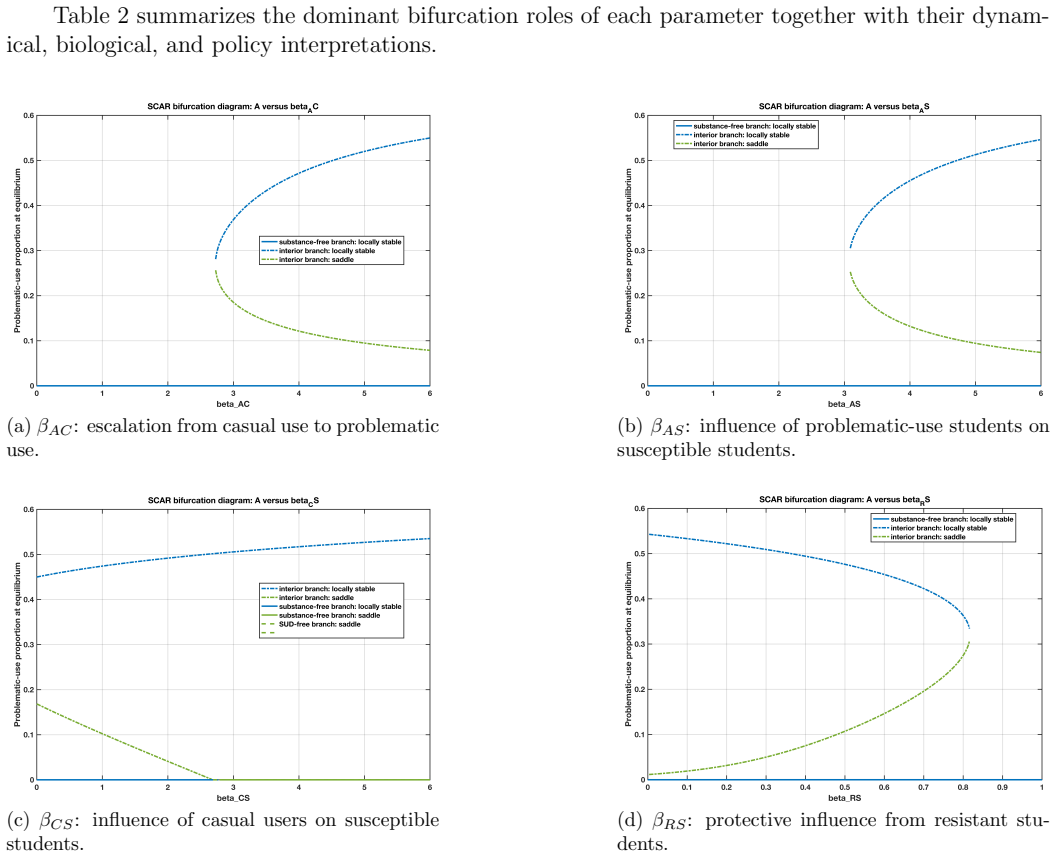
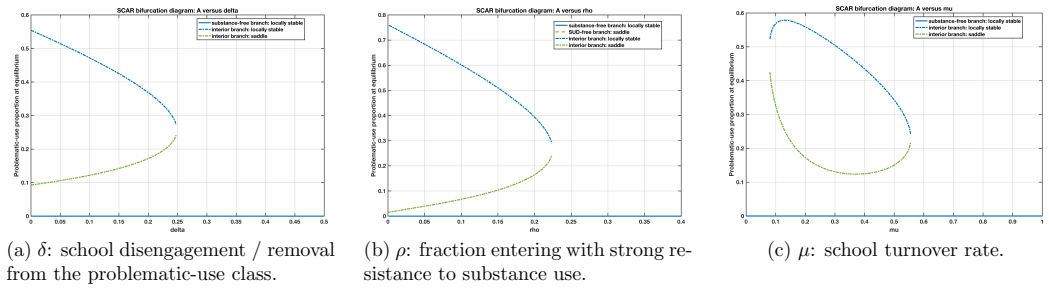
A school-based SCAR model of adolescent substance use exhibits multistability, so that long-term outcomes can depend on initial conditions and the return rate after dropout.
A machine-rendered reading of the paper's core claim, the machinery that carries it, and where it could break.
Core claim
The SCAR model shows three main results. The return parameter φ separates two regimes: when φ equals 1 the total population is conserved and interior equilibria may exist; when φ is less than 1 problematic use produces net school-population loss. Initiation and escalation are governed by distinct thresholds. The model can exhibit multistability, including bistability between a substance-free state and a stable high-use state, so long-term outcomes may depend on initial conditions.
What carries the argument
The four-compartment SCAR model with peer-driven initiation and escalation rates, protective influence, school disengagement, and the return parameter φ that controls whether population is conserved or lost.
If this is right
- When the return parameter equals 1, conserved total population allows interior equilibria to represent endemic states.
- When the return parameter is less than 1, net population loss means positive scaled equilibria may not correspond to true endemic levels.
- Distinct thresholds mean policies must separately address first initiation and later progression to problematic use.
- Bistability implies that identical schools can reach different long-term states depending on starting conditions.
- Effective policy therefore requires universal prevention, early intervention for casual users, targeted support for at-risk students, recovery environments, and re-engagement pathways.
Where Pith is reading between the lines
- If bistability is present, brief changes in school environment or peer norms could switch a population from one stable state to the other.
- The separation of thresholds suggests that interventions aimed only at preventing first use may leave escalation pathways intact even when initiation is reduced.
- Re-entry after rehabilitation becomes especially important under net-loss regimes because dropout can otherwise lock the remaining population into the high-use equilibrium.
Load-bearing premise
The chosen mathematical forms for how peers drive first use, escalation to problematic use, protective effects, and rates of school dropout and re-entry correctly represent the dominant processes in real high-school populations.
What would settle it
Longitudinal tracking of substance-use prevalence across many high schools that starts with different initial fractions of casual and addicted students and checks whether some schools remain near zero use while otherwise similar schools reach and stay at high-use levels.
Figures

read the original abstract
We develop a four-compartment susceptible--casual--addicted--resistant (SCAR) model for adolescent substance use in a high-school setting. The model divides students into susceptible non-users, casual or experimental users, students with sustained or substance-use-disorder (SUD)-level involvement, and resistant students in protective anti-use environments. It includes peer-driven initiation, escalation from casual to problematic use, protective peer influence, school disengagement, and partial re-entry after rehabilitation. Qualitative analysis and bifurcation diagrams show three main results. First, the return parameter \(\phi\) separates two regimes: when \(\phi=1\), the total population is conserved and interior equilibria may exist; when \(\phi<1\), problematic use causes net school-population loss, so positive scaled equilibria may not represent true endemic equilibria. Second, initiation and escalation are governed by distinct thresholds, meaning first use and progression to problematic use are dynamically different. Third, the model can exhibit multistability, including bistability between a substance-free state and a stable high-use state, so long-term outcomes may depend on initial conditions. These findings suggest that effective school policy should combine universal prevention, early intervention for casual users, targeted support for students at risk of problematic use, recovery-supportive environments, and strong school re-engagement pathways.
Editorial analysis
A structured set of objections, weighed in public.
Referee Report
Summary. The manuscript develops a four-compartment SCAR (susceptible-casual-addicted-resistant) model for adolescent substance use that incorporates peer-driven initiation and escalation, protective peer influence, school disengagement, and partial re-entry. Qualitative analysis and bifurcation diagrams are used to establish three results: the return parameter φ distinguishes a conserved-population regime (φ=1) from a net-loss regime (φ<1); initiation and escalation are governed by distinct thresholds; and the system exhibits multistability, including bistability between a substance-free equilibrium and a stable high-use state, implying that long-term outcomes can depend on initial conditions. Policy recommendations for combining universal prevention, early intervention, and re-engagement pathways are offered.
Significance. If the posited nonlinear rate functions correctly locate the system in a multistable regime, the bistability result would be significant for understanding path dependence in school-level substance-use trajectories and for motivating interventions that target tipping points rather than average effects. The separation of initiation versus escalation thresholds provides a useful dynamical distinction that aligns with staged prevention models. The φ-regime analysis clarifies when scaled equilibria remain interpretable under population loss.
major comments (3)
- [Model formulation] Model formulation section: The functional forms for peer-driven initiation, escalation from casual to addicted, protective influence, and disengagement rates are introduced as posited nonlinearities without derivation from longitudinal school data or micro-level behavioral mechanisms. Because the number and stability of equilibria (including the bistability between substance-free and high-use states) are generated by the specific nonlinearities in these terms, this choice is load-bearing for the third main result.
- [Bifurcation analysis] Bifurcation analysis section: No structural sensitivity checks are presented to determine whether bistability persists when the mass-action peer-influence terms are replaced by bounded or saturating alternatives; altering these forms can change the number of equilibria, so the multistability claim requires explicit robustness verification.
- [Qualitative analysis] Qualitative analysis section: The claim that positive scaled equilibria may not represent true endemic equilibria when φ<1 is stated, but the mapping from scaled variables back to actual population counts under net loss is not demonstrated with explicit steady-state equations or numerical examples.
minor comments (2)
- [Abstract] The abstract refers to 'bifurcation diagrams' supporting the three results, but the main text should include at least one representative diagram with labeled axes and parameter values so readers can verify the reported thresholds and bistable regions.
- [Results] Notation for the return parameter φ and the scaled equilibria should be introduced with a brief reminder of their definitions when first used in the results, to improve readability for readers outside mathematical epidemiology.
Simulated Author's Rebuttal
We thank the referee for the constructive and detailed comments. We address each major point below and indicate the revisions planned for the next version of the manuscript.
read point-by-point responses
-
Referee: [Model formulation] Model formulation section: The functional forms for peer-driven initiation, escalation from casual to addicted, protective influence, and disengagement rates are introduced as posited nonlinearities without derivation from longitudinal school data or micro-level behavioral mechanisms. Because the number and stability of equilibria (including the bistability between substance-free and high-use states) are generated by the specific nonlinearities in these terms, this choice is load-bearing for the third main result.
Authors: The functional forms are posited, drawing on standard mass-action assumptions from social contagion and addiction modeling literature rather than fitted to new longitudinal data. This is a genuine limitation for claims about multistability. In revision we will add a dedicated paragraph in the model formulation section that justifies each nonlinearity with references to behavioral mechanisms, cites supporting empirical studies on peer influence, and explicitly discusses the implications of the modeling choice for the bistability result. revision: yes
-
Referee: [Bifurcation analysis] Bifurcation analysis section: No structural sensitivity checks are presented to determine whether bistability persists when the mass-action peer-influence terms are replaced by bounded or saturating alternatives; altering these forms can change the number of equilibria, so the multistability claim requires explicit robustness verification.
Authors: We agree that explicit robustness checks are needed. In the revised bifurcation analysis section we will add new diagrams and analysis in which the peer-influence terms are replaced by saturating (e.g., Michaelis-Menten) alternatives and will report whether the separation of initiation/escalation thresholds and the bistability between substance-free and high-use states persist under these bounded forms. revision: yes
-
Referee: [Qualitative analysis] Qualitative analysis section: The claim that positive scaled equilibria may not represent true endemic equilibria when φ<1 is stated, but the mapping from scaled variables back to actual population counts under net loss is not demonstrated with explicit steady-state equations or numerical examples.
Authors: We will expand the qualitative analysis section to include the explicit steady-state equations written in the original (unscaled) variables for the φ<1 regime. We will also add numerical examples with concrete parameter values that map the scaled equilibria back to actual population sizes, showing the conditions under which a positive scaled equilibrium corresponds to a true endemic state versus net population loss. revision: yes
Circularity Check
No circularity: model is posited and analyzed mathematically without reduction to fits or self-citations.
full rationale
The paper develops a SCAR compartmental model by positing functional forms for rates (peer-driven initiation, escalation, protective influence, disengagement) and performs qualitative analysis plus bifurcation diagrams on the resulting ODE system. No equations are shown to be fitted to data, no predictions are renamed fitted quantities, and no load-bearing steps reduce to self-citations or prior author work. The multistability result follows directly from the chosen nonlinearities under the stated assumptions, which are external to the derivation itself. This is a standard theoretical modeling paper whose central claims are not forced by construction from its inputs.
Axiom & Free-Parameter Ledger
Reference graph
Works this paper leans on
-
[1]
A. Abidemi. Optimal cost-effective control of drug abuse by students: Insight from mathematical modeling.Modeling Earth Systems and Environment, 9(1):811–829, 2023
2023
-
[2]
Ali and A
S. Ali and A. Ahmad. Nonlinear incidence models for youth drug use.Applied Mathematical Modelling, 2024
2024
-
[3]
Andrawus, A
J. Andrawus, A. Iliyasu Muhammad, B. Akawu Denue, H. Abdul, A. Yusuf, and S. Salahshour. Unraveling the importance of early awareness strategy on the dynamics of drug addiction using mathematical modeling approach.Chaos: An Interdisciplinary Journal of Nonlinear Science, 34(8), 2024
2024
-
[4]
Batalla, S
A. Batalla, S. Bhattacharyya, M. Y¨ ucel, P. Fusar-Poli, J. A. Crippa, S. Nogue, M. Torrens, J. Pujol, M. Farre, and R. Martin-Santos. Structural and functional imaging studies in chronic cannabis users: A systematic review of adolescent and adult findings.PLOS ONE, 8(2):e55821, 2013
2013
-
[5]
Berkowitz
A. Berkowitz. The social norms approach: Theory and practice. The Higher Education Center, 2004
2004
-
[6]
N. Bharti. Linking human behaviors and infectious diseases.Proceedings of the National Academy of Sciences, 118(11):e2101345118, 2021
2021
-
[7]
A. O. Binuyo and A. T. Adeniji. Compartmental models for cannabis use dynamics.Mathematics in Applied Sciences, 2021
2021
-
[8]
Cannabis and teens.https://www.cdc.gov/ cannabis/health-effects/cannabis-and-teens.html, 2024
Centers for Disease Control and Prevention. Cannabis and teens.https://www.cdc.gov/ cannabis/health-effects/cannabis-and-teens.html, 2024. Accessed: 22 August 2025
2024
-
[9]
Do and S
H. Do and S. Lee. Transmission models in adolescent substance use.Mathematical Biosciences, 2014
2014
-
[10]
F. Y. Eguda, C. A. Ocheme, M. M. Sule, S. E. Abah, and G. A. Hamza. Analysis of a mathematical model of the population dynamics of drug addiction among youths.Dutse Journal of Pure and Applied Sciences, 8(1a):55–69, 2022
2022
-
[11]
M. E. Eisenberg and J. L. Forster. Peer influence mechanisms in substance use.Health Psychology, 2014
2014
-
[12]
J. D. Hawkins, R. F. Catalano, and J. Y. Miller. Risk and protective factors for alcohol and other drug problems in adolescence and early adulthood.Psychological Bulletin, 1992. 35
1992
-
[13]
J. D. Hawkins and J. G. Weis. The social development model: An integrated approach to delin- quency prevention.Journal of Primary Prevention, 1992
1992
-
[14]
S. A. Hemphill et al. Risk and protective factors for adolescent substance use.Journal of Adolescent Health, 2011
2011
-
[15]
Holt-Lunstad
J. Holt-Lunstad. Social connection as a critical factor for mental and physical health: Evidence, trends, challenges, and future implications.World Psychiatry, 23(3):312–332, 2024
2024
-
[16]
L. D. Johnston, R. A. Miech, M. E. Patrick, P. M. O’Malley, J. E. Schulenberg, and J. G. Bachman. Monitoring the future national survey results on drug use, 1975–2022: Overview, key findings on adolescent drug use. Technical report, Institute for Social Research, 2023
1975
-
[17]
A. Y. Loke and Y. W. Mak. Protective peer factors against adolescent drug use.Journal of Adolescence, 2013
2013
-
[18]
Mennis, T
J. Mennis, T. P. McKeon, and G. J. Stahler. Recreational cannabis legalization alters associations among cannabis use, perception of risk, and cannabis use disorder treatment for adolescents and young adults.Addictive Behaviors, 138:107552, 2023
2023
-
[19]
National Academies Press, 2017
National Academies of Sciences, Engineering, and Medicine.The Health Effects of Cannabis and Cannabinoids: The Current State of Evidence and Recommendations for Research. National Academies Press, 2017
2017
-
[20]
H. V. Nguyen, S. Mital, and S. Bornstein. Short-term effects of recreational cannabis legalization on youth cannabis initiation.Journal of Adolescent Health, 72(1):111–117, 2023
2023
-
[21]
M. S. Schuler and J. S. Tucker. Adolescent cannabis use trajectories.Addiction, 2019
2019
-
[22]
J. C. Strickland and M. A. Smith. The effects of social contact on drug use: Behavioral mechanisms controlling drug intake.Experimental and Clinical Psychopharmacology, 22(1):23, 2014
2014
-
[23]
Stritzel and L
H. Stritzel and L. Wolff. Cannabis use, school disengagement, and dropout.Prevention Science, 2021
2021
-
[24]
National survey on drug use and health.https://www.samhsa.gov/data/, 2024
Substance Abuse and Mental Health Services Administration. National survey on drug use and health.https://www.samhsa.gov/data/, 2024
2024
-
[25]
Ullah, H
A. Ullah, H. Sakidin, S. Gul, K. Shah, Y. Hamed, and T. Abdeljawad. Mathematical model with sensitivity analysis and control strategies for marijuana consumption.Partial Differential Equations in Applied Mathematics, 10:100657, 2024
2024
-
[26]
Ullah, H
A. Ullah, H. Sakidin, K. Shah, Y. Hamed, and T. Abdeljawad. A mathematical model with control strategies for marijuana smoking prevention.Electronic Research Archive, 32(4), 2024
2024
-
[27]
News & World Report
U.S. News & World Report. Where is weed legal? a guide to mar- ijuana legalization.https://www.usnews.com/news/best-states/articles/ where-is-marijuana-legal-a-guide-to-marijuana-legalization, 2025. Accessed: 22 August 2025
2025
-
[28]
B. V. Watts et al. Progression from casual use to cannabis dependence in adolescents.Journal of Addiction Medicine, 2024. 36
2024
-
[29]
Whitesell, A
M. Whitesell, A. Bachand, J. Peel, and M. Brown. Familial, social, and individual factors con- tributing to risk for adolescent substance use.Journal of Addiction, 2013(1):579310, 2013
2013
-
[30]
S. T. Wilkinson, G. I. van Schalkwyk, L. Davidson, and D. C. D’Souza. The formation of marijuana risk perception in a population of substance abusing patients.Psychiatric Quarterly, 87(1):177– 187, 2016
2016
-
[31]
E. N. Woodward et al. Peer networks and substance use among adolescents.Journal of Youth and Adolescence, 2023
2023
-
[32]
Yusuf and F
T. Yusuf and F. Benyah. Modelling the dynamics of marijuana use.Journal of Mathematical Modelling, 2014
2014
-
[33]
T. T. Yusuf. Modelling marijuana smoking epidemics among adults: An optimal control panacea. Journal of Modelling Simulation, Identification, and Control, 2:83–97, 2014. 37
2014
discussion (0)
Sign in with ORCID, Apple, or X to comment. Anyone can read and Pith papers without signing in.