Individual Control Barrier Functions-Guided Diffusion Model for Safe Offline Multi-Agent Reinforcement Learning
Pith reviewed 2026-06-27 10:21 UTC · model grok-4.3
The pith
Embedding neural individual control barrier functions into diffusion models enables safe offline multi-agent reinforcement learning.
A machine-rendered reading of the paper's core claim, the machinery that carries it, and where it could break.
Core claim
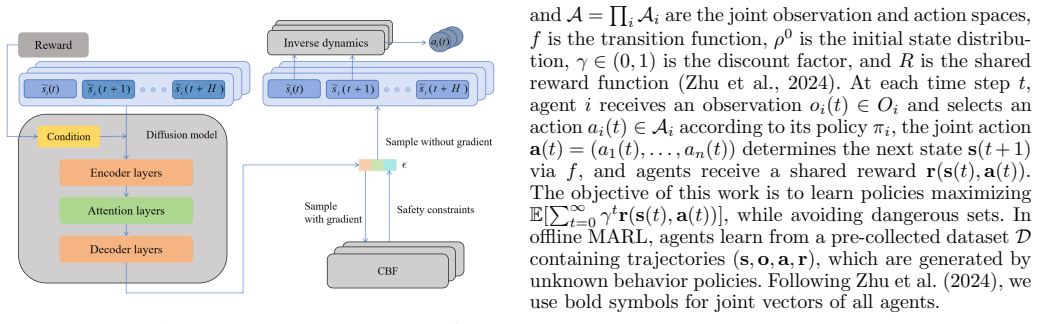
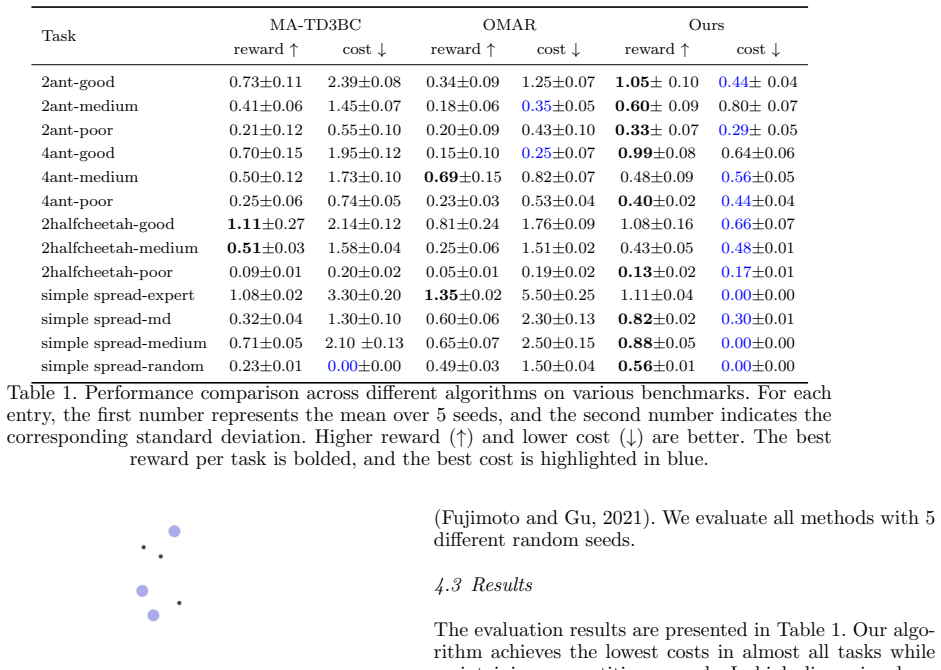
By embedding neural individual control barrier functions into the diffusion model, the algorithm constrains the trajectory generation process to maintain safety in multi-agent offline reinforcement learning settings. Control policies are recovered through inverse dynamics, eliminating the need for online interaction. Evaluations across diverse benchmarks confirm substantial safety improvements alongside competitive reward levels.
What carries the argument
neural individual control barrier functions embedded into the diffusion model to constrain trajectory generation
If this is right
- The diffusion process produces trajectories that satisfy the individual safety constraints encoded by the barrier functions.
- Policies recovered via inverse dynamics inherit the safety properties of the generated trajectories.
- Safety gains occur without online data collection or post-hoc verification steps.
- The same framework applies across varied multi-agent benchmarks while preserving task rewards.
Where Pith is reading between the lines
- If the embedding succeeds, the approach could scale to larger agent counts by reusing the same per-agent barrier functions without retraining the full model.
- The method implicitly suggests that safety can be injected at the generative stage rather than only at policy execution time.
- One could test whether replacing the diffusion backbone with another generative model preserves the safety benefit while changing sample efficiency.
Load-bearing premise
Neural individual control barrier functions can be trained and embedded to constrain the diffusion process in multi-agent settings without introducing new instabilities or requiring online verification.
What would settle it
Running the trained model on a held-out multi-agent benchmark and observing that sampled trajectories still enter unsafe states would show the embedding does not deliver the claimed safety constraint.
Figures

read the original abstract
Offline reinforcement learning allows control policies to be learned directly from data without online interaction, making it suitable for safety-critical tasks. Recent studies have applied diffusion models to offline reinforcement learning to leverage their strong capacity for modeling complex data distributions. However, existing approaches primarily focus on single-agent settings, leaving the safety challenges in multi-agent environments largely unexplored. In this work, we propose a safe offline multi-agent reinforcement learning algorithm that embeds neural individual control barrier functions into the diffusion model to enhance safety during trajectory generation, with control policies recovered through inverse dynamics. We evaluate our algorithm across diverse benchmarks, demonstrating substantial safety improvements while maintaining competitive rewards.
Editorial analysis
A structured set of objections, weighed in public.
Referee Report
Summary. The paper proposes a safe offline multi-agent reinforcement learning algorithm that embeds neural individual control barrier functions into the diffusion model to enhance safety during trajectory generation, with control policies recovered through inverse dynamics. The approach is evaluated across diverse benchmarks, claiming substantial safety improvements while maintaining competitive rewards.
Significance. If validated with detailed mechanisms and evidence, the integration of neural individual CBFs to constrain diffusion-based trajectory generation in multi-agent offline RL could address an important gap, as most prior diffusion-RL work focuses on single-agent cases. This combination may enable safer policy learning from offline data in safety-critical multi-agent domains without requiring online interaction or verification.
major comments (1)
- The central claim of safety improvements via embedding neural individual CBFs into the diffusion process cannot be assessed, as the provided manuscript text supplies no equations, training procedure, embedding mechanism (e.g., how CBF constraints modify the denoising steps or loss), stability analysis, or quantitative results with ablations.
Simulated Author's Rebuttal
We thank the referee for their review and for highlighting the need for greater technical detail. We agree that the submitted manuscript did not provide sufficient equations, procedures, or analyses to allow full assessment of the central claims, and we will revise accordingly.
read point-by-point responses
-
Referee: The central claim of safety improvements via embedding neural individual CBFs into the diffusion process cannot be assessed, as the provided manuscript text supplies no equations, training procedure, embedding mechanism (e.g., how CBF constraints modify the denoising steps or loss), stability analysis, or quantitative results with ablations.
Authors: We acknowledge this limitation in the submitted version. The revised manuscript will add a dedicated technical section containing: the explicit equations defining the neural individual control barrier functions; the complete training procedure for the diffusion model and the CBF networks; the precise embedding mechanism (including how CBF values constrain the denoising steps and enter the training loss); a stability analysis; and expanded ablation studies reporting quantitative safety and reward metrics. These additions will make the safety improvements verifiable. revision: yes
Circularity Check
No significant circularity identified
full rationale
The abstract describes a high-level proposal to embed neural individual control barrier functions into a diffusion model for safe offline multi-agent RL, with policies recovered via inverse dynamics, and reports benchmark evaluations. No equations, derivation steps, parameter-fitting procedures, or citations (self or otherwise) are present in the provided text. Consequently, no load-bearing steps can be identified that reduce by construction to inputs, self-definitions, fitted predictions, or self-citation chains. The derivation chain cannot be walked due to absence of technical details, but the available content exhibits no circularity.
Axiom & Free-Parameter Ledger
Reference graph
Works this paper leans on
-
[1]
Achiam, J., Held, D., Tamar, A., and Abbeel, P. (2017). Constrained policy optimization. InInternational Con- ference on Machine Learning
2017
- [2]
-
[3]
Ajay, A., Du, Y., Gupta, A., Tenenbaum, J.B., Jaakkola, T.S., and Agrawal, P. (2023). Is conditional generative modeling all you need for decision making? InInterna- tional Conference on Learning Representations
2023
-
[4]
(1999).Constrained Markov Decision Pro- cesses
Altman, E. (1999).Constrained Markov Decision Pro- cesses. Chapman and Hall
1999
-
[5]
Ames, A.D., Grizzle, J.W., and Tabuada, P. (2014). Con- trol barrier function based quadratic programs with application to adaptive cruise control. InConference on Decision and Control
2014
-
[6]
Basso, R., Kulcs´ ar, B., Sanchez-Diaz, I., and Qu, X. (2022). Dynamic stochastic electric vehicle routing with safe reinforcement learning.Transportation Research Part E: Logistics and Transportation Review
2022
-
[7]
Berducci, L., Yang, S., Mangharam, R., and Grosu, R. (2023). Learning adaptive safety for multi-agent sys- tems.International Conference on Robotics and Au- tomation
2023
-
[8]
Mrani, N. (2022). A comprehensive survey on the appli- cation of deep and reinforcement learning approaches in autonomous driving.Journal of King Saud University - Computer and Information Sciences
2022
-
[9]
Topcu, U., and Feng, L. (2021). Safe multi-agent reinforcement learning via shielding. InAdaptive Agents and Multi-Agent Systems
2021
-
[10]
Formanek, C., Jeewa, A., Shock, J., and Pretorius, A. (2023). Off-the-grid marl: Datasets and baselines for offline multi-agent reinforcement learning. InInterna- tional Conference on Autonomous Agents and Multia- gent Systems
2023
-
[11]
and Gu, S.S
Fujimoto, S. and Gu, S.S. (2021). A minimalist approach to offline reinforcement learning. InInternational Con- ference on Neural Information Processing Systems
2021
-
[12]
Gu, S., Huang, D., Wen, M., Chen, G., and Knoll, A. (2024). Safe multiagent learning with soft constrained policy optimization in real robot control.Transactions on Industrial Informatics
2024
-
[13]
Ho, J., Jain, A., and Abbeel, P. (2020). Denoising diffusion probabilistic models. InInternational Conference on Neural Information Processing Systems
2020
-
[14]
Isele, D., Nakhaei, A., and Fujimura, K. (2018). Safe reinforcement learning on autonomous vehicles.Inter- national Conference on Intelligent Robots and Systems
2018
- [15]
-
[16]
Qin, Z., Zhang, K., Chen, Y., Chen, J., and Fan, C. (2021). Learning safe multi-agent control with decentralized neural barrier certificates. InInternational Conference on Learning Representations
2021
-
[17]
Shi, J., Guo, Q., and Kucner, T.P. (2025). Event-triggered maps of dynamics: A framework for modeling spatial motion patterns in non-stationary environments. In International Conference on Intelligent Robots and Sys- tems
2025
-
[18]
Thomas, G., Luo, Y., and Ma, T. (2021). Safe reinforce- ment learning by imagining the near future. InInter- national Conference on Neural Information Processing Systems
2021
-
[19]
Udatha, S., Lyu, Y., and Dolan, J. (2023). Reinforcement learning with probabilistically safe control barrier func- tions for ramp merging. InInternational Conference on Robotics and Automation
2023
-
[20]
Wang, Y., Zhan, S.S., Jiao, R., Wang, Z., Jin, W., Yang, Z., Wang, Z., Huang, C., and Zhu, Q. (2023). Enforcing hard constraints with soft barriers: safe reinforcement learning in unknown stochastic environments. InInter- national Conference on Machine Learning
2023
-
[21]
Xiao, W., Wang, T.H., Gan, C., Hasani, R., Lechner, M., and Rus, D. (2025). Safediffuser: Safe planning with diffusion probabilistic models. InInternational Conference on Learning Representations
2025
-
[22]
Yu, C., Velu, A., Vinitsky, E., Wang, Y., Bayen, A.M., and Wu, Y. (2021). The surprising effectiveness of ppo in cooperative multi-agent games. InInternational Conference on Neural Information Processing Systems
2021
-
[23]
Zhang, C., Yan, H., Wei, J., Zhang, F., Shi, Z., and Li, X. (2024). Research on the safety design and trajectory planning for a new dual upper limb rehabilitation robot. Actuators
2024
-
[24]
Zhang, Q., Dong, H., and Pan, W. (2020). Lyapunov- based reinforcement learning for decentralized multi- agent control. InInternational Conference on Dis- tributed Artificial Intelligence
2020
-
[25]
Zheng, Y., Li, J., Yu, D., Yang, Y., Li, S.E., Zhan, X., and Liu, J. (2024). Safe offline reinforcement learning with feasibility-guided diffusion model. InInternational Conference on Learning Representations
2024
-
[26]
Ermon, S., and Zhang, W. (2024). Madiff: offline multi- agent learning with diffusion models. InInternational Conference on Neural Information Processing Systems
2024
discussion (0)
Sign in with ORCID, Apple, or X to comment. Anyone can read and Pith papers without signing in.