"Is This Not Enough?": Asymmetries in Institutional Accountability and Collective Sensemaking in the Case of Canada's Algorithmic Visa Triage System
Pith reviewed 2026-06-27 05:37 UTC · model grok-4.3
The pith
Canada's algorithmic visa triage creates three asymmetries between institutional accountability and how applicants experience it.
A machine-rendered reading of the paper's core claim, the machinery that carries it, and where it could break.
Core claim
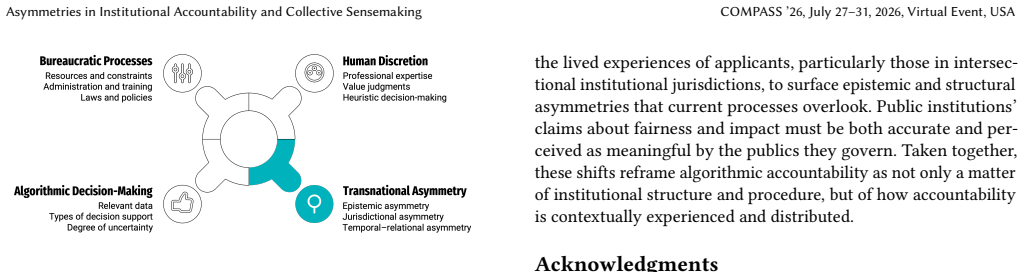
While IRCC's Algorithmic Impact Assessment for the TRV triage system, evaluated via the ADMAPS framework, emphasizes transparency, procedural safeguards, and bounded impacts, applicants engage in collective sensemaking on Reddit to interpret opaque decisions amid uncertainty, revealing three asymmetries: epistemic in access to decision logic, jurisdictional in exposure shaped by geopolitical positioning, and temporal-relational in how waiting and uncertainty are experienced.
What carries the argument
The three asymmetries (epistemic, jurisdictional, and temporal-relational) between institutional accountability structures and applicant perceptions, derived from mixed-methods analysis of official assessments and Reddit discussions.
If this is right
- Algorithmic governance systems in transnational migration produce structured asymmetries not captured by institutional disclosure frameworks.
- Extending frameworks like ADMAPS can account for uneven translations of accountability into lived experience.
- Policy attention should shift from institutional design of transparency to the uneven distribution of experiences with public-sector algorithmic governance.
Where Pith is reading between the lines
- The pattern may appear in visa or border algorithms used by other countries, pointing to a wider issue in how migration systems handle opacity.
- Incorporating applicant-driven feedback loops could directly address the epistemic and temporal asymmetries.
- Reducing processing delays might mitigate one asymmetry without changing the underlying algorithm.
Load-bearing premise
Reddit discussions among applicants provide sufficient and representative data for analyzing collective sensemaking and lived experiences across geopolitical contexts.
What would settle it
A large-scale survey of visa applicants from multiple countries finding that their reported experiences align closely with institutional disclosures and lack the three asymmetries would falsify the central claim.
Figures

read the original abstract
This paper examines how algorithmic accountability in Canada's visa system is articulated institutionally and experienced by applicants across borders. We analyzed Immigration, Refugees and Citizenship Canada (IRCC)'s Algorithmic Impact Assessment (AIA) for the temporary resident visa (TRV) triage system using the algorithmic decision-making adapted for the public sector (ADMAPS) framework and analyzed Reddit discussions among applicants using a mixed-methods approach. We show that while institutional artifacts emphasize transparency, procedural safeguards, and bounded impacts, applicants engage in collective sensemaking to interpret opaque decisions, often relying on peer knowledge amid uncertainty. We identify three asymmetries between how institutional accountability is structured and how people perceive the process: epistemic asymmetry in access to decision logic, jurisdictional asymmetry in exposure shaped by geopolitical positioning, and temporal--relational asymmetry in how waiting and uncertainty are experienced. We emphasize why it is important to shift attention from institutional design to the uneven distribution of experiences with public-sector algorithmic governance. Together, these contributions demonstrate how algorithmic governance systems in the context of transnational migration produce structured asymmetries not captured by institutional disclosure frameworks, and how extending ADMAPS can account for those uneven translations of accountability.
Editorial analysis
A structured set of objections, weighed in public.
Referee Report
Summary. The manuscript examines how algorithmic accountability in Canada's temporary resident visa (TRV) triage system is articulated in IRCC's Algorithmic Impact Assessment (AIA) via the ADMAPS framework and experienced by applicants through a mixed-methods analysis of Reddit discussions. It identifies three asymmetries—epistemic (access to decision logic), jurisdictional (exposure shaped by geopolitical positioning), and temporal-relational (waiting and uncertainty)—and argues that institutional disclosure frameworks fail to capture the uneven distribution of experiences in transnational migration, calling for an extension of ADMAPS.
Significance. If the asymmetries are securely demonstrated, the paper contributes to socio-technical studies of public-sector algorithmic governance by providing a case study of how institutional transparency artifacts diverge from collective sensemaking among applicants. The application of ADMAPS to a migration context and the emphasis on lived uncertainty represent strengths that could inform policy debates on accountability in high-stakes systems.
major comments (2)
- [Abstract and Methods] Abstract and Methods section: the description of the mixed-methods Reddit analysis provides no sampling details, coding procedures, validation steps, or mapping of posts to IRCC's global TRV applicant distribution by nationality or processing region. This is load-bearing for the central claim, as the jurisdictional asymmetry (exposure shaped by geopolitical positioning) and temporal-relational asymmetry are derived from these data; without such details the attribution risks conflating platform demographics with geopolitical effects.
- [Findings] Findings on jurisdictional asymmetry: the claim that exposure is shaped by geopolitical positioning rests on Reddit discussions whose representativeness across contexts is not established, weakening the distinction from the epistemic asymmetry and the overall argument that institutional artifacts miss structured asymmetries.
minor comments (1)
- [Abstract] The acronym ADMAPS is used in the abstract before its full expansion; expand on first use for clarity.
Simulated Author's Rebuttal
We thank the referee for their insightful comments, which help us improve the clarity and rigor of our analysis on algorithmic accountability in Canada's visa triage system. We provide point-by-point responses below.
read point-by-point responses
-
Referee: [Abstract and Methods] Abstract and Methods section: the description of the mixed-methods Reddit analysis provides no sampling details, coding procedures, validation steps, or mapping of posts to IRCC's global TRV applicant distribution by nationality or processing region. This is load-bearing for the central claim, as the jurisdictional asymmetry (exposure shaped by geopolitical positioning) and temporal-relational asymmetry are derived from these data; without such details the attribution risks conflating platform demographics with geopolitical effects.
Authors: We agree that the Methods section requires more detail to substantiate our claims. In the revised version, we will include specific information on our sampling approach for Reddit posts, the coding procedures used in the mixed-methods analysis, any validation steps employed, and a discussion of how the data relates to broader applicant distributions. We will also explicitly address potential limitations, including the risk of conflating platform demographics with geopolitical effects, to strengthen the support for the jurisdictional and temporal-relational asymmetries. revision: yes
-
Referee: [Findings] Findings on jurisdictional asymmetry: the claim that exposure is shaped by geopolitical positioning rests on Reddit discussions whose representativeness across contexts is not established, weakening the distinction from the epistemic asymmetry and the overall argument that institutional artifacts miss structured asymmetries.
Authors: We will revise the Findings section to better establish the basis for the jurisdictional asymmetry by providing additional context on the Reddit discussions and how they reflect geopolitical positioning. This will include clarifying the distinction from the epistemic asymmetry with more detailed examples. We acknowledge the need to discuss representativeness and will add appropriate caveats while maintaining that the observed patterns support our argument about structured asymmetries not captured by institutional frameworks. revision: yes
Circularity Check
No significant circularity
full rationale
The paper's central claims—the three asymmetries—are derived from external inputs: the public IRCC AIA document analyzed via the ADMAPS framework and mixed-methods coding of Reddit applicant discussions. No equations, fitted parameters, or predictions are present that reduce to the paper's own outputs by construction. ADMAPS is invoked as an established framework for the analysis rather than a self-defined construct whose extension is justified solely by prior self-citation. The derivation chain remains self-contained against the cited public documents and forum data; no load-bearing step collapses into renaming, ansatz smuggling, or uniqueness imported from the authors' prior work.
Axiom & Free-Parameter Ledger
axioms (2)
- domain assumption Reddit discussions among applicants accurately reflect collective sensemaking processes under uncertainty
- domain assumption The ADMAPS framework can be adapted to capture asymmetries in transnational migration contexts
Reference graph
Works this paper leans on
-
[1]
Saar Alon-Barkat and Madalina Busuioc. 2024. Public administration meets arti- ficial intelligence: Towards a meaningful behavioral research agenda on algorith- mic decision-making in government.Journal of Behavioral Public Administration 7 (2024)
2024
-
[2]
Louise Amoore. 2006. Biometric borders: Governing mobilities in the war on terror.Political geography25, 3 (2006), 336–351
2006
-
[3]
Mike Ananny and Kate Crawford. 2018. Seeing without knowing: Limitations of the transparency ideal and its application to algorithmic accountability.new media & society20, 3 (2018), 973–989
2018
-
[4]
Julia Angwin, Jeff Larson, Surya Mattu, and Lauren Kirchner. 2016. Machine Bias: There’s software used across the country to predict future criminals. And it’s biased against blacks. (2016). https://www.propublica.org/article/machine- bias-risk-assessments-in-criminal-sentencing
2016
-
[5]
2020.Patients of the state: The politics of waiting in Argentina
Javier Auyero. 2020.Patients of the state: The politics of waiting in Argentina. Duke University Press
2020
-
[6]
Jinze Bai, Shuai Bai, Yunfei Chu, Zeyu Cui, Kai Dang, Xiaodong Deng, Yang Fan, Wenbin Ge, Yu Han, Fei Huang, et al. 2023. Qwen technical report.arXiv preprint arXiv:2309.16609(2023)
Pith/arXiv arXiv 2023
-
[7]
Nagadivya Balasubramaniam, Marjo Kauppinen, Antti Rannisto, Kari Hiekkanen, and Sari Kujala. 2023. Transparency and explainability of AI systems: From ethical guidelines to requirements.Information and Software Technology159 (2023), 107197
2023
-
[8]
Eric PS Baumer, David Mimno, Shion Guha, Emily Quan, and Geri K Gay. 2017. Comparing grounded theory and topic modeling: Extreme divergence or unlikely convergence?Journal of the Association for Information Science and Technology 68, 6 (2017), 1397–1410
2017
-
[9]
Danièle Bélanger and Gabriel Bergevin-Estable. 2025. Revisiting ‘who gets in’: borders and migration management in the era of automation and AI in Canada. AI & SOCIETY(2025), 1–14
2025
-
[10]
Didier Bigo. 2002. Security and immigration: Toward a critique of the govern- mentality of unease.Alternatives27, 1_suppl (2002), 63–92
2002
-
[11]
Reuben Binns. 2018. Algorithmic accountability and public reason.Philosophy & technology31, 4 (2018), 543–556
2018
-
[12]
Geoffrey C. Bowker and Susan Leigh Star. 1999.Sorting Things Out: Classification and Its Consequences. The MIT Press. doi:10.7551/mitpress/6352.001.0001
-
[13]
Evelyn Z Brodkin. 2011. Policy work: Street-level organizations under new managerialism.Journal of public administration research and theory21, suppl_2 (2011), i253–i277
2011
-
[14]
2018.If
Taina Bucher. 2018.If... then: Algorithmic power and politics. Oxford University Press
2018
-
[15]
Taina Bucher. 2019. The algorithmic imaginary: Exploring the ordinary affects of Facebook algorithms. InThe social power of algorithms. Routledge, 30–44
2019
-
[16]
Madalina Busuioc. 2021. Accountable artificial intelligence: Holding algorithms to account.Public administration review81, 5 (2021), 825–836
2021
-
[17]
Nicolas Chartier-Edwards, Marek Blottiere, and Jonathan Roberge. 2025. AI statecraft heating-up: the automation of governance through Canada’s Chinook case study.AI & SOCIETY40, 2 (2025), 765–774
2025
-
[18]
Jianfen Chen, Shyam Pandey, and Sweta Baniya. 2025. Navigating immigration as an alien: A critical interface analysis of the US citizenship and immigration services website.IEEE Transactions on Professional Communication(2025)
2025
-
[19]
Jennifer Cobbe, Michael Veale, and Jatinder Singh. 2023. Understanding account- ability in algorithmic supply chains. InProceedings of the 2023 ACM Conference on Fairness, Accountability, and Transparency. 1186–1197
2023
-
[20]
Juliet M Corbin and Anselm Strauss. 1990. Grounded theory research: Procedures, canons, and evaluative criteria.Qualitative sociology13, 1 (1990), 3–21. COMPASS ’26, July 27–31, 2026, Virtual Event, USA Dipto Das, Matthew Tamura, Syed Ishtiaque Ahmed, and Shion Guha
1990
-
[21]
Karl de Fine Licht and Jenny de Fine Licht. 2020. Artificial intelligence, trans- parency, and public decision-making: Why explanations are key when trying to produce perceived legitimacy.AI & society35, 4 (2020), 917–926
2020
-
[22]
Algorithms ruin everything
Michael Ann DeVito, Darren Gergle, and Jeremy Birnholtz. 2017. " Algorithms ruin everything" # RIPTwitter, Folk Theories, and Resistance to Algorithmic Change in Social Media. InProceedings of the 2017 CHI conference on human factors in computing systems. 3163–3174
2017
-
[23]
Nicholas Diakopoulos. 2016. Accountability in algorithmic decision making. Commun. ACM59, 2 (2016), 56–62
2016
-
[24]
Malin Eiband, Hanna Schneider, Mark Bilandzic, Julian Fazekas-Con, Mareike Haug, and Heinrich Hussmann. 2018. Bringing transparency design into practice. InProceedings of the 23rd international conference on intelligent user interfaces. 211–223
2018
-
[25]
Motahhare Eslami, Karrie Karahalios, Christian Sandvig, Kristen Vaccaro, Aimee Rickman, Kevin Hamilton, and Alex Kirlik. 2016. First I" like" it, then I hide it: Folk Theories of Social Feeds. InProceedings of the 2016 cHI conference on human factors in computing systems. 2371–2382
2016
-
[26]
V. Eubanks. 2018.Automating Inequality: How High-Tech Tools Profile, Police, and Punish the Poor. St. Martin’s Press. https://books.google.ca/books?id= pn4pDwAAQBAJ
2018
-
[27]
Florian Eyert and Paola Lopez. 2023. Rethinking transparency as a commu- nicative constellation. InProceedings of the 2023 ACM Conference on Fairness, Accountability, and Transparency. 444–454
2023
-
[28]
Heike Felzmann, Eduard Fosch Villaronga, Christoph Lutz, and Aurelia Tamò- Larrieux. 2019. Transparency you can trust: Transparency requirements for artificial intelligence between legal norms and contextual concerns.Big Data & Society6, 1 (2019), 2053951719860542
2019
-
[29]
Timnit Gebru, Jamie Morgenstern, Briana Vecchione, Jennifer Wortman Vaughan, Hanna Wallach, Hal Daumé Iii, and Kate Crawford. 2021. Datasheets for datasets. Commun. ACM64, 12 (2021), 86–92
2021
-
[30]
Ellen P Goodman and Julia Trehu. 2022. Algorithmic auditing: Chasing AI accountability.Santa Clara High Tech. LJ39 (2022), 289
2022
-
[31]
Samuel Groesch, Alena Birrer, Natascha Just, and Florian Saurwein. 2025. Big data, small answers: How the DSA Transparency Database falls short of its regulatory objectives.Telecommunications Policy(2025), 103088
2025
-
[32]
Maarten Grootendorst. 2022. BERTopic: Neural topic modeling with a class-based TF-IDF procedure.arXiv preprint arXiv:2203.05794(2022)
Pith/arXiv arXiv 2022
-
[33]
M Haataja, L van de Fliert, and P Rautio. 2020. Public AI Registers: Realising AI transparency and civic participation in government use of AI.Whitepaper Version1 (2020)
2020
-
[34]
Ghassan Hage et al. 2009. Waiting out the crisis: On stuckedness and govern- mentality.Anthropological theory5, 1 (2009), 463–475
2009
-
[35]
Refugees and Citizenship Canada Immigration. 2025. Algorithmic Impact As- sessment - Advanced Analytics Triage of Overseas Temporary Resident Visa Applications - Open Government Portal. https://open.canada.ca/data/en/dataset/ 6cba99b1-ea2c-4f8a-b954-3843ecd3a7f0
2025
-
[36]
Rishabh Kaushal, Jacob Van De Kerkhof, Catalina Goanta, Gerasimos Spanakis, and Adriana Iamnitchi. 2024. Automated transparency: A legal and empirical analysis of the digital services act transparency database. InProceedings of the 2024 ACM Conference on Fairness, Accountability, and Transparency. 1121–1132
2024
-
[37]
Rob Kitchin and Gavin McArdle. 2016. What makes Big Data, Big Data? Exploring the ontological characteristics of 26 datasets.Big data & society3, 1 (2016), 2053951716631130
2016
-
[38]
Joshua A Kroll. 2021. Outlining traceability: A principle for operationalizing accountability in computing systems. InProceedings of the 2021 ACM Conference on fairness, accountability, and transparency. 758–771
2021
-
[39]
Maciej Kuziemski and Gianluca Misuraca. 2020. AI governance in the public sector: Three tales from the frontiers of automated decision-making in democratic settings.Telecommunications policy44, 6 (2020), 101976
2020
-
[40]
Koen Leurs and Kevin Smets. 2018. Five questions for digital migration studies: Learning from digital connectivity and forced migration in (to) Europe.Social media+ society4, 1 (2018), 2056305118764425
2018
-
[41]
2010.Street-level bureaucracy: Dilemmas of the individual in public service
Michael Lipsky. 2010.Street-level bureaucracy: Dilemmas of the individual in public service. Russell sage foundation
2010
-
[42]
Jessica Mach. 2026. Lack of clarity on how immigration offi- cials use automated tools leads lawyers to launch monitoring org. https://www.canadianlawyermag.com/practice-areas/immigration/lack- of-clarity-on-how-immigration-officials-use-automated-tools-leads-lawyers- to-launch-monitoring-org/393784. [Accessed: March 18, 2026]
2026
-
[43]
Leland McInnes, John Healy, Steve Astels, et al. 2017. HDBSCAN: Hierarchical density-based clustering.J. Open Source Softw.2, 11 (2017), 205
2017
-
[44]
Leland McInnes, John Healy, and James Melville. 2018. UMAP: Uniform man- ifold approximation and projection for dimension reduction.arXiv preprint arXiv:1802.03426(2018)
Pith/arXiv arXiv 2018
-
[45]
Jacob Metcalf, Emanuel Moss, Elizabeth Anne Watkins, Ranjit Singh, and Madeleine Clare Elish. 2021. Algorithmic impact assessments and accountability: The co-construction of impacts. InProceedings of the 2021 ACM conference on fairness, accountability, and transparency. 735–746
2021
-
[46]
Margaret Mitchell, Simone Wu, Andrew Zaldivar, Parker Barnes, Lucy Vasserman, Ben Hutchinson, Elena Spitzer, Inioluwa Deborah Raji, and Timnit Gebru. 2019. Model cards for model reporting. InProceedings of the conference on fairness, accountability, and transparency. 220–229
2019
-
[47]
Mareike Möhlmannn, Carolina Alves de Lima Salge, and Marco Marabelli. 2023. Algorithm sensemaking: how platform workers make sense of algorithmic man- agement.Journal of the Association for Information Systems24, 1 (2023), 35–64
2023
-
[48]
2018.Bots at the Gate: A Human Rights Analysis of Automated Decision-Making in Canada’s Immigration and Refugee System
Petra Molnar and Lex Gill. 2018.Bots at the Gate: A Human Rights Analysis of Automated Decision-Making in Canada’s Immigration and Refugee System. Technical Report Research Report No. 114. The Citizen Lab and International Human Rights Program, Faculty of Law, University of Toronto, Toronto
2018
-
[49]
Erina Seh-Young Moon, Devansh Saxena, Dipto Das, and Shion Guha. 2025. The Datafication of Care in Public Homelessness Services. InProceedings of the 2025 CHI Conference on Human Factors in Computing Systems. 1–16
2025
-
[50]
Sourav Mukherjee, Tim Oates, Vince DiMascio, Huguens Jean, Rob Ares, David Widmark, and Jaclyn Harder. 2020. Immigration document classification and automated response generation. In2020 International Conference on Data Mining Workshops (ICDMW). IEEE, 782–789
2020
-
[51]
Michael Muller, Shion Guha, Eric PS Baumer, David Mimno, and N Sadat Shami
-
[52]
InProceedings of the 2016 ACM international conference on supporting group Work
Machine learning and grounded theory method: convergence, divergence, and combination. InProceedings of the 2016 ACM international conference on supporting group Work. 3–8
2016
-
[53]
Black Box
Maya Murad. 2021.Beyond the" Black Box": Enabling Meaningful Transparency of Algorithmic Decision-Making Systems through Public Registers. Ph. D. Dissertation. Massachusetts Institute of Technology
2021
-
[54]
National Research Council Canada. 2025. Peer Review for Advanced Analytics Triage of Overseas Temporary Resident Visa Applica- tions. https://open.canada.ca/data/en/dataset/6cba99b1-ea2c-4f8a-b954- 3843ecd3a7f0/resource/3ad57506-42ea-4916-8e5f-d06ea01e449b
2025
-
[55]
Chris Norval, Kristin Cornelius, Jennifer Cobbe, and Jatinder Singh. 2022. Dis- closure by Design: Designing information disclosures to support meaningful transparency and accountability. InProceedings of the 2022 ACM Conference on Fairness, Accountability, and Transparency. 679–690
2022
-
[56]
Government of Canada. 2021. Directive on Automated Decision-Making. https: //www.tbs-sct.canada.ca/pol/doc-eng.aspx?id=32592. [Accessed: March 15, 2026]
2021
-
[57]
Government of Canada. 2022. CIMM — Chinook Development and Imple- mentation in Decision-Making. https://www.canada.ca/en/immigration- refugees-citizenship/corporate/transparency/committees/cimm-feb-15-17- 2022/chinook-development-implementation-decision-making.html. [Accessed: March 18, 2026]
2022
-
[58]
Government of Canada. 2025. Gender-based Analysis Plus (GBA Plus). https://www.canada.ca/en/women-gender-equality/gender-based-analysis- plus.html. [Accessed: March 1, 2026]
2025
-
[59]
Government of Canada. 2025. Government of Canada AI Register (Minimum Viable Product) - GC AI Register (MVP). https://open.canada.ca/data/en/dataset/ fcbc0200-79ba-4fa4-94a6-00e32facea6b/resource/369f6f34-148a-42ed-b581- 8c164e941a89. [Accessed: December 16, 2025]
2025
-
[60]
Government of Canada. 2026. Algorithmic Impact Assessment tool. https://www. canada.ca/en/government/system/digital-government/digital-government- innovations/responsible-use-ai/algorithmic-impact-assessment.html. [Accessed: March 1, 2026]
2026
-
[61]
Mayowa Oluwasanmi. 2021. Algorithms & the Border: The Human Rights Impli- cations of Automated Decision Systems in Canadian Immigration.Federalism-E 22, 1 (2021), 87–98
2021
-
[62]
Kentrell Owens, Yael Eiger, Basia Radka, Tadayoshi Kohno, and Franziska Roesner
-
[63]
InProceedings of the 2025 ACM Conference on Fairness, Accountability, and Transparency
Understanding experiences with compulsory immigration surveillance in the US. InProceedings of the 2025 ACM Conference on Fairness, Accountability, and Transparency. 887–899
2025
-
[64]
Lindsay Poirier. 2021. Reading datasets: Strategies for interpreting the politics of data signification.Big Data & Society8, 2 (2021), 20539517211029322
2021
-
[65]
Emilee Rader, Kelley Cotter, and Janghee Cho. 2018. Explanations as mechanisms for supporting algorithmic transparency. InProceedings of the 2018 CHI conference on human factors in computing systems. 1–13
2018
-
[66]
Inioluwa Deborah Raji, Andrew Smart, Rebecca N White, Margaret Mitchell, Timnit Gebru, Ben Hutchinson, Jamila Smith-Loud, Daniel Theron, and Parker Barnes. 2020. Closing the AI accountability gap: Defining an end-to-end frame- work for internal algorithmic auditing. InProceedings of the 2020 conference on fairness, accountability, and transparency. 33–44
2020
-
[67]
Joanna Redden. 2018. Democratic governance in an age of datafication: Lessons from mapping government discourses and practices.Big Data & Society5, 2 (2018), 2053951718809145
2018
-
[68]
Joanna Redden, Jessica Brand, Ina Sander, Harry Warne, A Grant, and D White
-
[69]
Automating public services: Learning from cancelled systems.Cardiff, UK: Data Justice Lab, Cardiff University30 (2022)
2022
-
[70]
Joanna Redden, Lina Dencik, and Harry Warne. 2020. Datafied child welfare services: unpacking politics, economics and power.Policy Studies41, 5 (2020), 507–526. Asymmetries in Institutional Accountability and Collective Sensemaking COMPASS ’26, July 27–31, 2026, Virtual Event, USA
2020
-
[71]
Devansh Saxena, Karla Badillo-Urquiola, Pamela J Wisniewski, and Shion Guha
-
[72]
A framework of high-stakes algorithmic decision-making for the public sector developed through a case study of child-welfare.Proceedings of the ACM on Human-Computer Interaction5, CSCW2 (2021), 1–41
2021
-
[73]
Devansh Saxena and Shion Guha. 2024. Algorithmic harms in child welfare: Uncertainties in practice, organization, and street-level decision-making.ACM Journal on Responsible Computing1, 1 (2024), 1–32
2024
-
[74]
Devansh Saxena, Erina Seh-Young Moon, Aryan Chaurasia, Yixin Guan, and Shion Guha. 2023. Rethinking" Risk" in Algorithmic Systems Through A Computational Narrative Analysis of Casenotes in Child-Welfare. InProceedings of the 2023 CHI conference on human factors in computing systems. 1–19
2023
-
[75]
Andrew D Selbst. 2021. An institutional view of algorithmic impact assessments. Harv. JL & Tech.35 (2021), 117
2021
-
[76]
Andrew D Selbst, Danah Boyd, Sorelle A Friedler, Suresh Venkatasubramanian, and Janet Vertesi. 2019. Fairness and abstraction in sociotechnical systems. In Proceedings of the conference on fairness, accountability, and transparency. 59–68
2019
-
[77]
Nando Sigona. 2012. ‘I have too much baggage’: the impacts of legal status on the social worlds of irregular migrants.Social Anthropology/Anthropologie Sociale 20, 1 (2012), 50–65
2012
-
[78]
Kacper Sokol and Peter Flach. 2020. Explainability fact sheets: A framework for systematic assessment of explainable approaches. InProceedings of the 2020 conference on fairness, accountability, and transparency. 56–67
2020
-
[79]
Christopher Starke, Janine Baleis, Birte Keller, and Frank Marcinkowski. 2022. Fairness perceptions of algorithmic decision-making: A systematic review of the empirical literature.Big Data & Society9, 2 (2022), 20539517221115189
2022
-
[80]
Steinman and Naomi-Edith Barandereka
Robert M. Steinman and Naomi-Edith Barandereka. 2023. Chi- nook: Immigration Canada’s new tool for immigration applications. https://www.mccarthy.ca/en/insights/blogs/spotlight-can-asia/chinook- immigration-canadas-new-tool-immigration-applications. [Accessed: March 18, 2026]
2023
discussion (0)
Sign in with ORCID, Apple, or X to comment. Anyone can read and Pith papers without signing in.