Specifying Hardware Communication as Programs
Pith reviewed 2026-06-27 04:51 UTC · model grok-4.3
The pith
A single imperative program in a DSL can specify hardware protocols for both driving designs and monitoring transactions.
A machine-rendered reading of the paper's core claim, the machinery that carries it, and where it could break.
Core claim
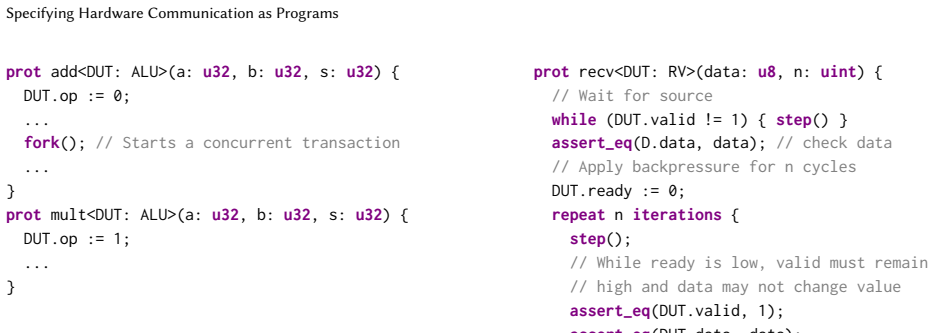
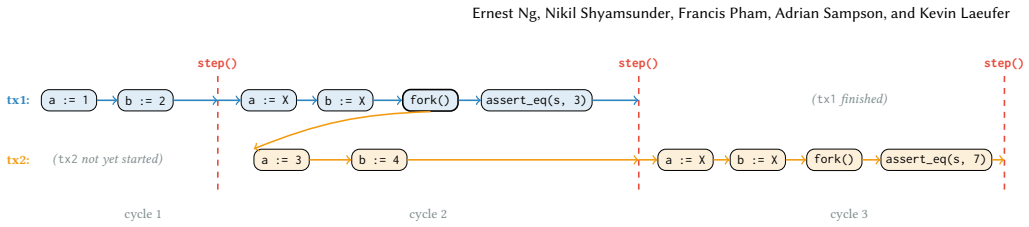
The paper claims that hardware communication protocols can be expressed as succinct imperative programs inside a DSL, and that a single such program is sufficient both to drive a hardware module by emitting the required signal-level interactions and to monitor an execution by automatically inferring a consistent transaction-level trace from an observed waveform.
What carries the argument
The DSL of succinct imperative programs that describe protocol behavior, together with the inference procedure that, given the program and a waveform, produces a transaction trace consistent with both.
If this is right
- Protocol authors maintain only one artifact instead of separate driver and monitor implementations.
- The inference tool produces a transaction-level view directly from any waveform that matches the specification.
- The same specification can be reused across design, test, and debug flows without manual translation.
- Evaluation on Wishbone and AXI-Stream would show whether the DSL is expressive enough for production interconnect protocols.
Where Pith is reading between the lines
- The single-spec approach might allow the same program to serve as a reference model for formal equivalence checking between RTL implementations and the protocol definition.
- If the inference procedure can be made efficient, it could be embedded inside existing waveform viewers to provide on-the-fly transaction annotations.
- Extending the DSL with timing or power annotations could let the same program drive both functional and non-functional verification tasks.
Load-bearing premise
One succinct imperative program can encode all protocol rules needed for both driving and monitoring without forcing separate logic or leaving inconsistencies that the inference procedure cannot resolve.
What would settle it
Apply the inference tool to a waveform generated from a known correct transaction sequence on a protocol such as AXI-Stream; if the resulting inferred trace differs from the known sequence or the tool reports that no consistent trace exists, the central claim is falsified.
Figures





read the original abstract
To test and debug hardware modules, it is common to write two programs: a driver, which translates high-level transactions into interactions on the module's input and output signals, and a monitor, which analyzes a signal-level execution trace and recognizes a transaction. These two programs are commonly implemented separately for each hardware protocol, but this separation entails manual effort and risks inconsistencies. We advocate an alternative approach. We present a DSL in which users specify hardware communication protocols as succinct imperative programs. Crucially, the same specification can be used to both drive designs and monitor transactions. We present the design of a tool, which given a specification in our DSL and a waveform, automatically infers a transaction-level trace consistent with the waveform. We discuss plans to evaluate our DSL on real-world interconnects such as Wishbone and AXI-Stream.
Editorial analysis
A structured set of objections, weighed in public.
Referee Report
Summary. The manuscript proposes a DSL in which hardware communication protocols are specified as succinct imperative programs. The central claim is that a single such specification can be used both to drive designs (translating high-level transactions to signal interactions) and to monitor transactions (via an automatic tool that infers a transaction-level trace from a waveform). The paper outlines the high-level design of the inference tool and states plans to evaluate the DSL on real-world interconnects such as Wishbone and AXI-Stream.
Significance. If the approach were realized with a consistent dual semantics and working inference procedure, it would address a genuine source of manual effort and inconsistency in hardware verification. However, the manuscript contains only an abstract-level design proposal with no examples, semantics, algorithm description, or evaluation results, so any significance remains prospective.
major comments (3)
- Abstract: the claim that 'the same specification can be used to both drive designs and monitor transactions' is presented without any formal semantics for the DSL, any description of the dual interpretation (generative vs. recognition), or any mechanism for ensuring consistency between the two modes. This is load-bearing for the central claim.
- Abstract: no worked example of even a simple protocol in the DSL is provided, nor any illustration of an inferred trace or how the inference tool would resolve nondeterminism. Without such concrete detail it is impossible to assess whether a single succinct program can faithfully serve both roles.
- Abstract: the inference tool is described only at the level of 'we present the design'; no algorithm, complexity argument, or handling of potential inconsistencies between driving and monitoring modes is supplied. This directly undermines the feasibility assertion in the reader's weakest assumption.
Simulated Author's Rebuttal
We thank the referee for the detailed and constructive feedback. We acknowledge that the current manuscript is a high-level proposal outlining the DSL concept and tool design without concrete examples or formal details, and we will revise the paper to incorporate the requested elements.
read point-by-point responses
-
Referee: Abstract: the claim that 'the same specification can be used to both drive designs and monitor transactions' is presented without any formal semantics for the DSL, any description of the dual interpretation (generative vs. recognition), or any mechanism for ensuring consistency between the two modes. This is load-bearing for the central claim.
Authors: We agree that formal semantics are necessary to support the central claim. The manuscript presents the idea at a conceptual level; in the revised version we will add a section defining the DSL semantics, specifying the generative interpretation for driving and the recognition interpretation for monitoring, and outlining how consistency between the two is maintained through a shared program representation. revision: yes
-
Referee: Abstract: no worked example of even a simple protocol in the DSL is provided, nor any illustration of an inferred trace or how the inference tool would resolve nondeterminism. Without such concrete detail it is impossible to assess whether a single succinct program can faithfully serve both roles.
Authors: We agree that the absence of a worked example limits assessment. The revised manuscript will include a simple protocol example (such as a basic handshake), showing the DSL program, its use for driving, a sample waveform, the inferred transaction trace, and how nondeterminism is resolved during inference. revision: yes
-
Referee: Abstract: the inference tool is described only at the level of 'we present the design'; no algorithm, complexity argument, or handling of potential inconsistencies between driving and monitoring modes is supplied. This directly undermines the feasibility assertion in the reader's weakest assumption.
Authors: We accept that the current description of the inference tool is high-level. In revision we will expand this section with an algorithm outline (including pseudocode), a complexity discussion, and explicit handling of nondeterminism and consistency with the driving semantics. revision: yes
Circularity Check
No circularity: design proposal with no derivations or fitted quantities
full rationale
The paper is a high-level design proposal for a DSL and inference tool. It contains no mathematical derivations, equations, predictions, fitted parameters, or uniqueness theorems. The central claim (one succinct program serving both driving and monitoring) is presented as a design goal without any self-referential reduction to its own inputs or self-citations that bear the load of a proof. No steps match any of the enumerated circularity patterns.
Axiom & Free-Parameter Ledger
Reference graph
Works this paper leans on
-
[1]
Antmicro. 2022. Wishbone Interconnect Burst Mode Bench- mark.https://github.com/antmicro/wishbone-interconnect-burst- mode-benchmark
2022
-
[2]
1999.AMBA Specification (Rev 2.0)
ARM Limited. 1999.AMBA Specification (Rev 2.0). ARM Limited. https://developer.arm.com/documentation/ihi0011/latest/
1999
-
[3]
2021.AMBA AXI-Stream Protocol Specification
Arm Limited. 2021.AMBA AXI-Stream Protocol Specification. Arm Limited.https://developer.arm.com/documentation/ihi0051/latest/ Issue B, ID040921
2021
-
[4]
2024.AMBA AXI and ACE Protocol Specification
ARM Limited. 2024.AMBA AXI and ACE Protocol Specification. ARM Limited.https://developer.arm.com/documentation/ihi0022/latest/ Issue L
2024
-
[5]
Jonathan Bachrach, Huy Vo, Brian Richards, Yunsup Lee, Andrew Waterman, Rimas Avižienis, John Wawrzynek, and Krste Asanović
-
[6]
Chisel: constructing hardware in a scala embedded language,
Chisel: constructing hardware in a Scala embedded language. InProceedings of the 49th Annual Design Automation Conference(San Francisco, California)(DAC ’12). Association for Computing Machin- ery, New York, NY, USA, 1216–1225. doi:10.1145/2228360.2228584
-
[7]
Roberto Baldoni, Emilio Coppa, Daniele Cono D’Elia, Camil Deme- trescu, and Irene Finocchi. 2018. A Survey of Symbolic Execution Techniques.ACM Comput. Surv.51, 3, Article 50 (2018)
2018
-
[8]
Thomas Ball, Jakub Daniel, and Thomas Ball. 2015.Deconstructing Dynamic Symbolic Execution(proceedings of the 2014 marktoberdorf summer school on dependable software systems engineering, the 2014 marktober summer school on deop ed.). Technical Report MSR- TR-2015-95.https://www.microsoft.com/en-us/research/publication/ deconstructing-dynamic-symbolic-exec...
2015
-
[9]
Griffin Berlstein, Rachit Nigam, Christophe Gyurgyik, and Adrian Sampson. 2023. Stepwise Debugging for Hardware Accelerators. In Proceedings of the 28th ACM International Conference on Architectural Support for Programming Languages and Operating Systems (ASPLOS 2023), Volume 2(Vancouver, BC, Canada). Association for Comput- ing Machinery, New York, NY, U...
-
[10]
Thomas Bourgeat, Clément Pit-Claudel, Adam Chlipala, and Arvind
-
[11]
The essence of Bluespec: a core language for rule-based hardware design. InProceedings of the 41st ACM SIGPLAN Conference on Pro- gramming Language Design and Implementation(London, UK)(PLDI 2020). Association for Computing Machinery, New York, NY, USA, 243–257. doi:10.1145/3385412.3385965
-
[12]
Cristian Cadar, Vijay Ganesh, Peter Pawlowski, David Dill, and Daw- son Engler. 2006. EXE: Automatically Generating Inputs of Death. InACM Conference on Computer and Communications Security (CCS 2006)(Alexandria, VA, USA). 322–335
2006
-
[13]
Cristian Cadar and Koushik Sen. 2013. Symbolic execution for software testing: three decades later.Commun. ACM56, 2 (Feb. 2013), 82–90. doi:10.1145/2408776.2408795
-
[14]
Luca P Carloni, Kenneth L McMillan, and Alberto L Sangiovanni- Vincentelli. 2001. Theory of latency-insensitive design.IEEE Transac- tions on Computer-Aided Design of Integrated Circuits and Systems20, 9 (2001), 1059–1076. doi:10.1109/43.945302
-
[15]
Joonwon Choi, Muralidaran Vijayaraghavan, Benjamin Sherman, Adam Chlipala, and Arvind. 2017. Kami: a platform for high-level parametric hardware specification and its modular verification. In Proceedings of the 22nd ACM SIGPLAN International Conference on Functional Programming (ICFP). Association for Computing Machin- ery, New York, NY, USA, Article 24, ...
-
[16]
Lori A. Clarke. 1976. A Program Testing System. InThe ACM Annual Conference. doi:10.1145/800191.805647
-
[17]
cocotb contributors. 2021.cocotb: A coroutine based cosimulation library for writing VHDL and Verilog testbenches in Python.https: //github.com/cocotb/cocotbPython-based chip (RTL) verification framework
2021
-
[18]
Stephen A. Cook. 1971. The complexity of theorem-proving pro- cedures. InProceedings of the Third Annual ACM Symposium on Theory of Computing(Shaker Heights, Ohio, USA)(STOC ’71). As- sociation for Computing Machinery, New York, NY, USA, 151–158. doi:10.1145/800157.805047
-
[19]
Leonardo De Moura and Nikolaj Bjørner. 2011. Satisfiability modulo theories: introduction and applications.Commun. ACM54, 9 (Sept. 2011), 69–77. doi:10.1145/1995376.1995394
-
[20]
Patrice Godefroid, Nils Klarlund, and Koushik Sen. 2005. DART: directed automated random testing. InProgramming Language De- sign and Implementation (PLDI)(Chicago, IL, USA)(PLDI ’05). As- sociation for Computing Machinery, New York, NY, USA, 213–223. doi:10.1145/1065010.1065036
-
[21]
GTKWave contributors. [n. d.].GTKWave: A Fully Featured GTK+ Based Wave Viewer.https://gtkwave.sourceforge.netWaveform viewer for Unix, Win32, and Mac OSX supporting LXT, LXT2, VZT, FST, GHW, and Verilog VCD/EVCD files
-
[22]
2010.WISHBONE System-on-Chip (SoC) Inter- connection Architecture for Portable IP Cores
Richard Herveille. 2010.WISHBONE System-on-Chip (SoC) Inter- connection Architecture for Portable IP Cores. OpenCores.https: //cdn.opencores.org/downloads/wbspec_b4.pdfRevision B.4
2010
-
[23]
IEEE. 2020. IEEE Standard for Universal Verification Methodology Language Reference Manual.IEEE Std 1800.2-2020 (Revision of IEEE Std 1800.2-2017)(2020), 1–458. doi:10.1109/IEEESTD.2020.9195920
-
[25]
IEEE. 2024. IEEE Standard for SystemVerilog–Unified Hardware De- sign, Specification, and Verification Language.IEEE Std 1800-2023 (Revision of IEEE Std 1800-2017)(2024), 1–1354. doi:10.1109/IEEESTD. 2024.10458102
-
[26]
James C. King. 1976. Symbolic execution and program testing.Com- mun. ACM19, 7 (July 1976), 385–394. doi:10.1145/360248.360252
-
[27]
Lucas Klemmer and Daniel Große. 2022. WAL: A Novel Waveform Analysis Language for Advanced Design Understanding and Debug- ging. InProceedings of the 27th Asia and South Pacific Design Automa- tion Conference(Taipei, Taiwan)(ASPDAC ’22). IEEE Press, 358–364. doi:10.1109/ASP-DAC52403.2022.9712600
-
[28]
2024.Automated Testing, Verification and Repair of RTL Hardware Designs
Kevin Laeufer. 2024.Automated Testing, Verification and Repair of RTL Hardware Designs. Ph. D. Dissertation. EECS Department, Uni- versity of California, Berkeley.http://www2.eecs.berkeley.edu/Pubs/ TechRpts/2024/EECS-2024-157.html
2024
-
[29]
2021.chiseltest: The batteries-included testing and formal verification library for Chisel-based RTL designs
Richard Lin and Kevin Laeufer. 2021.chiseltest: The batteries-included testing and formal verification library for Chisel-based RTL designs. https://github.com/ucb-bar/chiseltest
2021
-
[30]
Jiacheng Ma, Gefei Zuo, Kevin Loughlin, Haoyang Zhang, Andrew Quinn, and Baris Kasikci. 2022. Debugging in the brave new world of reconfigurable hardware. InProceedings of the 27th ACM International Conference on Architectural Support for Programming Languages and Operating Systems(Lausanne, Switzerland)(ASPLOS ’22). Association for Computing Machinery, N...
arXiv 2022
-
[31]
Peter Hofstee, and Zaid Al-Ars
Raffaele Meloni, H. Peter Hofstee, and Zaid Al-Ars. 2024. In2024 IEEE Nordic Circuits and Systems Conference (NorCAS). 1–6. doi:10.1109/ NorCAS64408.2024.10752465
arXiv 2024
-
[32]
Rachit Nigam. 2026. Defining Safe Hardware Design. Workshop on Languages, Tools, and Techniques for Accelerator Design (LATTE). Co-located with ASPLOS ’26
2026
-
[33]
Rachit Nigam, Pedro Henrique Azevedo de Amorim, and Adrian Sampson. 2023. Modular Hardware Design with Timeline Types. InProceedings of the 44th ACM SIGPLAN Conference on Programming Language Design and Implementation (PLDI), Vol. 7. Association for Computing Machinery, New York, NY, USA, Article 120, 25 pages. doi:10.1145/3591234
-
[34]
Rachit Nigam, Ethan Gabizon, Edmund Lam, Carolyn Zech, Jonathan Balkind, and Adrian Sampson. 2026. Parameterized Hardware Design with Latency-Abstract Interfaces. InASPLOS ’26: 31st ACM Interna- tional Conference on Architectural Support for Programming Languages and Operating Systems. doi:10.1145/3779212.3790199
-
[35]
Rishiyur Nikhil. 2004. Bluespec System Verilog: efficient, correct RTL from high level specifications. InProceedings of the Second ACM/IEEE International Conference on Formal Methods and Models for Co-Design (MEMOCODE ’04). IEEE Computer Society, USA, 69–70. doi:10.1109/ MEMCOD.2004.1459818
arXiv 2004
-
[36]
Clément Pit-Claudel, Thomas Bourgeat, Stella Lau, Arvind, and Adam Chlipala. 2021. Effective simulation and debugging for a high-level hardware language using software compilers. InProceedings of the 26th ACM International Conference on Architectural Support for Pro- gramming Languages and Operating Systems (ASPLOS ’21). Asso- ciation for Computing Machin...
-
[37]
Amir Pnueli. 1977. The temporal logic of programs. In18th Annual Symposium on Foundations of Computer Science (SFCS 1977). doi:10. 1109/sfcs.1977.32
1977
-
[38]
Andrew Ray. 2020. Using ASCII Waveforms to Test Hardware De- signs.https://blog.janestreet.com/using-ascii-waveforms-to-test- hardware-designs/. Published on the Jane Street Technology Blog
2020
-
[39]
Andy Ray, Benjamin Devlin, Fu Yong Quah, and Rahul Yesantharao
-
[40]
Hardcaml: An OCaml Hardware Domain-Specific Language for Efficient and Robust Design. InProceedings of the 2024 ACM/SIGDA International Symposium on Field Programmable Gate Arrays(Mon- terey, CA, USA)(FPGA ’24). Association for Computing Machinery, New York, NY, USA, 41. doi:10.1145/3626202.3637586
-
[41]
Katharina Ruep and Daniel Große. 2022. SpinalFuzz: Coverage-Guided Fuzzing for SpinalHDL Designs. In2022 IEEE European Test Symposium (ETS). 1–4. doi:10.1109/ETS54262.2022.9810421 15 Ernest Ng, Nikil Shyamsunder, Francis Pham, Adrian Sampson, and Kevin Laeufer
-
[42]
Daniel Schemmel, Julian Büning, César Rodríguez, David Laprell, and Klaus Wehrle. 2020. Symbolic Partial-Order Execution for Testing Multi-Threaded Programs. InComputer Aided Verification (CA V) 2020 (Los Angeles, CA, USA). Springer-Verlag, Berlin, Heidelberg, 376–400. doi:10.1007/978-3-030-53288-8_18
-
[43]
Koushik Sen and Gul Agha. 2006. CUTE and jCUTE: concolic unit testing and explicit path model-checking tools. InComputer Aided Verification (CA V)(Seattle, WA)(CA V’06). Springer-Verlag, Berlin, Hei- delberg, 419–423. doi:10.1007/11817963_38
-
[44]
Frans Skarman, Lucas Klemmer, Daniel Große, Oscar Gustafsson, and Kevin Laeufer. 2025. Surfer — An Extensible Waveform Viewer. In Computer Aided Verification: 37th International Conference, CA V 2025, Zagreb, Croatia, July 23-25, 2025, Proceedings, Part IV(Zagreb, Croatia). Springer-Verlag, Berlin, Heidelberg, 392–404. doi:10.1007/978-3-031- 98685-7_19
-
[45]
Jason Zhijingcheng Yu, Aditya Ranjan Jha, Umang Mathur, Trevor E. Carlson, and Prateek Saxena. 2026. Anvil: A General-Purpose Timing- Safe Hardware Description Language. InASPLOS ’26: 31st ACM Interna- tional Conference on Architectural Support for Programming Languages and Operating Systems. doi:10.1145/3779212.3790125
-
[46]
2022.Source-Level Debugging for Hardware Generator Frameworks
Keyi Zhang. 2022.Source-Level Debugging for Hardware Generator Frameworks. Ph. D. Dissertation. Stanford University. 16
2022
discussion (0)
Sign in with ORCID, Apple, or X to comment. Anyone can read and Pith papers without signing in.