Exploring the Relationship Between Bars, Star Formation Activity, and Host Galaxy Properties from z sim 0 to z sim 2
Pith reviewed 2026-06-27 02:55 UTC · model grok-4.3
The pith
Bars shift from mostly star-forming disks at high redshift to common in quiescent galaxies with bulges today.
A machine-rendered reading of the paper's core claim, the machinery that carries it, and where it could break.
Core claim
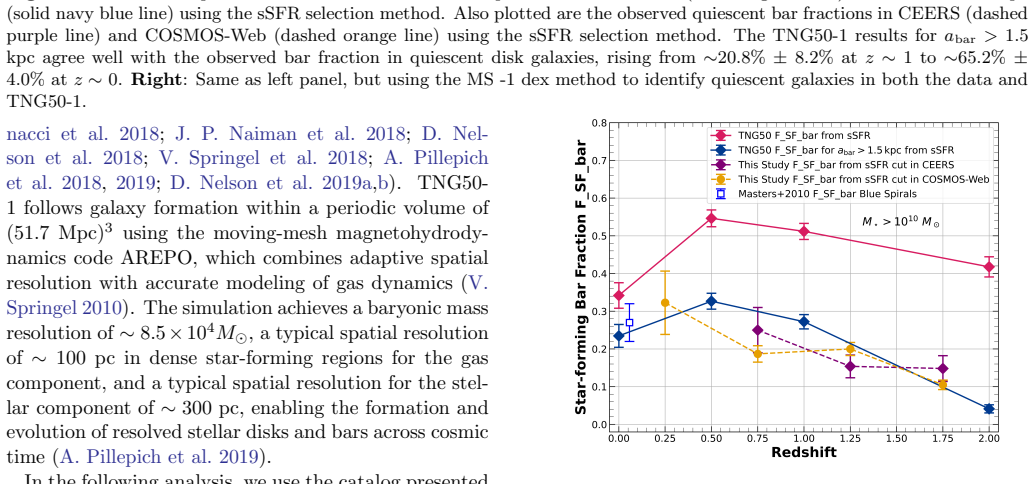
The fractional contribution of barred quiescent galaxies to the total bar fraction rises steeply from z~2 to z~0 while the contribution from barred star-forming galaxies falls; the fraction of quiescent galaxies hosting bars also increases over the last 10 Gyr. These empirical trends agree with TNG50-1 simulations for bars longer than 1.5 kpc and allow for bar-driven secular evolution that promotes quiescence or for bars that simply survive and grow better in gas-poor hosts.
What carries the argument
The redshift evolution of the bar fraction when split by host star-formation activity (quiescent versus actively star-forming), which isolates the growing dominance of quiescent barred systems.
If this is right
- Repeated bar-driven inflows can produce central starbursts that deplete gas and move galaxies toward quiescence.
- Bars become stronger as gas fractions drop and bulges grow.
- Short, dynamically young bars in gas-rich high-redshift disks can evolve into longer, stronger bars in low-gas systems.
- Bar-driven secular evolution offers one channel for the observed decline in cosmic star-formation activity over the last 10 Gyr.
Where Pith is reading between the lines
- The same sequence may link bar properties to the global drop in star-formation rate density if bar fractions are measured in volume-limited samples across redshift.
- Future work could test whether bar length or torque strength at fixed stellar mass correlates with current gas fraction or bulge-to-disk ratio.
- Analogous trends might appear for other internal drivers of secular evolution such as spirals or oval distortions.
Load-bearing premise
Bar identification and the separation of galaxies into quiescent versus star-forming categories remain accurate and unbiased from z~0 to z~2.
What would settle it
Higher-resolution imaging or an independent bar-detection method at z~1-2 that yields a flat or declining quiescent bar fraction instead of the reported steep rise.
Figures







read the original abstract
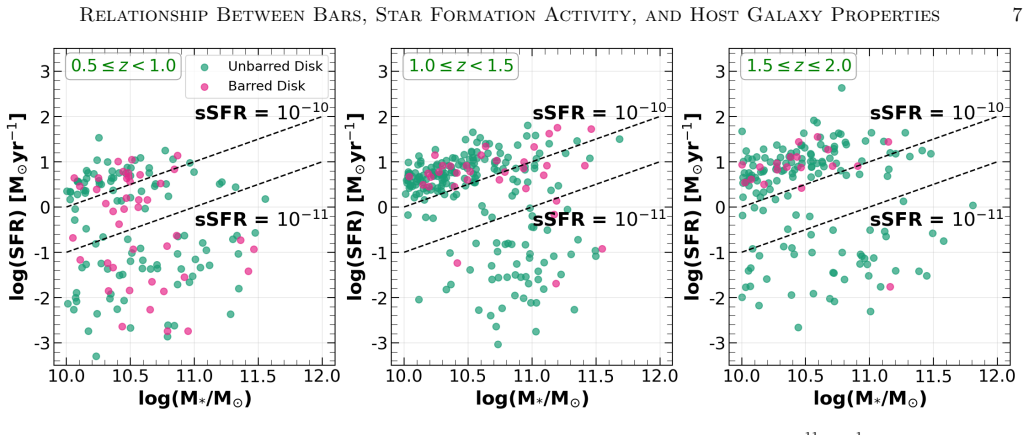
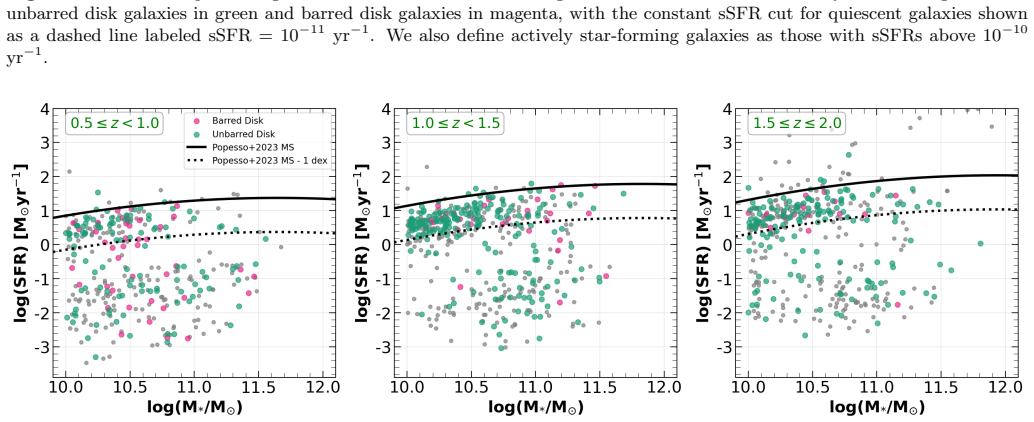
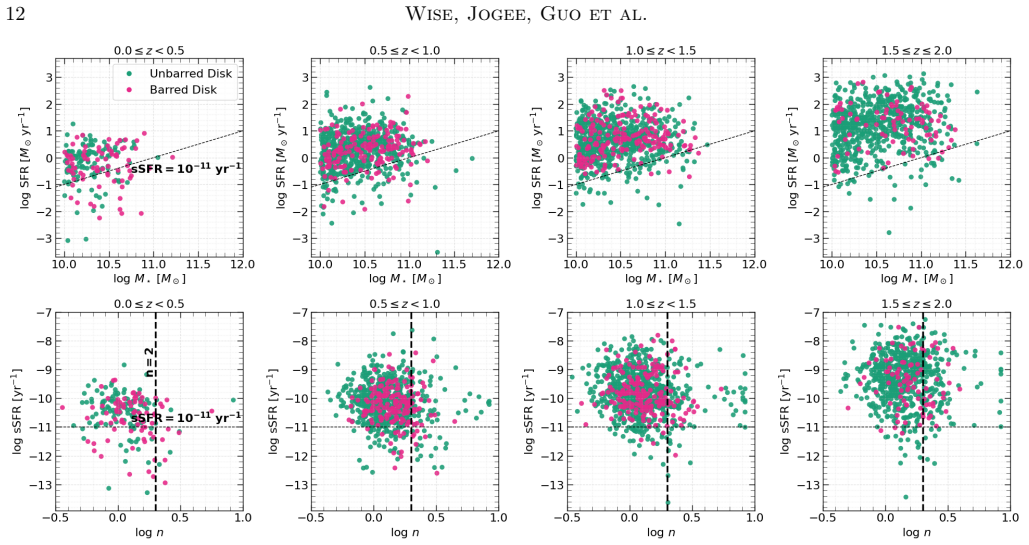
We present the most comprehensive study to date of the relationship between bars, star formation, and galaxy properties from $z \sim$ 0 to $z \sim$ 2. We use a mass-complete sample of 1,171 galaxies from the JWST CEERS survey with $M_\star > 10^{10} M_\odot$ and repeat the analysis using COSMOS-Web data. Our results are: 1) At high redshift ($z \sim$ $1-2$) barred galaxies tend to have high sSFRs and low S\'ersic indices ($n \leq 2$), while at low redshifts barred galaxies emerge with both low sSFR and higher $n$, suggestive of quiescent galaxies with bulges. 2) The fractional contribution of barred quiescent galaxies to the bar fraction rises steeply from $z \sim$ 2 to $z \sim$ 0, while that of barred actively star-forming galaxies falls. 3) The fraction of quiescent galaxies that are barred rises steeply over the last 10 Gyr. 4) Our empirical results show good agreement with the TNG50-1 simulations for bars with $a_{\mathrm{bar}}$ $>$ 1.5 kpc. Our results allow for the possibility that bar-driven secular evolution may lead to quiescence and/or that bars are more likely to persist and grow in gas-poor, quiescent galaxies. The steep rise in the quiescent bar fraction over 10 Gyr may represent an evolutionary sequence whereby gas-rich disks at high redshift first develop short, dynamically young bars and over time, repeated bar-driven gas inflows lead to central starbursts and declining gas fractions that strengthen the bar as the galaxy transitions toward quiescence.
Editorial analysis
A structured set of objections, weighed in public.
Referee Report
Summary. The paper analyzes a mass-complete sample of 1,171 galaxies (M* > 10^10 Msun) from JWST CEERS and COSMOS-Web to study bar fractions as a function of specific star formation rate (sSFR), Sersic index n, and redshift from z~0 to z~2. Key results include: at z~1-2 barred galaxies show high sSFR and n≤2, while at low z they show low sSFR and higher n; the contribution of quiescent barred galaxies to the total bar fraction rises steeply toward z=0 while the star-forming barred fraction falls; the barred fraction among quiescent galaxies rises over 10 Gyr; and the trends agree with TNG50-1 for bars with a_bar >1.5 kpc. The authors interpret this as possible evidence for an evolutionary sequence in which gas-rich high-z disks form short bars that drive inflows, trigger starbursts, deplete gas, and strengthen bars en route to quiescence.
Significance. If the bar classifications prove robust, the work would supply one of the first direct observational mappings of bar demographics across the star-forming to quiescent transition over 10 Gyr, providing a concrete test of secular evolution models. The mass-complete selection, dual-survey replication, and explicit comparison to TNG50 for resolved bars are positive features that strengthen the empirical foundation.
major comments (1)
- [simulation comparison and discussion of evolutionary sequence] The central evolutionary-sequence interpretation (abstract and final paragraph) rests on the measured rise in the quiescent bar fraction being free of redshift-dependent detection bias. The manuscript states agreement with TNG50 only for a_bar >1.5 kpc but does not report application of the observational bar-finding pipeline (including resolution, surface-brightness limits, and visual or quantitative classification) to mock JWST images of the simulated galaxies at z~1-2. Without this test, it remains possible that the steep trend is partly driven by incompleteness for short bars in compact, low-n high-z disks rather than physical evolution.
minor comments (1)
- [sample selection] The stellar-mass threshold of 10^10 Msun is stated as the sample limit but its impact on bar detection completeness at the faint end of the high-z sample is not quantified.
Simulated Author's Rebuttal
We thank the referee for their careful reading of our manuscript and for providing constructive comments. Below we respond to the major comment.
read point-by-point responses
-
Referee: The central evolutionary-sequence interpretation (abstract and final paragraph) rests on the measured rise in the quiescent bar fraction being free of redshift-dependent detection bias. The manuscript states agreement with TNG50 only for a_bar >1.5 kpc but does not report application of the observational bar-finding pipeline (including resolution, surface-brightness limits, and visual or quantitative classification) to mock JWST images of the simulated galaxies at z~1-2. Without this test, it remains possible that the steep trend is partly driven by incompleteness for short bars in compact, low-n high-z disks rather than physical evolution.
Authors: We agree that applying our full bar classification pipeline to mock JWST images of TNG50 galaxies at z~1-2 would provide a more robust test of detection biases. However, generating such mocks with appropriate resolution, surface brightness limits, and noise properties is a significant effort that was beyond the scope of the current study. Our comparison is restricted to bars with a_bar > 1.5 kpc, which are expected to be more reliably detected across redshifts, and we find good agreement in the trends for these larger bars. We will revise the manuscript to explicitly discuss the potential for redshift-dependent incompleteness in shorter bars and qualify the evolutionary sequence interpretation as suggestive rather than definitive, pending more detailed forward modeling. revision: partial
Circularity Check
No significant circularity; purely observational measurements of bar fractions and galaxy properties.
full rationale
The paper reports direct observational measurements of bar fractions, sSFR, Sersic indices, and quiescent vs. star-forming classifications from JWST CEERS and COSMOS-Web data across redshift bins. No derivations, predictions, or fitted parameters are presented that reduce by construction to the paper's own inputs or equations. The evolutionary sequence interpretation is offered as one possible reading of the observed trends, not as a mathematical result derived from self-referential steps. Self-citations are absent from the load-bearing claims, and the TNG50 comparison is an external benchmark rather than an internal loop. The analysis is self-contained against the survey data.
Axiom & Free-Parameter Ledger
free parameters (1)
- Stellar mass threshold of 10^10 solar masses
axioms (1)
- standard math Standard flat Lambda-CDM cosmology to convert redshift to lookback time
Reference graph
Works this paper leans on
-
[1]
Abraham, R. G., Merrifield, M. R., Ellis, R. S., Tanvir, N. R., & Brinchmann, J. 1999, MNRAS, 308, 569, doi: 10.1046/j.1365-8711.1999.02766.x
-
[2]
Alonso, M. S., Coldwell, G., & Lambas, D. G. 2013, A&A, 549, A141, doi: 10.1051/0004-6361/201220117 Angl´ es-Alc´ azar, D., Faucher-Gigu` ere, C.-A., Kereˇ s, D., et al. 2017, MNRAS, 470, 4698, doi: 10.1093/mnras/stx1517 Arrabal Haro, P., Dickinson, M., Finkelstein, S. L., et al. 2023, ApJL, 951, L22, doi: 10.3847/2041-8213/acdd54
-
[3]
1992, Monthly Notices of the Royal Astronomical Society, 259, 345, doi: 10.1093/mnras/259.2.345
Athanassoula, E. 1992, Monthly Notices of the Royal Astronomical Society, 259, 345, doi: 10.1093/mnras/259.2.345
-
[4]
Athanassoula, E. 2003, MNRAS, 341, 1179, doi: 10.1046/j.1365-8711.2003.06473.x
-
[5]
Athanassoula, E. 2005, MNRAS, 358, 1477, doi: 10.1111/j.1365-2966.2005.08872.x
-
[6]
Athanassoula, E., Lambert, J. C., & Dehnen, W. 2005, MNRAS, 363, 496, doi: 10.1111/j.1365-2966.2005.09445.x
-
[7]
Athanassoula, E., Machado, R. E. G., & Rodionov, S. A. 2013, MNRAS, 429, 1949, doi: 10.1093/mnras/sts452
-
[8]
Bagley, M. B., Finkelstein, S. L., Koekemoer, A. M., et al. 2023, ApJL, 946, L12, doi: 10.3847/2041-8213/acbb08
-
[9]
Barden, M., Rix, H.-W., Somerville, R. S., et al. 2005, ApJ, 635, 959, doi: 10.1086/497679
-
[10]
Barnes, J. E., & Hernquist, L. 1992, ARA&A, 30, 705, doi: 10.1146/annurev.aa.30.090192.003421
-
[11]
Barro, G., Faber, S. M., P´ erez-Gonz´ alez, P. G., et al. 2013, ApJ, 765, 104, doi: 10.1088/0004-637X/765/2/104
-
[12]
2023, ApJ, 953, 173, doi: 10.3847/1538-4357/ace2b9
Beane, A., Hernquist, L., D’Onghia, E., et al. 2023, ApJ, 953, 173, doi: 10.3847/1538-4357/ace2b9
-
[13]
Bell, E. F., McIntosh, D. H., Barden, M., et al. 2004, ApJL, 600, L11, doi: 10.1086/381388
-
[14]
Bertin, E., & Arnouts, S. 1996, A&AS, 117, 393, doi: 10.1051/aas:1996164
-
[15]
2022, ApJ, 934, 52, doi: 10.3847/1538-4357/ac779b
Bi, D., Shlosman, I., & Romano-D´ ıaz, E. 2022, ApJ, 934, 52, doi: 10.3847/1538-4357/ac779b
-
[16]
Bittner, A., S´ anchez-Bl´ azquez, P., Gadotti, D. A., et al. 2020, A&A, 643, A65, doi: 10.1051/0004-6361/202038450
-
[17]
2024, ApJ, 968, 86, doi: 10.3847/1538-4357/ad4118
Federrath, C. 2024, ApJ, 968, 86, doi: 10.3847/1538-4357/ad4118
-
[18]
Blitz, L., & Spergel, D. N. 1991, ApJ, 379, 631, doi: 10.1086/170535
-
[19]
2002, A&A, 392, 83, doi: 10.1051/0004-6361:20020920
Bournaud, F., & Combes, F. 2002, A&A, 392, 83, doi: 10.1051/0004-6361:20020920
-
[20]
2005, MNRAS, 364, L18, doi: 10.1111/j.1745-3933.2005.00096.x
Bournaud, F., Combes, F., & Semelin, B. 2005, MNRAS, 364, L18, doi: 10.1111/j.1745-3933.2005.00096.x
-
[21]
, archivePrefix = "arXiv", eprint =
Brammer, G. B., van Dokkum, P. G., & Coppi, P. 2008, ApJ, 686, 1503, doi: 10.1086/591786
work page internal anchor Pith review doi:10.1086/591786 2008
-
[22]
2009, ApJ, 694, 396, doi: 10.1088/0004-637X/694/1/396
Wadsley, J. 2009, ApJ, 694, 396, doi: 10.1088/0004-637X/694/1/396
-
[23]
doi:10.5281/zenodo.7429939 , url =
Bushouse, H., Eisenhamer, J., Dencheva, N., et al. 2022, JWST Calibration Pipeline, 1.8.5 Zenodo, doi: 10.5281/zenodo.7429939
-
[24]
1996, FCPh, 17, 95
Buta, R., & Combes, F. 1996, FCPh, 17, 95
1996
-
[25]
Calzetti, D., Armus, L., Bohlin, R. C., et al. 2000, ApJ, 533, 682, doi: 10.1086/308692
work page internal anchor Pith review doi:10.1086/308692 2000
-
[26]
Cameron, E., Carollo, C. M., Oesch, P., et al. 2010, MNRAS, 409, 346, doi: 10.1111/j.1365-2966.2010.17314.x
-
[27]
Carnall, A. C., McLeod, D. J., McLure, R. J., et al. 2023, MNRAS, 520, 3974, doi: 10.1093/mnras/stad369
-
[28]
Casey, C. M., Kartaltepe, J. S., Drakos, N. E., et al. 2023, ApJ, 954, 31, doi: 10.3847/1538-4357/acc2bc
-
[29]
Galactic Stellar and Substellar Initial Mass Function
Chabrier, G. 2003, PASP, 115, 763, doi: 10.1086/376392
work page internal anchor Pith review doi:10.1086/376392 2003
-
[30]
Cheung, E., Athanassoula, E., Masters, K. L., et al. 2013, ApJ, 779, 162, doi: 10.1088/0004-637X/779/2/162
-
[31]
2005, AJ, 130, 65, doi: 10.1086/430526
Vollmer, B. 2005, AJ, 130, 65, doi: 10.1086/430526
-
[32]
Daddi, E., Renzini, A., Pirzkal, N., et al. 2005, ApJ, 626, 680, doi: 10.1086/430104
-
[33]
Davis, M., Guhathakurta, P., Konidaris, N. P., et al. 2007, ApJL, 660, L1, doi: 10.1086/517931 de S´ a-Freitas, C., Gadotti, D. A., Fragkoudi, F., et al. 2025, A&A, 698, A5, doi: 10.1051/0004-6361/202453367
-
[34]
Debattista, V. P., Mayer, L., Carollo, C. M., et al. 2006, ApJ, 645, 209, doi: 10.1086/504147
-
[35]
doi:10.1111/j.1365-2966.2006.11038.x , eprint =
Dekel, A., & Birnboim, Y. 2006, MNRAS, 368, 2, doi: 10.1111/j.1365-2966.2006.10145.x
-
[36]
Dekel, A., Sari, R., & Ceverino, D. 2009, ApJ, 703, 785, doi: 10.1088/0004-637X/703/1/785 D’Onghia, E., & L. Aguerri, J. A. 2020, ApJ, 890, 117, doi: 10.3847/1538-4357/ab6bd6
-
[37]
2019, MNRAS, 485, 4817, doi: 10.1093/mnras/stz712
Donnari, M., Pillepich, A., Nelson, D., et al. 2019, MNRAS, 485, 4817, doi: 10.1093/mnras/stz712
-
[38]
Ellison, S. L., Nair, P., Patton, D. R., et al. 2011, MNRAS, 416, 2182, doi: 10.1111/j.1365-2966.2011.19195.x
-
[39]
Elmegreen, B. G., Elmegreen, D. M., & Hirst, A. C. 2004, ApJ, 612, 191, doi: 10.1086/422407
-
[40]
2018, MNRAS, 474, 5372, doi: 10.1093/mnras/stx3117
Erwin, P. 2018, MNRAS, 474, 5372, doi: 10.1093/mnras/stx3117
-
[41]
Eskridge, P. B., Frogel, J. A., Pogge, R. W., et al. 2000, AJ, 119, 536, doi: 10.1086/301203 Espejo Salcedo, J. M., Pastras, S., V´ acha, J., et al. 2025, A&A, 700, A42, doi: 10.1051/0004-6361/202554725 Relationship Between Bars, Star Formation Activity, and Host Galaxy Properties27 Euclid Collaboration, Gentile, F., Daddi, E., et al. 2025, arXiv e-prints...
-
[42]
Fang, J. J., Faber, S. M., Koo, D. C., et al. 2018, ApJ, 858, 100, doi: 10.3847/1538-4357/aabcba
-
[43]
Finkelstein, S. L., Bagley, M. B., Haro, P. A., et al. 2022, ApJL, 940, L55, doi: 10.3847/2041-8213/ac966e
-
[44]
Finkelstein, S. L., Leung, G. C. K., Bagley, M. B., et al. 2023, arXiv e-prints, arXiv:2311.04279, doi: 10.48550/arXiv.2311.04279
-
[45]
Finkelstein, S. L., Leung, G. C. K., Bagley, M. B., et al. 2024, ApJL, 969, L2, doi: 10.3847/2041-8213/ad4495
-
[46]
Finkelstein, S. L., Bagley, M. B., Arrabal Haro, P., et al. 2025, ApJL, 983, L4, doi: 10.3847/2041-8213/adbbd3
-
[47]
Fontanot, F., De Lucia, G., Monaco, P., Somerville, R. S., & Santini, P. 2009, MNRAS, 397, 1776, doi: 10.1111/j.1365-2966.2009.15058.x
-
[48]
2020, MNRAS, 495, 4158, doi: 10.1093/mnras/staa1416
Fraser-McKelvie, A., Arag´ on-Salamanca, A., Merrifield, M., et al. 2020, MNRAS, 495, 4158, doi: 10.1093/mnras/staa1416
-
[49]
Frogel, J. A., Quillen, A. C., & Pogge, R. W. 1996, in Astrophysics and Space Science Library, Vol. 209, New Extragalactic Perspectives in the New South Africa, ed. D. L. Block & J. M. Greenberg, 65, doi: 10.1007/978-94-009-0335-7 7
-
[50]
Gadotti, D. A. 2008, MNRAS, 384, 420, doi: 10.1111/j.1365-2966.2007.12723.x
-
[51]
A., S´ anchez-Bl´ azquez, P., Falc´ on-Barroso, J., et al
Gadotti, D. A., S´ anchez-Bl´ azquez, P., Falc´ on-Barroso, J., et al. 2019, MNRAS, 482, 506, doi: 10.1093/mnras/sty2666
-
[52]
A., Bittner, A., Falc´ on-Barroso, J., et al
Gadotti, D. A., Bittner, A., Falc´ on-Barroso, J., et al. 2020, A&A, 643, A14, doi: 10.1051/0004-6361/202038448
-
[53]
Galloway, M. A., Willett, K. W., Fortson, L. F., et al. 2015, MNRAS, 448, 3442, doi: 10.1093/mnras/stv235
work page internal anchor Pith review doi:10.1093/mnras/stv235 2015
-
[54]
Gardner, J. P., Mather, J. C., Clampin, M., et al. 2006, SSRv, 123, 485, doi: 10.1007/s11214-006-8315-7
-
[55]
Gardner, J. P., Mather, J. C., Abbott, R., et al. 2023, PASP, 135, 068001, doi: 10.1088/1538-3873/acd1b5
-
[56]
Gargiulo, I. D., Monachesi, A., G´ omez, F. A., et al. 2022, MNRAS, 512, 2537, doi: 10.1093/mnras/stac629
-
[57]
Garland, I. L., Fahey, M. J., Simmons, B. D., et al. 2023, MNRAS, 522, 211, doi: 10.1093/mnras/stad966
-
[58]
2020, A&A, 644, A79, doi: 10.1051/0004-6361/202038810
George, K., Joseph, P., Mondal, C., et al. 2020, A&A, 644, A79, doi: 10.1051/0004-6361/202038810
-
[59]
2021, A&A, 651, A107, doi: 10.1051/0004-6361/202140697 G´ eron, T., Smethurst, R
George, K., & Subramanian, S. 2021, A&A, 651, A107, doi: 10.1051/0004-6361/202140697 G´ eron, T., Smethurst, R. J., Lintott, C., et al. 2021, MNRAS, 507, 4389, doi: 10.1093/mnras/stab2064 G´ eron, T., Smethurst, R. J., Lintott, C., et al. 2024, ApJ, 973, 129, doi: 10.3847/1538-4357/ad66b7 G´ eron, T., Smethurst, R. J., Dickinson, H., et al. 2025, ApJ, 987...
-
[60]
Gnedin, O. Y. 2003, ApJ, 582, 141, doi: 10.1086/344636
-
[61]
, archivePrefix = "arXiv", eprint =
Grogin, N. A., Kocevski, D. D., Faber, S. M., et al. 2011, ApJS, 197, 35, doi: 10.1088/0067-0049/197/2/35
-
[62]
Gunn, J. E., & Gott, III, J. R. 1972, ApJ, 176, 1, doi: 10.1086/151605
-
[63]
2025, ApJ, 985, 181, doi: 10.3847/1538-4357/adc8a7
Guo, Y., Jogee, S., Wise, E., et al. 2025, ApJ, 985, 181, doi: 10.3847/1538-4357/adc8a7
-
[64]
Hopkins, P. F., & Hernquist, L. 2010, MNRAS, 402, 985, doi: 10.1111/j.1365-2966.2009.15933.x
-
[65]
Huertas-Company, M., Iyer, K. G., Angeloudi, E., et al. 2024, A&A, 685, A48, doi: 10.1051/0004-6361/202346800
-
[66]
2025, arXiv e-prints, arXiv:2502.03532, doi: 10.48550/arXiv.2502.03532
Huertas-Company, M., Shuntov, M., Dong, Y., et al. 2025, arXiv e-prints, arXiv:2502.03532, doi: 10.48550/arXiv.2502.03532
-
[67]
Iyer, K. G., Gawiser, E., Faber, S. M., et al. 2019, ApJ, 879, 116, doi: 10.3847/1538-4357/ab2052
-
[68]
Jedrzejewski, R. I. 1987, MNRAS, 226, 747, doi: 10.1093/mnras/226.4.747
-
[69]
2006, in Physics of Active Galactic Nuclei at all Scales, ed
Jogee, S. 2006, in Physics of Active Galactic Nuclei at all Scales, ed. D. Alloin, Vol. 693, 143, doi: 10.1007/3-540-34621-X 6
-
[70]
Jogee, S., Knapen, J. H., Laine, S., et al. 2002, ApJL, 570, L55, doi: 10.1086/340974
-
[71]
Jogee, S., Scoville, N., & Kenney, J. D. P. 2005, ApJ, 630, 837, doi: 10.1086/432106
-
[72]
Jogee, S., Barazza, F. D., Rix, H.-W., et al. 2004, ApJL, 615, L105, doi: 10.1086/426138
-
[73]
Kartaltepe, J. S., Rose, C., Vanderhoof, B. N., et al. 2023, ApJL, 946, L15, doi: 10.3847/2041-8213/acad01
-
[74]
Katz, N., Keres, D., Dave, R., & Weinberg, D. H. 2003, in Astrophysics and Space Science Library, Vol. 281, The IGM/Galaxy Connection. The Distribution of Baryons at z=0, ed. J. L. Rosenberg & M. E. Putman, 185, doi: 10.1007/978-94-010-0115-1 34 Kereˇ s, D., Katz, N., Weinberg, D. H., & Dav´ e, R. 2005, MNRAS, 363, 2, doi: 10.1111/j.1365-2966.2005.09451.x
-
[75]
Khoperskov, S., Haywood, M., Di Matteo, P., Lehnert, M. D., & Combes, F. 2018, A&A, 609, A60, doi: 10.1051/0004-6361/201731211
-
[76]
, archivePrefix = "arXiv", eprint =
Koekemoer, A. M., Faber, S. M., Ferguson, H. C., et al. 2011, ApJS, 197, 36, doi: 10.1088/0067-0049/197/2/36
-
[77]
Koopmann, R. A., & Kenney, J. D. P. 2004, ApJ, 613, 866, doi: 10.1086/423191
-
[78]
1993, in IAU Symposium, Vol
Kormendy, J. 1993, in IAU Symposium, Vol. 153, Galactic Bulges, ed. H. Dejonghe & H. J. Habing, 209
1993
-
[79]
Kormendy, J., & Kennicutt, Jr., R. C. 2004, ARA&A, 42, 603, doi: 10.1146/annurev.astro.42.053102.134024 28Wise, Jogee, Guo et al
-
[80]
2012, ApJ, 757, 60, doi: 10.1088/0004-637X/757/1/60
Kraljic, K., Bournaud, F., & Martig, M. 2012, ApJ, 757, 60, doi: 10.1088/0004-637X/757/1/60
discussion (0)
Sign in with ORCID, Apple, or X to comment. Anyone can read and Pith papers without signing in.