MeiBRD: Meta-Learning Intraoperative Biomechanical Residual Deformation
Pith reviewed 2026-06-27 02:35 UTC · model grok-4.3
The pith
Meta-learning a residual deformation function corrects bias in biomechanical liver models from sparse intraoperative data.
A machine-rendered reading of the paper's core claim, the machinery that carries it, and where it could break.
Core claim
The central claim is that a geometry-aware graph neural diffusion function, meta-learned from intraoperative context samples treated as complete input-output pairs, can serve as a residual corrector that removes the persistent bias of linear biomechanical predictions and thereby produces more accurate and more generalizable liver registrations under sparse data constraints.
What carries the argument
Geometry-aware graph neural diffusion function over the 3D liver mesh that models the residual deformation and is adapted by feedforward meta-learners from sparse observed context pairs.
If this is right
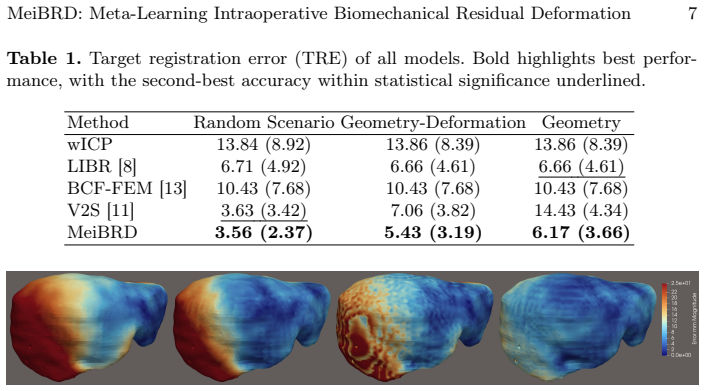
- Registration accuracy exceeds that of rigid, biomechanical-only, and data-driven baselines on the phantom dataset.
- Generalization improves for out-of-distribution liver geometries and deformation patterns.
- Physical plausibility is retained because the learned component acts only as a correction to the biomechanical prior.
- Long-range information transfer from sparse observations is achieved through the graph diffusion structure.
Where Pith is reading between the lines
- The same residual-meta-learning pattern could be tested on registration tasks for other soft organs that admit surface mesh representations.
- If the feedforward adaptation remains fast, the approach may support patient-specific updates during live procedures without full retraining.
- Validation on in-vivo human data would be required to determine whether phantom results hold when measurement noise and tissue properties differ.
- The framing indicates that systematic bias in other physics-based models may be correctable in a data-efficient way by treating sparse observations as meta-learning context.
Load-bearing premise
Sparse intraoperative correspondences supply fully observed input-output pairs sufficient for meta-learners to learn a stable residual correction without introducing instability or new errors.
What would settle it
A new set of liver phantom experiments in which the meta-learned residual method produces equal or higher registration error than the uncorrected biomechanical baseline on out-of-distribution cases.
Figures



read the original abstract
Accurate intraoperative liver registration is challenging due to substantial soft-tissue deformation yet sparse intraoperative measurements. Biomechanical models regularize this ill-posedness with prior knowledge but exhibit persistent prediction bias due to simplifying assumptions, while data-driven learning solutions struggle with data efficiency, generalization, and physical plausibility. We propose a hybrid registration framework that adapts a biomechanical prior using sparse intraoperative correspondences. Rather than learning a full deformation field, we learn a residual deformation function that corrects linear biomechanical predictions, modeled as a graph neural diffusion function with geometry-aware attention over the 3D liver mesh. To enable long-range information transfer of sparse observations, we take a novel perspective of sparse intraoperative measurements as \textit{context} samples where input-output pairs of the residual deformation function are fully observed, casting the problem into learning-to-learn this residual function from intraoperative context samples with feedforward meta-learners. Experiments on a deformable liver phantom dataset demonstrate improved registration accuracy and generalization compared to rigid, biomechanical, and data-driven baselines, particularly for out-of-distribution geometries and deformations.
Editorial analysis
A structured set of objections, weighed in public.
Referee Report
Summary. The paper proposes MeiBRD, a hybrid registration framework for intraoperative liver registration. It adapts a linear biomechanical prior by learning a residual deformation function modeled as a geometry-aware graph neural diffusion process on the 3D liver mesh. Sparse intraoperative correspondences are treated as fully observed context input-output pairs to train feedforward meta-learners that learn this residual correction. Experiments on a deformable liver phantom dataset claim improved registration accuracy and generalization over rigid, biomechanical, and data-driven baselines, especially for out-of-distribution geometries and deformations.
Significance. If the quantitative claims hold with proper validation, the hybrid meta-learning approach could meaningfully advance data-efficient, physically plausible registration in computer-assisted surgery by correcting systematic bias in biomechanical models without requiring large intraoperative datasets.
major comments (1)
- [Abstract] Abstract: the central claim of improved accuracy and generalization is asserted without any quantitative metrics, error bars, statistical tests, ablation studies, or baseline numbers; this prevents evaluation of whether the method actually outperforms the cited baselines on the phantom data.
minor comments (2)
- [Methods] The description of how the diffusion process is conditioned on context pairs and the exact meta-learning loss formulation would benefit from an explicit equation or pseudocode in the methods.
- [Methods] Clarify whether the graph neural network operates on a fixed mesh topology or adapts to varying liver geometries across subjects.
Simulated Author's Rebuttal
We thank the referee for the constructive feedback and positive assessment of the work's potential significance. We address the single major comment below.
read point-by-point responses
-
Referee: [Abstract] Abstract: the central claim of improved accuracy and generalization is asserted without any quantitative metrics, error bars, statistical tests, ablation studies, or baseline numbers; this prevents evaluation of whether the method actually outperforms the cited baselines on the phantom data.
Authors: We agree that the abstract would benefit from quantitative support to substantiate the claims of improved accuracy and generalization. The full manuscript contains detailed experimental results with metrics, error bars, and baseline comparisons on the phantom dataset, but these were not summarized in the abstract. In the revised version, we will update the abstract to include specific quantitative results (e.g., mean target registration errors with standard deviations for MeiBRD versus rigid, biomechanical, and data-driven baselines), along with any relevant statistical tests or ablation insights where space permits. revision: yes
Circularity Check
No significant circularity identified
full rationale
The abstract describes a hybrid framework that learns a residual deformation function via meta-learning on external phantom measurements treated as context input-output pairs, correcting a separate biomechanical prior. No equations, fitting procedures, or self-citations are shown that would reduce any claimed prediction to an input by construction. The approach is presented as relying on independent external data for learning rather than tautological redefinitions or fitted quantities renamed as predictions. This matches the default expectation of a self-contained method without load-bearing circular steps.
Axiom & Free-Parameter Ledger
Reference graph
Works this paper leans on
-
[1]
Annals of Surgery268(1), 11–18 (Jul 2018)
Abu Hilal, M., Aldrighetti, L., Dagher, I., Edwin, B., Troisi, R.I., Alikhanov, R., Aroori, S., Belli, G., Besselink, M., Briceno, J., Gayet, B., D’Hondt, M., Lesurtel, M., Menon, K., Lodge, P., Rotellar, F., Santoyo, J., Scatton, O., Soubrane, O., Sutcliffe, R., Van Dam, R., White, S., Halls, M.C., Cipriani, F., Van Der Poel, M., Ciria, R., Barkhatov, L....
-
[2]
Wiley, 2 edn
Belytschko, T., Liu, W.K., Moran, B.: Nonlinear Finite Elements for Continua and Structures. Wiley, 2 edn. (2013)
2013
-
[3]
Cambridge University Press (2008)
Bonet, J., Wood, R.D.: Nonlinear Continuum Mechanics for Finite Element Anal- ysis. Cambridge University Press (2008)
2008
-
[4]
In: Shen, D., Liu, T., Peters, T.M., Staib, L.H., Essert, C., Zhou, S., Yap, P.T., Khan, A
Brunet, J.N., Mendizabal, A., Petit, A., Golse, N., Vibert, E., Cotin, S.: Physics- Based Deep Neural Network for Augmented Reality During Liver Surgery. In: Shen, D., Liu, T., Peters, T.M., Staib, L.H., Essert, C., Zhou, S., Yap, P.T., Khan, A. (eds.) Medical Image Computing and Computer Assisted Intervention – MICCAI 2019. pp. 137–145. Springer Internat...
-
[5]
In: Proceedings of the 38th International Conference on Machine Learning
Chamberlain, B., Rowbottom, J., Gorinova, M.I., Bronstein, M., Webb, S., Rossi, E.: GRAND: Graph Neural Diffusion. In: Proceedings of the 38th International Conference on Machine Learning. pp. 1407–1418. PMLR (Jul 2021)
2021
-
[6]
In: Proceedings of the 34th International Conference on Machine Learning (ICML)
Finn, C., Abbeel, P., Levine, S.: Model-agnostic meta-learning for fast adaptation of deep networks. In: Proceedings of the 34th International Conference on Machine Learning (ICML). Proceedings of Machine Learning Research, vol. 70, pp. 1126– 1135 (2017)
2017
-
[7]
In: Medical Imaging 2023: Image-Guided Procedures, Robotic Interventions, and Modeling
Heiselman, J.S., Collins, J.A., Ringel, M.J., Jarnagin, W.R., Miga, M.I.: Compar- ison study of sparse data-driven soft tissue registration: Preliminary results from the image-to-physical liver registration sparse data challenge. In: Medical Imaging 2023: Image-Guided Procedures, Robotic Interventions, and Modeling. vol. 12466, pp. 150–161. SPIE (Apr 2023...
-
[8]
IEEE Transactions on Medical Imaging39(6), 2223– 2234 (Jun 2020)
Heiselman, J.S., Jarnagin, W.R., Miga, M.I.: Intraoperative Correction of Liver Deformation Using Sparse Surface and Vascular Features via Linearized Iterative Boundary Reconstruction. IEEE Transactions on Medical Imaging39(6), 2223– 2234 (Jun 2020). https://doi.org/10.1109/TMI.2020.2967322
-
[9]
In: Visualization and Mathematics III
Meyer, M., Desbrun, M., Schröder, P., Barr, A.H.: Discrete differential-geometry operators for triangulated 2-manifolds. In: Visualization and Mathematics III. Springer (2003)
2003
-
[10]
Annals of Biomedical Engineering44(1), 128–138 (Jan 2016)
Miga, M.I.: Computational Modeling for Enhancing Soft Tissue Image Guided Surgery: An Application in Neurosurgery. Annals of Biomedical Engineering44(1), 128–138 (Jan 2016). https://doi.org/10.1007/s10439-015-1433-1
-
[11]
Wolf, Linard Arquint, Martin Clochard, Wytse Oortwijn, João Carlos Pereira, and Peter Müller
Pfeiffer,M.,Riediger,C.,Leger,S.,Kühn,J.P.,Seppelt,D.,Hoffmann,R.T.,Weitz, J., Speidel, S.: Non-Rigid Volume to Surface Registration Using a Data-Driven Biomechanical Model. In: Martel, A.L., Abolmaesumi, P., Stoyanov, D., Mateus, D., Zuluaga, M.A., Zhou, S.K., Racoceanu, D., Joskowicz, L. (eds.) Medical Image Computing and Computer Assisted Intervention ...
-
[12]
Phase-field Approaches to Structural Topology Optimization
Wang, D., Azadvar, S., Heiselman, J., Jiang, X., Miga, M., Wang, L.: LIBR+: Improving Intraoperative Liver Registration by Learning the Residual of Biomechanics-Based Deformable Registration. In: Linguraru, M.G., Dou, Q., Feragen, A., Giannarou, S., Glocker, B., Lekadir, K., Schnabel, J.A. (eds.) Med- ical Image Computing and Computer Assisted Interventio...
-
[13]
IEEE Transactions on Medical Imaging pp
Yang, Z., Simon, R., Merrell, K., Linte, C.A.: Boundary Constraint-free Biomechanical Model-Based Surface Matching for Intraoperative Liver Defor- mation Correction. IEEE Transactions on Medical Imaging pp. 1–1 (2024). https://doi.org/10.1109/TMI.2024.3515632
discussion (0)
Sign in with ORCID, Apple, or X to comment. Anyone can read and Pith papers without signing in.