A coarse Menger theorem for hyperbolic graphs, finitely presented groups, and more
Pith reviewed 2026-06-27 00:29 UTC · model grok-4.3
The pith
Graphs whose cycle space is generated by cycles of bounded length have the coarse Menger property.
A machine-rendered reading of the paper's core claim, the machinery that carries it, and where it could break.
Core claim
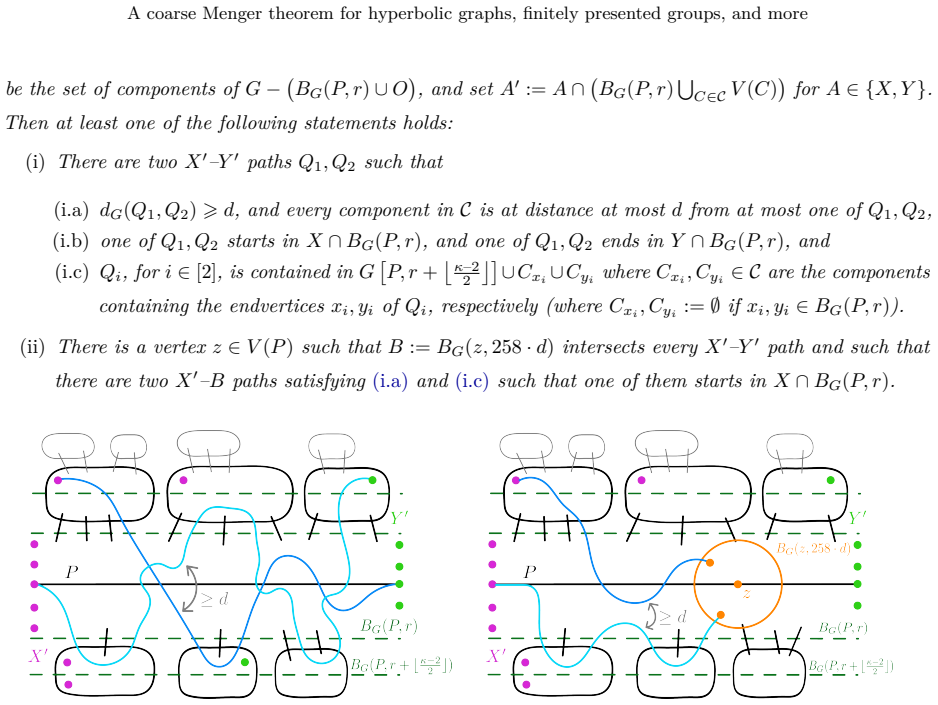
If the cycle space of a graph is generated by cycles of bounded length, then for any vertex sets X and Y, any positive integer k, and any distance d, either there exist k paths from X to Y that are pairwise at distance at least d, or there exists a set of at most k-1 balls of bounded radius that intersects every X-Y path.
What carries the argument
The cycle space generated by cycles of bounded length, which supplies short cycles that bound the radius of the balls needed for separators.
Load-bearing premise
The cycle space of the graph is generated by cycles of bounded length.
What would settle it
An explicit graph whose cycle space is generated by cycles of length at most some fixed L, together with sets X, Y, integers k and d, such that neither k far-apart paths nor a (k-1)-ball separator of bounded radius exists.
Figures




read the original abstract
Menger's theorem is one of the most fundamental results in graph theory. It states that if a graph $G$ does not contain $k$ disjoint paths between two given sets $X$ and $Y$ of vertices in $G$, then there is a set of at most $k-1$ vertices that intersects every path between $X$ and $Y$. Nguyen, Scott, and Seymour gave a counterexample to the conjectured natural coarse variant in which the paths are required to be pairwise at distance at least $d$, and, conversely, there is a set of at most $k-1$ bounded-radius balls intersecting every path between $X$ and $Y$. In other words, the coarse Menger property does not hold in general. We prove that graphs whose cycles space is generated by cycles of bounded length do have the coarse Menger property. As a corollary, we show that many natural graphs and geodesic metric spaces have the coarse Menger property. These include hyperbolic graphs, Cayley graphs of finitely presented groups, planar graphs with bounded face size, and complete Riemannian planes.
Editorial analysis
A structured set of objections, weighed in public.
Referee Report
Summary. The manuscript proves that graphs whose cycle space is generated by cycles of bounded length satisfy the coarse Menger property: if there do not exist k pairwise distance-at-least-d paths between vertex sets X and Y, then there exists a separator consisting of at most k-1 balls of bounded radius that intersects every X-Y path. Corollaries are derived for hyperbolic graphs, Cayley graphs of finitely presented groups, planar graphs with bounded face size, and complete Riemannian planes, by verifying that these classes satisfy the cycle-space hypothesis.
Significance. If the central theorem holds, the result supplies a natural, checkable combinatorial condition (bounded-length cycle-space generators) that is sufficient for the coarse Menger property and that is known to hold for several geometrically significant classes. This directly addresses the counterexample of Nguyen-Scott-Seymour by delineating a broad family of graphs and spaces in which the coarse variant is valid, with potential utility in coarse geometry and geometric group theory.
minor comments (3)
- Abstract, line 3: 'cycles space' should read 'cycle space'.
- The main theorem statement (presumably §3 or §4) would benefit from an explicit remark on whether the radius bound in the separator is a function of the cycle-length bound alone or also depends on other graph parameters.
- In the corollaries section, the verification that each listed class has its cycle space generated by bounded-length cycles should include a brief pointer to the relevant reference or short argument establishing the bound, to make the applications self-contained.
Simulated Author's Rebuttal
We thank the referee for the careful reading, positive assessment of the significance, and recommendation of minor revision. No major comments were listed in the report.
Circularity Check
No significant circularity; derivation self-contained
full rationale
The paper states a conditional theorem: graphs whose cycle space is generated by cycles of bounded length satisfy the coarse Menger property. This is presented as a direct proof under an explicitly declared hypothesis, with corollaries obtained by verifying that standard classes (hyperbolic graphs, finitely presented groups, etc.) meet the hypothesis. No equations, fitted parameters, self-citations, or ansatzes are invoked in the abstract or described argument that reduce the conclusion to the input by construction. The result is therefore independent of its own statement.
Axiom & Free-Parameter Ledger
axioms (1)
- standard math Standard facts from graph theory and algebraic topology on cycle spaces (e.g., that the cycle space is a vector space over GF(2)).
Reference graph
Works this paper leans on
-
[1]
Small counterexamples to the fat minor conjecture
arXiv: 2508.15342. [ADG26] S. Albrechtsen, M. Distel, and A. Georgakopoulos. “Small counterexamples to the fat minor conjecture”
-
[2]
Asymptotic half-grid and full-grid minors
arXiv:2601.05761. [AH26] S. Albrechtsen and M. Hamann. “Asymptotic half-grid and full-grid minors”. In:Journal of Combinatorical Theory, Series B176 (2026), pp. 440–485. [AHJ+24] S. Albrechtsen, T. Huynh, R. W. Jacobs, P. Knappe, and P. Wollan. “A Menger-type theorem for two induced paths”. In:SIAM Journal on Discrete Mathematics38.2 (2024), pp. 1438–1450...
arXiv 2026
-
[3]
Fat minors cannot be thinned (by quasi-isometries)
arXiv:2605.11112. [DHIM24] J. Davies, R. Hickingbotham, F. Illingworth, and R. McCarty. “Fat minors cannot be thinned (by quasi-isometries)”
-
[4]
String graphs are quasi-isometric to planar graphs
arXiv:2405.09383. [Dav25] J. Davies. “String graphs are quasi-isometric to planar graphs”
- [5]
-
[6]
Infinite-ended groups with planar Cayley graphs
arXiv:2509.08762v2. 18 Sandra Albrechtsen [Dro06] C. Droms. “Infinite-ended groups with planar Cayley graphs”. In:Journal of Group Theory9 (2006), pp. 487–496. [EGG26] L. Esperet, H. Gahlawat, and U. Giocanti. “Coarse cops and robber in graphs and groups”. In: European Journal of Combinatorics135 (2026), p. 104356. [GKL23] P. Gartland, T. Korhonen, and D....
Pith/arXiv arXiv 2006
-
[7]
Graph minors and metric spaces
arXiv:2309.08169. [GP25] A. Georgakopoulos and P. Papasoglu. “Graph minors and metric spaces”. In:Combinatorica 45.33 (2025). [Ham18a] M. Hamann. “Accessibility in Transitive Graphs”. In:Combinatorica 38 (2018), pp. 847–859. [Ham18b] M. Hamann. “Planar transitive graphs”. In:Electronic Journal of Combinatorics25(4) (2018), Article No. P4.8. [HNST24] K. He...
arXiv 2025
-
[8]
Almost planar finitely presented groups
arXiv: 2605.10068. [MMS26] J. M. Mackay, J. P. MacManus, and D. Spriano. “Almost planar finitely presented groups”
-
[9]
Fat minors in finitely presented groups
arXiv: 2605.03040. [Mac25] J. P. MacManus. “Fat minors in finitely presented groups”. In:Combinatorica 45.40 (2025). [Men27] K. Menger. “Zur allgemeinen Kurventheorie”. In:Fundamenta Mathematicae10 (1927), pp. 96–
Pith/arXiv arXiv 2025
-
[10]
A counterexample to the coarse Menger conjecture
[NSS25a] T. Nguyen, A. Scott, and P. D. Seymour. “A counterexample to the coarse Menger conjecture”. In: Journal of Combinatorial Theory, Series B173 (2025), pp. 68–82. arXiv:2401.06685. [NSS25b] T. Nguyen, A. Scott, and P. D. Seymour. “Asymptotic structure. IV. A counterexample to the weak coarse Menger conjecture”
arXiv 2025
-
[11]
Asymptotic structure. VI. Distant paths across a disc
arXiv:2508.14332. [NSS25c] T. Nguyen, A. Scott, and P. D. Seymour. “Asymptotic structure. VI. Distant paths across a disc”
-
[12]
arXiv:2509.07174. 19
discussion (0)
Sign in with ORCID, Apple, or X to comment. Anyone can read and Pith papers without signing in.