Children Are Not the Enemy: Child-Fit Security as an Alternative to Bans and Surveillance
Pith reviewed 2026-06-27 00:13 UTC · model grok-4.3
The pith
Technologies for children must treat them as legitimate users whose wellbeing and rights define security requirements.
A machine-rendered reading of the paper's core claim, the machinery that carries it, and where it could break.
Core claim
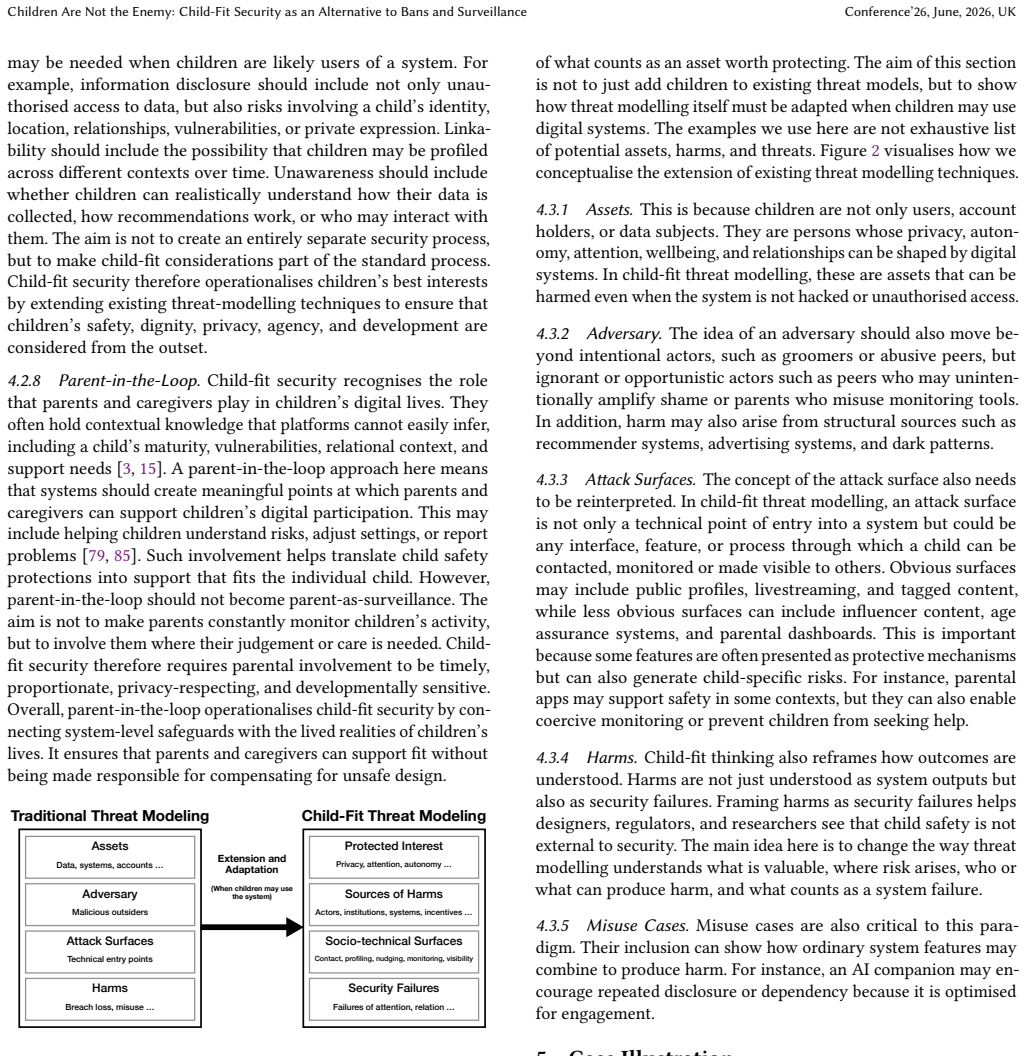
Child-fit security is a design paradigm that treats children as legitimate users in technologies they are likely to use, making their wellbeing, development, privacy, safety, agency, and rights core security requirements, thereby focusing protection on the child-system relationship rather than containment.
What carries the argument
Child-fit security, a design paradigm that integrates children's wellbeing, development, privacy, safety, agency, and rights as core security requirements instead of exclusion or restriction.
If this is right
- Security mechanisms would prioritize enabling safe participation over blocking access to adult systems.
- Design processes would include children's agency and rights as non-negotiable requirements alongside traditional security goals.
- Evaluation of security would measure outcomes in child development and wellbeing, not just risk reduction.
- Research would focus on creating systems that adapt to children's developmental needs rather than applying uniform adult controls.
Where Pith is reading between the lines
- If adopted, child-fit security could inform regulations that require tech companies to design for child participation rather than defaulting to age gates.
- Designers could test this by creating prototypes of apps that embed child rights into authentication and content moderation.
- Neighboring areas like accessibility design might adopt similar user-centered security paradigms for other marginalized groups.
Load-bearing premise
Dominant containment mechanisms are inadequate because they restrict access to adult systems, and that centering children's wellbeing and rights in security will produce better outcomes for protection and participation.
What would settle it
A controlled study comparing child wellbeing and safety metrics in a child-fit security designed platform versus a standard containment-based one, where no significant improvement or worse outcomes would falsify the approach.
Figures

read the original abstract
Digital technologies are now central to children's learning, play, communication, identity formation, and social participation. Yet dominant approaches to children's online safety often rely on containment mechanisms, including bans, age gates, parental controls, monitoring, and screen-time restrictions. These approaches can be useful in specific contexts, but they often frame child protection primarily as a problem of restricting access to systems designed for adults. In this paper, we argue that this framing is inadequate for children's digital lives and insufficient as a security paradigm. We propose Child-fit security, a design paradigm in which technologies likely to be used by children treat a child as legitimate users, not attackers to be excluded, vulnerabilities to be patched, or risks to be managed. In this paradigm, children's wellbeing, development, privacy, safety, agency, and rights become core security requirements. This shifts the focus of protection from apps, accounts, and data to the child-system relationship, which means protecting both the child and their participation. We conceptualise child-fit security, contrast it with containment-oriented approaches, define its core principles, and discuss its implications for security design. We conclude by presenting a research agenda for making child-fit security operational.
Editorial analysis
A structured set of objections, weighed in public.
Referee Report
Summary. The paper claims that dominant containment mechanisms for children's online safety (bans, age gates, parental controls, monitoring) are inadequate as they frame protection as restricting access to adult-designed systems. It proposes Child-fit security as an alternative design paradigm in which technologies treat children as legitimate users and incorporate their wellbeing, development, privacy, safety, agency, and rights as core security requirements. The manuscript contrasts the two approaches, defines core principles of the new paradigm, discusses implications for security design, and outlines a research agenda for operationalization.
Significance. If the proposed paradigm can be operationalized, it could shift research and practice in usable security and socio-technical systems toward rights-based, participatory designs that support rather than restrict children's digital lives. The conceptual reframing from exclusion to inclusion has potential to influence design guidelines and policy, though the absence of empirical validation or concrete examples limits immediate applicability.
major comments (1)
- [Research agenda] Research agenda section: The central normative claim that re-centering security requirements on children's wellbeing and rights will produce superior protection and participation outcomes is not supported by any illustrative design scenario, hypothetical evaluation, or comparison of outcomes for a concrete system (e.g., a messaging app or educational platform). This absence makes the claimed advantages over containment unassessable from the manuscript.
minor comments (1)
- The contrast with existing mechanisms would be strengthened by explicit citations to prior work in child-computer interaction and usable security that already incorporates some participatory elements.
Simulated Author's Rebuttal
We thank the referee for their detailed and constructive review. We address the single major comment below.
read point-by-point responses
-
Referee: Research agenda section: The central normative claim that re-centering security requirements on children's wellbeing and rights will produce superior protection and participation outcomes is not supported by any illustrative design scenario, hypothetical evaluation, or comparison of outcomes for a concrete system (e.g., a messaging app or educational platform). This absence makes the claimed advantages over containment unassessable from the manuscript.
Authors: We agree that the absence of even a hypothetical design scenario limits the assessability of the claimed advantages. The manuscript is intentionally conceptual: it defines the paradigm, contrasts it with containment, and presents a research agenda rather than empirical results. The central claim is normative rather than predictive. To address the concern directly, the revised manuscript will add a concise hypothetical scenario in the research agenda section (or as a new subsection) using a messaging app as the example. The scenario will outline two design paths—one following containment (monitoring, age gates) and one following child-fit principles (child-controlled privacy settings, agency-preserving defaults, rights-respecting data flows)—and discuss plausible differences in protection and participation outcomes. This addition will make the normative argument more concrete while preserving the paper's non-empirical scope. revision: yes
Circularity Check
No significant circularity; derivation is self-contained normative framing
full rationale
The paper is a conceptual position paper that defines Child-fit security as an alternative paradigm by contrasting it with containment mechanisms (bans, age gates, etc.). The central claim is normative: re-centering security requirements on children's wellbeing, agency, and rights. No equations, fitted parameters, predictions, or technical derivations exist that could reduce to inputs by construction. No self-citations are invoked as load-bearing uniqueness theorems or ansatzes. The argument treats the inadequacy of existing approaches as a premise rather than a derived result, and the research agenda defers operationalization. This is the most common honest finding for purely definitional position papers.
Axiom & Free-Parameter Ledger
axioms (1)
- domain assumption Dominant approaches frame child protection primarily as restricting access to systems designed for adults and this framing is inadequate for children's digital lives.
invented entities (1)
-
Child-fit security
no independent evidence
Reference graph
Works this paper leans on
-
[1]
Harold Abelson, Ross Anderson, Steven M Bellovin, Josh Benaloh, Matt Blaze, Jon Callas, Whitfield Diffie, Susan Landau, Peter G Neumann, Ronald L Rivest, et al. 2024. Bugs in our pockets: the risks of client-side scanning.Journal of Cybersecurity10, 1 (2024), tyad020
2024
-
[2]
Anne Adams and Martina Angela Sasse. 1999. Users are not the enemy.Commun. ACM42, 12 (1999), 40–46
1999
-
[3]
Mamtaj Akter, Amy J Godfrey, Jess Kropczynski, Heather R Lipford, and Pamela J Wisniewski. 2022. From parental control to joint family oversight: Can parents and teens manage mobile online safety and privacy as equals?Proceedings of the ACM on Human-Computer Interaction6, CSCW1 (2022), 1–28
2022
-
[4]
Apple. 2025. Apple can no longer offer Advanced Data Protection in the United Kingdom to new users. https://support.apple.com/en-gb/122234. Accessed 10 May 2026
2025
-
[5]
Catherine J Archer. 2025. Coming of age with, in and on social media: A critique of how politicians are responding to children’s social media engagement.Journal of Children and Media19, 1 (2025), 58–64
2025
-
[6]
Associated Press. 2025. Schools use AI to monitor kids, hoping to prevent violence. Our investigation found security risks. https://apnews.com/article/ 25a3946727397951fd42324139aaf70f
2025
-
[7]
Karla Badillo-Urquiola, Diva Smriti, Brenna McNally, Evan Golub, Elizabeth Bonsignore, and Pamela J. Wisniewski. 2019. Stranger Danger! Social Media App Features Co-designed with Children to Keep Them Safe Online. InProceedings of the 18th ACM International Conference on Interaction Design and Children(Boise, ID, USA)(IDC ’19). Association for Computing M...
-
[8]
2026.Brazil Regulates the Children and Adolescents Online Safety Act
Baker McKenzie. 2026.Brazil Regulates the Children and Adolescents Online Safety Act. https://www.bakermckenzie.com/en/insight/publications/2026/03/brazil- regulates-the-children-and-adolescents-online-safety-act Accessed 9 May 2026
2026
-
[9]
Barry, Chloe L
Christopher T. Barry, Chloe L. Sidoti, Shanelle M. Briggs, Shari R. Reiter, and Rebecca A. Lindsey. 2017. Adolescent social media use and mental health from adolescent and parent perspectives.Journal of Adolescence61 (2017), 1–11. doi:10. 1016/j.adolescence.2017.08.005
2017
-
[10]
2025.Australia’s Social Media Ban for Kids Under 16 – How Will It Work?BBC News
BBC News. 2025.Australia’s Social Media Ban for Kids Under 16 – How Will It Work?BBC News. https://www.bbc.com/news/articles/cwyp9d3ddqyo
2025
-
[11]
2022.Two Arrested in Egypt after Teenage Girl’s Suicide Sparks Outrage
BBC News. 2022.Two Arrested in Egypt after Teenage Girl’s Suicide Sparks Outrage. BBC News. https://www.bbc.co.uk/news/world-middle-east-59868721
2022
-
[12]
2014.{Parents’} and {Teens’} Perspectives on Privacy In a {Technology-Filled} World
Lorrie Faith Cranor, Adam L Durity, Abigail Marsh, and Blase Ur. 2014.{Parents’} and {Teens’} Perspectives on Privacy In a {Technology-Filled} World. In10th Symposium On Usable Privacy and Security (SOUPS 2014). 19–35
2014
-
[13]
2026.Digital Statute for Children and Adolescents – Law No
Demarest Advogados. 2026.Digital Statute for Children and Adolescents – Law No. 15,211/2025. https://www.demarest.com.br/en/digital-statute-for-children- and-adolescents-law-no-15211-2025/ Accessed 9 May 2026
2026
-
[14]
Department for Digital, Culture, Media & Sport and Home Office. 2021. Government funds new tech in the fight against online child abuse. https://www.gov.uk/government/news/government-funds-new-tech-in- the-fight-against-online-child-abuse. Accessed 10 May 2026
2021
-
[15]
It’s hard for him to make choices sometimes and he needs guidance
Prakriti Dumaru, Hanieh Atashpanjeh, and Mahdi Nasrullah Al-Ameen. 2024. " It’s hard for him to make choices sometimes and he needs guidance": Re-orienting Parental Control for Children.Proceedings of the ACM on Human-Computer Interaction8, CSCW1 (2024), 1–51
2024
-
[16]
ECIJA. 2026. Law No. 21.801: prohibition and regulation of the use of mobile devices in educational establishments. https://www.ecija.com/en/news- and-insights/ley-n-21801-prohibicion-y-regulacion-del-uso-de-dispositivos- moviles-en-establecimientos-educacionales/
2026
-
[17]
2022.Men Who Blackmailed Egyptian Girl to Suicide Get 15 Years in Jail
Egyptian Streets. 2022.Men Who Blackmailed Egyptian Girl to Suicide Get 15 Years in Jail. Egyptian Streets. https://egyptianstreets.com/2022/05/11/men- who-blackmailed-egyptian-girl-to-suicide-get-15-years-in-jail/
2022
-
[18]
Money makes the world go around
Anirudh Ekambaranathan, Jun Zhao, and Max Van Kleek. 2021. “Money makes the world go around”: Identifying Barriers to Better Privacy in Children’s Apps From Developers’ Perspectives. InProceedings of the 2021 CHI conference on human factors in computing systems. 1–15
2021
-
[19]
eSafety Commissioner. 2026. Social Media Age Restrictions. https://www.esafety. gov.au/about-us/industry-regulation/social-media-age-restrictions Accessed 9 May 2026
2026
-
[20]
eSafety Commissioner. 2026. Which Social Media Platforms Are Age- Restricted? https://www.esafety.gov.au/about-us/industry-regulation/social- media-age-restrictions/which-platforms-are-age-restricted Accessed 9 May 2026
2026
-
[21]
European Digital Rights (EDRi) et al. 2023. Open letter: EU countries should say no to the CSAR mass surveillance proposal. https://edri.org/tag/open-letter/ Civil society open letter to EU governments on the proposed CSA Regulation
2023
-
[22]
Eurydice Unit Netherlands. 2025. Netherlands: A ban on mobile phones in the classroom. https://eurydice.eacea.ec.europa.eu/news/netherlands-ban-mobile- phones-classroom
2025
-
[23]
Álvaro Feal, Paolo Calciati, Narseo Vallina-Rodriguez, Carmela Troncoso, and Alessandra Gorla. 2020. Angel or devil? a privacy study of mobile parental control apps.Proceedings on Privacy Enhancing Technologies(2020)
2020
-
[24]
Federal Trade Commission. n.d.. Children’s Online Privacy Protection Rule ("COPPA"). https://www.ftc.gov/legal-library/browse/rules/childrens-online- privacy-protection-rule-coppa
-
[25]
FOX Carolina News Staff. 2023. Greenville Co. Schools blocks YouTube on devices due to potential access to inappropriate videos. https://www.foxcarolina.com/2023/11/16/greenville-co-schools-blocks- youtube-devices-due-potential-access-inappropriate-videos/
2023
-
[26]
Freedom House. 2024. China: Freedom on the Net 2024 Country Report. https: //freedomhouse.org/country/china/freedom-net/2024 Accessed 9 May 2026
2024
-
[27]
Heidi Hartikainen, Netta Iivari, and Marianne Kinnula. 2019. Children’s Design Recommendations for Online Safety Education.International Journal of Child- Computer Interaction22 (2019), 100146. doi:10.1016/j.ijcci.2019.100146
-
[28]
Ellen J. Helsper. 2021. The Digital Disconnect: The Social Causes and Conse- quences of Digital Inequalities.SAGE Publications(2021). https://uk.sagepub. com/en-gb/eur/the-digital-disconnect/book270303
2021
-
[29]
Information Commissioner’s Office. n.d.. Age Appropriate Design: A Code of Practice for Online Services. https://ico.org.uk/for-organisations/uk-gdpr- guidance-and-resources/childrens-information/childrens-code-guidance-and- resources/age-appropriate-design-a-code-of-practice-for-online-services/
-
[30]
Internet Society. 2023. Client-Side Scanning: What It Is and Why It Threat- ens Trustworthy, Private Communication. https://www.internetsociety.org/ resources/doc/2023/client-side-scanning/ Accessed 10 May 2026
2023
-
[32]
Chelsea Jarvie and Karen Renaud. 2024. Online Age Verification: Government Legislation, Supplier Responsibilization, and Public Perceptions.Children11, 9 (2024). doi:10.3390/children11091068
-
[33]
Mark Keierleber. 2022. Survey reveals extent that cops surveil students online in school and at home. https://www.the74million.org/article/survey-reveals-extent- that-cops-surveil-students-online-in-school-and-at-home/
2022
-
[34]
Mark Keierleber. 2024. Ohio school districts use surveillance software to monitor student devices. https://www.the74million.org/article/ohio-school-districts-use- surveillance-software-to-monitor-student-devices/
2024
-
[35]
2024.The Story Behind Netflix’s Moving Documentary The Remarkable Life of Ibelin
Jake King-Schreifels. 2024.The Story Behind Netflix’s Moving Documentary The Remarkable Life of Ibelin. TIME. https://time.com/7095887/the-remarkable-life- of-ibelin-true-story-netflix/
arXiv 2024
-
[36]
Marianne Kinnula and Netta Iivari. 2021. Manifesto for children’s genuine participation in digital technology design and making.International Journal of Child-Computer Interaction28 (2021), 100244. doi:10.1016/j.ijcci.2020.100244
-
[37]
Kumar, Fiona O’Connell, Lucy Li, Virginia L
Priya C. Kumar, Fiona O’Connell, Lucy Li, Virginia L. Byrne, Marshini Chetty, Tamara L. Clegg, and Jessica Vitak. 2023. Understanding Research Related to Designing for Children’s Privacy and Security: A Document Analysis. InProceed- ings of the 22nd Annual ACM Interaction Design and Children Conference(Chicago, IL, USA)(IDC ’23). Association for Computing...
-
[38]
Lanjing Liu, Xiaozheng Wang, Shaddi Hasan, and Yaxing Yao. 2025. Co-Design Privacy Notice and Controls with Children. InProceedings of the Extended Ab- stracts of the CHI Conference on Human Factors in Computing Systems (CHI EA ’25). Association for Computing Machinery, New York, NY, USA, Article 137, 7 pages. doi:10.1145/3706599.3719886
-
[39]
LoiLo Inc. 2021. LoiLoNote School Pamphlet. https://assets.loilo.tv/loilonote/pdf/ LNS_Pamphlets_en.pdf
2021
-
[40]
Supreet Mann, Angela Calvin, Amanda Lenhart, and Michael B. Robb
-
[41]
The Common Sense Census: Media Use by Kids Zero to Eight,
-
[42]
https://www.commonsensemedia.org/sites/default/files/research/report/ 2025-common-sense-census-web-2.pdf
2025
-
[43]
Alice E. Marwick. 2008. To Catch a Predator? The MySpace Moral Panic.First Monday13, 6 (2008). doi:10.5210/fm.v13i6.2152
-
[44]
National Academies of Sciences, Engineering, and Medicine. 2024. Introduction. InSocial Media and Adolescent Health, Anne Wojtowicz, Gillian J. Buckley, and Sandro Galea (Eds.). National Academies Press, Washington, DC. https://www. ncbi.nlm.nih.gov/books/NBK603432/
2024
-
[45]
New America. 2023. How Anti-LGBTQ Web Filters Stand Be- tween LGBTQ Youth and the Online Resources They Need. https: //www.newamerica.org/insights/how-anti-lgbtq-web-filters-stand-between- lgbtq-youth-and-the-online-resources-they-need/
2023
-
[46]
Tanya Notley. 2009. Young people, online networks, and social inclusion.Journal of computer-mediated communication14, 4 (2009), 1208–1227
2009
-
[47]
Ofcom. 2025. Children and Parents: Media Use and Attitudes Report. https://www.ofcom.org.uk/siteassets/resources/documents/research-and- data/media-literacy-research/children/childrens-media-use-and-attitudes- report-2025/childrens-media-literacy-report-2025.pdf?v=396621
2025
-
[48]
Ofcom. 2025. Children’s Passive Online Measurement. https: //www.ofcom.org.uk/siteassets/resources/documents/online-safety/research- statistics-and-data/protecting-children/ofcom-childrens-passive-online- measurement.pdf?v=408844
2025
-
[49]
Ofcom. 2022. Families’ Attitudes Towards Age Assurance. https: //www.ofcom.org.uk/siteassets/resources/documents/research-and- data/online-research/keeping-children-safe-online/families-attitudes-towards- age-assurance-/drcf-ofcom-ico-age-assurance.pdf
2022
-
[50]
Ofcom. 2025. Age Checks to Protect Children Online. https://www.ofcom.org. uk/online-safety/protecting-children/age-checks-to-protect-children-online
2025
-
[51]
Ofcom. 2025. Statement: Age Assurance and Children’s Access. https: //www.ofcom.org.uk/siteassets/resources/documents/consultations/category- 1-10-weeks/statement-age-assurance-and-childrens-access/statement-age- assurance-and-childrens-access.pdf
2025
-
[52]
Office of the Australian Information Commissioner. 2025. Social Media Mini- mum Age. https://www.oaic.gov.au/privacy/your-privacy-rights/social-media- minimum-age Accessed 9 May 2026
2025
-
[53]
Open Rights Group and European Digital Rights (EDRi). 2023. Civil society organisations urge UK to protect global digital security and safeguard private communication. https://www.openrightsgroup.org/publications/open-letter- protect-encrypted-messaging/ Open letter concerning the UK Online Safety Bill and client-side scanning
2023
-
[54]
Rizu Paudel and Mahdi Nasrullah Al-Ameen. 2024. Leveraging the power of storytelling to encourage and empower children towards strong passwords. Proceedings of the ACM on Human-Computer Interaction8, CSCW2 (2024), 1–27
2024
-
[55]
2022.Scoping the Evaluation of CSAM Preven- tion and Detection Tools in the Context of End-to-End Encryption Environments
Claudia Peersman, Emiliano De Cristofaro, Corinne May-Chahal, Ryan Mc- Conville, and Awais Rashid. 2022.Scoping the Evaluation of CSAM Preven- tion and Detection Tools in the Context of End-to-End Encryption Environments. Technical Report Version 1.1. REPHRAIN. https://www.rephrain.ac.uk/wp- content/uploads/E2EE_evaluation_criteria_document24.03.21.pdf
2022
-
[56]
2025.Teens and Internet, Device Access Fact Sheet
Pew Research Center. 2025.Teens and Internet, Device Access Fact Sheet. Pew Research Center. https://www.pewresearch.org/internet/fact-sheet/teens-and- internet-device-access-fact-sheet/
2025
-
[57]
Kate Prendergast and Emily Dyer. 2026. Youth social media age restrictions: ex- amining Trans-Tasman media coverage of Australia’s social media ‘ban’.Journal of Youth Studies(2026), 1–17
2026
-
[58]
Awais Rashid, Corinne May-Chahal, and Claudia Peersman. 2025. Weakening End-to-End Encryption Considered Harmful.IEEE Security & Privacy23, 3 (2025), 51–54. doi:10.1109/MSEC.2025.3563092
-
[59]
Reuters. 2025. Apple pulls data protection feature in UK amid government demands. https://www.reuters.com/technology/apple-removing-end-to-end- cloud-encryption-feature-uk-bloomberg-news-reports-2025-02-21/. Accessed 10 May 2026
2025
-
[60]
Reuters. 2026. Australia, Europe countries move to curb children’s social media access. https://www.reuters.com/legal/government/australia-europe-countries- move-curb-childrens-social-media-access-2026-04-24/
2026
-
[61]
Won’t somebody think of the children?
Irwin Reyes, Primal Wijesekera, Joel Reardon, Amit Elazari Bar On, Abbas Raza- ghpanah, Narseo Vallina-Rodriguez, Serge Egelman, et al. 2018. “Won’t somebody think of the children?” examining COPPA compliance at scale. InThe 18th Privacy Enhancing Technologies Symposium (PETS 2018)
2018
-
[62]
Roblox. n.d.. Parental Controls. https://about.roblox.com/parental-controls
-
[63]
2019.Først da Mats var død, forsto foreldrene verdien av gamingen hans
Vicky Schaubert. 2019.Først da Mats var død, forsto foreldrene verdien av gamingen hans. NRK. https://www.nrk.no/dokumentar/xl/forst-da-mats-var-dod_-forsto- foreldrene-verdien-av-gamingen-hans-1.14197198
2019
-
[64]
Scientists and Researchers on the EU’s Proposed Child Sexual Abuse Regulation
-
[65]
Joint statement of scientists and researchers on EU’s proposed Child Sexual Abuse Regulation. https://edri.org/wp-content/uploads/2023/07/Open- Letter-CSA-Scientific-community.pdf Open letter addressed to Members of the European Parliament and Member States of the Council of the European Union
2023
-
[66]
Shaffique and Simone van der Hof
Muhammad R. Shaffique and Simone van der Hof. 2025. Behavioural Profiling for Age Assurance: Do the Ends Justify the Means?International Data Privacy Law(2025). doi:10.1093/idpl/ipaf012
-
[67]
Jessica Simms. 2025. Greenwich Schools, Conn., Block YouTube for Elementary Students. https://www.govtech.com/education/k-12/greenwich-schools-conn- block-youtube-for-elementary-students
2025
-
[68]
Lukas Struppek, Dominik Hintersdorf, Daniel Neider, and Kristian Kersting. 2022. Learning to break deep perceptual hashing: The use case neuralhash. InProceed- ings of the 2022 ACM Conference on Fairness, Accountability, and Transparency. 58–69
2022
-
[69]
The Guardian. 2026. Los Angeles school district to limit screen time and block YouTube in classrooms. https://www.theguardian.com/us-news/2026/apr/22/los- angeles-school-district-screen-time
2026
-
[70]
The State Council of the People’s Republic of China. 2021. Stricter Limits on Minors’ Online Gaming. https://english.www.gov.cn/statecouncil/ministries/ 202108/31/content_WS612da2a2c6d0df57f98df6bd.html Accessed 9 May 2026
2021
-
[71]
Mary Theofanos, Yee-Yin Choong, and Olivia Murphy. 2021. ’Passwords Keep Me Safe’–Understanding What Children Think about Passwords. In30th USENIX Security Symposium (USENIX Security 21). 19–35
2021
-
[72]
UK Parliament, Joint Committee on the Draft Online Safety Bill. 2021. Corrected Oral Evidence: Consideration of Government’s Draft Online Safety Bill. Oral evidence, Evidence Session No. 11, Questions 154–192. https://committees. parliament.uk/oralevidence/2884/html/ Witness: Frances Haugen, former Face- book employee
2021
-
[73]
UN Committee on the Rights of the Child. 2021. General Com- ment No. 25 (2021) on Children’s Rights in Relation to the Digital En- vironment. https://www.ohchr.org/en/documents/general-comments-and- recommendations/general-comment-no-25-2021-childrens-rights-relation
2021
-
[74]
UNESCO Global Education Monitoring Report. 2026. Phone bans in schools are spreading worldwide as the policy debate rages on. https://www.unesco.org/gem-report/en/articles/phone-bans-schools-are- spreading-worldwide-policy-debate-rages
2026
-
[75]
UNICEF Innocenti. 2020. Encryption, Privacy and Children’s Right to Protec- tion from Harm. https://www.unicef.org/innocenti/media/3446/file/UNICEF- Encryption-Privacy-Right-Protection-From-Harm-2020.pdf
2020
-
[76]
UNICEF Innocenti. 2025. Best Interests of the Child in Relation to the Digital Environment. https://www.unicef.org/innocenti/reports/best-interests-child- relation-digital-environment
2025
-
[77]
UNICEF Innocenti. 2025. Childhood in a Digital World. https://www.unicef.org/ innocenti/reports/childhood-digital-world
2025
-
[78]
Congress, House Committee on Energy and Commerce, Subcommittee on Telecommunications and the Internet
U.S. Congress, House Committee on Energy and Commerce, Subcommittee on Telecommunications and the Internet. 2006. H.R. 5319, The Deleting Online Predators Act of 2006. Hearing before the Subcommittee on Telecommunications and the Internet, Committee on Energy and Commerce, House of Representatives, 109th Congress, 2nd Session. https://www.govinfo.gov/cont...
2006
-
[79]
Voice of America. 2024. ‘Digital Pause’: France Pilots School Mobile Phone Ban. https://www.voanews.com/a/digital-pause-france-pilots-school-mobile- phone-ban/7771105.html
arXiv 2024
-
[80]
Stephanie Volz. 2026. Age restrictions as a tool for enhancing children’s online safety: an analysis with special reference to Australian law.Computer Law & Security Review61 (2026), 1–9
2026
-
[81]
Ge Wang, Jun Zhao, Max Van Kleek, and Nigel Shadbolt. 2021. Protection or punishment? relating the design space of parental control apps and perceptions about them to support parenting for online safety.Proceedings of the ACM on Human-Computer Interaction5, CSCW2 (2021), 1–26
2021
discussion (0)
Sign in with ORCID, Apple, or X to comment. Anyone can read and Pith papers without signing in.