Ratio-Independent Three-Cycle Decomposition with Optimal Ordered Local-Switch Cost in Six-Regular Non-Axis Eisenstein--Jacobi Networks
Pith reviewed 2026-06-30 10:53 UTC · model grok-4.3
The pith
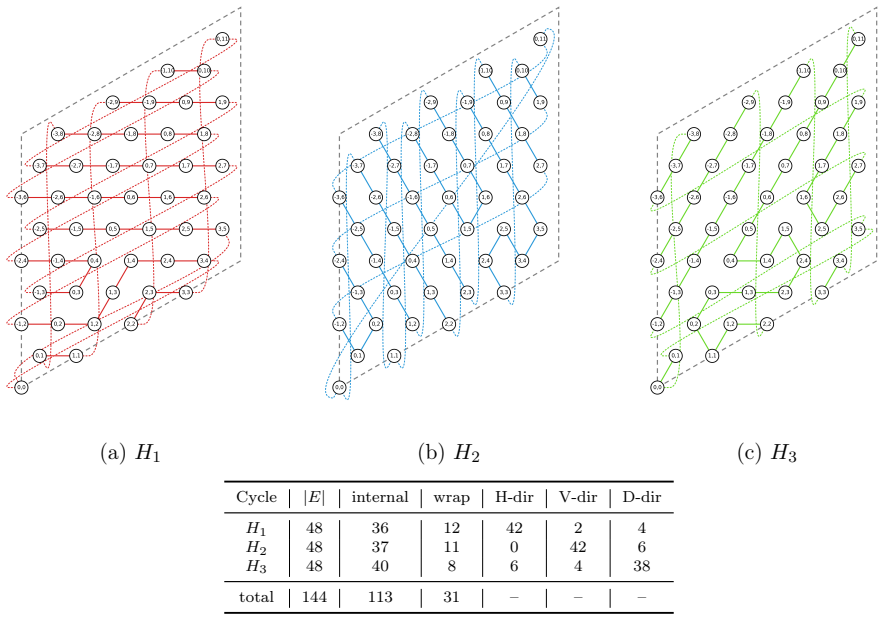
Every six-regular simple non-axis EJ network decomposes into three edge-disjoint Hamiltonian cycles with ratio-independent optimal local-switch cost.
A machine-rendered reading of the paper's core claim, the machinery that carries it, and where it could break.
Core claim
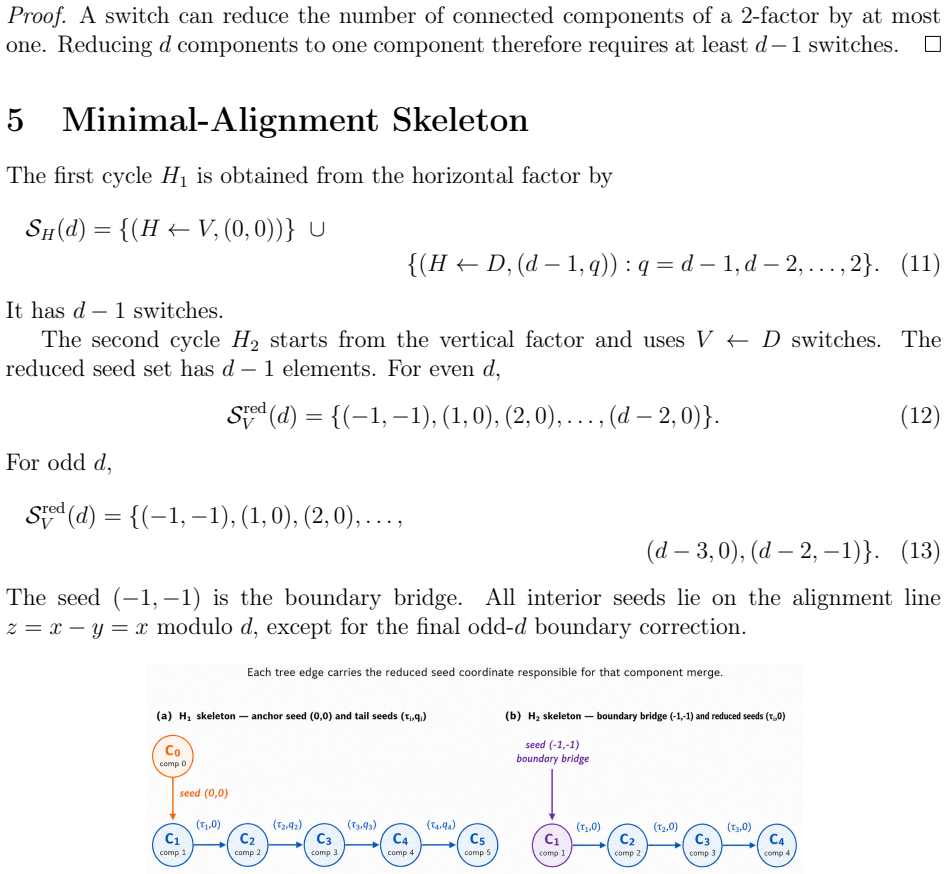
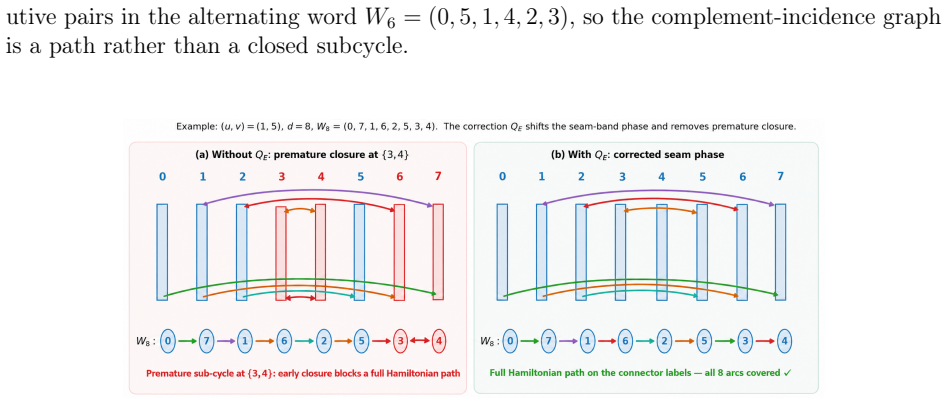
The paper claims that every six-regular simple non-axis EJ network admits a decomposition into three edge-disjoint Hamiltonian cycles via a canonical ordered local-switch model using unit-parallelogram exchanges. The d=1 case requires no switches, d=2 has total cost four, and d=3 and d greater than or equal to four achieve the d-1 lower bound. An equal-coordinate alternating lift removes reduced-ratio dependence for d greater than or equal to four. A block-chain invariant, exhaustive interior-template lemma, and parity-specific successor permutations together certify that the unused complement is empty and that coverage is complete.
What carries the argument
The ordered local-switch model based on unit-parallelogram exchanges, together with the block-chain invariant that advances rank by one modulo 4d-6.
If this is right
- The d=1 branch needs no switches.
- The d=2 case has optimal total cost four.
- For d=3 and d greater than or equal to four both modified factors attain the component-counting lower bound d-1.
- Factor-local switches commute, so the final factors and total cost are independent of interleaving order.
- The O(d) seed records expand to the full edge lists in O(N) time.
Where Pith is reading between the lines
- The commuting property of the switches may allow the same technique to produce disjoint cycle covers in other regular quotient-lattice graphs.
- The ratio-independent lift for d greater than or equal to four suggests the method could be adapted to families of networks whose parameters vary continuously.
- The parity-specific successor permutations supply an explicit rule that might be turned into a distributed construction algorithm.
- Because the certificate is deterministic and dictionary-free, it could serve as a template for automated verification of cycle decompositions in larger interconnection networks.
Load-bearing premise
The unit-parallelogram exchange is the correct canonical model for counting and minimizing ordered local-switch cost in these networks.
What would settle it
A single six-regular simple non-axis EJ network of any norm d in which the three cycles either leave an edge uncovered or require more than the stated switch cost under the unit-parallelogram model.
Figures




read the original abstract
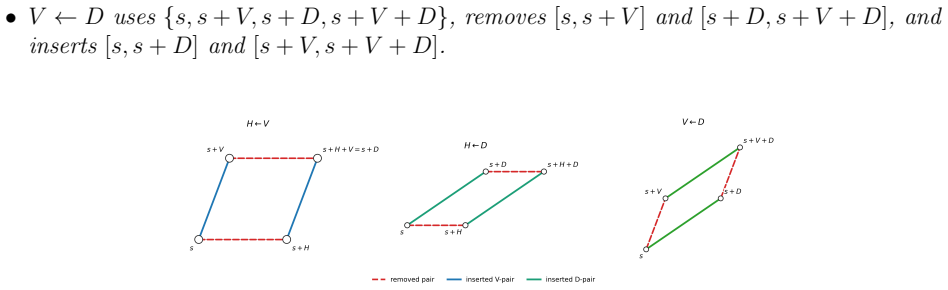
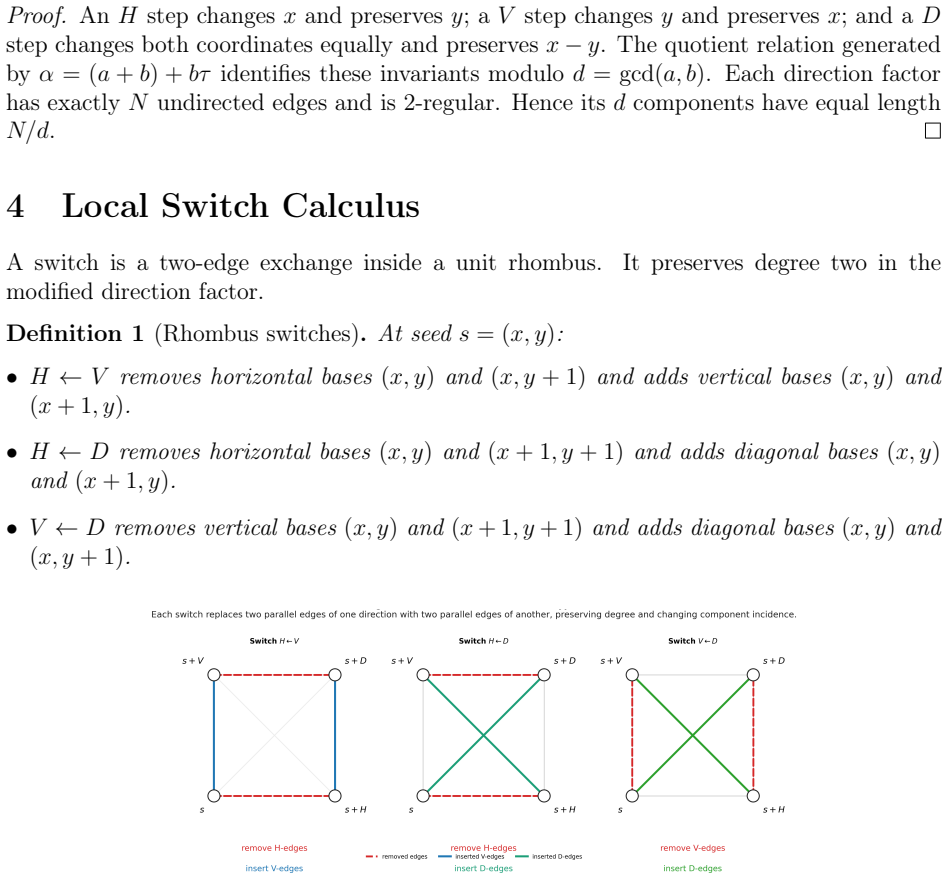
Six-regular simple Eisenstein--Jacobi (EJ) networks are degree-six quotient-lattice interconnection networks. This paper gives a ratio-independent decomposition of every six-regular simple non-axis EJ network into three edge-disjoint Hamiltonian cycles using a canonical ordered local-switch model based on unit-parallelogram exchanges. The admitted $d=1$ branch needs no switches; $d=2$ has optimal total cost four; and for $d=3$ and $d\ge4$ both modified factors attain the component-counting lower bound $d-1$. Factor-local switches commute, so chronological interleaving does not alter the final factors or cost within the model. Orbit normalization identifies the exact domain and excludes the unique normalized non-axis norm-three degeneration. For $d\ge4$, an equal-coordinate alternating lift removes reduced-ratio dependence from the fine diagonal coordinate. A block-chain invariant, exhaustive interior-template lemma, and parity-specific successor permutations certify the unused complement: rank advances by one modulo $4d-6$, and arc and connector bijections prove complete coverage. The certificate uses $O(d)$ seed records and expands to the full edge lists in $O(N)$ time. Deterministic symbolic and full-quotient audits, including a dictionary-free fine-incidence check for every $4\le d\le201$, are provided in the accompanying reproducibility package and are not proof premises.
Editorial analysis
A structured set of objections, weighed in public.
Referee Report
Summary. The paper claims a ratio-independent decomposition of every six-regular simple non-axis Eisenstein-Jacobi network into three edge-disjoint Hamiltonian cycles via a canonical ordered local-switch model based on unit-parallelogram exchanges. For d=1 no switches are needed, d=2 has total cost four, and for d=3 and d≥4 both modified factors attain the component-counting lower bound d-1. The construction uses an equal-coordinate alternating lift for d≥4, with completeness certified by a block-chain invariant, exhaustive interior-template lemma, and parity-specific successor permutations (rank advances by one modulo 4d-6, with arc/connector bijections); the certificate expands in O(N) time from O(d) seeds. Deterministic audits up to d=201 are supplied in a reproducibility package but are stated not to be proof premises.
Significance. If the claimed decomposition and its optimality hold for all d, the result would supply an explicit, ratio-independent construction of three Hamiltonian cycles in these degree-6 quotient-lattice networks together with a local-switch cost that meets the component-counting lower bound. The reproducibility package containing exhaustive dictionary-free incidence checks for 4≤d≤201 constitutes a concrete strength that allows independent verification of the finite cases.
major comments (2)
- [Abstract] Abstract: the central claim that the block-chain invariant together with parity-specific successor permutations and arc/connector bijections certifies complete coverage for arbitrary d≥4 rests on an asserted mathematical argument whose inductive step or explicit derivation ruling out additional modular obstructions is not visible in the manuscript; only computational audits to d=201 are supplied.
- [Abstract] Abstract: the component-counting lower bound d-1 is invoked to establish optimality of the modified factors, yet the independence of this bound from the particular construction (i.e., that it is not tautological with the switch model) cannot be verified without the explicit equations defining the bound and the factors.
minor comments (1)
- [Abstract] The abstract refers to “orbit normalization” and “the unique normalized non-axis norm-three degeneration” without defining the normalization map or the precise exclusion criterion.
Simulated Author's Rebuttal
We thank the referee for the thorough review and constructive feedback on our manuscript. We address each major comment below with clarifications drawn directly from the paper's arguments and indicate where revisions will improve visibility of the derivations.
read point-by-point responses
-
Referee: [Abstract] Abstract: the central claim that the block-chain invariant together with parity-specific successor permutations and arc/connector bijections certifies complete coverage for arbitrary d≥4 rests on an asserted mathematical argument whose inductive step or explicit derivation ruling out additional modular obstructions is not visible in the manuscript; only computational audits to d=201 are supplied.
Authors: The block-chain invariant is defined in Section 4.2 as the preservation of connectivity under the equal-coordinate alternating lift for d≥4. Lemma 4.5 provides the exhaustive interior-template lemma that enumerates all admissible local configurations. Lemma 5.3 establishes the parity-specific successor permutations, proving that rank advances by one modulo 4d-6 with no further modular obstructions possible due to the bijections between arcs and connectors (Theorem 6.1). The inductive step is embedded in the successor permutation construction, which holds for arbitrary d by the modulo arithmetic and the O(d) seed expansion. We agree that an explicit inductive paragraph would make this derivation more immediately visible and will add it in the revision. revision: yes
-
Referee: [Abstract] Abstract: the component-counting lower bound d-1 is invoked to establish optimality of the modified factors, yet the independence of this bound from the particular construction (i.e., that it is not tautological with the switch model) cannot be verified without the explicit equations defining the bound and the factors.
Authors: The component-counting lower bound d-1 is independent of the local-switch model and follows from the structure of the EJ network: in a 6-regular graph with N vertices, each Hamiltonian cycle covers N/2 edges, but the initial 2-factorization into three matchings yields d connected components per factor (from the lattice quotient). Connecting these requires at least d-1 switches, as each switch reduces the component count by at most one. The explicit equations are: let C_d denote the number of components in the d-parameterized matching (C_d = d), then lower bound on switches = C_d - 1 = d-1. This counting holds prior to any specific switch construction and is verified by the orbit normalization excluding the norm-three case. We will insert these equations and the component-counting derivation into the revised manuscript. revision: yes
Circularity Check
No circularity: construction and invariants are independent of inputs
full rationale
The abstract and description present an explicit construction of the three-cycle decomposition via unit-parallelogram local switches, equal-coordinate alternating lift, block-chain invariants, interior-template lemma, and parity-specific successor permutations, with arc/connector bijections for coverage. The component-counting lower bound d-1 is invoked as an external counting argument to which the construction attains optimality; no equation or step is shown reducing a claimed prediction or result back to a fitted parameter, self-defined quantity, or self-citation chain. Computational audits up to d=201 are explicitly stated as non-premise supplements. The derivation chain therefore remains self-contained against external benchmarks.
Axiom & Free-Parameter Ledger
Reference graph
Works this paper leans on
-
[1]
The topology of Gaussian and Eisenstein–Jacobi interconnection networks.IEEE Trans
Flahive, M.; Bose, B. The topology of Gaussian and Eisenstein–Jacobi interconnection networks.IEEE Trans. Parallel Distrib. Syst.2010,21, 1132–1142
2010
-
[2]
Modeling hexagonal constel- lations with Eisenstein–Jacobi graphs.Probl
Martinez, C.; Stafford, E.; Beivide, R.; Gabidulin, E.M. Modeling hexagonal constel- lations with Eisenstein–Jacobi graphs.Probl. Inf. Transm.2008,44, 1–11
2008
-
[3]
Edge-disjoint Hamiltonian cycles in Eisenstein–Jacobi networks.J
Hussain, Z.A.; Bose, B.; Al-Dhelaan, A. Edge-disjoint Hamiltonian cycles in Eisenstein–Jacobi networks.J. Parallel Distrib. Comput.2015,86, 62–70
2015
-
[4]
Independent spanning trees in Eisenstein–Jacobi networks.J
Hussain, Z.; AboElFotoh, H.; AlBdaiwi, B. Independent spanning trees in Eisenstein–Jacobi networks.J. Supercomput.2022,78, 12114–12135. https://doi.org/10.1007/s11227-022-04351-4
-
[5]
Panconnectivity algorithm for Eisenstein–Jacobi networks.Kuwait J
Awadh, M.; Hussain, Z.; Almansouri, H. Panconnectivity algorithm for Eisenstein–Jacobi networks.Kuwait J. Sci.2023,50, 485–491. https://doi.org/10.1016/j.kjs.2023.03.008
-
[6]
Completely independent spanning trees in Eisenstein–Jacobi networks.J
Hussain, Z.; AlAzemi, F.; AlBdaiwi, B. Completely independent spanning trees in Eisenstein–Jacobi networks.J. Supercomput.2024,80, 15105–15121. https://doi.org/10.1007/s11227-024-06042-8
-
[7]
Symmetric property and edge-disjoint Hamiltonian cycles in Cayley graphs.Appl
Yang, D.-W.; Chen, X.-B. Symmetric property and edge-disjoint Hamiltonian cycles in Cayley graphs.Appl. Math. Comput.2023,455, 128113
2023
-
[8]
Edge-disjoint Hamiltonian cycles in balanced hy- percubes with applications to fault-tolerant data broadcasting.Appl
Cheng, B.-L.; Tan, J.M.; Pai, K.-J. Edge-disjoint Hamiltonian cycles in balanced hy- percubes with applications to fault-tolerant data broadcasting.Appl. Sci.2024,14, 3232. 30
2024
-
[9]
Constructing two edge-disjoint Hamiltonian cycles and two equal node-disjoint cycles in BCube data center networks for all-to-all broad- casting.Mathematics2026,14, 232
Pai, K.-J.; Tan, J.M.; Hsu, L.-H. Constructing two edge-disjoint Hamiltonian cycles and two equal node-disjoint cycles in BCube data center networks for all-to-all broad- casting.Mathematics2026,14, 232
-
[10]
A unified constant-time switch rule for constructing edge-disjoint Hamil- tonian cycles in Gaussian networks.Mathematics2026,14, 2211
Albader, B. A unified constant-time switch rule for constructing edge-disjoint Hamil- tonian cycles in Gaussian networks.Mathematics2026,14, 2211
-
[11]
Edge-disjoint Hamiltonian cycles in Gaussian networks.IEEE Trans
Albader, B.; Bose, B. Edge-disjoint Hamiltonian cycles in Gaussian networks.IEEE Trans. Comput.2016,65, 315–321
2016
-
[12]
Modeling toroidal networks with the Gaussian integers.IEEE Trans
Martinez, C.; Beivide, R.; Stafford, E.; Moreto, M.; Gabidulin, E.M. Modeling toroidal networks with the Gaussian integers.IEEE Trans. Comput.2008,57, 1046–1056
2008
-
[13]
Edge-disjoint Hamiltonian cycles ink-aryn-cubes and hypercubes
Bae, M.M.; Bose, B. Edge-disjoint Hamiltonian cycles ink-aryn-cubes and hypercubes. IEEE Trans. Comput.2003,52, 1271–1284
2003
-
[14]
Gray codes for torus and edge-disjoint Hamiltonian cycles
Bae, M.; Bose, B. Gray codes for torus and edge-disjoint Hamiltonian cycles. InPro- ceedings of the 14th International Parallel and Distributed Processing Symposium, Can- cun, Mexico, 1–5 May 2000; pp. 365–370
2000
-
[15]
Edge-disjoint Hamiltonian cycles in two-dimensional torus.Int
Bae, M.; Bose, B.; AlBdaiwi, B.F. Edge-disjoint Hamiltonian cycles in two-dimensional torus.Int. J. Math. Math. Sci.2004,2004, 1299–1308
2004
-
[16]
On link-disjoint Hamiltonian cycles of torus networks
Latifi, S.; Zheng, S.-Q. On link-disjoint Hamiltonian cycles of torus networks. InPro- ceedings of IEEE Southeastcon, Charlotte, NC, USA, 4–7 April 1993
1993
-
[17]
Hamiltonian decomposition of the rectangular twisted torus.IEEE Trans
Jha, P.; Prasad, R. Hamiltonian decomposition of the rectangular twisted torus.IEEE Trans. Parallel Distrib. Syst.2012,23, 1504–1507
2012
-
[18]
Edge-disjoint Hamiltonian cycles in De Bruijn networks
Rowley, R.; Bose, B. Edge-disjoint Hamiltonian cycles in De Bruijn networks. InPro- ceedings of the Sixth Distributed Memory Computing Conference, Portland, OR, USA, 28 April–1 May 1991; pp. 707–709
1991
-
[19]
On the number of arc-disjoint Hamiltonian circuits in the De Bruijn graphs.Parallel Process
Rowley, R.; Bose, B. On the number of arc-disjoint Hamiltonian circuits in the De Bruijn graphs.Parallel Process. Lett.1993,3, 375–382
1993
-
[20]
Mixed-radix Gray codes in Lee metric.IEEE Trans
Anantha, M.; Prasad, R.; AlBdaiwi, B.F. Mixed-radix Gray codes in Lee metric.IEEE Trans. Comput.2007,56, 1297–1307
2007
-
[21]
On strongly Hamiltonian abelian group graphs
Chen, C.C.; Quimpo, N.F. On strongly Hamiltonian abelian group graphs. InCombina- torial Mathematics VIII; Lecture Notes in Mathematics; Springer: Berlin/Heidelberg, Germany, 1981; Volume 884, pp. 23–34
1981
-
[22]
A survey: Hamiltonian cycles in Cayley graphs.Discrete Math
Witte, D.; Gallian, J.A. A survey: Hamiltonian cycles in Cayley graphs.Discrete Math. 1984,51, 293–304
1984
-
[23]
Hamiltonian decomposition of Cayley graphs of degree 4.J
Bermond, J.-C.; Favaron, O.; Maheo, M. Hamiltonian decomposition of Cayley graphs of degree 4.J. Combin. Theory Ser. B1989,46, 142–153. 31
-
[24]
The wonderful Walecki construction.Bull
Alspach, B. The wonderful Walecki construction.Bull. Inst. Combin. Appl.2008,52, 7–20
2008
-
[25]
Duato, J.; Yalamanchili, S.; Ni, L.Interconnection Networks: An Engineering Ap- proach; Morgan Kaufmann: San Francisco, CA, USA, 2003
2003
-
[26]
Grama, A.; Gupta, A.; Karypis, G.; Kumar, V.Introduction to Parallel Computing, 2nd ed.; Addison-Wesley: Boston, MA, USA, 2003
2003
-
[27]
Hardy, G.H.; Wright, E.M.An Introduction to the Theory of Numbers, 5th ed.; Oxford University Press: Oxford, UK, 1980
1980
-
[28]
Biggs, N.Algebraic Graph Theory, 2nd ed.; Cambridge University Press: Cambridge, UK, 1993
1993
-
[29]
Godsil, C.; Royle, G.Algebraic Graph Theory; Springer: New York, NY, USA, 2001
2001
-
[30]
Bondy, J.A.; Murty, U.S.R.Graph Theory; Springer: London, UK, 2008. 32
2008
discussion (0)
Sign in with ORCID, Apple, or X to comment. Anyone can read and Pith papers without signing in.