The Lifecycle and Emission Properties of PAHs in Cosmological Hydrodynamic Galaxy Formation Simulations
Pith reviewed 2026-06-26 16:18 UTC · model grok-4.3
The pith
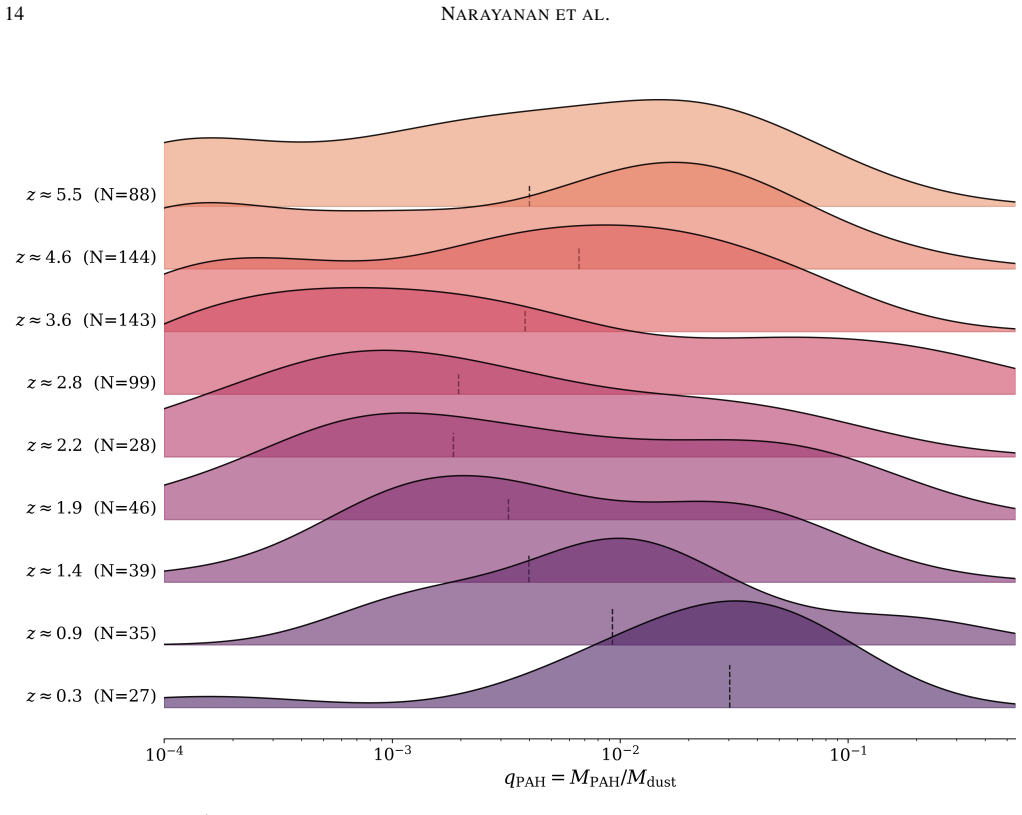
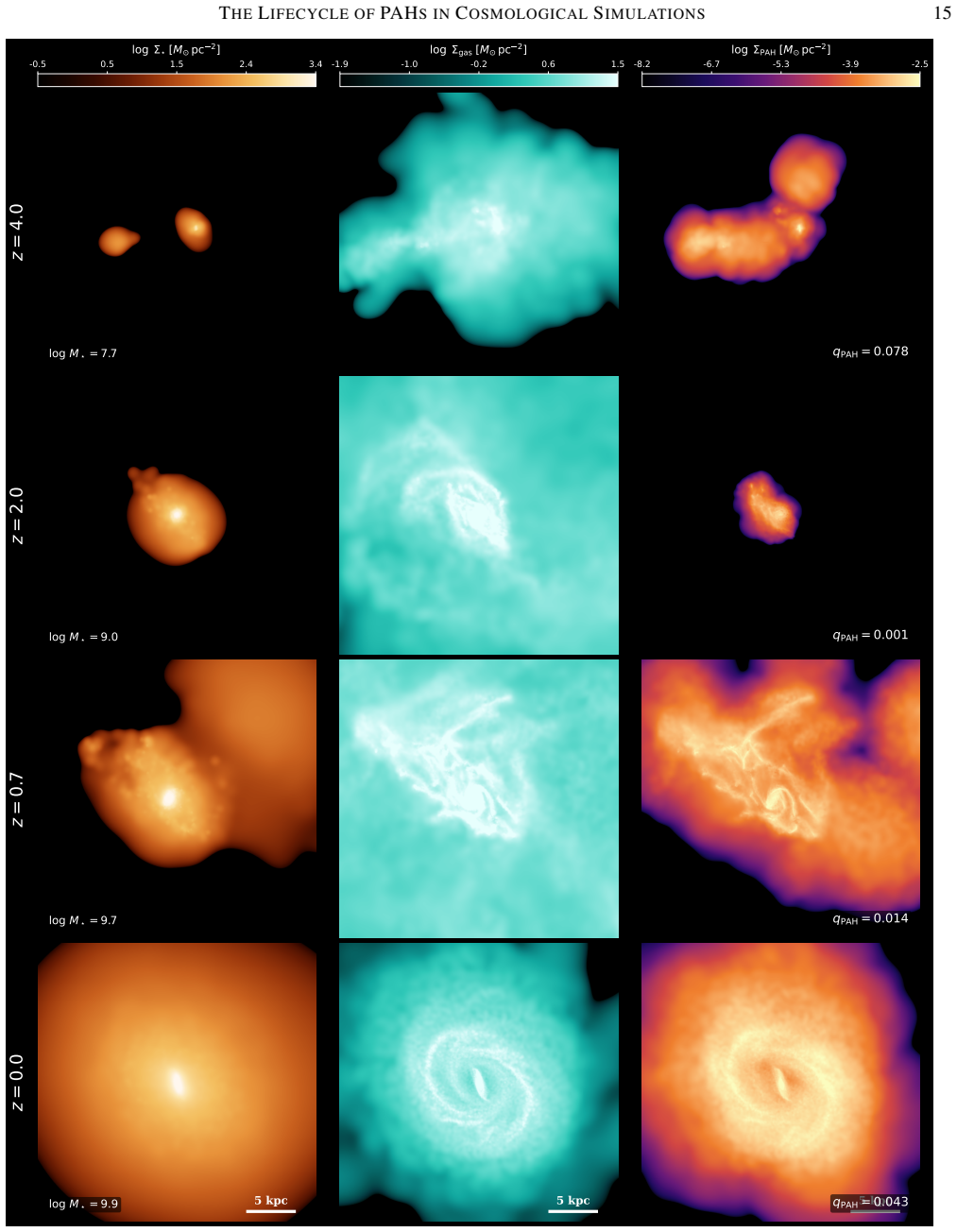
Grain-grain shattering in diffuse interstellar gas drives the rise of PAH abundances from z=6 to today.
A machine-rendered reading of the paper's core claim, the machinery that carries it, and where it could break.
Core claim
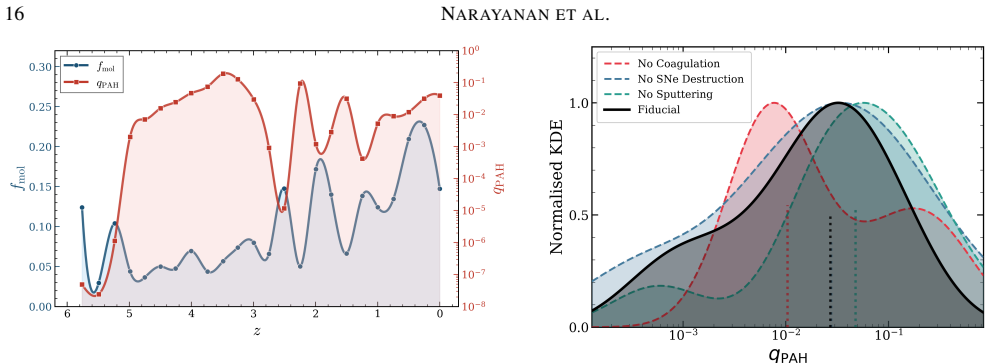
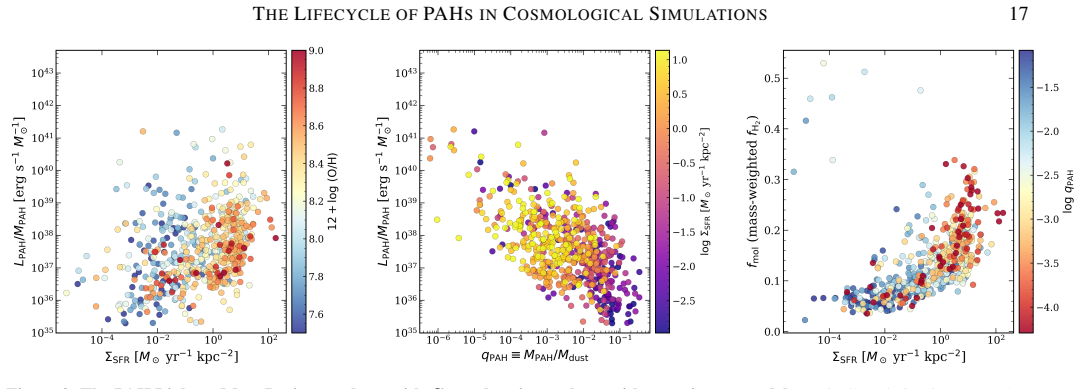
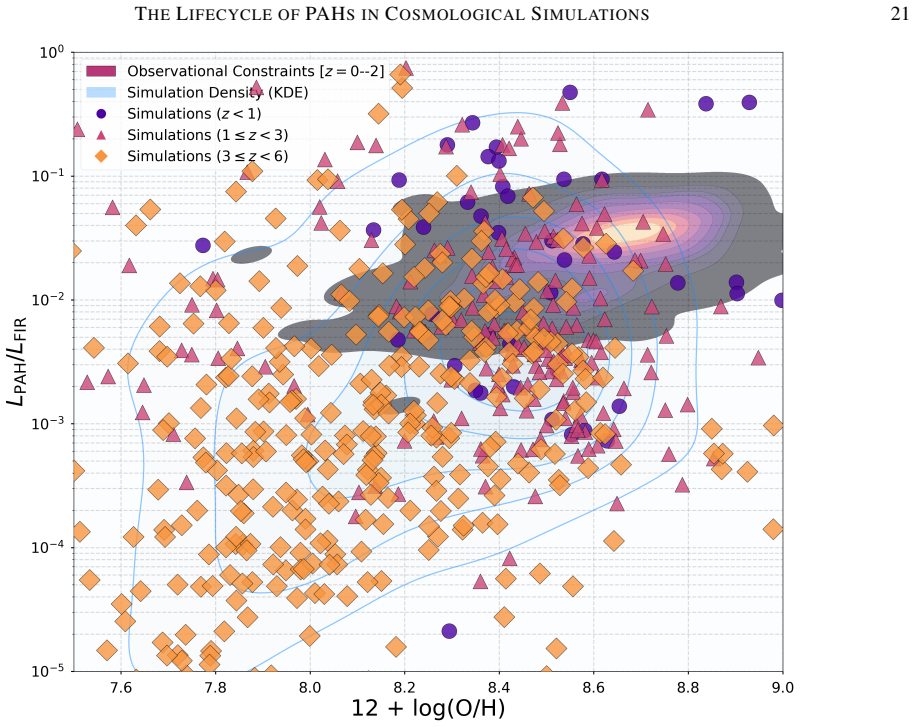
If dust is injected as large grains, grain-grain shattering in the diffuse ISM naturally generates ultrasmall PAHs, raising their mass fraction qPAH from roughly 5 times 10 to the minus 4 at z approximately 4 to 10 to the minus 2 at z=0 as the diffuse-gas mass fraction grows. The same process produces an inverse qPAH-molecular gas fraction relation, a light-to-mass ratio that scales with radiation-field intensity yet anti-correlates with qPAH, and the PAH-metallicity relation that matches observations from z=0 to z=2. The LPAH-SFR and LPAH-M_mol relations follow from larger PAH reservoirs in massive galaxies combined with more efficient excitation per unit mass in high-SFR systems.
What carries the argument
on-the-fly dust grain evolution model in 40 zoom-in cosmological hydrodynamic simulations, in which grain-grain collisions in low-density diffuse gas convert large carbonaceous grains into PAHs smaller than 13 Angstrom
If this is right
- qPAH increases steadily from z approximately 4 to z=0 as the diffuse ISM fraction grows.
- qPAH and molecular gas fraction are inversely related at fixed redshift.
- PAH light-to-mass ratio scales linearly with radiation field intensity but falls with rising qPAH because dense gas suppresses shattering.
- The PAH-metallicity relation appears automatically once enrichment and diffuse-gas growth occur together.
- LPAH-SFR and LPAH-M_mol relations arise because more massive galaxies hold larger PAH reservoirs while higher-SFR galaxies excite PAHs more efficiently per unit mass.
Where Pith is reading between the lines
- PAH emission may trace star formation less directly at high redshift if diffuse-gas fractions are lower.
- Changing the density distribution of the ISM in simulations would alter the predicted redshift evolution of qPAH.
- If future models include direct stellar injection of small grains, the required shattering efficiency to match observations would decrease.
Load-bearing premise
Dust enters the ISM already as large grains so that PAHs can be created later by shattering collisions rather than being injected or formed by other channels.
What would settle it
Observations showing that PAH mass fraction does not rise with the fractional mass of diffuse gas, or that the PAH-metallicity relation requires direct injection of small grains from stars.
Figures




read the original abstract
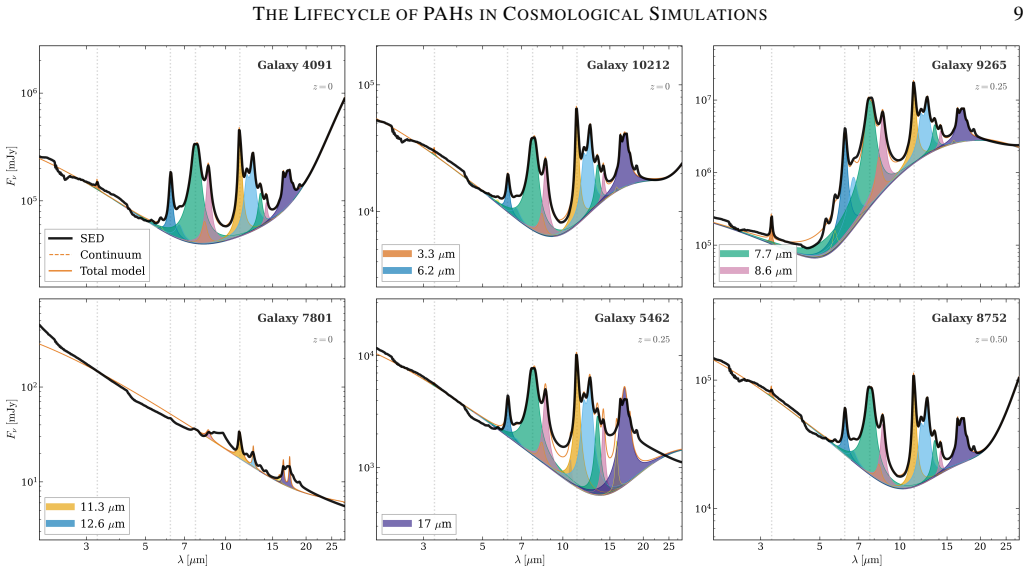
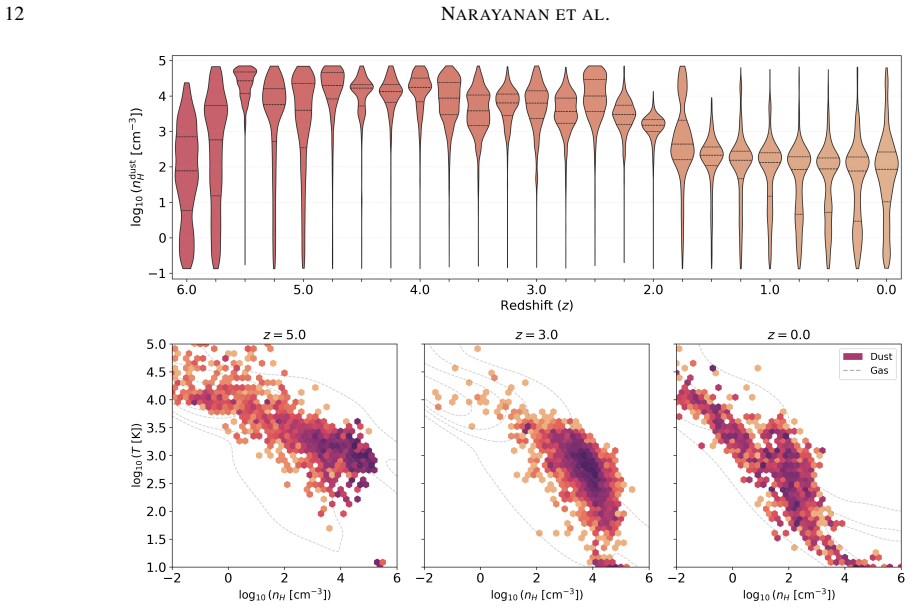
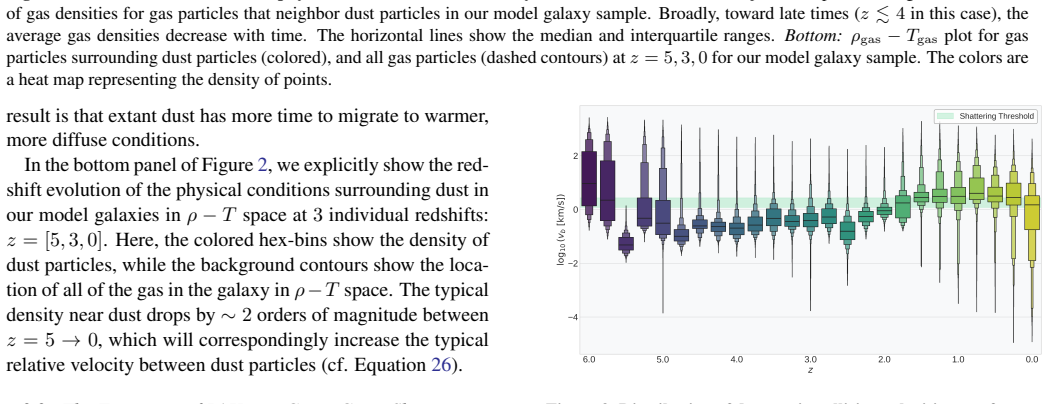
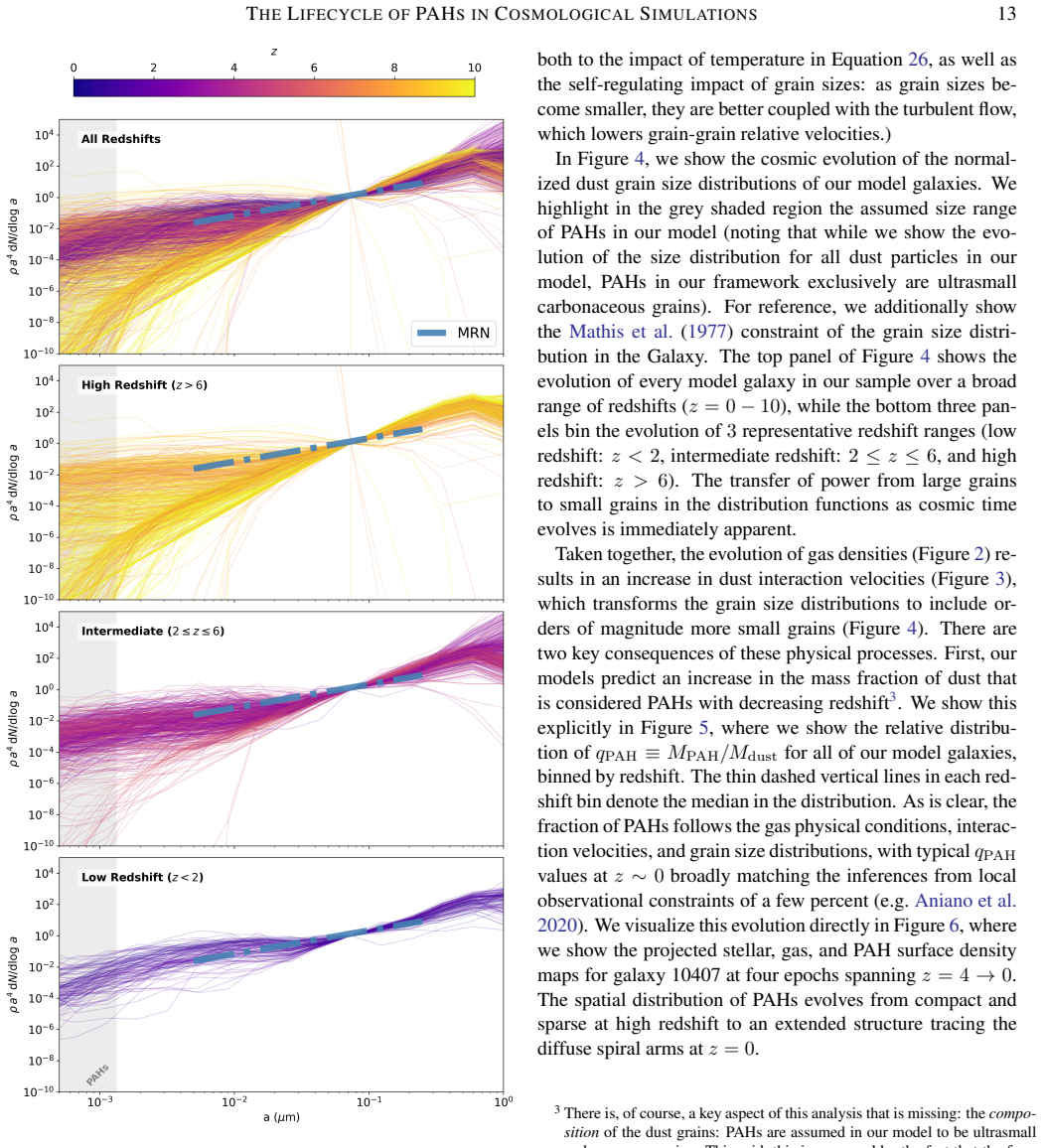
We present the first cosmological model for the lifecycle and luminous properties of PAHs in galaxies as they evolve from z=6-->0. We model 40 zoom-in galaxies, coupled with an on-the-fly model for the evolution of dust grains in the ISM. We assume that PAHs are ultrasmall (a < 13 Angstrom) carbonaceous dust grains, and couple this model with single-photon excitation calculations to compute the emergent mid-infrared spectra. (1) If we assume that dust is large upon formation, then PAHs are naturally able to form in situ in the ISM via grain-grain shattering. Interstellar collision velocities increase in low density, diffuse gas in our model; as galaxies evolve, the increase in fractional mass of diffuse gas drives an increase in grain-grain collision velocities and a corresponding rise in the PAH mass fraction (qPAH) from ~5 x 10^{-4} at z~4 to ~10^{-2} at z~0. (2) Increased PAH production in the diffuse ISM results in an inverse relationship between qPAH and the molecular gas fraction. (3) The PAH light-to-mass ratio scales linearly with the radiation field intensity (LPAH/MPAH ~ G_0) but anti-correlates with qPAH, because high-Sigma_SFR galaxies have a denser ISM that suppresses shattering. This means the physical qPAH and observed LPAH/LFIR do not evolve in lockstep. (4) The PAH-metallicity relationship (PZR) arises naturally in this framework: galaxies enrich and grow their diffuse ISM fraction simultaneously, linking rising metallicity to rising qPAH. Our models represent the first to reproduce the PZR observed across z=0-2. (5) The LPAH-SFR and LPAH-M_mol relations emerge from two effects: more massive galaxies have larger PAH reservoirs, and higher-SFR galaxies excite their PAHs more efficiently per unit mass. Taken together, these results suggest that grain-grain shattering in the diffuse ISM is the main driver behind the evolution of cosmic PAH abundances.
Editorial analysis
A structured set of objections, weighed in public.
Referee Report
Summary. The manuscript presents the first cosmological hydrodynamic model of PAH lifecycle and emission in 40 zoom-in galaxies from z=6 to z=0. It assumes dust forms large (a ≫ 13 Å) and couples an on-the-fly grain evolution model (with shattering in diffuse ISM) to single-photon excitation calculations for mid-IR spectra. The central claims are that this produces a rising qPAH from ~5e-4 at z~4 to ~1e-2 at z=0, an inverse qPAH–f_mol relation, the observed PZR across z=0–2, and LPAH–SFR/M_mol scalings, with grain-grain shattering in the diffuse ISM identified as the main driver of cosmic PAH evolution.
Significance. If the shattering channel is shown to be robust, the work would provide a physically motivated, parameter-light framework linking galaxy ISM evolution to PAH abundances and luminosities, representing a notable advance over ad-hoc injection prescriptions. The on-the-fly dust model and radiative coupling are technical strengths. However, the significance is reduced by the lack of differential tests against direct-injection alternatives, leaving open whether the reported relations are emergent predictions or consequences of the initial-size assumption.
major comments (2)
- [Abstract] Abstract (points 1 and 5): The attribution of PAH evolution and the PZR to grain-grain shattering as the 'main driver' rests on the assumption that dust forms exclusively large, with no direct stellar injection of ultrasmall grains. No control simulation injecting a realistic fraction of carbon dust as a < 13 Å grains from AGB stars or SNe is shown; without this, the trends could arise from standard growth plus direct injection, rendering the uniqueness claim untested.
- [Abstract] Abstract: The statement that the model 'reproduces the PZR observed across z=0-2' and other relations provides no quantitative metrics (e.g., slope, scatter, reduced chi-squared, or direct overlay with observational data points), nor error analysis on the qPAH(z) evolution, making it impossible to assess the fidelity of the match.
minor comments (1)
- [Abstract] The abstract introduces qPAH, LPAH, and G_0 without explicit definitions or units on first use; these should be defined at the outset for clarity.
Simulated Author's Rebuttal
We thank the referee for their constructive comments, which help clarify the scope and presentation of our results. We address each major comment below, indicating planned revisions where appropriate.
read point-by-point responses
-
Referee: [Abstract] Abstract (points 1 and 5): The attribution of PAH evolution and the PZR to grain-grain shattering as the 'main driver' rests on the assumption that dust forms exclusively large, with no direct stellar injection of ultrasmall grains. No control simulation injecting a realistic fraction of carbon dust as a < 13 Å grains from AGB stars or SNe is shown; without this, the trends could arise from standard growth plus direct injection, rendering the uniqueness claim untested.
Authors: We acknowledge that the model explicitly assumes dust forms exclusively as large grains (a ≫ 13 Å), as stated in the abstract and methods, and that this assumption is central to identifying shattering in the diffuse ISM as the driver of rising qPAH. This choice follows from standard dust formation models in which stellar sources (AGB stars and SNe) primarily inject larger grains, with ultrasmall grains arising via ISM processing. We agree that, without a control run including direct injection of a realistic fraction of small grains, the claim that shattering is the unique main driver remains untested against alternatives that combine growth with direct injection. In revision we will (i) explicitly qualify the 'main driver' language in the abstract and conclusions to refer to results under the large-grain formation assumption, (ii) add a short discussion paragraph noting that direct small-grain injection would introduce additional free parameters not required in the current framework, and (iii) flag a direct-injection control simulation as a natural extension for future work. revision: partial
-
Referee: [Abstract] Abstract: The statement that the model 'reproduces the PZR observed across z=0-2' and other relations provides no quantitative metrics (e.g., slope, scatter, reduced chi-squared, or direct overlay with observational data points), nor error analysis on the qPAH(z) evolution, making it impossible to assess the fidelity of the match.
Authors: We agree that the abstract and main text currently lack quantitative metrics (slopes, scatters, reduced χ²) and direct data overlays for the PZR and related relations, as well as uncertainty estimates on the qPAH(z) trend. In the revised manuscript we will add these elements: fitted slopes and 1σ scatters for the PZR at z = 0 and z ≈ 2, a direct overlay of model points with observational compilations in the relevant figure, and error bars derived from the 40-galaxy sample on the qPAH evolution. Corresponding quantitative statements will be inserted into the abstract and results section. revision: yes
Circularity Check
Shattering as main driver of PAH evolution follows by construction from assumption of large initial dust
specific steps
-
self definitional
[Abstract]
"If we assume that dust is large upon formation, then PAHs are naturally able to form in situ in the ISM via grain-grain shattering. ... as galaxies evolve, the increase in fractional mass of diffuse gas drives an increase in grain-grain collision velocities and a corresponding rise in the PAH mass fraction (qPAH) from ~5 x 10^{-4} at z~4 to ~10^{-2} at z~0. ... Taken together, these results suggest that grain-grain shattering in the diffuse ISM is the main driver behind the evolution of cosmic PAH abundances."
The model is defined to exclude direct PAH injection by assuming a ≫ 13 Å dust at formation, then the simulation produces rising qPAH via shattering and the paper concludes shattering is the main driver. The attribution is the direct logical consequence of the input assumption rather than demonstrated by comparison to alternative formation channels.
full rationale
The paper's central claim that grain-grain shattering is the main driver of cosmic PAH evolution reduces directly to its modeling choice of large dust upon formation (no direct small-grain injection). The abstract states the assumption, derives the qPAH rise and PZR from it, and concludes the driver attribution without a control simulation using direct injection. This matches the self-definitional pattern where the reported outcome is the expected consequence of the input assumption rather than an independent test.
Axiom & Free-Parameter Ledger
axioms (2)
- domain assumption PAHs are ultrasmall (a < 13 Angstrom) carbonaceous dust grains
- ad hoc to paper dust is large upon formation
Reference graph
Works this paper leans on
-
[1]
Allamandola L. J., Tielens A. G. G. M., Barker J. R., 1985, @doi [ ] 10.1086/184435 , https://ui.adsabs.harvard.edu/abs/1985ApJ...290L..25A 290, L25
-
[2]
Andrews B. H., Martini P., 2013, @doi [ ] 10.1088/0004-637X/765/2/140 , https://ui.adsabs.harvard.edu/abs/2013ApJ...765..140A 765, 140
-
[3]
Aniano G., et al., 2020, @doi [ ] 10.3847/1538-4357/ab5fdb , https://ui.adsabs.harvard.edu/abs/2020ApJ...889..150A 889, 150
-
[4]
Aoyama S., Hou K.-C., Shimizu I., Hirashita H., Todoroki K., Choi J.-H., Nagamine K., 2017, @doi [ ] 10.1093/mnras/stw3061 , https://ui.adsabs.harvard.edu/abs/2017MNRAS.466..105A 466, 105
-
[5]
Aoyama S., Hou K.-C., Hirashita H., Nagamine K., Shimizu I., 2018, @doi [ ] 10.1093/mnras/sty1431 , https://ui.adsabs.harvard.edu/abs/2018MNRAS.478.4905A 478, 4905
-
[6]
Aoyama S., Hirashita H., Nagamine K., 2020, @doi [ ] 10.1093/mnras/stz3253 , https://ui.adsabs.harvard.edu/abs/2020MNRAS.491.3844A 491, 3844
-
[7]
Aravena M., et al., 2019, @doi [ ] 10.3847/1538-4357/ab30df , https://ui.adsabs.harvard.edu/abs/2019ApJ...882..136A 882, 136
-
[8]
Asano R. S., Takeuchi T. T., Hirashita H., Nozawa T., 2013, @doi [ ] 10.1093/mnras/stt506 , https://ui.adsabs.harvard.edu/abs/2013MNRAS.432..637A 432, 637
-
[9]
Bakes E. L. O., Tielens A. G. G. M., 1994, @doi [ ] 10.1086/174188 , https://ui.adsabs.harvard.edu/abs/1994ApJ...427..822B 427, 822
-
[10]
The Average Star Formation Histories of Galaxies in Dark Matter Halos from z=0-8
Behroozi P. S., Wechsler R. H., Conroy C., 2013, @doi [ ] 10.1088/0004-637X/770/1/57 , https://ui.adsabs.harvard.edu/abs/2013ApJ...770...57B 770, 57
work page internal anchor Pith review doi:10.1088/0004-637x/770/1/57 2013
-
[11]
Bekki K., 2013, @doi [ ] 10.1093/mnras/stt589 , https://ui.adsabs.harvard.edu/abs/2013MNRAS.432.2298B 432, 2298
-
[12]
Bendo G. J., et al., 2008, @doi [ ] 10.1111/j.1365-2966.2008.13567.x , https://ui.adsabs.harvard.edu/abs/2008MNRAS.389..629B 389, 629
-
[13]
Bianchi S., Schneider R., 2007, @doi [ ] 10.1111/j.1365-2966.2007.11829.x , https://ui.adsabs.harvard.edu/abs/2007MNRAS.378..973B 378, 973
-
[14]
Catinella B., et al., 2018, @doi [ ] 10.1093/mnras/sty089 , https://ui.adsabs.harvard.edu/abs/2018MNRAS.476..875C 476, 875
-
[15]
Chabrier G., 2003, @doi [ ] 10.1086/376392 , http://adsabs.harvard.edu/abs/2003PASP..115..763C 115, 763
work page internal anchor Pith review doi:10.1086/376392 2003
-
[16]
Chastenet J., et al., 2019, @doi [ ] 10.3847/1538-4357/ab16cf , https://ui.adsabs.harvard.edu/abs/2019ApJ...876...62C 876, 62
-
[17]
Chastenet J., et al., 2023, @doi [ ] 10.3847/2041-8213/acadd7 , https://ui.adsabs.harvard.edu/abs/2023ApJ...944L..11C 944, L11
-
[18]
Chastenet J., et al., 2025, @doi [ ] 10.3847/1538-4365/ad8a5c , https://ui.adsabs.harvard.edu/abs/2025ApJS..276....2C 276, 2
-
[19]
Cherchneff I., Barker J. R., Tielens A. G. G. M., 1992, @doi [ ] 10.1086/172059 , https://ui.adsabs.harvard.edu/abs/1992ApJ...401..269C 401, 269
-
[20]
R., Salim S., Kere s D., Hayward C
Choban C. R., Salim S., Kere s D., Hayward C. C., Sandstrom K. M., 2025, @doi [ ] 10.1093/mnras/staf118 , https://ui.adsabs.harvard.edu/abs/2025MNRAS.537.1518C 537, 1518
-
[21]
Ashes of FIRE: Modeling Dust Grain Size Evolution in the Local Group with FIRE
Choban C. R., Salim S., Kere s D., Roman-Duval J., Sandstrom K. M., 2026, @doi [arXiv/2603.08504] 10.48550/arXiv.2603.08504 , https://ui.adsabs.harvard.edu/abs/2026arXiv260308504C p. arXiv:2603.08504
work page internal anchor Pith review Pith/arXiv arXiv doi:10.48550/arxiv.2603.08504 2026
-
[22]
Choi J., Dotter A., Conroy C., Cantiello M., Paxton B., Johnson B. D., 2016, @doi [ ] 10.3847/0004-637X/823/2/102 , https://ui.adsabs.harvard.edu/abs/2016ApJ...823..102C 823, 102
work page internal anchor Pith review doi:10.3847/0004-637x/823/2/102 2016
-
[23]
Chown R., Li C., Parker L., Wilson C. D., Li N., Gao Y., 2021, @doi [ ] 10.1093/mnras/staa3288 , https://ui.adsabs.harvard.edu/abs/2021MNRAS.500.1261C 500, 1261
-
[24]
Conroy C., Gunn J. E., 2010, @doi [ ] 10.1088/0004-637X/712/2/833 , http://adsabs.harvard.edu/abs/2010ApJ...712..833C 712, 833
work page internal anchor Pith review doi:10.1088/0004-637x/712/2/833 2010
-
[25]
Conroy C., Wechsler R. H., 2009, @doi [ ] 10.1088/0004-637X/696/1/620 , http://adsabs.harvard.edu/abs/2009ApJ...696..620C 696, 620
-
[26]
Conroy C., White M., Gunn J. E., 2010, @doi [ ] 10.1088/0004-637X/708/1/58 , http://adsabs.harvard.edu/abs/2010ApJ...708...58C 708, 58
-
[27]
Cortzen I., et al., 2019, @doi [ ] 10.1093/mnras/sty2777 , https://ui.adsabs.harvard.edu/abs/2019MNRAS.482.1618C 482, 1618
-
[28]
Curti M., Mannucci F., Cresci G., Maiolino R., 2020, @doi [ ] 10.1093/mnras/stz2910 , https://ui.adsabs.harvard.edu/abs/2020MNRAS.491..944C 491, 944
-
[29]
Dale D. A., et al., 2009, @doi [ ] 10.1088/0004-637X/703/1/517 , https://ui.adsabs.harvard.edu/abs/2009ApJ...703..517D 703, 517
-
[30]
Dav \'e R., Crain R. A., Stevens A. R. H., Narayanan D., Saintonge A., Catinella B., Cortese L., 2020, @doi [ ] 10.1093/mnras/staa1894 , https://ui.adsabs.harvard.edu/abs/2020MNRAS.497..146D 497, 146
-
[31]
L., 1990, , https://ui.adsabs.harvard.edu/abs/1990A&A...237..215D 237, 215
Desert F.-X., Boulanger F., Puget J. L., 1990, , https://ui.adsabs.harvard.edu/abs/1990A&A...237..215D 237, 215
1990
-
[32]
T., 2011, Physics of the Interstellar and Intergalactic Medium
Draine B. T., 2011, Physics of the Interstellar and Intergalactic Medium . Princeton University Press: Princeton, NJ
2011
-
[33]
Draine B. T., Lee H. M., 1984, @doi [ ] 10.1086/162480 , https://ui.adsabs.harvard.edu/abs/1984ApJ...285...89D 285, 89
-
[34]
Draine B. T., Li A., 2001, @doi [ ] 10.1086/320227 , https://ui.adsabs.harvard.edu/abs/2001ApJ...551..807D 551, 807
-
[35]
Draine B. T., Li A., 2007, @doi [ ] 10.1086/511055 , http://adsabs.harvard.edu/abs/2007ApJ...657..810D 657, 810
work page internal anchor Pith review doi:10.1086/511055 2007
-
[36]
Draine B. T., Salpeter E. E., 1979, @doi [ ] 10.1086/157165 , https://ui.adsabs.harvard.edu/abs/1979ApJ...231...77D 231, 77
-
[37]
Draine B. T., Li A., Hensley B. S., Hunt L. K., Sandstrom K., Smith J. D. T., 2021, @doi [ ] 10.3847/1538-4357/abff51 , https://ui.adsabs.harvard.edu/abs/2021ApJ...917....3D 917, 3
-
[38]
Dubois Y., et al., 2024, @doi [arXiv/2402.18515] 10.48550/arXiv.2402.18515 , https://ui.adsabs.harvard.edu/abs/2024arXiv240218515D p. arXiv:2402.18515
-
[39]
Dwek E., 1998, @doi [ ] 10.1086/305829 , http://adsabs.harvard.edu/abs/1998ApJ...501..643D 501, 643
-
[40]
Egorov O. V., et al., 2023, @doi [ ] 10.3847/2041-8213/acac92 , https://ui.adsabs.harvard.edu/abs/2023ApJ...944L..16E 944, L16
-
[41]
Engelbracht C. W., Gordon K. D., Rieke G. H., Werner M. W., Dale D. A., Latter W. B., 2005, @doi [ ] 10.1086/432613 , https://ui.adsabs.harvard.edu/abs/2005ApJ...628L..29E 628, L29
-
[42]
Engelbracht C. W., Rieke G. H., Gordon K. D., Smith J. D. T., Werner M. W., Moustakas J., Willmer C. N. A., Vanzi L., 2008, @doi [ ] 10.1086/529513 , https://ui.adsabs.harvard.edu/abs/2008ApJ...678..804E 678, 804
-
[43]
Silicate cosmic dust grain collisions in the interstellar medium: A molecular dynamics study
Esmerian C. J., et al., 2026, @doi [arXiv/2605.22225] 10.48550/arXiv.2605.22225 , https://ui.adsabs.harvard.edu/abs/2026arXiv260522225E p. arXiv:2605.22225
work page internal anchor Pith review Pith/arXiv arXiv doi:10.48550/arxiv.2605.22225 2026
-
[44]
Evans A. S., et al., 2022, @doi [ ] 10.3847/2041-8213/ac9971 , https://ui.adsabs.harvard.edu/abs/2022ApJ...940L...8E 940, L8
-
[45]
J., et al., 2013, RMXAA, http://adsabs.harvard.edu/abs/2013RMxAA..49..137F 49, 137
Ferland G. J., et al., 2013, RMXAA, http://adsabs.harvard.edu/abs/2013RMxAA..49..137F 49, 137
2013
-
[46]
Ferrarotti A. S., Gail H. P., 2006, @doi [ ] 10.1051/0004-6361:20041198 , https://ui.adsabs.harvard.edu/abs/2006A&A...447..553F 447, 553
-
[47]
Foley N., Cazaux S., Egorov D., Boschman L. M. P. V., Hoekstra R., Schlath \"o lter T., 2018, @doi [ ] 10.1093/mnras/sty1528 , https://ui.adsabs.harvard.edu/abs/2018MNRAS.479..649F 479, 649
-
[48]
D., 1989, @doi [ ] 10.1086/167501 , https://ui.adsabs.harvard.edu/abs/1989ApJ...341..372F 341, 372
Frenklach M., Feigelson E. D., 1989, @doi [ ] 10.1086/167501 , https://ui.adsabs.harvard.edu/abs/1989ApJ...341..372F 341, 372
-
[49]
Galliano F., Dwek E., Chanial P., 2008, @doi [ ] 10.1086/523621 , https://ui.adsabs.harvard.edu/abs/2008ApJ...672..214G 672, 214
-
[50]
Garcia A. M., et al., 2024, @doi [ ] 10.1093/mnras/stae1252 , https://ui.adsabs.harvard.edu/abs/2024MNRAS.531.1398G 531, 1398
-
[51]
Genzel R., et al., 1998, @doi [ ] 10.1086/305576 , https://ui.adsabs.harvard.edu/abs/1998ApJ...498..579G 498, 579
-
[52]
Gillett F. C., Forrest W. J., Merrill K. M., 1973, @doi [ ] 10.1086/152211 , https://ui.adsabs.harvard.edu/abs/1973ApJ...183...87G 183, 87
-
[53]
Gjergo E., Granato G. L., Murante G., Ragone-Figueroa C., Tornatore L., Borgani S., 2018, @doi [ ] 10.1093/mnras/sty1564 , https://ui.adsabs.harvard.edu/abs/2018MNRAS.479.2588G 479, 2588
-
[54]
Gordon K. D., Engelbracht C. W., Rieke G. H., Misselt K. A., Smith J. D. T., Kennicutt Robert C. J., 2008, @doi [ ] 10.1086/589567 , https://ui.adsabs.harvard.edu/abs/2008ApJ...682..336G 682, 336
-
[55]
Monthly Notices of the Royal Astronomical Society , author =
Granato G. L., et al., 2021, @doi [ ] 10.1093/mnras/stab362 , https://ui.adsabs.harvard.edu/abs/2021MNRAS.503..511G 503, 511
-
[56]
Guo F., Oh S. P., 2008, @doi [ ] 10.1111/j.1365-2966.2007.12692.x , https://ui.adsabs.harvard.edu/abs/2008MNRAS.384..251G 384, 251
-
[57]
J., 1968, , https://ui.adsabs.harvard.edu/abs/1968BAN....19..421H 19, 421
Habing H. J., 1968, , https://ui.adsabs.harvard.edu/abs/1968BAN....19..421H 19, 421
1968
-
[58]
Hahn O., Abel T., 2011, @doi [ ] 10.1111/j.1365-2966.2011.18820.x , http://adsabs.harvard.edu/abs/2011MNRAS.415.2101H 415, 2101
-
[59]
Helou G., Lu N. Y., Werner M. W., Malhotra S., Silbermann N., 2000, @doi [ ] 10.1086/312549 , https://ui.adsabs.harvard.edu/abs/2000ApJ...532L..21H 532, L21
-
[60]
Helou G., et al., 2004, @doi [ ] 10.1086/422640 , https://ui.adsabs.harvard.edu/abs/2004ApJS..154..253H 154, 253
-
[61]
Hensley B. S., Draine B. T., 2022, arXiv/2208.12365, https://ui.adsabs.harvard.edu/abs/2022arXiv220812365H p. arXiv:2208.12365
arXiv 2022
-
[62]
Hensley B. S., Draine B. T., 2023, @doi [ ] 10.3847/1538-4357/acc4c2 , https://ui.adsabs.harvard.edu/abs/2023ApJ...948...55H 948, 55
-
[63]
Hensley B. S., Murray C. E., Dodici M., 2022, @doi [ ] 10.3847/1538-4357/ac5cbd , https://ui.adsabs.harvard.edu/abs/2022ApJ...929...23H 929, 23
-
[64]
Hirashita H., 2000, @doi [ ] 10.1093/pasj/52.4.585 , https://ui.adsabs.harvard.edu/abs/2000PASJ...52..585H 52, 585
-
[65]
Hirashita H., 2015, @doi [ ] 10.1093/mnras/stu2617 , https://ui.adsabs.harvard.edu/abs/2015MNRAS.447.2937H 447, 2937
-
[66]
Hirashita H., 2022, @doi [ ] 10.1093/mnras/stac3394 , https://ui.adsabs.harvard.edu/abs/2022MNRAS.tmp.3171H
-
[67]
Hirashita H., Murga M. S., 2020, @doi [ ] 10.1093/mnras/stz3640 , https://ui.adsabs.harvard.edu/abs/2020MNRAS.492.3779H 492, 3779
-
[68]
Hirashita H., Yan H., 2009, @doi [ ] 10.1111/j.1365-2966.2009.14405.x , https://ui.adsabs.harvard.edu/abs/2009MNRAS.394.1061H 394, 1061
-
[69]
Hirashita H., Deng W., Murga M. S., 2020, @doi [ ] 10.1093/mnras/staa3101 , https://ui.adsabs.harvard.edu/abs/2020MNRAS.499.3046H 499, 3046
-
[70]
Hopkins P. F., Richards G. T., Hernquist L., 2007, @doi [ ] 10.1086/509629 , http://adsabs.harvard.edu/abs/2007ApJ...654..731H 654, 731
-
[71]
FIRE-2 Simulations: Physics versus Numerics in Galaxy Formation
Hopkins P. F., et al., 2018, @doi [ ] 10.1093/mnras/sty1690 , https://ui.adsabs.harvard.edu/abs/2018MNRAS.480..800H 480, 800
work page internal anchor Pith review doi:10.1093/mnras/sty1690 2018
-
[72]
Hou K.-C., Aoyama S., Hirashita H., Nagamine K., Shimizu I., 2019, @doi [ ] 10.1093/mnras/stz121 , https://ui.adsabs.harvard.edu/abs/2019MNRAS.485.1727H 485, 1727
-
[73]
Hunt L. K., Thuan T. X., Izotov Y. I., Sauvage M., 2010, @doi [ ] 10.1088/0004-637X/712/1/164 , https://ui.adsabs.harvard.edu/abs/2010ApJ...712..164H 712, 164
-
[74]
Hunt L. K., Izotov Y. I., Sauvage M., Thuan T. X., 2011, in Joblin C., Tielens A. G. G. M., eds, EAS Publications Series Vol. 46, EAS Publications Series. pp 143--148, @doi 10.1051/eas/1146015
-
[75]
Jackson D. C., Cannon J. M., Skillman E. D., Lee H., Gehrz R. D., Woodward C. E., Polomski E., 2006, @doi [ ] 10.1086/504707 , https://ui.adsabs.harvard.edu/abs/2006ApJ...646..192J 646, 192
-
[76]
Jones A. P., Tielens A. G. G. M., Hollenbach D. J., 1996, @doi [ ] 10.1086/177823 , https://ui.adsabs.harvard.edu/abs/1996ApJ...469..740J 469, 740
-
[77]
Kennicutt Jr. R. C., 1998, @doi [ ] 10.1146/annurev.astro.36.1.189 , http://adsabs.harvard.edu/abs/1998ARA
work page internal anchor Pith review doi:10.1146/annurev.astro.36.1.189 1998
-
[78]
Krumholz M. R., Tan J. C., 2007, @doi [ ] 10.1086/509101 , https://ui.adsabs.harvard.edu/abs/2007ApJ...654..304K 654, 304
-
[79]
Krumholz M. R., McKee C. F., Tumlinson J., 2008, @doi [ ] 10.1086/592490 , http://adsabs.harvard.edu/abs/2008ApJ...689..865K 689, 865
-
[80]
Krumholz M. R., McKee C. F., Tumlinson J., 2009, @doi [ ] 10.1088/0004-637X/693/1/216 , http://adsabs.harvard.edu/abs/2009ApJ...693..216K 693, 216
discussion (0)
Sign in with ORCID, Apple, or X to comment. Anyone can read and Pith papers without signing in.