Little Red Dots as Supermassive Analogs of SS 433
Pith reviewed 2026-06-26 13:59 UTC · model grok-4.3
The pith
Little red dots are the edge-on, hyper-Eddington supermassive analogs of the microquasar SS 433.
A machine-rendered reading of the paper's core claim, the machinery that carries it, and where it could break.
Core claim
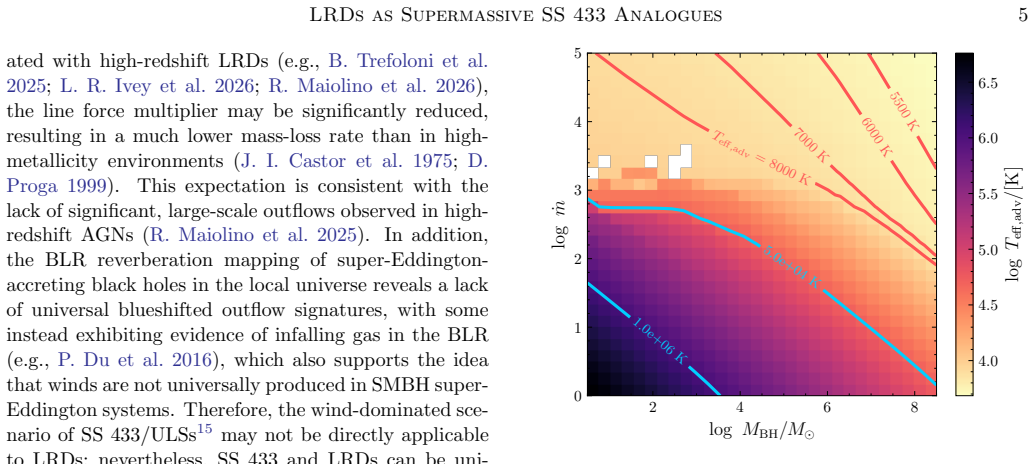
LRDs represent supermassive, high-redshift analogs of SS 433 viewed at high inclinations. The hyper-Eddington accretion physics scaled to larger masses produces the observed features via the self-shielding geometry of a puffed-up accretion disk. X-ray weakness and soft optical SEDs arise because the disk blocks direct view of the inner engine, while Balmer breaks and broad lines result from the anisotropic radiation field. Low-inclination counterparts manifest as little blue dots or normal active galactic nuclei.
What carries the argument
The self-shielding geometry of a puffed-up hyper-Eddington accretion disk, scaled from the stellar-mass system SS 433.
If this is right
- The strength of the Balmer break increases with the width of the broad emission lines.
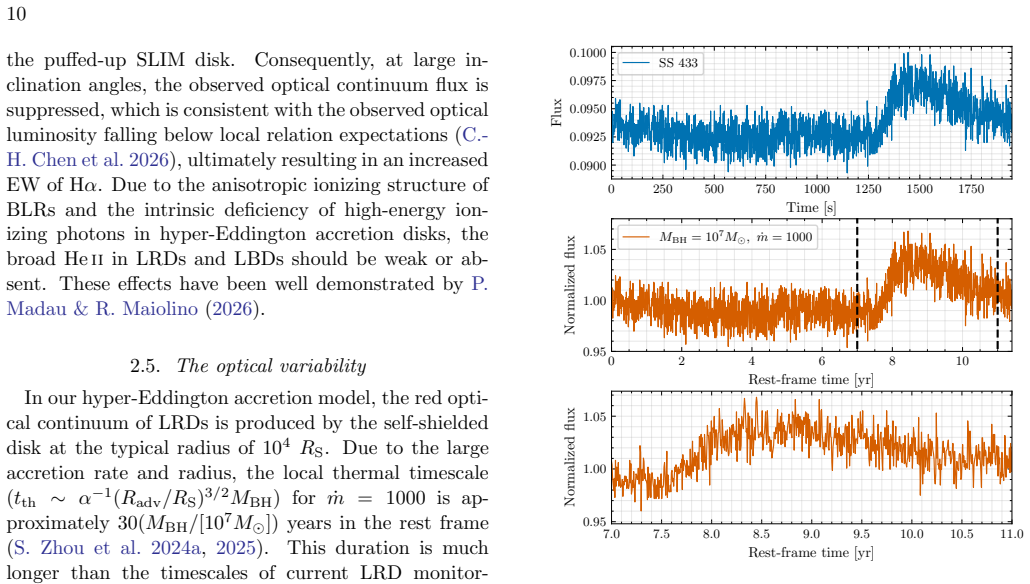
- Broad emission lines show greater variability than the optical continuum.
- LRDs are intrinsically more luminous than their observed fluxes suggest.
- Little blue dots exhibit higher variability than LRDs.
- LRDs trace the rapid growth phase of early supermassive black holes.
Where Pith is reading between the lines
- If the scaling holds, orientation effects may hide a large fraction of high-redshift black hole growth from direct observation.
- The model suggests searching for extended nebulae or jet signatures around LRDs similar to W50.
- It could be extended to predict the fraction of LRDs versus LBDs based on random orientations.
- Connections to other high-redshift compact sources might emerge from varying accretion rates.
Load-bearing premise
The accretion disk structure and radiation anisotropy in SS 433 can be scaled to supermassive black holes without major modifications from changes in physical scale or environment.
What would settle it
Finding a population of LRDs with strong, isotropic X-ray emission at levels expected for their optical luminosity would contradict the self-shielding requirement.
Figures





read the original abstract
High-redshift little red dots (LRDs) are compact sources characterized by V-shaped spectral energy distributions (SEDs), broad emission lines, and often prominent Balmer breaks. Their high number density and apparently large black hole masses suggest that they are essential to the early evolution of galaxies and supermassive black holes (SMBHs); however, the nature of their central engines remains uncertain. Here, we propose that LRDs are the supermassive, high-redshift analogs of the hyper-Eddington accreting Galactic microquasar SS~433, viewed at high inclinations. By scaling the hyper-Eddington accretion physics from stellar-mass black holes to supermassive scales, we show that the observed LRD features, including X-ray weakness, soft optical SEDs, apparent sub-Eddington accretion ratio, and Balmer breaks, emerge naturally from the self-shielding geometry of a puffed-up accretion disk. In this framework, the broad-line regions are ionized by anisotropic radiation escaping from the inner disk, analogous to the unseen UV/X-ray emission revealed by the W50 nebula in SS 433. Their low-inclination or lower-accretion-rate counterparts would appear as little blue dots (LBDs) or normal active galactic nuclei. Our model predicts that the Balmer break strength positively correlates with the broad-line width, that the emission lines are more variable than the optical continuum, that LRDs are intrinsically more luminous than observed, and that LBDs are more variable than LRDs. This unified-scale model redefines LRDs as the essential laboratories for observing the rapid accretion-driven growth that shaped the early assembly of galaxies and their central SMBHs.
Editorial analysis
A structured set of objections, weighed in public.
Referee Report
Summary. The manuscript proposes that high-redshift little red dots (LRDs) are supermassive, high-inclination analogs of the hyper-Eddington microquasar SS 433. By scaling the puffed-up, self-shielding accretion-disk geometry from stellar-mass to 10^7–10^9 M_⊙ black holes, the authors argue that the observed V-shaped SEDs, X-ray weakness, soft optical continua, apparent sub-Eddington ratios, and Balmer breaks arise naturally, while the broad-line region is ionized by anisotropic radiation that escapes the disk; low-inclination or lower-accretion counterparts would appear as little blue dots or ordinary AGN. The paper lists several testable predictions, including a positive correlation between Balmer-break strength and broad-line width and greater variability in lines than in the optical continuum.
Significance. If the direct scaling can be shown to reproduce the observed LRD distributions without additional tuning, the model would supply a physically motivated link between Galactic hyper-Eddington accretion and the rapid early growth of SMBHs, offering a unified picture that reinterprets LRD number densities and SED shapes. The absence of any quantitative scaling relations or order-of-magnitude checks, however, leaves the significance currently speculative.
major comments (2)
- [abstract and scaling discussion] The central claim (abstract and §2) that LRD observables “emerge naturally” from scaling the SS 433 disk geometry rests on an untested extrapolation. No relation is derived for how disk scale height H/R, Compton optical depth, or escaping UV/X-ray fraction change with black-hole mass at fixed Eddington ratio; the characteristic temperature drop (T ∝ M^{-1/4}) and shifts in pair-production thresholds are not evaluated, so it is not demonstrated that the same self-shielding produces the observed Balmer-break strengths or X-ray suppression factors.
- [broad-line region and predictions] The assertion that the broad-line region is ionized by anisotropic radiation escaping the inner disk (analogous to the W50 nebula) is presented without any estimate of the solid angle or ionization parameter that would result at supermassive scales. This leaves the predicted line luminosities and the claimed correlation between Balmer-break strength and line width (§4) without quantitative grounding.
minor comments (2)
- The manuscript would benefit from an explicit list of the free parameters retained from the SS 433 model versus those newly introduced for the SMBH case.
- Figure captions should state the assumed black-hole mass, Eddington ratio, and inclination range used to generate any illustrative SEDs.
Simulated Author's Rebuttal
We thank the referee for the constructive and detailed report. We respond point-by-point to the major comments below, acknowledging where the manuscript is currently limited and indicating the revisions we will make.
read point-by-point responses
-
Referee: [abstract and scaling discussion] The central claim (abstract and §2) that LRD observables “emerge naturally” from scaling the SS 433 disk geometry rests on an untested extrapolation. No relation is derived for how disk scale height H/R, Compton optical depth, or escaping UV/X-ray fraction change with black-hole mass at fixed Eddington ratio; the characteristic temperature drop (T ∝ M^{-1/4}) and shifts in pair-production thresholds are not evaluated, so it is not demonstrated that the same self-shielding produces the observed Balmer-break strengths or X-ray suppression factors.
Authors: We agree that the manuscript presents a conceptual scaling argument without explicit derivations of the mass dependence of disk parameters such as H/R or Compton depth at fixed Eddington ratio. The temperature scaling T ∝ M^{-1/4} is standard thin-disk physics and would shift the emission peak, but the self-shielding is set by radiation-pressure-supported vertical structure, which we expect to remain geometrically similar. Nevertheless, the referee is correct that this leaves the claim of “emerging naturally” without quantitative support. In the revised manuscript we will add order-of-magnitude scaling relations in §2 for H/R, optical depth, and escaping fraction, showing that the Compton-thick, anisotropic regime persists at 10^7–10^9 M_⊙. revision: yes
-
Referee: [broad-line region and predictions] The assertion that the broad-line region is ionized by anisotropic radiation escaping the inner disk (analogous to the W50 nebula) is presented without any estimate of the solid angle or ionization parameter that would result at supermassive scales. This leaves the predicted line luminosities and the claimed correlation between Balmer-break strength and line width (§4) without quantitative grounding.
Authors: We acknowledge that no solid-angle or ionization-parameter estimates are provided, leaving the BLR ionization argument and the §4 correlation without numerical grounding. The W50 analogy is qualitative at present. In revision we will add a short calculation in §4 that scales the disk funnel opening angle from SS 433 to estimate the covering fraction and resulting ionization parameter at supermassive scales, showing consistency with observed line strengths and thereby supporting the predicted Balmer-break versus line-width correlation. revision: yes
Circularity Check
No circularity; analogical proposal contains no derivations, fits, or self-referential steps
full rationale
The provided abstract and text contain no equations, scaling relations, fitted parameters, or quantitative predictions. The central claim is a qualitative analogy asserting that LRD features 'emerge naturally' from SS 433 self-shielding when scaled, but no derivation chain is exhibited that could reduce outputs to inputs by construction. No self-citations are invoked for uniqueness theorems, no ansatzes are smuggled, and no 'predictions' are shown to be statistically forced by data fits. The argument is therefore self-contained as an unquantified hypothesis rather than a closed loop; absence of explicit calculation is a limitation of evidence strength, not circularity.
Axiom & Free-Parameter Ledger
axioms (1)
- domain assumption Hyper-Eddington accretion physics and disk self-shielding geometry scale directly from stellar-mass to supermassive black holes.
Reference graph
Works this paper leans on
-
[1]
Black-Hole Accretion Disks --- Towards a New Paradigm ---
-
[2]
The Astrophysical Journal , author =
The Astropy Project: Sustaining and Growing a Community-oriented Open-source Project and the Latest Major Release (v5.0) of the Core Package. , keywords =. doi:10.3847/1538-4357/ac7c74 , archivePrefix =. 2206.14220 , primaryClass =
work page internal anchor Pith review Pith/arXiv arXiv doi:10.3847/1538-4357/ac7c74
-
[3]
The supercritical accretion disk in SS433 and ultraluminous X-ray sources
The supercritical accretion disk in SS 433 and ultraluminous X-ray sources. Black Holes from Stars to Galaxies -- Across the Range of Masses , year = 2007, editor =. doi:10.1017/S1743921307005017 , archivePrefix =. astro-ph/0610664 , primaryClass =
work page internal anchor Pith review Pith/arXiv arXiv doi:10.1017/s1743921307005017 2007
-
[4]
Mass ratio in SS433 revisited. , keywords =. doi:10.1093/mnras/stz610 , archivePrefix =. 1902.11137 , primaryClass =
work page internal anchor Pith review Pith/arXiv arXiv doi:10.1093/mnras/stz610 1902
-
[5]
The Evolutionary Status of SS433
The Evolutionary Status of SS 433. , keywords =. doi:10.1086/312475 , archivePrefix =. astro-ph/9912396 , primaryClass =
work page internal anchor Pith review Pith/arXiv arXiv doi:10.1086/312475
-
[6]
Vistas in Astronomy , keywords =
SS 433, X-ray binaries and stellar evolution. Vistas in Astronomy , keywords =. doi:10.1016/0083-6656(81)90050-7 , adsurl =
-
[7]
The nature of SS433 and the ultraluminous X-ray sources. , keywords =. doi:10.1111/j.1365-2966.2006.10469.x , archivePrefix =. astro-ph/0604497 , primaryClass =
-
[8]
Observational appearance
Black holes in binary systems. Observational appearance. , year = 1973, month = jan, volume =
1973
-
[9]
Black hole winds. , keywords =. doi:10.1046/j.1365-8711.2003.06980.x , archivePrefix =. astro-ph/0305541 , primaryClass =
-
[10]
The Nature of ULX Source M101 X-1: Optically Thick Outflow from A Stellar Mass Black Hole
The nature of ULX source M101 X-1: optically thick outflow from a stellar mass black hole. , keywords =. doi:10.1093/mnrasl/slu183 , archivePrefix =. 1411.0681 , primaryClass =
work page internal anchor Pith review Pith/arXiv arXiv doi:10.1093/mnrasl/slu183
-
[11]
Revisiting the ultraluminous supersoft source in M101: an optically thick outflow model
Revisiting the ultraluminous supersoft source in M 101: an optically thick outflow model. , keywords =. doi:10.1093/mnras/stv2671 , archivePrefix =. 1511.04797 , primaryClass =
work page internal anchor Pith review Pith/arXiv arXiv doi:10.1093/mnras/stv2671
-
[12]
Thick Accretion Disk Model for Ultraluminous Supersoft Sources
Thick Accretion Disk Model for Ultraluminous Supersoft Sources. , keywords =. doi:10.3847/2041-8205/818/1/L4 , archivePrefix =. 1601.04750 , primaryClass =
work page internal anchor Pith review Pith/arXiv arXiv doi:10.3847/2041-8205/818/1/l4 2041
-
[13]
2023, NewAR, 96, 101672, doi: 10.1016/j.newar.2022.101672
Ultraluminous X-ray sources. , keywords =. doi:10.1016/j.newar.2022.101672 , archivePrefix =. 2302.10605 , primaryClass =
-
[14]
Ultraluminous X-Ray Sources. , keywords =. doi:10.1146/annurev-astro-091916-055259 , archivePrefix =. 1703.10728 , primaryClass =
work page internal anchor Pith review Pith/arXiv arXiv doi:10.1146/annurev-astro-091916-055259
-
[15]
Radiation GRMHD Models of Accretion onto Stellar-Mass Black Holes: II. Super-Eddington Accretion. arXiv e-prints , keywords =. doi:10.48550/arXiv.2509.10638 , archivePrefix =. 2509.10638 , primaryClass =
-
[16]
Slim Accretion Disks. , keywords =. doi:10.1086/166683 , adsurl =
-
[17]
BlackTHUNDER ─ A non-stellar Balmer break in a black hole-dominated little red dot at z = 7.04. , keywords =. doi:10.1093/mnras/staf1867 , archivePrefix =. 2501.13082 , primaryClass =
-
[18]
Dust Budget Crisis in Little Red Dots. , keywords =. doi:10.3847/2041-8213/ae1955 , archivePrefix =. 2505.22600 , primaryClass =
-
[19]
The Balmer Break and Optical Continuum of Little Red Dots from Super-Eddington Accretion. , keywords =. doi:10.3847/1538-4357/ae0c19 , archivePrefix =. 2507.07190 , primaryClass =
-
[20]
Black holes in radiation-dominated gas: an analogue of the Bondi accretion problem. , keywords =. doi:10.1093/mnras/184.1.53 , adsurl =
-
[21]
Radiation Pressure-supported Accretion Disks: Vertical Structure, Energy Advection, and Convective Stability. , keywords =. doi:10.1088/0004-637X/753/2/118 , archivePrefix =. 1205.1387 , primaryClass =
work page internal anchor Pith review Pith/arXiv arXiv doi:10.1088/0004-637x/753/2/118
-
[22]
Advection-Dominated Accretion Disks: Geometrically Slim or Thick?
Advection-Dominated Accretion Disks: Geometrically Slim or Thick?. , keywords =. doi:10.1093/pasj/61.6.1313 , archivePrefix =. 0909.4838 , primaryClass =
work page internal anchor Pith review Pith/arXiv arXiv doi:10.1093/pasj/61.6.1313
-
[23]
Geometrical Effect of Supercritical Accretion Flows: Observational Implications of Galactic Black-Hole Candidates and Ultraluminous X-Ray Sources. , keywords =. doi:10.1093/pasj/57.3.513 , archivePrefix =. astro-ph/0504196 , primaryClass =
work page internal anchor Pith review Pith/arXiv arXiv doi:10.1093/pasj/57.3.513
-
[24]
Self-shadowing Effects of Slim Accretion Disks in Active Galactic Nuclei: The Diverse Appearance of the Broad-line Region. , keywords =. doi:10.1088/0004-637X/797/1/65 , archivePrefix =. 1410.5285 , primaryClass =
work page internal anchor Pith review Pith/arXiv arXiv doi:10.1088/0004-637x/797/1/65
-
[25]
, keywords =
Thick Accretion Disks and Supercritical Luminosities. , keywords =
-
[26]
Mildly Super-Eddington Accretion onto Slowly Spinning Black Holes Explains the X-Ray Weakness of the Little Red Dots. , keywords =. doi:10.3847/1538-4357/ad84f7 , archivePrefix =. 2407.15915 , primaryClass =
-
[27]
X-Ray Weak Active Galactic Nuclei from Super-Eddington Accretion onto Infant Black Holes. , keywords =. doi:10.3847/2041-8213/ad90e1 , archivePrefix =. 2410.00417 , primaryClass =
-
[28]
Little Red Dots host Black Hole Stars: A unified family of gas-reddened AGN revealed by JWST/NIRSpec spectroscopy. arXiv e-prints , keywords =. doi:10.48550/arXiv.2511.21820 , archivePrefix =. 2511.21820 , primaryClass =
-
[29]
Extremely Dense Gas around Little Red Dots and High-redshift Active Galactic Nuclei: A Nonstellar Origin of the Balmer Break and Absorption Features. , keywords =. doi:10.3847/2041-8213/adaebd , archivePrefix =. 2409.07805 , primaryClass =
-
[30]
Lord of LRDs: insights into a 'Little Red Dot' with a low-ionization spectrum at z = 0.1. , keywords =. doi:10.1093/mnras/staf2235 , archivePrefix =. 2507.23774 , primaryClass =
-
[31]
A "Black Hole Star" Reveals the Remarkable Gas-Enshrouded Hearts of the Little Red Dots
A ``Black Hole Star'' Reveals the Remarkable Gas-Enshrouded Hearts of the Little Red Dots. arXiv e-prints , keywords =. doi:10.48550/arXiv.2503.16596 , archivePrefix =. 2503.16596 , primaryClass =
work page internal anchor Pith review Pith/arXiv arXiv doi:10.48550/arxiv.2503.16596
-
[32]
Radiation-Dominated Disks Are Thermally Stable
Radiation-Dominated Disks are Thermally Stable. , keywords =. doi:10.1088/0004-637X/691/1/16 , archivePrefix =. 0809.1708 , primaryClass =
work page internal anchor Pith review Pith/arXiv arXiv doi:10.1088/0004-637x/691/1/16
-
[33]
Two-dimensional radiative transfer. I. Planar geometry. , keywords =. doi:10.1086/155988 , adsurl =
-
[34]
Little red dots as young supermassive black holes in dense ionized cocoons. , keywords =. doi:10.1038/s41586-025-09900-4 , archivePrefix =. 2503.16595 , primaryClass =
-
[35]
The Engine and its Flows: Little Red Dot spectra are shaped by the column densities of their gas envelopes. arXiv e-prints , keywords =. doi:10.48550/arXiv.2603.17667 , archivePrefix =. 2603.17667 , primaryClass =
-
[36]
arXiv e-prints , keywords =
Little Red and Blue Dots: simply stratified Broad Line Regions. arXiv e-prints , keywords =
-
[37]
Contributions of the Astronomical Observatory Skalnate Pleso , keywords =
Line shapes in narrow-line Seyfert 1 galaxies: a tracer of physical properties?. Contributions of the Astronomical Observatory Skalnate Pleso , keywords =. doi:10.31577/caosp.2020.50.1.270 , archivePrefix =. 1909.12343 , primaryClass =
-
[38]
A Comprehensive Study of 2000 Narrow Line Seyfert 1 Galaxies from the Sloan Digital Sky Survey. I. The Sample. , keywords =. doi:10.1086/504869 , archivePrefix =. astro-ph/0603759 , primaryClass =
work page internal anchor Pith review Pith/arXiv arXiv doi:10.1086/504869 2000
-
[39]
Hyper-Eddington accretion flows onto massive black holes
Hyper-Eddington accretion flows on to massive black holes. , keywords =. doi:10.1093/mnras/stw836 , archivePrefix =. 1511.02116 , primaryClass =
work page internal anchor Pith review Pith/arXiv arXiv doi:10.1093/mnras/stw836
-
[40]
How Long Will the Quasar UV/Optical Flickering Be Damped?. , keywords =. doi:10.3847/1538-4357/ad2fbc , archivePrefix =. 2403.01691 , primaryClass =
-
[41]
On the Variability Features of Active Galactic Nuclei in Little Red Dots. , keywords =. doi:10.3847/1538-4357/adfd5f , archivePrefix =. 2508.16795 , primaryClass =
-
[42]
Stellar Black Holes Can ``Stretch'' Supermassive Black Hole Accretion Disks. , keywords =. doi:10.3847/2041-8213/ad3c3f , archivePrefix =. 2404.07407 , primaryClass =
-
[43]
Do Little Red Dots Vary?. , keywords =. doi:10.3847/1538-4357/ae1f08 , archivePrefix =. 2509.03571 , primaryClass =
-
[44]
doi:10.5281/zenodo.17935053 , url =
jon-morag/Freq\_Dept\_Opac\_Table: NuPac - 2.1 , month = dec, year = 2025, publisher =. doi:10.5281/zenodo.17935053 , url =
-
[45]
On Atomic Line Opacities for Modeling Astrophysical Radiative Transfer
On Atomic Line Opacities for Modeling Astrophysical Radiative Transfer. arXiv e-prints , keywords =. doi:10.48550/arXiv.2509.17003 , archivePrefix =. 2509.17003 , primaryClass =
work page internal anchor Pith review Pith/arXiv arXiv doi:10.48550/arxiv.2509.17003
-
[46]
Spectral Appearance of Self-gravitating AGN Disks Powered by Stellar Objects: Universal Effective Temperature in the Optical Continuum and Application to Little Red Dots. arXiv e-prints , keywords =. doi:10.48550/arXiv.2602.06954 , archivePrefix =. 2602.06954 , primaryClass =
work page internal anchor Pith review Pith/arXiv arXiv doi:10.48550/arxiv.2602.06954
-
[47]
The composite spectrum of little red dots from a standard inner disk and an unstable outer disk. Nature Astronomy , keywords =. doi:10.1038/s41550-026-02785-x , archivePrefix =. 2505.12719 , primaryClass =
-
[48]
Space Telescope and Optical Reverberation Mapping Project. IV. Anomalous Behavior of the Broad Ultraviolet Emission Lines in NGC 5548. , keywords =. doi:10.3847/0004-637X/824/1/11 , archivePrefix =. 1603.08741 , primaryClass =
work page internal anchor Pith review Pith/arXiv arXiv doi:10.3847/0004-637x/824/1/11
-
[49]
A Wind-based Unification Model for NGC 5548: Spectral Holidays, Nondisk Emission, and Implications for Changing-look Quasars. , keywords =. doi:10.3847/2041-8213/ab3d41 , archivePrefix =. 1908.07686 , primaryClass =
-
[50]
Little Red Dots as Late-stage Quasi-stars. , keywords =. doi:10.3847/1538-4357/ae274a , archivePrefix =. 2507.09085 , primaryClass =
-
[51]
Quasi-stars: accreting black holes inside massive envelopes. , keywords =. doi:10.1111/j.1365-2966.2008.13344.x , archivePrefix =. 0711.4078 , primaryClass =
-
[52]
Black hole envelopes in Little Red Dots. , keywords =. doi:10.1093/mnras/staf1898 , archivePrefix =. 2505.06965 , primaryClass =
-
[53]
The GRAVITY+ Project: Towards All-sky, Faint-Science, High-Contrast Near-Infrared Interferometry at the VLTI. The Messenger , keywords =. doi:10.18727/0722-6691/5285 , archivePrefix =. 2301.08071 , primaryClass =
-
[54]
Detection of unexpected leading delays in broad H line reverberations in the quasar PHL 1092. arXiv e-prints , keywords =. doi:10.48550/arXiv.2511.07716 , archivePrefix =. 2511.07716 , primaryClass =
-
[55]
Little red dots as embryos of active galactic nuclei. arXiv e-prints , keywords =. doi:10.48550/arXiv.2511.09278 , archivePrefix =. 2511.09278 , primaryClass =
-
[56]
Relativistic baryonic jets from an ultraluminous supersoft X-ray source
Relativistic baryonic jets from an ultraluminous supersoft X-ray source. , keywords =. doi:10.1038/nature15751 , archivePrefix =. 1511.09200 , primaryClass =
work page internal anchor Pith review Pith/arXiv arXiv doi:10.1038/nature15751
-
[57]
Radio detection of a local little red dot. , keywords =. doi:10.1051/0004-6361/202558326 , archivePrefix =. 2512.03331 , primaryClass =
-
[58]
Little Red Dots as Hidden Neutrino Sources
Little Red Dots as Hidden Neutrino Sources. arXiv e-prints , keywords =. doi:10.48550/arXiv.2601.11203 , archivePrefix =. 2601.11203 , primaryClass =
work page internal anchor Pith review Pith/arXiv arXiv doi:10.48550/arxiv.2601.11203
-
[59]
JADES: The diverse population of infant black holes at 4 < z < 11: Merging, tiny, poor, but mighty. , keywords =. doi:10.1051/0004-6361/202347640 , archivePrefix =. 2308.01230 , primaryClass =
-
[60]
A JWST/NIRSpec First Census of Broad-line AGNs at z = 4-7: Detection of 10 Faint AGNs with M _ BH 10 ^ 6 - 10 ^ 8 M _ ☉ and Their Host Galaxy Properties. , keywords =. doi:10.3847/1538-4357/ad029e , archivePrefix =. 2303.11946 , primaryClass =
-
[61]
Hidden Little Monsters: Spectroscopic Identification of Low-mass, Broad-line AGNs at z > 5 with CEERS. , keywords =. doi:10.3847/2041-8213/ace5a0 , archivePrefix =. 2302.00012 , primaryClass =
-
[62]
GA-NIFS: The ultra-dense, interacting environment of a dual AGN at z 3.3 revealed by JWST/NIRSpec IFS. , keywords =. doi:10.1051/0004-6361/202346649 , archivePrefix =. 2304.06756 , primaryClass =
-
[63]
UNCOVER Spectroscopy Confirms the Surprising Ubiquity of Active Galactic Nuclei in Red Sources at z > 5. , keywords =. doi:10.3847/1538-4357/ad1e5f , archivePrefix =. 2309.05714 , primaryClass =
-
[64]
NEXUS: A Spectroscopic Census of Broad-line AGNs and Little Red Dots at 3 z 6. , keywords =. doi:10.3847/1538-4357/ae3612 , archivePrefix =. 2505.20393 , primaryClass =
-
[65]
The Discovery of Little Red Dots in the Local Universe: Signatures of Cool Gas Envelopes. , keywords =. doi:10.3847/1538-4357/ae2bdf , archivePrefix =. 2507.10659 , primaryClass =
-
[66]
RUBIES: Evolved Stellar Populations with Extended Formation Histories at z 7─8 in Candidate Massive Galaxies Identified with JWST/NIRSpec. , keywords =. doi:10.3847/2041-8213/ad55f7 , archivePrefix =. 2405.01473 , primaryClass =
-
[67]
Tip of the Iceberg: Overmassive Black Holes at 4 < z < 7 Found by JWST Are Not Inconsistent with the Local Relation. , keywords =. doi:10.3847/1538-4357/ada603 , archivePrefix =. 2403.00074 , primaryClass =
-
[68]
Evidence for heavy-seed origin of early supermassive black holes from a z ≍ 10 X-ray quasar. Nature Astronomy , keywords =. doi:10.1038/s41550-023-02111-9 , archivePrefix =. 2305.15458 , primaryClass =
-
[69]
Planck 2013 results. XVI. Cosmological parameters. , keywords =. doi:10.1051/0004-6361/201321591 , archivePrefix =. 1303.5076 , primaryClass =
work page internal anchor Pith review Pith/arXiv arXiv doi:10.1051/0004-6361/201321591 2013
-
[70]
A Black Hole Star at Cosmic Noon: Extreme Balmer break, photospheric continuum, and broad absorption by thick winds in a Little Red Dot at z=1.7. arXiv e-prints , keywords =. doi:10.48550/arXiv.2603.28335 , archivePrefix =. 2603.28335 , primaryClass =
work page internal anchor Pith review Pith/arXiv arXiv doi:10.48550/arxiv.2603.28335
-
[71]
The Dust Content and Opacity of Actively Star-forming Galaxies. , keywords =. doi:10.1086/308692 , archivePrefix =. astro-ph/9911459 , primaryClass =
work page internal anchor Pith review Pith/arXiv arXiv doi:10.1086/308692
-
[72]
SS 433 as an Eclipsing Binary. , keywords =. doi:10.1093/mnras/194.3.761 , adsurl =
-
[73]
Ten Years of SS 433 Kinematics. , keywords =. doi:10.1086/168132 , adsurl =
-
[74]
, keywords =
SS 433 in the ultraviolet. , keywords =
-
[75]
An Improved Line-Strength Parameterization in Hot-Star Winds. , keywords =. doi:10.1086/176492 , adsurl =
-
[76]
A black hole in a near-pristine galaxy 700 million years after the Big Bang
A black hole in a near pristine galaxy 700 Myr after the big bang. , keywords =. doi:10.1093/mnras/staf2109 , archivePrefix =. 2505.22567 , primaryClass =
work page internal anchor Pith review Pith/arXiv arXiv doi:10.1093/mnras/staf2109
-
[77]
The Cliff: A Metal-Poor Little Red Dot Hosting an Overmassive Black Hole at $z = 3.55$
The Cliff: A Metal-Poor Little Red Dot Hosting an Overmassive Black Hole at z = 3.55. arXiv e-prints , keywords =. doi:10.48550/arXiv.2604.09177 , archivePrefix =. 2604.09177 , primaryClass =
work page internal anchor Pith review Pith/arXiv arXiv doi:10.48550/arxiv.2604.09177
-
[78]
Radiation-driven winds in Of stars. , keywords =. doi:10.1086/153315 , adsurl =
-
[79]
Comparison of theoretical radiation-driven winds from stars and discs. , keywords =. doi:10.1046/j.1365-8711.1999.02408.x , archivePrefix =. astro-ph/9901019 , primaryClass =
-
[80]
Modelling the behaviour of accretion flows in X-ray binaries
Modelling the behaviour of accretion flows in X-ray binaries. Everything you always wanted to know about accretion but were afraid to ask. , keywords =. doi:10.1007/s00159-007-0006-1 , archivePrefix =. 0708.0148 , primaryClass =
work page internal anchor Pith review Pith/arXiv arXiv doi:10.1007/s00159-007-0006-1
discussion (0)
Sign in with ORCID, Apple, or X to comment. Anyone can read and Pith papers without signing in.