LUMINA-26: Low-Light Understanding for Modeling and Interpreting Night-time Actions
Pith reviewed 2026-06-26 09:27 UTC · model grok-4.3
The pith
Illumi-Net adapts enhancement and features to video illumination levels, reaching 75.95% top-1 accuracy on the new LUMINA-26 low-light action dataset.
A machine-rendered reading of the paper's core claim, the machinery that carries it, and where it could break.
Core claim
LUMINA-26 supplies 6,784 clips across 26 classes captured under naturally occurring low light. Illumi-Net conditions adaptive enhancement and spatio-temporal transformer extraction on video-level illumination cues, then fuses decisions across experts to reach 55.13% top-1 and 78.87% top-5 on ELLAR while establishing 75.95% top-1 and 93.58% top-5 on LUMINA-26.
What carries the argument
Illumi-Net, an illumination-adaptive mixture-of-experts network that uses video-level illumination cues to select enhancement parameters and to route spatio-temporal transformer features before expert-conditioned fusion.
If this is right
- Future low-light action models can train and evaluate against a dataset that covers both indoor and outdoor night scenes with balanced classes.
- The same illumination-guided mixture-of-experts design lifts accuracy on the earlier ELLAR benchmark.
- Transformer-based spatio-temporal features become more effective when conditioned on per-video light level.
- Practical systems gain a concrete performance reference point for night-time human activity understanding.
Where Pith is reading between the lines
- The adaptation mechanism might transfer to low-light object detection or pose estimation without major redesign.
- Adding synthetic light variation during training could test whether the illumination cue remains useful outside the captured range.
- Expanding the dataset with more subjects or weather conditions would reveal how much the current numbers depend on the specific capture setup.
Load-bearing premise
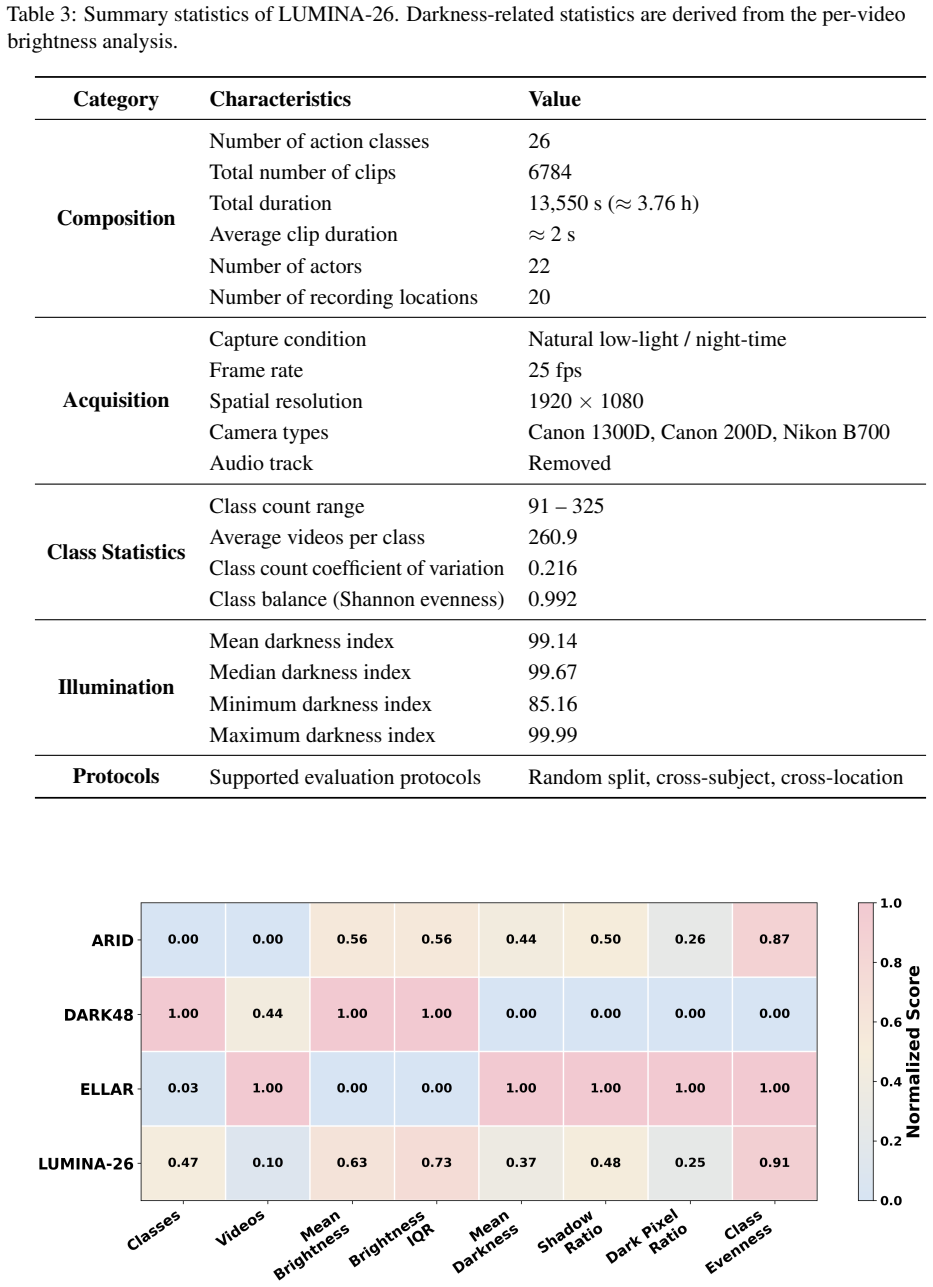
Clips from 20 locations and 22 subjects under natural low-light conditions are diverse enough to stand in for the full variety of real night-time action scenes.
What would settle it
A new collection of low-light action videos recorded at unseen locations or with different subjects on which the model drops below 60% top-1 accuracy would show the benchmark does not generalize.
Figures



read the original abstract
Low-light human action recognition remains a challenging problem due to poor illumination, amplified noise, motion ambiguity, and diverse real-world scenes. Existing low-light datasets often lack sufficient action diversity, capture realism, or balanced class distribution, limiting the development of robust models. To address this, we introduce LUMINA-26: Low-Light Understanding for Modeling and Interpreting Night-time Actions, comprising 6,784 clips across 26 action classes, recorded from 22 subjects across 20 indoor and outdoor locations under naturally occurring low-light conditions. We also propose Illumi-Net: An Illumination-Adaptive Mixture-of-Experts Network, which leverages video-level illumination cues to guide adaptive enhancement and transformer-based spatio-temporal feature extraction, with expert-conditioned decision fusion. Our method surpasses previous state-of-the-art performance on ELLAR (Top-1: 55.13%, Top-5: 78.87%) and establishes a strong baseline on LUMINA-26 (Top-1: 75.95%, Top-5: 93.58%), offering a practical benchmark for future low-light action recognition research.
Editorial analysis
A structured set of objections, weighed in public.
Referee Report
Summary. The paper introduces LUMINA-26, a dataset of 6,784 low-light action clips spanning 26 classes recorded from 22 subjects across 20 indoor/outdoor locations under natural low-light conditions. It also proposes Illumi-Net, an illumination-adaptive mixture-of-experts network that uses video-level illumination cues for adaptive enhancement and transformer-based spatio-temporal features with expert-conditioned fusion. The method is reported to surpass prior SOTA on ELLAR (Top-1: 55.13%, Top-5: 78.87%) and to establish a baseline on LUMINA-26 (Top-1: 75.95%, Top-5: 93.58%).
Significance. If the performance claims and generalization properties hold after verification of splits and ablations, the work would supply a new real-world low-light action benchmark and an adaptive architecture that explicitly conditions on illumination statistics. The emphasis on naturally captured rather than synthetically degraded data is a positive contribution to the field.
major comments (2)
- [Abstract / Dataset description] Abstract and (presumed) §3 (Dataset): The description of LUMINA-26 provides no information on train/test split construction (subject-independent, location-independent, or otherwise), no illumination statistics (lux ranges, noise levels), and no cross-location or cross-subject performance breakdowns. These omissions directly undermine the claim that the dataset constitutes a reliable, generalizable benchmark.
- [Abstract / Results] Abstract and (presumed) §4–5 (Method and Results): Concrete accuracy numbers are stated without accompanying baseline comparisons, component ablations, statistical significance tests, or error analysis. This absence makes it impossible to verify that the reported gains on ELLAR and the LUMINA-26 baseline are attributable to the proposed illumination-adaptive MoE design rather than other factors.
minor comments (1)
- [Abstract] The abstract would benefit from a brief statement of the number of parameters or computational cost of Illumi-Net relative to the baselines it surpasses.
Simulated Author's Rebuttal
We thank the referee for the constructive feedback. We address each major comment below and will revise the manuscript to incorporate the requested details and analyses.
read point-by-point responses
-
Referee: [Abstract / Dataset description] Abstract and (presumed) §3 (Dataset): The description of LUMINA-26 provides no information on train/test split construction (subject-independent, location-independent, or otherwise), no illumination statistics (lux ranges, noise levels), and no cross-location or cross-subject performance breakdowns. These omissions directly undermine the claim that the dataset constitutes a reliable, generalizable benchmark.
Authors: We agree these details are essential. The LUMINA-26 splits are subject-independent (no subject overlap between train and test) and largely location-independent. We will expand §3 with explicit split methodology, illumination statistics (lux ranges 0.1–10 lux measured under natural conditions, noise via SNR), and cross-subject/cross-location accuracy breakdowns to substantiate the benchmark's reliability and generalizability. revision: yes
-
Referee: [Abstract / Results] Abstract and (presumed) §4–5 (Method and Results): Concrete accuracy numbers are stated without accompanying baseline comparisons, component ablations, statistical significance tests, or error analysis. This absence makes it impossible to verify that the reported gains on ELLAR and the LUMINA-26 baseline are attributable to the proposed illumination-adaptive MoE design rather than other factors.
Authors: We acknowledge the need for fuller validation. The manuscript includes baseline comparisons and MoE component ablations in §5; we will add statistical significance tests (e.g., paired t-tests across runs) and error analysis (confusion matrices, illumination-stratified failures) to confirm attribution to the illumination-adaptive design. These will be expanded in the revised results section. revision: yes
Circularity Check
No circularity; purely empirical dataset and model evaluation
full rationale
The paper introduces the LUMINA-26 dataset (6,784 clips, 26 classes, 22 subjects, 20 locations) and Illumi-Net architecture, then reports Top-1/Top-5 accuracies on held-out splits of LUMINA-26 and ELLAR. No equations, derivations, fitted parameters renamed as predictions, or self-citation chains appear in the provided text. All claims reduce to direct experimental measurement on test data rather than any self-referential construction, satisfying the default expectation of no significant circularity.
Axiom & Free-Parameter Ledger
Reference graph
Works this paper leans on
-
[1]
Lin, M.-T
W. Lin, M.-T. Sun, R. Poovandran, Z. Zhang, Human activity recognition for video surveillance, in: 2008 IEEE international symposium on circuits and systems (ISCAS), IEEE, 2008, pp. 2737–2740
2008
-
[2]
Diraco, G
G. Diraco, G. Rescio, P. Siciliano, A. Leone, Review on human action recognition in smart living: Sensing technology, multimodality, real-time processing, interoperability, and resource-constrained processing, Sensors 23 (2023). 16
2023
-
[3]
W. Hu, D. Xie, Z. Fu, W. Zeng, S. Maybank, Semantic-based surveillance video retrieval, IEEE Transactions on Image Processing 16 (2007) 1168–1181
2007
-
[4]
Rodomagoulakis, N
I. Rodomagoulakis, N. Kardaris, V . Pitsikalis, E. Mavroudi, A. Katsamanis, A. Tsiami, P. Maragos, Multimodal human action recognition in assistive human-robot interaction, 2016 IEEE International Conference on Acoustics, Speech and Signal Processing (ICASSP) (2016) 2702–2706
2016
-
[5]
J. Shotton, A. Fitzgibbon, M. Cook, T. Sharp, M. Finocchio, R. Moore, A. Kipman, A. Blake, Real-time human pose recognition in parts from single depth images, in: CVPR 2011, 2011, pp. 1297–1304. doi:10.1109/CVPR.2011.5995316
-
[6]
X. Wang, R. Girshick, A. Gupta, K. He, Non-local neural networks, in: Proceedings of the IEEE conference on computer vision and pattern recognition, 2018, pp. 7794–7803
2018
-
[7]
D. Tran, H. Wang, L. Torresani, J. Ray, Y . LeCun, M. Paluri, A closer look at spatiotemporal convolutions for action recognition, in: Proceedings of the IEEE conference on Computer Vision and Pattern Recognition, 2018, pp. 6450–6459
2018
-
[8]
D. Tran, H. Wang, L. Torresani, M. Feiszli, Video classification with channel-separated convolutional networks, in: Proceedings of the IEEE/CVF international conference on computer vision, 2019, pp. 5552–5561
2019
-
[9]
D. Tran, L. Bourdev, R. Fergus, L. Torresani, M. Paluri, Learning spatiotemporal features with 3d convolutional networks, in: Proceedings of the IEEE international conference on computer vision, 2015, pp. 4489–4497
2015
-
[10]
Feichtenhofer, H
C. Feichtenhofer, H. Fan, J. Malik, K. He, Slowfast networks for video recognition, in: Proceedings of the IEEE/CVF international conference on computer vision, 2019, pp. 6202–6211
2019
-
[11]
Carreira, A
J. Carreira, A. Zisserman, Quo vadis, action recognition? a new model and the kinetics dataset, in: proceedings of the IEEE Conference on Computer Vision and Pattern Recognition, 2017, pp. 6299–6308
2017
-
[12]
Arnab, M
A. Arnab, M. Dehghani, G. Heigold, C. Sun, M. Luˇci´c, C. Schmid, Vivit: A video vision transformer, in: Proceedings of the IEEE/CVF international conference on computer vision, 2021, pp. 6836–6846
2021
-
[13]
Bertasius, H
G. Bertasius, H. Wang, L. Torresani, Is space-time attention all you need for video understanding?, in: Icml, volume 2, 2021, p. 4
2021
- [14]
-
[15]
Z. Liu, J. Ning, Y . Cao, Y . Wei, Z. Zhang, S. Lin, H. Hu, Video swin transformer, in: Proceedings of the IEEE/CVF conference on computer vision and pattern recognition, 2022, pp. 3202–3211
2022
-
[16]
X. Zhao, C. Tang, H. Hu, W. Wang, S. Qiao, A. Tong, Attention mechanism based multimodal feature fusion network for human action recognition, Journal of Visual Communication and Image Representation 110 (2025) 104459
2025
-
[17]
T. Lu, C. Chang, Cache-adapter: Efficient video action recognition using adapter fine-tuning and cache memorization technique, Journal of Visual Communication and Image Representation (2025) 104543
2025
-
[18]
UCF101: A Dataset of 101 Human Actions Classes From Videos in The Wild
K. Soomro, A. R. Zamir, M. Shah, Ucf101: A dataset of 101 human actions classes from videos in the wild, arXiv preprint arXiv:1212.0402 (2012)
work page internal anchor Pith review Pith/arXiv arXiv 2012
-
[19]
J. Carreira, A. Zisserman, Quo vadis, action recognition? a new model and the kinetics dataset, in: 2017 IEEE Conference on Computer Vision and Pattern Recognition (CVPR), 2017, pp. 4724–4733. doi:10.1109/CVPR.2017.502. 17
-
[20]
A Short Note about Kinetics-600
J. Carreira, E. Noland, A. Banki-Horvath, C. Hillier, A. Zisserman, A short note about kinetics-600, CoRR abs/1808.01340 (2018)
work page internal anchor Pith review Pith/arXiv arXiv 2018
-
[21]
J. Carreira, E. Noland, C. Hillier, A. Zisserman, A short note on the kinetics-700 human action dataset, arXiv preprint arXiv:1907.06987 (2019)
-
[22]
something something
R. Goyal, S. Ebrahimi Kahou, V . Michalski, J. Materzynska, S. Westphal, H. Kim, V . Haenel, I. Fruend, P. Yianilos, M. Mueller-Freitag, et al., The" something something" video database for learning and evaluating visual common sense, in: Proceedings of the IEEE international conference on computer vision, 2017, pp. 5842–5850
2017
-
[23]
Soumya, S
T. Soumya, S. M. Thampi, Recolorizing dark regions to enhance night surveillance video, Multimedia Tools and Applications 76 (2017) 24477–24493
2017
-
[24]
A. I. Maqueda, A. Loquercio, G. Gallego, N. García, D. Scaramuzza, Event-based vision meets deep learning on steering prediction for self-driving cars, in: Proceedings of the IEEE conference on computer vision and pattern recognition, 2018, pp. 5419–5427
2018
-
[25]
Y . Xu, J. Yang, H. Cao, K. Mao, J. Yin, S. See, Arid: A new dataset for recognizing action in the dark, in: Deep Learning for Human Activity Recognition: Second International Workshop, DL-HAR 2020, Held in Conjunction with IJCAI-PRICAI 2020, Kyoto, Japan, January 8, 2021, Proceedings 2, Springer, 2021, pp. 70–84
2020
-
[26]
Z. Tu, Y . Liu, Y . Zhang, Q. Mu, J. Yuan, Dtcm: Joint optimization of dark enhancement and action recognition in videos, IEEE Transactions on Image Processing 32 (2023) 3507–3520
2023
-
[27]
Ha, W.-G
M. Ha, W.-G. Bae, G. Bae, J. T. Lee, Ellar: an action recognition dataset for extremely low-light conditions with dual gamma adaptive modulation, in: Proceedings of the Asian Conference on Computer Vision, 2024, pp. 800–817
2024
-
[29]
Blank, L
M. Blank, L. Gorelick, E. Shechtman, M. Irani, R. Basri, Actions as space-time shapes, IEEE Transactions on Pattern Analysis and Machine Intelligence 27 (2005) 586–599
2005
-
[30]
Weinland, R
D. Weinland, R. Ronfard, E. Boyer, Free viewpoint action recognition using motion history volumes, Computer vision and image understanding 104 (2006) 249–257
2006
-
[31]
In: 2011 International Conference on Computer Vision
H. Kuehne, H. Jhuang, E. Garrote, T. Poggio, T. Serre, Hmdb: A large video database for human motion recognition, in: 2011 International Conference on Computer Vision, 2011, pp. 2556–2563. doi:10.1109/ICCV.2011.6126543
-
[32]
B. G. Fabian Caba Heilbron, Victor Escorcia, J. C. Niebles, Activitynet: A large-scale video benchmark for human activity understanding, in: Proceedings of the IEEE Conference on Computer Vision and Pattern Recognition, 2015, pp. 961–970
2015
-
[33]
A. Pandey, A. Parihar, A comparative analysis of deep learning based human action recognition algorithms, 2023, pp. 1–7. doi:10.1109/ICCCNT56998.2023.10308200
-
[34]
Schuldt, I
C. Schuldt, I. Laptev, B. Caputo, Recognizing human actions: A local svm approach, in: Proceedings of the 17th International Conference on Pattern Recognition (ICPR), IEEE, Cambridge, UK, 2004, pp. 32–36
2004
-
[35]
K. Soomro, A. R. Zamir, Action Recognition in Realistic Sports Videos, Springer International Publish- ing, Cham, 2014, pp. 181–208. URL: https://doi.org/10.1007/978-3-319-09396-3_9. doi: 10.1007/ 978-3-319-09396-3_9. 18
-
[36]
Marszalek, I
M. Marszalek, I. Laptev, C. Schmid, Actions in context, in: 2009 IEEE Conference on Computer Vision and Pattern Recognition, IEEE, 2009, pp. 2929–2936
2009
-
[37]
in the wild
J. Liu, J. Luo, M. Shah, Recognizing realistic actions from videos “in the wild”, in: 2009 IEEE conference on computer vision and pattern recognition, IEEE, 2009, pp. 1996–2003
2009
-
[38]
K. K. Reddy, M. Shah, Recognizing 50 human action categories of web videos, Machine vision and applications 24 (2013) 971–981
2013
-
[39]
Xia, C.-C
L. Xia, C.-C. Chen, J. K. Aggarwal, View invariant human action recognition using histograms of 3d joints, in: 2012 IEEE computer society conference on computer vision and pattern recognition workshops, IEEE, 2012, pp. 20–27
2012
-
[40]
in the wild
H. Idrees, A. R. Zamir, Y .-G. Jiang, A. Gorban, I. Laptev, R. Sukthankar, M. Shah, The thumos challenge on action recognition for videos “in the wild”, Computer Vision and Image Understanding 155 (2017) 1–23
2017
-
[41]
In: 2014 IEEE Conference on Computer Vision and Pattern Recognition
A. Karpathy, G. Toderici, S. Shetty, T. Leung, R. Sukthankar, L. Fei-Fei, Large-scale video classification with convolutional neural networks, in: 2014 IEEE Conference on Computer Vision and Pattern Recognition, 2014, pp. 1725–1732. doi:10.1109/CVPR.2014.223
-
[42]
YouTube-8M: A Large-Scale Video Classification Benchmark
S. Abu-El-Haija, N. Kothari, J. Lee, P. Natsev, G. Toderici, B. Varadarajan, S. Vijayanarasimhan, Youtube-8m: A large-scale video classification benchmark, CoRR abs/1609.08675 (2016)
work page internal anchor Pith review Pith/arXiv arXiv 2016
-
[43]
Shahroudy, J
A. Shahroudy, J. Liu, T.-T. Ng, G. Wang, Ntu rgb+ d: A large scale dataset for 3d human activity analysis, in: Proceedings of the IEEE conference on computer vision and pattern recognition, 2016, pp. 1010–1019
2016
-
[44]
C. Gu, C. Sun, D. A. Ross, C. V ondrick, C. Pantofaru, Y . Li, S. Vijayanarasimhan, G. Toderici, S. Ricco, R. Sukthankar, et al., Ava: A video dataset of spatio-temporally localized atomic visual actions, in: Proceedings of the IEEE conference on computer vision and pattern recognition, 2018, pp. 6047–6056
2018
- [45]
-
[46]
J. Xu, Y . Rao, X. Yu, G. Chen, J. Zhou, J. Lu, Finediving: A fine-grained dataset for procedure-aware action quality assessment, in: Proceedings of the IEEE/CVF conference on computer vision and pattern recognition, 2022, pp. 2949–2958
2022
-
[47]
Kapoor, A
S. Kapoor, A. Sharma, A. Verma, S. Singh, Aeriform in-action: A novel dataset for human action recognition in aerial videos, Pattern Recognition 140 (2023) 109505
2023
-
[48]
Grauman, A
K. Grauman, A. Westbury, L. Torresani, K. Kitani, J. Malik, T. Afouras, K. Ashutosh, V . Baiyya, S. Bansal, B. Boote, et al., Ego-exo4d: Understanding skilled human activity from first-and third-person perspectives, in: Proceedings of the IEEE/CVF Conference on Computer Vision and Pattern Recognition, 2024, pp. 19383–19400
2024
-
[49]
C. Wei, W. Wang, W. Yang, J. Liu, Deep retinex decomposition for low-light enhancement, arXiv preprint arXiv:1808.04560 (2018)
work page internal anchor Pith review Pith/arXiv arXiv 2018
-
[50]
C. Chen, Q. Chen, J. Xu, V . Koltun, Learning to see in the dark, in: Proceedings of the IEEE conference on computer vision and pattern recognition, 2018, pp. 3291–3300
2018
-
[51]
S. Lee, J. Rim, B. Jeong, G. Kim, B. Woo, H. Lee, S. Cho, S. Kwak, Human pose estimation in extremely low-light conditions, in: Proceedings of the IEEE/CVF conference on computer vision and pattern recognition, 2023, pp. 704–714
2023
-
[52]
Abdullah-Al-Wadud, M
M. Abdullah-Al-Wadud, M. H. Kabir, M. A. A. Dewan, O. Chae, A dynamic histogram equalization for image contrast enhancement, IEEE transactions on consumer electronics 53 (2007) 593–600. 19
2007
-
[53]
Celik, T
T. Celik, T. Tjahjadi, Contextual and variational contrast enhancement, IEEE Transactions on Image Processing 20 (2011) 3431–3441
2011
-
[54]
P. E. Trahanias, A. N. Venetsanopoulos, Color image enhancement through 3-d histogram equalization, in: International Conference on Pattern Recognition, IEEE COMPUTER SOCIETY PRESS, 1992, pp. 545–545
1992
-
[55]
Huang, F.-C
S.-C. Huang, F.-C. Cheng, Y .-S. Chiu, Efficient contrast enhancement using adaptive gamma correction with weighting distribution, IEEE transactions on image processing 22 (2012) 1032–1041
2012
-
[56]
Poynton, Digital video and HD: Algorithms and Interfaces, Elsevier, 2012
C. Poynton, Digital video and HD: Algorithms and Interfaces, Elsevier, 2012
2012
-
[57]
M. Li, J. Liu, W. Yang, X. Sun, Z. Guo, Structure-revealing low-light image enhancement via robust retinex model, IEEE transactions on image processing 27 (2018) 2828–2841
2018
-
[58]
Rahman, D
Z.-u. Rahman, D. J. Jobson, G. A. Woodell, Multi-scale retinex for color image enhancement, in: Proceedings of 3rd IEEE international conference on image processing, volume 3, IEEE, 1996, pp. 1003–1006
1996
-
[59]
C. Guo, C. Li, J. Guo, C. C. Loy, J. Hou, S. Kwong, R. Cong, Zero-reference deep curve estimation for low-light image enhancement, in: Proceedings of the IEEE/CVF conference on computer vision and pattern recognition, 2020, pp. 1780–1789
2020
-
[60]
X. Guo, Y . Li, H. Ling, Lime: Low-light image enhancement via illumination map estimation, IEEE Transactions on image processing 26 (2016) 982–993
2016
-
[61]
K. Wei, Y . Fu, J. Yang, H. Huang, A physics-based noise formation model for extreme low-light raw denoising, in: Proceedings of the IEEE/CVF Conference on Computer Vision and Pattern Recognition, 2020, pp. 2758–2767
2020
-
[62]
W. Wu, J. Weng, P. Zhang, X. Wang, W. Yang, J. Jiang, Uretinex-net: Retinex-based deep unfolding network for low-light image enhancement, in: Proceedings of the IEEE/CVF conference on computer vision and pattern recognition, 2022, pp. 5901–5910
2022
-
[63]
Zhang, J
Y . Zhang, J. Zhang, X. Guo, Kindling the darkness: A practical low-light image enhancer, in: Proceedings of the 27th ACM international conference on multimedia, 2019, pp. 1632–1640
2019
-
[64]
A. S. Parihar, O. P. Verma, C. Khanna, Fuzzy-contextual contrast enhancement, IEEE Transactions on Image Processing 26 (2017) 1810–1819
2017
-
[65]
Singh, A
K. Singh, A. S. Parihar, Dse-net: Deep simultaneous estimation network for low-light image enhancement, Journal of Visual Communication and Image Representation 91 (2023) 103780
2023
-
[66]
Singh, A
K. Singh, A. S. Parihar, Illumination estimation for nature preserving low-light image enhancement, The Visual Computer 40 (2024) 121–136
2024
-
[67]
S. K. Acharjee, K. Singh, A. S. Parihar, Qlight-net: Quaternion based low light image enhancement network, Journal of Visual Communication and Image Representation 110 (2025) 104478
2025
-
[68]
R. Chen, J. Chen, Z. Liang, H. Gao, S. Lin, Darklight networks for action recognition in the dark, in: 2021 IEEE/CVF Conference on Computer Vision and Pattern Recognition Workshops (CVPRW), 2021, pp. 846–852. doi:10.1109/CVPRW53098.2021.00094. 20
discussion (0)
Sign in with ORCID, Apple, or X to comment. Anyone can read and Pith papers without signing in.