A missed opportunity? Labor demand and workforce diversity
Pith reviewed 2026-06-26 06:06 UTC · model grok-4.3
The pith
A labor demand shock from German reunification dispersed academic hire quality and left female representation unchanged.
A machine-rendered reading of the paper's core claim, the machinery that carries it, and where it could break.
Core claim
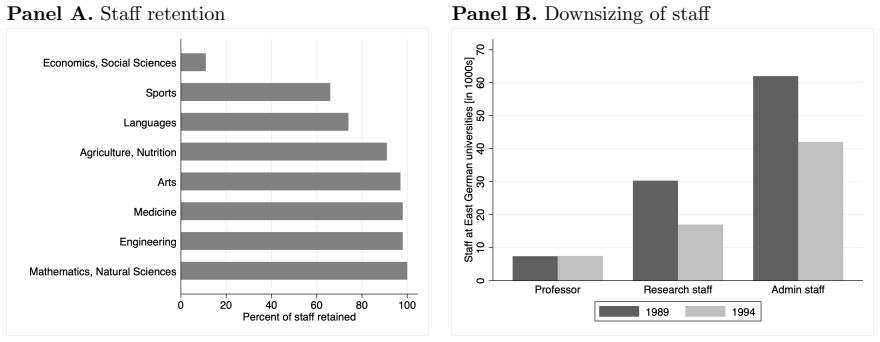
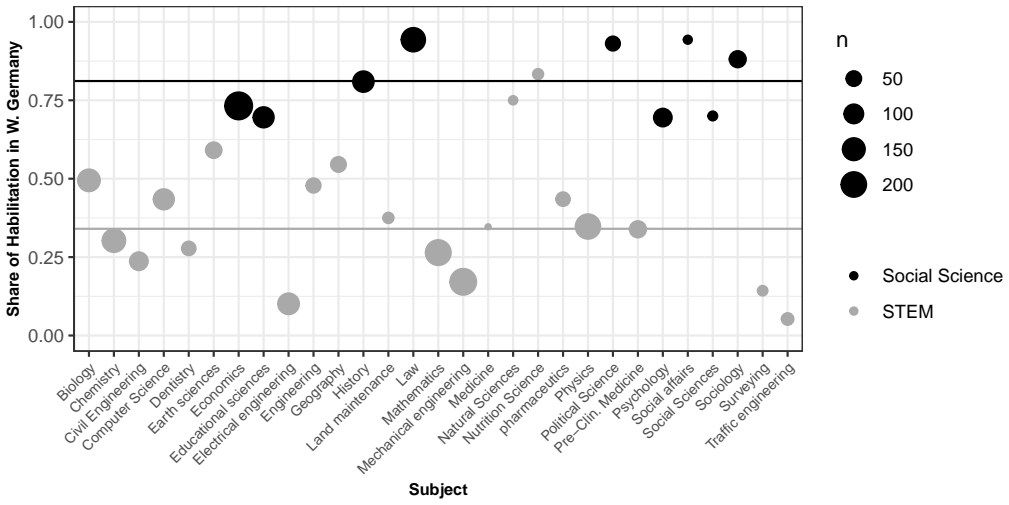
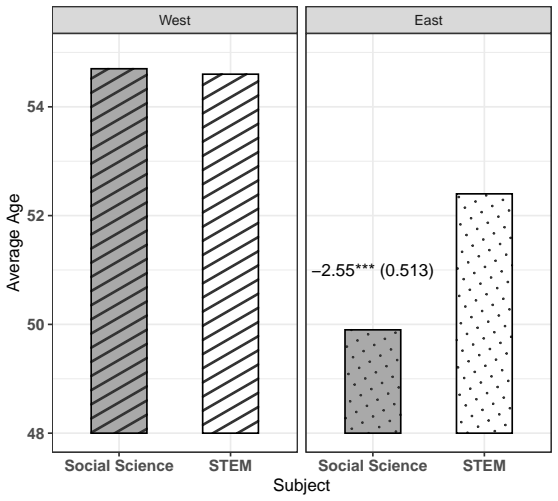
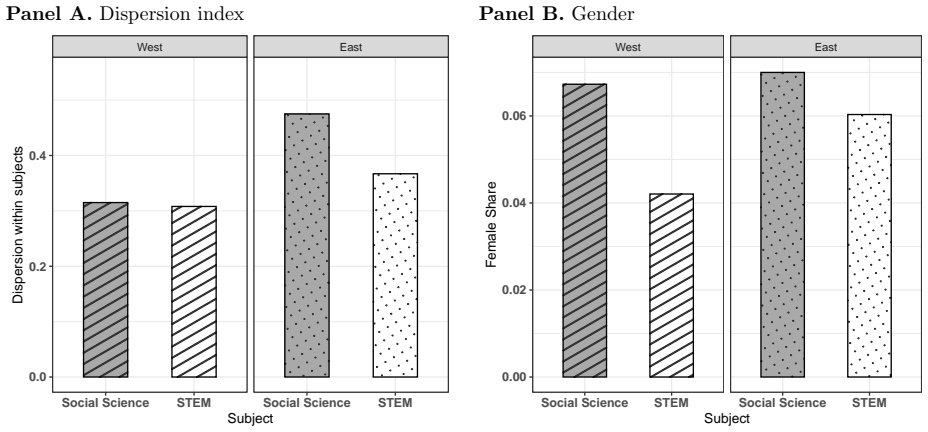
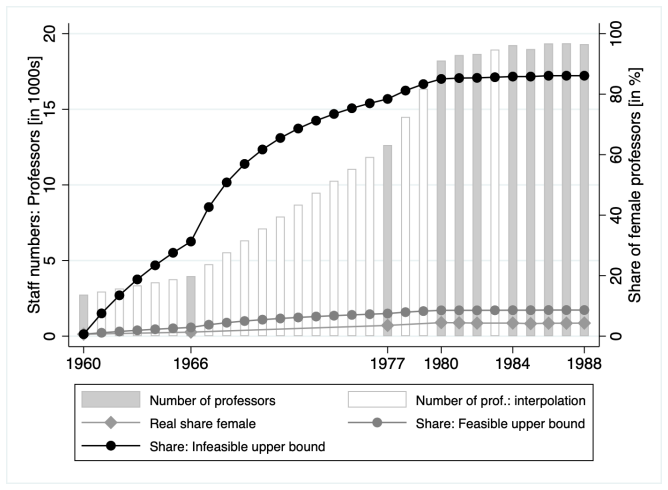
Exploiting the German reunification as a natural experiment, where nearly all social sciences professors in East Germany were replaced while STEM faculty remained largely unchanged, and using a regional difference-in-differences design on administrative data, the study finds increased dispersion in the institutional quality of hires together with convergence of East German hiring patterns to West German ones in gender composition. Female representation did not increase despite qualified women in the pipeline. Simulations under conservative assumptions show that the marginal female hire's quality is approximately half a standard deviation higher than the marginal male hire's quality when the
What carries the argument
A regional difference-in-differences design that treats German reunification as an exogenous positive labor demand shock to East German social science departments, paired with a conceptual framework that illustrates the potential trade-off between workforce demographic composition and quality composition.
If this is right
- New hires after the demand shock came from a wider range of departments, raising dispersion in institutional quality.
- East German gender composition of hires moved toward West German levels rather than increasing female representation.
- The pipeline contained qualified women who were not selected, producing an estimated quality gap of half a standard deviation between marginal female and male hires.
- Workforce expansion driven solely by demand can widen quality variation while leaving demographic composition unchanged.
Where Pith is reading between the lines
- The same pattern could appear in other academic fields or countries facing sudden hiring surges if selection criteria remain unchanged.
- Targeted diversity interventions might reduce both the observed quality dispersion and the gender gap identified in the simulations.
- Institutional norms shared across regions appear to shape gender outcomes more than local differences in applicant supply.
Load-bearing premise
The German reunification created a clean exogenous labor demand shock in East German social sciences whose effects can be isolated by comparing regions without other changes in applicant pools or hiring rules.
What would settle it
Administrative records showing that the distribution of qualified female applicants available to East German departments shifted differently from West German departments after reunification would undermine the claim that hiring choices, rather than supply, explain the stable gender share.
Figures





read the original abstract
How do labor demand shocks affect workforce diversity in the absence of targeted diversity policies? A conceptual framework illustrates the potential trade-off between the demographic and quality composition of a workforce when there is a positive labor demand shock. Exploiting the German reunification as a natural experiment, we analyze the academic labor market where nearly all social sciences professors in East Germany were replaced while STEM faculty remained largely unchanged. Using administrative data and a regional difference-in-differences design, we find increased dispersion in the institutional quality of hires, indicating that the new hires came from less select departments. At the same time, female representation did not increase despite qualified women in the pipeline. Instead, East German hiring patterns converged to those in West Germany in terms of gender composition. In simulations, we investigate implied losses: Under conservative assumptions, we show that, considering the pipeline of qualified applicants, the marginal female hire's quality is approximately half a standard deviation higher than the marginal male hire's quality.
Editorial analysis
A structured set of objections, weighed in public.
Referee Report
Summary. The paper claims that a positive labor demand shock—induced by the near-total replacement of East German social-science faculty after reunification, while STEM faculty remained stable—led to greater dispersion in the institutional quality of new hires (indicating recruitment from less selective departments), no increase in female representation despite qualified women in the pipeline, convergence of East German gender hiring patterns to those in West Germany, and (via simulations) that the marginal female hire's quality exceeds that of the marginal male hire by roughly half a standard deviation under conservative assumptions.
Significance. If the identification holds, the results document a concrete trade-off between expanding workforce size and achieving demographic diversity in the absence of targeted policies, with quantitative implications for the quality cost of forgoing female hires. The use of administrative data on academic hiring and the simulation exercise that translates pipeline differences into quality gaps are strengths that would contribute to the literature on labor demand shocks and gender in high-skill markets.
major comments (2)
- [Abstract / identification strategy] The regional difference-in-differences design (Abstract) treats the reunification-driven replacement of East German social-science faculty as an exogenous positive demand shock whose effects are isolated by comparing to West Germany and to STEM fields. This claim is load-bearing for both the quality-dispersion and gender-composition results, yet the design is vulnerable to differential post-1990 changes in applicant pools, East-West mobility, political vetting, or hiring-committee composition that could contaminate the treated group relative to controls.
- [Simulations] The simulation exercise that concludes the marginal female hire is approximately half a standard deviation higher quality than the marginal male hire (Abstract) rests on 'conservative assumptions' about the pipeline of qualified applicants. Without explicit reporting of how the applicant pool is constructed, how institutional quality is measured, or sensitivity to alternative thresholds, it is difficult to assess whether the half-SD gap is robust or an artifact of the maintained assumptions.
minor comments (1)
- [Abstract] The abstract states the main findings but provides no information on data sources, sample construction, or the precise definition of 'institutional quality,' which makes it hard to evaluate the dispersion result.
Simulated Author's Rebuttal
We thank the referee for the detailed and constructive report. Below we respond to the major comments and indicate the planned revisions to the manuscript.
read point-by-point responses
-
Referee: [Abstract / identification strategy] The regional difference-in-differences design (Abstract) treats the reunification-driven replacement of East German social-science faculty as an exogenous positive demand shock whose effects are isolated by comparing to West Germany and to STEM fields. This claim is load-bearing for both the quality-dispersion and gender-composition results, yet the design is vulnerable to differential post-1990 changes in applicant pools, East-West mobility, political vetting, or hiring-committee composition that could contaminate the treated group relative to controls.
Authors: The design exploits the near-total replacement of East German social-science faculty (the demand shock) against two controls: STEM fields within East Germany, where replacement was minimal, and West Germany, where no analogous shock occurred. This isolates the effect while netting out national trends and field-specific factors. We will revise the manuscript to add an extended discussion of potential threats, including descriptive evidence on hire origins to address mobility and applicant-pool shifts, and historical context on political vetting (which was concentrated in the East but applied across fields as part of the replacement process itself). We will also report robustness checks that exclude potentially mobile hires and discuss available information on hiring-committee changes. These additions will clarify why the design remains credible while acknowledging remaining limitations. revision: partial
-
Referee: [Simulations] The simulation exercise that concludes the marginal female hire is approximately half a standard deviation higher quality than the marginal male hire (Abstract) rests on 'conservative assumptions' about the pipeline of qualified applicants. Without explicit reporting of how the applicant pool is constructed, how institutional quality is measured, or sensitivity to alternative thresholds, it is difficult to assess whether the half-SD gap is robust or an artifact of the maintained assumptions.
Authors: We agree that greater transparency is needed. In the revised manuscript we will expand the simulation section with a dedicated subsection that (i) details the construction of the qualified applicant pool from the observed pipeline data, (ii) specifies the exact institutional-quality metric and its source, and (iii) presents a full set of sensitivity analyses varying thresholds and alternative conservative assumptions. These additions will allow readers to verify that the reported half-standard-deviation quality advantage for the marginal female hire holds under the range of specifications considered. revision: yes
Circularity Check
No circularity: identification rests on external historical variation
full rationale
The paper's central claims derive from a regional difference-in-differences design that treats German reunification as an exogenous labor-demand shock affecting East German social-science faculty replacement while leaving STEM and West German controls largely unchanged. This identification draws on documented historical facts outside the paper's fitted values or internal definitions. No equations reduce fitted parameters to predictions by construction, no self-citations supply load-bearing uniqueness theorems, and the simulations apply stated conservative assumptions to pipeline data without tautological closure. The derivation chain is therefore self-contained against external benchmarks.
Axiom & Free-Parameter Ledger
axioms (1)
- domain assumption Parallel trends assumption in the difference-in-differences design
Reference graph
Works this paper leans on
-
[2]
Climbing the
Abramitzky, Ran and Greska, Lena and P. Climbing the
-
[3]
Adams, Ren. Women in the. Journal of Financial Economics , volume =. doi:10.1016/j.jfineco.2008.10.007 , urldate =
-
[4]
Excitation of Unidentified Infrared Bands by H atom impact
Adams, Ren. Beyond the. Management Science , volume =. doi:10.1287/mnsc.1110.1452 , urldate =
work page internal anchor Pith review Pith/arXiv arXiv doi:10.1287/mnsc.1110.1452
-
[5]
Ahern and Amy K
Kenneth R. Ahern and Amy K. Dittmar , journal =. 2012 , url =
2012
-
[6]
Inequality in Science : Who Becomes a Star ?
Airoldi, Anna and Moser, Petra. Inequality in Science : Who Becomes a Star ?. 2024
2024
-
[7]
Alan, Sule and Ertac, Seda and Kubilay, Elif and Loranth, Gyongyi , year = 2020, url =. Understanding. The Economic Journal , volume =. doi:10.1093/ej/uez050 , urldate =
-
[8]
Alan, Sule and Corekcioglu, Gozde and Kaba, Mustafa and Sutter, Matthias , url =. Female
-
[9]
Alesina, Alberto and Ferrara, Eliana La , year = 2005, month = sep, journal =. Ethnic. doi:10.1257/002205105774431243 , urldate =
-
[10]
Journal of Population Economics , volume =
Asian. Journal of Population Economics , volume =. doi:10.1007/s00148-024-00985-1 , urldate =
-
[11]
Antecol, Heather and Bedard, Kelly and Stearns, Jenna , year = 2018, month = sep, journal =. Equal but. doi:10.1257/aer.20160613 , urldate =
-
[12]
Antman, Francisca M. and Doran, Kirk B. and Qian, Xuechao and Weinberg, Bruce A. , Title =. AEA Papers and Proceedings , Volume =. 2024 , Month =. doi:10.1257/pandp.20241116 , URL =
-
[13]
Antman, Francisca M. and Doran, Kirk B. and Qian, Xuechao and Weinberg, Bruce A. , Title =. AEA Papers and Proceedings , Volume =. 2024 , Month =. doi:10.1257/pandp.20241129 , URL =
-
[14]
Arag. Gender. Proceedings of the National Academy of Sciences , volume =. doi:10.1073/pnas.2118466120 , urldate =
-
[16]
Ashenfelter, Orley and Hannan, Timothy , year = 1986, month = feb, journal =. Sex. doi:10.2307/1884646 , urldate =
-
[17]
Gender and the
Ashraf, Nava and Bandiera, Oriana and Minni, Virginia and. Gender and the
-
[18]
Ashraf, Nava and Bandiera, Oriana and Minni, Virginia and. Gender
-
[19]
The Economic Journal , volume =
Do. The Economic Journal , volume =. doi:10.1111/j.1468-0297.2007.02024.x , url=
-
[20]
Auer, Daniel , year = 2022, month = jan, journal =. Firing. doi:10.1371/journal.pone.0262337 , url =
-
[21]
Proceedings of the National Academy of Sciences , volume =
Emmanuelle Auriol and Guido Friebel and Alisa Weinberger and Sascha Wilhelm , title = ". Proceedings of the National Academy of Sciences , volume =. 2022 , doi =
2022
-
[22]
Auriol, Emmanuelle and Friebel, Guido and Weinberger, Alisa and Wilhelm, Sascha , year = 2022, month = apr, journal =. Underrepresentation of. doi:10.1073/pnas.2118853119 , url =
-
[23]
Azlor, Luz and Damm, Anna Piil and. Local. Labour Economics , volume =. doi:10.1016/j.labeco.2020.101808 , url =
-
[24]
Gender Gaps in Unemployment Rates in OECD Countries ,
Ghazala Azmat and Maia Güell and Alan Manning , journal =. Gender Gaps in Unemployment Rates in OECD Countries ,
-
[25]
Azmat, Ghazala and G. Gender. Journal of Labor Economics , volume =. doi:10.1086/497817 , urldate =
-
[26]
Azmat, Ghazala and Cu. Gender. Management Science , volume =. doi:10.1287/mnsc.2023.00715 , urldate =
-
[27]
Azoulay, Pierre and. Does. American Economic Review , volume =. doi:10.1257/aer.20161574 , urldate =
-
[28]
Baert, Stijn and Cockx, Bart and Gheyle, Niels and Vandamme, Cora , year = 2013, month = jan, number =. Do. doi:10.2139/ssrn.2214896 , urldate =. Social Science Research Network , langid =:2214896 , publisher =
-
[29]
Baert, Stijn and Cockx, Bart and Gheyle, Niels and Vandamme, Cora , year = 2015, journal =. Is. 24810311 , eprinttype =
2015
-
[30]
Baert, Stijn , year = 2018, pages =. Hiring. Audit. doi:10.1007/978-3-319-71153-9_3 , url =
-
[31]
Bagues, M.F. and. Can. Review of Economic Studies , volume =. doi:10.1111/j.1467-937X.2009.00601.x , url =
-
[33]
Bagues, Manuel and. Does the. American Economic Review , volume =. doi:10.1257/aer.20151211 , urldate =
-
[34]
Balgova, Maria and Illing, Hannah , year =. The. Journal of Human Resources , issn =. doi:10.2139/ssrn.5046041 , urldate =
-
[35]
The Labor Market Costs of Job Displacement by Migrant Status , author=
-
[36]
Baltrunaite, Audinga and Casarico, Alessandra and Rizzica, Lucia , year = 2025, month = nov, journal =. Women in. doi:10.1016/j.euroecorev.2025.105155 , url =
-
[37]
Einwanderung Klug, Einfach Und Fair Gestalten: Ein Vorschlag Mit Doppelter Dividende ,
Barišić, Manuela and J \"a ger, Simon and Manning, Alan and Mu\ noz, Mathilde and Rinne, Ulf and Stuhler, Jan. Einwanderung Klug, Einfach Und Fair Gestalten: Ein Vorschlag Mit Doppelter Dividende ,. 2023
2023
-
[38]
Barth, Erling and Bratsberg, Bernt and Raaum, Oddbj. Identifying. The Scandinavian Journal of Economics , volume =. doi:10.1111/j.0347-0520.2004.t01-1-00345.x , urldate =
-
[39]
and Patacchini, Eleonora , year = 2023, month = jul, journal =
Battaglini, Marco and Harris, Jorgen M. and Patacchini, Eleonora , year = 2023, month = jul, journal =. Interactions with. doi:10.1086/720392 , url=
-
[40]
Journal of Economic Perspectives , Volume =
Bayer, Amanda and Rouse, Cecilia Elena , Title = ". Journal of Economic Perspectives , Volume =. 2016 , Month =. doi:10.1257/jep.30.4.221 , URL =
-
[41]
and Duflo, E
Beaman, L. and Duflo, E. and Pande, R. and Topalova, P. , year = 2012, month = jan, journal =. Female
2012
-
[42]
Bear, Stephen and Rahman, Noushi and Post, Corinne , year = 2010, month = dec, journal =. The. doi:10.1007/s10551-010-0505-2 , urldate =
-
[43]
The Economics of Discrimination
Becker, Gary , year=. The Economics of Discrimination
-
[44]
and Fernandes, Ana and Weichselbaumer, Doris , year = 2019, month = aug, journal =
Becker, Sascha O. and Fernandes, Ana and Weichselbaumer, Doris , year = 2019, month = aug, journal =. Discrimination in Hiring Based on Potential and Realized Fertility:. doi:10.1016/j.labeco.2019.04.009 , urldate =
-
[45]
and Mergele, Lukas and Woessmann, Ludger , year = 2020, month = may, journal =
Becker, Sascha O. and Mergele, Lukas and Woessmann, Ludger , year = 2020, month = may, journal =. The. doi:10.1257/jep.34.2.143 , url =
-
[46]
Journal of Economic Perspectives , volume=
The Separation and Reunification of Germany: Rethinking a Natural Experiment Interpretation of the Enduring Effects of Communism , author=. Journal of Economic Perspectives , volume=. 2020 , url =
2020
-
[47]
Bednar, Steven and Gicheva, Dora , year = 2014, month = may, journal =. Are. doi:10.1257/aer.104.5.370 , urldate =
-
[48]
Bello, Piera and Casarico, Alessandra and Nozza, Debora , year = 2023, journal =. Research. doi:10.2139/ssrn.4583747 , urldate =
-
[49]
American Economic Review , Volume =
Benson, Alan and Li, Danielle and Shue, Kelly , Title =. American Economic Review , Volume =. 2026 , Month =. doi:10.1257/aer.20220831 , URL =
-
[50]
Berb. The. Economic Policy , volume =. doi:10.1093/epolic/eiae040 , url =
-
[51]
and Weber, Michael , year = 2024, month = jan, series =
Bergman, Nittai and Born, Benjamin and Matsa, David A. and Weber, Michael , year = 2024, month = jan, series =. Inclusive. doi:10.3386/w29651 , url =. 29651 , publisher =
-
[52]
Bertrand, Marianne and Mullainathan, Sendhil , year = 2004, month = sep, journal =. Are. doi:10.1257/0002828042002561 , urldate =
-
[53]
American Economic Review , volume=
Are Emily and Greg More Employable Than Lakisha and Jamal? a Field Experiment on Labor Market Discrimination , author=. American Economic Review , volume=
-
[54]
Field Experiments on Discrimination , publisher =. 2017 , issn =. doi:https://doi.org/10.1016/bs.hefe.2016.08.004 , url =
-
[56]
Bertrand, Marianne and Black, Sandra E. and Jensen, Sissel and. Breaking the. The Review of Economic Studies , volume =. doi:10.1093/restud/rdy032 , urldate =
-
[57]
2023 , institution=
Bethmann, Dirk and Bransch, Felix and Kvasnicka, Michael and Sadrieh, Abdolkarim , title=. 2023 , institution=
2023
-
[58]
Biasi, Barbara and Ma, Song , langid =. The
-
[59]
Biddle, Jeff E. and Hamermesh, Daniel S. , year = 2013, month = jul, journal =. Wage. doi:10.1186/2193-9004-2-7 , urldate =
-
[60]
Biliotti, Carolina and Verginer, Luca and Riccaboni, Massimo , year = 2025, month = jan, number =. Breaking. doi:10.48550/arXiv.2404.04707 , urldate =. arXiv , langid =:2404.04707 , primaryclass =
-
[61]
2025 , month=
Cagatay Bircan and Guido Friebel and Tristan Stahl , title=. 2025 , month=. doi:None , url=
2025
-
[62]
Black, Sandra E. and Strahan, Philip E. , year = 2001, month = sep, journal =. The. doi:10.1257/aer.91.4.814 , URL =
-
[63]
and Brainerd, Elizabeth , year = 2004, journal =
Black, Sandra E. and Brainerd, Elizabeth , year = 2004, journal =. Importing. doi:10.2307/4126682 , urldate =. 4126682 , eprinttype =
-
[65]
Black, Sandra E. and Denning, Jeffrey T. and Rothstein, Jesse , year = 2023, month = jan, journal =. Winners and. doi:10.1257/app.20200137 , urldate =
-
[66]
Blau, Francine D and Lynch, Lisa M , year = 2024, number =. 50
2024
-
[67]
2024 , month=
Barbara Boelmann , title=. 2024 , month=. doi:None , url=
2024
-
[68]
and Leigh, Andrew and Varganova, Elena , year = 2012, journal =
Booth, Alison L. and Leigh, Andrew and Varganova, Elena , year = 2012, journal =. Does. doi:10.1111/j.1468-0084.2011.00664.x , urldate =
-
[69]
Bordalo, Pedro and Coffman, Katherine and Gennaioli, Nicola and Shleifer, Andrei , year = 2019, month = mar, journal =. Beliefs About. doi:10.1257/aer.20170007 , urldate =
-
[70]
Boring, Anne , year = 2017, month = jan, journal =. Gender. doi:10.1016/j.jpubeco.2016.11.006 , url =
-
[71]
Social Desirability Bias in Attitudes Towards Sexism and
Boring, Anne and Delfgaauw, Josse , year = 2024, month = sep, journal =. Social Desirability Bias in Attitudes Towards Sexism and. doi:10.1016/j.jebo.2024.07.010 , urldate =
-
[72]
Born, Andreas and Ranehill, Eva and Sandberg, Anna , year = 2022, month = mar, journal =. Gender and. doi:10.1162/rest_a_00955 , urldate =
-
[73]
Bornmann, Lutz and Mutz, R. Gender. Journal of Informetrics , series =. doi:10.1016/j.joi.2007.03.001 , url =
-
[75]
, year = 2019, month = may, journal =
Boulware, Karl David and Kuttner, Kenneth N. , year = 2019, month = may, journal =. Labor. doi:10.1257/pandp.20191086 , urldate =
-
[76]
Bransch, Felix and Kvasnicka, Michael , year = 2022, month = oct, journal =. Male. doi:10.1016/j.jebo.2022.07.031 , url=
-
[77]
Bratsberg, Bernt and Barth, Erling and Raaum, Oddbj. Local. Review of Economics and Statistics , volume =. doi:10.1162/rest.88.2.243 , urldate =
-
[78]
Hochschulen in den Neuen L \"a ndern der Bundesrepublik Deutschland
Buck-Bechler, Gertraude and Schaefer, Hans-Dieter and Wagemann, Carl-Hellmut , year=. Hochschulen in den Neuen L \"a ndern der Bundesrepublik Deutschland. Ein Handbuch zur Hochschulernennung
-
[80]
Buckles, Kasey , year = 2019, month = feb, journal =. Fixing the. doi:10.1257/jep.33.1.43 , urldate =
-
[81]
Frauen Der
Budde, Gunilla-Friederike , year=. Frauen Der
-
[82]
Personalbestand an Hochschulen Der Ehemaligen DDR 1989 Und 1990 ,
Burkhardt, Anke and Scherer, Doris and Erdner, Sabine , year=. Personalbestand an Hochschulen Der Ehemaligen DDR 1989 Und 1990 ,
1989
-
[83]
1995 , publisher = "
Burkhardt, Anke and Scherer, Doris , title =. 1995 , publisher = "
1995
-
[84]
Burkhardt, Anke , year = 1997, number =. Stellen
1997
-
[85]
Butcher, Kristin F. and McEwan, Patrick J. and Weerapana, Akila , year = 2024, month = apr, journal =. Women's. doi:10.1080/13545701.2024.2334886 , url =
-
[87]
Card, David and DellaVigna, Stefano and Funk, Patricia and Iriberri, Nagore , year = 2020, month = feb, journal =. Are. doi:10.1093/qje/qjz035 , urldate =
-
[89]
Card, David and DellaVigna, Stefano and Funk, Patricia and Iriberri, Nagore , year = 2022, journal =. Gender. doi:10.3982/ECTA18027 , urldate =
discussion (0)
Sign in with ORCID, Apple, or X to comment. Anyone can read and Pith papers without signing in.