Dynamic multi-agent deep reinforcement learning-based pricing and incentivization approach in multimodal transportation networks
Pith reviewed 2026-06-26 09:11 UTC · model grok-4.3
The pith
A multi-agent deep reinforcement learning framework coordinates dynamic pricing for shared mobility services and incentives for public transport to reduce costs and emissions while increasing profits and equity.
A machine-rendered reading of the paper's core claim, the machinery that carries it, and where it could break.
Core claim
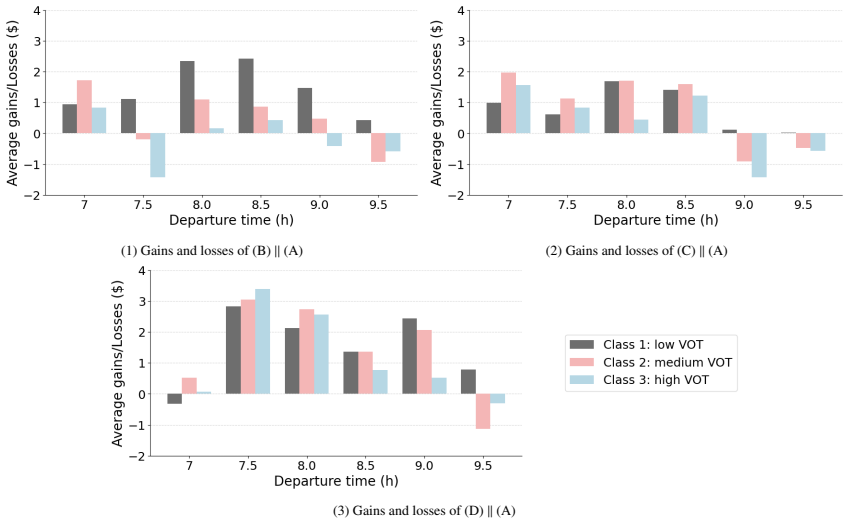
The multi-agent deep reinforcement learning framework integrates two agents that capture interactions through dynamic pricing and incentivization strategies for SMSs and public transport, adapt to evolving demand, congestion, and network conditions, and in numerical experiments over a three-hour morning peak period effectively reduce congestion peaks, lower commuters' costs by around 20% and emissions by approximately 10%, while nearly doubling public transport profit and supporting a more equitable distribution of benefits.
What carries the argument
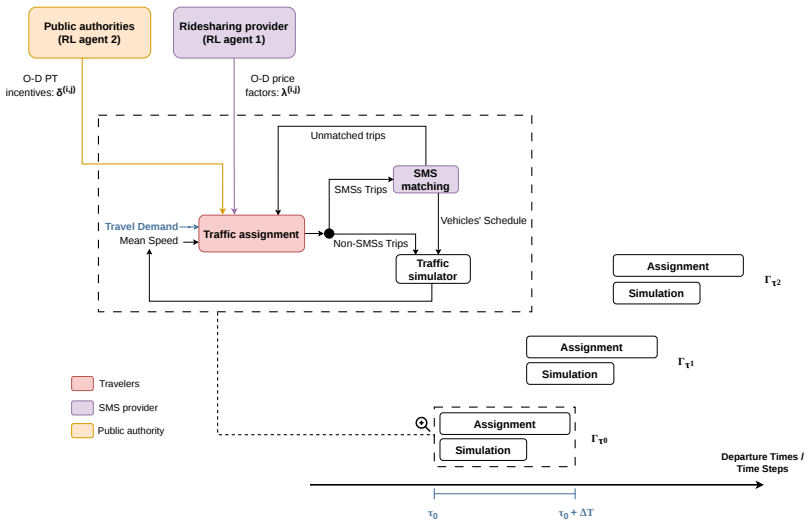
Two reinforcement learning agents, one for the public authority allocating spatio-temporal incentives and one for the SMS provider dynamically adjusting fares, that interact with the transportation system.
If this is right
- Congestion peaks are reduced during peak periods.
- Commuter costs drop by around 20%.
- Emissions fall by about 10%.
- Public transport profit nearly doubles.
- Benefits are distributed more equitably.
Where Pith is reading between the lines
- The framework could be used to simulate and test the impacts of various policy changes before implementing them in real cities.
- Similar multi-agent reinforcement learning methods might coordinate stakeholders in other domains with conflicting goals, such as resource allocation in smart cities.
- Validating the models with real traveler data would allow checking if the reported improvements hold outside the simulation.
- Adding more agents for other mobility options could extend the coordination to larger systems.
Load-bearing premise
The simulated transportation system and traveler response model used in the experiments accurately represent real-world demand patterns, congestion dynamics, and behavioral responses to pricing and incentives.
What would settle it
Applying the pricing and incentivization strategies learned by the agents in an actual city network and finding no reduction in congestion peaks or commuter costs would show the approach does not deliver the claimed benefits.
Figures





read the original abstract
In multimodal transportation systems, shared mobility services (SMSs) are promoted for their potential to enhance flexibility and reduce congestion. However, SMS demand is often concentrated in high-density areas, which can limit the effectiveness and accessibility for various commuter groups. This uneven integration challenges transportation system efficiency, especially in terms of emissions and spatial equity. Addressing these issues requires coordination among multiple stakeholders whose objectives frequently conflict. Whereas authorities aim to ensure sustainable and equitable mobility, SMS providers focus on revenue maximization, and travelers seek to minimize personal travel costs. This paper proposes a multi-agent deep reinforcement learning framework that captures these interactions through dynamic pricing and incentivization strategies for SMSs and public transport. The framework integrates two reinforcement learning (RL) agents: (i) a public authority that allocates spatio-temporal public transport incentives to improve equity, emissions, and efficiency, and (ii) an SMS provider that dynamically adjusts fares to optimize revenue. The agents interact with the transportation system and adapt strategies in response to evolving demand, congestion, and network conditions. Numerical experiments conducted over a three-hour morning peak period show that dynamic incentivization effectively reduces congestion peaks, lowers commuters' costs by around 20% and emissions by approximately 10%, while nearly doubling public transport profit and supporting a more equitable distribution of benefits. When combined with dynamic SMS pricing, the two RL agents demonstrate the ability to balance conflicting objectives between private providers and public authorities. The proposed approach provides a decision-support tool for sustainable and equitable multimodal mobility planning.
Editorial analysis
A structured set of objections, weighed in public.
Referee Report
Summary. The manuscript proposes a multi-agent deep reinforcement learning framework for coordinating dynamic pricing by shared mobility service (SMS) providers and spatio-temporal incentivization by public authorities in multimodal transportation networks. Two RL agents interact with an agent-based simulator: one optimizes SMS fares for revenue, the other allocates incentives to improve equity, emissions, and system efficiency. Numerical experiments over a three-hour morning peak period report that the approach reduces congestion peaks, lowers commuter costs by around 20%, cuts emissions by approximately 10%, nearly doubles public transport profit, and improves equity; combining both agents balances stakeholder objectives.
Significance. If the experimental claims hold under validated conditions, the work could supply a practical decision-support tool for balancing revenue, sustainability, and equity goals in multimodal systems via adaptive RL agents. The multi-agent formulation directly addresses conflicting objectives among authorities, providers, and travelers, which is a relevant direction for transportation optimization. No machine-checked proofs, open code, or parameter-free derivations are described.
major comments (2)
- [Abstract and Numerical Experiments] Abstract and Numerical Experiments section: the central quantitative claims (commuter costs reduced by ~20%, emissions by ~10%, public transport profit nearly doubled) rest on an internally generated synthetic demand model whose origin-destination matrix, mode-choice probabilities, congestion functions, and behavioral elasticities are not calibrated to observed counts or revealed-preference data. No calibration metrics, hold-out validation, sensitivity analysis over key parameters, or comparison against real-world network topology are supplied, so the reported deltas cannot be distinguished from artifacts of the chosen functional forms.
- [Abstract and Numerical Experiments] Abstract and Numerical Experiments section: the experiments supply no information on simulation setup details (network size, demand generation procedure, baseline policies, number of runs, error bars, or statistical significance tests), making it impossible to assess whether the reported improvements are robust or reproducible.
minor comments (1)
- [Abstract] Abstract: the description of the two RL agents would be clearer if the specific deep RL algorithms (e.g., DQN, PPO, or actor-critic variants) and state/action spaces were named.
Simulated Author's Rebuttal
We thank the referee for the detailed and constructive comments on the experimental claims and setup. We address each point below and will revise the manuscript accordingly to improve transparency and clarify the scope of the numerical results.
read point-by-point responses
-
Referee: [Abstract and Numerical Experiments] Abstract and Numerical Experiments section: the central quantitative claims (commuter costs reduced by ~20%, emissions by ~10%, public transport profit nearly doubled) rest on an internally generated synthetic demand model whose origin-destination matrix, mode-choice probabilities, congestion functions, and behavioral elasticities are not calibrated to observed counts or revealed-preference data. No calibration metrics, hold-out validation, sensitivity analysis over key parameters, or comparison against real-world network topology are supplied, so the reported deltas cannot be distinguished from artifacts of the chosen functional forms.
Authors: We agree that the demand model is fully synthetic and has not been calibrated against real-world counts or revealed-preference data. This design choice was made to enable controlled, reproducible experiments that isolate the impact of the multi-agent RL policies under varying congestion and equity conditions. We acknowledge that the reported percentage improvements are therefore illustrative rather than predictive of any specific city. In the revised manuscript we will (i) add an explicit Limitations subsection stating the synthetic nature of the demand model, (ii) include a sensitivity analysis over the main behavioral elasticities and congestion parameters, and (iii) clarify that future work will seek calibration with observed data. These changes will prevent readers from over-generalizing the numerical deltas. revision: yes
-
Referee: [Abstract and Numerical Experiments] Abstract and Numerical Experiments section: the experiments supply no information on simulation setup details (network size, demand generation procedure, baseline policies, number of runs, error bars, or statistical significance tests), making it impossible to assess whether the reported improvements are robust or reproducible.
Authors: We apologize for the omission of these implementation details. The revised manuscript will contain a new subsection (likely 4.1 or 4.2) that reports: network topology (number of nodes, links, and zones), the exact procedure used to generate the synthetic origin-destination matrix and time-varying demand, the baseline policies against which the RL agents are compared, the number of independent simulation runs performed, the presence of error bars or confidence intervals on all reported figures, and the statistical tests (e.g., paired t-tests) used to assess significance of the observed differences. We believe these additions will allow readers to evaluate reproducibility. revision: yes
Circularity Check
No circularity detected; simulation results do not reduce to self-referential inputs by construction.
full rationale
The paper describes a multi-agent RL framework for dynamic pricing and incentives, then reports outcomes from numerical experiments on a three-hour peak period. No derivation chain, equations, or parameter-fitting steps are presented that would make the reported 20% cost reduction, 10% emissions drop, or doubled PT profit equivalent to the model's own inputs by definition. The results are generated by running the proposed agents inside a simulator; this is standard empirical evaluation rather than a fitted-input-called-prediction or self-definitional loop. No self-citation is invoked as a uniqueness theorem or load-bearing premise. The paper is therefore self-contained against the circularity criteria, with the quantitative claims resting on the simulator's behavior rather than on any internal algebraic identity.
Axiom & Free-Parameter Ledger
Reference graph
Works this paper leans on
-
[1]
Transportation Research Record: Journal of the Transportation Research Board , author =
Optimizing. Transportation Research Record: Journal of the Transportation Research Board , author =. 2021 , pages =. doi:10.1177/03611981211025512 , abstract =
-
[2]
Transportation Research Part C: Emerging Technologies , author =
Personalized incentives for promoting sustainable travel behaviors , volume =. Transportation Research Part C: Emerging Technologies , author =. 2020 , keywords =. doi:10.1016/j.trc.2019.05.015 , abstract =
-
[3]
The effects of public transport subsidies for lower-income users on public transport use:. Transport Policy , author =. 2022 , keywords =. doi:10.1016/j.tranpol.2022.07.016 , abstract =
-
[4]
A. Mathematics , author =. 2025 , note =. doi:10.3390/math13111738 , abstract =
-
[5]
The potential of governmental regulation on shared mobility-on-demand systems , volume =. Transportation Research Part A: Policy and Practice , author =. 2025 , pages =. doi:10.1016/j.tra.2024.104360 , abstract =
-
[6]
Transportation Research Part C: Emerging Technologies , author =
Regulating mobility-on-demand services:. Transportation Research Part C: Emerging Technologies , author =. 2021 , pages =. doi:10.1016/j.trc.2021.103075 , abstract =
-
[7]
Zardini, Gioele and Lanzetti, Nicolas and Guerrini, Laura and Frazzoli, Emilio and Dörfler, Florian , month = sep, year =. Game. 2021. doi:10.1109/ITSC48978.2021.9564501 , abstract =
-
[8]
Gerstgrasser, Matthias and Parkes, David C , year =. Meta-
-
[9]
Nekoei, Hadi and Badrinaaraayanan, Akilesh and Sinha, Amit and Amini, Mohammad and Rajendran, Janarthanan and Mahajan, Aditya and Chandar, Sarath , year =. Dealing. 2nd
-
[10]
Nekoei, Hadi and Badrinaaraayanan, Akilesh and Sinha, Amit and Amini, Mohammad and Rajendran, Janarthanan and Mahajan, Aditya and Chandar, Sarath , year =
-
[11]
Transportation Research Part C: Emerging Technologies , author =
Personalised incentives for demand management of congested public transport systems:. Transportation Research Part C: Emerging Technologies , author =. 2026 , keywords =. doi:10.1016/j.trc.2026.105566 , abstract =
-
[12]
OECD Net Zero+ Policy Papers , author =
Unlocking the potential of demand-side climate mitigation strategies , url =. OECD Net Zero+ Policy Papers , author =
-
[13]
European Commission: Mobility and Transport , author =
Sustainable & smart. European Commission: Mobility and Transport , author =
-
[14]
OECD Publishing , author =
-
[15]
OECD Publishing , author =
Regulating. OECD Publishing , author =
-
[16]
ITF Research Reports , author =
Sustainable. ITF Research Reports , author =
-
[17]
OECD Publishing , author =
How. OECD Publishing , author =
-
[18]
European Commission , year =. Road
-
[19]
Finding the. Manage. Sci. , author =. 1971 , pages =. doi:10.1287/mnsc.17.11.712 , abstract =
-
[20]
Transportation Research Part D: Transport and Environment , author =
Deep learning approach to predict microscopic pollutant emissions from mesoscopic traffic simulations , volume =. Transportation Research Part D: Transport and Environment , author =. 2025 , keywords =. doi:10.1016/j.trd.2025.104791 , abstract =
-
[21]
Transportation Research Record: Journal of the Transportation Research Board , author =
Integrating. Transportation Research Record: Journal of the Transportation Research Board , author =. 2016 , pages =. doi:10.3141/2597-03 , abstract =
-
[22]
Transportation Research Part A: Policy and Practice , author =
Exploring travelers’ responses to a prepeak discount fare policy and optimizing the pricing strategy to ease peak congestion:. Transportation Research Part A: Policy and Practice , author =. 2025 , keywords =. doi:10.1016/j.tra.2024.104335 , abstract =
-
[23]
Transportation Planning and Technology , author =
Ride-pooling adoption, efficiency and level of service under alternative demand, behavioural and pricing settings , volume =. Transportation Planning and Technology , author =. 2023 , note =. doi:10.1080/03081060.2023.2194874 , abstract =
-
[24]
Simulating impacts of. Cities , author =. 2021 , keywords =. doi:10.1016/j.cities.2021.103345 , abstract =
-
[25]
Transportation Research Record: Journal of the Transportation Research Board , author =
Estimation of. Transportation Research Record: Journal of the Transportation Research Board , author =. 2024 , pages =. doi:10.1177/03611981231223752 , abstract =
-
[26]
Transportation Research Part A: Policy and Practice , author =
Quantifying the employment accessibility benefits of shared automated vehicle mobility services:. Transportation Research Part A: Policy and Practice , author =. 2020 , keywords =. doi:10.1016/j.tra.2020.09.002 , abstract =
-
[27]
Transportation Research Part A: Policy and Practice , author =
Who benefits from. Transportation Research Part A: Policy and Practice , author =. 2021 , keywords =. doi:10.1016/j.tra.2021.09.013 , abstract =
-
[28]
Transportation Research Part C: Emerging Technologies , author =
Transit-oriented autonomous vehicle operation with integrated demand-supply interaction , volume =. Transportation Research Part C: Emerging Technologies , author =. 2018 , keywords =. doi:10.1016/j.trc.2018.10.018 , abstract =
-
[29]
Transportation Research Part E: Logistics and Transportation Review , author =
Regulating the ride-hailing market in the age of uberization , volume =. Transportation Research Part E: Logistics and Transportation Review , author =. 2023 , keywords =. doi:10.1016/j.tre.2022.102969 , abstract =
-
[30]
Transportation Research Part A: Policy and Practice , author =
Optimal fare and fleet size regulation in a taxi/ride-sourcing market with congestion effects, emission externalities, and gasoline/electric vehicles , volume =. Transportation Research Part A: Policy and Practice , author =. 2022 , keywords =. doi:10.1016/j.tra.2021.12.012 , abstract =
-
[31]
Transportation Research Part C: Emerging Technologies , author =
Economic analysis of ride-sourcing markets , volume =. Transportation Research Part C: Emerging Technologies , author =. 2016 , keywords =. doi:10.1016/j.trc.2016.07.010 , abstract =
-
[32]
Transportation Research Part B: Methodological , author =
Competition and third-party platform-integration in ride-sourcing markets , volume =. Transportation Research Part B: Methodological , author =. 2022 , keywords =. doi:10.1016/j.trb.2021.08.002 , abstract =
-
[33]
Transportation Research Part C: Emerging Technologies , author =
Dynamic pricing and penalty strategies in a coupled market with ridesourcing service and taxi considering time-dependent order cancellation behaviour , volume =. Transportation Research Part C: Emerging Technologies , author =. 2022 , keywords =. doi:10.1016/j.trc.2022.103621 , abstract =
-
[34]
Transportation Research Part C: Emerging Technologies , author =
Spatio-temporal pricing algorithm for ride-hailing platforms where drivers can decline ride requests , volume =. Transportation Research Part C: Emerging Technologies , author =. 2023 , keywords =. doi:10.1016/j.trc.2023.104200 , abstract =
-
[35]
European Journal of Operational Research , author =
Optimal pricing for ride-sourcing platforms , volume =. European Journal of Operational Research , author =. 2019 , keywords =. doi:10.1016/j.ejor.2019.04.044 , abstract =
-
[36]
Transportation Research Part C: Emerging Technologies , author =
A hierarchical control framework for vehicle repositioning in ride-hailing systems , volume =. Transportation Research Part C: Emerging Technologies , author =. 2024 , keywords =. doi:10.1016/j.trc.2024.104717 , abstract =
-
[37]
Transportation Research Part C: Emerging Technologies , author =
Real-world ride-hailing vehicle repositioning using deep reinforcement learning , volume =. Transportation Research Part C: Emerging Technologies , author =. 2021 , keywords =. doi:10.1016/j.trc.2021.103289 , abstract =
-
[38]
Li, Minne and Qin, Zhiwei and Jiao, Yan and Yang, Yaodong and Wang, Jun and Wang, Chenxi and Wu, Guobin and Ye, Jieping , year =. Efficient. The. doi:10.1145/3308558.3313433 , abstract =
-
[39]
Transportmetrica B: Transport Dynamics , author =
A stochastic evolutionary dynamic game model for analyzing the ride-sourcing market with limited platform reputation , volume =. Transportmetrica B: Transport Dynamics , author =. 2023 , note =. doi:10.1080/21680566.2023.2248399 , abstract =
-
[41]
The network equilibrium problem in integers , volume =. Networks , author =. 1973 , pages =. doi:10.1002/net.3230030104 , abstract =
-
[42]
Journal of Social Issues , author =
Travel. Journal of Social Issues , author =. 2007 , pages =. doi:10.1111/j.1540-4560.2007.00500.x , abstract =
-
[43]
Gurobi Optimization, LLC , year =. Gurobi
-
[44]
Sustainable Development , author =
The smart future for sustainable development:. Sustainable Development , author =. 2025 , keywords =. doi:10.1002/sd.3131 , abstract =
-
[45]
Proceedings of the Institute of Civil Engineers, Part II , author =
Some. Proceedings of the Institute of Civil Engineers, Part II , author =. 1952 , pages =. doi:10.1680/ipeds.1952.11362 , language =
-
[46]
IEEE Transactions on Intelligent Transportation Systems , author =
Multi-. IEEE Transactions on Intelligent Transportation Systems , author =. 2023 , pages =. doi:10.1109/TITS.2023.3302014 , abstract =
-
[47]
Journal of Advanced Transportation , author =
Macroscopic. Journal of Advanced Transportation , author =. 2020 , note =. doi:10.1155/2020/4951953 , abstract =
-
[48]
Transportation Research Part C: Emerging Technologies , author =
Leveraging ride-hailing services for social good:. Transportation Research Part C: Emerging Technologies , author =. 2023 , pages =. doi:10.1016/j.trc.2023.104284 , abstract =
-
[49]
World Transport Policy & Practice , author =
Evaluating. World Transport Policy & Practice , author =. 2017 , pages =
2017
-
[50]
Transportation Research Part A: Policy and Practice , author =
Equity in network design and pricing:. Transportation Research Part A: Policy and Practice , author =. 2023 , keywords =. doi:10.1016/j.tra.2023.103800 , abstract =
-
[51]
Transportation Research Part C: Emerging Technologies , author =
Dynamic tradable credit scheme for multimodal urban networks , volume =. Transportation Research Part C: Emerging Technologies , author =. 2023 , keywords =. doi:10.1016/j.trc.2023.104061 , abstract =
-
[52]
Annals of Operations Research , author =
Adaptive forecast-driven repositioning for dynamic ride-sharing , issn =. Annals of Operations Research , author =. doi:10.1007/s10479-022-04560-3 , abstract =
-
[53]
Manufacturing & Service Operations Management , author =
The. Manufacturing & Service Operations Management , author =. 2017 , note =. doi:10.1287/msom.2017.0618 , abstract =
-
[54]
Numerical optimization , publisher =
nocedal, Jorge and Wright, Stephen J , year =. Numerical optimization , publisher =
-
[55]
Transportation
Stabler, Ben and Bar-Gera, Hillel and Sall, Elizabeth , year =. Transportation
-
[56]
Efficient. IEEE Access , author =. 2019 , keywords =. doi:10.1109/ACCESS.2019.2942497 , abstract =
-
[57]
Multimodal Transportation , author =
A meso-to-macro cross-resolution performance approach for connecting polynomial arrival queue model to volume-delay function with inflow demand-to-capacity ratio , volume =. Multimodal Transportation , author =. 2022 , keywords =. doi:10.1016/j.multra.2022.100017 , abstract =
-
[58]
Urban planning division , institution =
US DoC , year =. Urban planning division , institution =
-
[59]
Studies in the
Beckmann, Martin and McGuire, Charles B and Winsten, Christopher B , year =. Studies in the
-
[60]
Transportation Research Interdisciplinary Perspectives , author =
How realistic is static traffic assignment?. Transportation Research Interdisciplinary Perspectives , author =. 2021 , keywords =. doi:10.1016/j.trip.2021.100320 , abstract =
-
[61]
Transportation Research Interdisciplinary Perspectives , author =
Multimodal transport route selection:. Transportation Research Interdisciplinary Perspectives , author =. 2024 , keywords =. doi:10.1016/j.trip.2024.101252 , abstract =
-
[62]
and Verhoef, Erik T
Small, Kenneth A. and Verhoef, Erik T. and Lindsey, Robin , month = jun, year =. The
-
[63]
Optimization of dynamic incentive strategies for public transportation based on reinforcement learning and network synergy effect , volume =. Scientific Reports , author =. 2025 , note =. doi:10.1038/s41598-025-16632-y , abstract =
-
[64]
Guo, Qianwen and Lu, Jiaqing and Chow, Joseph Y. J. and Schonfeld, Paul , month = oct, year =. Equity-aware. doi:10.48550/arXiv.2502.08731 , abstract =
-
[65]
Transportation Research Part A: Policy and Practice , author =
A multi-dimension and high-granularity equity measurement for transportation services through accessibility and reliability , volume =. Transportation Research Part A: Policy and Practice , author =. 2026 , keywords =. doi:10.1016/j.tra.2025.104729 , abstract =
-
[66]
Transportation Research Part C: Emerging Technologies , author =
Transit fares integrating alternative modes as a delay insurance , volume =. Transportation Research Part C: Emerging Technologies , author =. 2024 , keywords =. doi:10.1016/j.trc.2024.104745 , abstract =
-
[67]
Transportmetrica B: Transport Dynamics , author =
Day-to-day dynamics in two-sided ridesourcing markets , volume =. Transportmetrica B: Transport Dynamics , author =. 2025 , pages =. doi:10.1080/21680566.2024.2439987 , abstract =
-
[68]
Journal of Transport & Health , author =
Policy measures to reduce road congestion:. Journal of Transport & Health , author =. 2025 , keywords =. doi:10.1016/j.jth.2025.101984 , abstract =
-
[69]
Transportation Research Part C: Emerging Technologies , author =
A multi-agent reinforcement learning framework for integrated traffic signal control and dynamic bus lane access management , volume =. Transportation Research Part C: Emerging Technologies , author =. 2026 , keywords =. doi:10.1016/j.trc.2025.105391 , abstract =
-
[70]
van Wee, Bert and Mouter, Niek , editor =. Chapter. Advances in. 2021 , doi =
2021
-
[71]
Research in Transportation Economics , author =
Part. Research in Transportation Economics , author =. 2010 , keywords =. doi:10.1016/j.retrec.2010.03.002 , abstract =
-
[72]
Environment, Development and Sustainability , author =
A forecast analysis on world population and urbanization process , volume =. Environment, Development and Sustainability , author =. 2008 , keywords =. doi:10.1007/s10668-007-9081-8 , abstract =
-
[73]
Meeting goals of sustainability policy:. Energy Policy , author =. 2020 , keywords =. doi:10.1016/j.enpol.2019.111210 , abstract =
-
[74]
Journal of Machine Learning Research , author =
Stable-. Journal of Machine Learning Research , author =. 2021 , pages =
2021
-
[75]
Caspi, Itai and Leibovich, Gal and Endrawis, Shadi and Novik, Gal , month = dec, year =. Reinforcement. doi:10.5281/ZENODO.1134899 , note =
-
[76]
Transportation Research Part C: Emerging Technologies , author =
Assessing how ride-hailing rebalancing strategies improve the resilience of multi-modal transportation systems , volume =. Transportation Research Part C: Emerging Technologies , author =. 2025 , keywords =. doi:10.1016/j.trc.2025.105300 , abstract =
-
[77]
The critical role of the value of time in peer-to-peer ridesharing models , issn =. Transportation , author =. 2025 , keywords =. doi:10.1007/s11116-025-10677-8 , abstract =
-
[78]
Transportation Research Part C: Emerging Technologies , author =
Integrated operation of ride-hailing and shared micromobility services in multimodal transportation networks with public transit:. Transportation Research Part C: Emerging Technologies , author =. 2025 , keywords =. doi:10.1016/j.trc.2025.105340 , abstract =
-
[79]
Haarnoja, Tuomas and Zhou, Aurick and Abbeel, Pieter and Levine, Sergey , month = aug, year =. Soft. doi:10.48550/arXiv.1801.01290 , abstract =
work page internal anchor Pith review Pith/arXiv arXiv doi:10.48550/arxiv.1801.01290
-
[80]
Proximal Policy Optimization Algorithms
Schulman, John and Wolski, Filip and Dhariwal, Prafulla and Radford, Alec and Klimov, Oleg , month = aug, year =. Proximal. doi:10.48550/arXiv.1707.06347 , abstract =
work page internal anchor Pith review Pith/arXiv arXiv doi:10.48550/arxiv.1707.06347
-
[81]
Exploring the dynamics of dynamic ride-sharing: insights from a sensitivity analysis with an agent-based simulation , issn =. Transportation , author =. 2024 , keywords =. doi:10.1007/s11116-024-10564-8 , abstract =
discussion (0)
Sign in with ORCID, Apple, or X to comment. Anyone can read and Pith papers without signing in.