A Strongly Lensed Ultra-faint Arc at z approx 10 with an F200W excess in Abell S1063
Pith reviewed 2026-06-26 07:38 UTC · model grok-4.3
The pith
A highly magnified galaxy at redshift approximately 10 exhibits an F200W excess that fits either an extremely metal-poor stellar population or a young galaxy with strong ultraviolet emission lines.
A machine-rendered reading of the paper's core claim, the machinery that carries it, and where it could break.
Core claim
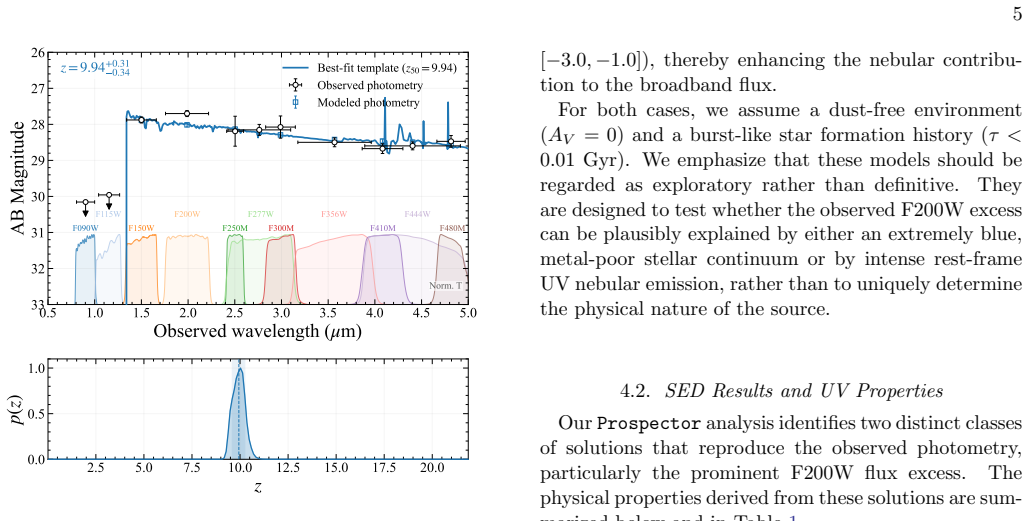
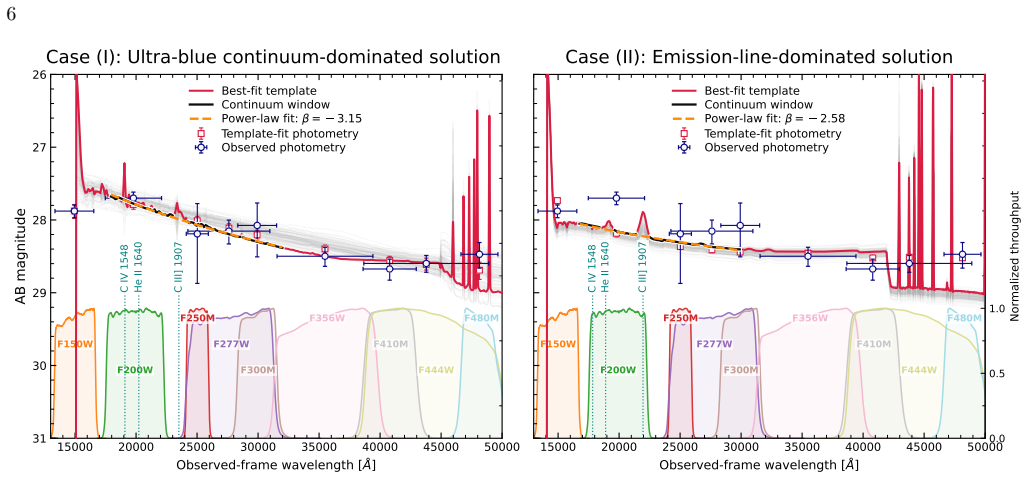
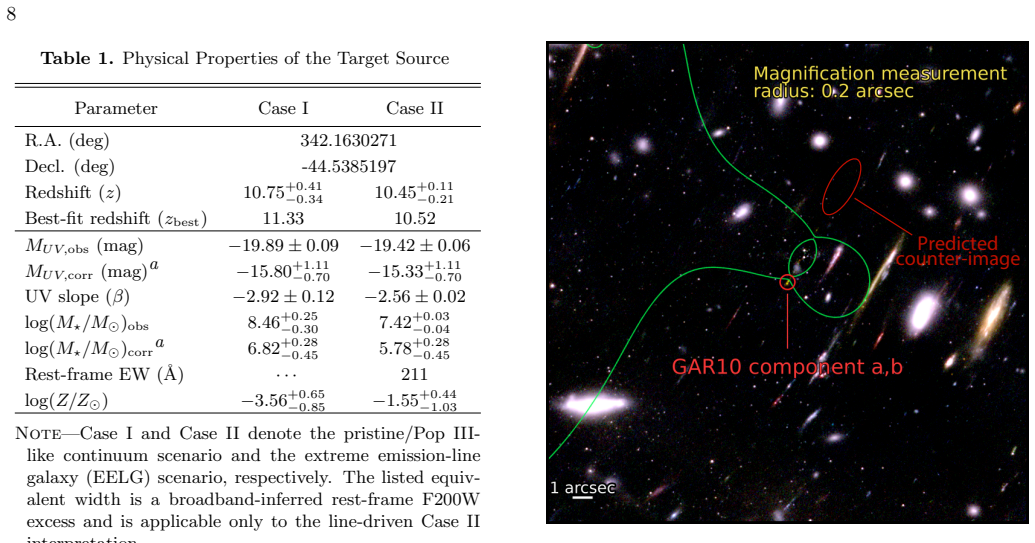
GAR10 is identified as a highly magnified ultra-faint arc at z≈10 with median magnification μ=43^{+78}_{-20} and intrinsic UV magnitude M_UV≈-15.8. Its photometry shows a blue UV continuum and a significant F200W excess relative to neighboring bands. Exploratory Prospector SED modeling yields two viable cases within the chosen priors: Case I is an extremely metal-poor (log(Z/Z_⊙)≈-3.56) continuum-dominated stellar population at z=10.75 with UV slope β≈-2.92, consistent with a Pop III-like interpretation; Case II is an extremely young (1-3 Myr) high-ionization galaxy at z=10.45 in which the excess is produced by intense rest-frame UV emission lines including CIV, HeII, and CIII]. Both remain
What carries the argument
The high-magnification lensing solution for the Abell S1063 cluster field combined with Prospector SED modeling that permits both the metal-poor continuum and emission-line interpretations of the F200W excess.
If this is right
- If the metal-poor case holds, ultra-faint galaxies at cosmic dawn can host extremely low-metallicity or Pop III-like stellar populations.
- If the emission-line case holds, intense UV lines from young stars can dominate the observed photometry in some high-redshift sources.
- Such objects provide a laboratory for testing how faint galaxies contributed to cosmic reionization.
- The two interpretations predict different chemical enrichment timelines for the earliest galaxies.
Where Pith is reading between the lines
- Searches for similar F115W-dropout sources in other strongly lensed fields could reveal additional ultra-faint examples at z≈10.
- Confirmation of either case would constrain the minimum halo mass capable of forming stars at these redshifts.
- The reliance on photometry alone leaves open the possibility that additional data could favor one interpretation over the other or reveal a third explanation.
Load-bearing premise
The lensing magnification for the source is correctly modeled near a median value of 43 and the SED modeling priors are appropriate for allowing both the metal-poor and emission-line scenarios to fit the photometry.
What would settle it
JWST/NIRSpec spectroscopy that directly measures either the presence and strength of UV emission lines or the true continuum slope to decide between the two cases.
Figures

read the original abstract
Strong gravitational lensing provides a powerful route to probing intrinsically faint galaxies during the first few hundred million years of cosmic history. In this Letter, we report the identification of GAR10, a highly magnified F115W-dropout galaxy at $z\approx10$ in the Abell S1063 cluster field, using deep JWST/NIRCam imaging from the GLIMPSE and GO-1840 programs. The source shows an unusually blue ultraviolet (UV) continuum and a significant F200W excess relative to adjacent bands. Under our high-magnification lensing solution, we infer a median magnification of $\mu=43^{+78}_{-20}$, corresponding to an intrinsic UV magnitude of $M_{\rm UV}\approx-15.8$. We use exploratory Prospector SED modeling to examine two physically motivated interpretations of the observed photometry. In Case I, GAR10 is described by an extremely metal-poor, continuum-dominated stellar population at $z=10.75_{-0.34}^{+0.41}$, with a blue UV slope of $\beta=-2.92\pm0.12$ and a low metallicity of $\log(Z/Z_\odot)=-3.56_{-0.85}^{+0.65}$, consistent with an extremely metal-poor or Pop III-like continuum-dominated interpretation under the adopted priors. In Case II, GAR10 is interpreted as an extremely young (1--3 Myr), high-ionization galaxy at $z=10.45_{-0.21}^{+0.11}$, in which the F200W excess is produced by intense rest-frame UV emission lines, including CIV, HeII, and CIII]. Both cases can partially reproduce the current photometry within the adopted priors, but they imply distinct ionizing sources, enrichment histories, and possible contributions to cosmic reionization. GAR10 therefore represents a rare laboratory for studying ultra-faint galaxy formation at cosmic dawn. Future JWST/NIRSpec spectroscopy will be essential to distinguishing between the steep continuum and emission-line origins of the F200W excess.
Editorial analysis
A structured set of objections, weighed in public.
Referee Report
Summary. The manuscript presents the identification of GAR10, a strongly lensed F115W-dropout galaxy at z ≈ 10 in the Abell S1063 cluster, detected in deep JWST/NIRCam imaging. It reports a median magnification of μ = 43^{+78}_{-20} corresponding to an intrinsic M_UV ≈ -15.8, and explores two interpretations via Prospector SED fitting: an extremely metal-poor continuum-dominated population at z = 10.75 or a young high-ionization galaxy with UV emission lines at z = 10.45, both partially reproducing the photometry. The paper emphasizes the need for future spectroscopy to distinguish the cases.
Significance. Should the high-magnification lensing model prove accurate and the SED modeling interpretations be confirmed by spectroscopy, this discovery would represent a significant advance by providing a rare, highly magnified view of an ultra-faint galaxy at cosmic dawn. It could serve as a laboratory for studying potential Pop III-like stars or intense high-ionization sources relevant to cosmic reionization, highlighting the power of strong lensing with JWST.
major comments (2)
- [Lensing analysis] The high-magnification solution with median μ=43^{+78}_{-20} underpins the intrinsic luminosity claim in the abstract; given the large asymmetric uncertainties, the lower bound implies a substantially brighter source, and the manuscript should provide more detail on how the cluster lens model for Abell S1063 was validated specifically for this arc to ensure the ultra-faint classification is robust.
- [SED modeling (exploratory Prospector runs)] The central claim of two viable physical interpretations rests on the statement that both cases partially reproduce the photometry within the adopted priors; however, the lack of quantitative fit statistics or sensitivity tests to alternative priors (e.g., different star formation histories) makes it difficult to evaluate whether the data genuinely support these conclusions or if they are prior-driven, as flagged by the need for spectroscopy.
minor comments (2)
- Ensure consistent use of error notation throughout, such as for redshift uncertainties.
- [Abstract] The programs GLIMPSE and GO-1840 should be briefly described or referenced for context on the data depth.
Simulated Author's Rebuttal
We thank the referee for their constructive and detailed report. We address each major comment below and outline the revisions we will make to strengthen the manuscript.
read point-by-point responses
-
Referee: [Lensing analysis] The high-magnification solution with median μ=43^{+78}_{-20} underpins the intrinsic luminosity claim in the abstract; given the large asymmetric uncertainties, the lower bound implies a substantially brighter source, and the manuscript should provide more detail on how the cluster lens model for Abell S1063 was validated specifically for this arc to ensure the ultra-faint classification is robust.
Authors: We agree that the asymmetric uncertainties on μ are large and that additional validation details are warranted to support the ultra-faint classification. In the revised manuscript we will expand the lensing section (and add an appendix if needed) with explicit validation steps for GAR10, including: (i) the specific multiple-image systems and constraints used near the arc, (ii) consistency checks against independent lens models of Abell S1063 from the literature, and (iii) a brief assessment of how the lower bound of μ affects the intrinsic magnitude. These additions will clarify that even the lower-magnification tail still places the source among the faintest known at z≈10. revision: yes
-
Referee: [SED modeling (exploratory Prospector runs)] The central claim of two viable physical interpretations rests on the statement that both cases partially reproduce the photometry within the adopted priors; however, the lack of quantitative fit statistics or sensitivity tests to alternative priors (e.g., different star formation histories) makes it difficult to evaluate whether the data genuinely support these conclusions or if they are prior-driven, as flagged by the need for spectroscopy.
Authors: We acknowledge that the current presentation would benefit from quantitative fit metrics. In the revision we will report reduced χ² values (or equivalent posterior predictive checks) for both Prospector cases and will add a short sensitivity test exploring an alternative star-formation-history parameterization (e.g., a delayed-τ model versus the current burst). These additions will make the degree of prior dependence more transparent. At the same time, we note that the manuscript already frames the modeling as exploratory and explicitly states that spectroscopy is required to distinguish the scenarios; the two interpretations remain physically distinct even if both are formally acceptable within the current priors. revision: partial
Circularity Check
No significant circularity in observational discovery and modeling
full rationale
The paper reports an observational identification of GAR10 via JWST F115W-dropout selection and applies standard cluster lensing modeling to obtain magnification μ=43^{+78}_{-20}, followed by exploratory Prospector SED fits under explicit priors that allow two alternative interpretations (metal-poor continuum at z=10.75 or young emission-line galaxy at z=10.45). Neither the lensing solution nor the SED cases reduce by the paper's own equations to a quantity defined in terms of itself or a fitted parameter renamed as a prediction. The two cases are presented as partial fits within the adopted priors rather than a forced unique derivation. No self-citation chains or ansatzes are invoked as load-bearing premises. The derivation chain is self-contained against external imaging data and standard modeling tools.
Axiom & Free-Parameter Ledger
free parameters (4)
- magnification μ =
43
- redshift z =
10.75 or 10.45
- metallicity log(Z/Z_⊙) =
-3.56
- stellar population age =
1-3 Myr
axioms (2)
- standard math Standard cosmological model for computing distances and lensing geometry
- domain assumption Prospector SED modeling framework and its adopted priors
Reference graph
Works this paper leans on
-
[1]
Adamo, A., Bradley, L. D., Vanzella, E., et al. 2024, Nature, 632, 513, doi: 10.1038/s41586-024-07703-7 Astropy Collaboration, Price-Whelan, A. M., Lim, P. L., et al. 2022, ApJ, 935, 167, doi: 10.3847/1538-4357/ac7c74
-
[2]
Atek, H., Labb´ e, I., Furtak, L. J., et al. 2024, Nature, 626, 975, doi: 10.1038/s41586-024-07043-6
-
[3]
Atek, H., Chisholm, J., Kokorev, V., et al. 2025, arXiv e-prints, arXiv:2511.07542, doi: 10.48550/arXiv.2511.07542
-
[4]
doi:10.1051/aas:1996164 , author =
Bertin, E., & Arnouts, S. 1996, A&AS, 117, 393, doi: 10.1051/aas:1996164 11
-
[5]
2016, Photutils: Photometry tools,, Astrophysics Source Code Library, record ascl:1609.011 http://ascl.net/1609.011
Bradley, L., Sipocz, B., Robitaille, T., et al. 2016, Photutils: Photometry tools,, Astrophysics Source Code Library, record ascl:1609.011 http://ascl.net/1609.011
2016
-
[6]
Brammer, G. B., van Dokkum, P. G., & Coppi, P. 2008, ApJ, 686, 1503, doi: 10.1086/591786
work page internal anchor Pith review doi:10.1086/591786 2008
-
[7]
2024, ApJ, 972, 143, doi: 10.3847/1538-4357/ad5f88
Castellano, M., Napolitano, L., Fontana, A., et al. 2024, ApJ, 972, 143, doi: 10.3847/1538-4357/ad5f88
-
[8]
Coe, D., Ben´ ıtez, N., S´ anchez, S. F., et al. 2006, AJ, 132, 926, doi: 10.1086/505530
-
[9]
Conroy, C., & Gunn, J. E. 2010, ApJ, 712, 833, doi: 10.1088/0004-637X/712/2/833
work page internal anchor Pith review doi:10.1088/0004-637x/712/2/833 2010
-
[10]
Cullen, F., McLeod, D. J., McLure, R. J., et al. 2024, MNRAS, 531, 997, doi: 10.1093/mnras/stae1211
-
[11]
Diego, J. M., Palencia, J. M., Goolsby, C., et al. 2026, arXiv e-prints, arXiv:2601.11704, doi: 10.48550/arXiv.2601.11704
-
[12]
Erb, D. K., Pettini, M., Shapley, A. E., et al. 2010, ApJ, 719, 1168, doi: 10.1088/0004-637X/719/2/1168
-
[13]
Fujimoto, S., Naidu, R. P., Chisholm, J., et al. 2025, ApJ, 989, 46, doi: 10.3847/1538-4357/ade9a1
-
[14]
2026, Science, 392, eady9404, doi: 10.1126/science.ady9404
Guo, Y., Zhang, H., Li, M., et al. 2026, Science, 392, eady9404, doi: 10.1126/science.ady9404
-
[15]
D., Leja, J., Conroy, C., & Speagle, J
Johnson, B. D., Leja, J., Conroy, C., & Speagle, J. S. 2021, ApJS, 254, 22, doi: 10.3847/1538-4365/abef67
work page internal anchor Pith review doi:10.3847/1538-4365/abef67 2021
-
[16]
2024, Astronomy and Astrophysics, 687, A67, doi: 10.1051/0004-6361/202347087
Maiolino, R., Scholtz, J., Curtis-Lake, E., et al. 2024, Astronomy and Astrophysics, 687, A67, doi: 10.1051/0004-6361/202347087
-
[17]
2026, A&A, 705, A173, doi: 10.1051/0004-6361/202556574
Messa, M., Vanzella, E., Loiacono, F., et al. 2026, A&A, 705, A173, doi: 10.1051/0004-6361/202556574
-
[18]
2025, A&A, 704, A97, doi: 10.1051/0004-6361/202555682
Mini, I., Meneghetti, M., Messa, M., et al. 2025, A&A, 704, A97, doi: 10.1051/0004-6361/202555682
-
[19]
Mowla, L., Iyer, K., Asada, Y., et al. 2024, Nature, 636, 332, doi: 10.1038/s41586-024-08293-0
-
[20]
2025, arXiv e-prints, arXiv:2506.11846, doi: 10.48550/arXiv.2506.11846
Nakajima, K., Ouchi, M., Harikane, Y., et al. 2025, arXiv e-prints, arXiv:2506.11846, doi: 10.48550/arXiv.2506.11846
-
[21]
Oke, J. B., & Gunn, J. E. 1983, ApJ, 266, 713, doi: 10.1086/160817
-
[22]
2024, ApJ, 976, 193, doi: 10.3847/1538-4357/ad85d3
Roberts-Borsani, G., Treu, T., Shapley, A., et al. 2024, ApJ, 976, 193, doi: 10.3847/1538-4357/ad85d3
-
[23]
2003, Astronomy and Astrophysics, 397, 527, doi: 10.1051/0004-6361:20021525
Schaerer, D. 2003, Astronomy and Astrophysics, 397, 527, doi: 10.1051/0004-6361:20021525
-
[24]
Senchyna, P., Stark, D. P., Chevallard, J., et al. 2019, Monthly Notices of the Royal Astronomical Society, 488, 3492, doi: 10.1093/mnras/stz1907
-
[25]
Stark, D. P. 2016, ARA&A, 54, 761, doi: 10.1146/annurev-astro-081915-023417
-
[26]
2025, Version 4 of the NIRCam Wisp Templates: Wisp Characterization, Stability, and Validation Testing, Tech
Sunnquist, B., Boyer, M., Brooks, B., et al. 2025, Version 4 of the NIRCam Wisp Templates: Wisp Characterization, Stability, and Validation Testing, Tech. Rep. Technical Report JWST-STScI-009225, STScI
2025
-
[27]
Topping, M. W., Stark, D. P., Endsley, R., et al. 2022, The Astrophysical Journal, 941, 153, doi: 10.3847/1538-4357/aca522
-
[28]
Topping, M. W., Stark, D. P., Senchyna, P., et al. 2024, Monthly Notices of the Royal Astronomical Society, 529, 3301, doi: 10.1093/mnras/stae807
-
[29]
Trussler, J. A. A., Conselice, C. J., Adams, N. J., et al. 2023, Monthly Notices of the Royal Astronomical Society, 525, 5328, doi: 10.1093/mnras/stad2553
-
[30]
2023, A&A, 678, A173, doi: 10.1051/0004-6361/202346981
Vanzella, E., Claeyssens, A., Welch, B., et al. 2023, Astronomy and Astrophysics, 678, A173, doi: 10.1051/0004-6361/202346981
-
[31]
Welch, B., Coe, D., Zitrin, A., et al. 2023, ApJ, 943, 2, doi: 10.3847/1538-4357/aca8a8
-
[32]
Whitler, L., Stark, D. P., Topping, M. W., et al. 2025, ApJ, 992, 63, doi: 10.3847/1538-4357/adfddc
-
[33]
2026, arXiv e-prints, arXiv:2601.06015, doi: 10.48550/arXiv.2601.06015
Yanagisawa, H., Ouchi, M., Golubchik, M., et al. 2026, arXiv e-prints, arXiv:2601.06015, doi: 10.48550/arXiv.2601.06015
discussion (0)
Sign in with ORCID, Apple, or X to comment. Anyone can read and Pith papers without signing in.