A First Measurement of Circumgalactic Dust Reddening from Only 4.6 deg² of the Rubin Observatory's DP1
Pith reviewed 2026-06-26 00:06 UTC · model grok-4.3
The pith
Circumgalactic dust reddening measured from just 4.6 square degrees of Rubin Observatory data matches results from much larger surveys.
A machine-rendered reading of the paper's core claim, the machinery that carries it, and where it could break.
Core claim
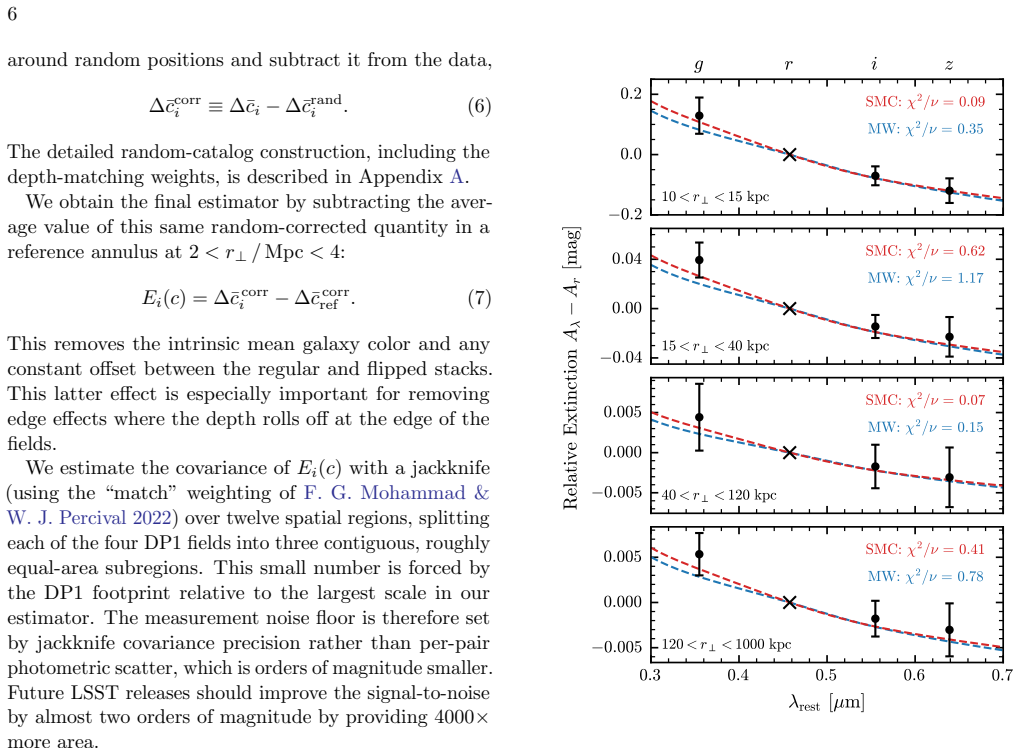
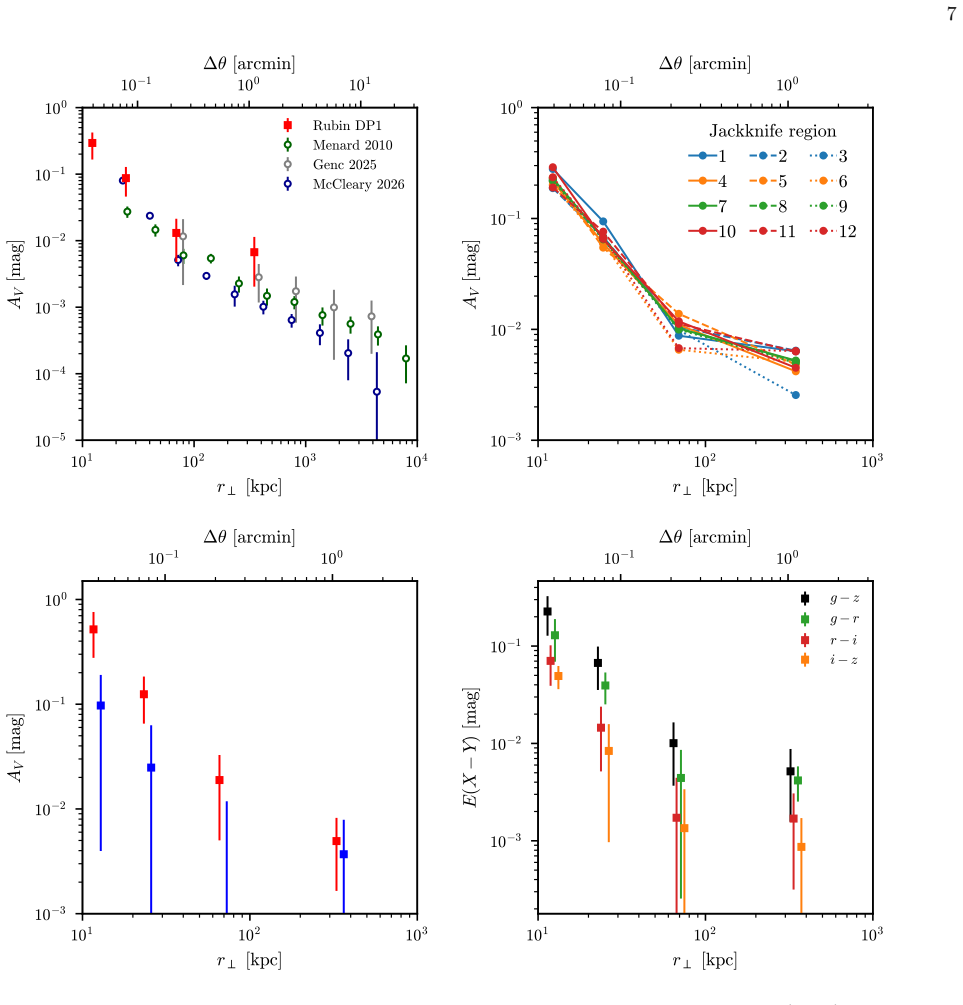
The authors detect a chromatic reddening profile by stacking background galaxy colors around foreground galaxy positions. Interpreting the average E(g-z) with a Milky Way extinction curve, they measure A_V = (1.2 ± 0.4) × 10^{-1} (r_⊥ / 20 kpc)^{-1.8 ± 0.4} within 120 kpc. This profile extends the measurement to lower stellar mass galaxies and shows that the innermost regions reach A_V around 0.3 magnitudes, comparable to Milky Way disk extinction.
What carries the argument
Stacking of background-galaxy colors around foreground-galaxy positions using photometric redshifts to extract the chromatic reddening profile.
If this is right
- The steep power-law slope of -1.8 implies the dust distribution does not simply trace the halo-gas profile.
- Redder foreground galaxies exhibit stronger reddening within 50 kpc, suggesting a dust-to-stellar-mass ratio near 1 percent.
- The measurement reaches comparable precision to prior work with 1000 times less area, demonstrating LSST's capability for such studies.
- Splitting the sample shows potential color dependence, though the blue subsample remains noisy.
Where Pith is reading between the lines
- If the Milky Way curve applies, the high dust content in lower-mass halos suggests efficient dust production or retention in these systems.
- Full LSST coverage could allow mapping how dust content varies with galaxy environment and redshift.
- The agreement with larger surveys validates the photometric redshift approach for future wide-field dust measurements.
Load-bearing premise
The observed color excess is due to dust reddening rather than photometric redshift errors, galaxy clustering biases, or other systematics, and the Milky Way extinction curve applies to circumgalactic dust.
What would settle it
Repeating the analysis with a sample of galaxies having spectroscopic redshifts that shows no significant color excess signal.
Figures


read the original abstract
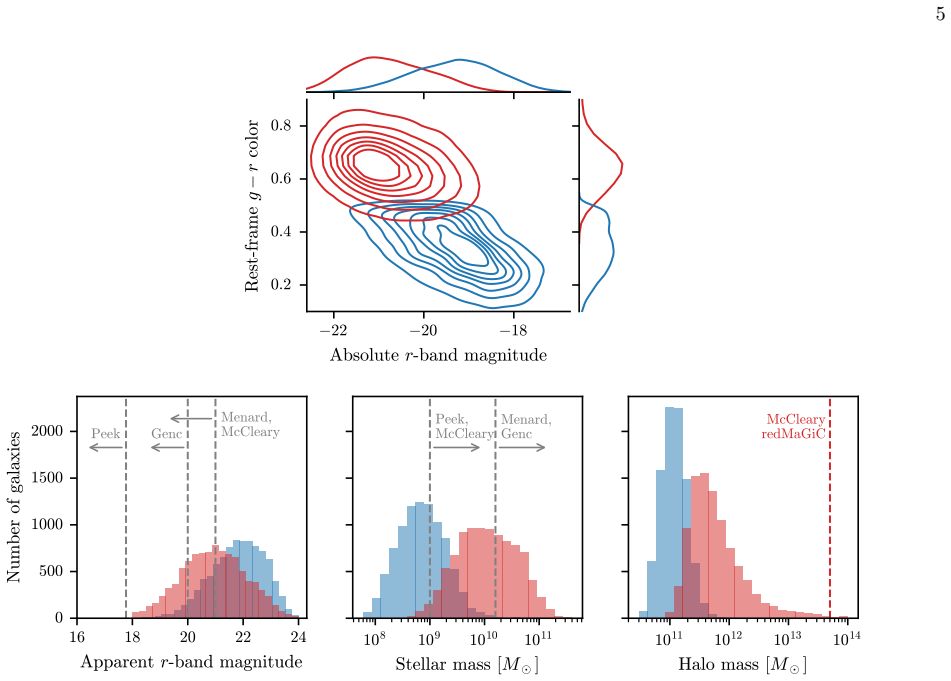
We present the first measurement of circumgalactic dust reddening from the Vera C. Rubin Observatory, using only 4.6 deg$^2$ of ComCam Data Preview 1 - roughly $0.03\%$ of the final LSST footprint. Using photometric redshifts, we stack background-galaxy colors around foreground-galaxy positions and detect a chromatic reddening profile from $r_\perp \simeq 10$ kpc to $1$ Mpc. Interpreting average $E(g-z)$ with a Milky Way extinction curve, we find $A_V = (1.2 \pm 0.4) \times 10^{-1} (r_\perp / 20\,\mathrm{kpc})^{-1.8 \pm 0.4}$ within $120$ kpc. The amplitude and radial dependence agree with earlier SDSS, KiDS, and DES results despite the $\sim1000\times$ smaller survey area and a foreground sample extending 3-6 mag fainter and 1-2 dex lower in stellar mass. The innermost 10-15 kpc bin reaches $A_V \simeq 0.3$ mag, comparable to high-latitude extinction through the Milky Way disk near the Solar circle; the steep power-law slope implies a dust distribution that does not simply trace the halo-gas profile. Splitting by rest-frame $g-r$ shows stronger extinction around red foreground galaxies (rest-frame $g-r > 0.5$), although the blue subsample is too noisy to establish a significant color dependence. This red sample, with median halo mass $5 \times 10^{11}\,M_\odot$, shows substantially more reddening within 50 kpc than previously measured around more massive LRGs and implies a dust-to-stellar-mass ratio of $\sim 1\%$, nearly saturating the dust budget allowed by stellar metal yields. These pathfinder data demonstrate LSST's promise for high-precision galaxy-dust measurements across galaxy mass, environment, and redshift.
Editorial analysis
A structured set of objections, weighed in public.
Referee Report
Summary. The paper presents the first measurement of circumgalactic dust reddening from 4.6 deg² of Rubin Observatory ComCam DP1 data. Using photometric redshifts, background galaxy colors are stacked around foreground galaxy positions to detect a chromatic reddening signal from ~10 kpc to 1 Mpc. Interpreting the average E(g-z) with a Milky Way extinction curve yields the power-law A_V = (1.2 ± 0.4) × 10^{-1} (r_⊥ / 20 kpc)^{-1.8 ± 0.4} within 120 kpc, with amplitude and slope consistent with prior SDSS/KiDS/DES results despite the ~1000× smaller area and fainter, lower-mass foreground sample. Additional findings include stronger reddening around red galaxies and implications for dust-to-stellar-mass ratios.
Significance. If robust, the result is significant as a pathfinder demonstrating LSST's capability for high-precision CGM dust measurements with limited data, extending prior work to lower-mass halos (~5×10^{11} M_⊙) and providing a steep radial profile that does not trace halo gas. The agreement with independent surveys and the detection in a small footprint are strengths.
major comments (3)
- [Methods (background selection and photo-z validation)] The central interpretation that the stacked E(g-z) arises from dust reddening (rather than photo-z errors, clustering biases, or selection effects) is load-bearing for the A_V profile and all downstream claims, yet the methods provide no quantitative validation of photometric redshift quality for the background sample or explicit tests (e.g., null tests with randomized positions or color-selected subsamples) to rule out these systematics. This is especially relevant given the foreground sample is 3-6 mag fainter than prior LRG studies.
- [Results (interpretation of E(g-z) and A_V fit)] The conversion of measured E(g-z) to A_V assumes a Milky Way extinction curve applies to CGM dust at these radii and galaxy masses; no justification, alternative curves, or sensitivity test is provided, directly affecting the quoted normalization and the comparison to prior work.
- [Results (power-law fit and error budget)] The power-law fit within 120 kpc reports uncertainties on amplitude and index, but the text does not detail how the covariance matrix incorporates the small survey area, sample variance, or potential systematics from the 4.6 deg² footprint; this undermines the claimed consistency with SDSS/KiDS/DES results.
minor comments (2)
- [Abstract and Introduction] The abstract and text use 'first measurement' without clarifying how it differs in methodology or sample from the cited SDSS/KiDS/DES works beyond area and depth.
- [Figures and Results] Figure captions and text should explicitly state the number of foreground/background pairs per radial bin to allow assessment of the innermost bin's A_V ~0.3 mag claim.
Simulated Author's Rebuttal
We thank the referee for their constructive comments, which highlight important areas for clarification in our pathfinder analysis. We address each major comment below with honest responses and commit to revisions that strengthen the manuscript without overstating the current data.
read point-by-point responses
-
Referee: The central interpretation that the stacked E(g-z) arises from dust reddening (rather than photo-z errors, clustering biases, or selection effects) is load-bearing for the A_V profile and all downstream claims, yet the methods provide no quantitative validation of photometric redshift quality for the background sample or explicit tests (e.g., null tests with randomized positions or color-selected subsamples) to rule out these systematics. This is especially relevant given the foreground sample is 3-6 mag fainter than prior LRG studies.
Authors: We agree this is a valid concern for a pathfinder result using fainter samples. The current manuscript relies on the detection significance and consistency with prior surveys for validation, but lacks explicit metrics. In revision we will add quantitative photo-z validation (e.g., outlier fractions and bias estimates from available spec-z overlaps) plus null tests with randomized foreground positions and color-selected background subsamples. These will be presented in a new methods subsection to directly rule out the listed systematics. revision: yes
-
Referee: The conversion of measured E(g-z) to A_V assumes a Milky Way extinction curve applies to CGM dust at these radii and galaxy masses; no justification, alternative curves, or sensitivity test is provided, directly affecting the quoted normalization and the comparison to prior work.
Authors: The manuscript adopts the MW curve for direct comparability with SDSS/KiDS/DES results but provides no explicit justification or alternatives. We will revise by adding a short justification paragraph citing prior CGM dust studies that support MW-like curves at these radii, plus a sensitivity test showing A_V changes under SMC/LMC curves. This will quantify the impact on normalization while preserving the core radial profile result. revision: yes
-
Referee: The power-law fit within 120 kpc reports uncertainties on amplitude and index, but the text does not detail how the covariance matrix incorporates the small survey area, sample variance, or potential systematics from the 4.6 deg² footprint; this undermines the claimed consistency with SDSS/KiDS/DES results.
Authors: The uncertainties are derived from bootstrap resampling over the 4.6 deg² footprint, which captures some sample variance, but the text indeed omits a full description of the covariance construction. We will expand the methods to detail the bootstrap procedure, its limitations for cosmic variance on this scale, and why the detected signal amplitude remains comparable to larger surveys. We maintain that the consistency claim is still supported by the high-significance detection, but the added text will make the error budget transparent. revision: partial
Circularity Check
No circularity: direct empirical stack and fit to observed colors
full rationale
The paper measures E(g-z) by stacking background galaxy colors around foreground positions in 4.6 deg² data, then converts the measured excess to A_V via an external Milky Way extinction curve and fits a power-law radial profile to the data. No step equates a claimed prediction or first-principles result to its own inputs by construction; the power-law parameters are fitted rather than presupposed, and no self-citations close any loop on the core measurement or interpretation. The derivation is self-contained against the observed photometry.
Axiom & Free-Parameter Ledger
free parameters (2)
- power-law index =
-1.8
- normalization amplitude =
0.12
axioms (1)
- domain assumption Milky Way extinction curve applies to circumgalactic dust
Reference graph
Works this paper leans on
-
[1]
Aguirre, A. N. 1999, The Astrophysical Journal, 525, 583, doi: 10.1086/307945
-
[2]
2021, Physical Review D, 103, 063514, doi: 10.1103/PhysRevD.103.063514
Amodeo, S., Battaglia, N., Schaan, E., et al. 2021, Physical Review D, 103, 063514, doi: 10.1103/PhysRevD.103.063514
-
[3]
Shimizu, I. 2018, Monthly Notices of the Royal Astronomical Society, 478, 4905, doi: 10.1093/mnras/sty1431 Aric` o, G., Angulo, R. E., Zennaro, M., et al. 2023, Astronomy and Astrophysics, 678, A109, doi: 10.1051/0004-6361/202346539
-
[4]
Arnouts, S., Cristiani, S., Moscardini, L., et al. 1999, MNRAS, 310, 540, doi: 10.1046/j.1365-8711.1999.02978.x Astropy Collaboration, Robitaille, T. P., Tollerud, E. J., et al. 2013, A&A, 558, A33, doi: 10.1051/0004-6361/201322068 Astropy Collaboration, Price-Whelan, A. M., Sip˝ ocz, B. M., et al. 2018, AJ, 156, 123, doi: 10.3847/1538-3881/aabc4f Astropy...
-
[5]
In the beginning: the first sources of light and the reionization of the universe , volume=
Barkana, R., & Loeb, A. 2001, PhR, 349, 125, doi: 10.1016/S0370-1573(01)00019-9
-
[6]
Blanton, M. R., & Roweis, S. 2007, The Astronomical Journal, 133, 734, doi: 10.1086/510127
-
[7]
Butsky, I. S., Fielding, D. B., Hayward, C. C., et al. 2020, ApJ, 903, 77, doi: 10.3847/1538-4357/abbad2
-
[8]
Butsky, I. S., Werk, J. K., Tchernyshyov, K., et al. 2022, ApJ, 935, 69, doi: 10.3847/1538-4357/ac7ebd
-
[9]
F., Zhang, T., et al
Charles, E., Crenshaw, J. F., Zhang, T., et al. 2025, Initial studies of photometric redshifts with LSSTComCam from DP1, Vera C. Rubin Observatory. https://sitcomtn-154.lsst.io/
2025
-
[10]
2025, ApJ, 981, 81, doi: 10.3847/1538-4357/ada942
Chen, Z., Wang, E., Zou, H., et al. 2025, ApJ, 981, 81, doi: 10.3847/1538-4357/ada942
-
[11]
Modelling baryonic feedback for survey cosmology
Chisari, N. E., Mead, A. J., Joudaki, S., et al. 2019, The Open Journal of Astrophysics, 2, 4, doi: 10.21105/astro.1905.06082
work page internal anchor Pith review Pith/arXiv arXiv doi:10.21105/astro.1905.06082 2019
-
[12]
2018, MNRAS, 481, 1690, doi: 10.1093/mnras/sty2380
Chisholm, J., Tremonti, C., & Leitherer, C. 2018, MNRAS, 481, 1690, doi: 10.1093/mnras/sty2380
-
[13]
Chisholm, J., Tremonti, C. A., Leitherer, C., & Chen, Y. 2017, MNRAS, 469, 4831, doi: 10.1093/mnras/stx1164 De Vis, P., Jones, A., Viaene, S., et al. 2019, A&A, 623, A5, doi: 10.1051/0004-6361/201834444
-
[14]
Draine, B. T. 2003, Annual Review of Astronomy and Astrophysics, 41, 241, doi: 10.1146/annurev.astro.41.011802.094840
work page internal anchor Pith review Pith/arXiv arXiv doi:10.1146/annurev.astro.41.011802.094840 2003
-
[15]
Draine, B. T., & Salpeter, E. E. 1979a, The Astrophysical Journal, 231, 77, doi: 10.1086/157165
-
[16]
Draine, B. T., & Salpeter, E. E. 1979b, The Astrophysical Journal, 231, 438, doi: 10.1086/157206
-
[17]
1998, The Astrophysical Journal, 501, 643, doi: 10.1086/305829
Dwek, E. 1998, The Astrophysical Journal, 501, 643, doi: 10.1086/305829
-
[18]
Dwek, E., & Arendt, R. G. 1992, Annual Review of Astronomy and Astrophysics, 30, 11, doi: 10.1146/annurev.aa.30.090192.000303
-
[19]
Faerman, Y., Sternberg, A., & McKee, C. F. 2017, ApJ, 835, 52, doi: 10.3847/1538-4357/835/1/52 Faucher-Gigu` ere, C.-A., & Oh, S. P. 2023, ARA&A, 61, 131, doi: 10.1146/annurev-astro-052920-125203
-
[20]
Fitzpatrick, E. L. 1999, PASP, 111, 63, doi: 10.1086/316293
-
[21]
Galliano, F., Galametz, M., & Jones, A. P. 2018, Annual Review of Astronomy and Astrophysics, 56, 673, doi: 10.1146/annurev-astro-081817-051900
-
[22]
Genc, E., Wright, A. H., & Hildebrandt, H. 2025, Measurement of Circumgalactic Extinction in the Kilo-Degree Survey’s Data Release 4, arXiv, doi: 10.48550/arXiv.2508.15490
-
[23]
2018, MNRAS, 479, 3042, doi: 10.1093/mnras/sty1653
Girichidis, P., Naab, T., Hanasz, M., & Walch, S. 2018, MNRAS, 479, 3042, doi: 10.1093/mnras/sty1653
-
[24]
2018, MNRAS, 477, L75, doi: 10.1093/mnrasl/sly053
Goobar, A., Dhawan, S., & Scolnic, D. 2018, MNRAS, 477, L75, doi: 10.1093/mnrasl/sly053
-
[25]
2024, The Journal of Open Source Software, 9, 7023, doi: 10.21105/joss.07023
Gordon, K. 2024, The Journal of Open Source Software, 9, 7023, doi: 10.21105/joss.07023
-
[26]
Gordon, K. D., Clayton, G. C., Misselt, K. A., Landolt, A. U., & Wolff, M. J. 2003, ApJ, 594, 279, doi: 10.1086/376774 16 G´ orski, K. M., Hivon, E., Banday, A. J., et al. 2005, ApJ, 622, 759, doi: 10.1086/427976 Grand´ on, D., Marques, G. A., Thiele, L., et al. 2024, Physical Review D, 110, 103539, doi: 10.1103/PhysRevD.110.103539
-
[27]
Harris, C. R., Millman, K. J., van der Walt, S. J., et al. 2020, Nature, 585, 357, doi: 10.1038/s41586-020-2649-2
-
[28]
Hopkins, P. F., Chan, T. K., Ji, S., et al. 2021, MNRAS, 501, 3640, doi: 10.1093/mnras/staa3690
-
[29]
Howk, J. C., & Savage, B. D. 1999, The Astronomical Journal, 117, 2077, doi: 10.1086/300857
-
[30]
Hunter, J. D. 2007, Computing in Science & Engineering, 9, 90, doi: 10.1109/MCSE.2007.55
-
[31]
Ilbert, O., Arnouts, S., McCracken, H. J., et al. 2006, A&A, 457, 841, doi: 10.1051/0004-6361:20065138 Ivezi´ c,ˇZ., Kahn, S. M., Tyson, J. A., et al. 2019a, The Astrophysical Journal, 873, 111, doi: 10.3847/1538-4357/ab042c
work page internal anchor Pith review doi:10.1051/0004-6361:20065138 2006
-
[32]
Izbicki, R., & Lee, A. B. 2017, Electronic Journal of Statistics, 11, 2800, doi: 10.1214/17-EJS1302
-
[33]
2004, MNRAS, 353, 1311, doi: 10.1111/j.1365-2966.2004.08157.x
Jarvis, M., Bernstein, G., & Jain, B. 2004, MNRAS, 352, 338, doi: 10.1111/j.1365-2966.2004.07926.x
-
[34]
Ji, S., Chan, T. K., Hummels, C. B., et al. 2020, MNRAS, 496, 4221, doi: 10.1093/mnras/staa1849
-
[35]
Jones, D. M., & Heavens, A. F. 2019, MNRAS, 483, 2487, doi: 10.1093/mnras/sty3279
-
[36]
Jones, T. J., Dowell, C. D., Lopez Rodriguez, E., et al. 2019, ApJL, 870, L9, doi: 10.3847/2041-8213/aaf8b9
-
[37]
2016, in Positioning and Power in Academic Publishing: Players, Agents and Agendas, ed
Kluyver, T., Ragan-Kelley, B., P´ erez, F., et al. 2016, in Positioning and Power in Academic Publishing: Players, Agents and Agendas, ed. F. Loizides & B. Scmidt (Netherlands: IOS Press), 87–90. https://eprints.soton.ac.uk/403913/
2016
-
[38]
2018, ApJ, 866, 36, doi: 10.3847/1538-4357/aadc08
Lan, T.-W., & Mo, H. 2018, ApJ, 866, 36, doi: 10.3847/1538-4357/aadc08
-
[39]
Lenz, D., Hensley, B. S., & Dor´ e, O. 2017, ApJ, 846, 38, doi: 10.3847/1538-4357/aa84af
-
[40]
2026, The Open Journal of Astrophysics, 9, 62504, doi: 10.33232/001c.162504
Liang, S., Adari, P., & von der Linden, A. 2026, The Open Journal of Astrophysics, 9, 62504, doi: 10.33232/001c.162504
-
[41]
2023, ApJ, 953, 113, doi: 10.3847/1538-4357/ace110
Lopez-Rodriguez, E. 2023, ApJ, 953, 113, doi: 10.3847/1538-4357/ace110
-
[42]
Ludlow, A. D., Navarro, J. F., Angulo, R. E., et al. 2014, MNRAS, 441, 378, doi: 10.1093/mnras/stu483
-
[43]
Macquart, J.-P., Prochaska, J. X., McQuinn, M., et al. 2020, Nature, 581, 391, doi: 10.1038/s41586-020-2300-2
-
[44]
2004, MNRAS, 353, 1311, doi: 10.1111/j.1365-2966.2004.08157.x
Maller, A. H., & Bullock, J. S. 2004, MNRAS, 355, 694, doi: 10.1111/j.1365-2966.2004.08349.x
-
[45]
Martin-Alvarez, S., Sijacki, D., Haehnelt, M. G., et al. 2026, MNRAS, 545, staf2106, doi: 10.1093/mnras/staf2106
-
[46]
McCleary, J. E., Huff, E. M., Bartlett, J. G., & Hensley, B. S. 2026, The Astrophysical Journal, 1000, 313, doi: 10.3847/1538-4357/ae4c3d
-
[47]
McKinnon, R., Torrey, P., Vogelsberger, M., Hayward, C. C., & Marinacci, F. 2017, Monthly Notices of the Royal Astronomical Society, 468, 1505, doi: 10.1093/mnras/stx467
-
[48]
2014, ApJL, 780, L33, doi: 10.1088/2041-8205/780/2/L33
McQuinn, M. 2014, ApJL, 780, L33, doi: 10.1088/2041-8205/780/2/L33
work page internal anchor Pith review doi:10.1088/2041-8205/780/2/l33 2014
-
[49]
2018, Astronomy and Computing, 24, 129, doi: 10.1016/j.ascom.2018.07.001 M´ enard, B., & Fukugita, M
Melchior, P., Moolekamp, F., Jerdee, M., et al. 2018, Astronomy and Computing, 24, 129, doi: 10.1016/j.ascom.2018.07.001 M´ enard, B., & Fukugita, M. 2012, The Astrophysical Journal, 754, 116, doi: 10.1088/0004-637X/754/2/116 M´ enard, B., Kilbinger, M., & Scranton, R. 2010a, Monthly Notices of the Royal Astronomical Society, 406, 1815, doi: 10.1111/j.136...
-
[50]
Mohammad, F. G., & Percival, W. J. 2022, MNRAS, 514, 1289, doi: 10.1093/mnras/stac1458 M¨ ortsell, E., & Goobar, A. 2003, Journal of Cosmology and Astroparticle Physics, 2003, 009, doi: 10.1088/1475-7516/2003/09/009
-
[51]
Moster, B. P., Naab, T., & White, S. D. M. 2013, MNRAS, 428, 3121, doi: 10.1093/mnras/sts261
work page internal anchor Pith review doi:10.1093/mnras/sts261 2013
-
[52]
Navarro, J. F., Frenk, C. S., & White, S. D. M. 1997, ApJ, 490, 493, doi: 10.1086/304888 NSF-DOE Vera C. Rubin Observatory. 2025, Legacy Survey of Space and Time Data Preview 1: standard bandpass dataset type [Data set], NSF-DOE Vera C. Rubin Observatory, doi: 10.71929/RUBIN/2587407
-
[53]
2024, MNRAS, 528, 5008, doi: 10.1093/mnras/stae342
Otsuki, M., & Hirashita, H. 2024, MNRAS, 528, 5008, doi: 10.1093/mnras/stae342
-
[54]
Pai, A., Blanton, M. R., & Moustakas, J. 2024, The Astrophysical Journal, 977, 102, doi: 10.3847/1538-4357/ad89b8
-
[55]
2022, Physical Review D, 105, 123526, doi: 10.1103/PhysRevD.105.123526
Pandey, S., Gatti, M., Baxter, E., et al. 2022, Physical Review D, 105, 123526, doi: 10.1103/PhysRevD.105.123526
-
[56]
Dust and Grain Size Evolution in Galaxy Simulations: What Matters and What Does Not
Parente, M., Narayanan, D., & Torrey, P. 2026, arXiv e-prints, arXiv:2604.06314, doi: 10.48550/arXiv.2604.06314
work page internal anchor Pith review Pith/arXiv arXiv doi:10.48550/arxiv.2604.06314 2026
-
[57]
Peek, J. E. G., M´ enard, B., & Corrales, L. 2015, The Astrophysical Journal, 813, 7, doi: 10.1088/0004-637X/813/1/7 17
-
[58]
Peeples, M. S., Werk, J. K., Tumlinson, J., et al. 2014, ApJ, 786, 54, doi: 10.1088/0004-637X/786/1/54 Planck Collaboration, Aghanim, N., Akrami, Y., et al. 2020, Astronomy and Astrophysics, 641, A6, doi: 10.1051/0004-6361/201833910
-
[59]
Qiao, M., Zheng, X. Z., Katsianis, A., et al. 2024, MNRAS, 528, 997, doi: 10.1093/mnras/stae047 RAIL Team, van den Busch, J. L., Charles, E., et al. 2026, The Open Journal of Astrophysics, 9, 58200, doi: 10.33232/001c.158200
-
[60]
Reback, J., McKinney, W., jbrockmendel, et al. 2020, Pandas-Dev/Pandas: Pandas 1.0.3,, Zenodo https://doi.org/10.5281/zenodo.3715232 R´ emy-Ruyer, A., Madden, S. C., Galliano, F., et al. 2015, A&A, 582, A121, doi: 10.1051/0004-6361/201526067
-
[61]
Richie, H. M., Schneider, E. E., Abruzzo, M. W., & Torrey, P. 2024, ApJ, 974, 81, doi: 10.3847/1538-4357/ad6a1c Ried Guachalla, B., Schaan, E., Hadzhiyska, B., Ferraro, S., et al. 2025, Physical Review D, 112, 103512, doi: 10.1103/lqbj-wcqj Rodr´ ıguez Montero, F., Martin-Alvarez, S., Slyz, A., et al. 2024, MNRAS, 530, 3617, doi: 10.1093/mnras/stae1083
-
[62]
2025, ApJ, 986, 231, doi: 10.3847/1538-4357/adc0a5
Rubin, D., Aldering, G., Betoule, M., et al. 2025, ApJ, 986, 231, doi: 10.3847/1538-4357/adc0a5
-
[63]
Salem, M., Bryan, G. L., & Corlies, L. 2016, MNRAS, 456, 582, doi: 10.1093/mnras/stv2641
-
[64]
Signatures of Suppressed Matter Clustering revealed by Fast Radio Bursts
Sharma, K., Krause, E., Ravi, V., et al. 2026, arXiv e-prints, arXiv:2604.17162, doi: 10.48550/arXiv.2604.17162 SLAC National Accelerator Laboratory, & NSF-DOE Vera C. Rubin Observatory. 2024, LSST Commissioning Camera, doi: 10.71929/rubin/2561361
work page internal anchor Pith review Pith/arXiv arXiv doi:10.48550/arxiv.2604.17162 2026
-
[65]
2022, in Proceedings of SPIE, Vol
Stalder, B., Reil, K., Aguilar, C., et al. 2022, in Proceedings of SPIE, Vol. 12184, Ground-Based and Airborne Instrumentation for Astronomy IX, 121840J, doi: 10.1117/12.2630184
-
[66]
2020, in Proceedings of SPIE, Vol
Stalder, B., Reil, K., Claver, C., et al. 2020, in Proceedings of SPIE, Vol. 11447, Ground-Based and Airborne Instrumentation for Astronomy VIII, 114470L, doi: 10.1117/12.2561132
-
[67]
Tumlinson, J., Peeples, M. S., & Werk, J. K. 2017, Annual Review of Astronomy and Astrophysics, 55, 389, doi: 10.1146/annurev-astro-091916-055240
work page internal anchor Pith review doi:10.1146/annurev-astro-091916-055240 2017
-
[68]
Tumlinson, J., Thom, C., Werk, J. K., et al. 2011, Science, 334, 948, doi: 10.1126/science.1209840 Vera C Rubin Observatory Team, et al. 2026, arXiv e-prints, arXiv:2603.23786, doi: 10.48550/arXiv.2603.23786
-
[69]
2016, MNRAS, 455, 4183, doi: 10.1093/mnras/stv2598
Vincenzo, F., Matteucci, F., Belfiore, F., & Maiolino, R. 2016, MNRAS, 455, 4183, doi: 10.1093/mnras/stv2598
-
[70]
Virtanen, P., Gommers, R., Oliphant, T. E., et al. 2020, Nature Methods, 17, 261, doi: 10.1038/s41592-019-0686-2
-
[71]
Waskom, M. L. 2021, Journal of Open Source Software, 6, 3021, doi: 10.21105/joss.03021
-
[72]
Werk, J. K., Prochaska, J. X., Tumlinson, J., et al. 2014, The Astrophysical Journal, 792, 8, doi: 10.1088/0004-637X/792/1/8 Wes McKinney. 2010, in Proceedings of the 9th Python in Science Conference, ed. S. van der Walt & Jarrod Millman, 56–61, doi: 10.25080/Majora-92bf1922-00a
-
[73]
White, S. D. M., & Frenk, C. S. 1991, ApJ, 379, 52, doi: 10.1086/170483
-
[74]
Yoon, J. H., Martin, C. L., Veilleux, S., et al. 2021, Monthly Notices of the Royal Astronomical Society, 502, 969, doi: 10.1093/mnras/staa3583
-
[75]
, year = 2005, month = apr, volume =
York, D. G., Khare, P., Vanden Berk, D., et al. 2006, Monthly Notices of the Royal Astronomical Society, 367, 945, doi: 10.1111/j.1365-2966.2005.10018.x
-
[76]
Dark Energy Survey Year 3 results: galaxy–halo connection from galaxy–galaxy lensing , volume=
Zacharegkas, G., Chang, C., Prat, J., et al. 2022, MNRAS, 509, 3119, doi: 10.1093/mnras/stab3155
-
[77]
Zhang, T., Charles, E., Crenshaw, J. F., et al. 2025, arXiv e-prints, arXiv:2510.07370, doi: 10.48550/arXiv.2510.07370
-
[78]
Zheng, Y., Faerman, Y., Oppenheimer, B. D., et al. 2024, ApJ, 960, 55, doi: 10.3847/1538-4357/acfe6b
-
[79]
2019, Journal of Open Source Software, 4, 1298, doi: 10.21105/joss.01298
Zonca, A., Singer, L., Lenz, D., et al. 2019, Journal of Open Source Software, 4, 1298, doi: 10.21105/joss.01298
discussion (0)
Sign in with ORCID, Apple, or X to comment. Anyone can read and Pith papers without signing in.