A parameterized family of balance indices for phylogenetic networks
Pith reviewed 2026-06-25 23:11 UTC · model grok-4.3
The pith
The H_α family extends the B2 balance index to phylogenetic networks via a grafting property that decomposes the index across biconnected components.
A machine-rendered reading of the paper's core claim, the machinery that carries it, and where it could break.
Core claim
The H_α indices are defined for phylogenetic networks and inherit the grafting property from the B2 index, which expresses the index of the whole network in terms of the indices of its biconnected components. This enables results on extrema and distributions for various network classes and random models.
What carries the argument
The grafting property, which allows expressing the H_α index of a network in terms of the H_α indices of its biconnected components.
If this is right
- Minimizers and maximizers of H_α exist and can be characterized inside each fixed class of phylogenetic networks.
- Exact distributions of H_α are obtainable for Galton-Watson trees and binary Markov branching trees, with explicit formulas under the Yule and PDA models.
- Local-limit techniques produce the asymptotic growth rate and limiting moments of H_α on large random networks.
- Moment formulas hold for the broader class of blowups of Galton-Watson trees.
Where Pith is reading between the lines
- Different choices of α may weight local versus global imbalance differently, offering a tunable diagnostic for network shape.
- The same grafting decomposition could be tested on balance indices already defined for directed or weighted networks.
- If the grafting property survives mild relaxations of the network definition, the same extremal and distributional results would apply to a larger set of biological graphs.
Load-bearing premise
The grafting property holds for every member of the H_α family.
What would settle it
An explicit phylogenetic network together with a value of α for which the H_α value cannot be recovered from the H_α values of its biconnected components.
Figures




read the original abstract
We introduce a new family of balance indices for phylogenetic networks: the $H_\alpha$ indices, where $\alpha$ is a positive real number. This family includes the $B_2$ index as a special case ($\alpha = 1$) and provides a natural extension of the Sackin index to phylogenetic networks. We show that the $H_\alpha$ indices share many structural properties with the $B_2$ index, most notably a "grafting property" that makes it possible to express the $H_\alpha$ index of a network in terms of the $H_\alpha$ indices of its biconnected components. These properties allow us to identify networks that minimize / maximize $H_\alpha$ for various classes of phylogenetic networks, and to study its distribution for several models of random trees and networks (in particular, Galton-Watson trees and binary Markov branching trees, with a focus on the Yule and PDA models). Finally, we show how local limits can be used to analyze the asymptotic behavior of $H_\alpha$ for large trees and networks, and we obtain general results for the moments of $H_\alpha$ for a broad class of random phylogenetic networks known as blowups of Galton-Watson trees.
Editorial analysis
A structured set of objections, weighed in public.
Referee Report
Summary. The paper introduces the H_α family of balance indices for phylogenetic networks, parameterized by a positive real α. This recovers the B2 index at α=1 and extends the Sackin index to networks. The central structural result is a grafting property that decomposes the index over biconnected components. This property is used to characterize networks minimizing or maximizing H_α in various classes, to study its distribution under Galton-Watson trees, binary Markov branching trees (with emphasis on Yule and PDA models), and to derive asymptotic results including moments via local limits for blowups of Galton-Watson trees.
Significance. If the grafting property and derived results hold, the work supplies a tunable family of indices with clean decomposition properties that facilitate extremal and distributional analysis on networks. Strengths include the explicit recovery of known indices as special cases, the use of local limits for asymptotics, and the focus on standard random models (Yule, PDA). These features could support further applications in phylogenetics.
minor comments (2)
- [Abstract] The abstract refers to 'several models of random trees and networks' but then specifies only Galton-Watson and binary Markov branching; a short clarifying sentence would help.
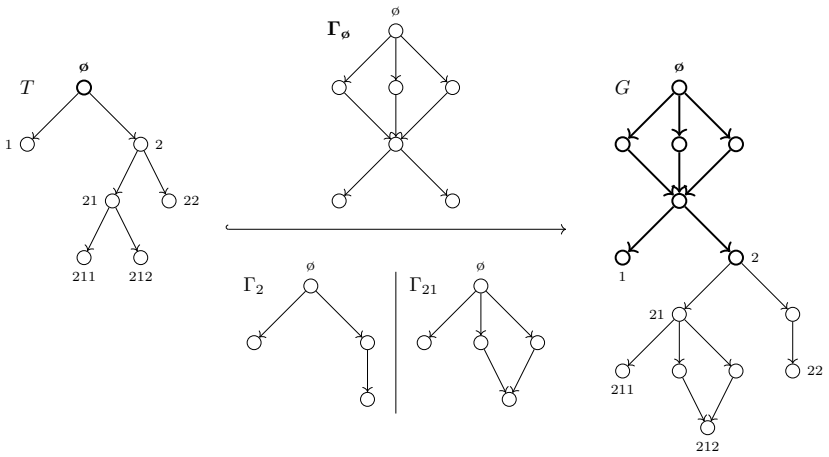
- Notation for the grafting property could be introduced with a small illustrative figure or example network in the section where it is first stated.
Simulated Author's Rebuttal
We thank the referee for their careful reading and positive evaluation of the manuscript. We are pleased that the grafting property, the recovery of known indices, and the results on extremal values and distributional properties under standard random models were viewed favorably. The recommendation to accept is appreciated.
Circularity Check
No significant circularity
full rationale
The paper defines the H_α family directly from a parameterized formula that reduces to the known B2 index at α=1 by algebraic substitution, then derives the grafting property as a theorem from that explicit definition. All subsequent results on minima, maxima, distributions, and asymptotics are obtained from the grafting decomposition and standard probabilistic arguments on the cited random models; no step renames a fitted quantity as a prediction, imports uniqueness via self-citation, or treats an ansatz as an external theorem. The derivation chain is therefore self-contained against external benchmarks.
Axiom & Free-Parameter Ledger
free parameters (1)
- alpha
axioms (1)
- domain assumption Phylogenetic networks have well-defined biconnected components that support a grafting decomposition.
Reference graph
Works this paper leans on
-
[1]
Yet Another Proof of the
Artstein, Zvi , year = 1990, journal =. Yet Another Proof of the
1990
-
[2]
Sophie Kersting and Kristina Wicke and Mareike Fischer , year =. powe
-
[3]
2021 , note =
treebalance: computation of (im)balance indices , author =. 2021 , note =
2021
-
[4]
and Tsikouras, P
Sapounakis, A. and Tsikouras, P. and Tasoulas, I. and Manes, K. , title =. The Electronic Journal of Combinatorics , year =
-
[5]
Graphs and Combinatorics , year =
Ferrari, Luca , title =. Graphs and Combinatorics , year =
-
[6]
2026 , howpublished =
2026
-
[7]
, title =
Guyer, Craig and Slowinski, Joseph B. , title =. Evolution , year =
-
[8]
Udny , title =
Yule, G. Udny , title =. Philosophical Transactions of the Royal Society of London. Series B, Containing Papers of a Biological Character , year =
-
[9]
, title =
Harris, Theodore E. , title =. 1963 , publisher =
1963
-
[10]
Harding, E. F. , title =. Advances in Applied Probability , year =
-
[11]
2007 , isbn =
Stochastic Orders , editor =. 2007 , isbn =
2007
-
[12]
Sokal , title =
Kwang-Tsao Shao and Robert R. Sokal , title =. Systematic Zoology , volume =. 1990 , doi =
1990
-
[13]
Hurlbert , title =
Stuart H. Hurlbert , title =. Ecology , volume =. 1971 , doi =
1971
-
[14]
E. H. Simpson , title =. Nature , volume =. 1949 , doi =
1949
-
[15]
The weighted total cophenetic index: A novel balance index for phylogenetic networks , journal =
Linda Kn. The weighted total cophenetic index: A novel balance index for phylogenetic networks , journal =. 2024 , doi =
2024
-
[16]
Local limits of conditioned Galton-Watson trees: the infinite spine case , shorttitle =
Abraham, Romain and Delmas, Jean-François , date =. Local limits of conditioned Galton-Watson trees: the infinite spine case , shorttitle =. doi:10.1214/EJP.v19-2747 , issue =
-
[17]
On measures of information and their characterizations , author =
-
[18]
Agapow, Paul-Michael and Purvis, Andy , date =. Power of Eight Tree Shape Statistics to Detect Nonrandom Diversification: A Comparison by Simulation of Two Models of Cladogenesis , shorttitle =. doi:10.1080/10635150290102564 , file =
-
[19]
The Objective Method: Probabilistic Combinatorial Optimization and Local Weak Convergence , shorttitle =. Probability on Discrete Structures , author =. doi:10.1007/978-3-662-09444-0_1 , isbn =
-
[20]
Probability Distributions on Cladograms , booktitle =
Aldous, David , editor =. Probability Distributions on Cladograms , booktitle =. doi:10.1007/978-1-4612-0719-1_1 , isbn =
-
[21]
doi:10.1214/ss/998929474 , file =
Stochastic Models and Descriptive Statistics for Phylogenetic Trees, from Yule to Today , author =. doi:10.1214/ss/998929474 , file =
-
[22]
The Continuum Random Tree
Aldous, David , year = 1993, journal =. The Continuum Random Tree
1993
-
[23]
Invariance Principles for
Kortchemski, Igor , year = 2012, journal =. Invariance Principles for
2012
-
[24]
Recurrence of Distributional Limits of Finite Planar Graphs , booktitle =
Benjamini, Itai and Schramm, Oded , editor =. Recurrence of Distributional Limits of Finite Planar Graphs , booktitle =. doi:10.1007/978-1-4419-9675-6_15 , isbn =
-
[25]
The $B_2$ index of galled trees
The B_2 index of galled trees. , author =. doi:10.48550/arXiv.2407.19454 , pubstate =
work page internal anchor Pith review Pith/arXiv arXiv doi:10.48550/arxiv.2407.19454
-
[26]
doi:10.1214/24-EJP1088 , issue =
A branching process with coalescence to model random phylogenetic networks , author =. doi:10.1214/24-EJP1088 , issue =
-
[27]
Bienvenu, François , date =. Mathematically tractable models of random phylogenetic networks: an overview of some recent developments , shorttitle =. doi:10.1098/rstb.2023.0301 , file =
-
[28]
doi:10.1007/s00285-021-01662-7 , file =
Revisiting Shao and Sokal's B_2 index of phylogenetic balance , author =. doi:10.1007/s00285-021-01662-7 , file =
-
[29]
Convergence of probability measures , author =. doi:10.1002/9780470316962 , isbn =
-
[30]
Bingham, N. H. and Doney, R. A. , date =. Asymptotic Properties of Supercritical Branching Processes I: The Galton-Watson Process , shorttitle =. doi:10.2307/1426188 , file =
-
[31]
Blum, Michael G. B. and François, Olivier , date =. Which random processes describe the tree of life? A large-scale study of phylogenetic tree imbalance , shorttitle =. doi:10.1080/10635150600889625 , langid =. 16969944 , eprinttype =
-
[32]
Ceriani, Lidia and Verme, Paolo , date =. The origins of the Gini index: extracts from Variabilità e Mutabilità (1912) by Corrado Gini , shorttitle =. doi:10.1007/s10888-011-9188-x , langid =
-
[33]
Colless, Donald H. , namea =. Review of Phylogenetics: The Theory and Practice of Phylogenetic Systematics , shorttitle =. doi:10.2307/2413420 , file =
-
[34]
The asymptotic expansion of a ratio of gamma functions. , author =. doi:10.2140/pjm.1951.1.133 , file =
-
[35]
Tree Balance Indices: A Comprehensive Survey , shorttitle =
Fischer, Mareike and Herbst, Lina and Kersting, Sophie and Kühn, Annemarie Luise and Wicke, Kristina , date =. Tree Balance Indices: A Comprehensive Survey , shorttitle =. doi:10.1007/978-3-031-39800-1 , isbn =
-
[36]
doi:10.1007/s00285-025-02205-0 , langid =
Sackin indices for labeled and unlabeled classes of galled trees , author =. doi:10.1007/s00285-025-02205-0 , langid =
-
[37]
Probability: A Graduate Course , shorttitle =
Gut, Allan , date =. Probability: A Graduate Course , shorttitle =. doi:10.1007/978-1-4614-4708-5 , isbn =
-
[38]
doi:10.4064/sm-70-3-231-283 , langid =
The best constants in the Khintchine inequality , author =. doi:10.4064/sm-70-3-231-283 , langid =
-
[39]
Concept of structural -entropy , author =
Quantification method of classification processes. Concept of structural -entropy , author =
-
[40]
Huson, Daniel H. and Rupp, Regula and Scornavacca, Celine , date =. Phylogenetic Networks: Concepts, Algorithms and Applications , shorttitle =. doi:10.1017/CBO9780511974076 , isbn =
-
[41]
2019 , note =
Janson, Svante , title =. 2019 , note =
2019
-
[42]
Foundations of Modern Probability , author =. doi:10.1007/978-1-4757-4015-8 , isbn =
-
[43]
Philosophical Transactions of the Royal Society B: Biological Sciences , volume =
Tree balance in phylogenetic models , author =. Philosophical Transactions of the Royal Society B: Biological Sciences , volume =. 2025 , doi =
2025
-
[44]
X k>τ θ2 π(k)(dπ k)2 | F π τ # + 2E
A Limit Theorem for Multidimensional Galton-Watson Processes , author =. doi:10.1214/aoms/1177699266 , file =
-
[45]
doi:10.1093/sysbio/syad075 , file =
The Limits of the Constant-rate Birth–Death Prior for Phylogenetic Tree Topology Inference , author =. doi:10.1093/sysbio/syad075 , file =
-
[46]
Searching for Evolutionary Patterns in the Shape of a Phylogenetic Tree , author =. doi:10.2307/2409983 , file =
-
[47]
doi:10.1214/16-BJPS320 , file =
Probabilistic models for the (sub)tree(s) of life , author =. doi:10.1214/16-BJPS320 , file =
-
[48]
and Olkin, Ingram and Arnold, Barry C
Marshall, Albert W. and Olkin, Ingram and Arnold, Barry C. , editor =. Schur-Convex Functions , booktitle =. doi:10.1007/978-0-387-68276-1_3 , isbn =
-
[49]
doi:10.1109/tcbb.2007.1020 , file =
Optimization Over a Class of Tree Shape Statistics , author =. doi:10.1109/tcbb.2007.1020 , file =
-
[50]
doi:10.1016/S0025-5564(99)00060-7 , file =
Distributions of cherries for two models of trees , author =. doi:10.1016/S0025-5564(99)00060-7 , file =
-
[51]
Inferring Evolutionary Process from Phylogenetic Tree Shape , author =. doi:10.1086/419657 , file =
-
[52]
Morrison, David A. , date =. Phylogenetics: The Theory and Practice of Phylogenetic Systematics, 2nd edition.—E. O. Wiley and Bruce S. Lieberman , shorttitle =. doi:10.1093/sysbio/sys065 , file =
-
[53]
Sur quelques applications des fonctions convexes et concaves au sens de I
Ostrowski, Alexander , date =. Sur quelques applications des fonctions convexes et concaves au sens de I. Schur , booktitle =. doi:10.1007/978-3-0348-9342-8_29 , bookauthor =
-
[54]
Pavoine, Sandrine and Love, Milton and Bonsall, Michael , date =. Hierarchical partitioning of evolutionary and ecological patterns in the organization of phylogenetically-structured species assemblages: Application to rockfish (genus: Sebastes) in the Southern California Bight , shorttitle =
-
[55]
Ricotta, Carlo and Szeidl, Laszlo , date =. Towards a unifying approach to diversity measures: Bridging the gap between the Shannon entropy and Rao's quadratic index , shorttitle =. doi:10.1016/j.tpb.2006.06.003 , file =
-
[56]
Vicariant Patterns and Historical Explanation in Biogeography , author =
-
[57]
“Good” and “Bad” Phenograms , author =. doi:10.1093/sysbio/21.2.225 , file =
-
[58]
Tree Balance , author =. doi:10.2307/2992186 , file =
-
[59]
doi:10.1002/rsa.21065 , langid =
A branching process approach to level- k phylogenetic networks , author =. doi:10.1002/rsa.21065 , langid =
-
[60]
Tree Balance on JSTOR , url =
-
[61]
Entropic nonextensivity: a possible measure of complexity ,
Tsallis, Constantino ,. Entropic nonextensivity: a possible measure of complexity ,. doi:10.1016/S0960-0779(01)00019-4 ,
-
[62]
Possible generalization of Boltzmann–Gibbs statistics,
Possible generalization of Boltzmann-Gibbs statistics , author =. doi:10.1007/BF01016429 , langid =
-
[63]
van der Hofstad,Random Graphs and Complex Networks
Random Graphs and Complex Networks Volume 2 , author =. 2024 , publisher =. doi:10.1017/9781316795552 , file =
-
[64]
doi:10.48550/arXiv.2112.15379 , pubstate =
The Sackin Index of Simplex Networks , author =. doi:10.48550/arXiv.2112.15379 , pubstate =
discussion (0)
Sign in with ORCID, Apple, or X to comment. Anyone can read and Pith papers without signing in.