Infinitesimal Causality
Pith reviewed 2026-06-25 21:39 UTC · model grok-4.3
The pith
Categorical causal sufficiency holds when algebraic Frobenius structure on variables is compatible with geometric involutive closure of interventions.
A machine-rendered reading of the paper's core claim, the machinery that carries it, and where it could break.
Core claim
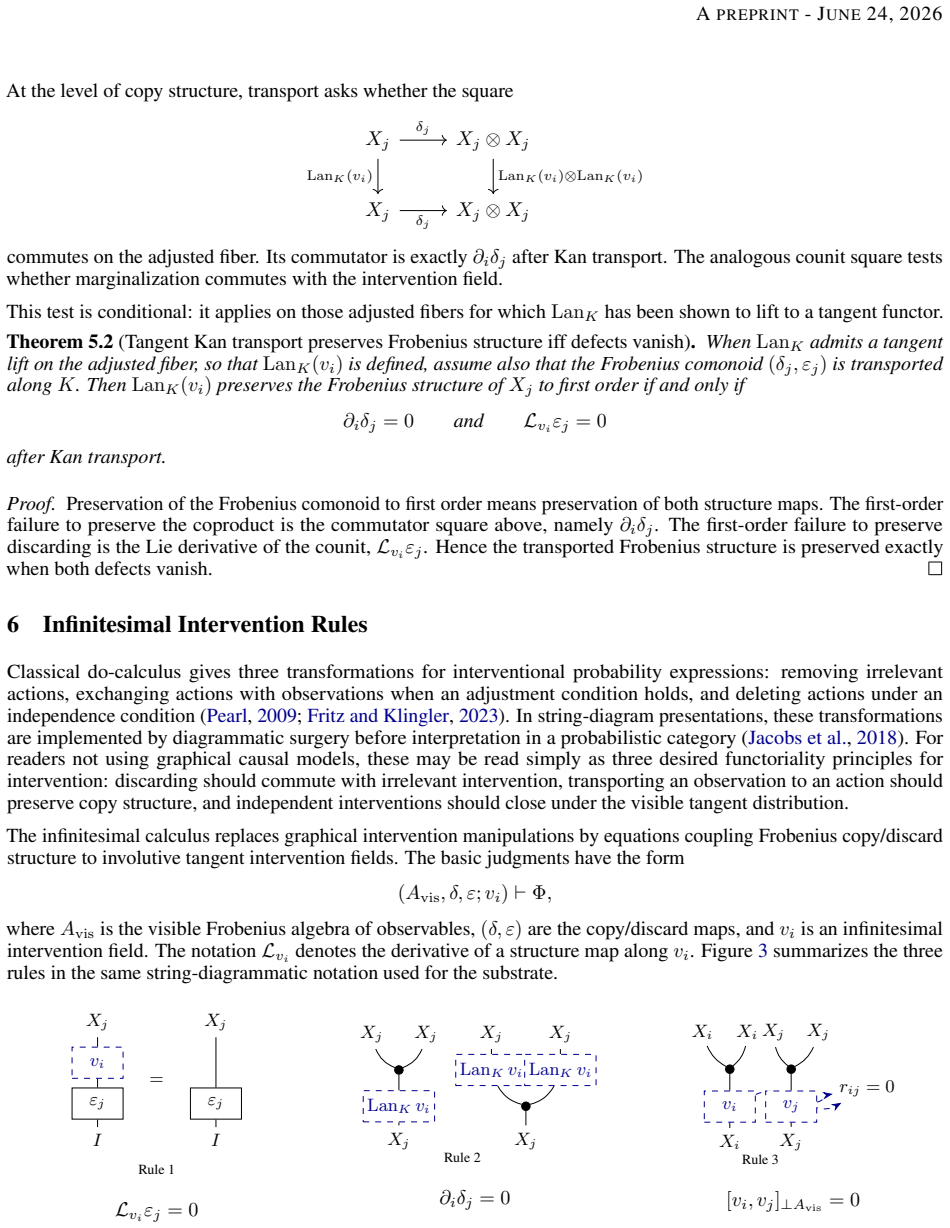
The central claim is that, for structural causal models, infinitesimal causality is formulated most naturally in the slice of deterministic mechanisms over exogenous variables, with visible stochastic kernels recovered only after pushforward. Interventions act as tangent vectors deforming the categorical Frobenius copy/discard operations; their Lie brackets measure whether the deformation preserves classical information-flow structure. Categorical causal sufficiency is the compatibility of the categorical Frobenius algebra on classical variables with the geometric Frobenius integrability condition of involutive closure of the intervention distribution.
What carries the argument
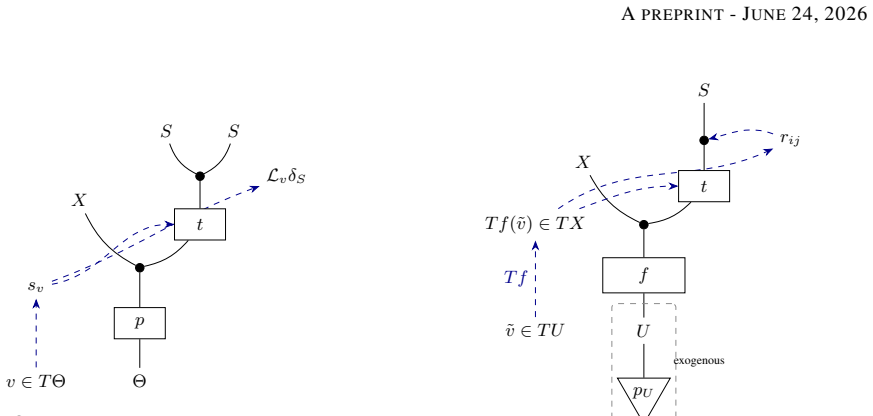
Tangent-bundle semantics in Frobenius Markov categories, in which interventions function as tangent deformations of the categorical Frobenius algebra on classical variables.
If this is right
- Ignoring irrelevant interventions corresponds to counit invariance of the Frobenius algebra.
- Action/observation exchange corresponds to coproduct compatibility under pushforward.
- Independence of interventions corresponds to involutive bracket closure of the visible intervention distribution.
- Visible stochastic kernels arise only after pushforward from the deterministic slice over exogenous variables.
Where Pith is reading between the lines
- The slice-category formulation separates deterministic mechanism structure from observed stochasticity, which may simplify proofs of causal identifiability.
- Lie-bracket closure supplies a differential-geometric test that could be discretized for finite causal graphs.
- The same compatibility condition may extend directly to other categorical models of processes that carry copy/discard structure.
Load-bearing premise
Infinitesimal causality for structural causal models is most naturally formulated in the slice of deterministic mechanisms over exogenous variables, with visible stochastic kernels recovered only after pushforward.
What would settle it
Construct a structural causal model in which two intervention tangent vectors have a nonzero Lie bracket yet the model still satisfies every identity of Pearl's do-calculus; the existence of such a model would falsify the claim that involutive closure is required for categorical causal sufficiency.
Figures
read the original abstract
This paper introduces a categorical account of infinitesimal causality in Frobenius Markov categories equipped with tangent-bundle semantics. IDC captures the infinitesimal layer in which interventions act as tangent deformations of copy/discard structure. Two distinct Frobenius structures interact: (1) the categorical Frobenius algebra on classical variables encoding copying, comparing, and discarding; and (2) the geometric Frobenius integrability condition, namely involutive closure of the intervention distribution, distinct from the algebraic Frobenius structure. Categorical causal sufficiency is defined as the compatibility of these two notions. A key observation is that, for structural causal models, infinitesimal causality is most naturally formulated in the slice of deterministic mechanisms over exogenous variables, with visible stochastic kernels obtained only after pushforward. Interventions are tangent vectors that deform the Frobenius copy/discard operations; their Lie brackets measure whether this deformation preserves classical information-flow structure. Pearl's do-calculus is used as a guiding example of intervention identities: ignoring irrelevant interventions corresponds to counit invariance, action/observation exchange to coproduct compatibility with pushforward, and independence to involutive bracket closure of the visible intervention distribution.
Editorial analysis
A structured set of objections, weighed in public.
Referee Report
Summary. The paper introduces infinitesimal causality (IDC) in Frobenius Markov categories equipped with tangent-bundle semantics. IDC is defined via compatibility of two Frobenius structures: the categorical Frobenius algebra on classical variables (encoding copy/compare/discard) and the geometric Frobenius integrability condition (involutive closure of the intervention distribution). Categorical causal sufficiency is this compatibility. The central claim is that, for structural causal models, IDC is naturally formulated in the slice category of deterministic mechanisms over exogenous variables, with visible stochastic kernels recovered by pushforward; Lie brackets of tangent vectors then measure preservation of classical information-flow structure. Pearl's do-calculus identities are recovered as counit invariance, coproduct compatibility, and involutive bracket closure.
Significance. If the compatibility definition and the pushforward transfer are rigorously established, the work would supply a novel infinitesimal layer for categorical causality that integrates algebraic Frobenius structure with geometric integrability, potentially clarifying intervention semantics in Markov categories. The explicit use of tangent deformations and Lie brackets to track information-flow preservation is a distinctive technical contribution.
major comments (2)
- [slice formulation / abstract] The key observation (abstract and the section introducing the slice formulation) states that IDC is most naturally formulated in the slice of deterministic mechanisms over exogenous variables, with stochastic kernels obtained only after pushforward. No derivation is supplied showing that the pushforward functor preserves tangent deformations and Lie-bracket closure in a manner that transfers the involutive-closure condition to the visible-level intervention identities (counit invariance and coproduct compatibility) without additional functoriality hypotheses on the pushforward.
- [definition of categorical causal sufficiency] Definition of categorical causal sufficiency as compatibility of the two Frobenius structures (categorical algebraic and geometric integrability) is presented as the central notion, yet the manuscript supplies no independent check or example verifying that this compatibility implies the stated do-calculus identities once the pushforward is applied.
minor comments (2)
- Notation for the tangent bundle and the two distinct Frobenius structures should be introduced with explicit comparison to standard references in categorical probability.
- The abstract claims that Lie brackets measure preservation of classical information-flow structure; a brief illustrative computation in a simple SCM would clarify this claim.
Simulated Author's Rebuttal
We thank the referee for the careful and constructive report. The two major comments correctly identify places where the manuscript would be strengthened by additional explicit derivations and verifications. We respond point-by-point below and will incorporate the requested material in a revised version.
read point-by-point responses
-
Referee: [slice formulation / abstract] The key observation (abstract and the section introducing the slice formulation) states that IDC is most naturally formulated in the slice of deterministic mechanisms over exogenous variables, with stochastic kernels obtained only after pushforward. No derivation is supplied showing that the pushforward functor preserves tangent deformations and Lie-bracket closure in a manner that transfers the involutive-closure condition to the visible-level intervention identities (counit invariance and coproduct compatibility) without additional functoriality hypotheses on the pushforward.
Authors: We agree that an explicit derivation of preservation under pushforward is required for rigor. In the revision we will add a dedicated subsection proving that the pushforward, induced by the deterministic mechanism in the slice, is a strict monoidal functor that commutes with the tangent-bundle construction and therefore preserves both tangent deformations and Lie brackets. This transfers the involutive-closure condition directly to the visible-level counit-invariance and coproduct-compatibility identities using only the existing Markov-category axioms. revision: yes
-
Referee: [definition of categorical causal sufficiency] Definition of categorical causal sufficiency as compatibility of the two Frobenius structures (categorical algebraic and geometric integrability) is presented as the central notion, yet the manuscript supplies no independent check or example verifying that this compatibility implies the stated do-calculus identities once the pushforward is applied.
Authors: We acknowledge that an independent verification would make the implication clearer. The revision will include a short worked example (a simple chain structural causal model with exogenous noise) that computes the two Frobenius structures in the slice, applies the pushforward, and explicitly checks that compatibility yields counit invariance, coproduct compatibility, and involutive bracket closure, thereby recovering the corresponding do-calculus identities at the visible level. revision: yes
Circularity Check
No significant circularity; framework consists of explicit definitions without reduction to inputs
full rationale
The paper introduces IDC as the infinitesimal layer of tangent deformations on copy/discard structure and explicitly defines categorical causal sufficiency as the compatibility of the categorical Frobenius algebra (copy/compare/discard) with the geometric Frobenius integrability condition (involutive closure). The slice formulation for structural causal models is presented as a key observation, with visible kernels obtained by pushforward and Lie brackets measuring preservation; Pearl's do-calculus is invoked only as a guiding example for interpreting counit invariance, coproduct compatibility, and bracket closure. No equations, fitted parameters, or predictions are shown that reduce by construction to prior inputs, no self-citations appear, and no ansatz or uniqueness theorem is smuggled in. The derivation chain is therefore self-contained as a definitional framework rather than a circular reduction.
Axiom & Free-Parameter Ledger
axioms (2)
- domain assumption Frobenius Markov categories equipped with tangent-bundle semantics exist and are suitable for modeling causality
- ad hoc to paper The two Frobenius structures (categorical algebraic and geometric integrability) interact via compatibility to define causal sufficiency
invented entities (1)
-
Infinitesimal causality (IDC)
no independent evidence
Reference graph
Works this paper leans on
-
[1]
K. Cho and B. Jacobs. Disintegration and Bayesian inversion via string diagrams. Mathematical Structures in Computer Science, 29 0 (7): 0 938--971, 2019. doi:10.1017/S0960129518000488. URL https://arxiv.org/abs/1709.00322
-
[2]
J. R. B. Cockett and G. S. H. Cruttwell. Differential structure, tangent structure, and SDG . Applied Categorical Structures, 22: 0 331--417, 2014. doi:10.1007/s10485-013-9312-0
-
[3]
T. Fritz. A synthetic approach to Markov kernels, conditional independence and theorems on sufficient statistics. Advances in Mathematics, 370: 0 107239, 2020. doi:10.1016/j.aim.2020.107239. URL https://arxiv.org/abs/1908.07021
-
[4]
Fritz and A
T. Fritz and A. Klingler. The d-Separation criterion in categorical probability. Journal of Machine Learning Research, 24 0 (46): 0 1--49, 2023. URL https://jmlr.org/papers/v24/22-0916.html
2023
-
[5]
S. B. Gillispie and M. D. Perlman. Enumerating Markov equivalence classes of acyclic digraph models. In Proceedings of the Seventeenth Conference on Uncertainty in Artificial Intelligence, pages 171--177, 2001. URL https://arxiv.org/abs/1301.2272
Pith/arXiv arXiv 2001
-
[6]
S. Guo, V. T \'o th, B. Sch \"o lkopf, and F. Husz \'a r. Causal de Finetti : On the identification of invariant causal structure in exchangeable data. In Advances in Neural Information Processing Systems, 2022. URL https://arxiv.org/abs/2203.15756
arXiv 2022
-
[7]
S. Guo, C. Zhang, K. Mohan, F. Husz \'a r, and B. Sch \"o lkopf. Do Finetti : On causal effects for exchangeable data. In Advances in Neural Information Processing Systems, 2024. URL https://arxiv.org/abs/2405.18836
arXiv 2024
-
[8]
B. Jacobs, A. Kissinger, and F. Zanasi. Causal inference by string diagram surgery. arXiv preprint arXiv:1811.08338, 2018. URL https://arxiv.org/abs/1811.08338
Pith/arXiv arXiv 2018
-
[9]
S. Mahadevan. Causal density functions, 2026 a . URL https://arxiv.org/abs/2606.00754
Pith/arXiv arXiv 2026
-
[10]
S. Mahadevan. Latent Confounded Causal Discovery via Lie Bracket Geometry , 2026 b . URL https://arxiv.org/abs/2606.19610
Pith/arXiv arXiv 2026
-
[11]
J. Pearl. Causality: Models, Reasoning, and Inference. Cambridge University Press, 2 edition, 2009
2009
-
[12]
The Annals of Statistics , author =
T. Richardson and P. Spirtes. Ancestral graph Markov models. The Annals of Statistics, 30 0 (4): 0 962--1030, 2002. doi:10.1214/aos/1031689015
-
[13]
Rosick \'y
J. Rosick \'y . Abstract tangent functors. Diagrammes, 12: 0 JR1--JR11, 1984
1984
-
[14]
D. B. Rubin. Causal inference using potential outcomes: Design, modeling, decisions. Journal of the American Statistical Association, 100 0 (469): 0 322--331, 2005. doi:10.1198/016214504000001880
-
[15]
D. Schmid and A. Sly. On the number and size of Markov equivalence classes of random directed acyclic graphs, 2022. URL https://arxiv.org/abs/2209.04395
arXiv 2022
-
[16]
Spirtes, C
P. Spirtes, C. Glymour, and R. Scheines. Causation, Prediction, and Search. MIT Press, 2 edition, 2000
2000
-
[17]
M. Studen \'y . Probabilistic Conditional Independence Structures. Information Science and Statistics. Springer London, 2005. ISBN 978-1-85233-891-6. doi:10.1007/b138557. URL https://link.springer.com/book/10.1007/b138557. Softcover ISBN 978-1-84996-948-2, published 2010
-
[18]
J. Zhang. On the completeness of orientation rules for causal discovery in the presence of latent confounders and selection bias. Artificial Intelligence, 172 0 (16--17): 0 1873--1896, 2008. doi:10.1016/j.artint.2008.08.001
discussion (0)
Sign in with ORCID, Apple, or X to comment. Anyone can read and Pith papers without signing in.