Causal Density Functions
Pith reviewed 2026-06-28 18:24 UTC · model grok-4.3
The pith
Causal density functions are Radon-Nikodym derivatives that let observational expectations be reweighted to recover interventional ones through the identity E_do[f(Y)] equals E_obs[f(Y) times rho(X,Y)].
A machine-rendered reading of the paper's core claim, the machinery that carries it, and where it could break.
Core claim
Causal density functions are Radon-Nikodym derivatives that compare interventional laws to observational laws and therefore act as local density ratios for causal effects. The basic identity E_do[f(Y)] = E_obs[f(Y) rho(X,Y)] makes causal density directly testable: if the estimated density ratio is correct, observational expectations reweighted by rho reproduce interventional expectations. The paper derives practical estimators for do-curves and directed edge scores and relates the construction to Radon-Nikodym and Kan semantics for conditioning and intervention.
What carries the argument
The causal density function rho, the Radon-Nikodym derivative between interventional and observational laws, which supplies the local density ratio used to reweight observational data into interventional expectations.
If this is right
- If the estimated density ratio is correct, observational expectations reweighted by rho reproduce interventional expectations.
- Estimators can be derived for do-curves and for scores on individual directed edges.
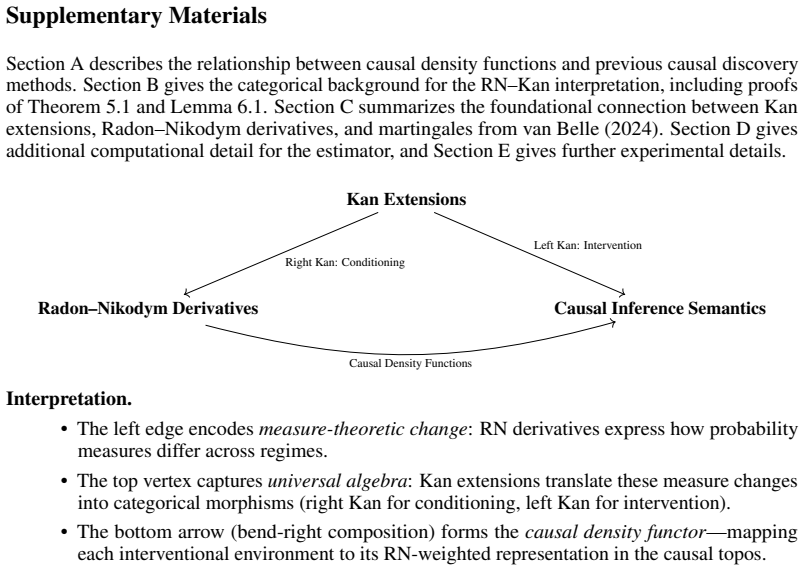
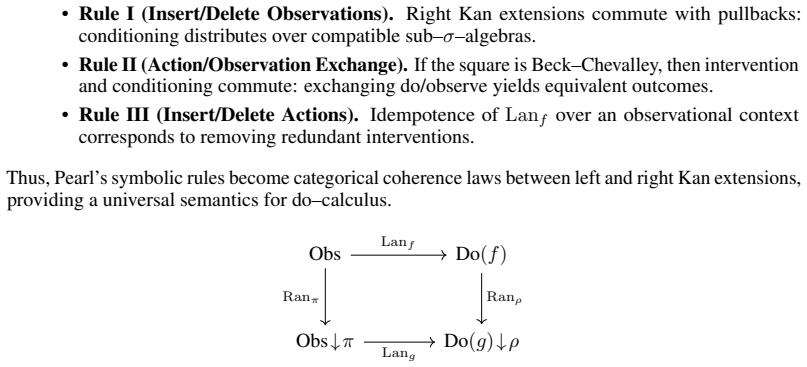
- The construction supplies a change-of-measure semantics that connects intervention to conditioning via Radon-Nikodym derivatives.
Where Pith is reading between the lines
- The same reweighting identity could be used to validate causal claims on data sets where only observational samples are available but limited interventional benchmarks exist for checking.
- Because the ratio is pointwise, it might be combined with kernel or neural density estimators to handle continuous or high-dimensional variables without requiring full distribution comparisons.
- The approach suggests a route to causal feature importance that scores each variable's directed contribution locally rather than through global distribution distances.
Load-bearing premise
The Radon-Nikodym derivative between the interventional and observational laws exists as a well-defined, estimable function that can be used to score directed influence.
What would settle it
A controlled experiment in which known interventional outcomes are compared against observational data reweighted by an estimated causal density ratio; systematic mismatch between the two would show that the ratio does not correctly capture the change of measure.
Figures



read the original abstract
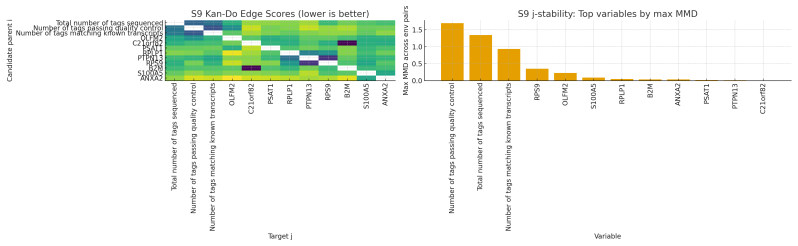
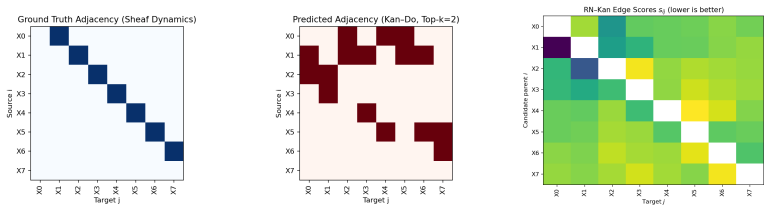
We introduce causal density functions: Radon-Nikodym derivatives that compare interventional laws to observational laws and therefore act as local density ratios for causal effects. Whereas many causal-strength measures compare whole distributions after graph surgery, causal density functions provide a pointwise change-of-measure object that can be estimated, calibrated, and used to score directed influence. The basic identity \[ \mathbb{E}_{\mathrm{do}}[f(Y)] = \mathbb{E}_{\mathrm{obs}}\!\left[f(Y)\rho(X,Y)\right] \] makes causal density directly testable: if the estimated density ratio is correct, observational expectations reweighted by $\rho$ reproduce interventional expectations. We derive practical estimators for do-curves and directed edge scores, relate the construction to Radon-Nikodym/Kan semantics for conditioning and intervention, and evaluate the resulting estimators on synthetic and real perturbation benchmarks.
Editorial analysis
A structured set of objections, weighed in public.
Referee Report
Summary. The paper introduces causal density functions as Radon-Nikodym derivatives between interventional and observational laws, serving as pointwise density ratios for causal effects. It presents the identity E_do[f(Y)] = E_obs[f(Y) ρ(X,Y)] as a testable relation allowing observational expectations reweighted by ρ to recover interventional ones, derives estimators for do-curves and directed edge scores, relates the approach to Radon-Nikodym semantics for intervention, and evaluates on synthetic and real benchmarks.
Significance. If the identity and estimators are well-defined, the construction supplies a local, estimable, and directly testable alternative to global post-intervention distribution comparisons, with potential utility for scoring directed influence. The reweighting identity is a strength if the Radon-Nikodym derivative exists and can be estimated reliably.
major comments (1)
- [Abstract / central identity] Abstract (central identity): The equality E_do[f(Y)] = E_obs[f(Y) ρ(X,Y)] requires the interventional measure to be absolutely continuous w.r.t. the observational measure for the Radon-Nikodym derivative ρ to exist as a measurable function. Standard hard interventions (e.g., do(X=x) inducing a Dirac mass) produce mutually singular measures, so ρ is undefined. The manuscript must state explicit conditions on intervention type (soft vs. hard) and measure classes guaranteeing absolute continuity, or demonstrate via counter-example where the construction fails.
Simulated Author's Rebuttal
We thank the referee for highlighting the important technical requirement of absolute continuity for the Radon-Nikodym derivative. We address this point directly below and will revise the manuscript accordingly.
read point-by-point responses
-
Referee: [Abstract / central identity] Abstract (central identity): The equality E_do[f(Y)] = E_obs[f(Y) ρ(X,Y)] requires the interventional measure to be absolutely continuous w.r.t. the observational measure for the Radon-Nikodym derivative ρ to exist as a measurable function. Standard hard interventions (e.g., do(X=x) inducing a Dirac mass) produce mutually singular measures, so ρ is undefined. The manuscript must state explicit conditions on intervention type (soft vs. hard) and measure classes guaranteeing absolute continuity, or demonstrate via counter-example where the construction fails.
Authors: We agree that the identity holds only when the interventional law is absolutely continuous with respect to the observational law. The manuscript's development of causal density functions is intended for regimes in which this absolute continuity obtains (e.g., soft or randomized interventions that do not introduce atoms on sets of observational measure zero). We will add an explicit statement of this assumption in the abstract, introduction, and methods, together with a short paragraph clarifying the distinction between soft and hard interventions and noting that the construction does not apply to deterministic hard interventions on continuous variables that produce mutually singular measures. A brief counter-example illustrating failure under hard intervention will also be included. revision: yes
Circularity Check
No significant circularity in derivation chain
full rationale
The paper defines causal density functions explicitly as Radon-Nikodym derivatives between interventional and observational measures, then states the change-of-measure identity that holds by the definition of the RN derivative. This is presented as the basic identity enabling testability, but the equality is tautological once ρ is defined as dP_do/dP_obs; no claimed prediction or first-principles result is shown to reduce to a fitted parameter or prior self-citation by construction. The paper proceeds to derive estimators for do-curves and edge scores and evaluates them on synthetic and real benchmarks, supplying independent empirical content. No load-bearing step matches the enumerated circularity patterns.
Axiom & Free-Parameter Ledger
axioms (1)
- domain assumption Existence of Radon-Nikodym derivative between interventional and observational probability measures
Forward citations
Cited by 2 Pith papers
-
Infinitesimal Causality
Infinitesimal causality is defined via compatibility of categorical and geometric Frobenius structures in Markov categories, with interventions as tangent vectors deforming copy/discard operations and Lie brackets mea...
-
Latent Confounded Causal Discovery via Lie Bracket Geometry
Introduces BRIDGE and SKFM algorithms that detect latent confounders via non-closing Lie brackets in interventional vector fields derived from density ratios.
Reference graph
Works this paper leans on
-
[1]
Probability and Measure
Patrick Billingsley. Probability and Measure. Wiley, 3rd edition, 1995
1995
-
[2]
Differentiable causal discovery from interventional data, 2020 a
Philippe Brouillard, Sébastien Lachapelle, Alexandre Lacoste, Simon Lacoste-Julien, and Alexandre Drouin. Differentiable causal discovery from interventional data, 2020 a . URL https://arxiv.org/abs/2007.01754
-
[3]
Differentiable causal discovery from interventional data
Pierre Brouillard, Benoit Lachapelle, Simon Lacoste-Julien, Alexandre Lacoste, and Boris Oreshkin. Differentiable causal discovery from interventional data. In Advances in Neural Information Processing Systems, 2020 b
2020
-
[4]
Optimal structure identification with greedy search
David Maxwell Chickering. Optimal structure identification with greedy search. In Journal of Machine Learning Research, volume 3, pages 507--554, Nov 2002
2002
-
[5]
Tobias Fritz. A synthetic approach to markov kernels, conditional independence and theorems on sufficient statistics. Advances in Mathematics, 370: 0 107239, August 2020. ISSN 0001-8708. doi:10.1016/j.aim.2020.107239. URL http://dx.doi.org/10.1016/j.aim.2020.107239
-
[6]
Paul R. Halmos. Measure Theory. Van Nostrand, 1950
1950
-
[7]
Imbens and Donald B
Guido W. Imbens and Donald B. Rubin. Causal Inference for Statistics, Social, and Biomedical Sciences: An Introduction. Cambridge University Press, USA, 2015. ISBN 0521885884
2015
-
[8]
Dominik Janzing, David Balduzzi, Moritz Grosse-Wentrup, and Bernhard Schölkopf. Quantifying causal influences. The Annals of Statistics, 41 0 (5), October 2013. ISSN 0090-5364. doi:10.1214/13-aos1145. URL http://dx.doi.org/10.1214/13-AOS1145
-
[9]
Learning causal effects via causal inference theory
Nan Ke, Alexander Didic, Xinyu Chen, Seungjin Kim, and Yoshua Bengio. Learning causal effects via causal inference theory. In International Conference on Learning Representations, 2019
2019
-
[10]
Gradient-based neural dag learning
Sébastien Lachapelle, Pierre Brouillard, Tristan Deleu, and Simon Lacoste-Julien. Gradient-based neural dag learning. In International Conference on Learning Representations, 2020
2020
-
[11]
Categories for the Working Mathematician
Saunders MacLane. Categories for the Working Mathematician. Springer-Verlag, New York, 1971. Graduate Texts in Mathematics, Vol. 5
1971
-
[12]
Intuitionistic j -do-calculus in topos causal models, 2025
Sridhar Mahadevan. Intuitionistic j -do-calculus in topos causal models, 2025. URL https://arxiv.org/abs/2510.17944
-
[13]
Mahadevan, S. (2026). Categories for AGI , https://people.cs.umass.edu/ mahadeva/papers/catagi.pdf
2026
-
[14]
Causality: Models, Reasoning and Inference
Judea Pearl. Causality: Models, Reasoning and Inference. Cambridge University Press, USA, 2nd edition, 2009. ISBN 052189560X
2009
-
[15]
E. Riehl. Category Theory in Context. Aurora: Dover Modern Math Originals. Dover Publications, 2017. ISBN 9780486820804. URL https://books.google.com/books?id=6B9MDgAAQBAJ
2017
-
[16]
Real and Complex Analysis
Walter Rudin. Real and Complex Analysis. McGraw-Hill, 3rd edition, 1987
1987
-
[17]
Causal protein-signaling networks derived from multiparameter single-cell data
Karen Sachs, Diego Perez, Dana Pe'er, Douglas A Lauffenburger, and Garry P Nolan. Causal protein-signaling networks derived from multiparameter single-cell data. Science, 308 0 (5721): 0 523--529, 2005. doi:10.1126/science.1105809
-
[18]
Causation, Prediction, and Search
Peter Spirtes, Clark Glymour, and Richard Scheines. Causation, Prediction, and Search. MIT Press, 2000
2000
-
[19]
Kan Extensions in Probability Theory
Ruben van Belle. Kan Extensions in Probability Theory. PhD thesis, University of Edinburgh, 2024
2024
-
[20]
Permutation-based causal inference algorithms with interventions
Yue Wang and Mathias Drton. Permutation-based causal inference algorithms with interventions. In Advances in Neural Information Processing Systems, 2017
2017
-
[21]
Dags with no tears: Continuous optimization for structure learning
Xun Zheng, Bryon Aragam, Pradeep Ravikumar, and Eric P Xing. Dags with no tears: Continuous optimization for structure learning. In Advances in Neural Information Processing Systems, 2018
2018
discussion (0)
Sign in with ORCID, Apple, or X to comment. Anyone can read and Pith papers without signing in.