Self-Modulating Quantum Fast-Weight Programmers for Efficient Adaptive Sequential Learning
Pith reviewed 2026-06-26 08:08 UTC · model grok-4.3
The pith
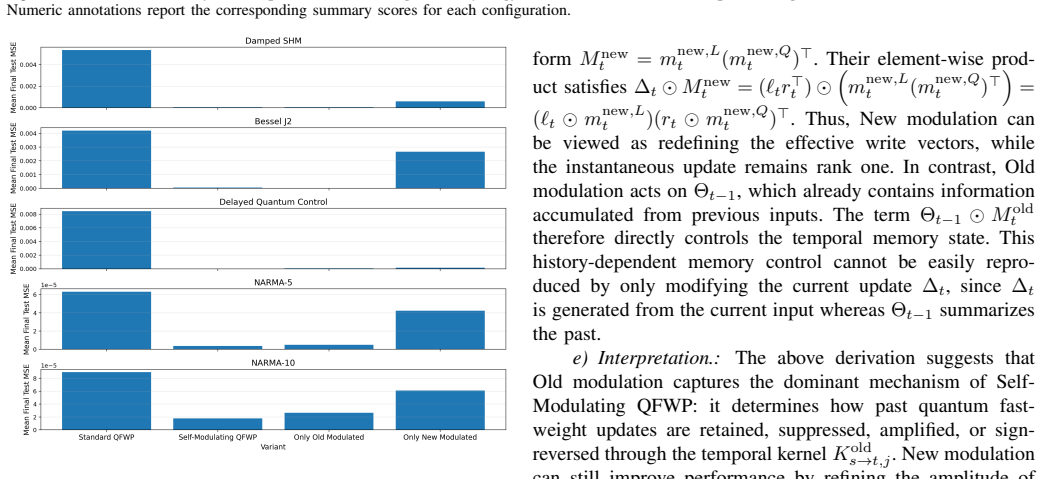
Self-modulating quantum fast-weight programmers improve convergence stability and prediction accuracy on sequential tasks.
A machine-rendered reading of the paper's core claim, the machinery that carries it, and where it could break.
Core claim
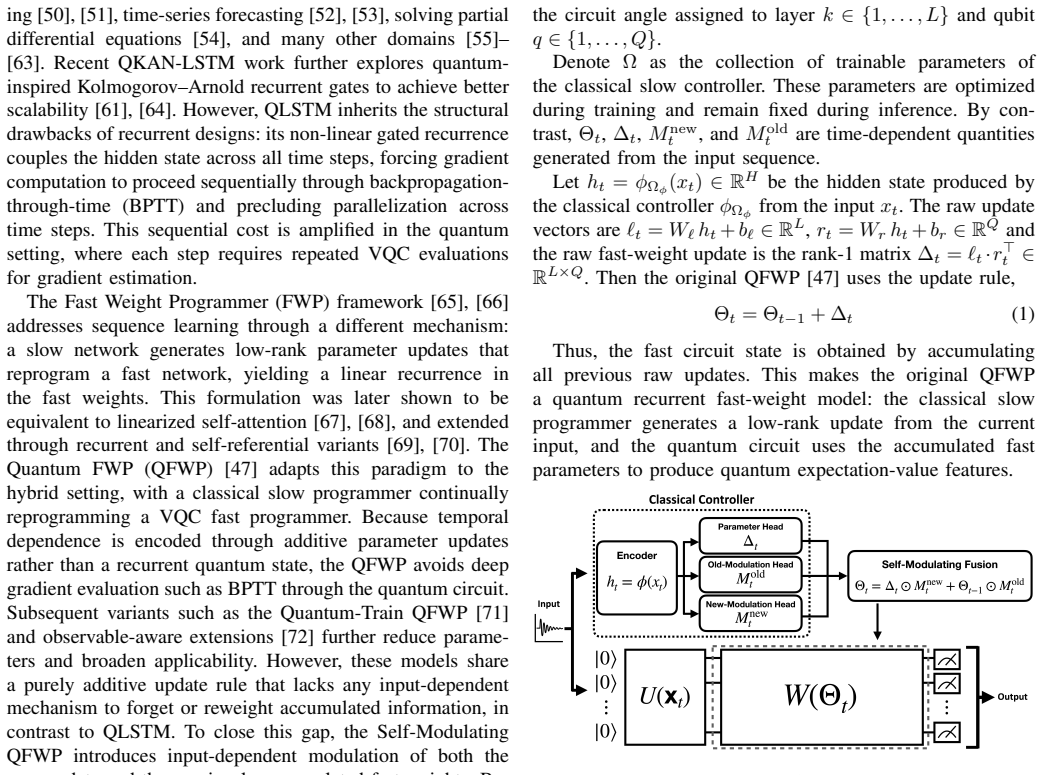
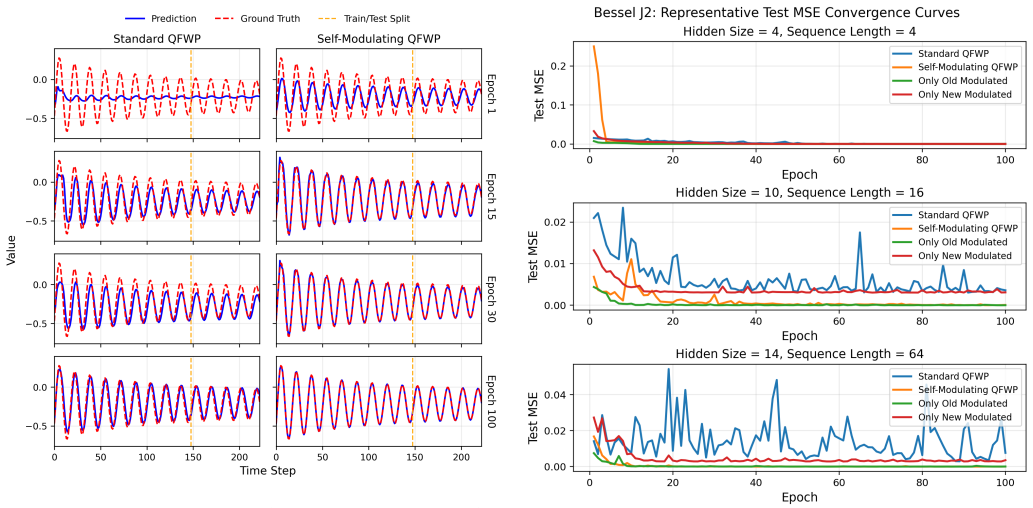
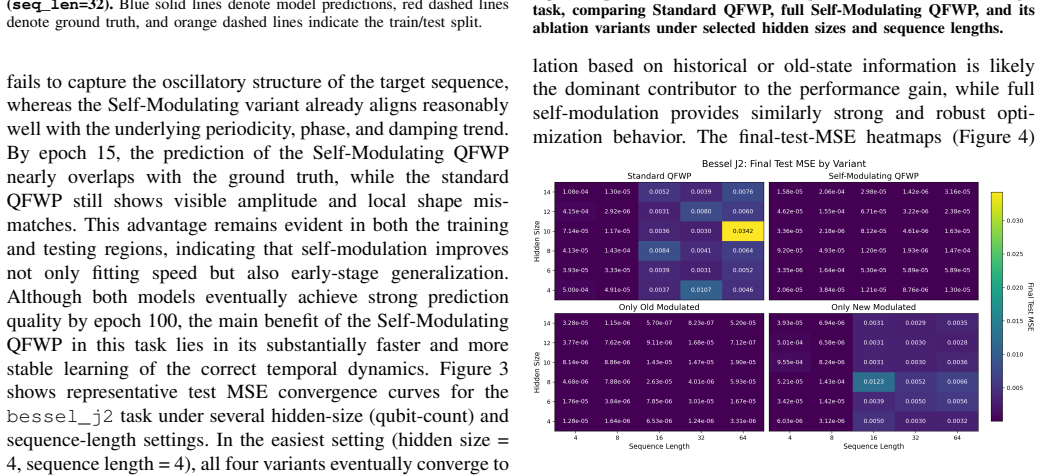
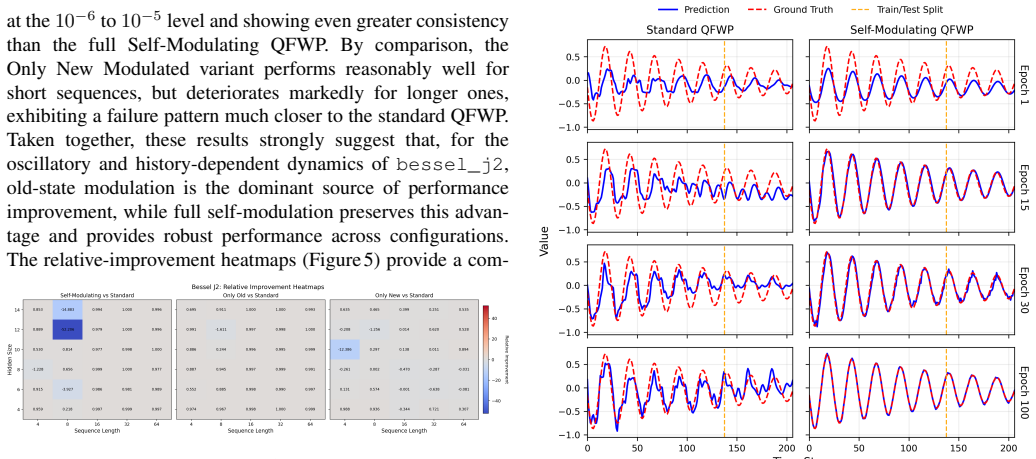
Self-Modulating Quantum Fast Weight Programmers introduce adaptive modulation that simultaneously controls the strength of new fast-weight updates and the decay rate of stored fast-weight memory. When this modulation is active, the model exhibits more stable training trajectories and stronger predictive performance on sequential data, with the improvement holding across variations in qubit number and input length. The authors supply theoretical arguments that the modulation rule achieves a controlled trade-off between new information injection and memory retention, thereby supporting longer-range temporal information flow.
What carries the argument
The self-modulation mechanism, which applies learned or rule-based scaling factors to both newly generated fast-weight updates and the retained historical fast-weight matrix.
If this is right
- Training curves become more stable without increasing model size.
- Prediction accuracy improves on time-series inputs of varying length.
- The same architecture works across different qubit counts without retuning.
- Temporal dependencies propagate farther through the quantum circuit.
Where Pith is reading between the lines
- Similar modulation logic could be tested in other quantum recurrent or memory-augmented circuits.
- The approach may allow smaller qubit registers to achieve performance previously requiring more qubits.
- Classical fast-weight models could adopt an analogous modulation step for comparison.
Load-bearing premise
The claimed balance between new information injection and memory retention produced by the modulation rule is what actually drives the observed numerical gains.
What would settle it
A controlled experiment on the same sequential tasks that applies the self-modulation rule but records no gain, or a loss, in convergence speed or final prediction accuracy relative to the unmodified quantum fast-weight programmer.
Figures




read the original abstract
Recent advances in quantum machine learning have motivated efficient models for sequential data processing. In this paper, we propose Self-Modulating Quantum Fast Weight Programmers, or Self-Modulating QFWP, which extends Quantum Fast Weight Programmers by introducing adaptive modulation over both newly generated fast-weight updates and historical fast-weight memory. Numerical results show that the proposed mechanism improves convergence stability and prediction performance across varying model settings, including different numbers of qubits and input sequence lengths. We further provide theoretical arguments explaining how self-modulation balances new information injection with memory retention, thereby enhancing temporal information propagation. These results suggest that Self-Modulating QFWP is a compact and effective framework for quantum machine learning on time-series data.
Editorial analysis
A structured set of objections, weighed in public.
Referee Report
Summary. The paper proposes Self-Modulating Quantum Fast-Weight Programmers (Self-Modulating QFWP) as an extension of Quantum Fast Weight Programmers. The extension introduces adaptive modulation applied to both newly generated fast-weight updates and historical fast-weight memory. Numerical results are reported to show improved convergence stability and prediction performance across varying numbers of qubits and input sequence lengths. Theoretical arguments are provided to explain how the self-modulation balances new information injection with memory retention to enhance temporal information propagation.
Significance. If the numerical improvements and theoretical arguments hold under scrutiny, the work offers a compact framework for quantum machine learning on sequential/time-series data. The combination of claimed empirical gains with an explanatory mechanism for stability is a positive feature when the derivations and controls are fully specified.
minor comments (3)
- [Abstract] Abstract: the claim of numerical improvements in stability and performance is stated without any quantitative values, error bars, baseline comparisons, or model hyperparameters; this makes it difficult for readers to gauge the magnitude of the reported gains.
- The manuscript should include explicit definitions or pseudocode for the self-modulation operator and the fast-weight update rule so that the theoretical balancing argument can be directly verified against the implementation.
- Figure and table captions should explicitly state the number of independent runs, random seeds, and statistical tests used to support the stability and performance claims.
Simulated Author's Rebuttal
We thank the referee for the positive summary, significance assessment, and recommendation of minor revision. No specific major comments were listed in the report, so we have no points requiring point-by-point response or manuscript changes at this stage.
Circularity Check
No significant circularity detected
full rationale
The paper introduces Self-Modulating QFWP as an extension of prior QFWP models, supported by numerical experiments across qubit counts and sequence lengths plus separate theoretical arguments on information balance. No equations, derivations, or parameter-fitting steps are exhibited in the manuscript that reduce a claimed prediction or uniqueness result to a self-definition, fitted input, or self-citation chain by construction. The central performance claims rest on external empirical benchmarks rather than internal re-labeling of inputs, satisfying the self-contained criterion.
Axiom & Free-Parameter Ledger
Reference graph
Works this paper leans on
-
[1]
M. A. Nielsen and I. L. Chuang,Quantum Computation and Quantum Information, 10th ed. Cambridge University Press, 2010. [Online]. Available: https://doi.org/10.1017/CBO9780511976667
-
[2]
Algorithms for quantum computation: discrete logarithms and factoring,
P. W. Shor, “Algorithms for quantum computation: discrete logarithms and factoring,” inProceedings 35th annual symposium on foundations of computer science. Ieee, 1994, pp. 124–134
1994
-
[3]
A fast quantum mechanical algorithm for database search,
L. K. Grover, “A fast quantum mechanical algorithm for database search,” inProceedings of the twenty-eighth annual ACM symposium on Theory of computing, 1996, pp. 212–219
1996
-
[4]
J. Biamonte, P. Wittek, N. Pancotti, P. Rebentrost, N. Wiebe, and S. Lloyd, “Quantum machine learning,”Nature, vol. 549, no. 7671, pp. 195–202, 2017. [Online]. Available: https://doi.org/10.1038/nature23474
-
[5]
Quantum artificial intelligence: From quantum neural networks to self-programming architectures [feature],
S. Y .-C. Chen, “Quantum artificial intelligence: From quantum neural networks to self-programming architectures [feature],”IEEE Circuits and Systems Magazine, vol. 26, no. 1, pp. 41–66, 2026
2026
-
[6]
Delgado and K
A. Delgado and K. E. Hamilton,Quantum Machine Learning: Concepts and possibilities. IOP Publishing, 2025
2025
-
[7]
Quantum machine learning in feature hilbert spaces,
M. Schuld and N. Killoran, “Quantum machine learning in feature hilbert spaces,”Physical review letters, vol. 122, no. 4, p. 040504, 2019
2019
-
[8]
Parameterized quantum circuits as machine learning models,
M. Benedetti, E. Lloyd, S. Sack, and M. Fiorentini, “Parameterized quantum circuits as machine learning models,”Quantum science and technology, vol. 4, no. 4, p. 043001, 2019
2019
-
[9]
The power of quantum neural networks,
A. Abbas, D. Sutter, C. Zoufal, A. Lucchi, A. Figalli, and S. Woerner, “The power of quantum neural networks,”Nature computational science, vol. 1, no. 6, pp. 403–409, 2021
2021
-
[10]
Expressibility and entan- gling capability of parameterized quantum circuits for hybrid quantum- classical algorithms,
S. Sim, P. D. Johnson, and A. Aspuru-Guzik, “Expressibility and entan- gling capability of parameterized quantum circuits for hybrid quantum- classical algorithms,”Advanced Quantum Technologies, vol. 2, no. 12, p. 1900070, 2019
2019
-
[11]
Noisy intermediate-scale quantum algorithms,
K. Bharti, A. Cervera-Lierta, T. H. Kyaw, T. Haug, S. Alperin- Lea, A. Anand, M. Degroote, H. Heimonen, J. S. Kottmann, T. Menke, W.-K. Mok, S. Sim, L.-C. Kwek, and A. Aspuru-Guzik, “Noisy intermediate-scale quantum algorithms,”Reviews of Modern Physics, vol. 94, no. 1, p. 015004, 2022. [Online]. Available: https://doi.org/10.1103/RevModPhys.94.015004
-
[12]
M. Cerezo, A. Arrasmith, R. Babbush, S. C. Benjamin, S. Endo, K. Fujii, J. R. McClean, K. Mitarai, X. Yuan, L. Cincio, and P. J. Coles, “Variational quantum algorithms,”Nature Reviews Physics, vol. 3, no. 9, pp. 625–644, 2021. [Online]. Available: https://doi.org/10.1038/s42254-021-00348-9
-
[13]
A variational eigenvalue solver on a photonic quantum processor,
A. Peruzzo, J. McClean, P. Shadbolt, M.-H. Yung, X.-Q. Zhou, P. J. Love, A. Aspuru-Guzik, and J. L. O’brien, “A variational eigenvalue solver on a photonic quantum processor,”Nature communications, vol. 5, no. 1, p. 4213, 2014
2014
-
[14]
Noise-induced barren plateaus in variational quantum algorithms,
S. Wang, E. Fontana, M. Cerezo, K. Sharma, A. Sone, L. Cincio, and P. J. Coles, “Noise-induced barren plateaus in variational quantum algorithms,”Nature communications, vol. 12, no. 1, p. 6961, 2021
2021
-
[15]
K. Mitarai, M. Negoro, M. Kitagawa, and K. Fujii, “Quantum circuit learning,”Physical Review A, vol. 98, no. 3, p. 032309, 2018. [Online]. Available: https://doi.org/10.1103/PhysRevA.98.032309
-
[16]
M. Schuld, A. Bocharov, K. M. Svore, and N. Wiebe, “Circuit- centric quantum classifiers,”Physical Review A, vol. 101, no. 3, p. 032308, 2020. [Online]. Available: https://doi.org/10.1103/PhysRevA. 101.032308
-
[17]
S. Y .-C. Chen, S. Yoo, and Y .-L. L. Fang, “Quantum long short-term memory,” inICASSP 2022-2022 IEEE International Conference on Acoustics, Speech and Signal Processing (ICASSP). IEEE, 2022, pp. 8622–8626. [Online]. Available: https://doi.org/10.1109/ICASSP43922. 2022.9747369
-
[18]
Variational quantum circuits for deep reinforcement learning,
S. Y .-C. Chen, C.-H. H. Yang, J. Qi, P.-Y . Chen, X. Ma, and H.-S. Goan, “Variational quantum circuits for deep reinforcement learning,” IEEE access, vol. 8, pp. 141 007–141 024, 2020. [Online]. Available: https://doi.org/10.1109/ACCESS.2020.3010470
-
[19]
Quantum convolutional neural network for classical data classification,
T. Hur, L. Kim, and D. K. Park, “Quantum convolutional neural network for classical data classification,”Quantum Machine Intelligence, vol. 4, no. 1, p. 3, 2022
2022
-
[20]
A variational algorithm for quantum single layer perceptron,
A. Macaluso, F. Orazi, M. Klusch, S. Lodi, and C. Sartori, “A variational algorithm for quantum single layer perceptron,” inInternational Confer- ence on Machine Learning, Optimization, and Data Science. Springer, 2022, pp. 341–356
2022
-
[21]
Cutting is all you need: Execution of large-scale quantum neural networks on limited- qubit devices,
A. Marchisio, E. Sychiuco, M. Kashif, and M. Shafique, “Cutting is all you need: Execution of large-scale quantum neural networks on limited- qubit devices,” in2025 IEEE International Conference on Quantum Artificial Intelligence (QAI). IEEE, 2025, pp. 330–336
2025
-
[22]
Time-series quantum reservoir computing with weak and pro- jective measurements,
P. Mujal, R. Mart ´ınez-Pe˜na, G. L. Giorgi, M. C. Soriano, and R. Zam- brini, “Time-series quantum reservoir computing with weak and pro- jective measurements,”npj Quantum Information, vol. 9, no. 1, p. 16, 2023
2023
-
[23]
Optimizing a quantum reservoir computer for time series prediction,
A. Kutvonen, K. Fujii, and T. Sagawa, “Optimizing a quantum reservoir computer for time series prediction,”Scientific reports, vol. 10, no. 1, p. 14687, 2020
2020
-
[24]
Validating large-scale quantum ma- chine learning: Efficient simulation of quantum support vector machines using tensor networks,
K.-C. Chen, T.-Y . Li, Y .-Y . Wang, S. See, C.-C. Wang, R. Wille, N.-Y . Chen, A.-C. Yang, and C.-Y . Lin, “Validating large-scale quantum ma- chine learning: Efficient simulation of quantum support vector machines using tensor networks,”Machine Learning: Science and Technology, vol. 6, no. 1, p. 015047, 2025
2025
-
[25]
Quantum-train- based distributed multi-agent reinforcement learning,
K.-C. Chen, S. Y .-C. Chen, C.-Y . Liu, and K. K. Leung, “Quantum-train- based distributed multi-agent reinforcement learning,” in2025 IEEE Symposium for Multidisciplinary Computational Intelligence Incubators (MCII Companion). IEEE, 2025, pp. 1–5
2025
-
[26]
Qtrl: Toward practical quantum reinforcement learning via quantum- train,
C.-Y . Liu, C.-H. A. Lin, C.-H. H. Yang, K.-C. Chen, and M.-H. Hsieh, “Qtrl: Toward practical quantum reinforcement learning via quantum- train,” in2024 IEEE International Conference on Quantum Computing and Engineering (QCE), vol. 2. IEEE, 2024, pp. 317–322
2024
-
[27]
Quantum-enhanced parameter-efficient learning for typhoon trajectory forecasting,
C.-Y . Liu, K.-C. Chen, Y .-C. Chen, S. Y .-C. Chen, W.-H. Huang, W.-J. Huang, and Y .-J. Chang, “Quantum-enhanced parameter-efficient learning for typhoon trajectory forecasting,” in2025 IEEE International Conference on Quantum Computing and Engineering (QCE), vol. 1. IEEE, 2025, pp. 2046–2056
2025
-
[28]
Quantum adaptive self-attention for quantum transformer models,
C.-S. Chen and E.-J. Kuo, “Quantum adaptive self-attention for quantum transformer models,”arXiv preprint arXiv:2504.05336, 2025
Pith/arXiv arXiv 2025
-
[29]
Quantum convolutional neural networks,
I. Cong, S. Choi, and M. D. Lukin, “Quantum convolutional neural networks,”Nature Physics, vol. 15, no. 12, pp. 1273–1278, 2019
2019
-
[30]
Quantum agents in the gym: A variational quantum algorithm for deep Q-learning,
A. Skolik, S. Jerbi, and V . Dunjko, “Quantum agents in the gym: A variational quantum algorithm for deep Q-learning,”Quantum, vol. 6, p. 720, 2022
2022
-
[31]
Parametrized quantum policies for reinforcement learning,
S. Jerbi, C. Gyurik, S. Marshall, H. J. Briegel, and V . Dunjko, “Parametrized quantum policies for reinforcement learning,” inAd- vances in Neural Information Processing Systems, vol. 34, 2021, pp. 28 362–28 375
2021
-
[32]
Enhancing variational quantum state diagonaliza- tion using reinforcement learning techniques,
A. Kundu, P. Bedełek, M. Ostaszewski, O. Danaci, Y . J. Patel, V . Dunjko, and J. A. Miszczak, “Enhancing variational quantum state diagonaliza- tion using reinforcement learning techniques,”New Journal of Physics, vol. 26, no. 1, p. 013034, 2024
2024
-
[33]
Reinforcement learning-assisted quantum architecture search for variational quantum algorithms,
A. Kundu, “Reinforcement learning-assisted quantum architecture search for variational quantum algorithms,”arXiv preprint arXiv:2402.13754, 2024
arXiv 2024
-
[34]
Policy gradients using variational quantum circuits,
A. Sequeira, L. P. Santos, and L. S. Barbosa, “Policy gradients using variational quantum circuits,”Quantum Machine Intelligence, vol. 5, no. 1, p. 18, 2023
2023
-
[35]
Vitjan Zavrtanik, Matej Kristan, and Danijel Skoˇcaj
S. S. Li, X. Zhang, S. Zhou, H. Shu, R. Liang, H. Liu, and L. P. Garcia, “Pqlm-multilingual decentralized portable quantum language model,” in ICASSP 2023-2023 IEEE International Conference on Acoustics, Speech and Signal Processing (ICASSP). IEEE, 2023, pp. 1–5. [Online]. Available: https://doi.org/10.1109/ICASSP49357.2023.10095215
-
[36]
The dawn of quantum natural language processing,
R. Di Sipio, J.-H. Huang, S. Y .-C. Chen, S. Mangini, and M. Worring, “The dawn of quantum natural language processing,” inICASSP 2022-2022 IEEE International Conference on Acoustics, Speech and Signal Processing (ICASSP). IEEE, 2022, pp. 8612–8616. [Online]. Available: https://doi.org/10.1109/ICASSP43922.2022.9747675
-
[37]
J. Stein, I. Christ, N. Kraus, M. B. Mansky, R. M ¨uller, and C. Linnhoff-Popien, “Applying qnlp to sentiment analysis in finance,” in2023 IEEE International Conference on Quantum Computing and Engineering (QCE), vol. 2. IEEE, 2023, pp. 20–25. [Online]. Available: https://doi.org/10.1109/QCE57702.2023.10178
-
[38]
Learning temporal data with a variational quantum recurrent neural network,
Y . Takaki, K. Mitarai, M. Negoro, K. Fujii, and M. Kitagawa, “Learning temporal data with a variational quantum recurrent neural network,” Physical Review Research, vol. 3, no. 4, p. 043140, 2021
2021
-
[39]
Recurrent quantum neural networks,
J. Bausch, “Recurrent quantum neural networks,”Advances in neural information processing systems, vol. 33, pp. 1368–1379, 2020
2020
-
[40]
Rapid training of quantum recurrent neural networks,
M. Siemaszko, A. Buraczewski, B. Le Saux, and M. Stobi ´nska, “Rapid training of quantum recurrent neural networks,”Quantum Machine Intelligence, vol. 5, no. 2, p. 31, 2023
2023
-
[41]
Quantum recurrent neural networks for sequential learning,
Y . Li, Z. Wang, R. Han, S. Shi, J. Li, R. Shang, H. Zheng, G. Zhong, and Y . Gu, “Quantum recurrent neural networks for sequential learning,” Neural Networks, vol. 166, pp. 148–161, 2023
2023
-
[42]
Density matrix emulation of quantum recurrent neural networks for multivariate time series prediction,
J. D. Viqueira, D. Fa ´ılde, M. M. Juane, A. G ´omez, and D. Mera, “Density matrix emulation of quantum recurrent neural networks for multivariate time series prediction,”Machine Learning: Science and Technology, vol. 6, no. 1, p. 015023, 2025
2025
-
[43]
Quantum kernel-based long short-term memory for climate time-series forecasting,
Y .-C. Hsu, N.-Y . Chen, T.-Y . Li, P.-H. H. Lee, and K.-C. Chen, “Quantum kernel-based long short-term memory for climate time-series forecasting,” in2025 International Conference on Quantum Communica- tions, Networking, and Computing (QCNC). IEEE, 2025, pp. 421–426
2025
-
[44]
Federated quantum-train long short-term memory for gravitational wave signal,
C.-Y . Liu, S. Y .-C. Chen, K.-C. Chen, W.-J. Huang, and Y .-J. Chang, “Federated quantum-train long short-term memory for gravitational wave signal,” inIEEE INFOCOM 2025-IEEE Conference on Computer Communications Workshops (INFOCOM WKSHPS). IEEE, 2025, pp. 1–6
2025
-
[45]
Quantum-train long short- term memory: Application on flood prediction problem,
C.-H. A. Lin, C.-Y . Liu, and K.-C. Chen, “Quantum-train long short- term memory: Application on flood prediction problem,” in2024 IEEE International Conference on Quantum Computing and Engineering (QCE), vol. 2. IEEE, 2024, pp. 268–273
2024
-
[46]
Quantum-enhanced channel mixing in rwkv models for time series forecasting,
C.-S. Chen and E.-J. Kuo, “Quantum-enhanced channel mixing in rwkv models for time series forecasting,”arXiv preprint arXiv:2505.13524, 2025
arXiv 2025
-
[47]
Learning to program variational quantum circuits with fast weights,
S. Y .-C. Chen, “Learning to program variational quantum circuits with fast weights,” in2024 International Joint Conference on Neural Networks (IJCNN). IEEE, 2024, pp. 1–9
2024
-
[48]
Long short-term memory,
S. Hochreiter and J. Schmidhuber, “Long short-term memory,”Neural computation, vol. 9, no. 8, pp. 1735–1780, 1997
1997
-
[49]
Lstm-qgan: Scalable nisq generative adversarial network,
C. Chu, A. Hastak, and F. Chen, “Lstm-qgan: Scalable nisq generative adversarial network,” inICASSP 2025-2025 IEEE International Conference on Acoustics, Speech and Signal Processing (ICASSP). IEEE, 2025, pp. 1–5. [Online]. Available: https://doi.org/10.1109/ ICASSP49660.2025.10888847
arXiv 2025
-
[50]
Vitjan Zavrtanik, Matej Kristan, and Danijel Skoˇcaj
S. Y .-C. Chen, “Quantum deep recurrent reinforcement learning,” in ICASSP 2023-2023 IEEE International Conference on Acoustics, Speech and Signal Processing (ICASSP). IEEE, 2023, pp. 1–5. [Online]. Available: https://doi.org/10.1109/ICASSP49357.2023.10096981
-
[51]
Efficient quantum recurrent reinforcement learning via quantum reservoir computing,
——, “Efficient quantum recurrent reinforcement learning via quantum reservoir computing,” inICASSP 2024-2024 IEEE International Conference on Acoustics, Speech and Signal Processing (ICASSP). IEEE, 2024, pp. 13 186–13 190. [Online]. Available: https://doi.org/10. 1109/ICASSP48485.2024.10446089
arXiv 2024
-
[52]
Linear- layer-enhanced quantum long short-term memory for carbon price forecasting,
Y . Cao, X. Zhou, X. Fei, H. Zhao, W. Liu, and J. Zhao, “Linear- layer-enhanced quantum long short-term memory for carbon price forecasting,”Quantum Machine Intelligence, vol. 5, no. 2, p. 26, 2023. [Online]. Available: https://doi.org/10.1007/s42484-023-00115-2
-
[53]
Benchmarking quantum and classical sequential models for urban telecommunication forecasting,
C.-S. Chen, S. Y .-C. Chen, and Y .-C. Tsai, “Benchmarking quantum and classical sequential models for urban telecommunication forecasting,” arXiv preprint arXiv:2508.04488, 2025
arXiv 2025
-
[54]
Y . Chen, A. Khaliq, and K. M. Furati, “Quantum recurrent neural networks with encoder-decoder for time-dependent partial differential equations,”arXiv preprint arXiv:2502.13370, 2025. [Online]. Available: https://doi.org/10.48550/arXiv.2502.13370
-
[55]
Quantum long sort- term memory-based identification of distributed denial of service attacks,
S. Tripathi, H. Upadhyay, and J. Soni, “Quantum long sort- term memory-based identification of distributed denial of service attacks,” in2025 IEEE 4th International Conference on AI in Cybersecurity (ICAIC). IEEE, 2025, pp. 1–8. [Online]. Available: https://doi.org/10.1109/ICAIC63015.2025.10849228
-
[56]
M. Elsayed and O. A. Dobre, “A hybrid quantum-classical machine learning approach for self-interference cancellation in full-duplex transceivers,”IEEE Communications Letters, 2025. [Online]. Available: https://doi.org/10.1109/LCOMM.2025.3543318
-
[57]
B.-N. D. Tran, M. Fahim, B. D. McNiven, M. Guizani, H. Shin, and T. Q. Duong, “Quantum lstm model for estimation of energy expenditure in human aging using wearable iot healthcare technology,”IEEE Internet of Things Journal, 2025. [Online]. Available: https://doi.org/10.1109/JIOT.2025.3563832
-
[58]
C. Chen, Y . Yang, and W. Jywe, “The development of the variational quantum circuits architecture of the quantum long short- term memory model for thermal error compensation in the z-axis of machine tools,”The International Journal of Advanced Manufacturing Technology, vol. 140, no. 1, pp. 577–593, 2025. [Online]. Available: https://doi.org/10.1007/s00170...
-
[59]
Wind turbine fault detection using quantum long- short term memory network,
Z. Zhang and X. Ma, “Wind turbine fault detection using quantum long- short term memory network,” in2025 30th International Conference on Automation and Computing (ICAC), 2025, pp. 1–6. [Online]. Available: https://doi.org/10.1109/ICAC65379.2025.11196477
-
[60]
Toward large-scale distributed quantum long short-term memory with modular quantum computers,
K.-C. Chen, S. Y .-C. Chen, C.-Y . Liu, and K. K. Leung, “Toward large-scale distributed quantum long short-term memory with modular quantum computers,” in2025 International Wireless Communications and Mobile Computing (IWCMC). IEEE, 2025, pp. 337–342. [Online]. Available: https://doi.org/10.1109/IWCMC65282.2025.11059527
-
[61]
QKAN-LSTM: Quantum- inspired Kolmogorov-Arnold long short-term memory,
Y .-C. Hsu, J.-C. Jiang, C.-H. Lin, K.-C. Peng, N.-Y . Chen, S. Y .-C. Chen, E.-J. Kuo, and H.-S. Goan, “QKAN-LSTM: Quantum- inspired Kolmogorov-Arnold long short-term memory,” 2025. [Online]. Available: https://arxiv.org/abs/2512.05049
arXiv 2025
-
[62]
Y .-C. Hsu, J.-C. Jiang, C.-H. Lin, W.-T. Chen, K.-C. Peng, P. Tiwari, S. Y .-C. Chen, and E.-J. Kuo, “Federated quantum kernel-based long short-term memory for human activity recognition,” in2025 IEEE International Conference on Quantum Computing and Engineering (QCE), vol. 2. IEEE, 2025, pp. 54–58. [Online]. Available: https://doi.org/10.1109/QCE65121.2...
-
[63]
A study on quantum reservoir recurrent models for time-constrained volatile sequence forecasting,
A. Rosato, A. Ceschini, F. Succetti, S. Y .-C. Chen, and M. Panella, “A study on quantum reservoir recurrent models for time-constrained volatile sequence forecasting,” in2025 International Joint Conference on Neural Networks (IJCNN). IEEE, 2025, pp. 1–8. [Online]. Available: https://doi.org/10.1109/IJCNN64981.2025.11228258
-
[64]
Quantum variational activation functions empower Kolmogorov-Arnold networks,
J.-C. Jiang, Y .-C. Huang, T. Chen, and H.-S. Goan, “Quantum variational activation functions empower Kolmogorov-Arnold networks,”arXiv preprint arXiv:2509.14026, 2025. [Online]. Available: https://arxiv.org/ abs/2509.14026
arXiv 2025
-
[65]
Learning to control fast-weight memories: An alterna- tive to dynamic recurrent networks,
J. Schmidhuber, “Learning to control fast-weight memories: An alterna- tive to dynamic recurrent networks,”Neural Computation, vol. 4, no. 1, pp. 131–139, 1992
1992
-
[66]
Reducing the ratio between learning complexity and number of time varying variables in fully recurrent nets,
——, “Reducing the ratio between learning complexity and number of time varying variables in fully recurrent nets,” inICANN’93: Pro- ceedings of the International Conference on Artificial Neural Networks Amsterdam, The Netherlands 13–16 September 1993 3. Springer, 1993, pp. 460–463
1993
-
[67]
Linear transformers are secretly fast weight programmers,
I. Schlag, K. Irie, and J. Schmidhuber, “Linear transformers are secretly fast weight programmers,” inInternational conference on machine learning. PMLR, 2021, pp. 9355–9366
2021
-
[68]
Transformers are rnns: Fast autoregressive transformers with linear attention,
A. Katharopoulos, A. Vyas, N. Pappas, and F. Fleuret, “Transformers are rnns: Fast autoregressive transformers with linear attention,” in International conference on machine learning. PMLR, 2020, pp. 5156– 5165
2020
-
[69]
Going beyond linear transformers with recurrent fast weight programmers,
K. Irie, I. Schlag, R. Csord ´as, and J. Schmidhuber, “Going beyond linear transformers with recurrent fast weight programmers,”Advances in neural information processing systems, vol. 34, pp. 7703–7717, 2021
2021
-
[70]
Practical computational power of linear transformers and their recurrent and self-referential extensions,
K. Irie, R. Csord ´as, and J. Schmidhuber, “Practical computational power of linear transformers and their recurrent and self-referential extensions,” inProceedings of the 2023 Conference on Empirical Methods in Natural Language Processing, 2023, pp. 9455–9465
2023
-
[71]
Programming variational quantum circuits with quantum-train agent,
C.-Y . Liu, S. Y .-C. Chen, K.-C. Chen, W.-J. Huang, and Y .-J. Chang, “Programming variational quantum circuits with quantum-train agent,” in2025 International Conference on Quantum Communications, Net- working, and Computing (QCNC). IEEE, 2025, pp. 544–548
2025
-
[72]
Learning to program quantum measurements for machine learning,
S. Y .-C. Chen, H.-H. Tseng, H.-Y . Lin, and S. Yoo, “Learning to program quantum measurements for machine learning,” in2025 IEEE International Conference on Quantum Computing and Engineering (QCE), vol. 1. IEEE, 2025, pp. 1826–1836
2025
-
[73]
Parallelizing linear recurrent neural nets over sequence length,
E. Martin and C. Cundy, “Parallelizing linear recurrent neural nets over sequence length,” inInternational Conference on Learning Representa- tions, 2018
2018
-
[74]
Reservoir computing via quantum recurrent neural networks,
S. Y .-C. Chen, D. Fry, A. Deshmukh, V . Rastunkov, and C. Stefanski, “Reservoir computing via quantum recurrent neural networks,” arXiv preprint arXiv:2211.02612, 2022. [Online]. Available: https: //doi.org/10.48550/arXiv.2211.02612
-
[75]
Quantum long short-term memory with differentiable architecture search,
S. Y .-C. Chen and P. Tiwari, “Quantum long short-term memory with differentiable architecture search,” in2025 IEEE International Conference on Quantum Artificial Intelligence (QAI). IEEE, 2025, pp. 13–18. [Online]. Available: https://doi.org/10.1109/QAI63978.2025. 00010
discussion (0)
Sign in with ORCID, Apple, or X to comment. Anyone can read and Pith papers without signing in.