A new H₀ measurement with SNe Requiem and Encore using texttt{Gravity.jl}
Pith reviewed 2026-06-26 05:40 UTC · model grok-4.3
The pith
A joint lens model using time delays from two supernovae in MACS J0138 yields H0 = 67.0 km/s/Mpc.
A machine-rendered reading of the paper's core claim, the machinery that carries it, and where it could break.
Core claim
By allowing H0 to vary and using the measured time delays of both SN Encore and SN Requiem together with their statistical uncertainties as observables, the Bayesian parametric fit jointly constrains the lens parameters and H0, returning H0 = 67.0_{-7.8}^{+9.3} km/s/Mpc.
What carries the argument
Gravity.jl Bayesian parametric lens-modelling framework that folds time-delay measurements directly into the joint posterior alongside image positions.
If this is right
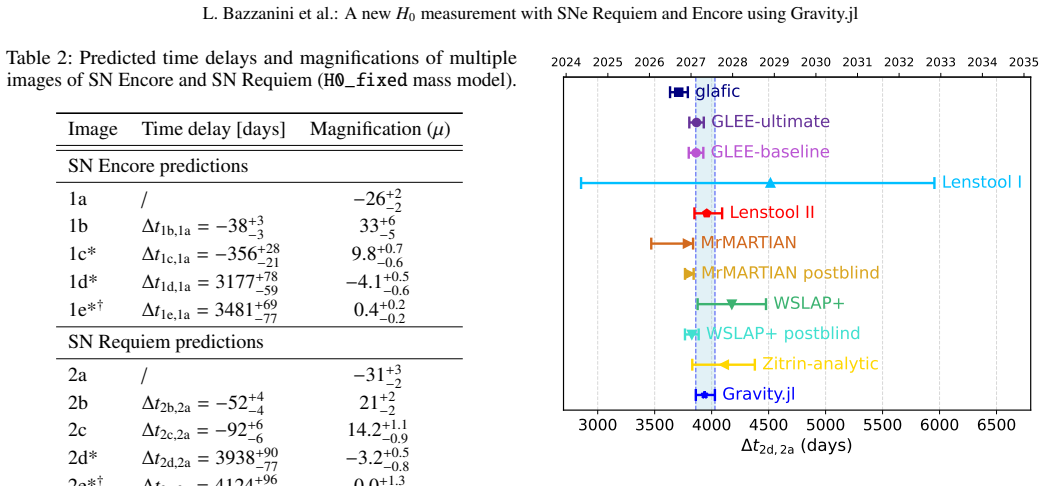
- The reference mass model predicts SN Encore counter-image reappearance in May-September 2032 and SN Requiem in February-July 2027.
- The derived H0 remains consistent with values obtained from independent lens models of the same cluster.
- Current error budget is dominated by time-delay uncertainty, leaving room for improvement once lens-model systematics are controlled.
- MACS J0138 is positioned as a potential high-precision anchor for cluster-scale time-delay cosmography.
Where Pith is reading between the lines
- A successful detection of the 2027 SN Requiem reappearance at the predicted epoch would immediately tighten the H0 constraint by a factor of several if the same lens model is retained.
- Repeated application of the same joint time-delay plus image-position approach to other cluster lenses could supply an independent local-universe route to H0 that bypasses both Cepheids and the cosmic microwave background.
- The method shows that multiply-imaged supernovae in clusters can serve as direct cosmological probes once their time delays are measured to better than 10 percent precision.
Load-bearing premise
The measured time delays can be treated as direct observables in the joint fit without substantial unmodeled systematics from lens-model assumptions or supernova light-curve analysis.
What would settle it
An observed reappearance epoch for SN Requiem that falls well outside the predicted February-July 2027 window under the reported H0 posterior would indicate either a discrepant Hubble constant or unaccounted systematics in the time delays or lens model.
Figures


read the original abstract
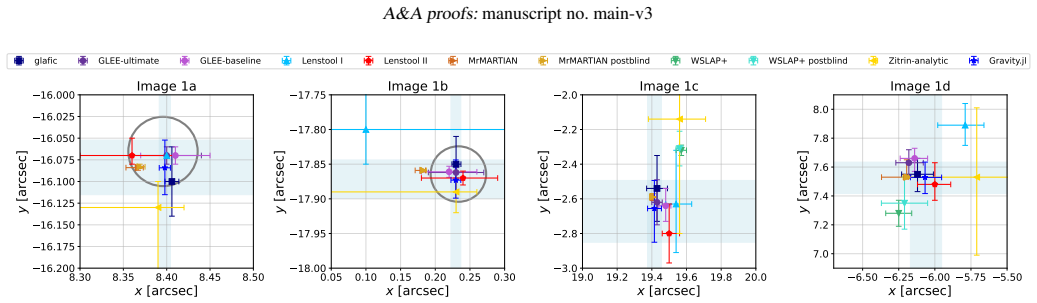
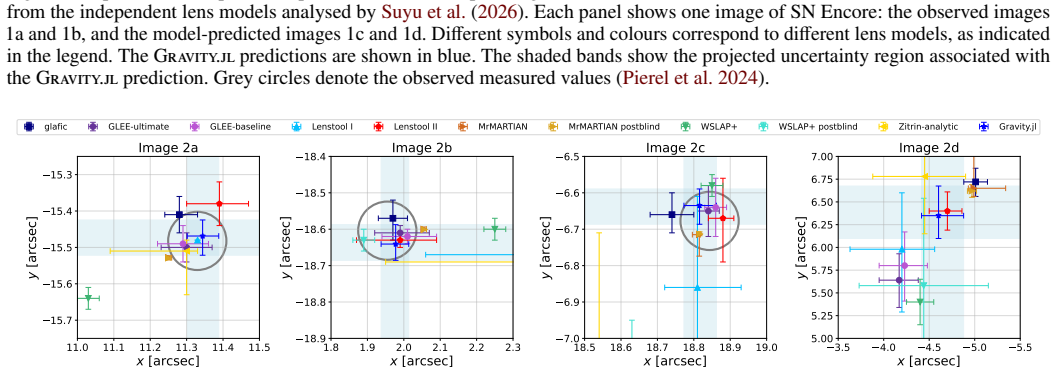
We present a strong-lensing (SL) analysis of the galaxy cluster MACS J0138.0-2155 (z=0.336), the first known lens cluster discovered to host two distinct multiply imaged Type Ia supernovae (SNe): SN Requiem and SN Encore. Both SNe are located in the massive, multiply imaged red galaxy MRG-M0138 at z=1.949. The projected total mass of this cluster has been investigated with several independent lens models (Suyu+26; Pierel+26), using a sample of 23 spectroscopically confirmed multiple images from 8 background sources (0.767<z<3.420), identified from HST and JWST imaging data, and VLT/MUSE spectroscopy. In this work, we develop a new SL model based on a novel Bayesian parametric lens-modelling framework $\texttt{Gravity.jl}$, exploiting the same SL dataset. Our reference mass model accurately reproduces the observed image positions, with an image-plane rms image position residual of 0.24''. Assuming H0 = 70 km/s/Mpc, we predict the future reappearances of highly delayed SNe counter-images, finding $D_t(1d,1a) = 3177_{-59}^{+78}$ d (May-September 2032) for SN Encore and $D_t(2d,2a) = 3938_{-77}^{+90}$ d (February-July 2027) for SN Requiem. By allowing H0 to vary, and using the measured time delays of both SN Encore and SN Requiem together with their statistical uncertainties as observables, we infer the value of H0 jointly with the other lens-model free parameters. From this analysis, we obtain a new measurement of $H_0 = 67.0_{-7.8}^{+9.3}$ km/s/Mpc, consistent with the value inferred from the aforementioned independent lens models. This error is currently dominated by the large relative uncertainty on the measured time delays (>10%). The forthcoming reappearance of SN Requiem offers an immediate opportunity to significantly improve constraints on H0, provided that lens-model systematics are controlled. These results establish M0138 as a premier anchor for high-precision cluster-scale TDC.
Editorial analysis
A structured set of objections, weighed in public.
Referee Report
Summary. The manuscript presents a strong-lensing analysis of MACS J0138.0-2155 (z=0.336) hosting two multiply-imaged Type Ia SNe (Requiem and Encore) in MRG-M0138 (z=1.949), using a new Bayesian parametric framework Gravity.jl on the same 23-image dataset as prior models. The reference model achieves 0.24'' image-plane rms; it predicts future counter-image reappearances and infers H0 = 67.0_{-7.8}^{+9.3} km/s/Mpc by jointly varying H0 with lens parameters while treating the measured time delays (with only their quoted statistical uncertainties) as direct observables.
Significance. If the joint fit is shown to be robust, the work introduces a novel open lens-modeling code and supplies an independent cluster-scale time-delay cosmography anchor using two SNe Ia, with explicit future-observation predictions that could tighten constraints. Consistency with independent models is noted as a positive cross-check.
major comments (2)
- [Abstract] Abstract (H0 inference paragraph): the central H0 posterior is obtained by treating the measured time delays (>10% relative uncertainty) as direct observables in a joint fit with lens-model parameters, yet no quantitative validation of this joint posterior is supplied—no reported covariances between H0 and lens parameters, no image-plane rms or goodness-of-fit metric for the free-H0 run, and no separate systematic error budget beyond the statement that time-delay uncertainty dominates. This directly affects the reliability of the quoted 67.0_{-7.8}^{+9.3} result.
- [H0 inference] H0 inference description: the assumption that the time-delay likelihood contains no substantial unmodeled systematics (microlensing, dust, light-curve modeling choices, or Fermat-potential assumptions in Gravity.jl) is load-bearing for the claim, but the manuscript provides no cross-check or sensitivity test that the quoted statistical uncertainties fully capture the total error; the abstract notes consistency with other models but does not quantify how much of the delay signal could be absorbed into the parametric lens degrees of freedom.
minor comments (1)
- [Abstract] The image labeling convention used for the predicted delays (e.g., D_t(1d,1a)) should be defined explicitly when first introduced.
Simulated Author's Rebuttal
We thank the referee for the constructive comments on the H0 inference. These points identify areas where additional validation and discussion are needed to strengthen the reliability of the result. We will revise the manuscript accordingly.
read point-by-point responses
-
Referee: [Abstract] Abstract (H0 inference paragraph): the central H0 posterior is obtained by treating the measured time delays (>10% relative uncertainty) as direct observables in a joint fit with lens-model parameters, yet no quantitative validation of this joint posterior is supplied—no reported covariances between H0 and lens parameters, no image-plane rms or goodness-of-fit metric for the free-H0 run, and no separate systematic error budget beyond the statement that time-delay uncertainty dominates. This directly affects the reliability of the quoted 67.0_{-7.8}^{+9.3} result.
Authors: We agree that the joint posterior requires explicit validation. In the revised manuscript we will report the covariances between H0 and the lens parameters, the image-plane rms and a goodness-of-fit metric for the free-H0 run, and an expanded systematic error budget that goes beyond the time-delay dominance statement. These additions will appear in both the abstract and the main text. revision: yes
-
Referee: [H0 inference] H0 inference description: the assumption that the time-delay likelihood contains no substantial unmodeled systematics (microlensing, dust, light-curve modeling choices, or Fermat-potential assumptions in Gravity.jl) is load-bearing for the claim, but the manuscript provides no cross-check or sensitivity test that the quoted statistical uncertainties fully capture the total error; the abstract notes consistency with other models but does not quantify how much of the delay signal could be absorbed into the parametric lens degrees of freedom.
Authors: We acknowledge the need for sensitivity tests. The revised manuscript will add a dedicated subsection on unmodeled systematics (microlensing, dust, light-curve modeling, and Fermat-potential assumptions) together with explicit sensitivity tests that compare the joint fit against runs with fixed lens parameters. This will quantify the fraction of the delay signal that can be absorbed by the parametric degrees of freedom. A full microlensing simulation is beyond the scope of the present data set and will be noted as future work. revision: partial
Circularity Check
No circularity: H0 inferred from external time-delay observables in joint parametric fit
full rationale
The derivation fits a Gravity.jl parametric lens model to image positions (rms 0.24'') and then uses independently measured SN time delays (with their statistical uncertainties) as additional observables to constrain H0 jointly with lens parameters. The time delays are external data from light-curve timing, not outputs of the model or prior fits; the model predicts Fermat-potential differences scaled by distances (hence H0) and matches them to the observed delays. This is standard time-delay cosmography and does not reduce the reported H0 value to the inputs by construction. Self-citations to Suyu+26/Pierel+26 are only for consistency checks on independent models and are not load-bearing for the central inference. No self-definitional, fitted-input-renamed-as-prediction, or ansatz-smuggling steps appear in the quoted abstract or described chain.
Axiom & Free-Parameter Ledger
free parameters (2)
- H0
- lens model parameters
axioms (1)
- domain assumption Standard flat Lambda-CDM background cosmology relating time delays to angular-diameter distances and H0
Reference graph
Works this paper leans on
-
[1]
Enhanced strong-lensing model of MACS J0138.0─2155 based on new JWST and VLT/MUSE observations. , keywords =. doi:10.1051/0004-6361/202554468 , archivePrefix =. 2503.09694 , primaryClass =
-
[2]
Cosmology with supernova Encore in the strong lensing cluster MACS J0138‑2155: Spectroscopy with MUSE. , keywords =. doi:10.1051/0004-6361/202453486 , archivePrefix =. 2412.13250 , primaryClass =
-
[3]
Cosmology with supernova Encore in the strong lensing cluster MACS J0138 - 2155: Photometry, cluster members, and lens mass model. , keywords =. doi:10.1051/0004-6361/202554477 , archivePrefix =. 2503.09718 , primaryClass =
-
[4]
Cosmology with supernova Encore in the strong lensing cluster MACS J0138─2155: Lens model comparison and H _ 0 measurement. , keywords =. doi:10.1051/0004-6361/202557235 , adsurl =
-
[5]
Lensed Type Ia Supernova ``Encore'' at z = 2: The First Instance of Two Multiply Imaged Supernovae in the Same Host Galaxy. , keywords =. doi:10.3847/2041-8213/ad4648 , archivePrefix =. 2404.02139 , primaryClass =
-
[6]
Cosmology with Supernova Encore in the Strong Lensing Cluster MACS J0138─2155: Time Delays and Hubble Constant Measurement. , keywords =. doi:10.3847/1538-4357/ae3159 , archivePrefix =. 2509.12301 , primaryClass =
-
[7]
A gravitationally lensed supernova with an observable two-decade time delay. Nature Astronomy , keywords =. doi:10.1038/s41550-021-01450-9 , archivePrefix =. 2106.08935 , primaryClass =
-
[8]
The 700 ks Chandra Spiderweb Field. I. Evidence for widespread nuclear activity in the protocluster. , keywords =. doi:10.1051/0004-6361/202142333 , archivePrefix =. 2203.02208 , primaryClass =
-
[9]
The Messenger , year = 2014, month = sep, volume =
MUSE Commissioning. The Messenger , year = 2014, month = sep, volume =
2014
-
[10]
Ground-based and Airborne Instrumentation for Astronomy III , year = 2010, editor =
The MUSE second-generation VLT instrument. Ground-based and Airborne Instrumentation for Astronomy III , year = 2010, editor =. doi:10.1117/12.856027 , archivePrefix =. 2211.16795 , primaryClass =
-
[11]
Spectroscopic analysis of the strongly lensed SN Encore: constraints on cosmic evolution of Type Ia supernovae. , keywords =. doi:10.1093/mnras/stae2434 , archivePrefix =. 2407.16492 , primaryClass =
-
[12]
Point-like and linearized extended sources
Gravity.jl: Fast and accurate gravitational lens modeling in Julia: I. Point-like and linearized extended sources. , keywords =. doi:10.1051/0004-6361/202451214 , archivePrefix =. 2406.15280 , primaryClass =
-
[13]
Parametric strong lensing model of the galaxy cluster Abell 2390 from Euclid and MUSE observations. , keywords =. doi:10.1051/0004-6361/202556396 , archivePrefix =. 2510.17192 , primaryClass =
-
[14]
A Catalog of Mass Models for Gravitational Lensing
A Catalog of Mass Models for Gravitational Lensing. arXiv e-prints , keywords =. doi:10.48550/arXiv.astro-ph/0102341 , archivePrefix =. astro-ph/0102341 , primaryClass =
work page internal anchor Pith review Pith/arXiv arXiv doi:10.48550/arxiv.astro-ph/0102341
-
[15]
Journal of the Royal Statistical Society Series B: Statistical Methodology , volume =
Syed, Saifuddin and Bouchard-Côté, Alexandre and Deligiannidis, George and Doucet, Arnaud , title =. Journal of the Royal Statistical Society Series B: Statistical Methodology , volume =. 2022 , month =. doi:10.1111/rssb.12464 , url =
-
[16]
Parallel Tempering With a Variational Reference. arXiv e-prints , keywords =. doi:10.48550/arXiv.2206.00080 , archivePrefix =. 2206.00080 , primaryClass =
-
[17]
2023, arXiv e-prints, arXiv:2308.09769, doi: 10.48550/arXiv.2308.09769
Pigeons.jl: Distributed Sampling From Intractable Distributions. arXiv e-prints , keywords =. doi:10.48550/arXiv.2308.09769 , archivePrefix =. 2308.09769 , primaryClass =
-
[18]
emcee: The MCMC Hammer , howpublished =
-
[19]
Dark matter stripping in galaxy clusters: a look at the stellar-to-halo mass relation in the Illustris simulation. , keywords =. doi:10.1093/mnras/stz1318 , archivePrefix =. 1811.04996 , primaryClass =
work page internal anchor Pith review Pith/arXiv arXiv doi:10.1093/mnras/stz1318
-
[20]
Enhanced cluster lensing models with measured galaxy kinematics. , keywords =. doi:10.1051/0004-6361/201935974 , archivePrefix =. 1905.13236 , primaryClass =
-
[21]
Where is the matter in the Merging Cluster Abell 2218?
Where is the matter in the Merging Cluster Abell 2218?. arXiv e-prints , keywords =. doi:10.48550/arXiv.0710.5636 , archivePrefix =. 0710.5636 , primaryClass =
work page internal anchor Pith review Pith/arXiv arXiv doi:10.48550/arxiv.0710.5636
-
[22]
Constraining the mass distribution of galaxies using galaxy-galaxy lensing in clusters and in the field. , keywords =. doi:10.1111/j.1365-2966.2004.08449.x , archivePrefix =. astro-ph/0405607 , primaryClass =
-
[23]
A Bayesian approach to strong lensing modelling of galaxy clusters
A Bayesian approach to strong lensing modelling of galaxy clusters. New Journal of Physics , keywords =. doi:10.1088/1367-2630/9/12/447 , archivePrefix =. 0706.0048 , primaryClass =
work page internal anchor Pith review Pith/arXiv arXiv doi:10.1088/1367-2630/9/12/447
-
[24]
MEASURING GALAXY MASSES USING GALAXY-GALAXY GRAVITATIONAL LENSING
Weak Gravitational Lensing by Galaxies. , keywords =. doi:10.1086/177537 , archivePrefix =. astro-ph/9503073 , primaryClass =
work page internal anchor Pith review Pith/arXiv arXiv doi:10.1086/177537
-
[25]
Statistical Science , author =
Inference from Iterative Simulation Using Multiple Sequences. Statistical Science , year = 1992, month = jan, volume =. doi:10.1214/ss/1177011136 , adsurl =
-
[26]
Dynamically Hot Galaxies. I. Structural Properties. , keywords =. doi:10.1086/171940 , adsurl =
-
[27]
Science , year = 1987, month = nov, volume =
Book-Review - Nearly Normal Galaxies from the Planck Time to the Present. Science , year = 1987, month = nov, volume =
1987
-
[28]
Lensing by galaxy halos in clusters of galaxies
Lensing by galaxy haloes in clusters of galaxies. , keywords =. doi:10.1093/mnras/287.4.833 , archivePrefix =. astro-ph/9609008 , primaryClass =
work page internal anchor Pith review Pith/arXiv arXiv doi:10.1093/mnras/287.4.833
-
[29]
CLASH-VLT: Insights on the Mass Substructures in the Frontier Fields Cluster MACS J0416.1-2403 through Accurate Strong Lens Modeling. , keywords =. doi:10.1088/0004-637X/800/1/38 , archivePrefix =. 1407.7866 , primaryClass =
work page internal anchor Pith review Pith/arXiv arXiv doi:10.1088/0004-637x/800/1/38
-
[30]
Cosmological Study of Very Faint Galaxies
-
[31]
Annals of Statistics , year = 1978, month = jul, volume =
Estimating the Dimension of a Model. Annals of Statistics , year = 1978, month = jul, volume =
1978
-
[32]
doi:10.1007/978-3-030-73582-1 , adsurl =
Introduction to Gravitational Lensing; With Python Examples. doi:10.1007/978-3-030-73582-1 , adsurl =
-
[33]
VLT/MUSE Observations of SDSS J1029+2623: Toward a High-precision Strong Lensing Model. , keywords =. doi:10.3847/1538-4357/ac3d35 , archivePrefix =. 2111.05871 , primaryClass =
-
[34]
Probing 3D Structure with a Large MUSE Mosaic: Extending the Mass Model of Frontier Field Abell 370
Probing 3D structure with a large MUSE mosaic: extending the mass model of Frontier Field Abell 370. , keywords =. doi:10.1093/mnras/stz620 , archivePrefix =. 1904.02158 , primaryClass =
work page internal anchor Pith review Pith/arXiv arXiv doi:10.1093/mnras/stz620 1904
-
[35]
Jellyfish: Evidence of extreme ram-pressure stripping in massive galaxy clusters
Jellyfish: Evidence of Extreme Ram-pressure Stripping in Massive Galaxy Clusters. , keywords =. doi:10.1088/2041-8205/781/2/L40 , archivePrefix =. 1312.6135 , primaryClass =
work page internal anchor Pith review Pith/arXiv arXiv doi:10.1088/2041-8205/781/2/l40 2041
-
[36]
Gibson, Catherine C. and O'Donnell, Jackson H. and Jeltema, Tesla E. , journal =. A. doi:10.33232/001c.160280 , year =
-
[37]
GAUSSN: Bayesian time-delay estimation for strongly lensed supernovae. , keywords =. doi:10.1093/mnras/stae1086 , archivePrefix =. 2311.17997 , primaryClass =
-
[38]
The case for space: estimating precise time delays from ground- and space-based observations of lensed supernovae with Glimpse. , keywords =. doi:10.1093/mnras/stag113 , archivePrefix =. 2509.25350 , primaryClass =
-
[39]
Turning Gravitationally Lensed Supernovae into Cosmological Probes
Turning Gravitationally Lensed Supernovae into Cosmological Probes. , keywords =. doi:10.3847/1538-4357/ab164a , archivePrefix =. 1902.01260 , primaryClass =
work page internal anchor Pith review Pith/arXiv arXiv doi:10.3847/1538-4357/ab164a 1902
-
[40]
HOLISMOKES. III. Achromatic phase of strongly lensed Type Ia supernovae. , keywords =. doi:10.1051/0004-6361/202039218 , archivePrefix =. 2008.10393 , primaryClass =
-
[41]
A hierarchical Bayesian SED model for Type Ia supernovae in the optical to near-infrared. , keywords =. doi:10.1093/mnras/stab3496 , archivePrefix =. 2008.07538 , primaryClass =
-
[42]
Relative Intrinsic Scatter in Hierarchical Type Ia Supernova Sibling Analyses: Application to SNe 2021hpr, 1997bq, and 2008fv in NGC 3147. , keywords =. doi:10.3847/1538-4357/acf7bb , archivePrefix =. 2209.10558 , primaryClass =
-
[43]
Scalable hierarchical BayeSN inference: investigating dependence of SN Ia host galaxy dust properties on stellar mass and redshift. , keywords =. doi:10.1093/mnras/stae1202 , archivePrefix =. 2401.08755 , primaryClass =
-
[44]
On the Origin of the Type Ia Supernova Width-Luminosity Relation
On the Origin of the Type Ia Supernova Width-Luminosity Relation. , keywords =. doi:10.1086/510375 , archivePrefix =. astro-ph/0609540 , primaryClass =
work page internal anchor Pith review Pith/arXiv arXiv doi:10.1086/510375
-
[45]
Magnification, dust, and time-delay constraints from the first resolved strongly lensed Type Ia supernova iPTF16geu. , keywords =. doi:10.1093/mnras/stz2965 , archivePrefix =. 1907.06756 , primaryClass =
-
[46]
LensWatch. II. Improved Photometry and Time-delay Constraints on the Strongly Lensed Type Ia Supernova 2022qmx (``SN Zwicky'') with Hubble Space Telescope Template Observations. , keywords =. doi:10.3847/1538-4357/ada776 , archivePrefix =. 2409.17239 , primaryClass =
-
[47]
Precise Time Delays from Strongly Gravitationally Lensed Type Ia Supernovae with Chromatically Microlensed Images. , keywords =. doi:10.3847/1538-4357/aaa975 , archivePrefix =. 1708.00003 , primaryClass =
work page internal anchor Pith review Pith/arXiv arXiv doi:10.3847/1538-4357/aaa975
-
[48]
SALT2: using distant supernovae to improve the use of Type Ia supernovae as distance indicators
SALT2: using distant supernovae to improve the use of type Ia supernovae as distance indicators. , keywords =. doi:10.1051/0004-6361:20066930 , archivePrefix =. astro-ph/0701828 , primaryClass =
work page internal anchor Pith review Pith/arXiv arXiv doi:10.1051/0004-6361:20066930
-
[49]
Cosmography with supernova Refsdal through time-delay cluster lensing: Independent measurements of the Hubble constant and geometry of the Universe. , keywords =. doi:10.1051/0004-6361/202449278 , archivePrefix =. 2401.10980 , primaryClass =
-
[50]
2013 , publisher=
Bayesian Data Analysis, Third Edition , author=. 2013 , publisher=
2013
-
[51]
Communications in Applied Mathematics and Computational Science, Vol
Ensemble samplers with affine invariance. Communications in Applied Mathematics and Computational Science , keywords =. doi:10.2140/camcos.2010.5.65 , adsurl =
-
[52]
Time-Delay Cosmography: Measuring the Hubble Constant and Other Cosmological Parameters with Strong Gravitational Lensing. , keywords =. doi:10.1007/s11214-024-01079-w , archivePrefix =. 2210.10833 , primaryClass =
-
[53]
Time delay cosmography. , keywords =. doi:10.1007/s00159-016-0096-8 , archivePrefix =. 1605.05333 , primaryClass =
work page internal anchor Pith review Pith/arXiv arXiv doi:10.1007/s00159-016-0096-8
-
[54]
, year = 1964, month = jan, volume =
On the possibility of determining Hubble's parameter and the masses of galaxies from the gravitational lens effect. , year = 1964, month = jan, volume =. doi:10.1093/mnras/128.4.307 , adsurl =
-
[55]
Lectures on Gravitational Lensing
Lectures on Gravitational Lensing. arXiv e-prints , keywords =. doi:10.48550/arXiv.astro-ph/9606001 , archivePrefix =. astro-ph/9606001 , primaryClass =
work page internal anchor Pith review Pith/arXiv arXiv doi:10.48550/arxiv.astro-ph/9606001
-
[56]
A spectroscopically confirmed, strongly lensed, metal-poor Type II supernova at z = 5.13. arXiv e-prints , keywords =. doi:10.48550/arXiv.2601.04156 , archivePrefix =. 2601.04156 , primaryClass =
-
[57]
The JWST Discovery of the Triply Imaged Type Ia ``Supernova H0pe'' and Observations of the Galaxy Cluster PLCK G165.7+67.0. , keywords =. doi:10.3847/1538-4357/ad1034 , archivePrefix =. 2309.07326 , primaryClass =
-
[58]
SN 2022riv in RX J2129: Discovery, Spectroscopic Classification, and Microlensing of a Strongly Lensed Type Ia Supernova from JWST and HST Observations. arXiv e-prints , keywords =. doi:10.48550/arXiv.2604.11882 , archivePrefix =. 2604.11882 , primaryClass =
work page internal anchor Pith review Pith/arXiv arXiv doi:10.48550/arxiv.2604.11882
-
[59]
Discovery of SN 2025wny: A Strongly Gravitationally Lensed Superluminous Supernova at z = 2.01. , keywords =. doi:10.3847/2041-8213/ae1d61 , archivePrefix =. 2510.23533 , primaryClass =
-
[60]
Multiple Images of a Highly Magnified Supernova Formed by an Early-Type Cluster Galaxy Lens
Multiple images of a highly magnified supernova formed by an early-type cluster galaxy lens. Science , keywords =. doi:10.1126/science.aaa3350 , archivePrefix =. 1411.6009 , primaryClass =
work page internal anchor Pith review Pith/arXiv arXiv doi:10.1126/science.aaa3350
-
[61]
On the Accuracy of Time-delay Cosmography in the Frontier Fields Cluster MACS J1149.5+2223 with Supernova Refsdal. , keywords =. doi:10.3847/1538-4357/ab9a4c , archivePrefix =. 2001.02232 , primaryClass =
-
[62]
The story of supernova 'Refsdal' told by MUSE
The Story of Supernova Refsdal Told by Muse. , keywords =. doi:10.3847/0004-637X/822/2/78 , archivePrefix =. 1511.04093 , primaryClass =
work page internal anchor Pith review Pith/arXiv arXiv doi:10.3847/0004-637x/822/2/78
-
[63]
Measuring the value of the Hubble constant "\`a la Refsdal"
Measuring the Value of the Hubble Constant \`a la Refsdal. , keywords =. doi:10.3847/1538-4357/aac2c9 , archivePrefix =. 1802.01584 , primaryClass =
work page internal anchor Pith review Pith/arXiv arXiv doi:10.3847/1538-4357/aac2c9
-
[64]
Constraints on the Hubble constant from supernova Refsdal's reappearance. Science , keywords =. doi:10.1126/science.abh1322 , archivePrefix =. 2305.06367 , primaryClass =
-
[65]
Deja Vu All Over Again: The Reappearance of Supernova Refsdal
Deja Vu All Over Again: The Reappearance of Supernova Refsdal. , keywords =. doi:10.3847/2041-8205/819/1/L8 , archivePrefix =. 1512.04654 , primaryClass =
work page internal anchor Pith review Pith/arXiv arXiv doi:10.3847/2041-8205/819/1/l8 2041
-
[66]
Hubble constant from the improved lens modeling of the cluster-lensed supernova Refsdal with new spectroscopic redshifts and the jackknife method. , keywords =. doi:10.1103/6gfm-11rr , archivePrefix =. 2509.09979 , primaryClass =
-
[67]
SN Refsdal: Classification as a Luminous and Blue SN 1987A-like Type II Supernova
SN Refsdal: Classification as a Luminous and Blue SN 1987A-like Type II Supernova. , keywords =. doi:10.3847/0004-637X/831/2/205 , archivePrefix =. 1512.09093 , primaryClass =
work page internal anchor Pith review Pith/arXiv arXiv doi:10.3847/0004-637x/831/2/205
-
[68]
Magnified or multiply imaged? - Search strategies for gravitationally lensed supernovae in wide-field surveys. , keywords =. doi:10.1093/mnras/stz1516 , archivePrefix =. 1903.07687 , primaryClass =
-
[69]
How to Find Gravitationally Lensed Type Ia Supernovae
How to Find Gravitationally Lensed Type Ia Supernovae. , keywords =. doi:10.3847/2041-8213/834/1/L5 , archivePrefix =. 1611.09459 , primaryClass =
work page internal anchor Pith review Pith/arXiv arXiv doi:10.3847/2041-8213/834/1/l5 2041
-
[70]
Strong Gravitational Lensing with the James Webb Space Telescope
Strong Gravitational Lensing with the James Webb Space Telescope. arXiv e-prints , keywords =. doi:10.48550/arXiv.2605.15189 , archivePrefix =. 2605.15189 , primaryClass =
work page internal anchor Pith review Pith/arXiv arXiv doi:10.48550/arxiv.2605.15189
-
[71]
The Impact of Microlensing on the Standardisation of Strongly Lensed Type Ia Supernovae
The impact of microlensing on the standardization of strongly lensed Type Ia supernovae. , keywords =. doi:10.1093/mnras/sty1346 , archivePrefix =. 1802.07738 , primaryClass =
work page internal anchor Pith review Pith/arXiv arXiv doi:10.1093/mnras/sty1346
-
[72]
Gravitationally lensed quasars and supernovae in future wide-field optical imaging surveys. , keywords =. doi:10.1111/j.1365-2966.2010.16639.x , archivePrefix =. 1001.2037 , primaryClass =
-
[73]
HOLISMOKES. I. Highly Optimised Lensing Investigations of Supernovae, Microlensing Objects, and Kinematics of Ellipticals and Spirals. , keywords =. doi:10.1051/0004-6361/202037757 , archivePrefix =. 2002.08378 , primaryClass =
-
[74]
Rates and Properties of Supernovae Strongly Gravitationally Lensed by Elliptical Galaxies in Time-domain Imaging Surveys. , keywords =. doi:10.3847/1538-4365/ab1fe0 , archivePrefix =. 1809.10147 , primaryClass =
work page internal anchor Pith review Pith/arXiv arXiv doi:10.3847/1538-4365/ab1fe0
-
[75]
Detecting strongly lensed type Ia supernovae with LSST. , keywords =. doi:10.1093/mnras/stae1356 , archivePrefix =. 2312.04621 , primaryClass =
-
[76]
MACS: A quest for the most massive galaxy clusters in the universe
MACS: A Quest for the Most Massive Galaxy Clusters in the Universe. , keywords =. doi:10.1086/320958 , archivePrefix =. astro-ph/0009101 , primaryClass =
work page internal anchor Pith review Pith/arXiv arXiv doi:10.1086/320958
-
[77]
H0LiCOW - XIII. A 2.4 per cent measurement of H _ 0 from lensed quasars: 5.3 tension between early- and late-Universe probes. , keywords =. doi:10.1093/mnras/stz3094 , archivePrefix =. 1907.04869 , primaryClass =
-
[78]
COSMOGRAIL. XIX. Time delays in 18 strongly lensed quasars from 15 years of optical monitoring. , keywords =. doi:10.1051/0004-6361/202037740 , archivePrefix =. 2002.05736 , primaryClass =
-
[79]
Dissecting the Gravitational lens B1608+656. II. Precision Measurements of the Hubble Constant, Spatial Curvature, and the Dark Energy Equation of State. , keywords =. doi:10.1088/0004-637X/711/1/201 , archivePrefix =. 0910.2773 , primaryClass =
work page internal anchor Pith review Pith/arXiv arXiv doi:10.1088/0004-637x/711/1/201
-
[80]
A Comprehensive Measurement of the Local Value of the Hubble Constant with 1 km s ^ -1 Mpc ^ -1 Uncertainty from the Hubble Space Telescope and the SH0ES Team. , keywords =. doi:10.3847/2041-8213/ac5c5b , archivePrefix =. 2112.04510 , primaryClass =
work page internal anchor Pith review Pith/arXiv arXiv doi:10.3847/2041-8213/ac5c5b 2041
discussion (0)
Sign in with ORCID, Apple, or X to comment. Anyone can read and Pith papers without signing in.