Amortized Simulation-Based Inference of Relativistic Mean-Field Couplings for Neutron-Star Equations of State
Pith reviewed 2026-06-25 21:03 UTC · model grok-4.3
The pith
Neural posterior estimation matches nested sampling for relativistic mean-field neutron-star models with no bias.
A machine-rendered reading of the paper's core claim, the machinery that carries it, and where it could break.
Core claim
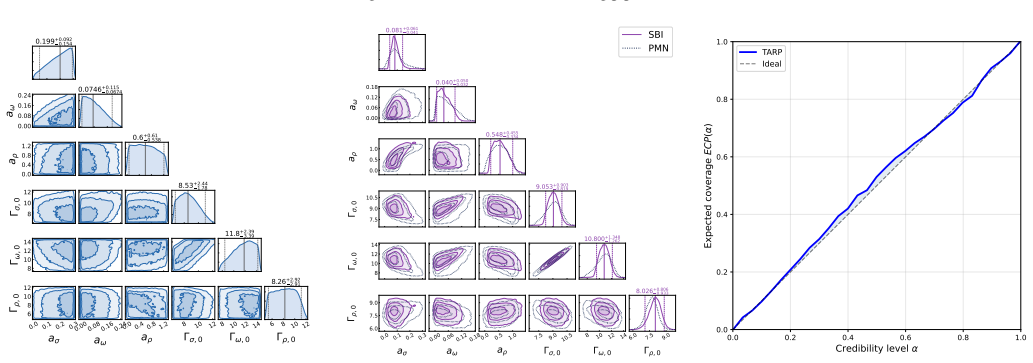
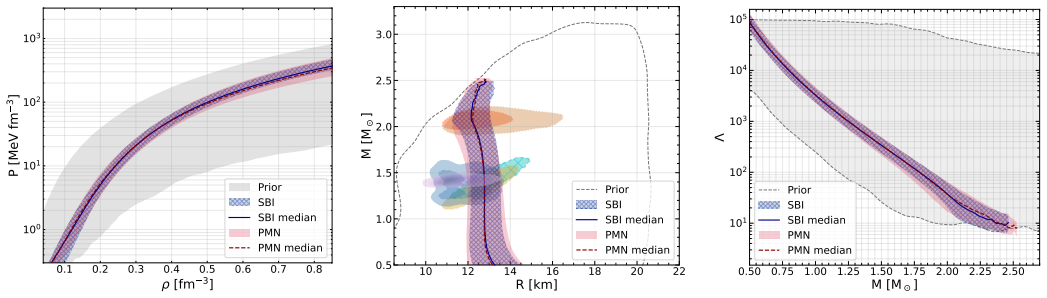
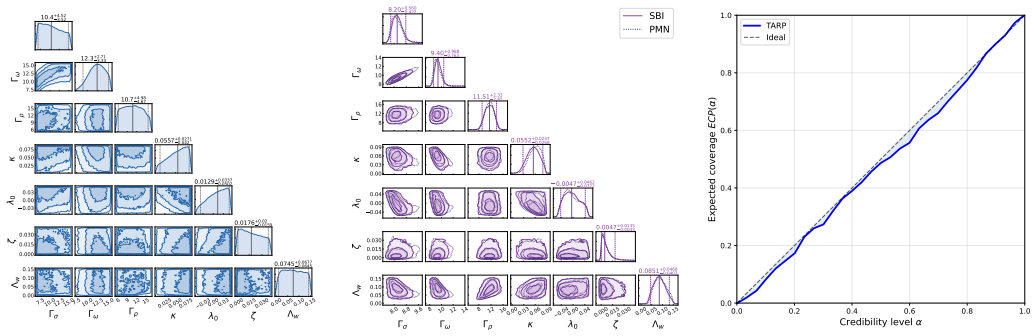
For both the density-dependent DDB and nonlinear RMF-NL parametrizations, the neural posterior reproduces the nested-sampling constraints on model couplings, nuclear-matter properties, and neutron-star observables with no significant bias. The amortized estimator generates 3 times 10 to the 4 posterior samples in about 2.5 seconds on a CPU, enabling a rapid inference workflow without the need for retraining for updated data. This constitutes a proof of concept that NPE-emulated RMF models, once validated, can be safely used for superfast exploratory inference.
What carries the argument
Neural posterior estimation that maps conditioning observables (nuclear saturation properties, chiral EFT pressures, maximum-mass constraint) to the posterior over RMF couplings.
If this is right
- The neural method reproduces constraints on model couplings, nuclear-matter properties, and neutron-star observables.
- The amortized estimator produces 30,000 posterior samples in 2.5 seconds on CPU without retraining.
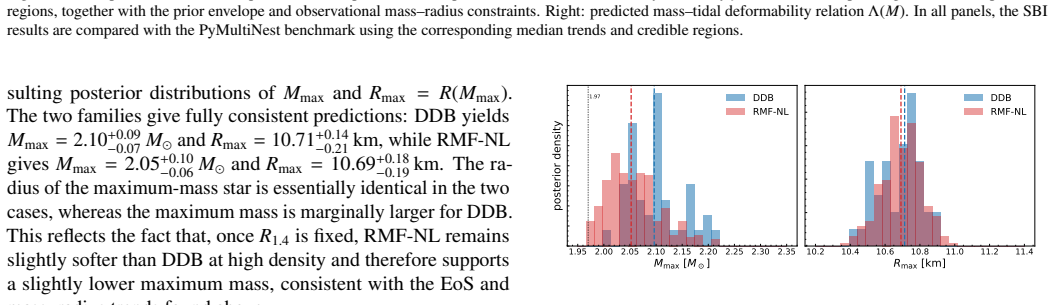
- Mock observations with R_1.4 fixed at 12 km and M_max greater than 1.97 solar masses yield consistent maximum-mass configurations for both families, with DDB slightly stiffer than RMF-NL at high density.
Where Pith is reading between the lines
- Fast amortized sampling could allow repeated inference runs as new neutron-star observations arrive without recomputing from scratch.
- The same training-plus-validation pattern might transfer to other equation-of-state families beyond the two RMF variants tested.
- If coverage remains good, the method lowers the barrier to exploring how variations in nuclear inputs propagate to neutron-star radius and mass predictions.
Load-bearing premise
The training simulations from the DDB and RMF-NL families adequately cover the relevant parameter space and the chosen conditioning observables are sufficient to constrain the RMF couplings without significant degeneracies or model misspecification.
What would settle it
A significant bias or poor TARP coverage between the neural posterior and nested-sampling posterior on held-out test simulations would falsify the no-bias claim.
Figures


read the original abstract
We present a simulation-based inference framework for constraining microscopic relativistic mean-field parameters of neutron-star equations of state. Neural posterior estimation is applied to two representative RMF families, a density-dependent DDB model and a nonlinear RMF-NL model, using nuclear saturation properties, chiral effective-field-theory pure-neutron-matter pressures, and the maximum-mass constraint as conditioning observables. The inferred posteriors are validated against the conventional nested sampler (PyMultiNest) calculations and tested with the TARP coverage diagnostic. For both RMF parametrizations, the neural posterior reproduces the nested-sampling constraints on model couplings, nuclear-matter properties, and neutron-star observables with no significant bias. The amortized estimator generates $3\times 10^{4}$ posterior samples in about $2.5\,\mathrm{s}$ on a CPU, enabling a rapid inference workflow without the need for retraining for updated data. This constitutes a proof of concept that NPE-emulated RMF models, once validated, can be safely used for superfast exploratory inference. As an additional mock-observation test, imposing $R_{1.4}=12\,{\rm km}$ and $M_{\rm max}>1.97\,M_\odot$ leads to consistent predictions for the maximum-mass configuration, with DDB giving $M_{\rm max}=2.10^{+0.09}_{-0.07}\,M_\odot$, $R_{\rm max}=10.71^{+0.14}_{-0.21}\,{\rm km}$ and RMF-NL giving $M_{\rm max}=2.05^{+0.10}_{-0.06}\,M_\odot$, $R_{\rm max}=10.69^{+0.18}_{-0.19}\,{\rm km}$; although fixing $R_{1.4}$ confines both families to a narrow EOS region, RMF-NL remains marginally softer than DDB at high density, consistent with its slightly lower maximum mass.
Editorial analysis
A structured set of objections, weighed in public.
Referee Report
Summary. The paper introduces a neural posterior estimation (NPE) framework for amortized simulation-based inference of relativistic mean-field (RMF) couplings in neutron-star equations of state. It trains on forward simulations from two RMF families (density-dependent DDB and nonlinear RMF-NL), conditions on nuclear saturation properties, chiral EFT pure-neutron-matter pressures, and the maximum-mass constraint, validates the resulting posteriors against PyMultiNest nested sampling with TARP coverage diagnostics, and demonstrates that the NPE reproduces the nested-sampling constraints on couplings, nuclear-matter properties, and neutron-star observables with no significant bias. The amortized estimator produces 3e4 samples in ~2.5 s on CPU; a mock-observation test with R_1.4=12 km and M_max>1.97 M_sun yields consistent maximum-mass predictions for both families.
Significance. If the validation holds, the work supplies a concrete proof-of-concept that NPE can be safely substituted for repeated nested-sampling runs once the training coverage and conditioning observables have been shown to be adequate. The explicit side-by-side comparison to PyMultiNest and the passing TARP diagnostic are concrete strengths that support the claim of unbiased reproduction; the reported wall-clock speed-up is a practical advantage for exploratory studies.
major comments (2)
- [Methods / Training procedure] The central claim that the neural posterior reproduces nested-sampling results with no significant bias for both RMF families rests on the assumption that the training simulations adequately cover the relevant coupling space. The manuscript does not report an explicit verification that the posterior support lies inside the prior ranges used to generate the training set (e.g., by overlaying posterior marginals on the prior boundaries or by checking that the maximum a-posteriori points remain within the simulated domain).
- [Results / Validation] The conditioning set (nuclear saturation properties + chiral EFT PNM pressures + M_max) is asserted to be sufficient to resolve parameter degeneracies. No test is presented that alternative or additional observables (e.g., tidal deformability or radius measurements at different masses) would yield statistically consistent coupling posteriors, which would strengthen the claim that the chosen observables are not under-constraining.
minor comments (1)
- [Abstract / Results] The abstract states that TARP coverage passes, but the main text should include the numerical TARP p-value or coverage plot for each RMF family so readers can judge the diagnostic quantitatively.
Simulated Author's Rebuttal
We thank the referee for the positive assessment and recommendation of minor revision. We address the two major comments point by point below.
read point-by-point responses
-
Referee: [Methods / Training procedure] The central claim that the neural posterior reproduces nested-sampling results with no significant bias for both RMF families rests on the assumption that the training simulations adequately cover the relevant coupling space. The manuscript does not report an explicit verification that the posterior support lies inside the prior ranges used to generate the training set (e.g., by overlaying posterior marginals on the prior boundaries or by checking that the maximum a-posteriori points remain within the simulated domain).
Authors: We agree that an explicit verification would strengthen the presentation. In the revised manuscript we will add a supplementary figure (or panel in an existing figure) that overlays the one-dimensional marginal posteriors on the prior boundaries for both RMF families and confirms that all maximum-a-posteriori points lie inside the simulated domain. Because the NPE posteriors already agree with the PyMultiNest results to within sampling noise, this check is expected to be satisfied, but reporting it directly addresses the concern. revision: yes
-
Referee: [Results / Validation] The conditioning set (nuclear saturation properties + chiral EFT PNM pressures + M_max) is asserted to be sufficient to resolve parameter degeneracies. No test is presented that alternative or additional observables (e.g., tidal deformability or radius measurements at different masses) would yield statistically consistent coupling posteriors, which would strengthen the claim that the chosen observables are not under-constraining.
Authors: The central claim of the paper is that, for the specific conditioning observables used, the amortized NPE reproduces the nested-sampling posteriors with no detectable bias (as verified by direct comparison and the TARP diagnostic). Demonstrating consistency under additional observables would be a natural extension, but lies outside the scope of this proof-of-concept study whose goal is to establish that NPE can safely replace repeated nested-sampling runs once training coverage has been validated for a given observable set. We therefore do not plan to add such tests in the present revision. revision: no
Circularity Check
No significant circularity in the NPE validation chain
full rationale
The paper trains NPE on forward RMF simulations and validates posteriors via explicit comparison to independent nested-sampling runs (PyMultiNest) plus TARP coverage on the same observables; this agreement is not forced by construction because the two inference algorithms are distinct and the nested-sampling results serve as an external benchmark. No self-definitional equations, fitted inputs renamed as predictions, load-bearing self-citations, or ansatz smuggling appear in the abstract or described workflow. The central claim of unbiased reproduction therefore rests on methodologically independent verification rather than reducing to the training inputs by definition.
Axiom & Free-Parameter Ledger
axioms (1)
- domain assumption The DDB and RMF-NL relativistic mean-field models are adequate phenomenological representations of the neutron-star equation of state when their couplings are constrained by the listed observables.
Reference graph
Works this paper leans on
-
[1]
J. M. Lattimer, M. Prakash, Neutron Star Observations: Prognosis for Equation of State Constraints, Phys. Rept. 442 (2007) 109–165. arXiv: astro-ph/0612440, doi:10.1016/j.physrep.2007.02.003
work page internal anchor Pith review Pith/arXiv arXiv doi:10.1016/j.physrep.2007.02.003 2007
-
[2]
G. F. Burgio, H. J. Schulze, I. Vidana, J. B. Wei, Neutron stars and the nuclear equation of state, Prog. Part. Nucl. Phys. 120 (2021) 103879. arXiv:2105.03747, doi:10.1016/j.ppnp.2021.103879
-
[3]
B. P. Abbott, et al., GW170817: Observation of Gravitational Waves from a Binary Neutron Star Inspiral, Phys. Rev. Lett. 119 (16) (2017) 161101. arXiv:1710.05832, doi:10.1103/PhysRevLett.119.161101
work page internal anchor Pith review Pith/arXiv arXiv doi:10.1103/physrevlett.119.161101 2017
-
[4]
T. E. Riley, et al., ANICER View of PSR J0030+0451: Millisecond Pulsar Parameter Estimation, Astrophys. J. Lett. 887 (1) (2019) L21. arXiv: 1912.05702, doi:10.3847/2041-8213/ab481c
-
[6]
T. E. Riley, et al., A NICER View of the Massive Pulsar PSR J0740+6620 Informed by Radio Timing and XMM-Newton Spectroscopy, Astro- phys. J. Lett. 918 (2) (2021) L27. arXiv:2105.06980, doi:10.3847/ 2041-8213/ac0a81
arXiv 2021
-
[7]
M. C. Miller, et al., The Radius of PSR J0740 +6620 from NICER and XMM-Newton Data, Astrophys. J. Lett. 918 (2) (2021) L28. arXiv: 2105.06979, doi:10.3847/2041-8213/ac089b
work page internal anchor Pith review Pith/arXiv arXiv doi:10.3847/2041-8213/ac089b 2021
-
[8]
A NICER View of the Nearest and Brightest Millisecond Pulsar: PSR J0437 4715
D. Choudhury, et al., A NICER View of the Nearest and Brightest Mil- lisecond Pulsar: PSR J0437–4715, Astrophys. J. Lett. 971 (1) (2024) L20. doi:10.3847/2041-8213/ad5a6f
-
[9]
Salmi, et al., A NICER View of PSR J1231−1411: A Complex Case, Astrophys
T. Salmi, et al., A NICER View of PSR J1231−1411: A Complex Case, Astrophys. J. 976 (1) (2024) 58. arXiv:2409.14923, doi:10.3847/ 1538-4357/ad81d2
arXiv 2024
-
[10]
Equation of state and neutron star properties constrained by nuclear physics and observation
K. Hebeler, J. Lattimer, C. Pethick, A. Schwenk, Equation of state and neu- tron star properties constrained by nuclear physics and observation, Astro- phys. J. 773 (2013) 11. arXiv:1303.4662, doi:10.1088/0004-637X/ 773/1/11
work page internal anchor Pith review Pith/arXiv arXiv doi:10.1088/0004-637x/ 2013
-
[11]
I. Tews, T. Kr ¨uger, K. Hebeler, A. Schwenk, Neutron matter at next- to-next-to-next-to-leading order in chiral e ffective field theory, Phys. Rev. Lett. 110 (3) (2013) 032504. arXiv:1206.0025, doi:10.1103/ PhysRevLett.110.032504
Pith/arXiv arXiv 2013
-
[12]
A. Kurkela, P. Romatschke, A. Vuorinen, Cold Quark Matter, Phys. Rev. D 81 (2010) 105021. arXiv:0912.1856, doi:10.1103/PhysRevD.81. 105021
work page internal anchor Pith review Pith/arXiv arXiv doi:10.1103/physrevd.81 2010
-
[13]
How Perturbative QCD Constrains the Equation of State at Neutron-Star Densities
O. Komoltsev, A. Kurkela, How Perturbative QCD Constrains the Equation of State at Neutron-Star Densities, Phys. Rev. Lett. 128 (20) (2022) 202701. arXiv:2111.05350, doi:10.1103/PhysRevLett.128.202701
-
[14]
Evidence for quark-matter cores in massive neutron stars
E. Annala, T. Gorda, A. Kurkela, J. N ¨attil¨a, A. Vuorinen, Evidence for quark-matter cores in massive neutron stars, Nature Phys. (2020). arXiv: 1903.09121, doi:10.1038/s41567-020-0914-9
-
[15]
Abac, et al., The Science of the Einstein Telescope, JCAP 03 (2026)
A. Abac, et al., The Science of the Einstein Telescope, JCAP 03 (2026)
2026
-
[16]
arXiv:2503.12263, doi:10.1088/1475-7516/2026/03/081
work page internal anchor Pith review Pith/arXiv arXiv doi:10.1088/1475-7516/2026/03/081 2026
-
[17]
Reitze, et al., Cosmic Explorer: The U.S
D. Reitze, et al., Cosmic Explorer: The U.S. Contribution to Gravitational- Wave Astronomy beyond LIGO, Bull. Am. Astron. Soc. 51 (7) (2019) 035. arXiv:1907.04833
Pith/arXiv arXiv 2019
-
[18]
A. W. Steiner, J. M. Lattimer, E. F. Brown, The Equation of State from Observed Masses and Radii of Neutron Stars, Astrophys. J. 722 (2010) 33–54. arXiv:1005.0811, doi:10.1088/0004-637X/722/1/33
work page internal anchor Pith review Pith/arXiv arXiv doi:10.1088/0004-637x/722/1/33 2010
-
[19]
G. Raaijmakers, et al., Constraining the dense matter equation of state with joint analysis of NICER and LIGO/Virgo measurements, Astrophys. J. Lett. 893 (1) (2020) L21. arXiv:1912.11031, doi:10.3847/2041-8213/ ab822f
-
[20]
G. Raaijmakers, S. K. Greif, K. Hebeler, T. Hinderer, S. Nissanke, A. Schwenk, T. E. Riley, A. L. Watts, J. M. Lattimer, W. C. G. Ho, Constraints on the Dense Matter Equation of State and Neutron Star Properties from NICER’s Mass–Radius Estimate of PSR J0740 +6620 and Multimessenger Observations, Astrophys. J. Lett. 918 (2) (2021) L29. arXiv:2105.06981, d...
-
[21]
S. Huth, et al., Constraining Neutron-Star Matter with Microscopic and Macroscopic Collisions, Nature 606 (2022) 276–280. arXiv:2107. 06229, doi:10.1038/s41586-022-04750-w
-
[22]
P. Landry, R. Essick, K. Chatziioannou, Nonparametric constraints on neutron star matter with existing and upcoming gravitational wave and pulsar observations, Phys. Rev. D 101 (12) (2020) 123007. arXiv:2003. 04880, doi:10.1103/PhysRevD.101.123007
-
[23]
K. Cranmer, J. Brehmer, G. Louppe, The frontier of simulation-based inference, Proceedings of the National Academy of Sciences 117 (48) (2020) 30055–30062. arXiv:https://www.pnas.org/doi/pdf/10. 1073/pnas.1912789117, doi:10.1073/pnas.1912789117. URL https://www.pnas.org/doi/abs/10.1073/pnas. 1912789117
-
[24]
Boelts, M
J. Boelts, M. Deistler, M. Gloeckler, ´Alvaro Tejero-Cantero, J.-M. Lueckmann, G. Moss, P. Steinbach, T. Moreau, F. Muratore, J. Lin- hart, C. Durkan, J. Vetter, B. K. Miller, M. Herold, A. Ziaeemehr, M. Pals, T. Gruner, S. Bischo ff, N. Krouglova, R. Gao, J. K. Lap- palainen, B. Mucs ´anyi, F. Pei, A. Schulz, Z. Stefanidi, P. Rodrigues, C. Schr ¨oder, F....
2025
-
[25]
URL https://doi.org/10.21105/joss.07754
doi:10.21105/joss.07754. URL https://doi.org/10.21105/joss.07754
-
[26]
J. Hermans, A. Delaunoy, F. Rozet, A. Wehenkel, V . Begy, G. Louppe, A trust crisis in simulation-based inference? your posterior approximations can be unfaithful (2022). arXiv:2110.06581. URL https://arxiv.org/abs/2110.06581
arXiv 2022
-
[28]
M. Dax, S. R. Green, J. Gair, J. H. Macke, A. Buonanno, B. Sch”olkopf, Real-Time Gravitational Wave Science with Neural Posterior Estimation, Phys. Rev. Lett. 127 (24) (2021) 241103. arXiv:2106.12594, doi: 10.1103/PhysRevLett.127.241103
-
[29]
M. Dax, S. R. Green, J. Gair, M. P”urrer, J. Wildberger, J. H. Macke, A. Buonanno, B. Sch”olkopf, Neural Importance Sampling for Rapid and Reliable Gravitational-Wave Inference, Phys. Rev. Lett. 130 (17) (2023) 171403. arXiv:2210.05686, doi:10.1103/PhysRevLett. 130.171403
-
[30]
M. Dax, S. R. Green, J. Gair, N. Gupte, M. P”urrer, V . Raymond, J. Wildberger, J. H. Macke, A. Buonanno, B. Sch”olkopf, Real-time inference for binary neutron star mergers using machine learning, Na- ture 639 (8053) (2025) 49–53. arXiv:2407.09602, doi:10.1038/ s41586-025-08593-z
arXiv 2025
-
[31]
V . Carvalho, M. Ferreira, M. Bejger, C. Providencia, Neural posterior estimation of neutron star equations of state, Phys. Rev. D 112 (8) (2025) 083044. arXiv:2507.23506, doi:10.1103/PhysRevD.112.083044
-
[32]
L. Brandes, C. Modi, A. Ghosh, D. Farrell, L. Lindblom, L. Heinrich, A. W. Steiner, F. Weber, D. Whiteson, Neural Simulation-Based Inference of the Neutron Star Equation of State directly from Telescope Spectra, JCAP 09 (2024) 009. arXiv:2403.00287, doi:10.1088/1475-7516/ 2024/09/009
-
[33]
T. Malik, M. Ferreira, B. K. Agrawal, C. Providˆencia, Relativistic Descrip- tion of Dense Matter Equation of State and Compatibility with Neutron Star Observables: A Bayesian Approach, Astrophys. J. 930 (1) (2022) 17. doi:10.3847/1538-4357/ac5d3c
-
[34]
J. Cartaxo, C. Huang, T. Malik, S. Sourav, W.-L. Yuan, T. Zhou, X. Liu, C. Providˆencia, Covariant Energy Density Functionals for Modeling the Equation of State of Neutron Star Matter: Cross-comparison Analysis Using CompactObject, Astrophys. J. Suppl. 282 (2) (2026) 33. arXiv: 2506.03112, doi:10.3847/1538-4365/ae2310
-
[35]
G. Papamakarios, I. Murray, Fast ϵ-free inference of simulation mod- 9 els with bayesian conditional density estimation (2018). arXiv:1605. 06376. URL https://arxiv.org/abs/1605.06376
Pith/arXiv arXiv 2018
-
[36]
P. Lemos, A. Coogan, Y . Hezaveh, L. Perreault-Levasseur, Sampling- Based Accuracy Testing of Posterior Estimators for General Inference, 40th International Conference on Machine Learning 202 (2023) 19256– 19273. arXiv:2302.03026, doi:10.48550/arXiv.2302.03026
-
[37]
Relativistic Mean-Field Hadronic Models under Nuclear Matter Constraints
M. Dutra, O. Louren c ¸o, S. S. Avancini, B. V . Carlson, A. Delfino, D. P. Menezes, C. Providˆencia, S. Typel, J. R. Stone, Relativistic Mean- Field Hadronic Models under Nuclear Matter Constraints, Phys. Rev. C 90 (5) (2014) 055203. arXiv:1405.3633, doi:10.1103/PhysRevC. 90.055203
work page internal anchor Pith review Pith/arXiv arXiv doi:10.1103/physrevc 2014
-
[38]
S. Shlomo, V . M. Kolomietz, G. Col`o, Deducing the nuclear-matter in- compressibility coefficient from data on isoscalar compression modes, Eur. Phys. J. A 30 (1) (2006) 23–30. doi:10.1140/epja/i2006-10100-3
-
[39]
R. Essick, I. Tews, P. Landry, A. Schwenk, Astrophysical Constraints on the Symmetry Energy and the Neutron Skin of Pb208 with Minimal Modeling Assumptions, Phys. Rev. Lett. 127 (19) (2021) 192701. arXiv: 2102.10074, doi:10.1103/PhysRevLett.127.192701
-
[40]
S. Typel, H. H. Wolter, Relativistic mean field calculations with density dependent meson nucleon coupling, Nucl. Phys. A 656 (1999) 331–364. doi:10.1016/S0375-9474(99)00310-3
-
[41]
The NANOGrav Nine-year Data Set: Mass and Geometric Measurements of Binary Millisecond Pulsars
E. Fonseca, et al., The NANOGrav Nine-year Data Set: Mass and Geo- metric Measurements of Binary Millisecond Pulsars, Astrophys. J. 832 (2) (2016) 167. arXiv:1603.00545, doi:10.3847/0004-637X/832/2/ 167
work page internal anchor Pith review Pith/arXiv arXiv doi:10.3847/0004-637x/832/2/ 2016
-
[42]
F. J. M. Jr., The kolmogorov-smirnov test for goodness of fit, Journal of the American Statistical Association 46 (253) (1951) 68–78. arXiv: https://www.tandfonline.com/doi/pdf/10.1080/01621459. 1951.10500769, doi:10.1080/01621459.1951.10500769. URL https://www.tandfonline.com/doi/abs/10.1080/ 01621459.1951.10500769 10
discussion (0)
Sign in with ORCID, Apple, or X to comment. Anyone can read and Pith papers without signing in.