Improving Richardson--Lucy Deconvolution with Diffusion Priors for Fluorescence Microscopy
Pith reviewed 2026-06-25 19:42 UTC · model grok-4.3
The pith
A score-based diffusion prior inserted into Richardson-Lucy iterations reduces noise amplification while preserving weak filamentous and punctate structures in low-photon fluorescence microscopy.
A machine-rendered reading of the paper's core claim, the machinery that carries it, and where it could break.
Core claim
Integrating a score-based diffusion prior into the RL optimization iterations while retaining Poisson data consistency in the RL step produces deconvolved fluorescence images that exhibit reduced noise amplification and improved preservation of weak filamentous and punctate structures under low photon counts.
What carries the argument
A decoupled inverse-problem framework that alternates RL updates enforcing Poisson data fidelity with score-based diffusion prior steps that supply structural guidance.
If this is right
- RL noise amplification decreases compared with unregularized or TV-regularized baselines.
- Weak filamentous and punctate structures are recovered more faithfully than with total-variation regularization.
- Convergence remains stable across low-photon regimes where standard RL becomes unstable.
- The same framework applies to varied biological samples and cellular morphologies without retraining the RL step.
Where Pith is reading between the lines
- The approach could be tested on simulated phantoms with known ground truth to quantify any residual bias introduced by the diffusion model.
- If the diffusion prior is trained on a narrow class of structures, reconstructions of novel morphologies may systematically favor patterns seen during training.
- The decoupled alternation suggests the method could be adapted to other Poisson-limited inverse problems in optical imaging by swapping the data-fidelity operator.
- Performance gains might diminish if the diffusion model was not trained on data with matching noise statistics or resolution.
Load-bearing premise
The diffusion prior must supply structural guidance compatible with the Poisson imaging model when inserted into the RL iterations without introducing systematic bias or artifacts.
What would settle it
Reconstructed images that display artifacts or intensity distributions matching patterns from the diffusion model's training data rather than the true underlying fluorescence distribution would falsify the claim of unbiased guidance.
Figures

read the original abstract
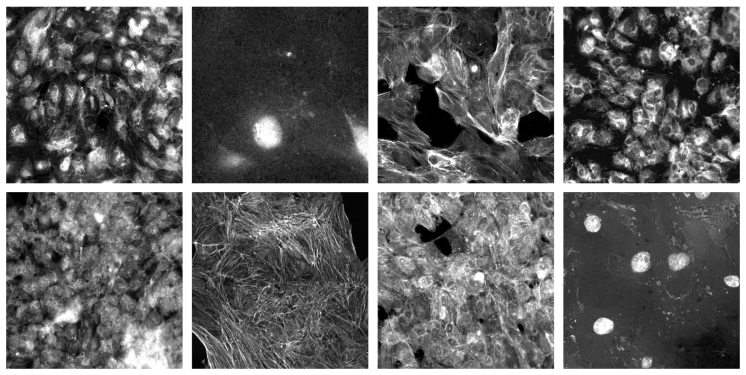
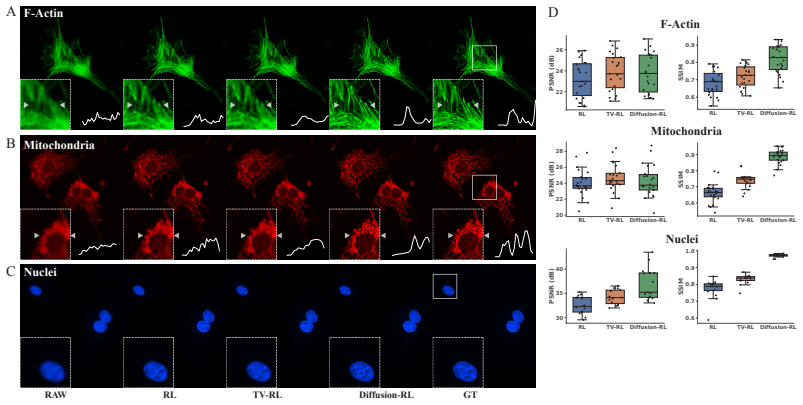
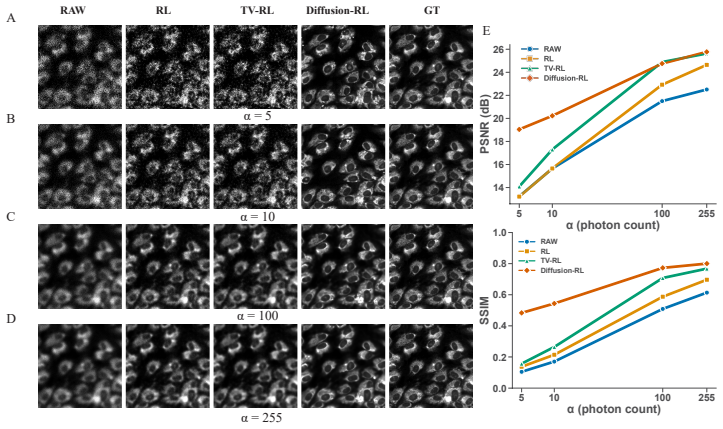
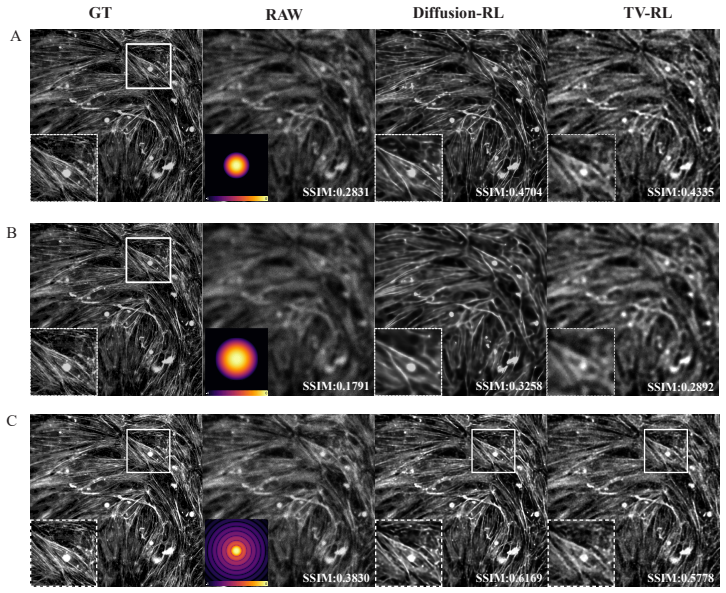
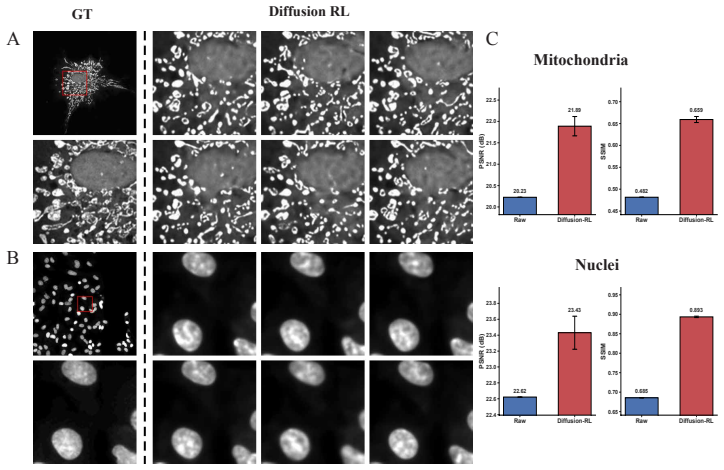
Richardson--Lucy (RL) deconvolution improves fluorescence microscopy images by recovering details lost to diffraction. It estimates the original fluorescence signal that most likely produced the measured photon counts under a Poisson imaging model. Although RL incorporates a physical model of fluorescence image formation and can improve contrast, deconvolution remains fundamentally ill-posed, and the measurements alone provide limited evidence for reliably reconstructing fine biological structure. Without additional structural guidance, RL can amplify noise and exhibit unstable convergence in low-photon regimes. Regularizers such as total variation (TV) reduce this instability but often introduce oversmoothing. Here, we investigate learned generative priors as a form of structural guidance for RL by integrating a score-based diffusion prior into a decoupled inverse-problem framework for fluorescence microscopy deconvolution. The diffusion prior is used during the RL optimization iterations, while RL retains Poisson data consistency. We validate the framework across diverse biological samples and cellular morphologies. The results show reduced RL noise amplification with improved preservation of weak filamentous and punctate structures under low photon counts.
Editorial analysis
A structured set of objections, weighed in public.
Referee Report
Summary. The manuscript proposes integrating a score-based diffusion prior into a decoupled Richardson-Lucy (RL) deconvolution framework for fluorescence microscopy. RL retains the Poisson data-consistency term while the diffusion prior supplies structural guidance during iterations. The central claim is that this reduces noise amplification relative to standard RL and improves preservation of weak filamentous and punctate structures under low photon counts, with validation performed across diverse biological samples and cellular morphologies.
Significance. If the empirical improvements hold under quantitative scrutiny, the work would demonstrate a practical way to combine physical Poisson imaging models with learned generative priors without sacrificing data consistency, potentially outperforming hand-crafted regularizers such as total variation in low-light fluorescence imaging. The decoupled formulation and explicit retention of the RL Poisson term are positive design choices that avoid obvious circularity.
major comments (3)
- [Abstract] Abstract: the claim that results show 'reduced RL noise amplification with improved preservation of weak filamentous and punctate structures' is presented without any quantitative metrics (PSNR, SSIM, error bars, or statistical tests), making the central empirical claim impossible to verify from the supplied description.
- [Method] Method description: the precise mechanism by which the diffusion prior is inserted into the RL iterations (the 'decoupled inverse-problem framework') is not specified with update equations or pseudocode; without this, it is impossible to confirm that the prior supplies guidance compatible with the Poisson model without introducing systematic bias or artifacts, which is load-bearing for the weakest assumption identified in the reader's note.
- [Validation/Results] Validation section: the statement that the framework was 'validated across diverse biological samples' supplies no details on the number of samples, photon-count regimes tested, or comparison baselines (standard RL, TV-RL), so the reported improvements cannot be assessed for reproducibility or generality.
minor comments (2)
- Add a table or figure panel with quantitative metrics and error analysis to support the qualitative claims in the abstract.
- Clarify notation for the diffusion score and how it is scaled or projected within each RL iteration.
Simulated Author's Rebuttal
We thank the referee for the constructive feedback. We address each major comment below and will revise the manuscript accordingly to improve clarity and verifiability.
read point-by-point responses
-
Referee: [Abstract] Abstract: the claim that results show 'reduced RL noise amplification with improved preservation of weak filamentous and punctate structures' is presented without any quantitative metrics (PSNR, SSIM, error bars, or statistical tests), making the central empirical claim impossible to verify from the supplied description.
Authors: We agree that the abstract would benefit from quantitative support. In the revised manuscript we will add specific PSNR/SSIM values, error bars, and statistical test results to substantiate the claims about noise reduction and structure preservation. revision: yes
-
Referee: [Method] Method description: the precise mechanism by which the diffusion prior is inserted into the RL iterations (the 'decoupled inverse-problem framework') is not specified with update equations or pseudocode; without this, it is impossible to confirm that the prior supplies guidance compatible with the Poisson model without introducing systematic bias or artifacts, which is load-bearing for the weakest assumption identified in the reader's note.
Authors: The current manuscript indeed omits the explicit update equations and pseudocode for the decoupled framework. We will include the full mathematical formulation and algorithmic steps in the revision to demonstrate how the diffusion prior is integrated while preserving Poisson data consistency. revision: yes
-
Referee: [Validation/Results] Validation section: the statement that the framework was 'validated across diverse biological samples' supplies no details on the number of samples, photon-count regimes tested, or comparison baselines (standard RL, TV-RL), so the reported improvements cannot be assessed for reproducibility or generality.
Authors: We acknowledge the lack of detail on sample counts, photon regimes, and baselines. The revised results section will specify the number of samples, tested photon counts, and direct quantitative comparisons against standard RL and TV-RL to enable assessment of reproducibility and generality. revision: yes
Circularity Check
No significant circularity in derivation chain
full rationale
The abstract and described approach combine the established Richardson-Lucy Poisson deconvolution with an external score-based diffusion prior inserted for guidance only, while explicitly retaining the RL data-consistency term. No equations, self-citations, or claims reduce any reported improvement (e.g., reduced noise amplification or better preservation of filamentous structures) to a fitted parameter, renamed input, or self-referential definition. The framework is presented as a modular integration of two independent components, with validation across samples rather than any internal reduction to the inputs. This matches the default expectation of a non-circular paper.
Axiom & Free-Parameter Ledger
axioms (1)
- domain assumption The diffusion prior can be inserted into RL iterations while retaining Poisson data consistency.
Reference graph
Works this paper leans on
-
[1]
Quantum shot noise.Physics Today, 56(5): 37–42, 2003
Carlo Beenakker and Christian Schönenberger. Quantum shot noise.Physics Today, 56(5): 37–42, 2003. doi: 10.1063/1.1583532
-
[2]
Belharbi, M.K.M
S. Belharbi, M.K.M. Whitford, P. Hoang, S. Murtaza, L. McCaffrey, and E. Granger. SR- CACO-2: A dataset for confocal fluorescence microscopy image super-resolution. InNeurIPS, 2024
2024
-
[3]
A simple method for the reduction of boundary effects in the richardson-lucy approach to image deconvolution.Astronomy & Astrophysics, 437(1): 369–374, 2005
Mario Bertero and Patrizia Boccacci. A simple method for the reduction of boundary effects in the richardson-lucy approach to image deconvolution.Astronomy & Astrophysics, 437(1): 369–374, 2005
2005
-
[4]
CRC Press, Boca Raton, FL, 2nd edition, 2021
Mario Bertero, Patrizia Boccacci, and Christine De Mol.Introduction to Inverse Problems in Imaging. CRC Press, Boca Raton, FL, 2nd edition, 2021. doi: 10.1201/9781003032755. 11
-
[5]
When Does the Richardson-Lucy Deconvolution Converge ?
Hongguang Bi and Gerhard Boerner. When does the richardson–lucy deconvolution converge? Astronomy & Astrophysics, 1994. doi: 10.48550/arXiv.astro-ph/9409093
work page internal anchor Pith review Pith/arXiv arXiv doi:10.48550/arxiv.astro-ph/9409093 1994
-
[6]
Charles Boncelet. Image noise models. InThe Essential Guide to Image Processing, pages 143–167. Academic Press, 2nd edition, 2009. doi: 10.1016/B978-0-12-374457-9.00007-X
-
[7]
Hao Chen, Renzheng Zhang, and Scott S. Howard. DAPS++: Rethinking diffusion inverse problems with decoupled posterior annealing. 2025. doi: 10.48550/arXiv.2511.17038
work page internal anchor Pith review Pith/arXiv arXiv doi:10.48550/arxiv.2511.17038 2025
-
[8]
Combs, Ivan Rey-Suarez, Hung-Yu Chang, Chi Chou Huang, Xuesong Li, Min Guo, Srineel Nizambad, Arpita Upadhyaya, Shih-Jong J
Jiji Chen, Hideki Sasaki, Hoyin Lai, Yijun Su, Jiamin Liu, Yicong Wu, Alexander Zhovmer, Christian A. Combs, Ivan Rey-Suarez, Hung-Yu Chang, Chi Chou Huang, Xuesong Li, Min Guo, Srineel Nizambad, Arpita Upadhyaya, Shih-Jong J. Lee, Luciano A. G. Lucas, and Hari Shroff. Three-dimensional residual channel attention networks denoise and sharpen fluorescence ...
2021
-
[9]
Diffusion posterior sampling for general noisy inverse problems
Hyungjin Chung, Jeongsol Kim, Michael T Mccann, Marc L Klasky, and Jong Chul Ye. Diffusion posterior sampling for general noisy inverse problems. InInternational Conference on Learning Representations, 2023
2023
-
[10]
Fluores- cent neuronal cells v2: multi-task, multi-format annotations for deep learning in microscopy
Luca Clissa, Antonio Macaluso, Roberto Morelli, Alessandra Occhinegro, Emiliana Piscitiello, Ludovico Taddei, Marco Luppi, Roberto Amici, Matteo Cerri, Timna Hitrec, et al. Fluores- cent neuronal cells v2: multi-task, multi-format annotations for deep learning in microscopy. Scientific Data, 11(1):184, 2024
2024
-
[11]
José-Angel Conchello and Jeff W. Lichtman. Optical sectioning microscopy.Nature Methods, 2(12):920–931, 2005. doi: 10.1038/nmeth815
-
[12]
Strickler, and Watt W
Winfried Denk, James H. Strickler, and Watt W. Webb. Two-photon laser scanning fluorescence microscopy.Science, 248(4951):73–76, 1990
1990
-
[13]
Nicolas Dey, Laure Blanc-Feraud, Christophe Zimmer, Pascal Roux, Zvi Kam, Jean-Christophe Olivo-Marin, and Josiane Zerubia. Richardson–lucy algorithm with total variation regularization for 3D confocal microscope deconvolution.Microscopy Research and Technique, 69(4):260– 266, 2006. doi: 10.1002/jemt.20294
-
[14]
Amicia D. Elliott. Confocal microscopy: Principles and modern practices.Current Protocols in Cytometry, 92(1):e68, 2020. doi: 10.1002/cpcy.68
-
[15]
Min Guo, Yue Li, Yijun Su, Talley Lambert, Damian Dalle Nogare, Mark W. Moyle, Leighton H. Duncan, Richard Ikegami, Anthony Santella, Ivan Rey-Suarez, Daniel Green, Anastasia Beiriger, Jiji Chen, Harshad Vishwasrao, Sundar Ganesan, Victoria Prince, Jennifer C. Wa- ters, Christina M. Annunziata, Markus Hafner, William A. Mohler, Ajay B. Chitnis, Arpita Upa...
-
[16]
Stefan W. Hell. Increasing the resolution of far-field fluorescence light microscopy by point-spread-function engineering. In Joseph R. Lakowicz, editor,Topics in Fluorescence Spectroscopy, Volume 5: Nonlinear and Two-Photon-Induced Fluorescence, pages 361–422. Springer, Boston, MA, 2002. doi: 10.1007/0-306-47070-5_9
-
[17]
Deep tissue two-photon microscopy.Nature Methods, 2 (12):932–940, 2005
Fritjof Helmchen and Winfried Denk. Deep tissue two-photon microscopy.Nature Methods, 2 (12):932–940, 2005. doi: 10.1038/nmeth818
-
[18]
Denoising diffusion probabilistic mod- els
Jonathan Ho, Ajay Jain, and Pieter Abbeel. Denoising diffusion probabilistic mod- els. InAdvances in Neural Information Processing Systems (NeurIPS), volume 33, pages 6840–6851, 2020. URL https://proceedings.neurips.cc/paper/2020/file/ 4c5bcfec8584af0d967f1ab10179ca4b-Paper.pdf
2020
-
[19]
ChemPhysChem24(16), 202300272 (2023) https://doi.org/10.1002/cphc
Maria Ingaramo, Andrew G. York, Eelco Hoogendoorn, Marten Postma, Hari Shroff, and George H. Patterson. Richardson–lucy deconvolution as a general tool for combining images with complementary strengths.ChemPhysChem, 15(4):794–800, 2014. doi: 10.1002/cphc. 201300831. 12
-
[20]
Elucidating the design space of diffusion-based generative models.Advances in neural information processing systems, 35: 26565–26577, 2022
Tero Karras, Miika Aittala, Timo Aila, and Samuli Laine. Elucidating the design space of diffusion-based generative models.Advances in neural information processing systems, 35: 26565–26577, 2022
2022
-
[21]
Noise2V oid: Learning denoising from single noisy images
Alexander Krull, Tim-Oliver Buchholz, and Florian Jug. Noise2V oid: Learning denoising from single noisy images. InProceedings of the IEEE/CVF Conference on Computer Vision and Pattern Recognition (CVPR), pages 2129–2137, 2019. doi: 10.1109/CVPR.2019.00223
-
[22]
Lakowicz.Principles of Fluorescence Spectroscopy
Joseph R. Lakowicz.Principles of Fluorescence Spectroscopy. Springer, New York, 3rd edition, 2006
2006
-
[23]
Vishwasrao, Xuesong Li, Ryan Christensen, Titas Sengupta, Mark W
Yue Li, Yijun Su, Min Guo, Xiaofei Han, Jiamin Liu, Harshad D. Vishwasrao, Xuesong Li, Ryan Christensen, Titas Sengupta, Mark W. Moyle, Ivan Rey-Suarez, Jiji Chen, Arpita Upadhyaya, Ted B. Usdin, Daniel Alfonso Colón-Ramos, Huafeng Liu, Yicong Wu, and Hari Shroff. Incorporating the image formation process into deep learning improves network performance. N...
-
[24]
Lichtman and José-Angel Conchello
Jeff W. Lichtman and José-Angel Conchello. Fluorescence microscopy.Nature Methods, 2(12): 910–919, 2005. doi: 10.1038/nmeth817
-
[25]
Noise amplification and ill-convergence of richardson–lucy deconvolution.Nature Communications, 2025
Yiming Liu, Spozmai Panezai, Yutong Wang, and Sjoerd Stallinga. Noise amplification and ill-convergence of richardson–lucy deconvolution.Nature Communications, 2025. doi: 10.1038/s41467-025-56241-x
-
[26]
Leon B. Lucy. An iterative technique for the rectification of observed distributions.The Astronomical Journal, 79:745–754, 1974
1974
-
[27]
Pretraining a foundation model for general- izable fluorescence microscopy-based image restoration.Nature Methods, 21(8):1558–1567, 2024
Chenxi Ma, Weimin Tan, Ruian He, and Bo Yan. Pretraining a foundation model for general- izable fluorescence microscopy-based image restoration.Nature Methods, 21(8):1558–1567, 2024
2024
-
[28]
Pawley, editor.Handbook of Biological Confocal Microscopy
James B. Pawley, editor.Handbook of Biological Confocal Microscopy. Springer, New York, 3rd edition, 2006
2006
-
[29]
Zero-shot learning enables instant denoising and super-resolution in optical fluorescence microscopy.Nature Communications, 15:4180, 2024
Chang Qiao, Yunmin Zeng, Quan Meng, Xingye Chen, Haoyu Chen, Tao Jiang, Rongfei Wei, Jiabao Guo, Wenfeng Fu, Huaide Lu, Dong Li, Yongtao Wang, Hui Qiao, Jiamin Wu, Dong Li, and Qionghai Dai. Zero-shot learning enables instant denoising and super-resolution in optical fluorescence microscopy.Nature Communications, 15:4180, 2024. doi: 10.1038/ s41467-024-48575-9
2024
-
[30]
Unsupervised Representation Learning with Deep Convolutional Generative Adversarial Networks
Alec Radford, Luke Metz, and Soumith Chintala. Unsupervised representation learning with deep convolutional generative adversarial networks. InInternational Conference on Learning Representations (ICLR), 2016. doi: 10.48550/arXiv.1511.06434
work page internal anchor Pith review Pith/arXiv arXiv doi:10.48550/arxiv.1511.06434 2016
-
[31]
S. M. Riad. The deconvolution problem: An overview.Proceedings of the IEEE, 74(1):82–85,
-
[32]
doi: 10.1109/PROC.1986.13407
-
[33]
Linear inverse problems in imaging.IEEE Signal Processing Magazine, 25(4), 2008
Alejandro Ribes and Francis Schmitt. Linear inverse problems in imaging.IEEE Signal Processing Magazine, 25(4), 2008. doi: 10.1109/MSP.2008.923099
-
[34]
Bayesian-based iterative method of image restoration.Journal of the Optical Society of America, 62(1):55–59, 1972
William Hadley Richardson. Bayesian-based iterative method of image restoration.Journal of the Optical Society of America, 62(1):55–59, 1972
1972
-
[35]
P. Sarder and A. Nehorai. Deconvolution methods for 3-d fluorescence microscopy images. IEEE Signal Processing Magazine, 23(3), 2006. doi: 10.1109/MSP.2006.1628876
-
[36]
Jean-Baptiste Sibarita. Deconvolution microscopy. InMicroscopy Techniques, volume 95 ofAdvances in Biochemical Engineering/Biotechnology, pages 201–243. Springer, Berlin, Heidelberg, 2005. doi: 10.1007/b102215
-
[37]
Denoising diffusion implicit models
Jiaming Song, Chenlin Meng, and Stefano Ermon. Denoising diffusion implicit models. In International Conference on Learning Representations, 2021. URL https://openreview. net/forum?id=St1giarCHLP. 13
2021
-
[38]
Generative modeling by estimating gradients of the data distribution.Advances in neural information processing systems, 32, 2019
Yang Song and Stefano Ermon. Generative modeling by estimating gradients of the data distribution.Advances in neural information processing systems, 32, 2019
2019
-
[39]
Improved techniques for training score-based generative models
Yang Song and Stefano Ermon. Improved techniques for training score-based generative models. Advances in neural information processing systems, 33:12438–12448, 2020
2020
-
[40]
Score-based generative modeling through stochastic differential equations
Yang Song, Jascha Sohl-Dickstein, Diederik P Kingma, Abhishek Kumar, Stefano Ermon, and Ben Poole. Score-based generative modeling through stochastic differential equations. In International Conference on Learning Representations, 2021
2021
-
[41]
Deconvolution in astronomy: A review
Jean-Luc Starck, Eric Pantin, and Fionn Murtagh. Deconvolution in astronomy: A review. Publications of the Astronomical Society of the Pacific, 114(800):1051–1069, 2002
2002
-
[42]
Widefield fluorescence microscopy with extended resolution.Histochemistry and Cell Biology, 130(5):807–817, 2008
Andreas Stemmer, Markus Beck, and Reto Fiolka. Widefield fluorescence microscopy with extended resolution.Histochemistry and Cell Biology, 130(5):807–817, 2008. doi: 10.1007/ s00418-008-0506-8
2008
-
[43]
Rxrx1: A dataset for evaluating experimental batch correction methods
Maciej Sypetkowski, Morteza Rezanejad, Saber Saberian, Oren Kraus, John Urbanik, James Taylor, Ben Mabey, Mason Victors, Jason Yosinski, Alborz Rezazadeh Sereshkeh, et al. Rxrx1: A dataset for evaluating experimental batch correction methods. InProceedings of the IEEE/CVF conference on computer vision and pattern recognition, pages 4285–4294, 2023
2023
-
[44]
Deep image prior.International Journal of Computer Vision, 128:1867–1888, 2020
Dmitry Ulyanov, Andrea Vedaldi, and Victor Lempitsky. Deep image prior.International Journal of Computer Vision, 128:1867–1888, 2020. doi: 10.1007/s11263-020-01303-4
-
[45]
Image quality assessment: from error visibility to structural similarity.IEEE transactions on image processing, 13(4): 600–612, 2004
Zhou Wang, Alan C Bovik, Hamid R Sheikh, and Eero P Simoncelli. Image quality assessment: from error visibility to structural similarity.IEEE transactions on image processing, 13(4): 600–612, 2004
2004
-
[46]
Martin Weigert, Uwe Schmidt, Tobias Boothe, Andreas Müller, Alexandr Dibrov, Akanksha Jain, Benjamin Wilhelm, Deborah Schmidt, Coleman Broaddus, Siân Culley, Maurício Rocha- Martins, Fabián Segovia-Miranda, Caren Norden, Ricardo Henriques, Marino Zerial, Michele Solimena, Jochen Rink, Pavel Tomancak, Loïc Royer, Florian Jug, and Eugene W. Myers. Content-a...
-
[47]
Baofa Zhang, Shangyong Zhao, and Ziyuan Liu. A review of image restoration methods based on the richardson–lucy algorithm.Digital Signal Processing, 169:105768, 2026. doi: 10.1016/j.dsp.2025.105768
-
[48]
Improving diffusion inverse problem solving with decoupled noise annealing
Bingliang Zhang, Wenda Chu, Julius Berner, Chenlin Meng, Anima Anandkumar, and Yang Song. Improving diffusion inverse problem solving with decoupled noise annealing. In Proceedings of the Computer Vision and Pattern Recognition Conference, pages 20895–20905, 2025
2025
-
[49]
Gaussian approximations of fluorescence microscope point-spread function models.Applied Optics, 46(10):1819–1829,
Bo Zhang, Josiane Zerubia, and Jean-Christophe Olivo-Marin. Gaussian approximations of fluorescence microscope point-spread function models.Applied Optics, 46(10):1819–1829,
-
[50]
doi: 10.1364/AO.46.001819
-
[51]
Correction of out-of-focus microscopic images by deep learning.Computational and Structural Biotechnology Journal, 20:1957–1966, 2022
Chi Zhang, Hao Jiang, Weihuang Liu, Junyi Li, Shiming Tang, Mario Juhas, and Yang Zhang. Correction of out-of-focus microscopic images by deep learning.Computational and Structural Biotechnology Journal, 20:1957–1966, 2022
1957
-
[52]
Yanwei Zhang, Song Lang, Hongwei Wang, Jiasheng Liao, and Yan Gong. Super-resolution algorithm based on richardson–lucy deconvolution for three-dimensional structured illumination microscopy.Journal of the Optical Society of America A, 36(2):173–178, 2019
2019
-
[53]
A poisson-gaussian denoising dataset with real fluorescence microscopy images
Yide Zhang, Yinhao Zhu, Evan Nichols, Qingfei Wang, Siyuan Zhang, Cody Smith, and Scott Howard. A poisson-gaussian denoising dataset with real fluorescence microscopy images. In Proceedings of the IEEE/CVF Conference on Computer Vision and Pattern Recognition, pages 11710–11718, 2019. 14
2019
-
[54]
InverseBench: Benchmarking plug-and-play diffusion priors for inverse problems in physical sciences
Hongkai Zheng, Wenda Chu, Bingliang Zhang, Zihui Wu, Austin Wang, Berthy Feng, Caifeng Zou, Yu Sun, Nikola Borislavov Kovachki, Zachary E Ross, Katherine Bouman, and Yisong Yue. InverseBench: Benchmarking plug-and-play diffusion priors for inverse problems in physical sciences. InInternational Conference on Learning Representations (ICLR), 2025. URLhttps:...
2025
-
[55]
Jun-Yan Zhu, Taesung Park, Phillip Isola, and Alexei A. Efros. Unpaired image-to-image translation using cycle-consistent adversarial networks. InProceedings of the IEEE International Conference on Computer Vision (ICCV), pages 2223–2232, 2017. doi: 10.1109/ICCV .2017.244
-
[56]
Zipfel, Rebecca M
Warren R. Zipfel, Rebecca M. Williams, and Watt W. Webb. Nonlinear magic: multiphoton microscopy in the biosciences.Nature Biotechnology, 21(11):1369–1377, 2003
2003
-
[57]
Alessandro Zunino, Marco Castello, and Giuseppe Vicidomini. Reconstructing the image scanning microscopy dataset: an inverse problem.Inverse Problems, 39(6):064004, 2023. doi: 10.1088/1361-6420/accdc5. 15
discussion (0)
Sign in with ORCID, Apple, or X to comment. Anyone can read and Pith papers without signing in.