KG-TRACE: A Neuro-Symbolic Framework for Mechanistic Grounding in Antimicrobial Resistance Prediction
Pith reviewed 2026-06-26 01:54 UTC · model grok-4.3
The pith
A neuro-symbolic framework grounds neural predictions of antimicrobial resistance in established mutation pathways via a learned trust gate.
A machine-rendered reading of the paper's core claim, the machinery that carries it, and where it could break.
Core claim
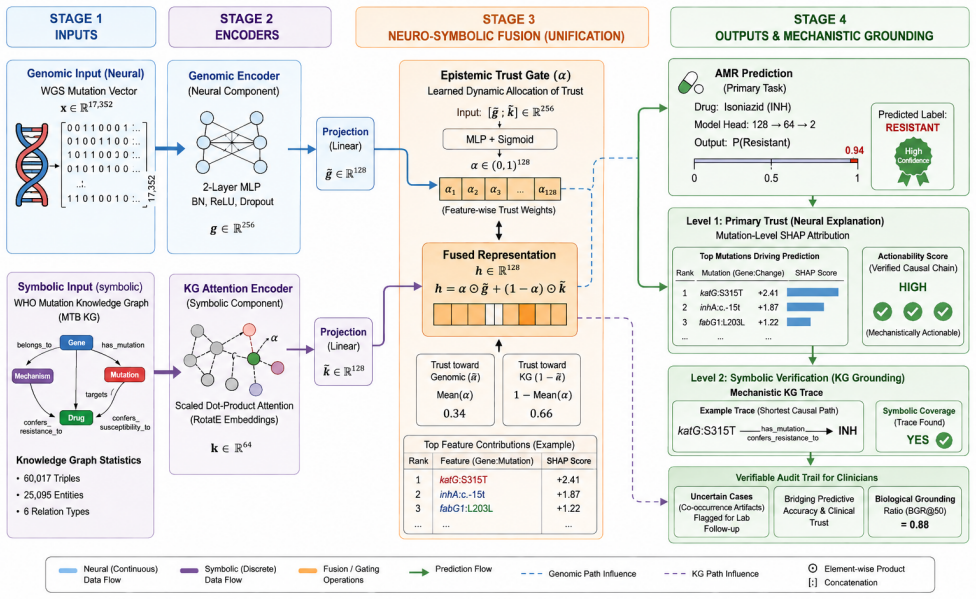
KG-TRACE integrates the mutation knowledge graph as a structured biological constraint on a neural genomic model. Genomic features and RotatE-based KG embeddings are fused through a learned epistemic trust gate that dynamically weights neural evidence against symbolic biological knowledge. On the CRyPTIC M. tuberculosis cohort the model reaches an AUROC of 0.9760 for isoniazid while attaining 92.5 percent symbolic coverage of resistant predictions and issuing laboratory follow-up flags for uncertain MDR co-occurrence cases, thereby supplying a verifiable audit trail that links predictions to established biology.
What carries the argument
The epistemic trust gate, which learns to weight neural genomic features against RotatE embeddings from the mutation knowledge graph, together with the Biological Grounding Ratio that quantifies dataset-level alignment between neural attributions and symbolic biological knowledge.
If this is right
- Predictions are accompanied by an explicit audit trail showing which attributions rest on documented mutation effects rather than learned correlations.
- Cases where neural and symbolic sources conflict are automatically flagged as uncertain and routed for additional laboratory confirmation.
- High symbolic coverage indicates that the majority of resistance calls are mechanistically consistent with known pathways instead of being driven by dataset artifacts.
- The same fusion mechanism can be applied to audit the biological plausibility of any existing neural resistance predictor without retraining from scratch.
Where Pith is reading between the lines
- The trust-gate architecture could be reused in other clinical prediction tasks that already possess a structured knowledge base of causal relations.
- If the Biological Grounding Ratio turns out to predict real-world treatment success, it would give clinicians a practical reliability score beyond raw accuracy.
- Replacing the current knowledge graph with one built from newer experimental data would test whether the reported coverage level is stable or sensitive to the underlying biology source.
- The approach leaves open whether the same grounding ratio would remain high when the model is evaluated on entirely new pathogen species not represented in the original graph.
Load-bearing premise
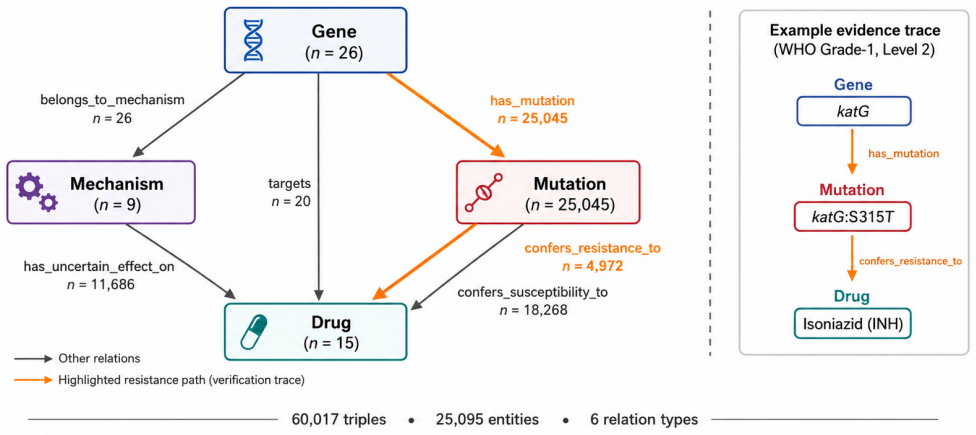
The mutation knowledge graph supplies an accurate, unbiased, and sufficiently complete record of established biological pathways that can act as an external constraint.
What would settle it
A controlled experiment in which the trust gate is removed or the knowledge graph is replaced by random edges, after which the Biological Grounding Ratio falls to near zero while predictive accuracy remains unchanged.
Figures


read the original abstract
While WGS-based AMR prediction has reached high accuracy, existing models lack a mechanism to ground neural attributions in established biological pathways. We present KG-TRACE, a novel neuro-symbolic framework that integrates the WHO mutation knowledge graph (KG) as a structured biological constraint on a neural genomic model. Unlike existing methods that learn statistical patterns in isolation, KG-TRACE fuses genomic features and RotatE-based KG embeddings through a learned epistemic trust gate, dynamically weighting neural evidence against symbolic biological knowledge. Evaluated on the CRyPTIC M. tuberculosis cohort, KG-TRACE achieves an AUROC of 0.9760 for isoniazid, achieving competitive accuracy while its primary value lies in symbolic grounding, not predictive uplift. More importantly, we introduce the Biological Grounding Ratio (BGR), a dataset-level metric that quantifies alignment between neural attributions and established biology. Our framework achieves a 92.5% symbolic coverage of isoniazid-resistant predictions and effectively identifies MDR co-occurrence artifacts by issuing laboratory follow-up flags for 'UNCERTAIN' cases. We demonstrate that neuro-symbolic grounding provides a verifiable audit trail for clinicians, bridging the gap between predictive accuracy and clinical trust.
Editorial analysis
A structured set of objections, weighed in public.
Referee Report
Summary. The manuscript presents KG-TRACE, a neuro-symbolic framework for antimicrobial resistance (AMR) prediction that integrates genomic features with RotatE embeddings of the WHO mutation knowledge graph (KG) through a learned epistemic trust gate. It reports an AUROC of 0.9760 on the CRyPTIC M. tuberculosis cohort for isoniazid resistance and introduces the Biological Grounding Ratio (BGR) metric, claiming 92.5% symbolic coverage of isoniazid-resistant predictions and the ability to flag 'UNCERTAIN' cases for MDR co-occurrence artifacts to provide a verifiable audit trail.
Significance. If the non-circularity of the BGR can be established, the framework could significantly advance the field by providing a mechanism to ground neural predictions in established biological pathways, thereby increasing clinical trust in WGS-based AMR models beyond mere predictive accuracy. The introduction of a dataset-level metric for symbolic alignment is a potentially useful contribution for interpretability in neuro-symbolic AI applied to biology.
major comments (2)
- [Abstract] Abstract (framework and BGR definition): The Biological Grounding Ratio is defined with respect to alignment against the same WHO KG that is injected as input via the trust gate; by the paper's own description the 'grounding' score therefore risks reducing to a measure of how faithfully the model reproduces its own symbolic input. This is load-bearing for the central claim of mechanistic grounding and 92.5% symbolic coverage.
- [Abstract] Abstract (evaluation paragraph): The abstract states performance numbers (AUROC 0.9760) and the 92.5% coverage figure but supplies no derivation, architecture diagram, training protocol, baseline comparisons, or validation procedure for the BGR metric; full methods unavailable for assessment. This undermines evaluation of the secondary claim that UNCERTAIN flags correctly surface MDR co-occurrence artifacts.
Simulated Author's Rebuttal
We thank the referee for their constructive and insightful comments on our manuscript. We address each major comment point by point below, with plans for revision where the concerns identify areas needing clarification or expansion.
read point-by-point responses
-
Referee: [Abstract] Abstract (framework and BGR definition): The Biological Grounding Ratio is defined with respect to alignment against the same WHO KG that is injected as input via the trust gate; by the paper's own description the 'grounding' score therefore risks reducing to a measure of how faithfully the model reproduces its own symbolic input. This is load-bearing for the central claim of mechanistic grounding and 92.5% symbolic coverage.
Authors: We thank the referee for identifying this potential circularity concern, which is central to the interpretability claim. The epistemic trust gate is a learned module that can assign low weight to the RotatE embeddings on a per-sample basis, allowing the neural component to dominate when genomic evidence conflicts with the KG. The BGR is computed post-gate on the final attribution vectors, quantifying the fraction of predictions whose supporting features align with KG relations rather than measuring input reproduction. To establish non-circularity rigorously, we will add a dedicated subsection in Methods with a formal argument and controlled ablation showing BGR remains high in regimes where gate trust is low. This revision will be incorporated. revision: yes
-
Referee: [Abstract] Abstract (evaluation paragraph): The abstract states performance numbers (AUROC 0.9760) and the 92.5% coverage figure but supplies no derivation, architecture diagram, training protocol, baseline comparisons, or validation procedure for the BGR metric; full methods unavailable for assessment. This undermines evaluation of the secondary claim that UNCERTAIN flags correctly surface MDR co-occurrence artifacts.
Authors: We agree the abstract is too terse for standalone evaluation of BGR and the UNCERTAIN flag claim. The full manuscript contains the architecture diagram (Figure 1), training protocol, BGR derivation (Section 3.3), and validation against MDR co-occurrence in Results. To address the referee's point, we will expand the abstract with a one-sentence description of BGR computation and validation, plus an explicit pointer to the Methods section. We will also ensure baseline comparisons for BGR appear clearly in the revised Results. This will be a partial revision focused on the abstract and cross-references. revision: partial
Circularity Check
BGR reduces to alignment with input WHO KG by construction via trust gate
specific steps
-
fitted input called prediction
[Abstract]
"KG-TRACE fuses genomic features and RotatE-based KG embeddings through a learned epistemic trust gate, dynamically weighting neural evidence against symbolic biological knowledge. ... we introduce the Biological Grounding Ratio (BGR), a dataset-level metric that quantifies alignment between neural attributions and established biology. Our framework achieves a 92.5% symbolic coverage of isoniazid-resistant predictions"
BGR is defined as alignment with the WHO KG; the trust gate is trained to maximize that alignment. The 92.5% coverage is therefore the direct output of the optimization that incorporates the KG, reducing the 'grounding' claim to a report of how faithfully the model reproduces its own symbolic constraint.
full rationale
The framework injects the WHO KG as a constraint through the epistemic trust gate (learned to weight against genomic features) and then defines BGR as the fraction of neural attributions aligning with that same KG. The reported 92.5% symbolic coverage therefore measures fidelity to the provided symbolic input rather than independent external validation. This matches the fitted_input_called_prediction pattern: the gate is optimized for alignment, after which BGR reports the resulting alignment as 'grounding'. The KG itself is external (WHO), so the circularity is internal to the BGR metric and the headline claim of mechanistic grounding, not a full self-citation chain. No other steps in the provided text exhibit the enumerated circularity patterns.
Axiom & Free-Parameter Ledger
free parameters (1)
- epistemic trust gate weights
axioms (1)
- domain assumption The WHO mutation knowledge graph accurately and comprehensively encodes established biological pathways relevant to AMR.
invented entities (2)
-
epistemic trust gate
no independent evidence
-
Biological Grounding Ratio (BGR)
no independent evidence
Reference graph
Works this paper leans on
-
[1]
GBD 2021 Antimicrobial Resistance Collaborators (M. Naghaviet al.), “Global burden of bacterial antimicrobial resistance 1990–2021: a sys- tematic analysis with forecasts to 2050,”The Lancet, vol. 404, no. 10459, pp. 1199–1226, Sep. 2024, doi: 10.1016/S0140-6736(24)01867-1
-
[2]
Global burden of bacterial antimicrobial resistance in 2019: a systematic analysis,
C. J. L. Murray, K. S. Ikuta, F. Sharara, L. Swetschinski, G. Rob- les Aguilaret al., “Global burden of bacterial antimicrobial resistance in 2019: a systematic analysis,”The Lancet, vol. 399, no. 10325, pp. 629– 655, Jan. 2022, doi: 10.1016/S0140-6736(21)02724-0
-
[3]
P. Bradley, N. C. Gordon, T. M. Walkeret al., “Rapid antibiotic- resistance predictions from genome sequence data forStaphylococ- cus aureusandMycobacterium tuberculosis,”Nature Communications, vol. 6, p. 10063, Dec. 2015, doi: 10.1038/ncomms10063
-
[4]
KvarQ: targeted and direct variant calling from FASTQ reads of bacterial genomes,
A. Steiner, D. Stucki, M. Coscollaet al., “KvarQ: targeted and direct variant calling from FASTQ reads of bacterial genomes,”BMC Ge- nomics, vol. 15, p. 881, 2014, doi: 1471-2164-15-881
2014
-
[5]
ResFinder 4.0 for predictions of phenotypes from genotypes,
V . Bortolaia, R. S. Kaas, E. Ruppeet al., “ResFinder 4.0 for predictions of phenotypes from genotypes,”Journal of Antimicrobial Chemotherapy, vol. 75, no. 12, pp. 3491–3500, Dec. 2020, doi: 10.1093/jac/dkaa345
-
[6]
M. Feldgarden, V . Brover, N. Gonzalez-Escalonaet al., “AMRFinderPlus and the Reference Gene Catalog facilitate examination of the genomic links among antimicrobial resistance, stress response, and virulence,” Scientific Reports, vol. 11, p. 12728, Jun. 2021, doi: 10.1038/s41598- 021-91456-0
-
[7]
The CRyPTIC Consortium, “Genome-wide association studies of global Mycobacterium tuberculosisresistance to 13 antimicrobials in 10,228 genomes identify new resistance mechanisms,”PLOS Biology, vol. 20, no. 8, p. e3001755, Aug. 2022, doi: 10.1371/journal.pbio.3001755
-
[9]
World Health Organization,Catalogue of Mutations in Mycobacterium tuberculosis Complex and Their Association with Drug Resistance, 2nd ed. Geneva: WHO, 2023 [Online]. Available: https://www.who.int/ publications/i/item/9789240082410
arXiv 2023
-
[10]
Machine learning for classifying tuberculosis drug-resistance from DNA sequencing data,
Y . Yang, T. M. Walker, A. S. Walkeret al., “Machine learning for classifying tuberculosis drug-resistance from DNA sequencing data,” Bioinformatics, vol. 34, no. 10, pp. 1666–1671, May 2018, doi: 10.1093/bioinformatics/btx801
-
[11]
Prediction of antibiotic resistance inEscherichia colifrom large-scale pan-genome data,
D. Moradigaravand, M. Palm, A. Farewellet al., “Prediction of antibiotic resistance inEscherichia colifrom large-scale pan-genome data,”PLOS Computational Biology, vol. 14, no. 12, p. e1006258, Dec. 2018, doi: 10.1371/journal.pcbi.1006258
-
[12]
Drug resistance prediction forMycobacterium tuberculosiswith reference graphs,
M. B. Hall, L. Lima, L. J. M. Coin, and Z. Iqbal, “Drug resistance prediction forMycobacterium tuberculosiswith reference graphs,”Mi- crobial Genomics, vol. 9, no. 8, p. mgen001081, Aug. 2023, doi: 10.1099/mgen.0.001081
-
[13]
Interpretable genotype-to- phenotype classifiers with performance guarantees,
A. Drouin, G. Letarte, F. Raymondet al., “Interpretable genotype-to- phenotype classifiers with performance guarantees,”Scientific Reports, vol. 9, p. 4071, 2019, doi: 10.1038/s41598-019-40561-2
-
[14]
DeepAMR for predicting co-occurrent resistance ofMycobacterium tuberculosis,
Y . Yang, T. M. Walker, A. S. Walkeret al., “DeepAMR for predicting co-occurrent resistance ofMycobacterium tuberculosis,”Bioinformatics, vol. 35, no. 18, pp. 3240–3249, Sep. 2019, doi: 10.1093/bioinformatic- s/btz067
-
[15]
Y . Wang, Z. Jiang, P. Liang, Z. Liu, H. Cai, and Q. Sun, “TB-DROP: deep learning-based drug resistance prediction ofMycobacterium tuber- culosisutilizing whole genome mutations,”BMC Genomics, vol. 25, p. 167, Feb. 2024, doi: 10.1186/s12864-024-10066-y
-
[16]
X. Kuang, H. Wang, M. Denget al., “Accurate and rapid prediction of tuberculosis drug resistance from genome sequence data using traditional machine learning algorithms and CNN,”Scientific Reports, vol. 12, p. 2427, Feb. 2022, doi: 10.1038/s41598-022-06449-4
-
[17]
A. G. Green, C. H. Yoon, M. L. Chenet al., “A convolutional neural network highlights mutations relevant to antimicrobial resistance in Mycobacterium tuberculosis,”Nature Communications, vol. 13, p. 3817, 2022, doi: 10.1038/s41467-022-31236-0
-
[18]
Y . Yang, T. M. Walker, S. Kouchakiet al., “An end-to-end heterogeneous graph attention network forMycobacterium tuberculosisdrug-resistance prediction,”Briefings in Bioinformatics, vol. 22, no. 6, p. bbab299, Nov. 2021, doi: 10.1093/bib/bbab299
-
[19]
A deep learning approach to antibiotic discovery,
J. M. Stokes, K. Yang, K. Swansonet al., “A deep learning approach to antibiotic discovery,”Cell, vol. 180, no. 4, pp. 688–702, Feb. 2020, doi: 10.1016/j.cell.2020.01.021
-
[20]
RotatE: Knowledge Graph Embedding by Relational Rotation in Complex Space
Z. Sun, Z.-H. Deng, J.-Y . Nie, and J. Tang, “RotatE: Knowledge graph embedding by relational rotation in complex space,” inProc. 7th Int. Conf. Learn. Representations (ICLR), New Orleans, LA, May 2019, doi: 10.48550/arXiv.1902.10197
work page internal anchor Pith review Pith/arXiv arXiv doi:10.48550/arxiv.1902.10197 2019
-
[21]
PyKEEN 1.0: A Python library for training and evaluating knowledge graph embeddings,
M. Ali, M. Berrendorf, C. T. Hoytet al., “PyKEEN 1.0: A Python library for training and evaluating knowledge graph embeddings,”Journal of Machine Learning Research, vol. 22, no. 82, pp. 1–6, 2021
2021
-
[22]
Modeling polypharmacy side effects with graph convolutional networks,
M. Zitnik, M. Agrawal, and J. Leskovec, “Modeling polypharmacy side effects with graph convolutional networks,”Bioinformatics, vol. 34, no. 13, pp. i457–i466, 2018, doi: 10.1093/bioinformatics/bty294
-
[23]
Constructing knowledge graphs and their biomedical applications,
D. N. Nicholson and C. S. Greene, “Constructing knowledge graphs and their biomedical applications,”Computational and Struc- tural Biotechnology Journal, vol. 18, pp. 1414–1428, 2020, doi: 10.1016/j.csbj.2020.05.017
-
[24]
ViLBERT: Pretraining task- agnostic visiolinguistic representations for vision-and-language tasks,
J. Lu, D. Batra, D. Parikh, and S. Lee, “ViLBERT: Pretraining task- agnostic visiolinguistic representations for vision-and-language tasks,” in Advances in Neural Information Processing Systems (NeurIPS), vol. 32, Vancouver, BC, Dec. 2019, doi: 10.48550/arXiv.1908.02265
-
[25]
Deep learning with multimodal representa- tion for pancancer prognosis prediction,
A. Cheerla and O. Gevaert, “Deep learning with multimodal representa- tion for pancancer prognosis prediction,”Bioinformatics, vol. 35, no. 14, pp. i446–i454, Jul. 2019, doi: 10.1093/bioinformatics/btz342
-
[26]
A Unified Approach to Interpreting Model Predictions
S. M. Lundberg and S.-I. Lee, “A unified approach to interpret- ing model predictions,” inAdvances in Neural Information Process- ing Systems (NeurIPS), vol. 30, Long Beach, CA, Dec. 2017, doi: 10.48550/arXiv.1705.07874
work page internal anchor Pith review Pith/arXiv arXiv doi:10.48550/arxiv.1705.07874 2017
-
[27]
A. Khaledi, A. Weimann, M. Schniederjanset al., “Predicting antimi- crobial resistance inPseudomonas aeruginosawith machine learning- enabled molecular diagnostics,”EMBO Molecular Medicine, vol. 12, no. 3, p. e10264, Mar. 2020, doi: 10.15252/emmm.201910264
-
[28]
Assessing computational predic- tions of antimicrobial resistance phenotypes from microbial genomes,
K. Hu, F. Meyer, Z.-L. Denget al., “Assessing computational predic- tions of antimicrobial resistance phenotypes from microbial genomes,” Briefings in Bioinformatics, vol. 25, no. 3, p. bbae206, May 2024, doi: 10.1093/bib/bbae206
-
[29]
Lightweight Multimodal CNN for Real-Time Bacterial Classification from Raman Spectroscopy,
Naman, G. Singh, S. Jain, S. Gupta, and S. Chandra, “Lightweight Multimodal CNN for Real-Time Bacterial Classification from Raman Spectroscopy,” inProc. 2026 Second Int. Conf. Multi-Agent Systems for Collaborative Intelligence (ICMSCI), Erode, India, 2026, pp. 1105– 1112, doi: 10.1109/ICMSCI67830.2026.11469385
-
[30]
Charting the evolution of neuro-symbolic AI in cybersecu- rity: a scientometric perspective,
S. Jainet al., “Charting the evolution of neuro-symbolic AI in cybersecu- rity: a scientometric perspective,”International Journal of Data Science and Analytics, 2026, doi: 10.1007/s41060-026-01062-4
-
[31]
S. Dalal and S. Jain, “TRUST-MH: Transparent and Responsible User- Level Semantic Tagging for Mental Health Assessment,” inRecom- mender Systems for Sustainability and Social Good, Communications in Computer and Information Science, 2026, doi: 10.1007/978-3-032- 13342-7_5
discussion (0)
Sign in with ORCID, Apple, or X to comment. Anyone can read and Pith papers without signing in.