A Stellar Role Reversal: Multiple Features in the Mass and Mass Ratio Distributions of Merging Binary Black Holes from Stable Mass Transfer
Pith reviewed 2026-06-26 01:18 UTC · model grok-4.3
The pith
Stable mass transfer produces two distinct subpopulations in binary black hole masses and mass ratios.
A machine-rendered reading of the paper's core claim, the machinery that carries it, and where it could break.
Core claim
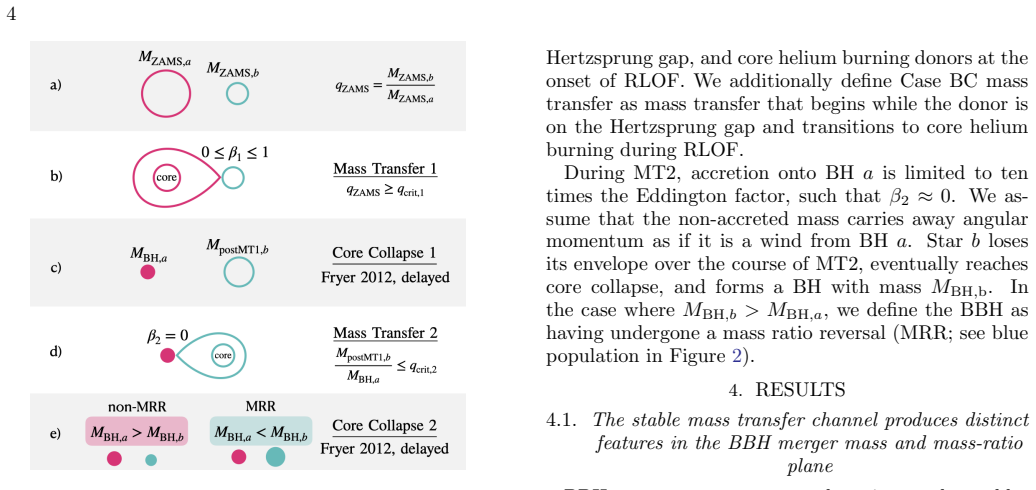
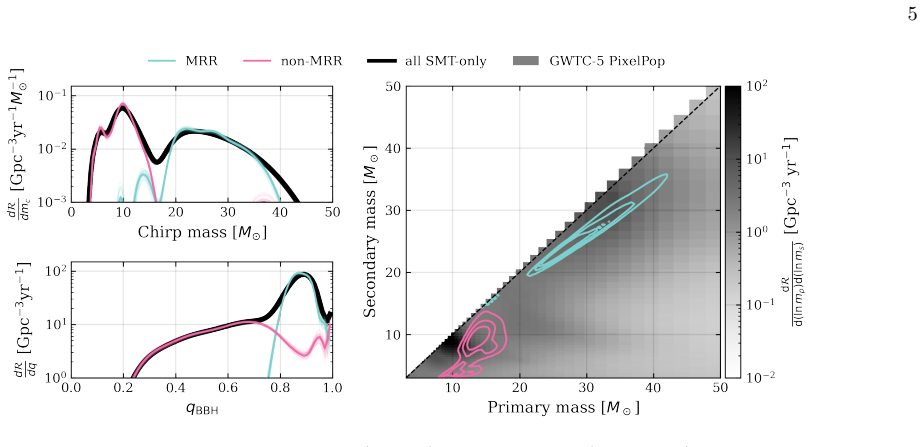
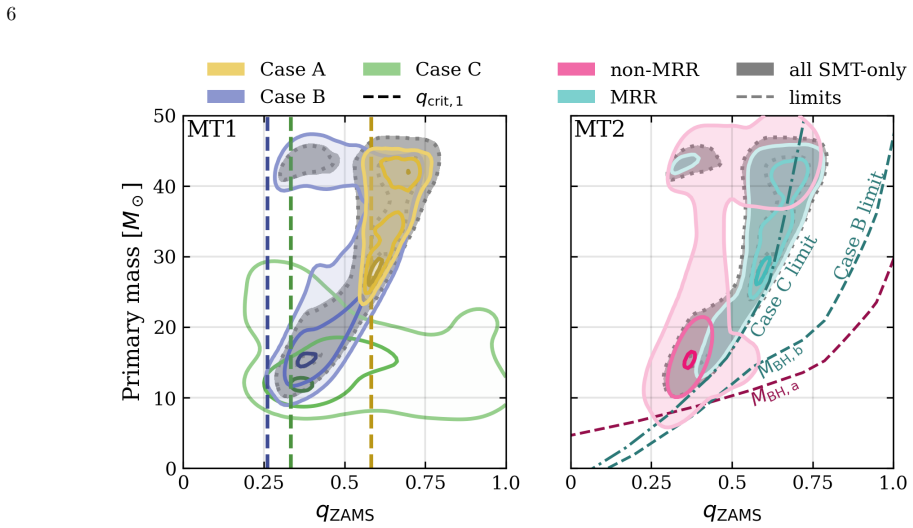
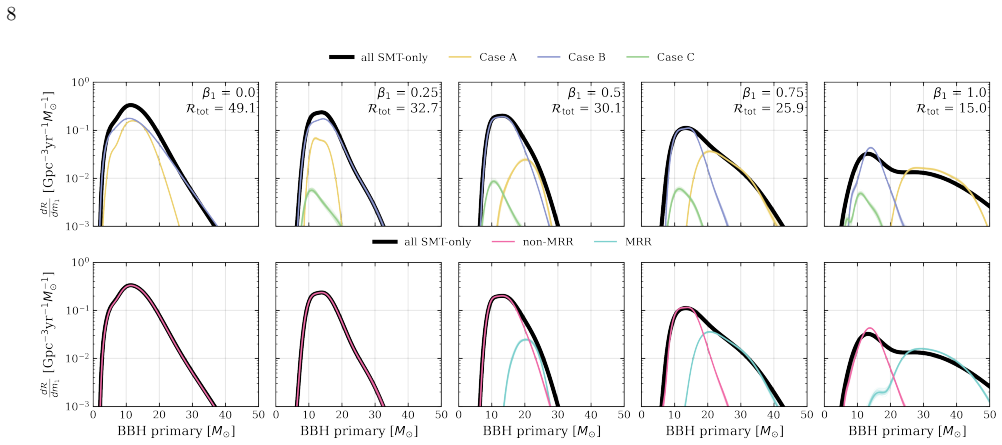
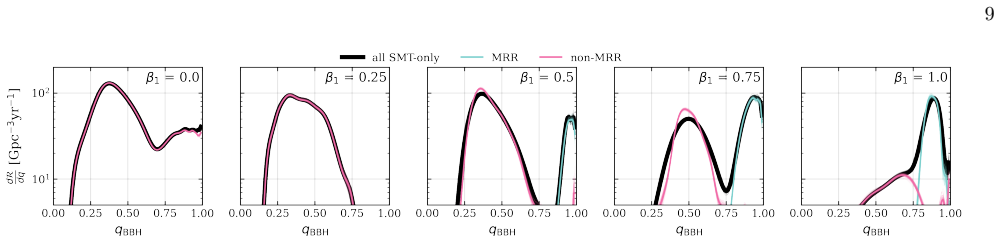
Under the assumption of conservative mass transfer, the SMT channel produces two observationally distinct subpopulations: a high primary mass, near equal mass ratio population formed through mass ratio reversal (MRR), and a low primary mass non-MRR subpopulation. The mass range where MRR occurs is determined by assumptions about binary SMT. In particular, the stability criteria for mass transfer at different stellar evolutionary stages carve out complementary regions in the primary-mass--mass-ratio plane, separating the MRR and non-MRR populations into distinct peaks at high and low primary mass respectively.
What carries the argument
Stability criteria for mass transfer at different stellar evolutionary stages, which divide the primary-mass--mass-ratio plane into complementary MRR and non-MRR regions.
If this is right
- The binary black hole mass function develops distinct peaks at high and low primary mass.
- Near-equal mass ratios become associated with the higher-mass peak.
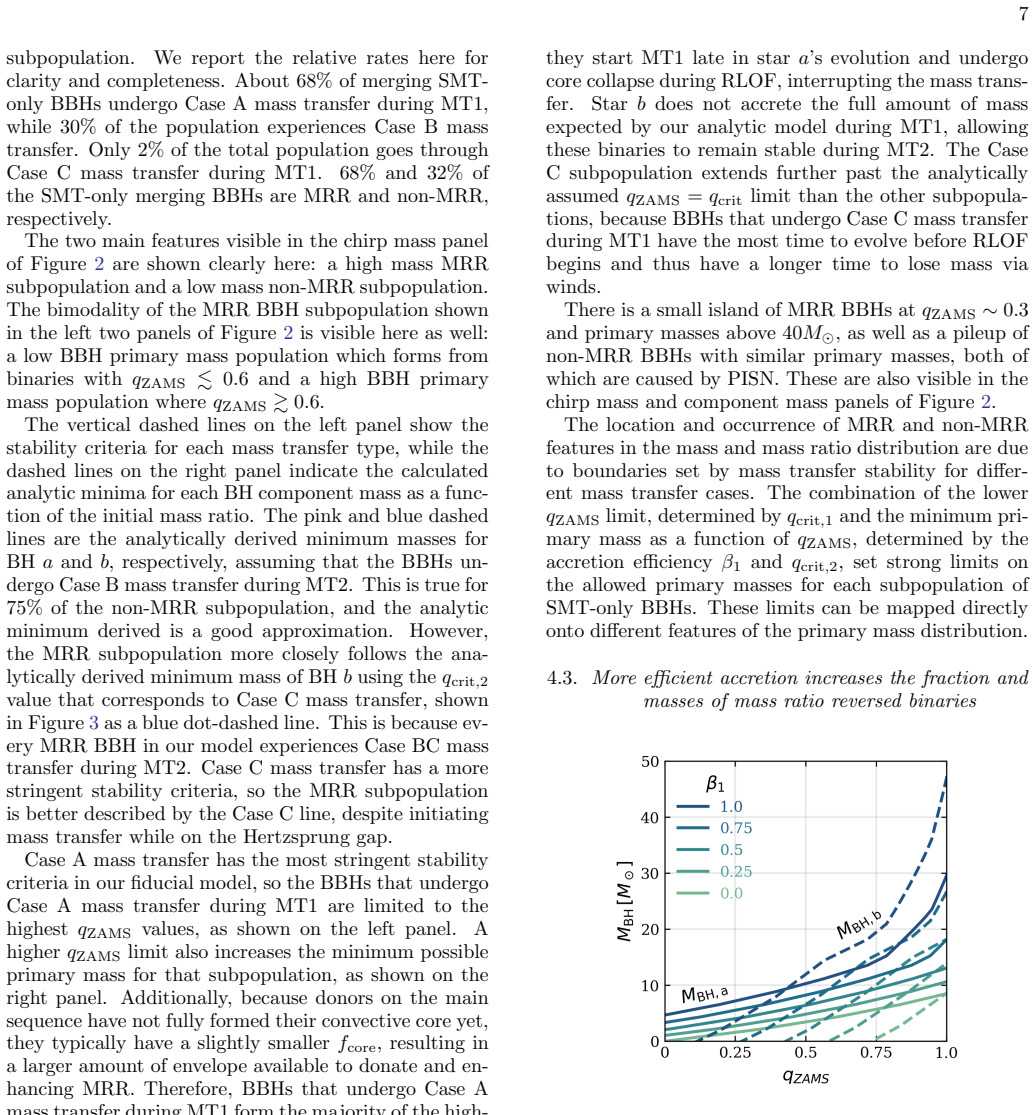
- The locations of the peaks shift when assumptions about mass-transfer stability or accretion efficiency change.
- Current and near-future gravitational-wave detectors can resolve these separate subpopulations.
Where Pith is reading between the lines
- Observed distributions lacking the predicted peaks would point toward non-conservative mass transfer or different stability rules.
- The separation supplies a potential way to isolate the stable mass transfer contribution from other formation channels in future catalogs.
- Varying the accretion efficiency in population models would move the boundary between the two subpopulations in a predictable way.
Load-bearing premise
Mass transfer is fully conservative so that all transferred mass is accreted, combined with the specific stability criteria applied at each evolutionary stage.
What would settle it
A catalog of merging binary black holes whose primary-mass and mass-ratio distribution shows a single continuous population without separated high-mass equal-ratio and low-mass peaks.
Figures
read the original abstract
Observations of gravitational wave events have enabled the measurement of the merging binary black hole (BBH) mass function. This mass function encodes the physical interactions which shape the formation and evolution of BBHs. In this work we investigate how the stable mass transfer (SMT) channel of BBH formation imprints onto the BBH primary mass and mass ratio distributions. We use both an analytic framework and binary population synthesis to show how assumptions about mass transfer accretion efficiency and mass transfer stability affect the BBH mass distribution. Under the assumption of conservative mass transfer, we find that the SMT channel produces two observationally distinct subpopulations: a high primary mass, near equal mass ratio population formed through mass ratio reversal (MRR), and a low primary mass non-MRR subpopulation. The mass range where MRR occurs is determined by assumptions about binary SMT. In particular, we find that the stability criteria for mass transfer at different stellar evolutionary stages carve out complementary regions in the primary-mass--mass-ratio plane, separating the MRR and non-MRR populations into distinct peaks at high and low primary mass respectively. Our results imply that the physics of SMT creates distinct features in gravitational wave populations which current and near future gravitational wave detectors may be able to resolve.
Editorial analysis
A structured set of objections, weighed in public.
Referee Report
Summary. The manuscript claims that under the assumption of conservative mass transfer, the stable mass transfer (SMT) channel for binary black hole formation produces two observationally distinct subpopulations in the primary-mass and mass-ratio distributions: a high-primary-mass, near-equal-q population formed via mass ratio reversal (MRR) and a low-primary-mass non-MRR subpopulation. These subpopulations arise because stability criteria for mass transfer at different stellar evolutionary stages carve complementary regions in the primary-mass--mass-ratio plane. The result is demonstrated with both an analytic framework and binary population synthesis.
Significance. If the result holds, it supplies a direct physical mechanism linking SMT assumptions to distinct, potentially resolvable features in the BBH mass function measured by gravitational-wave detectors. Explicit credit is due for the dual use of analytic modeling and population synthesis, which maps the input physics (accretion efficiency and stability criteria) onto observable distributions in a falsifiable way.
minor comments (1)
- [Abstract] The abstract and introduction should more explicitly flag that all reported subpopulations are conditional on the conservative-mass-transfer assumption and the adopted stability criteria; this is already stated but could be highlighted earlier to avoid misreading as a general prediction.
Simulated Author's Rebuttal
We thank the referee for their positive and accurate summary of our manuscript, as well as the recommendation for minor revision. The report correctly identifies the central result that conservative stable mass transfer produces two distinct subpopulations in the primary-mass and mass-ratio distributions via mass ratio reversal, with the separation arising from evolutionary-stage-dependent stability criteria. No specific major comments were raised.
Circularity Check
No significant circularity; derivation is self-contained from stated assumptions
full rationale
The paper derives the claimed subpopulations (high-mass MRR and low-mass non-MRR) directly from explicit inputs: conservative mass transfer plus adopted stability criteria at different evolutionary stages. These inputs are used in both analytic modeling and population synthesis to produce complementary regions in the primary-mass--mass-ratio plane. No parameter is fitted to data and then relabeled as a prediction, no self-citation chain supplies a load-bearing uniqueness theorem, and no ansatz is smuggled in. The result is conditional on the stated physics assumptions and does not reduce to those assumptions by construction.
Axiom & Free-Parameter Ledger
axioms (2)
- domain assumption Mass transfer is conservative (all mass lost by donor is accreted by companion)
- domain assumption Stability criteria for mass transfer depend on stellar evolutionary stage and carve complementary regions in the primary-mass--mass-ratio plane
Reference graph
Works this paper leans on
-
[1]
G., Abouelfettouh, I., Acernese, F., et al
Abac, A. G., Abouelfettouh, I., Acernese, F., et al. 2025, ApJL, 995, L18, doi: 10.3847/2041-8213/ae0c06
-
[2]
Abbott, B. P., Abbott, R., Abbott, T. D., et al. 2016, PhRvL, 116, 061102, doi: 10.1103/PhysRevLett.116.061102 14 Figure B1.Same as Figure 3, for allβ 1 variations explored in Section 4.3. Only the full SMT-only population has been shaded for clarity
-
[3]
Abbott, B. P., Abbott, R., Abbott, T. D., et al. 2019, Physical Review X, 9, 031040, doi: 10.1103/PhysRevX.9.031040
-
[4]
Abbott, R., Abbott, T. D., Abraham, S., et al. 2021, Physical Review X, 11, 021053, doi: 10.1103/PhysRevX.11.021053
-
[5]
Abbott, R., Abbott, T. D., Acernese, F., et al. 2023a, Physical Review X, 13, 041039, doi: 10.1103/PhysRevX.13.041039
-
[6]
Abbott, R., Abbott, T. D., Acernese, F., et al. 2023b, Physical Review X, 13, 011048, doi: 10.1103/PhysRevX.13.011048
-
[7]
Adamcewicz, C., Galaudage, S., Lasky, P. D., & Thrane, E. 2024, ApJL, 964, L6, doi: 10.3847/2041-8213/ad2df2
-
[8]
2025, The Journal of Open Source Software, 10, 8817, doi: 10.21105/joss.08817
Agrawal, P., Breivik, K., Hurley, J., et al. 2025, The Journal of Open Source Software, 10, 8817, doi: 10.21105/joss.08817
-
[9]
2023, MNRAS, 525, 933, doi: 10.1093/mnras/stad2334
Agrawal, P., Hurley, J., Stevenson, S., et al. 2023, MNRAS, 525, 933, doi: 10.1093/mnras/stad2334
-
[10]
2020, MNRAS, 497, 4549, doi: 10.1093/mnras/staa2264 Astropy Collaboration, Robitaille, T
Agrawal, P., Hurley, J., Stevenson, S., Sz´ ecsi, D., & Flynn, C. 2020, MNRAS, 497, 4549, doi: 10.1093/mnras/staa2264 Astropy Collaboration, Robitaille, T. P., Tollerud, E. J., et al. 2013, A&A, 558, A33, doi: 10.1051/0004-6361/201322068 Astropy Collaboration, Price-Whelan, A. M., Sip˝ ocz, B. M., et al. 2018, AJ, 156, 123, doi: 10.3847/1538-3881/aabc4f A...
-
[11]
Banagiri, S., Thrane, E., & Lasky, P. D. 2025, arXiv e-prints, arXiv:2509.15646, doi: 10.48550/arXiv.2509.15646
-
[12]
2025, ApJ, 987, 210, doi: 10.3847/1538-4357/addfd8
Bao, Y., Li, Z., Ge, H., Chen, X., & Han, Z. 2025, ApJ, 987, 210, doi: 10.3847/1538-4357/addfd8
-
[13]
S., Fragos, T., Qin, Y., et al
Bavera, S. S., Fragos, T., Qin, Y., et al. 2020, A&A, 635, A97, doi: 10.1051/0004-6361/201936204
-
[14]
Astronomy and Astrophysics , volume =
Bavera, S. S., Fragos, T., Zevin, M., et al. 2021, A&A, 647, A153, doi: 10.1051/0004-6361/202039804
-
[15]
S., Fragos, T., Zapartas, E., et al
Bavera, S. S., Fragos, T., Zapartas, E., et al. 2023, Nature Astronomy, 7, 1090, doi: 10.1038/s41550-023-02018-5
-
[16]
Begelman, M. C. 2002, ApJL, 568, L97, doi: 10.1086/340457
-
[17]
2026, in Encyclopedia of Astrophysics, Volume 3, Vol
Breivik, K. 2026, in Encyclopedia of Astrophysics, Volume 3, Vol. 3, 570–591, doi: 10.1016/B978-0-443-21439-4.00115-2
-
[18]
2023, TeamLEGWORK/LEGWORK: LEGWORK v0.4.7, v0.4.7 Zenodo, doi: 10.5281/zenodo.8436065
Breivik, K., & Wagg, T. 2023, TeamLEGWORK/LEGWORK: LEGWORK v0.4.7, v0.4.7 Zenodo, doi: 10.5281/zenodo.8436065
-
[20]
2020b, ApJ, 898, 71, doi: 10.3847/1538-4357/ab9d85
Breivik, K., Coughlin, S., Zevin, M., et al. 2020b, ApJ, 898, 71, doi: 10.3847/1538-4357/ab9d85
-
[21]
A case for Case A: detailed look at binary black hole formation through stable mass transfer
Briel, M. M., Fragos, T., Gallegos-Garcia, M., et al. 2026, arXiv e-prints, arXiv:2602.03629, doi: 10.48550/arXiv.2602.03629 15
work page internal anchor Pith review Pith/arXiv arXiv doi:10.48550/arxiv.2602.03629 2026
-
[22]
S., Stevenson, S., & Thrane, E
Broekgaarden, F. S., Stevenson, S., & Thrane, E. 2022, ApJ, 938, 45, doi: 10.3847/1538-4357/ac8879
-
[23]
Cheng, A. Q., Zevin, M., & Vitale, S. 2023, ApJ, 955, 127, doi: 10.3847/1538-4357/aced98
-
[24]
2024, Astropy, v6.1.0 Zenodo, doi: 10.5281/zenodo.11121433
Collaboration, A. 2024, Astropy, v6.1.0 Zenodo, doi: 10.5281/zenodo.11121433
-
[25]
Coughlin, S., Breivik, K., Zevin, M., et al. 2026, COSMIC-PopSynth/COSMIC: v4.1.0, v4.1.0 Zenodo, doi: 10.5281/zenodo.20721229 da Costa-Luis, C., Larroque, S. K., Altendorf, K., et al. 2024, tqdm: A fast, Extensible Progress Bar for Python and CLI, v4.66.2 Zenodo, doi: 10.5281/zenodo.3551211 de Mink, S. E., & Mandel, I. 2016, MNRAS, 460, 3545, doi: 10.109...
-
[26]
2025, ApJL, 989, L8, doi: 10.3847/2041-8213/adf286
Disberg, P., & Mandel, I. 2025, ApJL, 989, L8, doi: 10.3847/2041-8213/adf286
-
[27]
2024, MNRAS, 530, 3706, doi: 10.1093/mnras/stae152
Dorozsmai, A., & Toonen, S. 2024, MNRAS, 530, 3706, doi: 10.1093/mnras/stae152
-
[28]
2026, arXiv e-prints, arXiv:2606.14472, doi: 10.48550/arXiv.2606.14472
Flanagan, E., Antonini, F., Callister, T., et al. 2026, arXiv e-prints, arXiv:2606.14472, doi: 10.48550/arXiv.2606.14472
-
[29]
L., Belczynski, K., Wiktorowicz, G., et al
Fryer, C. L., Belczynski, K., Wiktorowicz, G., et al. 2012, ApJ, 749, 91, doi: 10.1088/0004-637X/749/1/91
-
[30]
2019, ApJL, 881, L1, doi: 10.3847/2041-8213/ab339b
Fuller, J., & Ma, L. 2019, ApJL, 881, L1, doi: 10.3847/2041-8213/ab339b
-
[31]
2021, ApJ, 922, 110, doi: 10.3847/1538-4357/ac2610
Kalogera, V. 2021, ApJ, 922, 110, doi: 10.3847/1538-4357/ac2610
-
[32]
Ge, H., Webbink, R. F., Chen, X., & Han, Z. 2015, ApJ, 812, 40, doi: 10.1088/0004-637X/812/1/40
-
[33]
2023, arXiv e-prints, arXiv:2304.01288, doi: 10.48550/arXiv.2304.01288
Godfrey, J., Edelman, B., & Farr, B. 2023, arXiv e-prints, arXiv:2304.01288, doi: 10.48550/arXiv.2304.01288
-
[34]
Godfrey, J., van Son, L., & Farr, B. 2026, arXiv e-prints, arXiv:2605.23083, doi: 10.48550/arXiv.2605.23083
work page internal anchor Pith review Pith/arXiv arXiv doi:10.48550/arxiv.2605.23083 2026
-
[35]
2023, scipy/scipy: SciPy 1.11.4, v1.11.4 Zenodo, doi: 10.5281/zenodo.10155614
Gommers, R., Virtanen, P., Haberland, M., et al. 2023, scipy/scipy: SciPy 1.11.4, v1.11.4 Zenodo, doi: 10.5281/zenodo.10155614
-
[36]
Harris, C. R., Millman, K. J., van der Walt, S. J., et al. 2020, Nature, 585, 357, doi: 10.1038/s41586-020-2649-2
-
[37]
Hjellming, M. S., & Webbink, R. F. 1987, ApJ, 318, 794, doi: 10.1086/165412
-
[38]
Hunter, J. D. 2007, Computing in Science & Engineering, 9, 90, doi: 10.1109/MCSE.2007.55
-
[39]
Abundance and colour gradients in discs
Hurley, J. R., Pols, O. R., & Tout, C. A. 2000, MNRAS, 315, 543, doi: 10.1046/j.1365-8711.2000.03426.x
-
[40]
Hurley, J. R., Tout, C. A., & Pols, O. R. 2002, MNRAS, 329, 897, doi: 10.1046/j.1365-8711.2002.05038.x
-
[41]
2017, MNRAS, 468, 5020, doi: 10.1093/mnras/stx757
Inayoshi, K., Hirai, R., Kinugawa, T., & Hotokezaka, K. 2017, MNRAS, 468, 5020, doi: 10.1093/mnras/stx757
-
[42]
Klencki, J., Nelemans, G., Istrate, A. G., & Chruslinska, M. 2021, A&A, 645, A54, doi: 10.1051/0004-6361/202038707
-
[43]
2026, A&A, 706, A296, doi: 10.1051/0004-6361/202555500
Klencki, J., Podsiadlowski, P., Langer, N., et al. 2026, A&A, 706, A296, doi: 10.1051/0004-6361/202555500
-
[44]
2016, in Positioning and Power in Academic Publishing: Players, Agents and Agendas, ed
Kluyver, T., Ragan-Kelley, B., P´ erez, F., et al. 2016, in Positioning and Power in Academic Publishing: Players, Agents and Agendas, ed. F. Loizides & B. Schmidt, IOS Press, 87–90
2016
-
[45]
Kroupa, P. 2001, MNRAS, 322, 231, doi: 10.1046/j.1365-8711.2001.04022.x
-
[46]
Lattimer, J. M., & Yahil, A. 1989, ApJ, 340, 426, doi: 10.1086/167404
-
[47]
Lechien, T., de Mink, S. E., Valli, R., et al. 2025, ApJL, 990, L51, doi: 10.3847/2041-8213/adfdd4
-
[48]
B., Agrawal, P., Breivik, K., et al
Maclean, D. B., Agrawal, P., Breivik, K., et al. 2026, in prep
2026
-
[49]
Madau, P., & Dickinson, M. 2014, ARA&A, 52, 415, doi: 10.1146/annurev-astro-081811-125615
work page internal anchor Pith review doi:10.1146/annurev-astro-081811-125615 2014
-
[50]
Maltsev, K., Schneider, F. R. N., Mandel, I., et al. 2025, A&A, 700, A20, doi: 10.1051/0004-6361/202554931
-
[51]
Mandel, I., & Broekgaarden, F. S. 2022, Living Reviews in Relativity, 25, 1, doi: 10.1007/s41114-021-00034-3
-
[52]
2020, MNRAS, 499, 3214, doi: 10.1093/mnras/staa3043
Mandel, I., & M¨ uller, B. 2020, MNRAS, 499, 3214, doi: 10.1093/mnras/staa3043
-
[53]
Astronomy and Astrophysics , volume =
Marchant, P., Langer, N., Podsiadlowski, P., Tauris, T. M., & Moriya, T. J. 2016, A&A, 588, A50, doi: 10.1051/0004-6361/201628133
-
[54]
Marchant, P., Pappas, K. M. W., Gallegos-Garcia, M., et al. 2021, A&A, 650, A107, doi: 10.1051/0004-6361/202039992
-
[55]
Marchant, P., Renzo, M., Farmer, R., et al. 2019, ApJ, 882, 36, doi: 10.3847/1538-4357/ab3426
-
[56]
First results from the IllustrisTNG simulations: radio haloes and magnetic fields
Marinacci, F., Vogelsberger, M., Pakmor, R., et al. 2018, MNRAS, 480, 5113, doi: 10.1093/mnras/sty2206
work page internal anchor Pith review doi:10.1093/mnras/sty2206 2018
-
[57]
Michaely, E., & Perets, H. B. 2019, ApJL, 887, L36, doi: 10.3847/2041-8213/ab5b9b
-
[58]
Mould, M., Gerosa, D., Broekgaarden, F. S., & Steinle, N. 2022, MNRAS, 517, 2738, doi: 10.1093/mnras/stac2859
-
[59]
Naiman, J. P., Pillepich, A., Springel, V., et al. 2018, MNRAS, 477, 1206, doi: 10.1093/mnras/sty618
work page internal anchor Pith review doi:10.1093/mnras/sty618 2018
-
[60]
First results from the IllustrisTNG simulations: the galaxy color bimodality
Nelson, D., Pillepich, A., Springel, V., et al. 2018, MNRAS, 475, 624, doi: 10.1093/mnras/stx3040
work page internal anchor Pith review doi:10.1093/mnras/stx3040 2018
-
[61]
2025, A&A, 695, A117, doi: 10.1051/0004-6361/202451564
Nuijten, M., & Nelemans, G. 2025, A&A, 695, A117, doi: 10.1051/0004-6361/202451564
-
[62]
2021, A&A, 651, A100, doi: 10.1051/0004-6361/202140520
Olejak, A., Belczynski, K., & Ivanova, N. 2021, A&A, 651, A100, doi: 10.1051/0004-6361/202140520
-
[63]
1981, A&A, 102, 17 pandas development team, T
Packet, W. 1981, A&A, 102, 17 pandas development team, T. 2023, pandas-dev/pandas: Pandas, v2.1.4 Zenodo, doi: 10.5281/zenodo.10304236 16
-
[64]
2015, ApJS, 220, 15, doi: 10.1088/0067-0049/220/1/15
Paxton, B., Marchant, P., Schwab, J., et al. 2015, ApJS, 220, 15, doi: 10.1088/0067-0049/220/1/15
work page internal anchor Pith review doi:10.1088/0067-0049/220/1/15 2015
-
[65]
Perez, F., & Granger, B. E. 2007, Computing in Science and Engineering, 9, 21, doi: 10.1109/MCSE.2007.53
-
[66]
Petrovic, J., Langer, N., & van der Hucht, K. A. 2005, A&A, 435, 1013, doi: 10.1051/0004-6361:20042368
-
[67]
2024, A&A, 681, A31, doi: 10.1051/0004-6361/202347090
Picco, A., Marchant, P., Sana, H., & Nelemans, G. 2024, A&A, 681, A31, doi: 10.1051/0004-6361/202347090
-
[68]
Pillepich, A., Nelson, D., Hernquist, L., et al. 2018, MNRAS, 475, 648, doi: 10.1093/mnras/stx3112
work page internal anchor Pith review doi:10.1093/mnras/stx3112 2018
-
[69]
2018, A&A, 616, A28, doi: 10.1051/0004-6361/201832839
Qin, Y., Fragos, T., Meynet, G., et al. 2018, A&A, 616, A28, doi: 10.1051/0004-6361/201832839
-
[70]
2019, ApJL, 870, L18, doi: 10.3847/2041-8213/aaf97b
Qin, Y., Marchant, P., Fragos, T., Meynet, G., & Kalogera, V. 2019, ApJL, 870, L18, doi: 10.3847/2041-8213/aaf97b
-
[71]
Raveh, Y., Michaely, E., & Perets, H. B. 2022, MNRAS, 514, 4246, doi: 10.1093/mnras/stac1605
-
[72]
M., Breivik, K., & Creighton, J
Ray, A., Hernandez, I. M., Breivik, K., & Creighton, J. 2025, ApJ, 991, 17, doi: 10.3847/1538-4357/adf22a
-
[73]
2026, arXiv e-prints, arXiv:2603.17987, doi: 10.48550/arXiv.2603.17987
Ray, A., Mukherjee, S., Zevin, M., & Kalogera, V. 2026, arXiv e-prints, arXiv:2603.17987, doi: 10.48550/arXiv.2603.17987
-
[74]
Science , archivePrefix = "arXiv", eprint =
Sana, H., de Mink, S. E., de Koter, A., et al. 2012, Science, 337, 444, doi: 10.1126/science.1223344
-
[75]
Smith, T. B., Broekgaarden, F., Levina, S., et al. 2026, arXiv e-prints, arXiv:2605.21580, doi: 10.48550/arXiv.2605.21580
work page internal anchor Pith review Pith/arXiv arXiv doi:10.48550/arxiv.2605.21580 2026
-
[76]
Soberman, G. E., Phinney, E. S., & van den Heuvel, E. P. J. 1997, A&A, 327, 620, doi: 10.48550/arXiv.astro-ph/9703016
-
[77]
2018, MNRAS, 475, 676, doi: 10.1093/mnras/stx3304
Springel, V., Pakmor, R., Pillepich, A., et al. 2018, MNRAS, 475, 676, doi: 10.1093/mnras/stx3304
-
[78]
2024, ApJL, 972, L19, doi: 10.3847/2041-8213/ad70bb
Stegmann, J., Vigna-G´ omez, A., Rantala, A., et al. 2024, ApJL, 972, L19, doi: 10.3847/2041-8213/ad70bb
-
[79]
Stevenson, S., & Clarke, T. A. 2022, MNRAS, 517, 4034, doi: 10.1093/mnras/stac2936
-
[80]
GWTC-5.0: Population Properties of Merging Compact Binaries
Temmink, K. D., Pols, O. R., Justham, S., & Blagorodnova, N. 2025, A&A, 703, A121, doi: 10.1051/0004-6361/202556333 The LIGO Scientific Collaboration, the Virgo Collaboration, & the KAGRA Collaboration. 2026a, arXiv e-prints, arXiv:2605.27226, doi: 10.48550/arXiv.2605.27226 The LIGO Scientific Collaboration, the Virgo Collaboration, the KAGRA Collaboratio...
work page internal anchor Pith review Pith/arXiv arXiv doi:10.1051/0004-6361/202556333 2025
-
[81]
Mink, S. E. 2017, MNRAS, 471, 4256, doi: 10.1093/mnras/stx1430 Van Rossum, G., & Drake, F. L. 2009, Python 3 Reference Manual (Scotts Valley, CA: CreateSpace) van Son, L. A. C., de Mink, S. E., Chru´ sli´ nska, M., et al. 2023, ApJ, 948, 105, doi: 10.3847/1538-4357/acbf51 van Son, L. A. C., De Mink, S. E., Broekgaarden, F. S., et al. 2020, ApJ, 897, 100, ...
work page internal anchor Pith review Pith/arXiv arXiv doi:10.1093/mnras/stx1430 2017
discussion (0)
Sign in with ORCID, Apple, or X to comment. Anyone can read and Pith papers without signing in.