REVIEW 2 major objections 59 references
SOLAR: AI-Powered Speed-of-Light Performance Analysis
T0 review · 2 major / 0 minor · reviewed 2026-06-26 · grok-4.3
Pith's one-line read A framework automatically derives validated speed-of-light performance bounds from deep learning source code.
desk verdict SOLAR automates SOL bound derivation via LLM-to-IR translation but the validation only checks outputs, not the loop semantics needed for the bounds. read the letter →
The pith
A machine-rendered reading of the paper's core claim, the machinery that carries it, and where it could break.
The reading
What carries the argument
The LLM frontend that translates source programs into an executable Affine Loop IR validated by output comparison, which carries the argument by enabling the subsequent deterministic lifting and bound computation.
What would settle it
A source program for which the generated bounds are violated by any actual execution or for which the translated representation produces output that differs from the original program.
Extended reading notes
Core claim
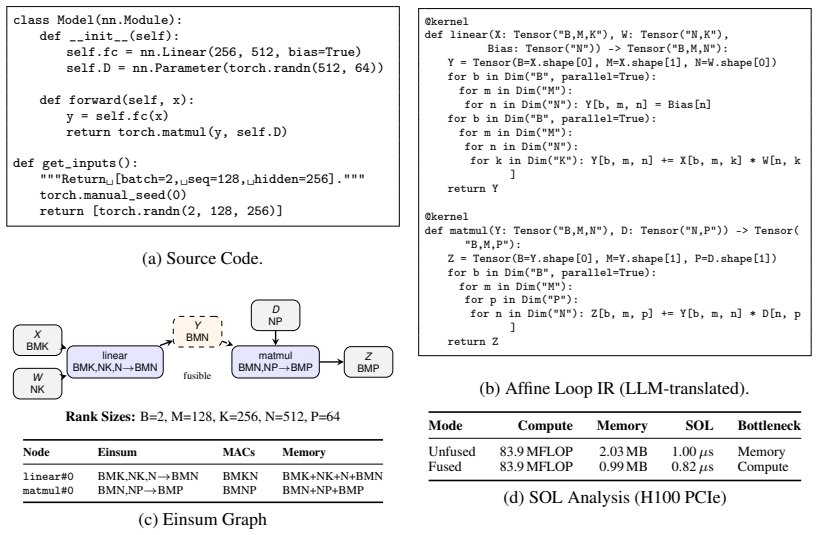
SOLAR derives validated SOL bounds from source code by translating it via an LLM frontend into an executable Affine Loop IR validated by output comparison, lifting the IR into an einsum graph, and applying an analytical backend to compute unfused, fused, and cache-aware bounds, yielding zero observed violations and enabling multi-fidelity tightening that surfaces optimization insights.
Load-bearing premise
The LLM frontend reliably translates arbitrary source programs into an executable intermediate representation whose semantics are preserved for subsequent bound calculation and validation by output comparison.
Editorial extensions
If this is right
- Headroom analysis at multiple fidelity levels becomes available directly from code without manual derivation.
- Optimization opportunities can be identified by observing how bounds tighten across fidelity levels.
- Cross-platform exploration of performance limits is supported through the same automated flow.
- Inverse-roofline hardware provisioning decisions can be informed by the computed bounds.
Reading between the lines
- Embedding the translation and bound steps into integrated development environments could provide immediate performance feedback while editing code.
- The multi-fidelity tightening process might be reused for other quantitative limits such as memory usage or energy consumption.
- If the translation component generalizes, similar automatic bound derivation could apply to workloads outside current deep learning code patterns.
Editorial analysis
A structured set of objections, weighed in public.
Referee Report
Summary. The manuscript introduces SOLAR, a framework for automatically deriving Speed-of-Light (SOL) performance bounds from PyTorch and JAX source code. It uses a generative LLM frontend to translate programs into an executable Affine Loop IR (validated via output comparison), followed by deterministic lifting to an einsum graph and an analytical backend that computes unfused, fused, and cache-aware SOL bounds. The work claims comprehensive operator/language coverage, zero observed SOL violations across evaluations on KernelBench, JAX/Flax models, and robotics workloads, and demonstrates four use cases: multi-fidelity headroom analysis, optimization opportunity identification, cross-platform exploration, and inverse-roofline hardware provisioning.
Significance. If the central claim holds, SOLAR would meaningfully advance the field by automating a process that is currently manual and disconnected from rapid model iteration, enabling routine integration of theoretical performance limits into ML development. The hybrid generative-deterministic architecture and explicit multi-fidelity tightening of bounds are practical strengths that could surface actionable optimization insights and support hardware-software co-design. The deterministic analytical backend and emphasis on validation are positive elements that, if substantiated, would strengthen reproducibility in performance analysis.
major comments (2)
- [Abstract] Abstract (validation description): The central claim of 'validated bounds with zero observed SOL violations' rests on output comparison for the LLM frontend, but this only establishes functional equivalence on sampled inputs and does not verify preservation of loop nests, data dependencies, or memory access patterns; any such mismatch would invalidate the subsequent analytical SOL bounds (unfused/fused/cache-aware) without necessarily triggering output mismatches.
- [Abstract] Abstract (LLM frontend): The weakest assumption—that the generative LLM produces an Affine Loop IR whose semantics exactly match the source for einsum-graph lifting and bound computation—is load-bearing, yet the manuscript provides no concrete error analysis, coverage metrics, or counterexample search beyond output comparison, leaving the reliability of the computed bounds unassessable from the given description.
Simulated Author's Rebuttal
We thank the referee for the careful review and for identifying the critical distinction between functional equivalence and structural preservation in the LLM frontend validation. The points raised are substantive and directly affect the strength of our claims regarding validated SOL bounds. We respond to each major comment below and will revise the manuscript accordingly.
read point-by-point responses
-
Referee: [Abstract] Abstract (validation description): The central claim of 'validated bounds with zero observed SOL violations' rests on output comparison for the LLM frontend, but this only establishes functional equivalence on sampled inputs and does not verify preservation of loop nests, data dependencies, or memory access patterns; any such mismatch would invalidate the subsequent analytical SOL bounds (unfused/fused/cache-aware) without necessarily triggering output mismatches.
Authors: We agree that output comparison on sampled inputs only confirms functional equivalence and does not guarantee preservation of loop nests, data dependencies, or memory access patterns. Any structural mismatch could invalidate the analytical SOL bounds without producing output discrepancies. This is a genuine limitation of the current validation approach described in the abstract. In the revised manuscript we will (1) qualify the validation claim in the abstract, (2) add a dedicated validation subsection that includes structural IR checks (loop-nest comparison and dependency-graph matching) on representative workloads, and (3) report the results of these additional checks. We will also discuss the residual risk to bound accuracy. revision: yes
-
Referee: [Abstract] Abstract (LLM frontend): The weakest assumption—that the generative LLM produces an Affine Loop IR whose semantics exactly match the source for einsum-graph lifting and bound computation—is load-bearing, yet the manuscript provides no concrete error analysis, coverage metrics, or counterexample search beyond output comparison, leaving the reliability of the computed bounds unassessable from the given description.
Authors: The manuscript does rely on the assumption that LLM-generated Affine Loop IR preserves the semantics needed for correct einsum-graph lifting and bound computation. The current description provides only output comparison and does not include error analysis, coverage metrics, or systematic counterexample search, making reliability difficult to assess. We accept this critique. The revision will add quantitative translation success rates, categorized error analysis from manual inspection of failures, and results from targeted counterexample searches. These additions will allow readers to evaluate the reliability of the computed bounds. revision: yes
Circularity Check
No circularity: analytical bounds derived from code via deterministic pipeline
full rationale
The paper describes a pipeline in which an LLM translates source to Affine Loop IR (validated only by output comparison on samples), a deterministic lift produces an einsum graph, and an analytical backend computes unfused/fused/cache-aware SOL bounds directly from that graph. No equations, parameters, or results are shown to be fitted to the target bounds or defined in terms of the bounds themselves. No self-citation chain is invoked as load-bearing justification for uniqueness or ansatz choices. The central claim therefore reduces to standard program analysis followed by closed-form roofline-style arithmetic rather than any self-referential construction.
Assumptions & free parameters
Cite this review
Pith. "Pith review of SOLAR: AI-Powered Speed-of-Light Performance Analysis." pith.science (2026). https://pith.science/paper/2CNMHRLP
@misc{pith2026260626383,
  author       = {Pith},
  title        = {Pith review of: SOLAR: AI-Powered Speed-of-Light Performance Analysis},
  year         = {2026},
  howpublished = {\url{https://pith.science/paper/2CNMHRLP}},
  note         = {Machine review of arXiv:2606.26383}
}
read the original abstract
How fast could a deep-learning model run on target hardware, and how far is today's implementation from that limit? These questions are central to software, hardware, and algorithm optimizations. Speed-of-Light (SOL) analysis answers them by computing a workload's theoretical minimum execution time on a given architecture. Yet deriving SOL bounds remains manual, error-prone, and disconnected from rapid model development. To close this gap, we introduce SOLAR, a framework that automatically derives validated SOL bounds from PyTorch and JAX source code. SOLAR leverages both generative and deterministic components in its flow: an LLM frontend translates any source programs into an executable Affine Loop IR, validated by output comparison; a deterministic flow lifts the IR into an einsum graph; and an analytical backend computes unfused, fused, and cache-aware SOL bounds. SOLAR provides comprehensive operator and language coverage, produces validated bounds with zero observed SOL violations, and offers multi-fidelity analysis that tightens bounds and surfaces optimization insights. We evaluate SOLAR across KernelBench, JAX/Flax models, and robotics workloads. These experiments demonstrate four use cases: headroom analysis at multiple fidelity levels, identifying optimization opportunities, cross-platform exploration, and inverse-roofline hardware provisioning.
Figures


Figures from the paper (8 more)


Reference graph
Works this paper leans on
-
[1]
Chen, Tianqi and Moreau, Thierry and Jiang, Ziheng and Zheng, Lianmin and Yan, Eddie and Cowan, Meghan and Shen, Haichen and Wang, Leyuan and Hu, Yuwei and Ceze, Luis and Guestrin, Carlos and Krishnamurthy, Arvind , booktitle = OSDI, year =
-
[2]
Evaluating Large Language Models Trained on Code
Evaluating Large Language Models Trained on Code , author =. arXiv preprint arXiv:2107.03374 , year =
-
[3]
Andrews, Martin and Witteveen, Sam , journal =
-
[4]
and Ermon, Stefano and Rudra, Atri and R
Dao, Tri and Fu, Daniel Y. and Ermon, Stefano and Rudra, Atri and R
-
[5]
arXiv preprint arXiv:2412.19437 , year =
-
[6]
The Meaning of Relativity , pages =
The General Theory of Relativity , author =. The Meaning of Relativity , pages =
-
[7]
Quantum , volume =
Hyper-Optimized Tensor Network Contraction , author =. Quantum , volume =
-
[8]
2026 , url =
Lin, Edward and Modi, Sahil and Hari, Siva Kumar Sastry and Huang, Qijing and Ye, Zhifan and Qin, Nestor and Zhou, Fengzhe and Zhang, Yuan and Wang, Jingquan and Damani, Sana and others , journal =. 2026 , url =
2026
Show all 59 references
-
[9]
IEEE Computer Architecture Letters , volume =
Cache-Aware Roofline Model: Upgrading the Loft , author =. IEEE Computer Architecture Letters , volume =
-
[10]
2025 , url =
Standardized Measurement Methodology for Kernel Benchmarking , author =. 2025 , url =
2025
-
[11]
Proceedings of the ACM on Programming Languages , volume =
The Tensor Algebra Compiler , author =. Proceedings of the ACM on Programming Languages , volume =
-
[12]
Li, Raymond and Ben Allal, Loubna and Zi, Yangtian and Muennighoff, Niklas and Kocetkov, Denis and Mou, Chenghao and Marone, Marc and Akiki, Christopher and Li, Jia and Chim, Jenny and others , journal =
-
[13]
Transformers are
Dao, Tri and Gu, Albert , booktitle = ICML, year =. Transformers are
-
[14]
Dissecting
Mei, Xinxin and Chu, Xiaowen , journal =. Dissecting
-
[15]
Nemotron-H: A Family of Hybrid
-
[16]
and Pellauer, Michael and Emer, Joel S
Odemuyiwa, Toluwanimi O. and Pellauer, Michael and Emer, Joel S. , journal =. The
-
[17]
Proceedings of the 51st Annual International Symposium on Computer Architecture (ISCA) , year =
Mind the Gap: Attainable Data Movement and Operational Intensity Bounds for Tensor Algorithms , author =. Proceedings of the 51st Annual International Symposium on Computer Architecture (ISCA) , year =
-
[18]
Andrulis, Tanner and Gilbert, Michael , title =
-
[19]
and Hu, William and R
Ouyang, Anne and Guo, Simon and Arora, Simran and Zhang, Alex L. and Hu, William and R. arXiv preprint arXiv:2502.10517 , year =
-
[20]
and Mukkara, Anurag and Venkatesan, Rangharajan and Khailany, Brucek and Keckler, Stephen W
Parashar, Angshuman and Raina, Priyanka and Shao, Yakun Sophia and Chen, Yu-Hsin and Ying, Victor A. and Mukkara, Anurag and Venkatesan, Rangharajan and Khailany, Brucek and Keckler, Stephen W. and Emer, Joel , booktitle = ISPASS, year =. Timeloop: A Systematic Approach to
-
[21]
Paleo: A Performance Model for Deep Neural Networks , author =
-
[22]
Reed, James and DeVito, Zachary and He, Horace and Ussery, Ansley and Ansel, Jason , booktitle = MLSys, year =
-
[23]
Peng, Bo and Alcaide, Eric and Anthony, Quentin and Albalak, Alon and Arcadinho, Samuel and Biderman, Stella and Cao, Huanqi and Cheng, Xin and Chung, Michael and others , booktitle =
-
[24]
and Gray, Johnnie , journal =
Smith, Daniel G.A. and Gray, Johnnie , journal =. opt\_einsum -- A
-
[25]
Design of a High-Performance
Springer, Paul and Bientinesi, Paolo , journal =. Design of a High-Performance
-
[26]
MAPL , year =
Triton: An Intermediate Language and Compiler for Tiled Neural Network Computations , author =. MAPL , year =
-
[27]
torchview: Visualize
-
[28]
Attention Is All You Need , author =
-
[29]
Benchmarking
Wang, Yu Emma and Wei, Gu-Yeon and Brooks, David , journal =. Benchmarking
-
[30]
Communications of the ACM , volume =
Roofline: An Insightful Visual Performance Model for Multicore Architectures , author =. Communications of the ACM , volume =
-
[31]
Xu, Bing and Chen, Terry and Zhou, Fengzhe and Chen, Tianqi and Jia, Yangqing and Grover, Vinod and Wu, Haicheng and Liu, Wei and Wittenbrink, Craig and Hwu, Wen-mei and Bringmann, Roger and Liu, Ming-Yu and Ceze, Luis and Lightstone, Michael and Shi, Humphrey , journal =
-
[32]
Hierarchical Roofline Analysis for
Yang, Charlene and Kurth, Thorsten and Williams, Samuel , journal =. Hierarchical Roofline Analysis for
-
[33]
USENIX ATC , year =
Habitat: A Runtime-Based Computational Performance Predictor for Deep Neural Network Training , author =. USENIX ATC , year =
-
[34]
Zhang, Li Lyna and Han, Shihao and Wei, Jianyu and Zheng, Ningxin and Cao, Ting and Yang, Yuqing and Liu, Yunxin , booktitle =. nn-
-
[35]
Zhu, Jiace and Chen, Wentao and Fan, Qi and Ren, Zhixing and Wu, Junying and Chai, Xing Zhe and Rungrueangwutthinon, Chotiwit and Ma, Yehan and Zou, An , journal =
-
[36]
Ding, Yuran and Chen, Xinwei and Zhang, Xiaofan and Zhou, Zongwei , journal =
-
[37]
Zaeed, Mohammad and Islam, Tanzima Z. and Ind. Opal: A Modular Framework for Optimizing Performance using Analytics and. arXiv preprint arXiv:2510.00932 , year =
-
[38]
arXiv preprint arXiv:2505.03988 , year =
Can Large Language Models Predict Parallel Code Performance? , author =. arXiv preprint arXiv:2505.03988 , year =
-
[39]
Yuan, Zhihang and others , journal =
-
[40]
ptflops: Flops Counter for
Sovrasov, Vladislav , howpublished =. ptflops: Flops Counter for
-
[41]
Dao, Tri , journal =
-
[42]
Ramanujam and P
Uday Bondhugula and Albert Hartono and J. Ramanujam and P. Sadayappan , title =. 2008 , doi =
2008
-
[43]
Tools and Algorithms for the Construction and Analysis of Systems (TACAS) , series =
Amir Pnueli and Michael Siegel and Eli Singerman , title =. Tools and Algorithms for the Construction and Analysis of Systems (TACAS) , series =. 1998 , publisher =
1998
-
[44]
Proceedings of the Fifth ACM SIGPLAN International Conference on Functional Programming (ICFP) , pages =
Koen Claessen and John Hughes , title =. Proceedings of the Fifth ACM SIGPLAN International Conference on Functional Programming (ICFP) , pages =. 2000 , doi =
2000
-
[45]
Competition-Level Code Generation with
Yujia Li and David Choi and Junyoung Chung and Nate Kushman and Julian Schrittwieser and R\'. Competition-Level Code Generation with. Science , volume =. 2022 , doi =
2022
-
[46]
Halide: A Language and Compiler for Optimizing Parallelism, Locality, and Recomputation in Image Processing Pipelines , booktitle = PLDI, pages =
Jonathan Ragan-Kelley and Connelly Barnes and Andrew Adams and Sylvain Paris and Fr\'. Halide: A Language and Compiler for Optimizing Parallelism, Locality, and Recomputation in Image Processing Pipelines , booktitle = PLDI, pages =. 2013 , doi =
2013
-
[47]
Noah Shinn and Federico Cassano and Ashwin Gopinath and Karthik Narasimhan and Shunyu Yao , title =
-
[48]
Necula , title =
George C. Necula , title =. 2000 , doi =
2000
-
[49]
Polyhedral Parallel Code Generation for
Sven Verdoolaege and Juan Carlos Juega and Albert Cohen and Jos. Polyhedral Parallel Code Generation for. 2013 , doi =
2013
-
[50]
Gonzalez and Ion Stoica , title =
Lianmin Zheng and Chengfan Jia and Minmin Sun and Zhao Wu and Cody Hao Yu and Ameer Haj-Ali and Yida Wang and Jun Yang and Danyang Zhuo and Koushik Sen and Joseph E. Gonzalez and Ion Stoica , title =
-
[51]
Unsupervised Translation of Programming Languages , booktitle = NIPS, year =
Baptiste Rozi. Unsupervised Translation of Programming Languages , booktitle = NIPS, year =
-
[52]
Teaching Large Language Models to Self-Debug , journal =
Xinyun Chen and Maxwell Lin and Nathanael Sch. Teaching Large Language Models to Self-Debug , journal =
-
[53]
Lin, Edward and Modi, Sahil and Hari, Siva Kumar Sastry and Huang, Qijing and Ye, Zhifan and Qin, Nestor and Zhou, Fengzhe and Zhang, Yuan and Wang, Jingquan and Damani, Sana and others , journal =
-
[54]
arXiv preprint arXiv:2406.01698 , year =
Abhimanyu Bambhaniya and Ritik Raj and Geonhwa Jeong and Souvik Kundu and Sudarshan Srinivasan and Suvinay Subramanian and Midhilesh Elavazhagan and Madhu Kumar and Tushar Krishna , title =. arXiv preprint arXiv:2406.01698 , year =
-
[55]
Jimenez and John Yang and Alexander Wettig and Shunyu Yao and Kexin Pei and Ofir Press and Karthik Narasimhan , journal =
Carlos E. Jimenez and John Yang and Alexander Wettig and Shunyu Yao and Kexin Pei and Ofir Press and Karthik Narasimhan , journal =
-
[56]
arXiv preprint arXiv:2108.07732 , year =
Program Synthesis with Large Language Models , author =. arXiv preprint arXiv:2108.07732 , year =
-
[57]
Naman Jain and King Han and Alex Gu and Wen-Ding Li and Fanjia Yan and Tianjun Zhang and Sida Wang and Armando Solar-Lezama and Koushik Sen and Ion Stoica , booktitle =
-
[58]
2020 , url =
Tyler Yep , title =. 2020 , url =
2020
-
[59]
arXiv preprint arXiv:2603.29010v1 , year =
Hari, Siva Kumar Sastry and Balaji, Vignesh and Damani, Sana and Huang, Qijing and Kozyrakis, Christos , title =. arXiv preprint arXiv:2603.29010v1 , year =
Reviewed June 26, 2026 · model on record in the stance chip above.
Discussion (0). Continue with ORCID to comment.