Compiler-Driven Approximation Tuning for Hyperdimensional Computing
Pith reviewed 2026-06-26 02:37 UTC · model grok-4.3
The pith
ApproxHDC automatically identifies and applies domain-specific approximations in hyperdimensional computing workloads to enable performance gains across CPUs, GPUs, and memory accelerators with minimal accuracy loss.
A machine-rendered reading of the paper's core claim, the machinery that carries it, and where it could break.
Core claim
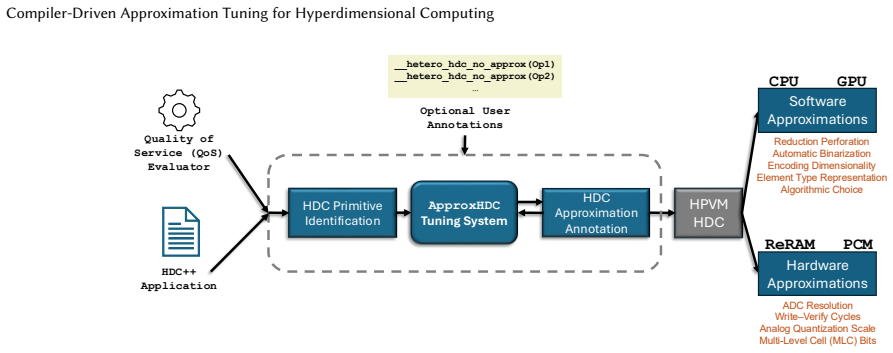
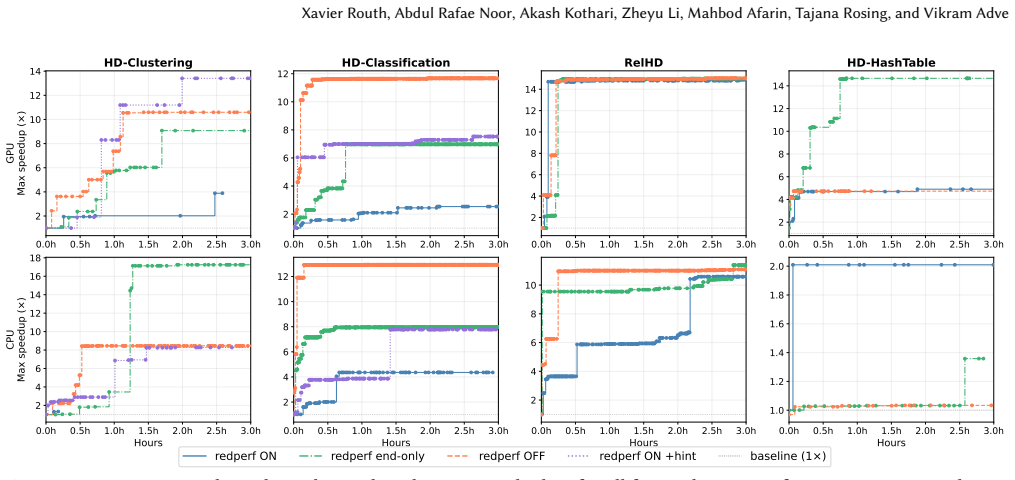
ApproxHDC extends the HPVM-HDC compiler infrastructure to enable automated identification and application of domain-specific approximations in HDC workloads. The framework supports retargetable compilation across diverse hardware backends, including CPUs, GPUs, and simulated ReRAM and PCM-based accelerators. It employs efficient search and analysis to navigate the exponentially large space of possible approximations and identify high-impact configurations spanning both software and hardware levels.
What carries the argument
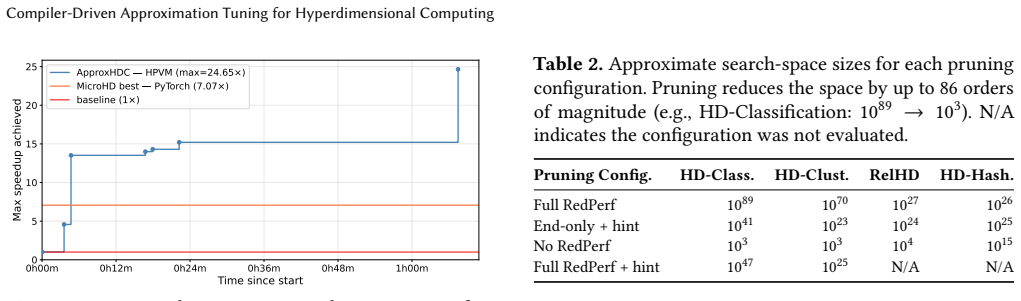
ApproxHDC's search and analysis engine, which navigates the exponential approximation space to locate high-impact configurations at software and hardware levels.
If this is right
- HDC workloads can be compiled once and executed efficiently on CPUs, GPUs, and simulated memory accelerators without manual approximation decisions.
- Performance gains become available at both software and hardware levels through a single automated pass.
- Retargeting to new backends such as ReRAM and PCM requires only backend-specific mapping rather than re-deriving approximations.
- The tolerance of HDC to approximation is turned into a systematic, compiler-driven optimization rather than an ad-hoc property.
Where Pith is reading between the lines
- The same automated navigation of approximation spaces could be tested on other noise-tolerant paradigms that map to heterogeneous hardware.
- If the search scales, it could lower the effort needed to port HDC algorithms to custom accelerators built from emerging memory technologies.
- Validation on physical rather than simulated ReRAM or PCM devices would directly test whether the identified configurations survive real device variation.
Load-bearing premise
Efficient search and analysis can navigate the exponentially large space of approximations to find configurations that deliver high performance impact with minimal accuracy loss.
What would settle it
Applying the configurations found by ApproxHDC to standard HDC benchmarks on the supported backends and measuring either negligible performance improvement or accuracy loss beyond the level tolerated by the target applications.
Figures

read the original abstract
As Moore's law reaches its physical and economic limits, domain-specific approaches are increasingly employed to accelerate machine learning workloads. Hyperdimensional Computing (HDC) represents one such emerging paradigm, offering an alternative to conventional deep learning techniques. Rooted in cognitive models of computation, HDC is designed bottom-up with hardware efficiency as a first-class objective. HDC workloads map naturally to heterogeneous hardware platforms, including CPUs, GPUs, and FPGAs, as well as emerging in-memory computing technologies such as Resistive RAM (ReRAM) and Phase-Change Memory (PCM). HDC algorithms are intrinsically tolerant to noise and approximation, enabling substantial performance gains with minimal accuracy loss. In this work, we introduce ApproxHDC, a framework for automated identification and application of domain-specific approximations in HDC workloads. ApproxHDC extends the HPVM-HDC compiler infrastructure to enable retargetable compilation across diverse hardware backends, including CPUs, GPUs, and simulated ReRAM and PCM-based accelerators. The space of possible approximations is exponentially large; ApproxHDC employs efficient search and analysis to navigate it and identify high-impact configurations spanning both software and hardware levels.
Editorial analysis
A structured set of objections, weighed in public.
Referee Report
Summary. The manuscript introduces ApproxHDC, a framework extending the HPVM-HDC compiler infrastructure for automated identification and application of domain-specific approximations in Hyperdimensional Computing (HDC) workloads. It supports retargetable compilation across CPUs, GPUs, and simulated ReRAM/PCM accelerators by using efficient search and analysis to navigate the exponentially large approximation space and identify high-impact configurations at software and hardware levels with minimal accuracy loss.
Significance. If the claims regarding tractable navigation of the approximation space hold, the work would be significant for approximate computing and domain-specific compilation. It could facilitate practical deployment of HDC on heterogeneous hardware by automating approximation tuning, leveraging HDC's noise tolerance for performance gains. The extension of an existing compiler infrastructure is a constructive approach toward retargetability.
major comments (1)
- [Abstract] Abstract: The central claim that ApproxHDC 'employs efficient search and analysis to navigate' the exponentially large space of approximations and 'identify high-impact configurations' is unsupported by any description of the search procedure (e.g., static analysis, heuristics, sampling), complexity argument, or empirical scaling data on search cost versus HDC dimension or number of sites. This is load-bearing for the practicality of the retargetable compilation benefit.
Simulated Author's Rebuttal
We thank the referee for the constructive review and for recognizing the potential significance of ApproxHDC for approximate computing and retargetable compilation. We address the single major comment below.
read point-by-point responses
-
Referee: [Abstract] Abstract: The central claim that ApproxHDC 'employs efficient search and analysis to navigate' the exponentially large space of approximations and 'identify high-impact configurations' is unsupported by any description of the search procedure (e.g., static analysis, heuristics, sampling), complexity argument, or empirical scaling data on search cost versus HDC dimension or number of sites. This is load-bearing for the practicality of the retargetable compilation benefit.
Authors: We agree that the abstract would be strengthened by briefly indicating the nature of the search procedure. The body of the manuscript (Section 4) describes a hybrid approach that first applies static dependency and sensitivity analysis to prune approximable sites, followed by a beam-search heuristic that uses lightweight profiling to rank configurations. Section 5.3 and Figure 8 present empirical scaling results showing search cost growing linearly with HDC dimension (up to D=10,000) and number of sites. We will revise the abstract to add a concise clause such as "via static sensitivity analysis and beam-search heuristics" so that the central claim is directly supported at the abstract level. revision: yes
Circularity Check
No circularity: framework introduction contains no derivations or self-referential reductions
full rationale
The paper introduces ApproxHDC as a new compiler framework extending HPVM-HDC, with claims about efficient search over approximation spaces. No equations, fitted parameters, predictions, or uniqueness theorems appear in the provided text. The central claims rest on the novelty of the framework itself rather than any reduction of outputs to inputs by construction or self-citation chains. This is the common case of a descriptive systems paper with no load-bearing mathematical steps to inspect for circularity.
Axiom & Free-Parameter Ledger
invented entities (1)
-
ApproxHDC framework
no independent evidence
Reference graph
Works this paper leans on
-
[1]
Jason Ansel, Shoaib Kamil, Kalyan Veeramachaneni, Jonathan Ragan- Kelley, Jeffrey Bosboom, Una-May O’Reilly, and Saman Amarasinghe
-
[2]
OpenTuner: an extensible framework for program autotuning. In Proceedings of the 23rd International Conference on Parallel Architectures and Compilation(Edmonton, AB, Canada)(PACT ’14). Association for Computing Machinery, New York, NY, USA, 303–316. doi:10.1145/ 2628071.2628092
-
[3]
Russel Arbore, Xavier Routh, Abdul Rafae Noor, Akash Kothari, Haichao Yang, Weihong Xu, Sumukh Pinge, Minxuan Zhou, Tajana Rosing, and Vikram Adve. 2025. HPVM-HDC: A Heterogeneous Pro- gramming System for Accelerating Hyperdimensional Computing. In Proceedings of the 52nd Annual International Symposium on Computer Architecture (ISCA ’25). Association for ...
-
[4]
Fatemeh Asgarinejad, Anthony Thomas, and Tajana Rosing. 2020. De- tection of epileptic seizures from surface eeg using hyperdimensional computing. In2020 42nd Annual International Conference of the IEEE Engineering in Medicine & Biology Society (EMBC). IEEE, 536–540
2020
-
[5]
Michael Carbin, Sasa Misailovic, and Martin C. Rinard. 2013. Ver- ifying quantitative reliability for programs that execute on unreli- able hardware. InProceedings of the 2013 ACM SIGPLAN Interna- tional Conference on Object Oriented Programming Systems Languages & Applications(Indianapolis, Indiana, USA)(OOPSLA ’13). As- sociation for Computing Machi...
-
[6]
En-Jui Chang, Abbas Rahimi, Luca Benini, and An-Yeu Andy Wu. 2019. Hyperdimensional computing-based multimodality emotion recogni- tion with physiological signals. In2019 IEEE International Conference on Artificial Intelligence Circuits and Systems (AICAS). IEEE, 137–141
2019
-
[7]
Ron Cole and Mark Fanty. 1994. ISOLET. UCI Machine Learning Repository. DOI: https://doi.org/10.24432/C51G69
-
[8]
Adel Ejjeh, Aaron Councilman, Akash Kothari, Maria Kotsifakou, Leon Medvinsky, Abdul Rafae Noor, Hashim Sharif, Yifan Zhao, Sarita Adve, Sasa Misailovic, et al. 2022. HPVM: Hardware-Agnostic Programming for Heterogeneous Parallel Systems.IEEE Micro42, 5 (2022), 108–117
2022
-
[9]
Keming Fan, Ashkan Moradifirouzabadi, Xiangjin Wu, Zheyu Li, Flavio Ponzina, Anton Persson, Eric Pop, Tajana Rosing, and Mingu Kang. 2024. SpecPCM: A Low-Power PCM-Based In-Memory Com- puting Accelerator for Full-Stack Mass Spectrometry Analysis.IEEE Journal on Exploratory Solid-State Computational Devices and Circuits 10 (2024), 161–169. doi:10.1109/JXCD...
-
[10]
Yunhui Guo, Mohsen Imani, Jaeyoung Kang, Sahand Salamat, Justin Morris, Baris Aksanli, Yeseong Kim, and Tajana Rosing. 2021. Hyper- rec: Efficient recommender systems with hyperdimensional comput- ing. InProceedings of the 26th Asia and South Pacific Design Automation Conference. 384–389
2021
-
[11]
Mike Heddes, Igor Nunes, Pere Vergés, Denis Kleyko, Danny Abraham, Tony Givargis, Alexandru Nicolau, and Alexander Veidenbaum. 2023. Torchhd: An Open Source Python Library to Support Research on Hyperdimensional Computing and Vector Symbolic Architectures. arXiv:2205.09208 [cs.LG]https://arxiv.org/abs/2205.09208
arXiv 2023
-
[12]
Mohsen Imani, Yeseong Kim, Thomas Worley, Saransh Gupta, and Tajana Rosing. 2019. HDCluster: An Accurate Clustering Using Brain- Inspired High-Dimensional Computing. In2019 Design, Automation & Test in Europe Conference & Exhibition (DATE). 1591–1594. doi:10. 23919/DATE.2019.8715147
arXiv 2019
-
[13]
Mohsen Imani, Deqian Kong, Abbas Rahimi, and Tajana Rosing. 2017. Voicehd: Hyperdimensional computing for efficient speech recogni- tion. In2017 IEEE international conference on rebooting computing (ICRC). IEEE, 1–8
2017
-
[14]
Pentti Kanerva. 2009. Hyperdimensional computing: An introduction to computing in distributed representation with high-dimensional random vectors.Cognitive computation1 (2009), 139–159
2009
-
[15]
Jaeyoung Kang, You Hak Lee, Minxuan Zhou, Weihong Xu, and Tajana Rosing. 2024. HygHD: Hyperdimensional Hypergraph Learning. In 2024 Design, Automation & Test in Europe Conference & Exhibition (DATE). 1–6. doi:10.23919/DATE58400.2024.10546871
-
[16]
Jaeyoung Kang, Minxuan Zhou, Abhinav Bhansali, Weihong Xu, An- thony Thomas, and Tajana Rosing. 2022. RelHD: A Graph-based Learning on FeFET with Hyperdimensional Computing. In2022 IEEE 40th International Conference on Computer Design (ICCD). 553–560. doi:10.1109/ICCD56317.2022.00087
-
[17]
Arman Kazemi, Franz Müller, Mohammad Mehdi Sharifi, Hamza Errahmouni, Gerald Gerlach, Thomas Kämpfe, Mohsen Imani, Xiaobo Sharon Hu, and Michael Niemier. 2022. Achieving software-equivalent accuracy for hyperdimensional computing with ferroelectric-based in-memory computing.Scientific reports12, 1 (2022), 19201. 12 Compiler-Driven Approximation Tuning for...
2022
-
[18]
Yeseong Kim, Mohsen Imani, Niema Moshiri, and Tajana Rosing. 2020. Geniehd: Efficient dna pattern matching accelerator using hyperdi- mensional computing. In2020 Design, Automation & Test in Europe Conference & Exhibition (DATE). IEEE, 115–120
2020
-
[19]
Rachkovskij, Evgeny Osipov, and Abbas Rahimi
Denis Kleyko, Dmitri A. Rachkovskij, Evgeny Osipov, and Abbas Rahimi. 2022. A Survey on Hyperdimensional Computing aka Vector Symbolic Architectures, Part I: Models and Data Transformations. ACM Comput. Surv.55, 6, Article 130 (Dec. 2022), 40 pages. doi:10. 1145/3538531
2022
-
[20]
Maria Kotsifakou, Prakalp Srivastava, Matthew D Sinclair, Rakesh Ko- muravelli, Vikram Adve, and Sarita Adve. 2018. Hpvm: Heterogeneous parallel virtual machine. InProceedings of the 23rd ACM SIGPLAN Sym- posium on Principles and Practice of Parallel Programming. 68–80
2018
-
[21]
Haitong Li, Wei-Chen Chen, Akash Levy, Ching-Hua Wang, Hongjie Wang, Po-Han Chen, Weier Wan, Win-San Khwa, Harry Chuang, Y.-D. Chih, Meng-Fan Chang, H.-S. Philip Wong, and Priyanka Raina. 2021. SAPIENS: A 64-kb RRAM-Based Non-Volatile Associative Memory for One-Shot Learning and Inference at the Edge.IEEE Transactions on Electron Devices68, 12 (2021), 663...
-
[22]
McCallum
A.K. McCallum. 2000. Automating the construction of internet portals with machine learning.Information Retrieval3 (01 2000), 127–163
2000
-
[23]
Anton Mitrokhin, P Sutor, Cornelia Fermüller, and Yiannis Aloimonos
-
[24]
Learning sensorimotor control with neuromorphic sensors: Toward hyperdimensional active perception.Science Robotics4, 30 (2019), eaaw6736
2019
-
[25]
Igor Nunes, Mike Heddes, Tony Givargis, Alexandru Nicolau, and Alex Veidenbaum. 2022. GraphHD: Efficient graph classification using hyperdimensional computing. In2022 Design, Automation & Test in Europe Conference & Exhibition (DATE). IEEE, 1485–1490
2022
-
[26]
Flavio Ponzina. 2024. MicroHD.https://github.com/flavio-ponzina/ MicroHD. Accessed: 2026-04-16
2024
-
[27]
Flavio Ponzina and Tajana Rosing. 2024. MicroHD: An Accuracy- Driven Optimization of Hyperdimensional Computing Algorithms for TinyML systems. arXiv:2404.00039 [cs.PF]https://arxiv.org/abs/2404. 00039
arXiv 2024
-
[28]
Abbas Rahimi, Simone Benatti, Pentti Kanerva, Luca Benini, and Jan M Rabaey. 2016. Hyperdimensional biosignal processing: A case study for EMG-based hand gesture recognition. In2016 IEEE International Conference on Rebooting Computing (ICRC). IEEE, 1–8
2016
-
[29]
Abbas Rahimi, Pentti Kanerva, and Jan M Rabaey. 2016. A robust and energy-efficient classifier using brain-inspired hyperdimensional computing. InProceedings of the 2016 international symposium on low power electronics and design. 64–69
2016
-
[30]
Adrian Sampson, Werner Dietl, Emily Fortuna, Danushen Gnanapra- gasam, Luis Ceze, and Dan Grossman. 2011. EnerJ: approximate data types for safe and general low-power computation.SIGPLAN Not.46, 6 (June 2011), 164–174. doi:10.1145/1993316.1993518
-
[31]
Adve, Sasa Misailovic, and Sarita Adve
Hashim Sharif, Prakalp Srivastava, Muhammad Huzaifa, Maria Kotsi- fakou, Keyur Joshi, Yasmin Sarita, Nathan Zhao, Vikram S. Adve, Sasa Misailovic, and Sarita Adve. 2019. ApproxHPVM: a portable compiler IR for accuracy-aware optimizations.Proc. ACM Program. Lang.3, OOPSLA, Article 186 (Oct. 2019), 30 pages. doi:10.1145/3360612
-
[32]
Adve, Sasa Misailovic, and Sarita Adve
Hashim Sharif, Yifan Zhao, Maria Kotsifakou, Akash Kothari, Ben Schreiber, Elizabeth Wang, Yasmin Sarita, Nathan Zhao, Keyur Joshi, Vikram S. Adve, Sasa Misailovic, and Sarita Adve. 2021. Approx- Tuner: a compiler and runtime system for adaptive approximations. InProceedings of the 26th ACM SIGPLAN Symposium on Principles and Practice of Parallel Programm...
-
[33]
Weihong Xu, Jaeyoung Kang, and Tajana Rosing. 2023. FSL-HD: Accelerating Few-Shot Learning on ReRAM using Hyperdimensional Computing. In2023 Design, Automation & Test in Europe Conference & Exhibition (DATE). 1–6. doi:10.23919/DATE56975.2023.10136901
-
[34]
Tinaqi Zhang, Sahand Salamat, Behnam Khaleghi, Justin Morris, Baris Aksanli, and Tajana Simunic Rosing. 2023. HD2FPGA: Automated Framework for Accelerating Hyperdimensional Computing on FPGAs. In2023 24th International Symposium on Quality Electronic Design (ISQED). 1–9. doi:10.1109/ISQED57927.2023.10129332
-
[35]
Zhuowen Zou, Hanning Chen, Prathyush Poduval, Yeseong Kim, Mahdi Imani, Elaheh Sadredini, Rosario Cammarota, and Mohsen Imani. 2022. BioHD: an efficient genome sequence search platform using HyperDimensional memorization. InProceedings of the 49th Annual International Symposium on Computer Architecture(New York, New York)(ISCA ’22). Association for Comput...
discussion (0)
Sign in with ORCID, Apple, or X to comment. Anyone can read and Pith papers without signing in.