Investigating the System Configuration of Kepler-451 through Orbital Period Variations: Dynamical and Magnetic Interpretations
Pith reviewed 2026-06-26 03:16 UTC · model grok-4.3
The pith
Modeling of eclipse timing variations supports a circumbinary planet at 3.4 AU around Kepler-451 as a second-generation body.
A machine-rendered reading of the paper's core claim, the machinery that carries it, and where it could break.
Core claim
By constructing updated O-C diagrams from ground- and space-based observations spanning 2004-2024 and testing various LTT configurations, the two-companion model provides the best fit for one dataset while the three-companion model does for the other. Applegate-mechanism tests indicate most signals exceed the energy budget, but outer terms may have magnetic origin. Removing magnetic terms yields dynamically stable configurations for at least 10^7 years. These findings support the presence of a second-generation circumbinary planet at 3.4 AU around Kepler-451, while the origin of the remaining LTT signals remains uncertain.
What carries the argument
Light-travel time (LTT) modeling of O-C eclipse timing variations combined with Applegate-mechanism energy budget tests to separate dynamical and magnetic contributions
If this is right
- The outer LTT terms are consistent with the Standard Applegate model and may have a magnetic origin.
- Removing the magnetic terms produces dynamically stable configurations for at least 10 million years.
- The inner companion in one dataset has a semi-amplitude below the systematic error, suggesting it may be due to observational systematics.
- The data support a second-generation circumbinary planet at 3.4 AU.
Where Pith is reading between the lines
- This suggests that planets can form or survive in binary systems after significant stellar evolution has occurred.
- Applying similar combined dynamical and magnetic analyses to other eclipsing binaries could clarify the prevalence of such companions.
- Longer-term observations might resolve whether the uncertain signals are real or artifacts by testing their persistence against magnetic cycle predictions.
Load-bearing premise
The observed O-C variations are produced by a combination of light-travel-time effects from companions and Applegate-mechanism magnetic activity, with no other unmodeled astrophysical or instrumental contributions of comparable size.
What would settle it
Continued monitoring over the next decade that shows the outer LTT signal amplitude or period at 3.4 AU deviates from the predicted planetary orbit or fails to remain stable against expected magnetic cycle changes.
Figures

read the original abstract
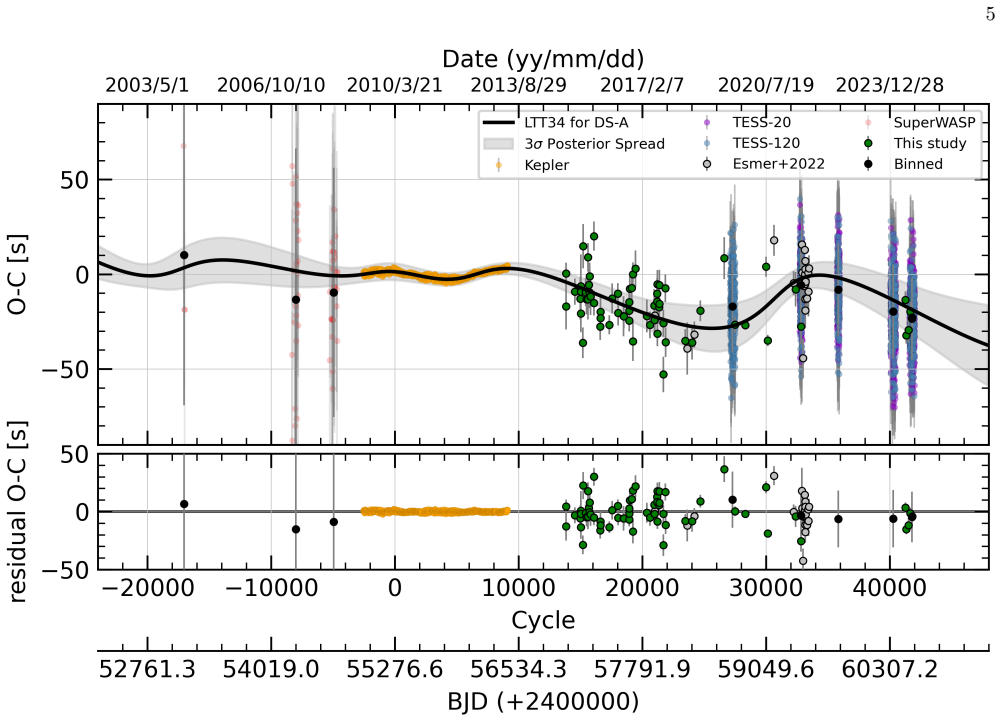
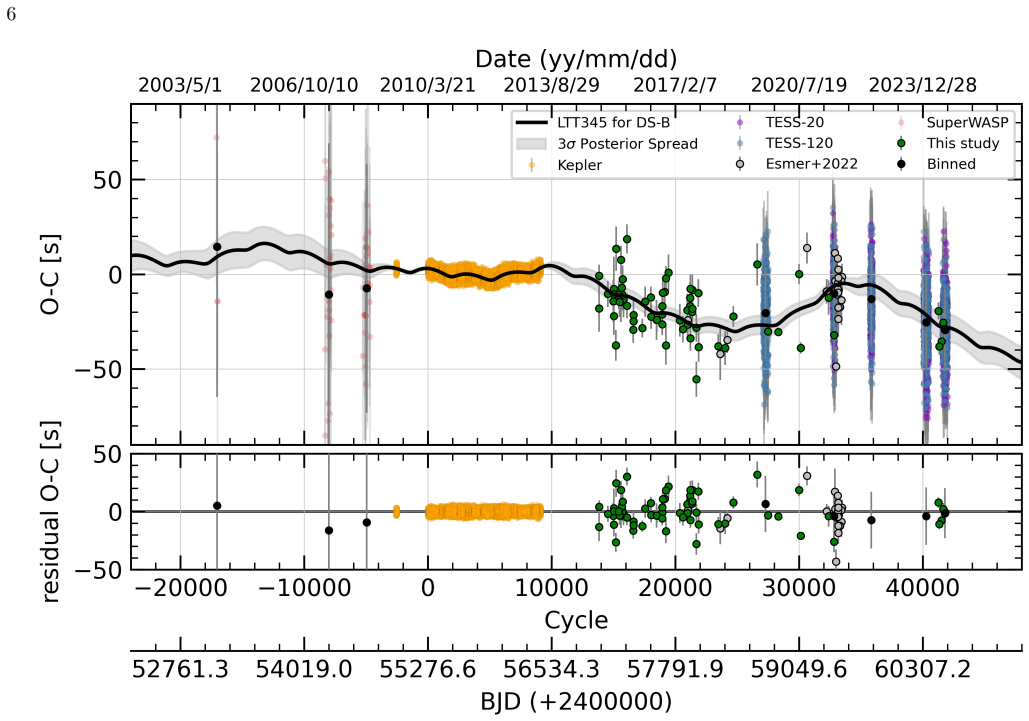
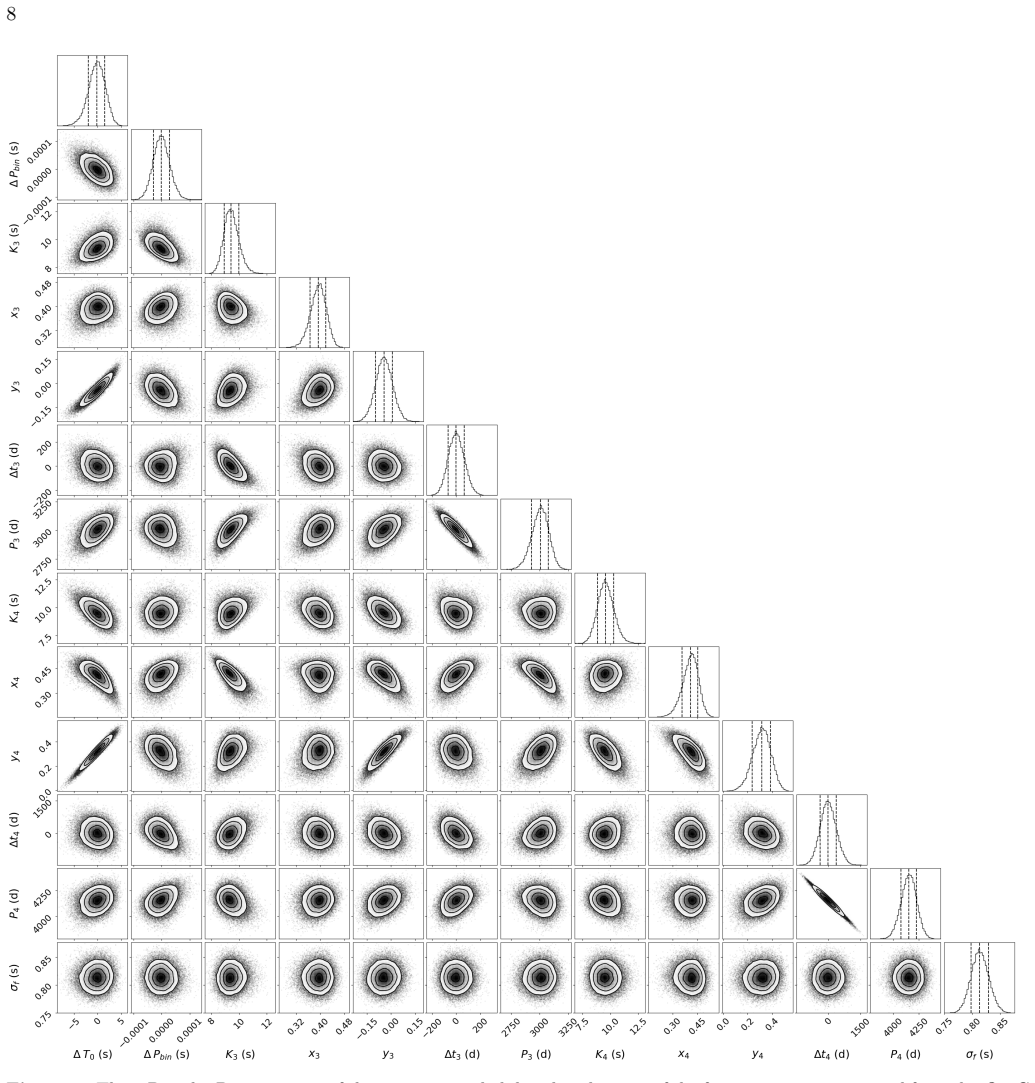
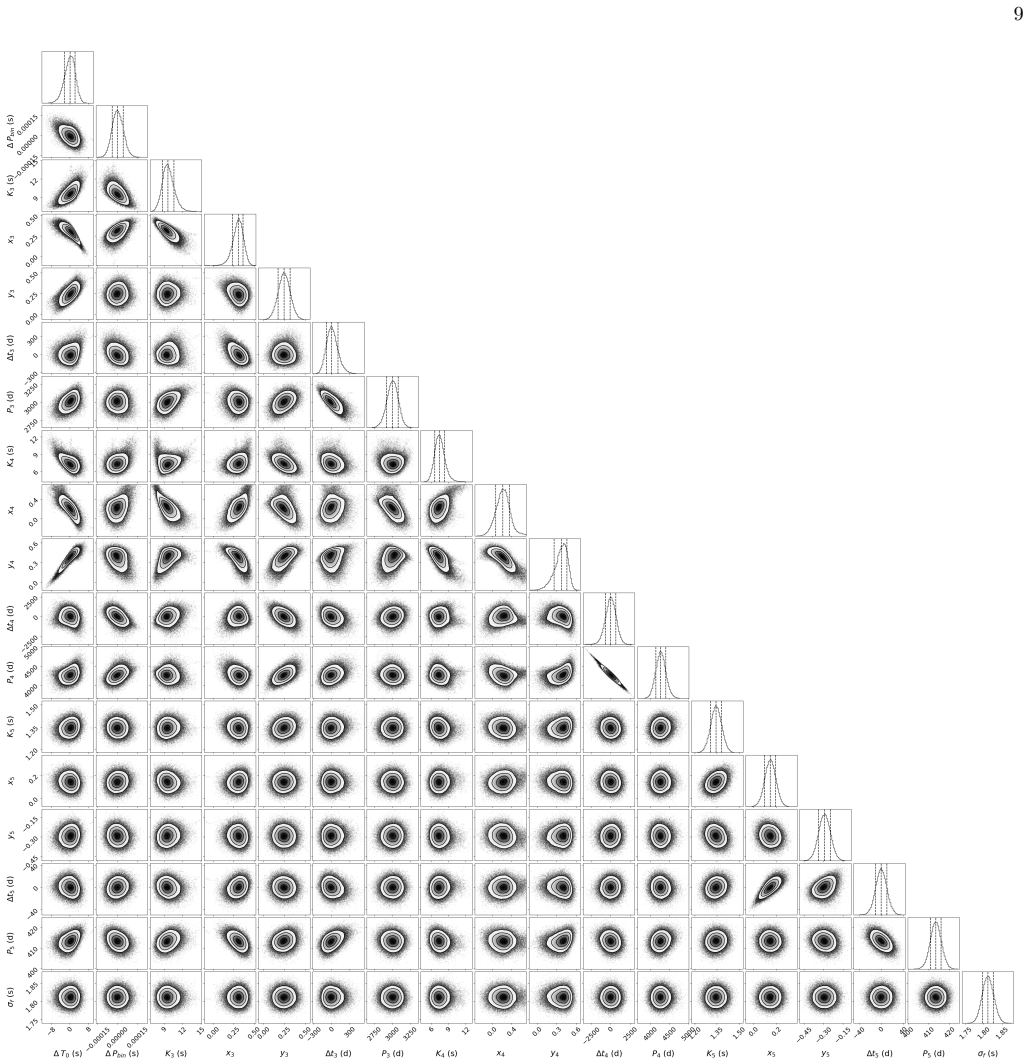
We present an analysis of eclipse timing variations in Kepler-451 using data spanning 2004-2024 from both ground- and space-based observations. Using two datasets, DS-A and DS-B, we constructed updated O-C diagrams. By modeling both datasets with various LTT configurations, we tested for the presence of circumbinary companions. For DS-A, the two-companion model (LTT34) provides the best fit with RMS = 3.23 s and chi^2_nu = 1.23, while inclusion a fifth body (LTT345) does not improve the fit (RMS = 3.24 s, chi^2_nu = 1.28). For DS-B, the three-companion model (LTT345) yields the best fit (RMS = 2.31 s, chi^2_nu = 1.01), although the semi-amplitude of the inner companion (1.34 s) is smaller than the systematic error (1.81 s), suggesting that it may originate from observational or calibration systematics. Applegate-mechanism tests indicate that most signals exceed the available energy budget, while the outer LTT terms in both datasets remain consistent with the Standard model and may have a magnetic origin. Removing these magnetic terms yields dynamically stable configurations for at least 10^7 yr. These findings support the presence of a second-generation circumbinary planet at 3.4 AU around Kepler-451, while the origin of the remaining LTT signals remains uncertain.
Editorial analysis
A structured set of objections, weighed in public.
Referee Report
Summary. The manuscript analyzes eclipse timing variations in Kepler-451 using two datasets (DS-A and DS-B) spanning 2004-2024 to construct O-C diagrams. It fits light-travel-time (LTT) models with two (LTT34) or three (LTT345) companions, selects models via RMS and reduced chi-squared, applies Applegate-mechanism energy-budget tests, and concludes that the results support a second-generation circumbinary planet at 3.4 AU while the origin of remaining LTT signals is uncertain.
Significance. If the LTT interpretation for the outer signal holds after addressing dataset inconsistencies, the result would add to the small sample of circumbinary planets and test second-generation formation scenarios in post-common-envelope binaries. The explicit comparison of LTT versus magnetic origins and the stability checks after removing magnetic terms are positive features, but the overall significance is tempered by the internal tensions in the model fits.
major comments (3)
- [Abstract] Abstract: The preference for the LTT345 model in DS-B rests on RMS = 2.31 s and chi^2_nu = 1.01, yet the inner companion semi-amplitude of 1.34 s lies below the stated 1.81 s systematic error. This directly undermines the claim that the three-companion configuration is physically preferred and tests the assumption that all O-C structure arises only from the reported LTT terms plus Applegate.
- [Abstract] Abstract (model comparison): DS-A prefers LTT34 (RMS 3.23 s, chi^2_nu 1.23) while DS-B prefers LTT345, producing a cross-dataset mismatch in the number of companions. This discrepancy indicates possible unmodeled dataset-specific systematics or astrophysical contributions of comparable amplitude, weakening the no-other-effects assumption required for the 3.4 AU planet claim.
- [Abstract] Abstract (Applegate tests): The energy-budget tests assign most signals to LTT but flag outer terms as possibly magnetic, after which stability is recovered. However, the same O-C data are used both to derive the companion parameters and to claim the planet, so the LTT interpretation for the 3.4 AU signal is defined by the fit itself rather than by an independent observable.
minor comments (1)
- The manuscript should clarify the exact construction of DS-A versus DS-B, including any differences in data reduction, weighting, or outlier rejection, to allow readers to assess whether the model-preference reversal is astrophysical or procedural.
Simulated Author's Rebuttal
We thank the referee for the constructive feedback on our manuscript. We address each major comment point by point below, clarifying our analysis choices and noting revisions where they strengthen the presentation without altering the core conclusions.
read point-by-point responses
-
Referee: [Abstract] Abstract: The preference for the LTT345 model in DS-B rests on RMS = 2.31 s and chi^2_nu = 1.01, yet the inner companion semi-amplitude of 1.34 s lies below the stated 1.81 s systematic error. This directly undermines the claim that the three-companion configuration is physically preferred and tests the assumption that all O-C structure arises only from the reported LTT terms plus Applegate.
Authors: We acknowledge the referee's point. The manuscript already states that the 1.34 s inner amplitude falls below the 1.81 s systematic error and may arise from systematics rather than an astrophysical companion. While the statistical metrics favor LTT345 for DS-B, this does not imply strong physical support for the inner term. The primary claim concerns the outer 3.4 AU companion, which remains robust across models. In revision we will explicitly state that the three-companion preference is statistical only and does not require a physical inner body, thereby weakening any assumption that all O-C structure is purely LTT plus Applegate. revision: partial
-
Referee: [Abstract] Abstract (model comparison): DS-A prefers LTT34 (RMS 3.23 s, chi^2_nu 1.23) while DS-B prefers LTT345, producing a cross-dataset mismatch in the number of companions. This discrepancy indicates possible unmodeled dataset-specific systematics or astrophysical contributions of comparable amplitude, weakening the no-other-effects assumption required for the 3.4 AU planet claim.
Authors: The cross-dataset difference in preferred model number is a valid concern and likely reflects differing systematic floors or sampling between DS-A and DS-B. The outer 3.4 AU signal, however, is recovered in both datasets with consistent period and amplitude. We will add a dedicated paragraph discussing possible dataset-specific contributions and will qualify the planet interpretation as relying on the consistent outer term rather than on an identical companion count across datasets. revision: yes
-
Referee: [Abstract] Abstract (Applegate tests): The energy-budget tests assign most signals to LTT but flag outer terms as possibly magnetic, after which stability is recovered. However, the same O-C data are used both to derive the companion parameters and to claim the planet, so the LTT interpretation for the 3.4 AU signal is defined by the fit itself rather than by an independent observable.
Authors: This circularity is inherent to all LTT-based companion detections. Our defense rests on the additional physical filters applied: the Applegate energy-budget test to separate magnetic from dynamical contributions, followed by N-body stability runs on the residual LTT terms. After removing the outer terms flagged as possibly magnetic, the remaining configuration (including the 3.4 AU body) remains stable for 10^7 yr. We will expand the discussion to make this methodological limitation and the supporting tests more explicit. revision: partial
Circularity Check
No significant circularity; standard model fitting to timing data
full rationale
The paper constructs O-C diagrams from 2004-2024 ground- and space-based eclipse timings, then fits families of LTT models (LTT34, LTT345) to each dataset (DS-A, DS-B) and selects the minimum-RMS / minimum-chi^2_nu solution. Companion periods, amplitudes and derived masses/a are obtained directly from those least-squares fits; the 3.4 AU claim follows from the orbital period of the outer LTT term via Kepler's law. This is ordinary parameter estimation: the model is adjusted to the same data used to evaluate its quality. No equation is defined in terms of its own output, no fitted quantity is relabeled as an independent prediction, and no load-bearing premise rests on a self-citation. The derivation chain is therefore self-contained against the supplied timing measurements and does not reduce to itself by construction.
Axiom & Free-Parameter Ledger
free parameters (2)
- LTT semi-amplitudes and periods for companions
- Number of companions (2 or 3)
axioms (2)
- domain assumption O-C variations arise only from LTT or Applegate mechanism
- domain assumption Applegate energy budget can be computed from stellar parameters alone
invented entities (1)
-
circumbinary planet at 3.4 AU
no independent evidence
Reference graph
Works this paper leans on
-
[1]
Applegate, J. H. 1992, ApJ, 385, 621, doi: 10.1086/170967
-
[2]
Baran, A. S., & Silvotti, R. 2020, Research Notes of the American Astronomical Society, 4, 237, doi: 10.3847/2515-5172/abd31a
-
[3]
2015, A&A, 577, A146, doi: 10.1051/0004-6361/201425392
Silvotti, R. 2015, A&A, 577, A146, doi: 10.1051/0004-6361/201425392
-
[4]
Barlow, B. N., Wade, R. A., & Liss, S. E. 2012, ApJ, 753, 101, doi: 10.1088/0004-637X/753/2/101
-
[5]
Beuermann, K., Dreizler, S., Hessman, F. V., & Deller, J. 2012a, A&A, 543, A138, doi: 10.1051/0004-6361/201219391
-
[6]
Beuermann, K., Hessman, F. V., Dreizler, S., et al. 2010, A&A, 521, L60, doi: 10.1051/0004-6361/201015472
-
[7]
2012b, A&A, 540, A8, doi: 10.1051/0004-6361/201118105
Beuermann, K., Breitenstein, P., Debski, B., et al. 2012b, A&A, 540, A8, doi: 10.1051/0004-6361/201118105
-
[8]
2019, A&A, 631, A155, doi: 10.1051/0004-6361/201935251
Beuzit, J. L., Vigan, A., Mouillet, D., et al. 2019, A&A, 631, A155, doi: 10.1051/0004-6361/201935251
-
[9]
Brown-Sevilla, S. B., Nascimbeni, V., Borsato, L., et al. 2021, MNRAS, 506, 2122, doi: 10.1093/mnras/stab1843
-
[10]
Cincotta, P. M., & Sim´ o, C. 2000, A&AS, 147, 205, doi: 10.1051/aas:2000108
-
[11]
Cuello, N., & Giuppone, C. A. 2019, A&A, 628, A119, doi: 10.1051/0004-6361/201833976
-
[12]
Eastman, J., Siverd, R., & Gaudi, B. S. 2010, PASP, 122, 935, doi: 10.1086/655938
-
[13]
2025, NewA, 119, 102414, doi: 10.1016/j.newast.2025.102414
Er, H. 2025, NewA, 119, 102414, doi: 10.1016/j.newast.2025.102414
-
[14]
2025, Advances in Space Research, 76, 1204, doi: 10.1016/j.asr.2025.05.009
Nasiroglu, I. 2025, Advances in Space Research, 76, 1204, doi: 10.1016/j.asr.2025.05.009
-
[15]
2021, MNRAS, 507, 809, doi: 10.1093/mnras/stab2054
Er, H., ¨Ozd¨ onmez, A., & Nasiroglu, I. 2021, MNRAS, 507, 809, doi: 10.1093/mnras/stab2054
-
[16]
Er, H., ¨Ozd¨ onmez, A., Nasiroglu, I., & Kenger, M. E. 2024, PASA, 41, e047, doi: 10.1017/pasa.2024.50
-
[17]
Esmer, E. M., Ba¸ st¨ urk,¨O., Selam, S. O., & Ali¸ s, S. 2022, MNRAS, 511, 5207, doi: 10.1093/mnras/stac357
-
[18]
2016, The Journal of Open Source Software, 1, 24, doi: 10.21105/joss.00024 18O’Connor et al
Foreman-Mackey, D. 2016, The Journal of Open Source Software, 1, 24, doi: 10.21105/joss.00024
-
[19]
Foreman-Mackey, D., Hogg, D. W., Lang, D., & Goodman, J. 2013, PASP, 125, 306, doi: 10.1086/670067
-
[20]
1993, Icarus, 106, 247, doi: 10.1006/icar.1993.1169
Gladman, B. 1993, Icarus, 106, 247, doi: 10.1006/icar.1993.1169
-
[21]
Communications in Applied Mathematics and Computational Science, Vol
Goodman, J., & Weare, J. 2010, Communications in Applied Mathematics and Computational Science, 5, 65, doi: 10.2140/camcos.2010.5.65 Go´ zdziewski, K., Bois, E., Maciejewski, A. J., &
-
[22]
Kiseleva-Eggleton, L. 2001, A&A, 378, 569, doi: 10.1051/0004-6361:20011189 Go´ zdziewski, K., Nasiroglu, I., S lowikowska, A., et al. 2012, MNRAS, 425, 930, doi: 10.1111/j.1365-2966.2012.21341.x Go´ zdziewski, K., S lowikowska, A., Dimitrov, D., et al. 2015, MNRAS, 448, 1118, doi: 10.1093/mnras/stu2728
-
[23]
Hardy, A., Schreiber, M. R., Parsons, S. G., et al. 2015, ApJL, 800, L24, doi: 10.1088/2041-8205/800/2/L24
-
[24]
Hardy, A., Schreiber, M. R., Parsons, S. G., et al. 2016, MNRAS, 459, 4518, doi: 10.1093/mnras/stw976 14
-
[25]
2009, ARA&A, 47, 211, doi: 10.1146/annurev-astro-082708-101836
Heber, U. 2009, ARA&A, 47, 211, doi: 10.1146/annurev-astro-082708-101836
-
[26]
2016, PASP, 128, 082001, doi: 10.1088/1538-3873/128/966/082001
Heber, U. 2016, PASP, 128, 082001, doi: 10.1088/1538-3873/128/966/082001
-
[27]
Hill, G. W. 1879, MNRAS, 39, 258, doi: 10.1093/mnras/39.4.258
-
[28]
Holman, M. J., & Wiegert, P. A. 1999, AJ, 117, 621, doi: 10.1086/300695
-
[29]
Horner, J., Hinse, T. C., Wittenmyer, R. A., Marshall, J. P., & Tinney, C. G. 2012, MNRAS, 427, 2812, doi: 10.1111/j.1365-2966.2012.22046.x
-
[30]
2020, A&A, 642, A105, doi: 10.1051/0004-6361/202038121
Krzesinski, J., Blokesz, A., Siwak, M., & Stachowski, G. 2020, A&A, 642, A105, doi: 10.1051/0004-6361/202038121
-
[31]
Lanza, A. F. 2020, MNRAS, 491, 1820, doi: 10.1093/mnras/stz3135
-
[32]
Lanza, A. F., Rodono, M., & Rosner, R. 1998, MNRAS, 296, 893, doi: 10.1046/j.1365-8711.1998.01446.x
-
[33]
Lee, J. W., Hinse, T. C., Youn, J.-H., & Han, W. 2014, MNRAS, 445, 2331, doi: 10.1093/mnras/stu1937
-
[34]
, archivePrefix = "arXiv", eprint =
Lee, J. W., Kim, S.-L., Kim, C.-H., et al. 2009, AJ, 137, 3181, doi: 10.1088/0004-6256/137/2/3181 Lightkurve Collaboration, Cardoso, J. V. d. M., Hedges, C., et al. 2018, Astrophysics Source Code Library
-
[35]
Lohr, M. E., Norton, A. J., Anderson, D. R., et al. 2014, A&A, 566, A128, doi: 10.1051/0004-6361/201424027
-
[36]
Macintosh, B., Graham, J. R., Ingraham, P., et al. 2014, Proceedings of the National Academy of Science, 111, 12661, doi: 10.1073/pnas.1304215111
-
[37]
Martin, D. V., Triaud, A. H. M. J., Udry, S., et al. 2019, A&A, 624, A68, doi: 10.1051/0004-6361/201833669
-
[38]
2010, in Society of Photo-Optical Instrumentation Engineers (SPIE) Conference Series, Vol
Minowa, Y., Hayano, Y., Oya, S., et al. 2010, in Society of Photo-Optical Instrumentation Engineers (SPIE) Conference Series, Vol. 7736, Adaptive Optics Systems II, ed. B. L. Ellerbroek, M. Hart, N. Hubin, & P. L. Wizinowich, 77363N, doi: 10.1117/12.857818
-
[39]
2017, AJ, 153, 137, doi: 10.3847/1538-3881/aa5d10
Nasiroglu, I., Go´ zdziewski, K., S lowikowska, A., et al. 2017, AJ, 153, 137, doi: 10.3847/1538-3881/aa5d10
-
[40]
2018, A&A, 615, A81, doi: 10.1051/0004-6361/201732425
Fuentealba, J., & V¨ olschow, M. 2018, A&A, 615, A81, doi: 10.1051/0004-6361/201732425
-
[41]
Nordhaus, J., & Spiegel, D. S. 2013, MNRAS, 432, 500, doi: 10.1093/mnras/stt569
-
[42]
Burrows, A. 2010, MNRAS, 408, 631, doi: 10.1111/j.1365-2966.2010.17155.x Østensen, R. H., Green, E. M., Bloemen, S., et al. 2010, MNRAS, 408, L51, doi: 10.1111/j.1745-3933.2010.00926.x ¨Ozd¨ onmez, A., Er, H., & Nasiroglu, I. 2023, MNRAS, 526, 4725, doi: 10.1093/mnras/stad3086
-
[43]
1976, in IAU Symposium, Vol
Paczynski, B. 1976, in IAU Symposium, Vol. 73, Structure and Evolution of Close Binary Systems, ed. P. Eggleton, S. Mitton, & J. Whelan, 75
1976
-
[44]
2015, ApJ, 807, 44, doi: 10.1088/0004-637X/807/1/44
Pu, B., & Wu, Y. 2015, ApJ, 807, 44, doi: 10.1088/0004-637X/807/1/44
-
[45]
2018, A&A, 611, A48, doi: 10.1051/0004-6361/201731125
Harrach, S. 2018, A&A, 611, A48, doi: 10.1051/0004-6361/201731125
-
[46]
D., Mallett, J., & von Harrach, S
Pulley, D., Sharp, I. D., Mallett, J., & von Harrach, S. 2022, MNRAS, 514, 5725, doi: 10.1093/mnras/stac1676
-
[47]
Puschmann, K. G., & Kneer, F. 2005, A&A, 436, 373, doi: 10.1051/0004-6361:20042320
-
[48]
Qian, S. B., Dai, Z. B., Liao, W. P., et al. 2009a, ApJL, 706, L96, doi: 10.1088/0004-637X/706/1/L96
-
[49]
Qian, S. B., Zhu, L. Y., Dai, Z. B., et al. 2012, ApJL, 745, L23, doi: 10.1088/2041-8205/745/2/L23
-
[50]
, archivePrefix = "arXiv", eprint =
Qian, S. B., Zhu, L. Y., Zola, S., et al. 2009b, ApJL, 695, L163, doi: 10.1088/0004-637X/695/2/L163
-
[51]
Qian, S. B., Zhu, L. Y., Liu, L., et al. 2010, Ap&SS, 329, 113, doi: 10.1007/s10509-010-0290-5
-
[52]
Rein, H. 2012, arXiv e-prints, arXiv:1211.7121, doi: 10.48550/arXiv.1211.7121
work page internal anchor Pith review Pith/arXiv arXiv doi:10.48550/arxiv.1211.7121 2012
-
[53]
Rein, H., & Liu, S. F. 2012, A&A, 537, A128, doi: 10.1051/0004-6361/201118085
work page internal anchor Pith review doi:10.1051/0004-6361/201118085 2012
-
[54]
2015, MNRAS, 452, 376, doi: 10.1093/mnras/stv1257
Rein, H., & Tamayo, D. 2015, MNRAS, 452, 376, doi: 10.1093/mnras/stv1257
-
[55]
Ricker, G. R., Winn, J. N., Vanderspek, R., et al. 2015, Journal of Astronomical Telescopes, Instruments, and Systems, 1, 014003, doi: 10.1117/1.JATIS.1.1.014003
work page internal anchor Pith review doi:10.1117/1.jatis.1.1.014003 2015
-
[56]
Tian, Y. P., Xiang, F. Y., & Tao, X. 2009, Ap&SS, 319, 119, doi: 10.1007/s10509-008-9975-4 Van Grootel, V., Pozuelos, F. J., Thuillier, A., et al. 2021, A&A, 650, A205, doi: 10.1051/0004-6361/202140381
-
[57]
2016, Royal Society Open Science, 3, 150571, doi: 10.1098/rsos.150571 V¨ olschow, M., Schleicher, D
Veras, D. 2016, Royal Society Open Science, 3, 150571, doi: 10.1098/rsos.150571 V¨ olschow, M., Schleicher, D. R. G., Perdelwitz, V., &
-
[58]
2016, A&A, 587, A34, doi: 10.1051/0004-6361/201527333
Banerjee, R. 2016, A&A, 587, A34, doi: 10.1051/0004-6361/201527333
-
[59]
Webbink, R. F. 1984, ApJ, 277, 355, doi: 10.1086/161701
-
[60]
Wizinowich, P., Acton, D. S., Shelton, C., et al. 2000, PASP, 112, 315, doi: 10.1086/316543
-
[61]
Wright, J. T. 2005, PASP, 117, 657, doi: 10.1086/430369
-
[62]
Zorotovic, M., & Schreiber, M. R. 2013, A&A, 549, A95, doi: 10.1051/0004-6361/201220321
-
[63]
Zorotovic, M., Schreiber, M. R., G¨ ansicke, B. T., & Nebot G´ omez-Mor´ an, A. 2010, A&A, 520, A86, doi: 10.1051/0004-6361/200913658
discussion (0)
Sign in with ORCID, Apple, or X to comment. Anyone can read and Pith papers without signing in.