Too shy to spin? Cosmic wallflowers as proto-globular clusters
Pith reviewed 2026-06-29 02:07 UTC · model grok-4.3
The pith
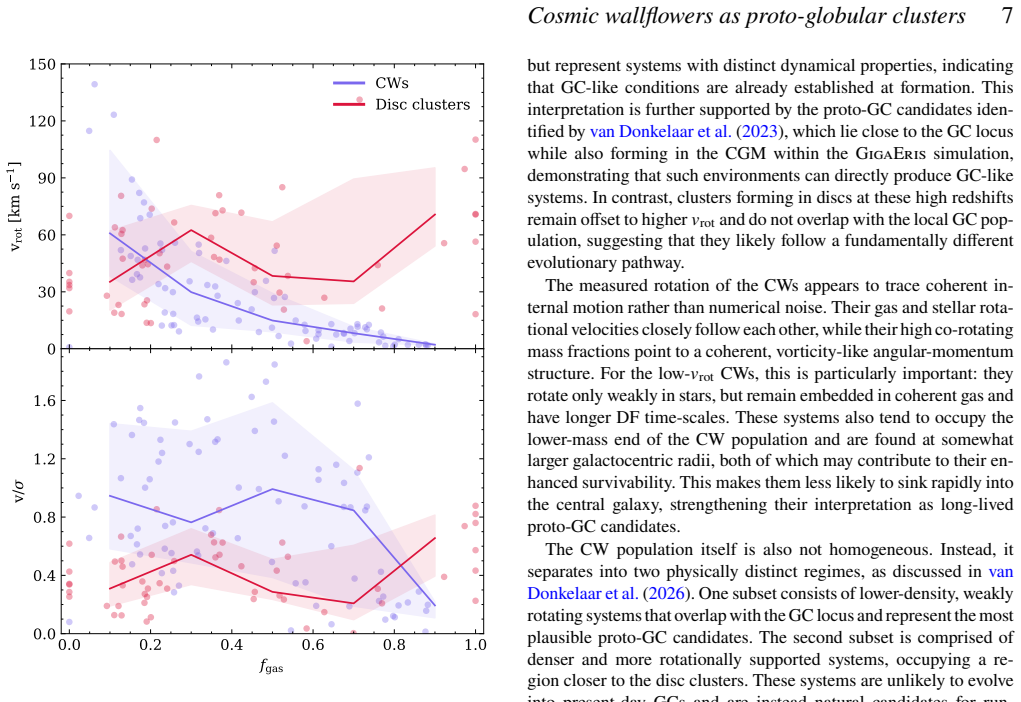
Weakly rotating gas-rich cosmic wallflowers at z~7.6 overlap with Milky Way globular cluster properties while disc clusters do not.
A machine-rendered reading of the paper's core claim, the machinery that carries it, and where it could break.
Core claim
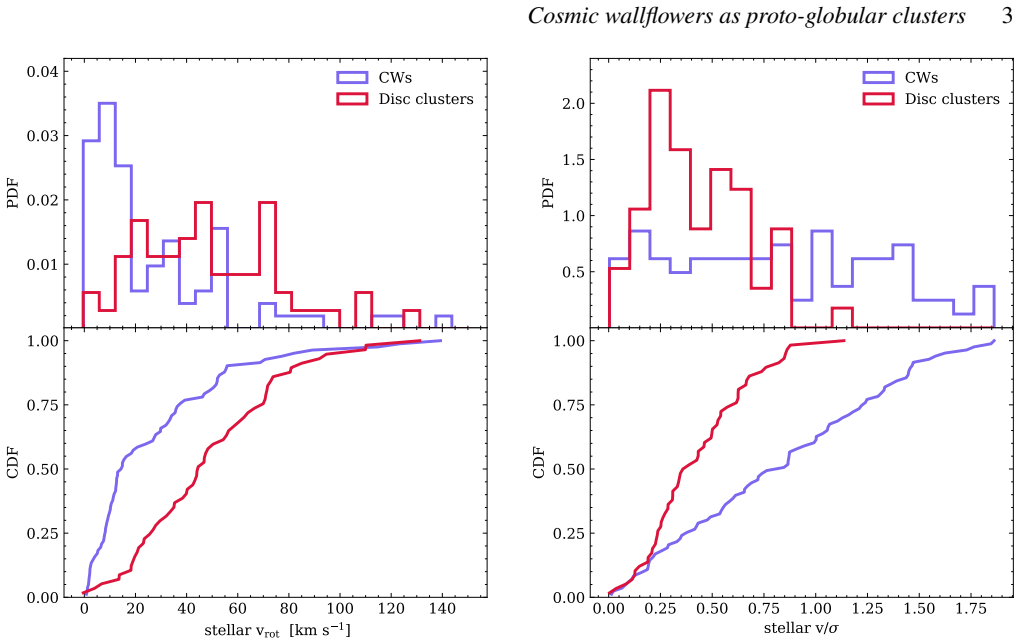
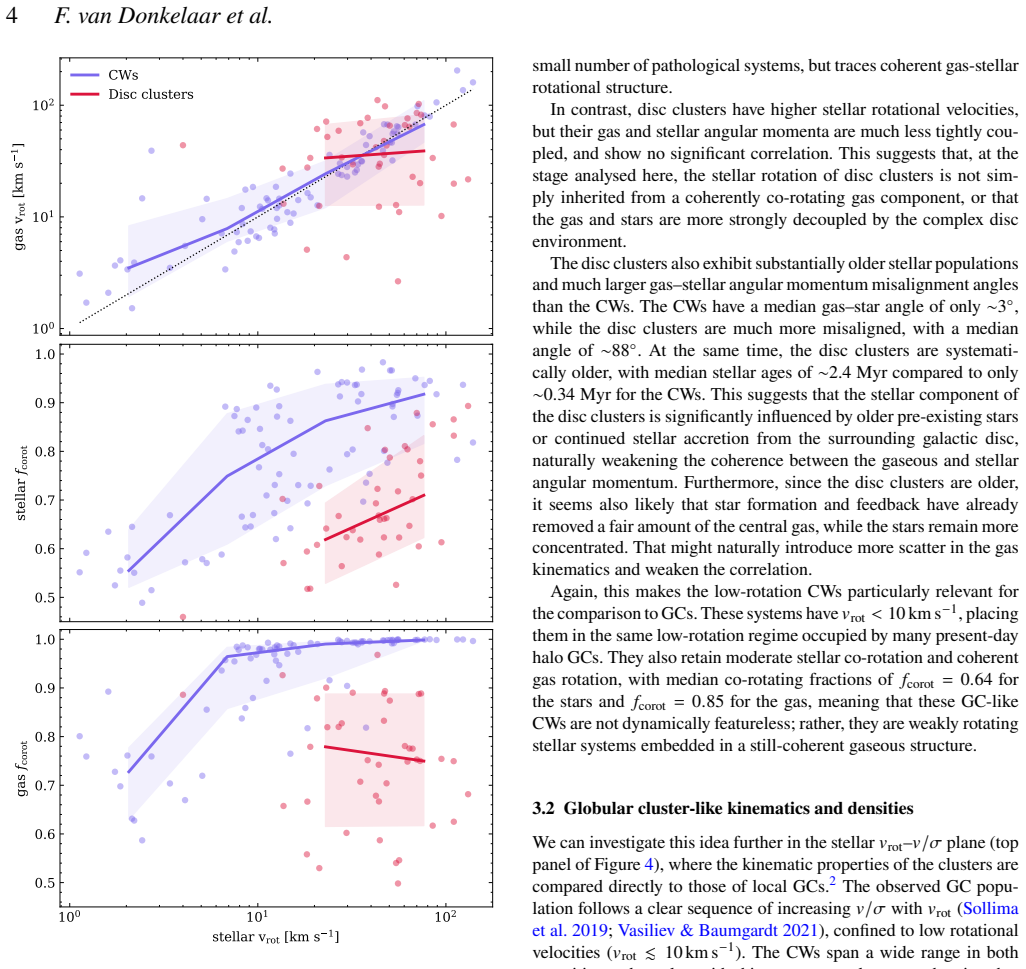
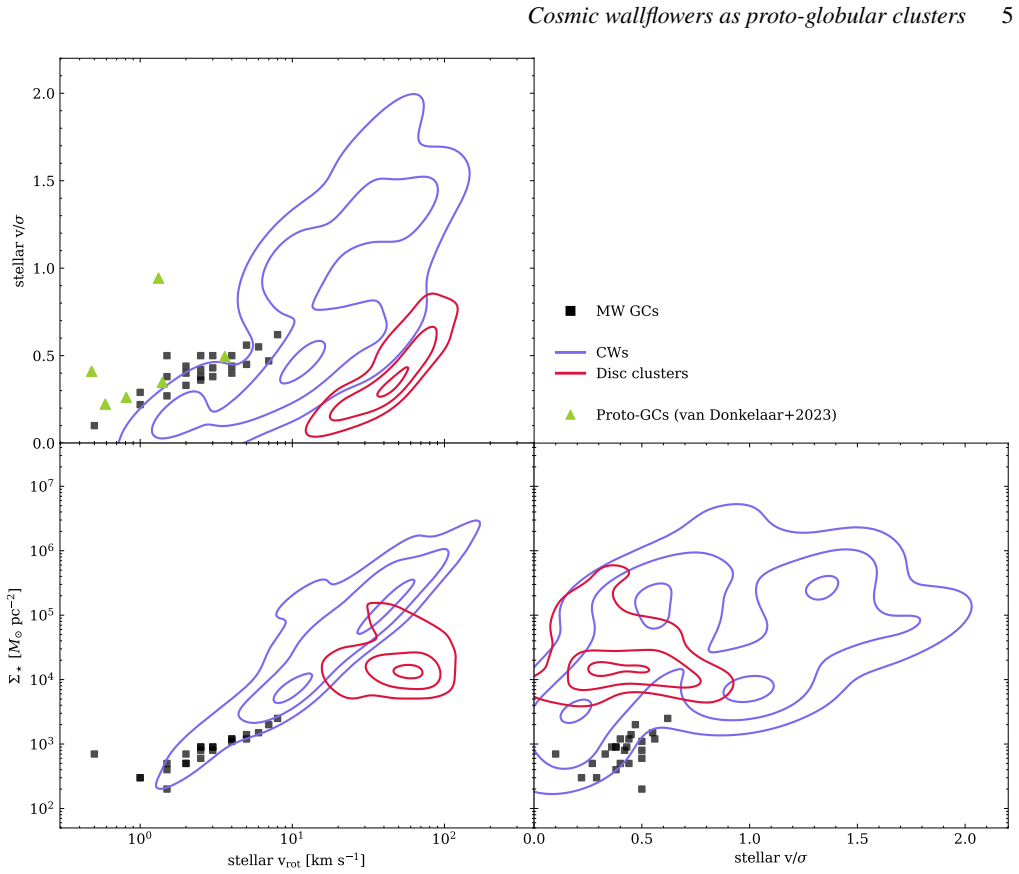
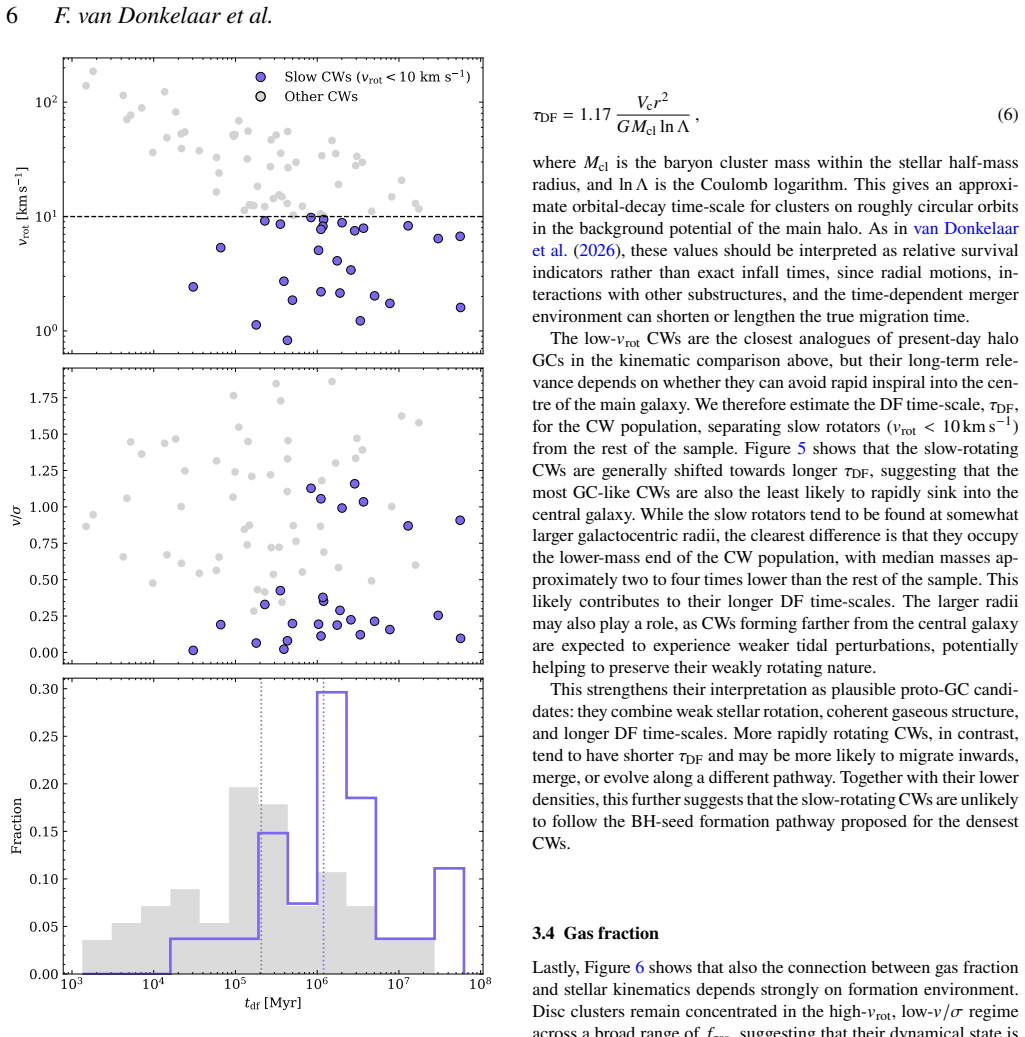
At z ~ 7.6, cosmic wallflowers born from filaments exhibit systematically lower rotational velocities and a broad range in v/σ compared with strongly rotation-dominated disc clusters formed via gravitational instability; when combined with stellar surface density, a gas-rich low-rotation subset of wallflowers lies close to the Milky Way globular cluster population while disc clusters remain offset, indicating that environment imprints on initial conditions and that weakly rotating wallflowers may evolve into present-day systems via angular momentum loss and dynamical heating.
What carries the argument
Separation of clusters into disc (gravitational instability) and cosmic wallflower (filament-born) channels, quantified through stellar rotational velocity v_rot and rotational support v/σ together with surface density.
If this is right
- Formation environment and baryonic gas content together determine the initial dynamical state of high-redshift clusters.
- Gas-rich wallflowers preferentially occupy the low-rotation regime that overlaps globular cluster properties.
- Denser, more rotationally supported wallflowers may follow a separate path possibly connected to massive black hole seed formation.
- Angular momentum loss and dynamical heating provide a plausible route for wallflowers to reach present-day globular cluster configurations.
Where Pith is reading between the lines
- A non-negligible fraction of today's globular clusters may have originated in isolation outside galactic discs.
- High-redshift kinematic surveys could directly test whether the observed rotation separation persists in real clusters.
- The distinction raises the question of how filamentary versus disc environments affect the long-term survival and structural evolution of dense stellar systems.
Load-bearing premise
The assumption that differences in rotation and density measured at z~7.6 between the two types will map directly onto present-day globular cluster properties without requiring detailed modeling of later dynamical evolution.
What would settle it
A follow-up simulation or observation demonstrating that low-rotation wallflowers systematically gain rotation or shift in surface density by z=0, erasing the overlap with Milky Way globular clusters.
Figures
read the original abstract
We investigate the rotational properties of star-forming clusters at $z \sim 7.6$ in the high-resolution simulation MassiveBlackPS, focusing on two formation channels: clusters forming in galactic discs via gravitational instability and isolated circumgalactic systems, referred to as cosmic wallflowers, born out of cosmic filaments. Using stellar kinematics, we compare their rotational velocities, $v_{\rm rot}$, and rotational support, $v/\sigma$, to study whether formation environment leaves a clear dynamical imprint. We find a clear separation, wherein cosmic wallflowers systematically have lower rotational velocities and span a wide range in $v/\sigma$, whereas the identified disc clusters are strongly rotation-dominated and extend to higher $v_{\rm rot}$. When combined with stellar surface densities, a subset of the low-$v_{\rm rot}$ cosmic wallflowers lie surprisingly close to the observed globular cluster population in the Milky Way, whereas disc clusters remain offset. Within the cosmic wallflower population, we identify two regimes: lower-density, weakly rotating systems that overlap with these globular cluster properties, and denser, more rotationally supported systems that likely follow a different evolutionary pathway, possibly linking them to the origin of massive black hole seeds at high redshift. We further find that the gas content correlates with this behaviour, with gas-rich cosmic wallflowers preferentially occupying this low-rotation regime. This all suggests that environment and baryonic content together play a key role in setting the initial dynamical state and possible fate of clusters. In particular, weakly rotating, gas-rich cosmic wallflowers emerge as natural proto-globular cluster candidates, potentially evolving towards present-day systems through angular momentum loss and dynamical heating.
Editorial analysis
A structured set of objections, weighed in public.
Referee Report
Summary. The manuscript analyzes star-forming clusters at z ≈ 7.6 in the MassiveBlackPS high-resolution simulation, distinguishing disc clusters (formed via gravitational instability, strongly rotation-dominated) from isolated 'cosmic wallflowers' (born from filaments, lower v_rot and wider v/σ range). It reports that a gas-rich subset of the low-v_rot wallflowers overlaps the Milky Way globular cluster locus in the (v_rot, stellar surface density) plane, proposing them as proto-GC candidates that could reach local properties via subsequent angular momentum loss and dynamical heating.
Significance. If the results hold, the work supplies a concrete high-redshift formation channel for globular clusters that originates outside galactic discs and ties initial kinematics and gas content to later evolution. The simulation enables a direct kinematic comparison that is difficult to obtain observationally. The reported separation between the two populations is a clear, testable outcome of the analysis.
major comments (2)
- [Abstract] Abstract: the claim that low-v_rot, gas-rich wallflowers are proto-globular cluster candidates because their z ≈ 7.6 (v_rot, surface-density) locus overlaps the Milky Way GC population is load-bearing, yet the manuscript supplies no forward integration, orbit-averaged torque estimates, mass-loss timescales, or dynamical-heating calculations to show that the overlap persists to z = 0. The evolutionary pathway is therefore stated as an assumption rather than a demonstrated outcome.
- [Cluster classification and measurement section] Cluster classification and measurement section: the criteria used to assign clusters to the disc versus wallflower categories, the number of objects in each sample, and the precise definitions and uncertainties on v_rot and surface density are not stated, preventing assessment of whether the reported separation and overlap are robust to reasonable variations in identification thresholds.
minor comments (1)
- The novel term 'cosmic wallflowers' should be defined explicitly on first use and its relation to standard circumgalactic or filamentary structures clarified.
Simulated Author's Rebuttal
We thank the referee for their constructive and detailed report. We address the two major comments below, clarifying the scope of the present simulation snapshot analysis while committing to improvements in clarity and precision where feasible.
read point-by-point responses
-
Referee: [Abstract] Abstract: the claim that low-v_rot, gas-rich wallflowers are proto-globular cluster candidates because their z ≈ 7.6 (v_rot, surface-density) locus overlaps the Milky Way GC population is load-bearing, yet the manuscript supplies no forward integration, orbit-averaged torque estimates, mass-loss timescales, or dynamical-heating calculations to show that the overlap persists to z = 0. The evolutionary pathway is therefore stated as an assumption rather than a demonstrated outcome.
Authors: We agree that the manuscript does not contain forward modeling, torque estimates, or dynamical evolution calculations to z=0, as the analysis is restricted to a single high-resolution snapshot at z≈7.6. The candidacy is proposed on the basis of the direct kinematic and density overlap plus the correlation with gas richness, which we argue provides a plausible initial condition for subsequent angular momentum loss and heating. We will revise the abstract and discussion sections to explicitly frame the result as identifying promising candidates whose properties match the local GC locus at formation, rather than claiming a fully demonstrated evolutionary track. revision: partial
-
Referee: [Cluster classification and measurement section] Cluster classification and measurement section: the criteria used to assign clusters to the disc versus wallflower categories, the number of objects in each sample, and the precise definitions and uncertainties on v_rot and surface density are not stated, preventing assessment of whether the reported separation and overlap are robust to reasonable variations in identification thresholds.
Authors: We acknowledge that these methodological details were insufficiently explicit. In the revised manuscript we will add a dedicated subsection (or expanded paragraph) that states the exact classification criteria (including any thresholds on isolation, filament association, and disc membership), reports the final sample sizes for each population, and provides the precise operational definitions of v_rot (including the radius and projection used) together with the measurement uncertainties and surface-density calculation method. revision: yes
- Forward integration, orbit-averaged torque estimates, mass-loss timescales, or dynamical-heating calculations demonstrating evolution from z≈7.6 to z=0
Circularity Check
No significant circularity: claims rest on direct simulation analysis and external observational comparison
full rationale
The paper derives its classification of disc clusters versus cosmic wallflowers from the formation environments identified in the MassiveBlackPS simulation output at z~7.6, then measures v_rot, v/σ, surface density, and gas content directly from the stellar particles. The overlap of a low-v_rot, gas-rich wallflower subset with the Milky Way GC locus is an external comparison to observed data, not a fitted parameter or self-referential definition. No equations redefine quantities in terms of the claimed proto-GC status, no predictions are statistically forced by prior fits, and the evolutionary suggestion (angular momentum loss) is presented as a hypothesis without being used to justify the initial classification. The derivation chain is therefore self-contained against external benchmarks.
Axiom & Free-Parameter Ledger
axioms (1)
- standard math Standard cosmological model and simulation physics in MassiveBlackPS
invented entities (1)
-
cosmic wallflowers
no independent evidence
Reference graph
Works this paper leans on
-
[1]
Far and extreme UV radiation feedback in molecular clouds and its influence on the mass and size of star clusters. , keywords =. doi:10.1093/mnras/stac244 , archivePrefix =. 2201.09995 , primaryClass =
-
[2]
On the ubiquity of extreme baryon concentrations in the early Universe. , keywords =. doi:10.1093/mnrasl/slae101 , archivePrefix =. 2410.22138 , primaryClass =
-
[3]
Cosmic wallflowers: the circumgalactic origins of isolated ultra-compact star clusters at $z>7$
Cosmic wallflowers: the circumgalactic origins of isolated ultra-compact star clusters at z > 7. , keywords =. doi:10.1093/mnras/stag792 , archivePrefix =. 2601.05333 , primaryClass =
work page internal anchor Pith review Pith/arXiv arXiv doi:10.1093/mnras/stag792
-
[4]
Gaia EDR3 view on galactic globular clusters. , keywords =. doi:10.1093/mnras/stab1475 , archivePrefix =. 2102.09568 , primaryClass =
-
[5]
The eye of Gaia on globular clusters kinematics: internal rotation
The eye of Gaia on globular clusters kinematics: internal rotation. , keywords =. doi:10.1093/mnras/stz505 , archivePrefix =. 1902.05895 , primaryClass =
work page internal anchor Pith review Pith/arXiv arXiv doi:10.1093/mnras/stz505 1902
-
[6]
Gas retention and its possible consequences
Gas in globular clusters ─ I. Gas retention and its possible consequences. , keywords =. doi:10.1093/mnras/staf1925 , archivePrefix =. 2509.02677 , primaryClass =
-
[7]
Disentangling the independently controllable factors of variation by interacting with the world
Embedded Clusters in Molecular Clouds. , keywords =. doi:10.1146/annurev.astro.41.011802.094844 , archivePrefix =. astro-ph/0301540 , primaryClass =
work page internal anchor Pith review Pith/arXiv arXiv doi:10.1146/annurev.astro.41.011802.094844
-
[8]
The Formation and Early Evolution of Young Massive Clusters
The Formation and Early Evolution of Young Massive Clusters. Protostars and Planets VI , year = 2014, editor =. doi:10.2458/azu_uapress_9780816531240-ch013 , archivePrefix =. 1401.4175 , primaryClass =
work page internal anchor Pith review Pith/arXiv arXiv doi:10.2458/azu_uapress_9780816531240-ch013 2014
-
[9]
The dynamics and outcome of star formation with jets, radiation, winds, and supernovae in concert. , keywords =. doi:10.1093/mnras/stac526 , archivePrefix =. 2201.00882 , primaryClass =
-
[10]
Formation and dynamical evolution of multiple stellar generations in globular clusters. , keywords =. doi:10.1111/j.1365-2966.2008.13915.x , archivePrefix =. 0809.1438 , primaryClass =
-
[11]
Exploring the fate of primordial discs in Milky Way-sized galaxies with the GigaEris simulation. , keywords =. doi:10.1093/mnras/staf597 , archivePrefix =. 2406.11960 , primaryClass =
-
[12]
On the Formation of Multiple Stellar Populations in Globular Clusters
On the Formation of Multiple Stellar Populations in Globular Clusters. , keywords =. doi:10.1088/0004-637X/726/1/36 , archivePrefix =. 1005.4934 , primaryClass =
work page internal anchor Pith review Pith/arXiv arXiv doi:10.1088/0004-637x/726/1/36
-
[13]
Multiple Stellar Populations in Globular Clusters
Multiple Stellar Populations in Globular Clusters. , keywords =. doi:10.1146/annurev-astro-081817-051839 , archivePrefix =. 1712.01286 , primaryClass =
work page internal anchor Pith review Pith/arXiv arXiv doi:10.1146/annurev-astro-081817-051839
-
[14]
C.\ 2013, , 51, 511, doi:10.1146/annurev-astro-082708-101811
Coevolution (Or Not) of Supermassive Black Holes and Host Galaxies. , keywords =. doi:10.1146/annurev-astro-082708-101811 , archivePrefix =. 1304.7762 , primaryClass =
work page internal anchor Pith review Pith/arXiv arXiv doi:10.1146/annurev-astro-082708-101811
-
[15]
The first billion years according to JWST. Nature Astronomy , keywords =. doi:10.1038/s41550-025-02624-5 , archivePrefix =. 2405.21054 , primaryClass =
-
[16]
Star Clusters Near and Far; Tracing Star Formation Across Cosmic Time. , keywords =. doi:10.1007/s11214-020-00690-x , archivePrefix =. 2005.06188 , primaryClass =
-
[17]
A Fundamental Relation Between Supermassive Black Holes and Their Host Galaxies
A Fundamental Relation between Supermassive Black Holes and Their Host Galaxies. , keywords =. doi:10.1086/312838 , archivePrefix =. astro-ph/0006053 , primaryClass =
work page internal anchor Pith review Pith/arXiv arXiv doi:10.1086/312838
-
[18]
Direct N-body and Monte Carlo simulations of dense star clusters
Rapid formation of a very massive star >50000 M_ and subsequently an IMBH from runaway collisions. Direct N-body and Monte Carlo simulations of dense star clusters. arXiv e-prints , keywords =. doi:10.48550/arXiv.2505.07491 , archivePrefix =. 2505.07491 , primaryClass =
-
[19]
Seeding High Redshift QSOs by Collisional Runaway in Primordial Star Clusters
Seeding high-redshift QSOs by collisional runaway in primordial star clusters. , keywords =. doi:10.1093/mnras/stv1048 , archivePrefix =. 1502.03448 , primaryClass =
work page internal anchor Pith review Pith/arXiv arXiv doi:10.1093/mnras/stv1048
-
[20]
Detailed study of the Milky Way globular cluster Laevens 3. , keywords =. doi:10.1093/mnras/stz2592 , archivePrefix =. 1909.08622 , primaryClass =
-
[21]
The observed properties of dwarf galaxies in and around the Local Group
The Observed Properties of Dwarf Galaxies in and around the Local Group. , keywords =. doi:10.1088/0004-6256/144/1/4 , archivePrefix =. 1204.1562 , primaryClass =
work page internal anchor Pith review Pith/arXiv arXiv doi:10.1088/0004-6256/144/1/4
-
[22]
A New Milky Way Companion: Unusual Globular Cluster or Extreme Dwarf Satellite?
A New Milky Way Companion: Unusual Globular Cluster or Extreme Dwarf Satellite?. , keywords =. doi:10.1086/430214 , archivePrefix =. astro-ph/0410416 , primaryClass =
work page internal anchor Pith review Pith/arXiv arXiv doi:10.1086/430214
-
[23]
The slope of the black-hole mass versus velocity dispersion correlation
The Slope of the Black Hole Mass versus Velocity Dispersion Correlation. , keywords =. doi:10.1086/341002 , archivePrefix =. astro-ph/0203468 , primaryClass =
work page internal anchor Pith review Pith/arXiv arXiv doi:10.1086/341002
-
[24]
Measuring Distance and Properties of the Milky Way's Central Supermassive Black Hole with Stellar Orbits. , keywords =. doi:10.1086/592738 , archivePrefix =. 0808.2870 , primaryClass =
work page internal anchor Pith review Pith/arXiv arXiv doi:10.1086/592738
-
[25]
Cold flows and the first quasars
Cold Flows and the First Quasars. , keywords =. doi:10.1088/2041-8205/745/2/L29 , archivePrefix =. 1107.1253 , primaryClass =
work page internal anchor Pith review Pith/arXiv arXiv doi:10.1088/2041-8205/745/2/l29 2041
-
[26]
High redshift supermassive blackholes: accretion through cold flows
High-redshift supermassive black holes: accretion through cold flows. , keywords =. doi:10.1093/mnras/stu432 , archivePrefix =. 1312.1391 , primaryClass =
work page internal anchor Pith review Pith/arXiv arXiv doi:10.1093/mnras/stu432
-
[27]
Resolution requirements for smoothed particle hydrodynamics calculations with self-gravity. , keywords =. doi:10.1093/mnras/288.4.1060 , adsurl =
-
[28]
Orbital Decay of Supermassive Black Hole Binaries in Clumpy Multiphase Merger Remnants
Orbital decay of supermassive black hole binaries in clumpy multiphase merger remnants. , keywords =. doi:10.1093/mnras/stv312 , archivePrefix =. 1406.4505 , primaryClass =
work page internal anchor Pith review Pith/arXiv arXiv doi:10.1093/mnras/stv312
-
[29]
The Galactic Center Massive Black Hole and Nuclear Star Cluster
The Galactic Center massive black hole and nuclear star cluster. Reviews of Modern Physics , keywords =. doi:10.1103/RevModPhys.82.3121 , archivePrefix =. 1006.0064 , primaryClass =
work page internal anchor Pith review Pith/arXiv arXiv doi:10.1103/revmodphys.82.3121
-
[30]
The Mass Distribution of Stellar-Mass Black Holes
The Mass Distribution of Stellar-mass Black Holes. , keywords =. doi:10.1088/0004-637X/741/2/103 , archivePrefix =. 1011.1459 , primaryClass =
work page internal anchor Pith review Pith/arXiv arXiv doi:10.1088/0004-637x/741/2/103
-
[31]
Counting Black Holes: The Cosmic Stellar Remnant Population and Implications for LIGO
Counting black holes: The cosmic stellar remnant population and implications for LIGO. , keywords =. doi:10.1093/mnras/stx1959 , archivePrefix =. 1703.02551 , primaryClass =
work page internal anchor Pith review Pith/arXiv arXiv doi:10.1093/mnras/stx1959
-
[32]
On the formation and evolution of black hole binaries. , keywords =. doi:10.1046/j.1365-8711.2003.06464.x , archivePrefix =. astro-ph/0207153 , primaryClass =
-
[33]
and Strader, Jay and Ho, Luis C
Intermediate-Mass Black Holes. , keywords =. doi:10.1146/annurev-astro-032620-021835 , archivePrefix =. 1911.09678 , primaryClass =
work page internal anchor Pith review Pith/arXiv arXiv doi:10.1146/annurev-astro-032620-021835 1911
-
[34]
X-ray emission from active galactic nuclei with intermediate mass black holes
X-Ray Emission from Active Galactic Nuclei with Intermediate-Mass Black Holes. , keywords =. doi:10.1086/591728 , archivePrefix =. 0801.3663 , primaryClass =
work page internal anchor Pith review Pith/arXiv arXiv doi:10.1086/591728
-
[35]
The XMM -Newton view of AGN with intermediate-mass black holes. , keywords =. doi:10.1111/j.1365-2966.2008.14334.x , archivePrefix =. 0812.1652 , primaryClass =
-
[36]
A New Sample of Candidate Intermediate-Mass Black Holes Selected by X-ray Variability
A New Sample of Candidate Intermediate-mass Black Holes Selected by X-Ray Variability. , keywords =. doi:10.1088/0004-637X/751/1/39 , archivePrefix =. 1205.2772 , primaryClass =
work page internal anchor Pith review Pith/arXiv arXiv doi:10.1088/0004-637x/751/1/39
-
[37]
The search for active black holes in nearby low-mass galaxies using optical and mid-IR data
The search for active black holes in nearby low-mass galaxies using optical and mid-IR data. , keywords =. doi:10.1093/mnras/stv2238 , archivePrefix =. 1509.08483 , primaryClass =
work page internal anchor Pith review Pith/arXiv arXiv doi:10.1093/mnras/stv2238
-
[38]
A New Sample of (Wandering) Massive Black Holes in Dwarf Galaxies from High-resolution Radio Observations. , keywords =. doi:10.3847/1538-4357/ab4999 , archivePrefix =. 1909.04670 , primaryClass =
-
[39]
An actively accreting massive black hole in the dwarf starburst galaxy Henize 2-10
An actively accreting massive black hole in the dwarf starburst galaxy Henize2-10. , keywords =. doi:10.1038/nature09724 , archivePrefix =. 1101.1309 , primaryClass =
work page internal anchor Pith review Pith/arXiv arXiv doi:10.1038/nature09724
-
[40]
The origins of off-centre massive black holes in dwarf galaxies. , keywords =. doi:10.1093/mnras/stab1665 , archivePrefix =. 2102.09566 , primaryClass =
-
[41]
Multimessenger Signatures of Massive Black Holes in Dwarf Galaxies
Multimessenger signatures of massive black holes in dwarf galaxies. , keywords =. doi:10.1093/mnras/sty2842 , archivePrefix =. 1806.00471 , primaryClass =
work page internal anchor Pith review Pith/arXiv arXiv doi:10.1093/mnras/sty2842
-
[42]
Kraken reveals itself - the merger history of the Milky Way reconstructed with the E-MOSAICS simulations. , keywords =. doi:10.1093/mnras/staa2452 , archivePrefix =. 2003.01119 , primaryClass =
-
[43]
Wandering Black Holes in Bright Disk Galaxy Halos
Wandering Black Holes in Bright Disk Galaxy Halos. , keywords =. doi:10.1088/2041-8205/721/2/L148 , archivePrefix =. 1008.5147 , primaryClass =
work page internal anchor Pith review Pith/arXiv arXiv doi:10.1088/2041-8205/721/2/l148 2041
-
[44]
Characterizing the velocity of a wandering black hole and properties of the surrounding medium using convolutional neural networks. , keywords =. doi:10.1103/PhysRevD.97.063001 , archivePrefix =. 1803.06060 , primaryClass =
work page internal anchor Pith review Pith/arXiv arXiv doi:10.1103/physrevd.97.063001
-
[45]
Wandering Supermassive Black Holes in Milky Way Mass Halos
Wandering Supermassive Black Holes in Milky-Way-mass Halos. , keywords =. doi:10.3847/2041-8213/aabc0a , archivePrefix =. 1802.06783 , primaryClass =
work page internal anchor Pith review Pith/arXiv arXiv doi:10.3847/2041-8213/aabc0a 2041
-
[46]
A Search for Wandering Black Holes in the Milky Way with Gaia and DECaLS. , keywords =. doi:10.3847/1538-4357/ac0896 , archivePrefix =. 2105.04581 , primaryClass =
-
[47]
Unveiling the Population of Wandering Black Holes via Electromagnetic Signatures. , keywords =. doi:10.3847/2041-8213/ac1170 , archivePrefix =. 2107.02132 , primaryClass =
-
[48]
Detectability of wandering intermediate-mass black holes in the Milky Way galaxy from radio to x-rays. , keywords =. doi:10.1093/mnras/stac1928 , archivePrefix =. 2204.12498 , primaryClass =
-
[49]
The impact of radiation on dwarf galaxies and their circumgalactic medium
The Seven Dwarfs illuminated. The impact of radiation on dwarf galaxies and their circumgalactic medium. arXiv e-prints , keywords =. doi:10.48550/arXiv.2508.19396 , archivePrefix =. 2508.19396 , primaryClass =
-
[50]
A Massive Black Hole 0.8 kpc from the Host Nucleus Revealed by the Offset Tidal Disruption Event AT2024tvd. , keywords =. doi:10.3847/2041-8213/add7de , archivePrefix =. 2502.17661 , primaryClass =
-
[51]
A luminous X-ray outburst from an intermediate-mass black hole in an off-centre star cluster
A luminous X-ray outburst from an intermediate-mass black hole in an off-centre star cluster. Nature Astronomy , keywords =. doi:10.1038/s41550-018-0493-1 , archivePrefix =. 1806.05692 , primaryClass =
work page internal anchor Pith review Pith/arXiv arXiv doi:10.1038/s41550-018-0493-1
-
[52]
Dynamics of intermediate-mass black holes wandering in the milky way galaxy using the illustris TNG50 simulation. , keywords =. doi:10.1093/mnras/stac179 , archivePrefix =. 2201.07234 , primaryClass =
-
[53]
A vast population of wandering and merging IMBHs at cosmic noon. , keywords =. doi:10.1093/mnras/stad2198 , archivePrefix =. 2210.14960 , primaryClass =
-
[54]
Orbital and radiative properties of wandering intermediate-mass black holes in the ASTRID simulation. , keywords =. doi:10.1093/mnras/stad347 , archivePrefix =. 2210.16319 , primaryClass =
-
[55]
Observational evidence for intermediate-mass black holes
Observational evidence for intermediate-mass black holes. International Journal of Modern Physics D , keywords =. doi:10.1142/S021827181730021X , archivePrefix =. 1705.09667 , primaryClass =
work page internal anchor Pith review Pith/arXiv arXiv doi:10.1142/s021827181730021x
-
[56]
Primordial rotating disk composed of at least 15 dense star-forming clumps at cosmic dawn. Nature Astronomy , keywords =. doi:10.1038/s41550-025-02592-w , archivePrefix =. 2402.18543 , primaryClass =
-
[57]
The James Webb Space Telescope
The James Webb Space Telescope. , keywords =. doi:10.1007/s11214-006-8315-7 , archivePrefix =. astro-ph/0606175 , primaryClass =
work page internal anchor Pith review Pith/arXiv arXiv doi:10.1007/s11214-006-8315-7
-
[58]
Formation of a low-mass galaxy from star clusters in a 600-million-year-old Universe. , keywords =. doi:10.1038/s41586-024-08293-0 , archivePrefix =. 2402.08696 , primaryClass =
-
[59]
Bound star clusters observed in a lensed galaxy 460 Myr after the Big Bang. , keywords =. doi:10.1038/s41586-024-07703-7 , archivePrefix =. 2401.03224 , primaryClass =
-
[60]
The First Stars. , keywords =. doi:10.1146/annurev.astro.42.053102.134034 , archivePrefix =. astro-ph/0311019 , primaryClass =
-
[61]
The Romulus cosmological simulations: a physical approach to the formation, dynamics and accretion models of SMBHs. , keywords =. doi:10.1093/mnras/stx1160 , archivePrefix =. 1607.02151 , primaryClass =
work page internal anchor Pith review Pith/arXiv arXiv doi:10.1093/mnras/stx1160
-
[62]
Clumpy Galaxies in CANDELS. I. The Definition of UV Clumps and the Fraction of Clumpy Galaxies at 0.5 < z < 3. , keywords =. doi:10.1088/0004-637X/800/1/39 , archivePrefix =. 1410.7398 , primaryClass =
work page internal anchor Pith review Pith/arXiv arXiv doi:10.1088/0004-637x/800/1/39
-
[63]
Reports on Progress in Physics , abstract =
Volker Bromm , title =. Reports on Progress in Physics , abstract =. 2013 , month =. doi:10.1088/0034-4885/76/11/112901 , url =
-
[64]
First stars, very massive black holes and metals
First Stars, Very Massive Black Holes, and Metals. , keywords =. doi:10.1086/339917 , archivePrefix =. astro-ph/0111341 , primaryClass =
work page internal anchor Pith review Pith/arXiv arXiv doi:10.1086/339917
-
[65]
One Hundred First Stars : Protostellar Evolution and the Final Masses
One Hundred First Stars: Protostellar Evolution and the Final Masses. , keywords =. doi:10.1088/0004-637X/781/2/60 , archivePrefix =. 1308.4456 , primaryClass =
work page internal anchor Pith review Pith/arXiv arXiv doi:10.1088/0004-637x/781/2/60
-
[66]
The evolution and fate of Very Massive Objects. , keywords =. doi:10.1086/162057 , adsurl =
-
[67]
The Nucleosynthetic Signature of Population III
The Nucleosynthetic Signature of Population III. , keywords =. doi:10.1086/338487 , archivePrefix =. astro-ph/0107037 , primaryClass =
work page internal anchor Pith review Pith/arXiv arXiv doi:10.1086/338487
-
[68]
First-generation black-hole-forming supernovae and the metal abundance pattern of a very iron-poor star. , keywords =. doi:10.1038/nature01571 , archivePrefix =. astro-ph/0301315 , primaryClass =
work page internal anchor Pith review Pith/arXiv arXiv doi:10.1038/nature01571
-
[69]
The Formation of the First Star in the Universe
The Formation of the First Star in the Universe. Science , keywords =. doi:10.1126/science.295.5552.93 , archivePrefix =. astro-ph/0112088 , primaryClass =
work page internal anchor Pith review Pith/arXiv arXiv doi:10.1126/science.295.5552.93
-
[70]
Collapse of Primordial Gas Clouds and the Formation of Quasar Black Holes
Collapse of Primordial Gas Clouds and the Formation of Quasar Black Holes. , keywords =. doi:10.1086/174548 , archivePrefix =. astro-ph/9401026 , primaryClass =
work page internal anchor Pith review Pith/arXiv arXiv doi:10.1086/174548
-
[71]
Origin of Quasar Progenitors from the Collapse of Low-Spin Cosmological Perturbations
Origin of Quasar Progenitors from the Collapse of Low-Spin Cosmological Perturbations. , keywords =. doi:10.1086/175498 , archivePrefix =. astro-ph/9401016 , primaryClass =
work page internal anchor Pith review Pith/arXiv arXiv doi:10.1086/175498
-
[72]
Formation of the First Supermassive Black Holes
Formation of the First Supermassive Black Holes. , keywords =. doi:10.1086/377529 , archivePrefix =. astro-ph/0212400 , primaryClass =
work page internal anchor Pith review Pith/arXiv arXiv doi:10.1086/377529
-
[73]
Formation of the first nuclear clusters and massive black holes at high redshift
Formation of the First Nuclear Clusters and Massive Black Holes at High Redshift. , keywords =. doi:10.1088/0004-637X/694/1/302 , archivePrefix =. 0810.1057 , primaryClass =
work page internal anchor Pith review Pith/arXiv arXiv doi:10.1088/0004-637x/694/1/302
-
[74]
The runaway growth of intermediate-mass black holes in dense star clusters
The Runaway Growth of Intermediate-Mass Black Holes in Dense Star Clusters. , keywords =. doi:10.1086/341798 , archivePrefix =. astro-ph/0201055 , primaryClass =
work page internal anchor Pith review Pith/arXiv arXiv doi:10.1086/341798
-
[75]
Massive black hole binaries from runaway collisions: the impact of metallicity
Massive black hole binaries from runaway collisions: the impact of metallicity. , keywords =. doi:10.1093/mnras/stw869 , archivePrefix =. 1604.03559 , primaryClass =
work page internal anchor Pith review Pith/arXiv arXiv doi:10.1093/mnras/stw869
-
[76]
Star cluster ecology. III. Runaway collisions in young compact star clusters. , keywords =
-
[77]
The formation of massive black holes through collision runaway in dense young star clusters
Formation of massive black holes through runaway collisions in dense young star clusters. , keywords =. doi:10.1038/nature02448 , archivePrefix =. astro-ph/0402622 , primaryClass =
work page internal anchor Pith review Pith/arXiv arXiv doi:10.1038/nature02448
-
[78]
Can Supermassive Black Holes Form in Metal-Enriched High-Redshift Protogalaxies ?
Can Supermassive Black Holes Form in Metal-enriched High-Redshift Protogalaxies?. , keywords =. doi:10.1086/591636 , archivePrefix =. 0804.3141 , primaryClass =
work page internal anchor Pith review Pith/arXiv arXiv doi:10.1086/591636
-
[79]
2011, MNRAS, 411, 2439, doi: 10.1111/j.1365-2966.2010.17855.x 20
High-redshift formation and evolution of central massive objects - I. Model description. , keywords =. doi:10.1111/j.1365-2966.2010.17363.x , archivePrefix =. 1001.3874 , primaryClass =
-
[80]
M., Sobral, D., Smail, I., et al
High-redshift formation and evolution of central massive objects - II. The census of BH seeds. , keywords =. doi:10.1111/j.1365-2966.2012.20406.x , archivePrefix =. 1201.3761 , primaryClass =
discussion (0)
Sign in with ORCID, Apple, or X to comment. Anyone can read and Pith papers without signing in.