The Hidden Geometry of Astrophysical Spectra: Path-Signatures of Line Profiles
Pith reviewed 2026-06-29 01:24 UTC · model grok-4.3
The pith
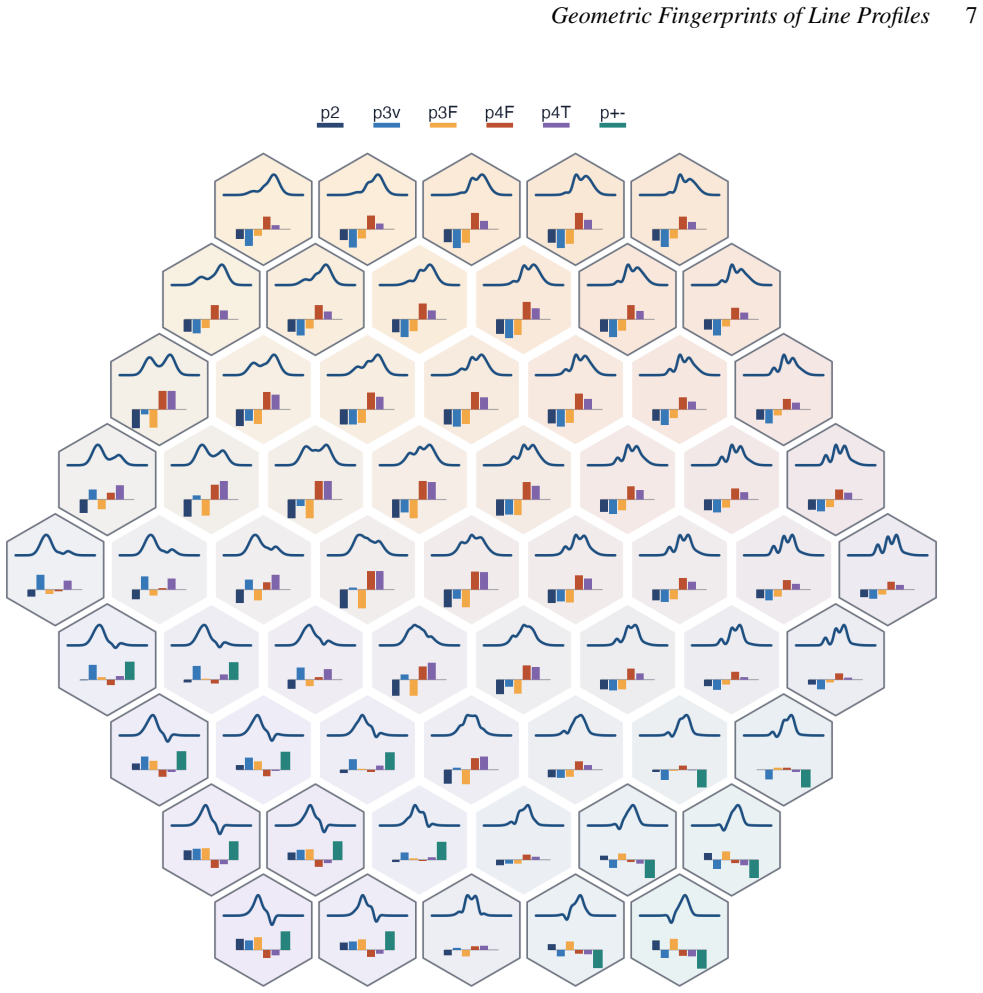
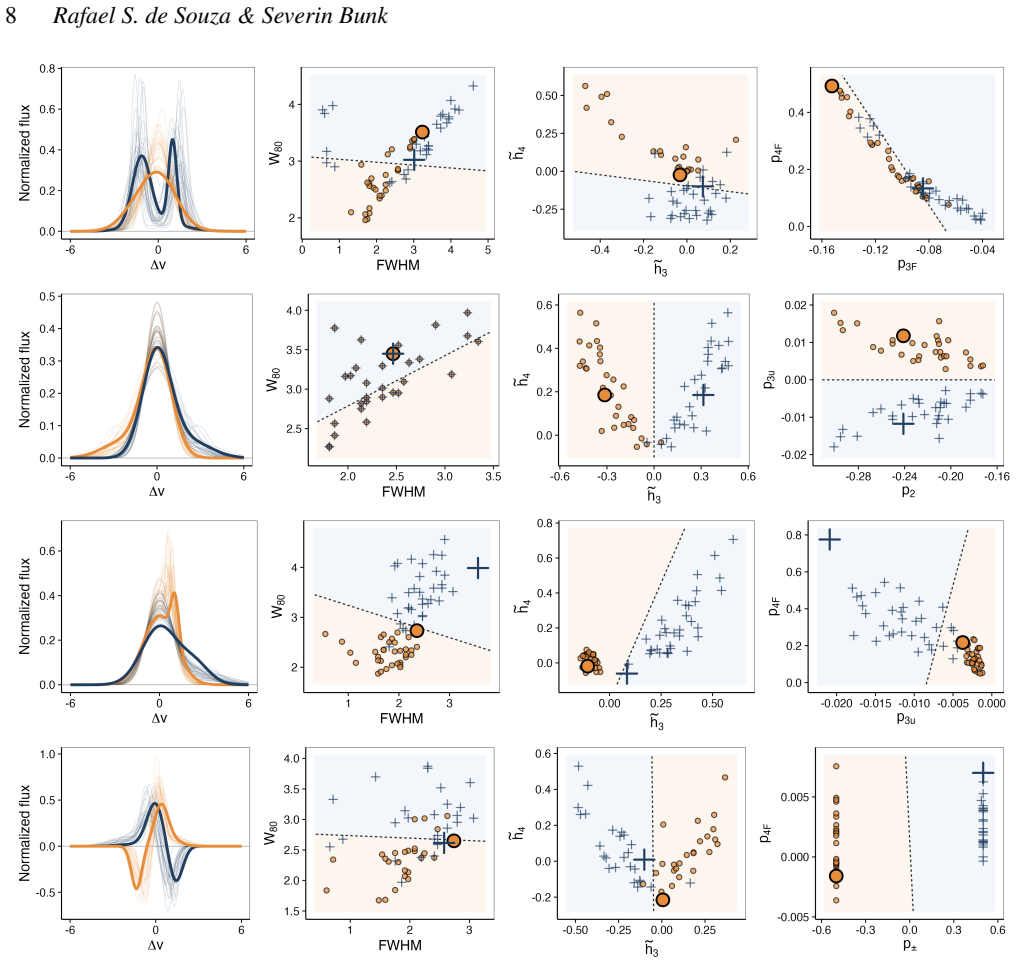
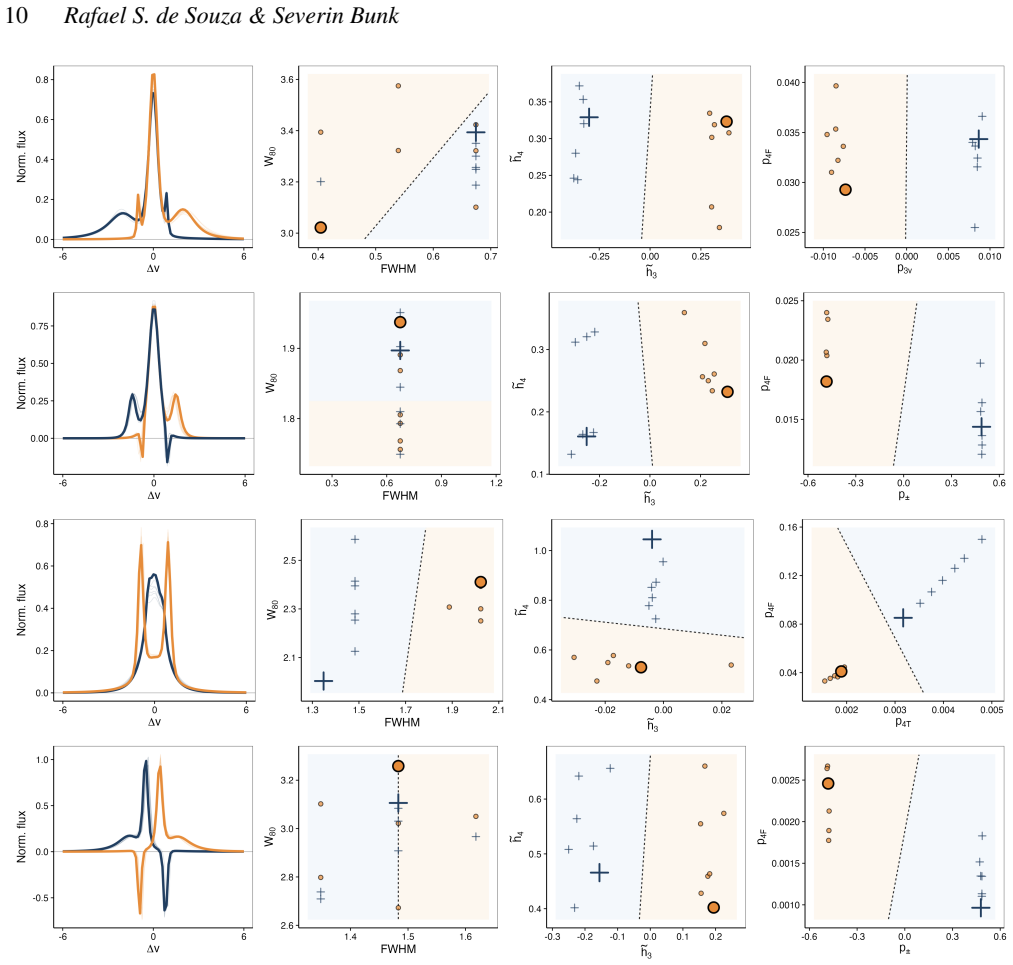
Spectral line profiles represented as paths in velocity-flux space have geometric descriptors that distinguish morphologies sharing the same FWHM and moments.
A machine-rendered reading of the paper's core claim, the machinery that carries it, and where it could break.
Core claim
Line profiles are treated as paths traversed from blue to red in velocity-flux space after mapping to a common rest-frame grid. Compact descriptors are defined for signed velocity-flux area, blue-red imbalance, shape complexity, and emission-absorption ordering. These descriptors separate similar morphologies in synthetics and enable clustering in real data that recovers velocity patterns without velocity input.
What carries the argument
The trajectory in velocity-flux space for each profile, from which path descriptors measure signed areas, imbalances, complexity and ordering.
If this is right
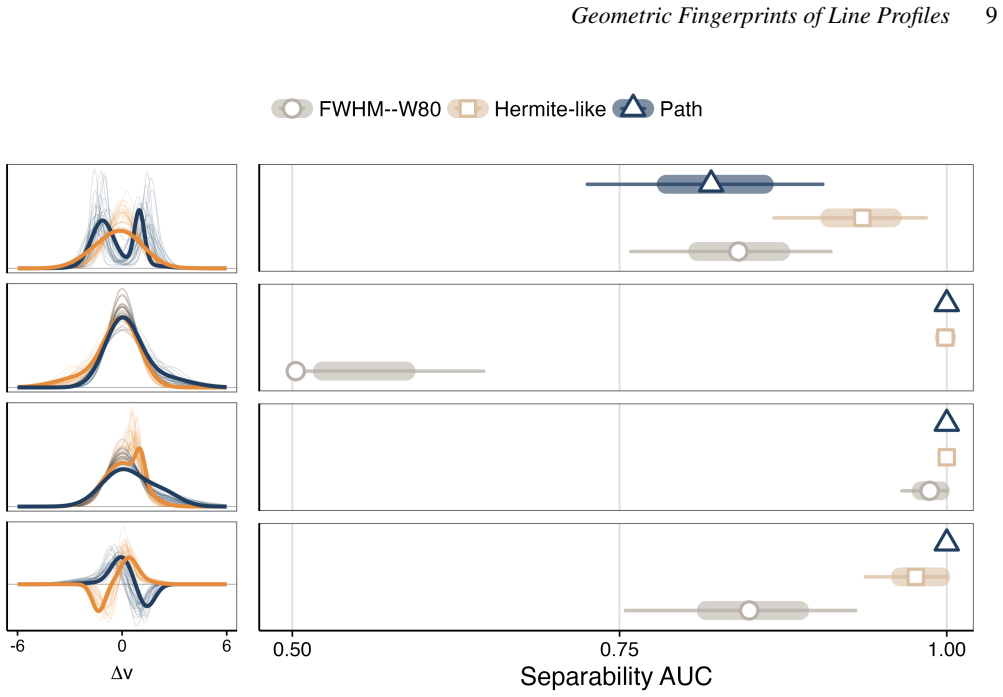
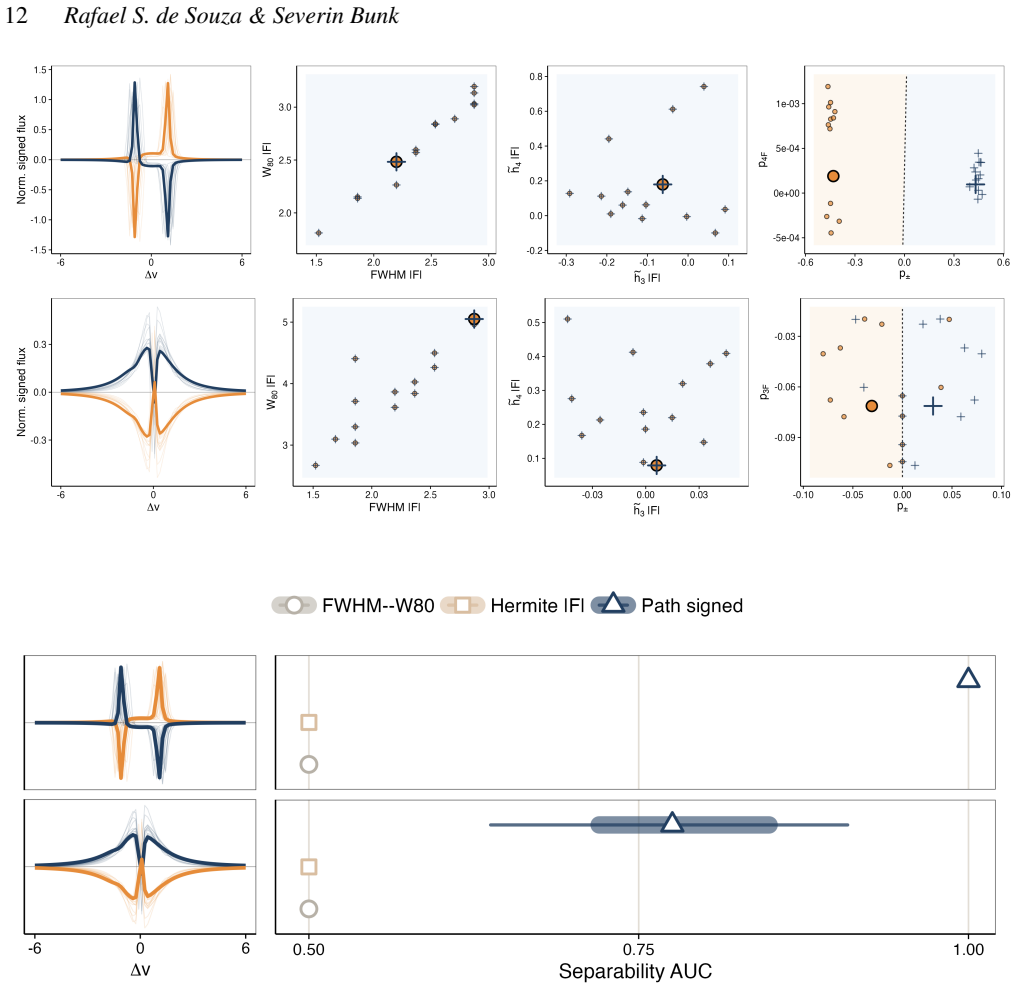
- These descriptors separate line morphologies that have similar FWHM, W80, and low-order moment summaries.
- Clustering the descriptors in MaNGA data yields spatially coherent regions of similar line morphology.
- Stacked spectra from the clusters recover large-scale centroid-velocity patterns consistent with reference fields.
Where Pith is reading between the lines
- The geometric descriptors could be applied to other spectral lines or different integral-field surveys to identify kinematic features.
- Such path-based representations might extend to absorption lines or composite profiles in high-redshift observations.
- Testing on simulated data with known velocity fields could quantify how well the clustering recovers dynamics.
Load-bearing premise
The mapping of each observed profile to a common systemic rest-frame velocity grid preserves morphological information without introducing velocity-dependent artifacts.
What would settle it
Finding that the path descriptors fail to separate synthetic profiles known to have different morphologies but matched traditional summaries, or that the MaNGA clusters do not produce stacked spectra with coherent velocity patterns.
Figures



read the original abstract
The morphology of a spectral-line profile contains information beyond scalar summaries of line strength, centroid, width, global asymmetry, or diagnostic line ratios. Broad wings, shoulders, double peaks, secondary components, and composite emission--absorption structures encode how flux is ordered across wavelength but can remain indistinguishable under conventional summaries. We introduce an interpretable geometric representation of line profiles inspired by rough path theory. Each wavelength-sampled profile is mapped to a common systemic rest-frame velocity grid and treated as a trajectory in velocity--flux space, traversed from blue to red. From this path, we define a compact set of low-order descriptors measuring signed velocity--flux area, blue--red imbalance localization, higher-order shape complexity, and emission--absorption ordering. Using synthetic profiles, we show that these descriptors separate morphologies with similar full width at half maximum (FWHM), non-parametric velocity width ($W_{80}$), and low-order moment summaries. We then apply the method to MaNGA integral-field spectroscopy by computing H$\alpha$ descriptors in individual spaxels and clustering them in a low-dimensional feature space. The resulting classes form spatially coherent regions of similar ordered line morphology. Although no external velocity field is supplied to the clustering, stacked spectra within these regions recover coherent large-scale centroid-velocity patterns broadly consistent with the MaNGA reference velocity fields. We release a minimalist MIT-licensed package ${\it spectropath}$, available at \href{https://rafaelsdesouza.com.br/spectropath/}{the project website}.
Editorial analysis
A structured set of objections, weighed in public.
Referee Report
Summary. The manuscript introduces a geometric representation of spectral-line profiles inspired by rough path theory. Each profile is mapped to a common systemic rest-frame velocity grid and treated as a trajectory in velocity-flux space; compact descriptors (signed area, blue-red imbalance, higher-order complexity, emission-absorption ordering) are extracted from the path. Synthetic-profile tests claim these descriptors separate morphologies that share similar FWHM, W80, and low-order moments. The method is then applied to MaNGA Hα spaxel data; clustering in the descriptor space yields spatially coherent regions whose stacked spectra recover large-scale centroid-velocity patterns consistent with reference fields, without supplying an external velocity field to the clustering step. An MIT-licensed package spectropath is released.
Significance. If the descriptors prove robust to alignment choices and the synthetic separation is quantitatively validated, the approach supplies a parameter-light, interpretable alternative to conventional scalar summaries for morphological classification in IFS surveys. The open release of spectropath supports reproducibility. The central claim that coherent velocity patterns emerge from morphology-only clustering would be a notable methodological contribution if the alignment step does not inadvertently encode velocity information.
major comments (2)
- [path construction / methods] The description of the path construction (mapping each observed profile to the common systemic rest-frame velocity grid) does not specify how the systemic velocity reference is obtained for each spaxel. If this reference is derived from the Hα centroid or moments (standard in IFS pipelines), the alignment step can partially cancel or encode the asymmetry and wing features the descriptors are intended to isolate. This directly affects the claim that 'no external velocity field is supplied to the clustering' yet coherent patterns emerge, and must be clarified with an explicit statement of the velocity reference used.
- [synthetic tests] The synthetic-profile tests are described only qualitatively in the abstract and introduction. No quantitative metrics (e.g., silhouette scores, classification accuracy, or statistical tests comparing descriptor separation against FWHM/W80 baselines) are referenced. Without these, it is impossible to assess whether the claimed separation of morphologies with similar conventional summaries is statistically meaningful or merely visual.
minor comments (2)
- [abstract / methods] The abstract states that descriptors measure 'signed velocity-flux area, blue-red imbalance localization, higher-order shape complexity, and emission-absorption ordering' but does not give the explicit formulas or the precise truncation order of the path signature; these should be stated once in the methods for reproducibility.
- [results / figures] Figure captions and axis labels in the MaNGA application section should explicitly note the velocity reference used for the stacked spectra so readers can judge consistency with the reference fields.
Simulated Author's Rebuttal
We thank the referee for the constructive comments, which highlight important points for clarification and strengthening of the validation. We address each major comment below.
read point-by-point responses
-
Referee: [path construction / methods] The description of the path construction (mapping each observed profile to the common systemic rest-frame velocity grid) does not specify how the systemic velocity reference is obtained for each spaxel. If this reference is derived from the Hα centroid or moments (standard in IFS pipelines), the alignment step can partially cancel or encode the asymmetry and wing features the descriptors are intended to isolate. This directly affects the claim that 'no external velocity field is supplied to the clustering' yet coherent patterns emerge, and must be clarified with an explicit statement of the velocity reference used.
Authors: We agree that the velocity reference must be stated explicitly. The revised manuscript will specify that the common systemic rest-frame velocity grid uses each galaxy's global systemic velocity (from the MaNGA DAP, determined independently of individual spaxel moments). Each spaxel's profile is shifted using the DAP velocity field to place it on this grid. While alignment incorporates this information to standardize the velocity axis, the clustering operates only on the extracted path-signature descriptors and receives no velocity values as input features. This distinction supports the morphology-only clustering claim. We will also add discussion of alignment robustness. revision: yes
-
Referee: [synthetic tests] The synthetic-profile tests are described only qualitatively in the abstract and introduction. No quantitative metrics (e.g., silhouette scores, classification accuracy, or statistical tests comparing descriptor separation against FWHM/W80 baselines) are referenced. Without these, it is impossible to assess whether the claimed separation of morphologies with similar conventional summaries is statistically meaningful or merely visual.
Authors: The referee is correct that the synthetic tests are presented qualitatively. The revised manuscript will add quantitative metrics, including silhouette scores to compare separation in descriptor space against baselines using FWHM and W80, along with appropriate statistical tests to establish the significance of the morphological distinctions. revision: yes
Circularity Check
No significant circularity detected
full rationale
The paper defines its path descriptors (signed area, blue-red imbalance, shape complexity) directly from the velocity-flux trajectories after mapping each profile to a common systemic rest-frame grid. Clustering is performed solely on these descriptors with no velocity field supplied as input. The subsequent observation that stacked spectra recover coherent centroid-velocity patterns is presented as an empirical result, not a prediction that reduces to the alignment step or descriptors by construction. No equations, self-citations, fitted parameters, or ansatzes are shown that would make any central claim equivalent to its inputs. The derivation chain is self-contained.
Axiom & Free-Parameter Ledger
axioms (1)
- domain assumption Rough path theory yields compact, interpretable signatures for one-dimensional trajectories that capture ordering and area information relevant to line profiles
Reference graph
Works this paper leans on
-
[1]
Molecular gas inflows and outflows in ultraluminous infrared galaxies at z 0.2 and one QSO at z = 6.1. , keywords =. doi:10.1051/0004-6361/201937109 , archivePrefix =. 1912.05548 , primaryClass =
-
[2]
P-Cygni Profiles of Molecular Lines toward Arp 220 Nuclei
P Cygni Profiles of Molecular Lines Toward Arp 220 Nuclei. , keywords =. doi:10.1088/0004-637X/700/2/L104 , archivePrefix =. 0906.5197 , primaryClass =
work page internal anchor Pith review Pith/arXiv arXiv doi:10.1088/0004-637x/700/2/l104
-
[3]
The origin of double-peak emission-line galaxies: Rotating discs, bars, or galaxy mergers?. , keywords =. doi:10.1051/0004-6361/202244746 , archivePrefix =. 2212.02529 , primaryClass =
-
[4]
Nevin, R. and Comerford, J. M. and Müller-Sánchez, F. and Barrows, R. and Cooper, M. C. , title =. Monthly Notices of the Royal Astronomical Society , volume =. 2018 , month =. doi:10.1093/mnras/stx2433 , url =
-
[5]
The Origin of Double-peaked Narrow Lines in Active Galactic Nuclei. I. Very Large Array Detections of Dual AGNs and AGN Outflows. , keywords =. doi:10.1088/0004-637X/813/2/103 , archivePrefix =. 1509.04291 , primaryClass =
work page internal anchor Pith review Pith/arXiv arXiv doi:10.1088/0004-637x/813/2/103
-
[6]
Narrow-line region gas kinematics of 24,264 optically-selected AGN: the radio connection
Narrow-line region gas kinematics of 24 264 optically selected AGN: the radio connection. , keywords =. doi:10.1093/mnras/stt751 , archivePrefix =. 1305.0263 , primaryClass =
work page internal anchor Pith review Pith/arXiv arXiv doi:10.1093/mnras/stt751
-
[7]
Veilleux, Sylvain and Cecil, Gerald and Bland-Hawthorn, Joss. Galactic Winds. Annual Review of Astronomy and Astrophysics. 2005. doi:https://doi.org/10.1146/annurev.astro.43.072103.150610
-
[8]
Absorption-Line Probes of Gas and Dust in Galactic Superwinds
Absorption-Line Probes of Gas and Dust in Galactic Superwinds. , keywords =. doi:10.1086/313421 , archivePrefix =. astro-ph/0002526 , primaryClass =
work page internal anchor Pith review Pith/arXiv arXiv doi:10.1086/313421
-
[9]
Proceedings of the Python in Science Conference , year =
-
[10]
2017 , howpublished =
2017
-
[11]
2021 , note=
Kidger, Patrick and Lyons, Terry , booktitle=. 2021 , note=
2021
-
[12]
and Graham, Benjamin , title =
Reizenstein, Jeremy F. and Graham, Benjamin , title =. 2020 , issue_date =. doi:10.1145/3371237 , journal =
-
[13]
, keywords =
SAGUI: SED-based Segmentation of Multi-band Galaxy Images -- Application to JADES in GOODS-South. , keywords =. 2026 , month = jun, doi =
2026
-
[14]
Refregier, Alexandre , title =. , volume =. 2003 , month =. doi:10.1046/j.1365-8711.2003.05901.x , url =
-
[15]
Generalized massive optimal data compression
Generalized massive optimal data compression. , keywords =. doi:10.1093/mnrasl/sly029 , archivePrefix =. 1712.00012 , primaryClass =
work page internal anchor Pith review Pith/arXiv arXiv doi:10.1093/mnrasl/sly029
-
[16]
Karhunen-Loeve eigenvalue problems in cosmology: how should we tackle large data sets?
Karhunen-Lo \`e ve Eigenvalue Problems in Cosmology: How Should We Tackle Large Data Sets?. , keywords =. doi:10.1086/303939 , archivePrefix =. astro-ph/9603021 , primaryClass =
work page internal anchor Pith review Pith/arXiv arXiv doi:10.1086/303939
-
[17]
Reichardt, Christian and Jimenez, Raul and Heavens, Alan F. , title =. , volume =. 2001 , month =. doi:10.1046/j.1365-8711.2001.04768.x , url =
-
[18]
Massive lossless data compression and multiple parameter estimation from galaxy spectra. , keywords =. doi:10.1046/j.1365-8711.2000.03692.x , archivePrefix =. astro-ph/9911102 , primaryClass =
-
[19]
Proceedings of the Fortieth Conference on Uncertainty in Artificial Intelligence , pages =
Approximate Bayesian Computation with Path Signatures , author =. Proceedings of the Fortieth Conference on Uncertainty in Artificial Intelligence , pages =. 2024 , editor =
2024
-
[20]
Kiraly and Harald Oberhauser , title =
Franz J. Kiraly and Harald Oberhauser , title =. Journal of Machine Learning Research , year =
-
[21]
Reutenauer, Christophe , title =
-
[22]
The Annals of Probability , volume =
Characteristic functions of measures on geometric rough paths , author =. The Annals of Probability , volume =
-
[23]
CAPIVARA: a spectral-based segmentation method for IFU data cubes. , keywords =. doi:10.1093/mnras/staf688 , archivePrefix =. 2410.21962 , primaryClass =
-
[24]
The signature of a rough path: Uniqueness , journal =
Horatio Boedihardjo and Xi Geng and Terry Lyons and Danyu Yang , keywords =. The signature of a rough path: Uniqueness , journal =. 2016 , issn =. doi:https://doi.org/10.1016/j.aim.2016.02.011 , url =
-
[25]
Annals of Mathematics , volume =
Hambly, Ben and Lyons, Terry , title =. Annals of Mathematics , volume =
-
[26]
Transactions of the American Mathematical Society , year=
INTEGRATION OF PATHS—A FAITHFUL REPRE- SENTATION OF PATHS BY NONCOMMUTATIVE FORMAL POWER SERIES , author=. Transactions of the American Mathematical Society , year=
-
[27]
The Fifteenth Data Release of the Sloan Digital Sky Surveys: First Release of MaNGA-derived Quantities, Data Visualization Tools, and Stellar Library. , keywords =. doi:10.3847/1538-4365/aaf651 , archivePrefix =. 1812.02759 , primaryClass =
work page internal anchor Pith review Pith/arXiv arXiv doi:10.3847/1538-4365/aaf651
-
[28]
Trager, S. C. and Faber, S. M. and Worthey, Guy and Gonz. The Stellar Population Histories of Local Early-Type Galaxies. I. Population Parameters , journal =. 2000 , volume =. doi:10.1086/301299 , eprint =
-
[29]
Worthey, Guy and Faber, S. M. and Gonzalez, J. Jesus and Burstein, D. , title =. ApJS , year =
-
[30]
1993 , volume =
A New Method for the Identification of Non-Gaussian Line Profiles in Elliptical Galaxies , journal =. 1993 , volume =
1993
-
[31]
PASP , year =
Cappellari, Michele and Emsellem, Eric , title =. PASP , year =
-
[32]
MNRAS , year =
Cappellari, Michele , title =. MNRAS , year =
-
[33]
A&A , year =
Bu, Yude and Zhao, Gang and Luo, A.-Li and Pan, Jingchang and Chen, Yuqin , title =. A&A , year =
-
[34]
MNRAS , year =
Wang, Ke and Guo, Ping and Luo, A.-Li , title =. MNRAS , year =
-
[35]
Spatially Resolved Spectroscopic Properties of Low-Redshift Star-Forming Galaxies , journal =
S. Spatially Resolved Spectroscopic Properties of Low-Redshift Star-Forming Galaxies , journal =. 2020 , volume =
2020
-
[36]
SDSS-IV MaNGA: pyPipe3D Analysis Release for 10,000 Galaxies , journal =
S. SDSS-IV MaNGA: pyPipe3D Analysis Release for 10,000 Galaxies , journal =. 2022 , volume =
2022
-
[37]
Connolly, A. J. and Szalay, A. S. , title =. AJ , year =
-
[38]
Yip, C. W. and Connolly, A. J. and Szalay, A. S. and Bud. Distributions of Galaxy Spectral Types in the Sloan Digital Sky Survey , journal =. 2004 , volume =
2004
-
[39]
Yip, C. W. and Connolly, A. J. and Vanden Berk, D. E. and Ma, Z. and Frieman, J. A. and SubbaRao, M. and Szalay, A. S. and Richards, G. T. and Hall, P. B. and Schneider, D. P. and Hopkins, A. M. and Trump, J. and Brinkmann, J. , title =. AJ , year =
-
[40]
Spectral Classification of Galaxies: An Orthogonal Approach
Spectral Classification of Galaxies: an Orthogonal Approach. , keywords =. doi:10.1086/117587 , archivePrefix =. astro-ph/9411044 , primaryClass =
work page internal anchor Pith review Pith/arXiv arXiv doi:10.1086/117587
-
[41]
Philosophical Transactions , number =
Bayes, Thomas , title =. Philosophical Transactions , number =. 1763 , month =. doi:10.1098/rstl.1763.0053 , url =
-
[42]
1997 , publisher=
The Fontana History of the Mathematical Sciences: The Rainbow of Mathematics , author=. 1997 , publisher=
1997
-
[43]
Aperture Synthesis with a Non-Regular Distribution of Interferometer Baselines , journal =
H. Aperture Synthesis with a Non-Regular Distribution of Interferometer Baselines , journal =
-
[44]
Horne, J. H. and Baliunas, S. L. , title =. The Astrophysical Journal , volume =. 1986 , doi =
1986
-
[45]
Lomb, N. R. , title =. Astrophysics and Space Science , volume =. 1976 , doi =
1976
-
[46]
Lagrange, Joseph-Louis , title =
-
[47]
Philosophical Transactions of the Royal Society of London , volume =
Hamilton, William Rowan , title =. Philosophical Transactions of the Royal Society of London , volume =. 1834 , doi =
-
[48]
Archive for History of Exact Sciences , volume =
Andersson, Karl Gunnar , title =. Archive for History of Exact Sciences , volume =. 1994 , doi =
1994
-
[49]
Poincar\'e, Henri , title =
-
[50]
Physical Review , volume =
Gell-Mann, Murray , title =. Physical Review , volume =. 1962 , doi =
1962
-
[51]
Weyl, Hermann , title =
-
[52]
Annalen der Physik , volume =
Schr\"odinger, Erwin , title =. Annalen der Physik , volume =. 1926 , doi =
1926
-
[53]
Dirac, P. A. M. , title =. Proceedings of the Royal Society A , volume =. 1928 , doi =
1928
-
[54]
Annalen der Physik , volume =
Einstein, Albert , title =. Annalen der Physik , volume =. 1916 , doi =
1916
-
[55]
, title =
Wigner, Eugene P. , title =. Annals of Mathematics , volume =. 1939 , doi =
1939
-
[56]
Yang, C. N. and Mills, Robert L. , title =. Physical Review , volume =. 1954 , doi =
1954
-
[57]
Zeitschrift f\"ur Physik , volume =
Born, Max and Jordan, Pascual , title =. Zeitschrift f\"ur Physik , volume =. 1925 , doi =
1925
-
[58]
Zeitschrift f\"ur Physik , volume =
Heisenberg, Werner , title =. Zeitschrift f\"ur Physik , volume =. 1925 , doi =
1925
-
[59]
Astronomical Journal , year = 1974, month = jun, volume =
An iterative technique for the rectification of observed distributions. Astronomical Journal , year = 1974, month = jun, volume =. doi:10.1086/111605 , adsurl =
-
[60]
Journal of the Optical Society of America (1917-1983) , year = 1972, month = jan, volume =
Bayesian-Based Iterative Method of Image Restoration. Journal of the Optical Society of America (1917-1983) , year = 1972, month = jan, volume =
1917
-
[61]
Studies in astronomical time series analysis. II. Statistical aspects of spectral analysis of unevenly spaced data. , keywords =. doi:10.1086/160554 , adsurl =
-
[62]
Commentarii Academiae Scientiarum Imperialis Petropolitanae , keywords =
Euler, Leonhard , biburl =. Commentarii Academiae Scientiarum Imperialis Petropolitanae , keywords =
-
[63]
Recent Advances in the Langlands Program
Recent Advances in the Langlands Program. arXiv Mathematics e-prints , keywords =. doi:10.48550/arXiv.math/0303074 , archivePrefix =. math/0303074 , primaryClass =
work page internal anchor Pith review Pith/arXiv arXiv doi:10.48550/arxiv.math/0303074
-
[64]
A Mathematical Theory of Communication , url =
Shannon, Claude Elwood , biburl =. A Mathematical Theory of Communication , url =. The Bell System Technical Journal , keywords =
-
[65]
1998 , publisher=
Categories for the Working Mathematician , author=. 1998 , publisher=
1998
-
[66]
2006 , publisher =
Starck, Jean-Luc and Murtagh, Fionn , title =. 2006 , publisher =
2006
-
[67]
, series=
de Laplace, P.S. , series=. Th. 1820 , publisher=
-
[68]
, series=
Fourier, J.B.J. , series=. Th. 1822 , publisher=
-
[69]
Mathematische Grundlagen der Quantenmechanik , url =
VonNeumann, John , language =. Mathematische Grundlagen der Quantenmechanik , url =
-
[70]
A graph-based spectral classification of Type II supernovae , journal =
R. A graph-based spectral classification of Type II supernovae , journal =. 2023 , issn =. doi:https://doi.org/10.1016/j.ascom.2023.100715 , url =
-
[71]
A Primer on the Signature Method in Machine Learning. arXiv e-prints , keywords =. doi:10.48550/arXiv.1603.03788 , archivePrefix =. 1603.03788 , primaryClass =
-
[72]
SPICY: The Spitzer/IRAC Candidate YSO Catalog for the Inner Galactic Midplane. , keywords =. doi:10.3847/1538-4365/abe465 , archivePrefix =. 2011.12961 , primaryClass =
-
[73]
arXiv:0704.0348 , archivePrefix = "arXiv", eprint =
What can emission lines tell us?. arXiv:0704.0348 , archivePrefix = "arXiv", eprint =
-
[74]
Mass Loss: Its Effect on the Evolution and Fate of High-Mass Stars
Mass Loss: Its Effect on the Evolution and Fate of High-Mass Stars. , keywords =. doi:10.1146/annurev-astro-081913-040025 , archivePrefix =. 1402.1237 , primaryClass =
work page internal anchor Pith review Pith/arXiv arXiv doi:10.1146/annurev-astro-081913-040025
-
[75]
, journal =
Lyons, Terry J. , journal =. Differential equations driven by rough signals. , url =
-
[76]
Firefly (Fitting IteRativEly For Likelihood analYsis): a full spectral fitting code
FIREFLY (Fitting IteRativEly For Likelihood analYsis): a full spectral fitting code. , keywords =. doi:10.1093/mnras/stx2215 , archivePrefix =. 1711.00865 , primaryClass =
work page internal anchor Pith review Pith/arXiv arXiv doi:10.1093/mnras/stx2215
-
[77]
Pipe3D, a pipeline to analyze Integral Field Spectroscopy data: I. New fitting phylosophy of FIT3D
Pipe3D, a pipeline to analyze Integral Field Spectroscopy Data: I. New fitting philosophy of FIT3D. , keywords =. doi:10.48550/arXiv.1509.08552 , archivePrefix =. 1509.08552 , primaryClass =
work page internal anchor Pith review Pith/arXiv arXiv doi:10.48550/arxiv.1509.08552
-
[78]
Fitting Analysis using Differential evolution Optimization (FADO):. Spectral population synthesis through genetic optimization under self-consistency boundary conditions. , keywords =. doi:10.1051/0004-6361/201628986 , archivePrefix =. 1704.03922 , primaryClass =
work page internal anchor Pith review Pith/arXiv arXiv doi:10.1051/0004-6361/201628986
-
[79]
S., Gopal-Krishna, Sagar R., Wiita P
Semi-empirical analysis of Sloan Digital Sky Survey galaxies - I. Spectral synthesis method. , eprint =. doi:10.1111/j.1365-2966.2005.08752.x , adsurl =
-
[80]
Parametric Recovery of Line-of-Sight Velocity Distributions from Absorption-Line Spectra of Galaxies via Penalized Likelihood. , keywords =. doi:10.1086/381875 , archivePrefix =. astro-ph/0312201 , primaryClass =
work page internal anchor Pith review Pith/arXiv arXiv doi:10.1086/381875
discussion (0)
Sign in with ORCID, Apple, or X to comment. Anyone can read and Pith papers without signing in.