Odyssey: Constructing Verifiable Local Truth-Preserving Foundation Models
Pith reviewed 2026-06-29 01:09 UTC · model grok-4.3
The pith
ODYSSEY composes foundries via left and right Kan extensions to build verifiable local truth-preserving foundation models.
A machine-rendered reading of the paper's core claim, the machinery that carries it, and where it could break.
Core claim
Foundation models can be constructed as compositions of foundries using left and right Kan extensions, where foundries are organized sheaves of knowledge carrying argumentation components, and the extensions enforce restriction, gluing, obstruction, and argumentation conditions required for local truth preservation and verifiability.
What carries the argument
Foundries as organized sheaves of knowledge with covers of local contexts, restriction maps, gluing rules, obstruction policies, and argumentation components, composed through left and right Kan extensions in Universal Foundry Learning.
If this is right
- The same categorical machinery supports domain construction, artifact replay, sheaf diagnostics, grounded Toulmin scrutiny, residual-obstruction ledgers, and causal-claim extraction.
- Foundry SQL provides a typed query surface for slicing maintained foundry artifacts using TICKET certification.
- Concrete foundries can be assembled from generic templates such as evidence/argument, scientific challenge, and evaluation-harness foundries.
- External or pre-built models can be admitted into durable ODYSSEY state through TICKET-compatible certification.
Where Pith is reading between the lines
- The framework could scale verification to models trained on mixed institutional and market data sources.
- Obstruction ledgers might serve as persistent records for auditing model updates over time.
- TICKET certification could allow selective incorporation of existing LLMs without rebuilding entire foundries.
Load-bearing premise
Left and right Kan extensions applied to foundries defined via restriction maps, gluing rules, and obstruction policies will enforce local truth preservation and verifiability in actual foundation model construction.
What would settle it
A constructed ODYSSEY model that produces inconsistent argumentation or fails obstruction policies when applied to a concrete domain with heterogeneous data sources.
Figures


read the original abstract
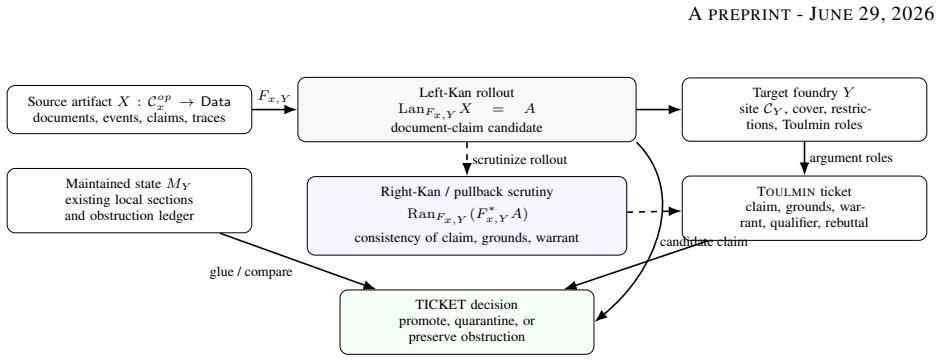
We introduce a categorical framework called ODYSSEY for constructing verifiable, local truth-preserving foundation models as compositions of foundries: building-block architectural components that specify a cover of local contexts, local representation families, restriction maps, gluing rules, obstruction policies, update obligations, and human-facing views. A foundry is an organized sheaf of knowledge that carries within it an argumentation component. Concrete foundries are built from generic foundries such as evidence/argument, operational decision, institutional/financial, market meaning, scientific challenge, research-program, assistant-build, and evaluation-harness foundries. Universal Foundry Learning (UFL) formalizes foundry construction as a composition of left and right Kan extensions, with left Kan extension rolling local artifacts into candidate foundries and right Kan extension enforcing the restriction, gluing, obstruction, and argumentation conditions required for promotion. Foundry SQL (FSQL) is a small typed query surface for slicing maintained foundry artifacts that uses TICKET (Topos Integration using Causal Kan Extension Transformers) certification for admitting external or pre-built models into durable ODYSSEY state. ODYSSEY is fully implemented and tested across a wide spectrum of concrete foundries, showing that the same categorical machinery supports domain construction, artifact replay, sheaf diagnostics, grounded Toulmin/local-LLM scrutiny, residual-obstruction ledgers, and optimized TICKET-compatible causal-claim extraction across heterogeneous sources. This paper is to be presented as a 2.5 hour tutorial at ICML 2026. The tutorial home page is at https://bit.ly/4ajS0nA.
Editorial analysis
A structured set of objections, weighed in public.
Referee Report
Summary. The manuscript introduces ODYSSEY, a categorical framework for constructing verifiable, local truth-preserving foundation models as compositions of foundries (sheaves carrying argumentation components, defined via restriction maps, gluing rules, obstruction policies, and update obligations). Universal Foundry Learning (UFL) is formalized via left and right Kan extensions, with left extensions rolling artifacts into candidate foundries and right extensions enforcing conditions for promotion; Foundry SQL (FSQL) and TICKET certification are introduced for querying and admitting models. The central claim is that ODYSSEY is fully implemented and tested across concrete foundries (evidence/argument, operational decision, etc.), supporting domain construction, artifact replay, sheaf diagnostics, Toulmin scrutiny, residual-obstruction ledgers, and causal-claim extraction.
Significance. If the implementation claims and Kan-extension enforcement were demonstrated with concrete computations and metrics, the work could offer a structured categorical approach to verifiability in foundation models that integrates local contexts and argumentation. The manuscript, however, contains no derivations, code, datasets, error analysis, or examples, so no assessment of significance is possible.
major comments (2)
- [Abstract] Abstract: the assertion that ODYSSEY 'is fully implemented and tested across a wide spectrum of concrete foundries' is load-bearing for the central claim of verifiability and truth-preservation, yet the manuscript supplies no pseudocode, no explicit computation of a left or right Kan extension on any model or dataset, no experimental metrics, and no reproducibility artifact.
- [Abstract] Abstract: verifiability and local truth-preservation are enforced solely by the Kan-extension conditions on the foundries themselves (restriction maps, gluing rules, obstruction policies); this reduces the enforcement to a definitional property with no described external benchmark or independent check.
minor comments (1)
- [Abstract] Abstract: the statement that the paper 'is to be presented as a 2.5 hour tutorial at ICML 2026' should be clarified to indicate whether the submission is intended as a research article or a tutorial description.
Simulated Author's Rebuttal
We thank the referee for the comments. We address each major comment below, noting where revisions to the manuscript are appropriate.
read point-by-point responses
-
Referee: [Abstract] Abstract: the assertion that ODYSSEY 'is fully implemented and tested across a wide spectrum of concrete foundries' is load-bearing for the central claim of verifiability and truth-preservation, yet the manuscript supplies no pseudocode, no explicit computation of a left or right Kan extension on any model or dataset, no experimental metrics, and no reproducibility artifact.
Authors: The manuscript is structured as the foundation for a 2.5-hour ICML 2026 tutorial, with the linked homepage (https://bit.ly/4ajS0nA) providing the detailed implementations, pseudocode, explicit Kan extension computations, and examples across foundries. The abstract summarizes results from those implementations. We agree the manuscript text itself does not contain these elements and will add selected pseudocode for UFL, a worked Kan extension example, and basic reproducibility notes in revision. revision: yes
-
Referee: [Abstract] Abstract: verifiability and local truth-preservation are enforced solely by the Kan-extension conditions on the foundries themselves (restriction maps, gluing rules, obstruction policies); this reduces the enforcement to a definitional property with no described external benchmark or independent check.
Authors: The framework defines verifiability and local truth-preservation via the Kan extension conditions, restriction maps, gluing rules, and obstruction policies as a deliberate categorical guarantee by construction. This is not an oversight but the intended formal mechanism. TICKET certification and the argumentation components within foundries provide interfaces for external validation where desired, though the core enforcement remains internal to the sheaf structure. revision: no
Circularity Check
Truth-preservation and verifiability defined into Kan-extension construction by fiat
specific steps
-
self definitional
[Abstract (UFL paragraph)]
"Universal Foundry Learning (UFL) formalizes foundry construction as a composition of left and right Kan extensions, with left Kan extension rolling local artifacts into candidate foundries and right Kan extension enforcing the restriction, gluing, obstruction, and argumentation conditions required for promotion."
The right Kan extension is introduced precisely to enforce the restriction/gluing/obstruction/argumentation conditions. These conditions are the paper's own definition of what makes a foundry 'verifiable' and 'local truth-preserving.' Therefore the claim that the construction enforces truth-preservation reduces directly to the definitional choice of the extension operator; no additional derivation or external validation is supplied.
full rationale
The paper's central claim is that UFL (left/right Kan extensions) constructs verifiable, local truth-preserving models. However, the right Kan extension is explicitly defined to enforce the very restriction/gluing/obstruction/argumentation conditions that constitute truth-preservation and verifiability in the framework. No independent external check or benchmark is described; the enforcement is the definition. The 'fully implemented and tested' assertion is stated without any exhibited computation or metric that could falsify it. This matches self-definitional circularity at the core of the derivation.
Axiom & Free-Parameter Ledger
axioms (1)
- domain assumption Categorical constructions such as sheaves and left/right Kan extensions can be used to enforce local truth preservation in foundation models.
invented entities (4)
-
Foundry
no independent evidence
-
Universal Foundry Learning (UFL)
no independent evidence
-
Foundry SQL (FSQL)
no independent evidence
-
TICKET
no independent evidence
Reference graph
Works this paper leans on
-
[1]
URL https://arxiv.org/abs/ 2402.01602. Rishi Bommasani, Drew A. Hudson, Ehsan Adeli, Russ Altman, Simran Arora, Sydney von Arx, Michael S. Bernstein, Jeannette Bohg, Antoine Bosselut, Emma Brunskill, et al. On the opportunities and risks of foundation models,
-
[2]
URLhttps://arxiv.org/abs/2108.07258. Haolong Chen, Hanzhi Chen, Zijian Zhao, Kaifeng Han, Guangxu Zhu, Yichen Zhao, Ying Du, Wei Xu, and Qingjiang Shi. An overview of domain-specific foundation model: Key technologies, applications and challenges,
-
[3]
Qing Cheng, Zefan Zeng, Xingchen Hu, Yuehang Si, and Zhong Liu
URL https://arxiv.org/abs/2409.04267. Qing Cheng, Zefan Zeng, Xingchen Hu, Yuehang Si, and Zhong Liu. A survey of event causality identification: Taxonomy, challenges, assessment, and prospects.ACM Computing Surveys, 58(3):1–37,
-
[4]
URLhttps://dl.acm.org/doi/10.1145/3756009
doi:10.1145/3756009. URLhttps://dl.acm.org/doi/10.1145/3756009. Amir Feder, Katherine A. Keith, Emaad Manzoor, Reid Pryzant, Dhanya Sridhar, Zach Wood-Doughty, Jacob Eisenstein, Justin Grimmer, Roi Reichart, Margaret E. Roberts, Brandon M. Stewart, Victor Veitch, and Diyi Yang. Causal inference in natural language processing: Estimation, prediction, inter...
-
[5]
Thomas McCoy, Paul Smolensky, Tal Linzen, Jianfeng Gao, and Asli Celikyilmaz
doi:10.1162/tacl a 00511. URL https: //aclanthology.org/2022.tacl-1.66/. Prashant Garg and Thiemo Fetzer. Testing causal claims in economics.arXiv preprint arXiv:2501.06873,
work page internal anchor Pith review doi:10.1162/tacl 2022
-
[6]
Dataset and analysis of causal claims extracted from economics papers
URL https://arxiv.org/abs/2501.06873. Dataset and analysis of causal claims extracted from economics papers. Ankita Gupta, Ethan Zuckerman, and Brendan O’Connor. Harnessing Toulmin’s theory for zero-shot argument explication. InProceedings of the 62nd Annual Meeting of the Association for Computational Linguistics (Volume 1: Long Papers), pages 10259–1027...
-
[7]
doi:10.18653/v1/2024.acl-long.552
Association for Computational Linguistics. doi:10.18653/v1/2024.acl-long.552. URLhttps://aclanthology.org/2024.acl-long.552/. Oktie Hassanzadeh, Debarun Bhattacharjya, Mark Feblowitz, Michael Perrone, Shirin Sohrabi, Kavitha Srinivas, and Michael Katz. Causal knowledge extraction through large-scale text mining. InProceedings of the AAAI Conference on Art...
-
[8]
Bridging language and items for retrieval and recommendation.arXiv preprint arXiv:2403.03952,
30 APREPRINT- JUNE29, 2026 Yupeng Hou, Jiacheng Li, Zhankui He, An Yan, Xiusi Chen, and Julian McAuley. Bridging language and items for retrieval and recommendation.arXiv preprint arXiv:2403.03952,
Pith/arXiv arXiv 2026
-
[9]
Accepted by TMLR; arXiv:2305.00050
URL https: //openreview.net/forum?id=mqoxLkX210. Accepted by TMLR; arXiv:2305.00050. Yundong Kim and Heyoung Yang. TRACE: Toulmin-based reasoning assessment through constructive elements for LLM CoT evaluation,
-
[10]
Hao Duong Le, Xin Xia, and Zhang Chen
URLhttps://arxiv.org/abs/2605.29656. Hao Duong Le, Xin Xia, and Zhang Chen. Multi-agent causal discovery using large language models.arXiv preprint arXiv:2407.15073,
-
[11]
URL https://arxiv.org/abs/2405.10467. Sridhar Mahadevan. Large causal models from large language models, 2025a. URL https://arxiv.org/abs/2512. 07796. Sridhar Mahadevan. CLIFF CatAgi: Categories for AGI local research interface. GitHub repository, 2025b. URL https://github.com/sridharmahadevan/CLIFF_CatAgi. Sridhar Mahadevan. Categories for AGI. Book manu...
-
[12]
Asko Parpola.Deciphering the Indus Script
URL https: //arxiv.org/abs/2604.17828. Asko Parpola.Deciphering the Indus Script. Cambridge University Press, reissue edition,
-
[13]
doi:10.1145/2187836.2187958. Stephen E. Toulmin.The Uses of Argument. Cambridge University Press,
-
[14]
URLhttps://arxiv.org/abs/2403.13784. Xinyi Xu, Zhaoxuan Wu, Rui Qiao, Arun Verma, Yao Shu, Jingtan Wang, Xinyuan Niu, Zhenfeng He, Jiangwei Chen, Zijian Zhou, et al. Data-centric AI in the age of large language models,
-
[15]
URL https://arxiv.org/abs/ 2406.14473. Yutaro Yamada, Robert Tjarko Lange, Cong Lu, Shengran Hu, Chris Lu, Jakob Foerster, Jeff Clune, and David Ha. The AI scientist-v2: Workshop-level automated scientific discovery via agentic tree search.arXiv preprint arXiv:2504.08066,
-
[16]
The AI Scientist-v2: Workshop-Level Automated Scientific Discovery via Agentic Tree Search
doi:10.48550/arXiv.2504.08066. Jie Yang, Soyeon Caren Han, and Josiah Poon. A survey on extraction of causal relations from natural language text. Knowledge and Information Systems, 64(5):1161–1186,
work page internal anchor Pith review Pith/arXiv arXiv doi:10.48550/arxiv.2504.08066
-
[17]
doi:10.1007/s10115-022-01665-w. Yifan Yang, Ziyang Gong, Weiquan Huang, Qihao Yang, Ziwei Zhou, Zisu Huang, Yan Li, Xuemei Gao, Qi Dai, Bei Liu, Kai Qiu, Yuqing Yang, Dongdong Chen, Xue Yang, and Chong Luo. Skillopt: Executive strategy for self-evolving agent skills,
-
[18]
URLhttps://arxiv.org/abs/2605.23904. 31 APREPRINT- JUNE29, 2026 Jiahang Zhou, Yanyu Chen, Zicong Hong, Wuhui Chen, Yue Yu, Tao Zhang, Hui Wang, Chuanfu Zhang, and Zibin Zheng. Training and serving system of foundation models: A comprehensive survey,
Pith/arXiv arXiv 2026
-
[19]
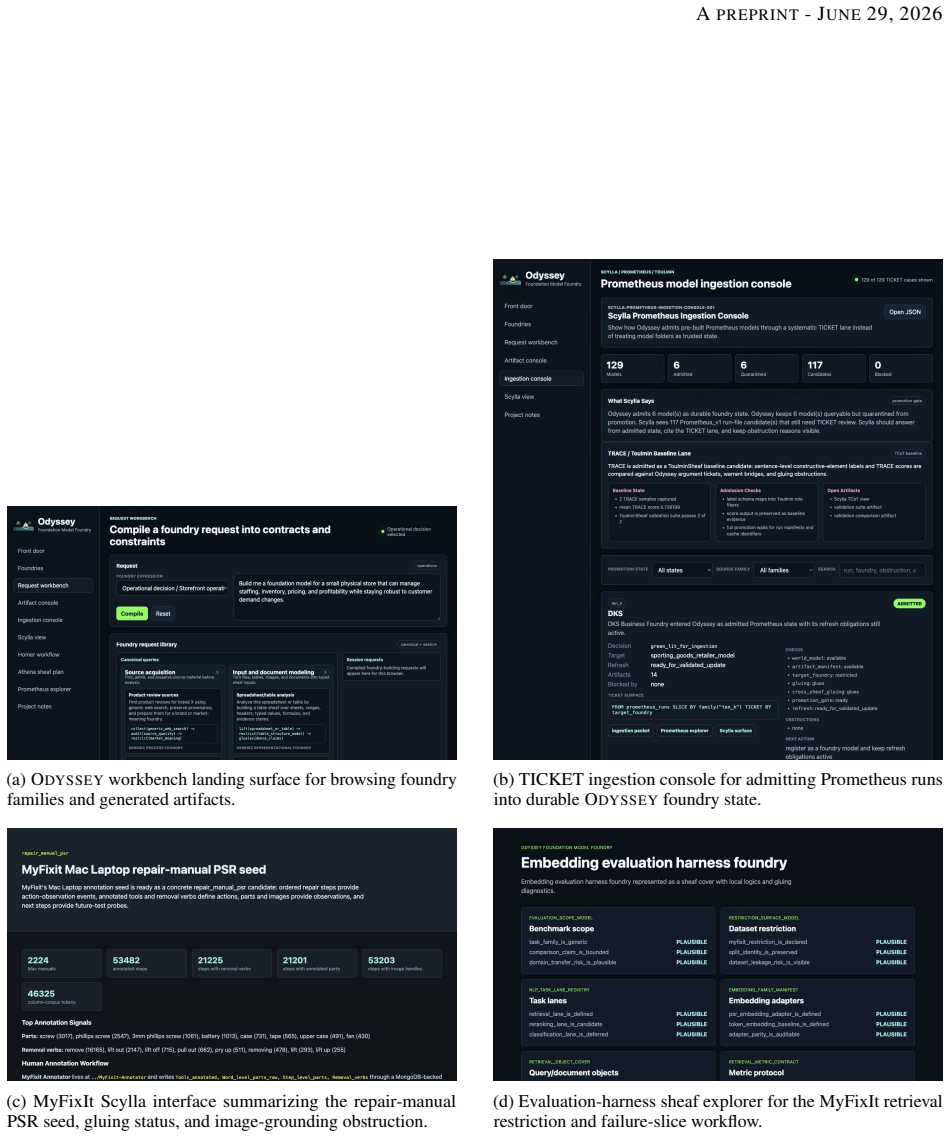
URL https: //arxiv.org/abs/2401.02643. 32 APREPRINT- JUNE29, 2026 Foundry Current gluing artifact Further validation Prometheus transport The ingestion console exposes 129 Prometheus-family cases: 6 admit- ted, 6 quarantined, and 117 legacy candidates awaiting TICKET re- view; DKS and MyFixIt compile back into Prometheus-compatible sheaf explorers. Full T...
arXiv 2026
discussion (0)
Sign in with ORCID, Apple, or X to comment. Anyone can read and Pith papers without signing in.