Drifting in the Future: Stabilizing Path Following Drifting on High-Latency Vehicle Systems
Pith reviewed 2026-06-29 04:31 UTC · model grok-4.3
The pith
A controller with delay predictor and brake stabilization sustains drifting on a production sports car despite actuator latencies over 250 ms.
A machine-rendered reading of the paper's core claim, the machinery that carries it, and where it could break.
Core claim
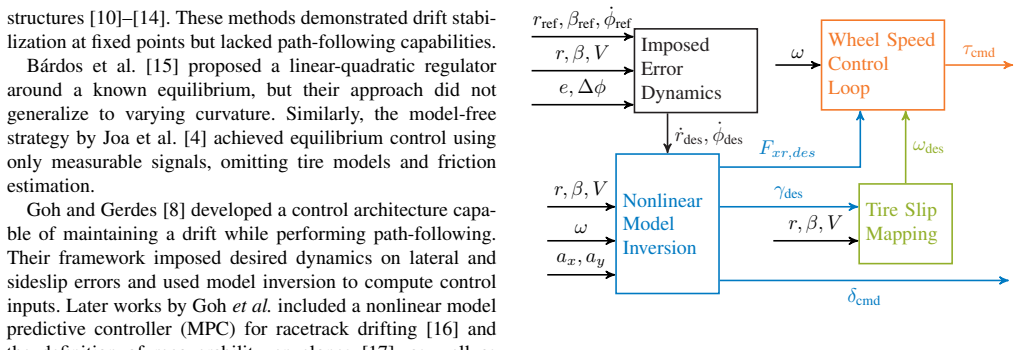
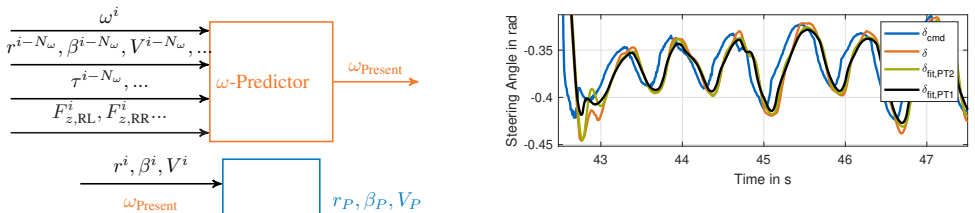
By adding a predictor for powertrain delays, revising the control formulation to handle higher actuation latencies and axle coupling, and applying brake-based velocity stabilization, the controller enables a production sports car to maintain robust circular and figure-eight drifts while limiting lateral error to 1.1 m and sideslip overshoot to 0.06 rad even when actuator delays exceed 250 ms.
What carries the argument
Delay-compensating predictor together with a revised control formulation for differential coupling and brake-based velocity stabilization.
If this is right
- Autonomous drifting becomes feasible on standard production cars with combustion engines and coupled axles.
- Advanced safety systems can be developed that stabilize vehicles in loss-of-control scenarios where conventional controllers fail.
- Path and sideslip tracking remain stable without inducing oscillations even at high latency.
- The approach removes the requirement for instantaneous torque or independent wheel actuation.
Where Pith is reading between the lines
- The same delay-compensation structure could be adapted to other vehicle dynamics tasks that suffer from comparable actuator lag.
- Extending the method to varying road friction or tire wear would test its robustness beyond the reported conditions.
- Integration with existing electronic stability programs on production cars might be a direct next step.
Load-bearing premise
The predictor and revised controller can accurately offset powertrain delays and axle coupling on a real production vehicle under the tested conditions.
What would settle it
Repeated experiments on the same vehicle where the controller fails to sustain the drift or produces lateral errors above 1.1 m or sideslip overshoot above 0.06 rad under identical delay conditions.
Figures






read the original abstract
Autonomously controlling and handling a vehicle at and beyond its stability limit is a mathematically and computationally demanding task. Prior demonstrations of automated drifting have been limited to research platforms with instantaneous torque delivery and independently actuated wheels, leaving their applicability to production vehicles with actuator latencies and mechanically coupled axles uncertain. To overcome these issues, we design a predictor to compensate for powertrain delays, develop a revised control formulation to accommodate higher actuation latencies as well as a differential coupling on the driven axle, and introduce brake-based velocity stabilization. This paper presents the controller framework, the model extensions, and real-world experimental results. We observe that our controller enables a production sports car with a combustion engine to robustly sustain circular and figure-eight drifts, limiting lateral error to 1.1 m and sideslip overshoot to 0.06 rad despite actuator delays exceeding 250 ms, while mitigating oscillations and maintaining stable path and sideslip tracking. In conclusion, our results establish that autonomous drifting is feasible on production-ready vehicles, opening pathways to advanced safety systems capable of stabilizing cars in scenarios where traditional control fails.
Editorial analysis
A structured set of objections, weighed in public.
Referee Report
Summary. The paper claims to overcome limitations of prior automated drifting work (limited to research platforms with instantaneous torque and independent wheels) by designing a predictor for powertrain delays, a revised control formulation accommodating >250 ms actuator latencies and differential coupling on the driven axle, and brake-based velocity stabilization. Real-world experiments on a production sports car with combustion engine are reported to enable sustained circular and figure-eight drifts, with lateral path error bounded by 1.1 m, sideslip overshoot by 0.06 rad, oscillation mitigation, and stable tracking.
Significance. If the experimental results hold under the stated conditions, the work is significant for demonstrating feasibility of autonomous drifting on production vehicles rather than specialized research platforms. This could open pathways to advanced vehicle safety systems that stabilize cars in loss-of-control scenarios where conventional controllers fail. The reliance on real-world experiments with a combustion-engine car and explicit handling of high latency and axle coupling is a notable strength.
minor comments (2)
- The abstract states specific performance bounds (1.1 m lateral error, 0.06 rad sideslip overshoot) but does not reference the corresponding experimental figures, tables, or data sets that support these numbers; adding such cross-references would improve verifiability.
- Notation for the predictor, revised control law, and brake stabilization is introduced in the abstract without defining key symbols or parameters; a short notation table or explicit definitions in the methods section would aid readability.
Simulated Author's Rebuttal
We thank the referee for their positive summary and significance assessment of our work on delay-compensating control for drifting on production vehicles. The recommendation for minor revision is noted. As no specific major comments are provided in the report, we have no point-by-point responses to address and will prepare a revised manuscript incorporating any editorial suggestions.
Circularity Check
No circularity; claims rest on real-vehicle experiments
full rationale
The paper presents a controller design (predictor for delays, revised formulation for latency and coupling, brake stabilization) validated through physical experiments on a production combustion-engine sports car. Performance is reported via measured quantities (lateral error ≤1.1 m, sideslip overshoot ≤0.06 rad) under >250 ms actuator delays. No derivation chain, fitted parameter renamed as prediction, or self-citation load-bearing step is present in the provided text. The central result is an empirical demonstration rather than an algebraic reduction to inputs. This matches the default non-circular case.
Axiom & Free-Parameter Ledger
Reference graph
Works this paper leans on
-
[1]
Autonomous vehicles on the edge: A survey on autonomous vehicle racing,
J. Betz, H. Zheng, A. Liniger, U. Rosolia, P . Karle, M. Behl, V . Krovi, and R. Mangharam, “Autonomous vehicles on the edge: A survey on autonomous vehicle racing,” IEEE Open Journal of Intelligent Transportation Systems , vol. 3, pp. 458–488, 2022. [Online]. Available: http://arxiv.org/pdf/2202.07008v1
-
[2]
On the dynamics of automobile drifting,
M. Abdulrahim, “On the dynamics of automobile drifting,” in SAE Technical Paper Series , ser. ANNUAL. SAE International, Apr
-
[3]
Available: http://dx.doi.org/10.4271/2006-01-1019
[Online]. Available: http://dx.doi.org/10.4271/2006-01-1019
-
[4]
An investiga- tion of optimal vehicle maneuvers for different road conditions,
B. Olofsson, K. Lundahl, K. Berntorp, and L. Nielsen, “An investiga- tion of optimal vehicle maneuvers for different road conditions,” IF AC Proceedings V olumes, vol. 46, no. 21, pp. 66–71, 2013
2013
-
[5]
A new control approach for automated drifting in consideration of the driving char- acteristics of an expert human driver,
E. Joa, H. Cha, Y . Hyun, Y . Koh, K. Yi, and J. Park, “A new control approach for automated drifting in consideration of the driving char- acteristics of an expert human driver,” Control Engineering Practice , vol. 96, p. 104293, 2020
2020
-
[6]
Self-learning drift control of automated vehicles beyond handling limit after rear-end collision,
Y . Yin, S. E. Li, K. Li, J. Y ang, and F. Ma, “Self-learning drift control of automated vehicles beyond handling limit after rear-end collision,” Transportation Safety and Environment , vol. 2, no. 2, pp. 97–105, 2020
2020
-
[7]
Human-inspired autonomous racing in low friction environments,
T. P . Weber, R. K. Aggarwal, and J. C. Gerdes, “Human-inspired autonomous racing in low friction environments,” IEEE Transactions on Intelligent V ehicles, pp. 1–14, 2024
2024
-
[8]
Autonomous drifting like professional racing drivers: A survey,
Y . Liu, F. Ma, X. Mei, B. Xue, J. Wu, and C. Zhang, “Autonomous drifting like professional racing drivers: A survey,” AppliedMath, vol. 5, no. 2, p. 33, 2025
2025
-
[9]
Toward automated vehicle control beyond the stability limits: Drifting along a general path,
J. Y . Goh, T. Goel, and J. Christian Gerdes, “Toward automated vehicle control beyond the stability limits: Drifting along a general path,” Journal of Dynamic Systems, Measurement, and Control , vol. 142, no. 2, 2020
2020
-
[10]
Autonomous driving drift control path-following drift- ing for highperformance production cars,
V . Boskovic, “Autonomous driving drift control path-following drift- ing for highperformance production cars,” Master’s thesis, Technical University Munich, 2024
2024
-
[11]
Analysis and control of high sideslip manoeuvres,
C. V oser, R. Y . Hindiyeh, and J. C. Gerdes, “Analysis and control of high sideslip manoeuvres,” V ehicle System Dynamics, vol. 48, no. sup1, pp. 317–336, 2010
2010
-
[12]
A controller framework for autonomous drifting: Design, stability, and experimental validation,
R. Y . Hindiyeh and J. Christian Gerdes, “A controller framework for autonomous drifting: Design, stability, and experimental validation,” Journal of Dynamic Systems, Measurement, and Control , vol. 136, no. 5, 2014
2014
-
[13]
Steady-state drifting stabilization of rwd vehicles,
E. V elenis, D. Katzourakis, E. Frazzoli, P . Tsiotras, and R. Happee, “Steady-state drifting stabilization of rwd vehicles,” Control Engineer- ing Practice , vol. 19, no. 11, pp. 1363–1376, 2011
2011
-
[14]
Gonzales, F
J. Gonzales, F. Zhang, K. Li, and F. Borrelli, Autonomous drifting with onboard sensors . Crc Press, Dec. 2016, p. 133138
2016
-
[15]
On full magv lateral dynamics exploitation: Autonomous drift control,
M. Acosta, S. Kanarachos, and M. E. Fitzpatrick, “On full magv lateral dynamics exploitation: Autonomous drift control,” in 2018 IEEE 15th International Workshop on Advanced Motion Control (AMC) . IEEE, Mar. 2018. [Online]. Available: http: //dx.doi.org/10.1109/AMC.2019.8371149
-
[16]
Im- plementation and experimental evaluation of a mimo drifting controller on a test vehicle,
A. Bardos, A. Domina, V . Tihanyi, Z. Szalay, and L. Palkovics, “Im- plementation and experimental evaluation of a mimo drifting controller on a test vehicle,” in 2020 IEEE Intelligent V ehicles Symposium (IV) . IEEE, 2020, pp. 1472–1478
2020
-
[17]
Be- yond the stable handling limits: nonlinear model predictive control for highly transient autonomous drifting,
J. Y . M. Goh, M. Thompson, J. Dallas, and A. Balachandran, “Be- yond the stable handling limits: nonlinear model predictive control for highly transient autonomous drifting,” V ehicle System Dynamics, vol. 62, no. 10, pp. 2590–2613, 2024
2024
-
[18]
Goh, Automated vehicle control beyond the stability limits , 2019
J. Goh, Automated vehicle control beyond the stability limits , 2019. [Online]. Available: https://purl.stanford.edu/th820zb4174
2019
-
[19]
Opening new dimensions: V ehicle motion planning and control using brakes while drifting,
T. Goel, J. Y . Goh, and J. C. Gerdes, “Opening new dimensions: V ehicle motion planning and control using brakes while drifting,” in 2020 IEEE Intelligent V ehicles Symposium (IV) . IEEE, 2020, pp. 560–565
2020
-
[20]
H. Dong, H. Y u, and J. Xi, “Real-time model predictive control for simultaneous drift and trajectory tracking of autonomous vehicles,” in 2022 6th CAA International Conference on V ehicular Control and Intelligence (CVCI) . IEEE, Oct. 2022, p. 16. [Online]. Available: http://dx.doi.org/10.1109/CVCI56766.2022.9964790
-
[21]
P . Stano, D. Tavernini, U. Montanaro, M. Tufo, G. Fiengo, L. Novella, and A. Sorniotti, “Enhanced active safety through integrated autonomous drifting and direct yaw moment control via nonlinear model predictive control,” IEEE Transactions on Intelligent V ehicles, vol. 9, no. 2, p. 41724190, Feb. 2024. [Online]. Available: http://dx.doi.org/10.1109/TIV ...
work page doi:10.1109/tiv 2024
-
[22]
A nonlinear model predictive control for automated drifting with a standard passenger vehicle,
S. Meijer, A. Bertipaglia, and B. Shyrokau, “A nonlinear model predictive control for automated drifting with a standard passenger vehicle,” 2024. [Online]. Available: https://arxiv.org/abs/2405.10859
-
[23]
One model to drift them all: Physics- informed conditional diffusion model for driving at the limits,
F. Djeumou, T. J. Lew, N. DING, M. Thompson, M. Suminaka, M. Greiff, and J. Subosits, “One model to drift them all: Physics- informed conditional diffusion model for driving at the limits,” in 8th Annual Conference on Robot Learning , 2024. [Online]. Available: https://openreview.net/forum?id=0gDbaEtVrd
2024
-
[24]
Autonomous drifting with 3 minutes of data via learned tire models,
F. Djeumou, J. Y . Goh, U. Topcu, and A. Balachandran, “Autonomous drifting with 3 minutes of data via learned tire models,” in 2023 IEEE International Conference on Robotics and Automation (ICRA) , 2023, pp. 968–974
2023
-
[25]
Sim-to-real application of reinforcement learning agents for autonomous, real vehicle drifting,
S. H. Tóth, Z. J. Viharos, . Bárdos, and Z. Szalay, “Sim-to-real application of reinforcement learning agents for autonomous, real vehicle drifting,” V ehicles, vol. 6, no. 2, p. 781798, Apr. 2024. [Online]. Available: http://dx.doi.org/10.3390/vehicles6020037
-
[26]
Reinforcement learning-based drift control for autonomous vehicles,
Y . Jiang, X. Xu, X. Zhang, J. Huang, and S. Gao, “Reinforcement learning-based drift control for autonomous vehicles,” in 2021 China Automation Congress (CAC) . IEEE, 2021, pp. 4508–4513
2021
-
[27]
Adaptive learning-based model predictive control strategy for drift vehicles,
B. Zhou, C. Hu, J. Zeng, Z. Li, J. Betz, L. Xie, and H. Su, “Adaptive learning-based model predictive control strategy for drift vehicles,” Robotics and Autonomous Systems , vol. 188, p. 104941, 2025
2025
-
[28]
A learning-based planning and control framework for inertia drift vehicles,
B. Zhou, Z. Li, L. Xie, H. Su, and J. Betz, “A learning-based planning and control framework for inertia drift vehicles,” arXiv preprint arXiv:2507.05748, 2025
-
[29]
High-speed autonomous drifting with deep reinforcement learning,
P . Cai, X. Mei, L. Tai, Y . Sun, and M. Liu, “High-speed autonomous drifting with deep reinforcement learning,” IEEE Robotics and Au- tomation Letters , vol. 5, no. 2, pp. 1247–1254, 2020
2020
-
[30]
Deep drifting: Autonomous drifting of arbitrary trajectories using deep reinforcement learning,
F. Domberg, C. C. Wembers, H. Patel, and G. Schildbach, “Deep drifting: Autonomous drifting of arbitrary trajectories using deep reinforcement learning,” in 2022 International Conference on Robotics and Automation (ICRA) , 2022, pp. 7753–7759
2022
-
[31]
Simultaneous stabilization and tracking of basic automobile drifting trajectories,
J. Y . Goh and J. C. Gerdes, “Simultaneous stabilization and tracking of basic automobile drifting trajectories,” in 2016 IEEE Intelligent V ehicles Symposium (IV). IEEE, 2016, pp. 597–602
2016
discussion (0)
Sign in with ORCID, Apple, or X to comment. Anyone can read and Pith papers without signing in.