Operating Regimes of Decentralized Learning Under Mobility and Bandwidth Constraints
Pith reviewed 2026-06-30 11:36 UTC · model grok-4.3
The pith
Decentralized averaging in mobile wireless networks falls into three operating regimes set by contact patterns and bandwidth limits.
A machine-rendered reading of the paper's core claim, the machinery that carries it, and where it could break.
Core claim
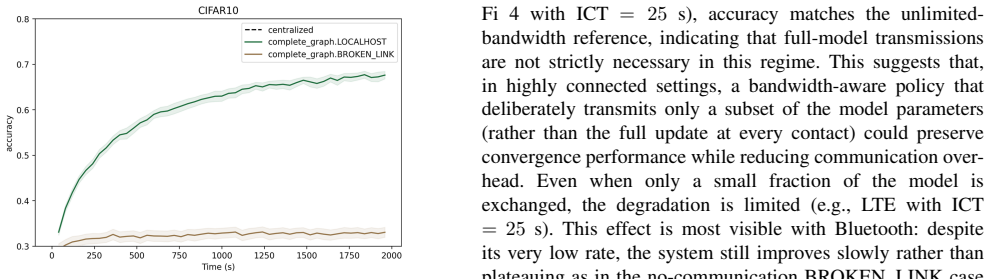
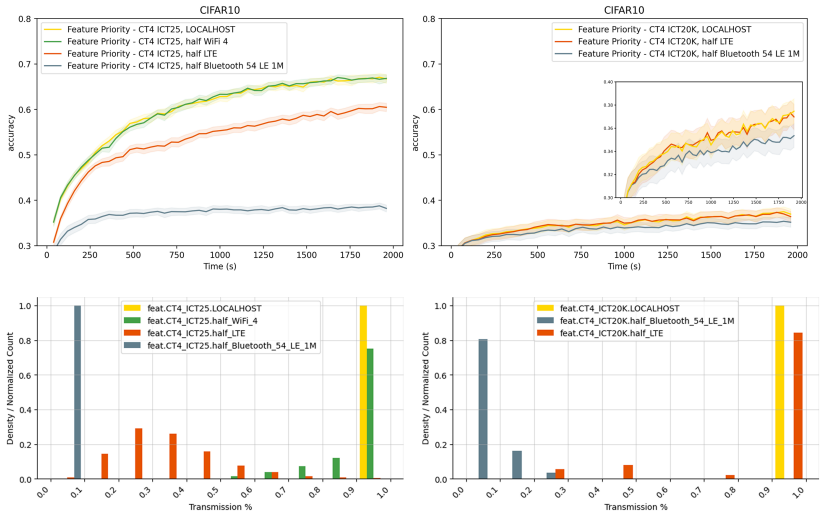
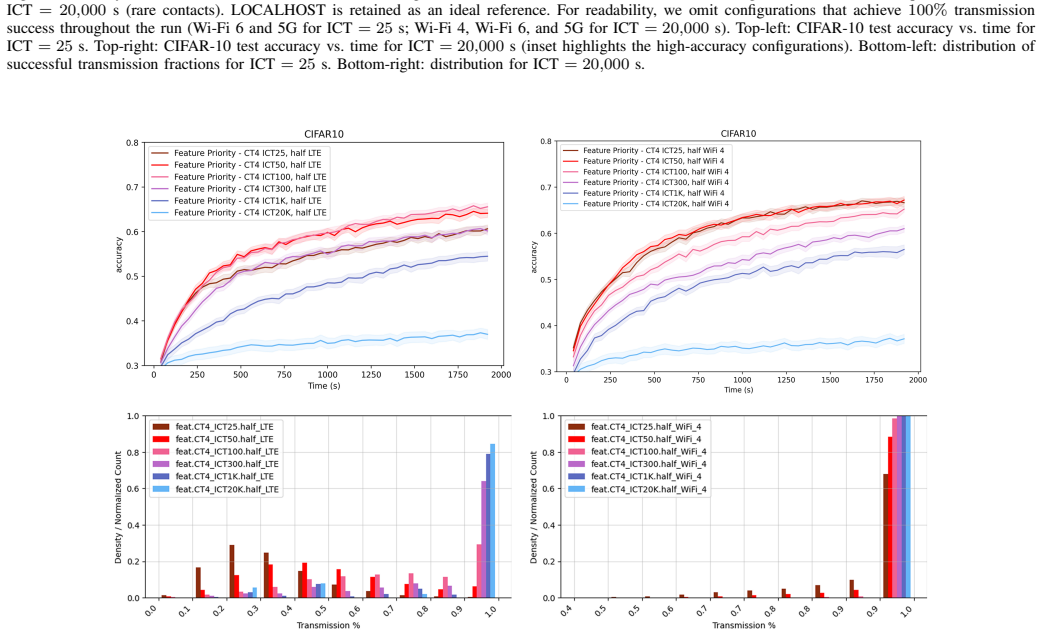
Decentralized learning convergence under client asynchrony, time-varying contact graphs, and technology-dependent throughput constraints falls into three operating regimes. Inter-contact time largely dictates convergence via mixing. Partial updates are often well tolerated when contacts are frequent. Very dense contact patterns can trigger contention, reducing effective throughput. These findings provide a practical lens to reason about decentralized learning deployments over realistic wireless systems.
What carries the argument
The fully decentralized protocol that overlaps synchronization with local training and supports partial tensor-level transfers when contacts end early, evaluated across Random Waypoint mobility traces and Bluetooth LE, LTE, and Wi-Fi throughput constraints.
If this is right
- Inter-contact time is the dominant factor controlling convergence speed through mixing.
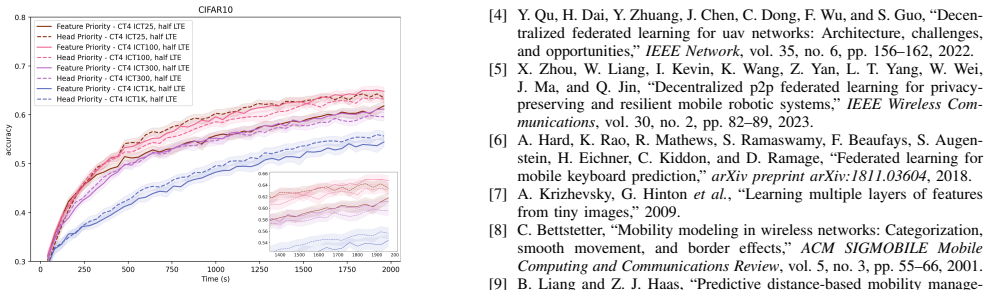
- Partial updates maintain acceptable convergence when contacts occur frequently.
- In very dense contact patterns, contention becomes the limiting factor on effective throughput.
- Improving connectivity, bandwidth, or contention mitigation has different priority depending on the observed regime.
Where Pith is reading between the lines
- In low-mobility settings the priority may shift toward creating more contact opportunities rather than increasing per-link bandwidth.
- An adaptive version of the protocol could monitor contact density and switch between full and partial updates accordingly.
- The regime framework could be used to set deployment thresholds for device density before contention dominates.
Load-bearing premise
The Random Waypoint mobility model together with the chosen wireless technology parameters sufficiently represents connectivity, asynchrony, and bandwidth constraints in actual mobile decentralized learning deployments.
What would settle it
Re-running the protocol on real human mobility traces instead of Random Waypoint and checking whether the same three regime boundaries still appear would test the claim.
Figures
read the original abstract
Decentralized learning is a promising paradigm for collaborative training in mobile and pervasive systems, as it avoids a central coordinator and does not require sharing raw data. Yet, most analyses rely on idealized communication assumptions that break down in wireless settings, where connectivity is intermittent, topology changes due to mobility, and bandwidth is limited. We study decentralized averaging under client asynchrony, time-varying contact graphs, and technology-dependent throughput constraints. We implement a fully decentralized protocol that overlaps synchronization with local training and supports partial tensor-level transfers when contacts end early. Using Random Waypoint mobility and multiple wireless technologies (Bluetooth LE, LTE, and Wi-Fi), we quantify how network dynamics and link capacity impact convergence. We identify three operating regimes: (i) inter-contact time largely dictates convergence via mixing, (ii) partial updates are often well tolerated when contacts are frequent, and (iii) very dense contact patterns can trigger contention, reducing effective throughput. These findings provide a practical lens to reason about decentralized learning deployments over realistic wireless systems, highlighting when improving connectivity, increasing bandwidth, or mitigating contention is most impactful.
Editorial analysis
A structured set of objections, weighed in public.
Referee Report
Summary. The manuscript simulates decentralized averaging under client asynchrony and time-varying contact graphs induced by Random Waypoint mobility, combined with throughput models for Bluetooth LE, LTE, and Wi-Fi. A fully decentralized protocol is implemented that overlaps synchronization with local training and permits partial tensor-level transfers. From these experiments the authors identify three operating regimes: (i) inter-contact time largely dictates convergence via mixing, (ii) partial updates are often tolerated when contacts are frequent, and (iii) very dense contact patterns trigger contention that reduces effective throughput. The work positions these regimes as a practical lens for reasoning about real wireless deployments.
Significance. If the regimes prove robust beyond the chosen synthetic mobility, the identification of distinct operating regimes supplies a concrete way to prioritize design choices (connectivity improvement versus bandwidth scaling versus contention mitigation) in mobile decentralized learning. The protocol's support for partial transfers and overlapping computation/communication is a concrete strength that increases realism relative to idealized synchronous models.
major comments (2)
- [§4 (Mobility and Wireless Models)] §4 (Mobility and Wireless Models): the central claim that the three regimes supply a 'practical lens' for realistic wireless systems rests on Random Waypoint plus fixed technology parameters generating qualitatively representative contact graphs and contention patterns. Because Random Waypoint is known to produce uniform spatial distributions, speed decay, and memoryless contacts, the mapping from observed regimes to deployment advice requires either validation against real contact traces or an explicit sensitivity analysis showing the regimes persist under alternative mobility models.
- [§5–6 (Regime Identification)] §5–6 (Regime Identification): the distinction among the three regimes is presented as emerging from the simulation campaign, yet no mention is made of the number of independent runs, confidence intervals on convergence metrics, or statistical tests separating the regimes. Without these, it is impossible to assess whether the reported qualitative behaviors are robust or sensitive to particular Random Waypoint parameter draws.
minor comments (1)
- [Abstract / §1] The abstract and introduction would benefit from a short statement of the exact wireless parameter sets (data rates, contact durations) used for each technology so readers can immediately judge the operating points examined.
Simulated Author's Rebuttal
We thank the referee for the constructive feedback. We address each major comment below and indicate the revisions we will make to strengthen the manuscript.
read point-by-point responses
-
Referee: §4 (Mobility and Wireless Models): the central claim that the three regimes supply a 'practical lens' for realistic wireless systems rests on Random Waypoint plus fixed technology parameters generating qualitatively representative contact graphs and contention patterns. Because Random Waypoint is known to produce uniform spatial distributions, speed decay, and memoryless contacts, the mapping from observed regimes to deployment advice requires either validation against real contact traces or an explicit sensitivity analysis showing the regimes persist under alternative mobility models.
Authors: Random Waypoint was selected as a standard, controllable model commonly employed in mobile networking studies to isolate the effects of inter-contact times and density. We agree that its limitations (uniformity, memoryless contacts) mean the regimes should not be over-generalized to all deployments without further checks. In the revision we will add a dedicated limitations paragraph in Section 4 that (i) explicitly lists the known RWP artifacts, (ii) qualifies the 'practical lens' claim to the class of synthetic mobility models with similar contact statistics, and (iii) outlines how the same regime-identification methodology could be reapplied to real traces or alternative models (e.g., Manhattan grid, trace-driven). Because performing a full sensitivity study or acquiring new traces would require substantial additional experiments beyond the current scope, we treat this as a partial revision that improves transparency while preserving the paper's focus. revision: partial
-
Referee: §5–6 (Regime Identification): the distinction among the three regimes is presented as emerging from the simulation campaign, yet no mention is made of the number of independent runs, confidence intervals on convergence metrics, or statistical tests separating the regimes. Without these, it is impossible to assess whether the reported qualitative behaviors are robust or sensitive to particular Random Waypoint parameter draws.
Authors: We acknowledge the omission. Each data point in Sections 5 and 6 was obtained from 10 independent Random Waypoint realizations with distinct random seeds. In the revised manuscript we will (i) state the number of runs in the experimental setup, (ii) add shaded confidence intervals (or error bars) to all convergence and throughput plots, and (iii) note that the three regimes remained qualitatively consistent across the run ensemble. These additions will allow readers to judge robustness directly from the figures. revision: yes
Circularity Check
No circularity; regimes are simulation outputs, not self-defined or fitted inputs
full rationale
The paper reports results from running a decentralized averaging protocol under Random Waypoint mobility combined with Bluetooth LE/LTE/Wi-Fi throughput models. The three operating regimes are presented as observed outcomes of these independent simulation experiments (inter-contact time effects, tolerance to partial updates, contention under dense contacts). No equations, parameters, or self-citations are shown that reduce the claimed regimes back to the inputs by construction, nor is any uniqueness theorem or ansatz imported from prior author work. The central claims rest on external simulation runs rather than tautological re-labeling of fitted quantities.
Axiom & Free-Parameter Ledger
free parameters (2)
- Random Waypoint mobility parameters
- Wireless technology throughput constraints
axioms (1)
- domain assumption Random Waypoint model accurately captures mobility-induced contact patterns in the target scenarios
Reference graph
Works this paper leans on
-
[1]
Advances and open problems in federated learning,
P. Kairouz and H. B. McMahan, “Advances and open problems in federated learning,”Foundations and trends in machine learning, vol. 14, no. 1-2, pp. 1–210, 2021
2021
-
[2]
Mdldroid: A chainsgd-reduce approach to mobile deep learning for personal mobile sensing,
Y . Zhang, T. Gu, and X. Zhang, “Mdldroid: A chainsgd-reduce approach to mobile deep learning for personal mobile sensing,”IEEE/ACM Transactions on Networking, vol. 30, no. 1, pp. 134–147, 2021
2021
-
[3]
Mobility-aware decentralized federated learning with joint optimization of local iteration and leader selection for vehicular networks,
D. Chen, T. Deng, J. Jia, S. Feng, and D. Yuan, “Mobility-aware decentralized federated learning with joint optimization of local iteration and leader selection for vehicular networks,”Computer Networks, vol. 263, p. 111232, 2025
2025
-
[4]
Decen- tralized federated learning for uav networks: Architecture, challenges, and opportunities,
Y . Qu, H. Dai, Y . Zhuang, J. Chen, C. Dong, F. Wu, and S. Guo, “Decen- tralized federated learning for uav networks: Architecture, challenges, and opportunities,”IEEE Network, vol. 35, no. 6, pp. 156–162, 2022
2022
-
[5]
Decentralized p2p federated learning for privacy- preserving and resilient mobile robotic systems,
X. Zhou, W. Liang, I. Kevin, K. Wang, Z. Yan, L. T. Yang, W. Wei, J. Ma, and Q. Jin, “Decentralized p2p federated learning for privacy- preserving and resilient mobile robotic systems,”IEEE Wireless Com- munications, vol. 30, no. 2, pp. 82–89, 2023
2023
-
[6]
Federated Learning for Mobile Keyboard Prediction
A. Hard, K. Rao, R. Mathews, S. Ramaswamy, F. Beaufays, S. Augen- stein, H. Eichner, C. Kiddon, and D. Ramage, “Federated learning for mobile keyboard prediction,”arXiv preprint arXiv:1811.03604, 2018
work page internal anchor Pith review Pith/arXiv arXiv 2018
-
[7]
Learning multiple layers of features from tiny images,
A. Krizhevsky, G. Hintonet al., “Learning multiple layers of features from tiny images,” 2009
2009
-
[8]
Mobility modeling in wireless networks: Categorization, smooth movement, and border effects,
C. Bettstetter, “Mobility modeling in wireless networks: Categorization, smooth movement, and border effects,”ACM SIGMOBILE Mobile Computing and Communications Review, vol. 5, no. 3, pp. 55–66, 2001
2001
-
[9]
Predictive distance-based mobility manage- ment for PCS networks,
B. Liang and Z. J. Haas, “Predictive distance-based mobility manage- ment for PCS networks,” inIEEE INFOCOM, 1999
1999
-
[10]
SLAW: Self-similar least-action human walk,
K. Lee, S. Hong, S. J. Kim, I. Rhee, and S. Chong, “SLAW: Self-similar least-action human walk,”IEEE/ACM Trans. Netw., vol. 20, no. 2, 2012
2012
-
[11]
HCMM: Modelling spatial and temporal properties of human mobility driven by users’ social relationships,
C. Boldrini and A. Passarella, “HCMM: Modelling spatial and temporal properties of human mobility driven by users’ social relationships,” Computer Communications, vol. 33, no. 9, pp. 1056–1074, 2010
2010
-
[12]
Communication-efficient learning of deep networks from decentralized data,
B. McMahan, E. Moore, D. Ramage, S. Hampson, and B. A. y Arcas, “Communication-efficient learning of deep networks from decentralized data,” inArtificial intelligence and statistics, 2017, pp. 1273–1282
2017
-
[13]
Impact of network topology on the performance of decentralized federated learning,
L. Palmieri, C. Boldrini, L. Valerio, A. Passarella, and M. Conti, “Impact of network topology on the performance of decentralized federated learning,”Computer Networks, vol. 253, p. 110681, 2024
2024
-
[14]
Initialisation and network effects in decentralised federated learning,
A. Badie-Modiri, C. Boldrini, L. Valerio, J. Kert ´esz, and M. Karsai, “Initialisation and network effects in decentralised federated learning,” Applied Network Science, vol. 10, no. 1, p. 53, 2025
2025
-
[15]
Opportunistic fed- erated learning: An exploration of egocentric collaboration for pervasive computing applications,
S. Lee, X. Zheng, J. Hua, H. Vikalo, and C. Julien, “Opportunistic fed- erated learning: An exploration of egocentric collaboration for pervasive computing applications,” in2021 IEEE PerCom. IEEE, 2021, pp. 1–8
2021
-
[16]
Bacombo—bandwidth- aware decentralized federated learning,
J. Jiang, L. Hu, C. Hu, J. Liu, and Z. Wang, “Bacombo—bandwidth- aware decentralized federated learning,”Electronics, vol. 9, no. 3, 2020
2020
-
[17]
Performance analysis for resource constrained decen- tralized federated learning over wireless networks,
Z. Yan and D. Li, “Performance analysis for resource constrained decen- tralized federated learning over wireless networks,”IEEE Transactions on Communications, vol. 72, no. 7, pp. 4084–4100, 2024
2024
-
[18]
Decentral- ized federated learning over imperfect communication channels,
W. Li, T. Lv, W. Ni, J. Zhao, E. Hossain, and H. V . Poor, “Decentral- ized federated learning over imperfect communication channels,”IEEE Transactions on Communications, vol. 72, no. 11, pp. 6973–6991, 2024
2024
-
[19]
Swift: Rapid decentralized federated learning via wait-free model communica- tion,
M. Bornstein, T. Rabbani, E. Wang, A. S. Bedi, and F. Huang, “Swift: Rapid decentralized federated learning via wait-free model communica- tion,”arXiv preprint arXiv:2210.14026, 2022
-
[20]
Draco: Decentralized asynchronous fed- erated learning over row-stochastic wireless networks,
E. Jeong and M. Kountouris, “Draco: Decentralized asynchronous fed- erated learning over row-stochastic wireless networks,”arXiv preprint arXiv:2406.13533, 2024
-
[21]
Decentralized federated averaging,
T. Sun, D. Li, and B. Wang, “Decentralized federated averaging,”IEEE Transactions on Pattern Analysis and Machine Intelligence, vol. 45, no. 4, pp. 4289–4301, 2022
2022
-
[22]
Robustness of decentralised learning to nodes and data disruption,
L. Palmieri, C. Boldrini, L. Valerio, A. Passarella, M. Conti, and J. Kert ´esz, “Robustness of decentralised learning to nodes and data disruption,”Computer Communications, vol. 241, p. 108250, 2025
2025
-
[23]
Coordination-free decentralised federated learning in per- vasive networks: Overcoming heterogeneity,
L. Valerio, C. Boldrini, A. Passarella, J. Kert ´esz, M. Karsai, and G. I ˜niguez, “Coordination-free decentralised federated learning in per- vasive networks: Overcoming heterogeneity,”Pervasive and Mobile Computing, vol. 118, p. 102184, 2026
2026
-
[24]
Federated learning with cooper- ating devices: A consensus approach for massive iot networks,
S. Savazzi, M. Nicoli, and V . Rampa, “Federated learning with cooper- ating devices: A consensus approach for massive iot networks,”IEEE Internet of Things Journal, vol. 7, no. 5, pp. 4641–4654, 2020
2020
-
[25]
Gaussian Error Linear Units (GELUs)
D. Hendrycks and K. Gimpel, “Gaussian error linear units (gelus),”arXiv preprint arXiv:1606.08415, 2016
work page internal anchor Pith review Pith/arXiv arXiv 2016
-
[26]
(2025) Wi-fi 8 (802.11 bn) — ultra-high reliability (uhr)
TP-Link. (2025) Wi-fi 8 (802.11 bn) — ultra-high reliability (uhr). Accessed: Oct. 31, 2025. [Online]. Available: https://www.tp- link.com/it/wifi8/
2025
-
[27]
(2025) 4th generation (lte) — long term evolu- tion (lte)
ETSI. (2025) 4th generation (lte) — long term evolu- tion (lte). Accessed: Oct. 31, 2025. [Online]. Available: https://www.etsi.org/technologies/mobile/4g
2025
-
[28]
M. Woolley. (2025) Bluetooth. Accessed: Oct. 31, 2025. Page 41. [Online]. Available: https://www.bluetooth.com/wp- content/uploads/2023/02/2301 5.4 Tech Overview FINAL.pdf
2025
-
[29]
(2025) 5th generation (lte)
ETSI. (2025) 5th generation (lte). Accessed: Oct. 31, 2025. [Online]. Available: https://www.etsi.org/technologies/mobile/5g
2025
discussion (0)
Sign in with ORCID, Apple, or X to comment. Anyone can read and Pith papers without signing in.